
Chinese Journal of Catalysis ›› 2026, Vol. 91: 163-175.DOI: 10.1016/S1872-2067(26)65208-4
• Articles • Previous Articles Next Articles
Xiao-Li Lianga,1, Zhao-Yu Wanga,1, Shi-Lin Yana, Ting-Ting Yina, Wei Zhangb,c,*( ), Hao Zhanga,*(), Xiaohong Liud, Liu-Bin Zhaoa,*()
Received:2026-03-19
Accepted:2026-05-13
Online:2026-12-18
Published:2026-10-13
About author:1Contributed equally to this work.
Supported by:Xiao-Li Liang, Zhao-Yu Wang, Shi-Lin Yan, Ting-Ting Yin, Wei Zhang, Hao Zhang, Xiaohong Liu, Liu-Bin Zhao. Machine learning-accelerated electrocatalytic microkinetic model for global reaction network simulation of CO2 reduction reaction[J]. Chinese Journal of Catalysis, 2026, 91: 163-175.
Add to citation manager EndNote|Ris|BibTeX
URL: https://www.cjcatal.com/EN/10.1016/S1872-2067(26)65208-4
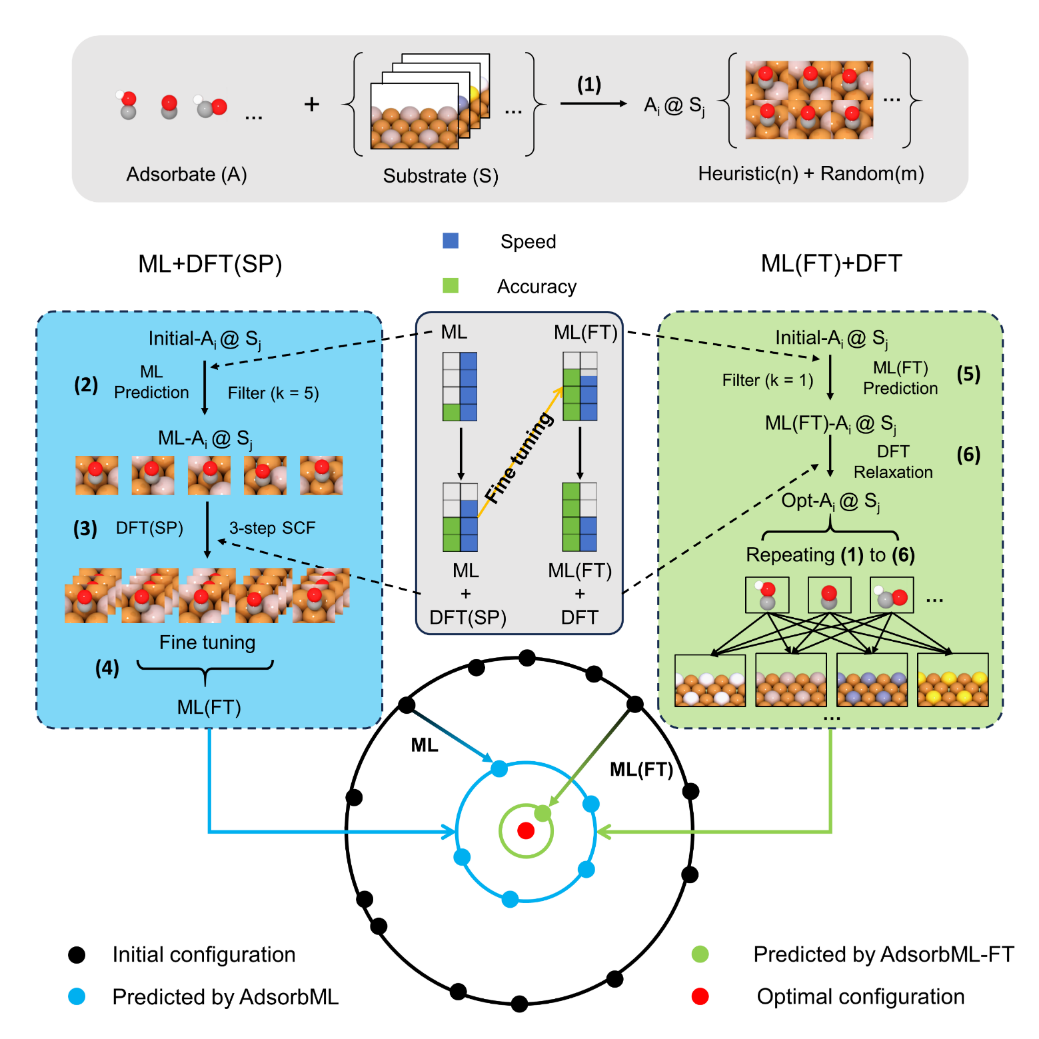
Fig. 1. Workflow of ML accelerated DFT calculations by AdsorbML-FT: (1) Initial configuration sampling: initial “adsorbate + substrate” configurations are generated for different combinations of adsorbate and substrate. (2) ML pre-screening: all initial configurations undergo ML-driven relaxation yielding ML-pre-relaxed configurations. (3) 3-Step DFT calculation: A three-step consecutive relaxation cycle is performed on the pre-relaxed configurations to calculate DFT single-point (DFT(SP)), which are used for validation or subsequent fine-tuning. (4) Fine tuning training: Use DFT single-point data for fine-tuning the pre-trained model. (5) Refined ML prediction: The fine-tuned ML (FT) model reprocesses different combinations of adsorbate and substrate to obtain a new set of more accurate ML-pre-relaxed optimal configurations. (6) Final DFT relaxation: The optimal configuration determined by ML(FT) will undergo a full DFT relaxation.
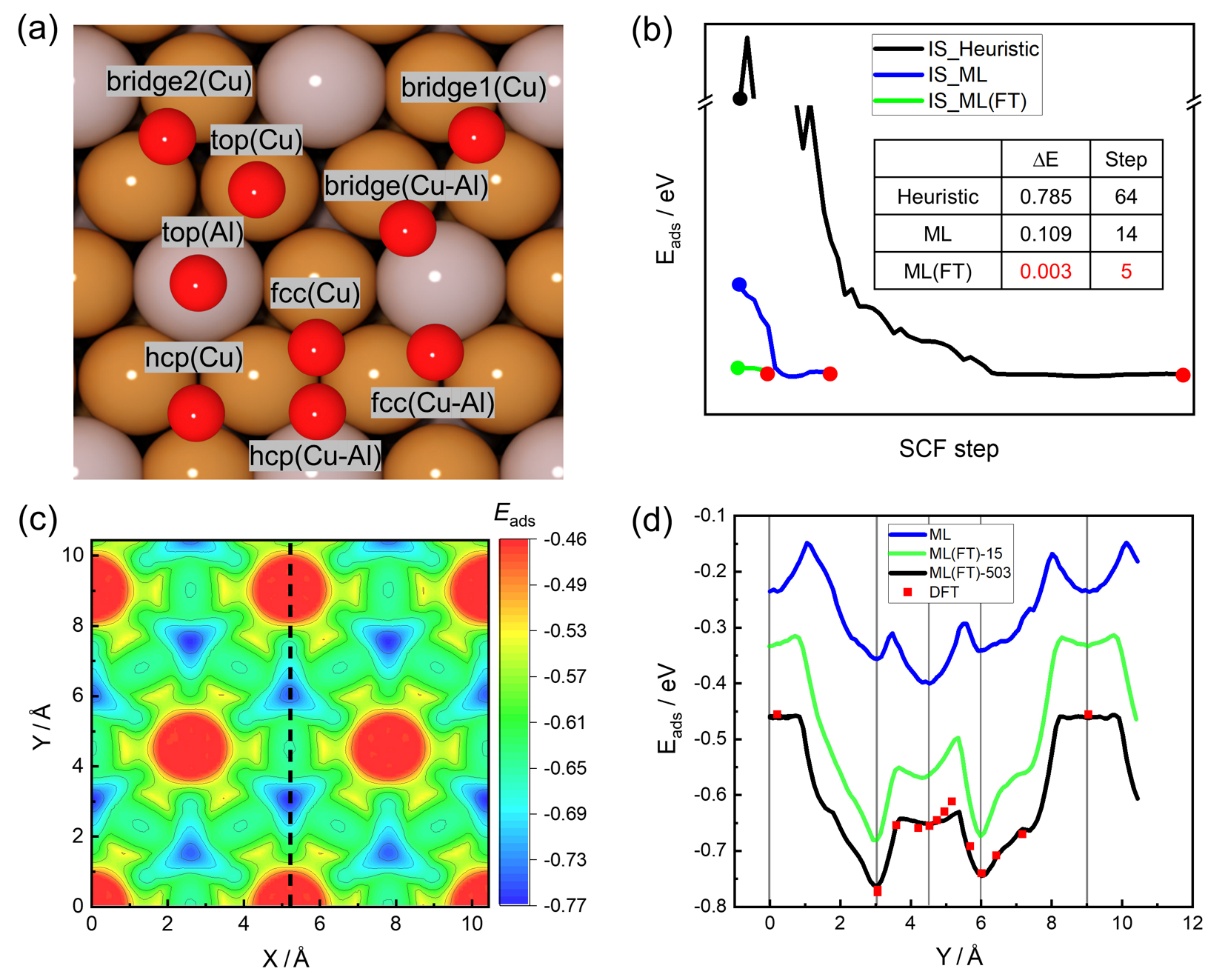
Fig. 2. (a) Top view of the Cu3Al1(111) surface. (b) DFT relaxation and adsorption energy changes of initial structures obtained by three methods (Heuristic, ML, ML(FT)), where the “SCF step” corresponds to the self-consistent field (SCF) calculation step in DFT. (c) Adsorption potential energy surface of CO on the surface shown in (a). (d) Adsorption energy profile along the x=5.3 Å line in (c), predicted by three different models,where ML(FT)-15 denotes a machine learning model trained using 15 DFT data points, and ML(FT)-503 denotes a machine learning model trained using 503 DFT data points.
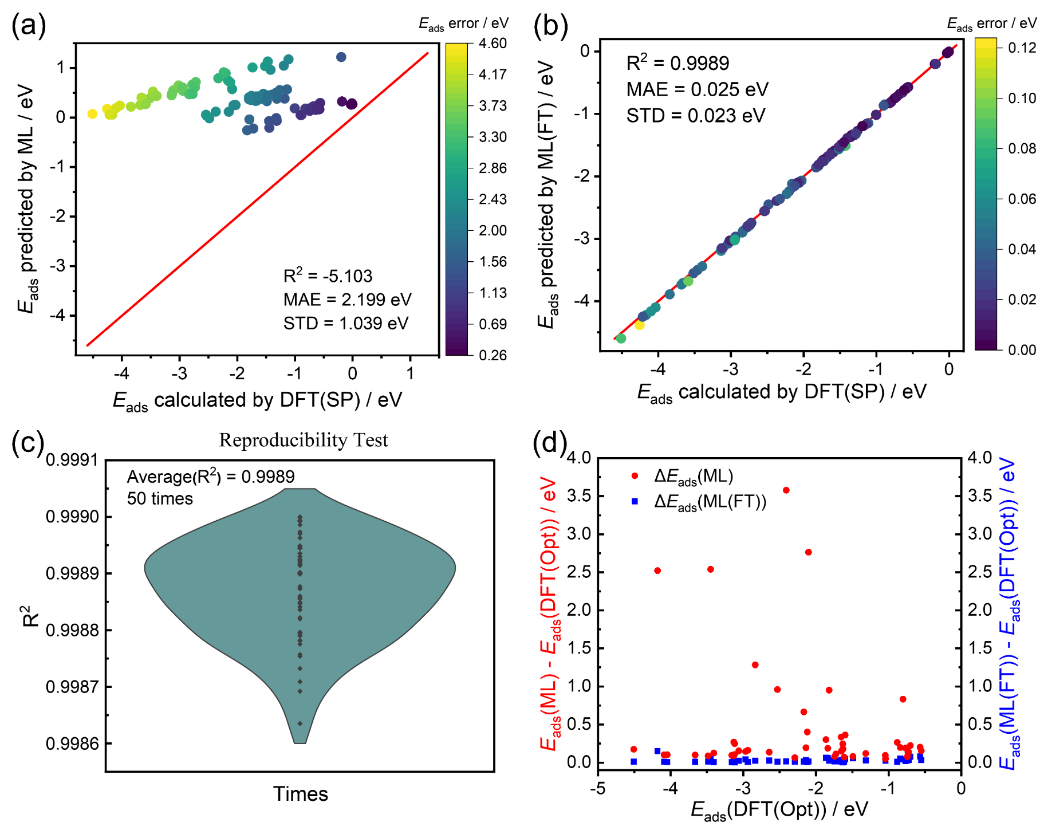
Fig. 3. (a) Comparison of adsorption energies between pre-trained ML predictions and DFT(SP) on the validation set. (b) Validation set performance: Fine-tuned ML model (537 training points) vs. DFT(SP) adsorption energies. (c) Reproducibility test: Violin plot showing the distribution of R2 scores for adsorption energies on independently constructed DFT validation (three-step single-point calculations per adsorbate + substrate combination) points over 50 independent runs. (d) Assessment of initial structure quality: Absolute deviation (ΔEads) between DFT single-point energies of ML-predicted initial structures and final relaxed states across 48 systems.
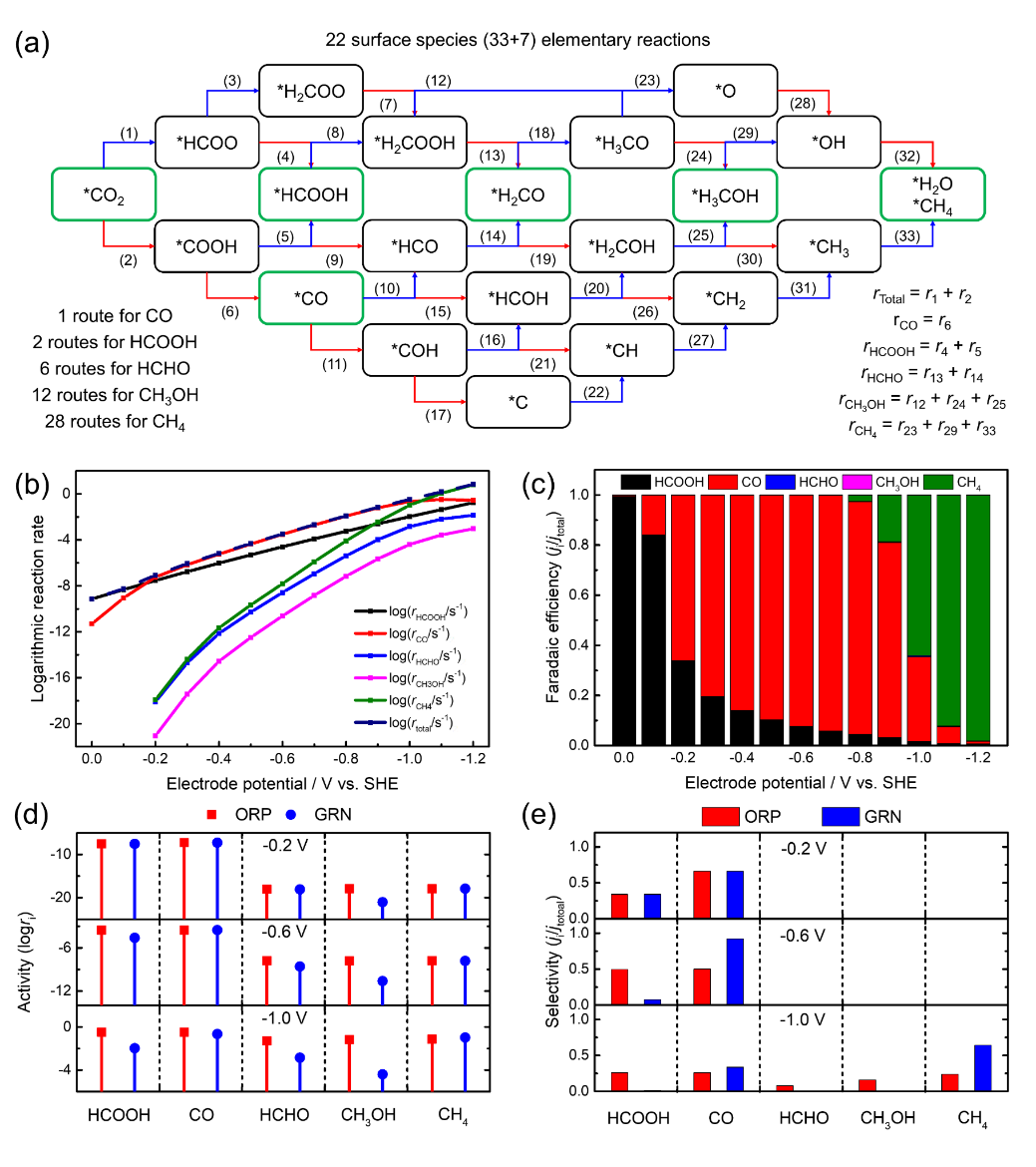
Fig. 4. (a) Global reaction networks of CO2 reduction to C1 products. (b) Partial and total reaction rates as a function of electrode potential evaluated by GRN. (c) Faradaic efficiency as a function of electrode potential calculated by GRN. (d) and (e) Comparison of catalytic activities and product selectivities estimated by GRN and ORP.
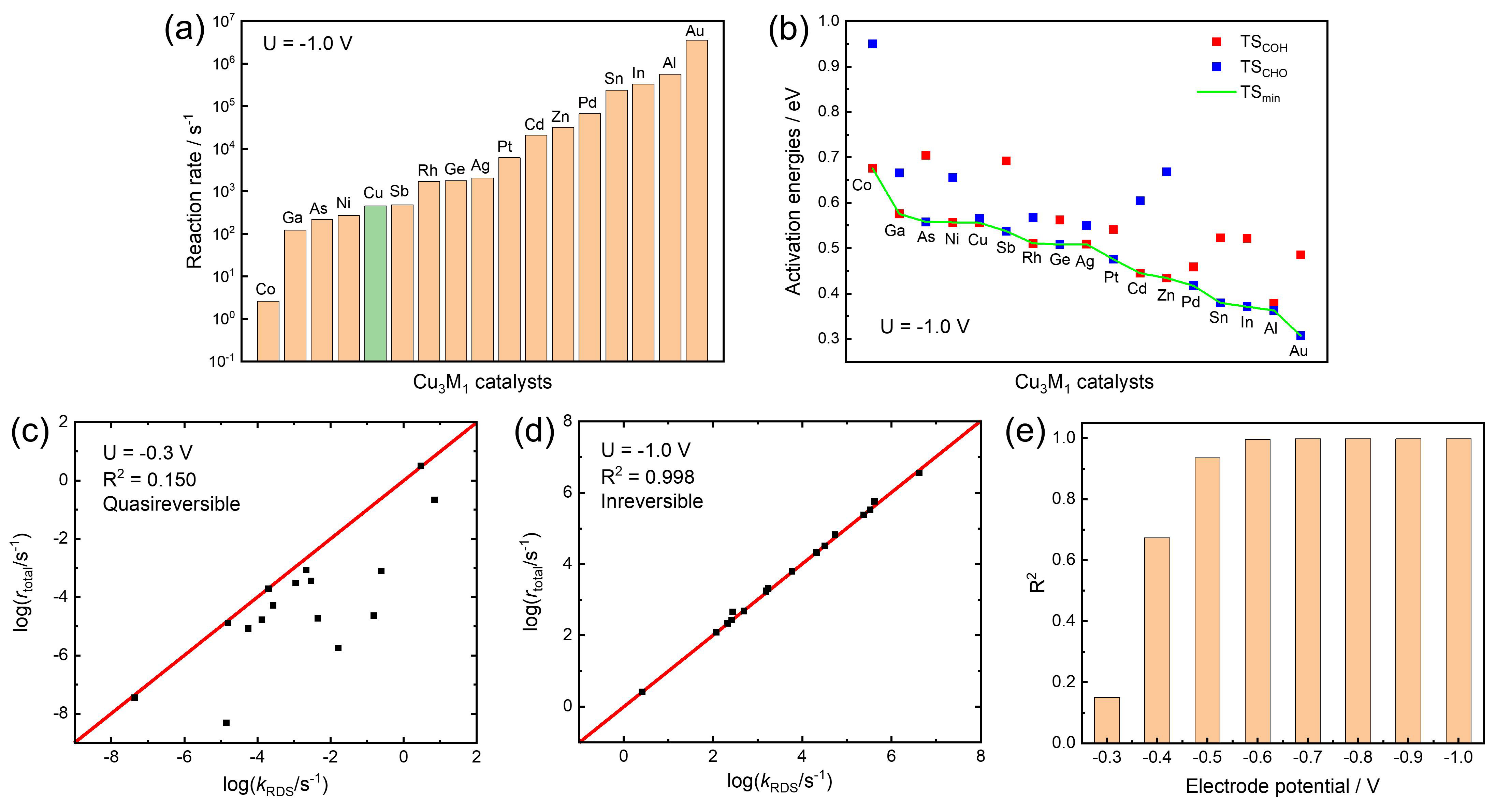
Fig. 5. Total reaction rates (a) and activation barriers (b) of CORR on Cu3M1 catalysts at U=-1.0 V vs. SHE. (c,d) Proportional function fitting of total reaction rate with rate constant of rate-determining step at U=-0.3 and -1.0 V vs. SHE. (e) Calculated coefficients of determination as a function of electrode potential.
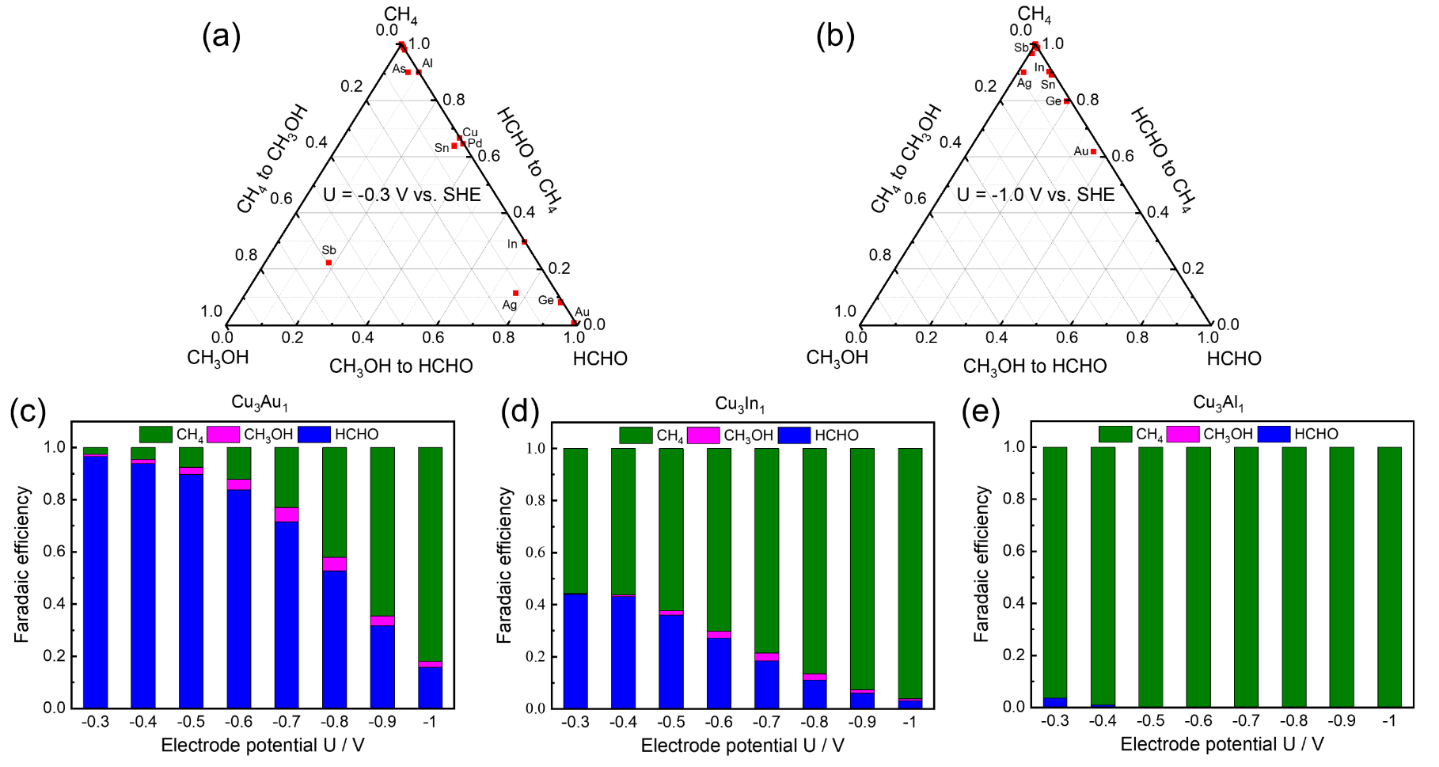
Fig. 6. (a,b) Product selectivity on different substrates with U=-0.3 and -1.0 V vs. SHE. Faradaic efficiency of CORR as a function of electrode potential on Cu3Au1 (c), Cu3In1 (d), and Cu3Al1 (e).
|
| [1] | Miao Wang, Tianyu Shen, Heng Zhou, Shuaikang Yang, Fengkun Hao, Chaohui Wang, Mohan Kumar, Zuoxiu Tie, Shuangming Chen, Zhanxi Fan, Zhong Jin. Direct electrosynthesis of ammonia from nitrate reduction using atomically precise carbonyl-rich metal clusters in neutral media [J]. Chinese Journal of Catalysis, 2026, 88(9): 259-268. |
| [2] | Jiaxiang Qin, Songpei Zhang, Xingju Li, Xintai Chen, Jia Zhao, Xiaoling Mou, Xiangen Song, Li Yan, Ronghe Lin, Yunjie Ding. Decoding structure-selectivity interplay in Pd-Ag nanocatalysts for butadiene semi-hydrogenation [J]. Chinese Journal of Catalysis, 2026, 87(8): 342-352. |
| [3] | Zhaochun He, Chunli Liu, Yonghua Liu, Tao Wang. Boosting homogeneous ammonia synthesis by balancing N≡N activation and N-H formation [J]. Chinese Journal of Catalysis, 2026, 87(8): 316-326. |
| [4] | Sen Wang, Shiying Li, Rui Geng, Bo Zhou, Pengfei Wang, Zhangfeng Qin, Mei Dong, Jianguo Wang, Unni Olsbye, Weibin Fan. The smallest Ni species triggering selective hydrogenation of CO2 to methane: Ni dimer embedded in MFI and enhancement of MnOx [J]. Chinese Journal of Catalysis, 2026, 87(8): 113-125. |
| [5] | Yang Ding, Yizhen Lu, Tianrong Yu, Mingrui Zhang, Rui Zhao, Ruijie Yang, Qixin Li, Shiqun Wu, Jinlong Zhang. Dual pathways in photo-driven Fischer-Tropsch synthesis for high selective hydrocarbon production [J]. Chinese Journal of Catalysis, 2026, 87(8): 22-46. |
| [6] | Bowen Li, Changlin Lin, Qi Wang, Yongfeng Lun, Jun Fang, Shuqin Song, Yi Wang. Ligand-shell engineering of a Au25 nanocluster boosting CO2 electroreduction to syngas with tunable range proportion [J]. Chinese Journal of Catalysis, 2026, 87(8): 396-409. |
| [7] | Yatai Zhou, Chengcheng Yuan, Wei Xia, Jun Wang, Xiaofeng Zhu, Yong Zhang, Bicheng Zhu, Jiaguo Yu. Synergistic optimization of interfacial electron transfer and surface hydrogen adsorption in a CdS/ZnO S-scheme heterojunction by site-specific doping: A DFT study [J]. Chinese Journal of Catalysis, 2026, 86(7): 327-337. |
| [8] | Shahla Karimi, Mehran Rezaei, Jiguang Deng, Hongxing Dai, Ali Rastegarpanah. Recent advances in noble metal-based catalysts for methane decomposition: Performance, mechanism, and optimization [J]. Chinese Journal of Catalysis, 2026, 86(7): 9-48. |
| [9] | Ben Li, Lihua Wang, De Xia, Yong Wang, Huajie Liu, Shanjun Mao. Zn-induced In-S bond modulation in In2S3 enables selective CO2-to-formate conversion at industrial current densities [J]. Chinese Journal of Catalysis, 2026, 85(6): 106-116. |
| [10] | Bin Yang, Ouardia Akdim, Chengcheng Yuan, Ruina Li, Luo Yu, Hermenegildo García, Jiaguo Yu, Graham J. Hutchings, Panyong Kuang. In-situ reconstructed Cu-In2O3 electron-rich interfaces facilitate high selective CO2-to-CO conversion at low potentials [J]. Chinese Journal of Catalysis, 2026, 85(6): 117-129. |
| [11] | Jiaying Liu, Yu Fang. Unraveling structure-activity relationships in 2-D covalent organic frameworks for photocatalysis: From molecular engineering to high-performance optimization [J]. Chinese Journal of Catalysis, 2026, 85(6): 47-87. |
| [12] | Lanlan Chen, Li Sheng, Yanan Zhou, Qiquan Luo, Zhenyu Li, Wenhua Zhang, Jinlong Yang. Unraveling the superiority of Ni1-MoS2 single-atom catalyst in CO2 hydrogenation to methanol: A DFT combined microkinetic study [J]. Chinese Journal of Catalysis, 2026, 85(6): 143-152. |
| [13] | Yihan Ye, Yilun Ding, Tao Peng, Cheng Liu, Xinzhe Li, Yongzhi Zhao, Jianping Xiao, Feng Jiao, Xiulian Pan. Role of accumulated carbonaceous species on dynamic confinement in zeolite catalysis [J]. Chinese Journal of Catalysis, 2026, 84(5): 74-79. |
| [14] | Jingyao Wu, Yujing Lv, Qiang Zhao, Shuo Wang, Ying Wang, Na Wen, Zhengxin Ding, Zizhong Zhang, Jinlin Long. Electron-proton duet in covalent organic frameworks for efficient direct oxygen reduction to hydrogen peroxide [J]. Chinese Journal of Catalysis, 2026, 84(5): 288-300. |
| [15] | Zhiyao Liu, Tangkang Liu, Chuan Qin, Guoliang Liu, Anmin Zheng. Zirconia-mediated interfacial catalysis for CO2 hydrogenation [J]. Chinese Journal of Catalysis, 2026, 84(5): 1-24. |
| Viewed | ||||||
|
Full text |
|
|||||
|
Abstract |
|
|||||


