
催化学报 ›› 2026, Vol. 91: 274-289.DOI: 10.1016/S1872-2067(26)65226-6
陈啸萱a, 李康a, 姜泽文a, 郭浩田b, 徐选文b, 董鹏玉a,*( )
收稿日期:2026-01-26
接受日期:2026-02-10
出版日期:2026-12-18
发布日期:2026-10-13
通讯作者:
*电子信箱: dongpy11@ycit.edu.cn (董鹏玉).基金资助:
Xiaoxuan Chena, Kang Lia, Zewen Jianga, Haotian Guob, Xuanwen Xub, Pengyu Donga,*()
Received:2026-01-26
Accepted:2026-02-10
Online:2026-12-18
Published:2026-10-13
About author:First author contact: Xiaoxuan Chen: Investigation, Data curation, Visualization, Writing-original draft; Kang Li: Data curation; Zewen Jiang: Data curation; Haotian Guo: Software, Data curation; Xuanwen Xu: Validation; Pengyu Dong: Conceptualization, Methodology, Supervision, Writing-review & editing.
Supported by:摘要:
光催化水分解技术是利用光催化剂将太阳能直接转化为化学能(例如氢气), 该过程通过光诱导的催化反应来完成; 获得的化学能有效地克服了太阳能转换过程中常见的不稳定性和间歇性问题, 是高效开发和利用太阳能资源的重要策略. 因此, 高性能光催化剂的制备已成为当务之急.
开发高效且成本低廉的C3N5基光催化剂以实现氢气生产具有重要意义. 此外, 从纳米级精度的空间角度研究C3N5基S-型异质结中光生电荷的表面电势分布仍比较缺乏. 本文利用具有强氧化能力的Al掺杂SrTiO3(ASTO)和具有高还原能力的C3N5纳米片, 通过水热法成功合成了一种新型的ASTO/C3N5 S-型异质结. 结果表明, 多面体的ASTO颗粒与C3N5纳米片能够紧密结合, 两者之间存在清晰且明显的界面. 最优的5%-ASTO/C3N5 S-型异质结在模拟太阳光照射下表现出较高的氢气生成速率(1.87 mmol g-1 h-1), 分别比原始的C3N5和ASTO高出2.5倍和37.4倍. 采用光辅助的开尔文探针力显微镜揭示了ASTO/C3N5 S型异质结中电荷转移动力学的空间分辨特征, 在ASTO/C3N5 S-型异质结中, 光生电子聚集在还原型光催化剂C3N5表面, 导致其表面光电压(SPV)低于纯C3N5, 而空穴则聚集在氧化型光催化剂ASTO表面, 因而比纯ASTO的SPV更高. 此外, ASTO (4.66 eV)和C3N5(4.25 eV)之间较大的功函数差异(0.41 eV)促使界面电子从C3N5转移到ASTO, 引发能带弯曲并形成强大的界面电场, 因而促进了S-型电荷迁移, 即ASTO导带中的光生电子与C3N5价带中的空穴发生复合, 从而使ASTO/C3N5 S-型异质结保持高氧化还原电位. 此外, 活性自由基测量证实了5%-ASTO/C3N5异质结中•O2-和•OH信号增强, 证实了S-型机制而非II型机制, 原位X-射线光电子能谱结果也证实了这一点.
综上, 本文不仅证明了ASTO/C3N5 S-型异质结是一种性能卓越的光催化剂,而且还对空间分辨的电荷转移机制提供了直接实验依据.
陈啸萱, 李康, 姜泽文, 郭浩田, 徐选文, 董鹏玉. 空间分辨电荷转移机制主导的Al掺杂SrTiO3/C3N5 S-型异质结增强太阳能光催化析氢[J]. 催化学报, 2026, 91: 274-289.
Xiaoxuan Chen, Kang Li, Zewen Jiang, Haotian Guo, Xuanwen Xu, Pengyu Dong. Exploring the spatially resolved charge transfer mechanism in the Al-doped SrTiO3/C3N5 S-scheme heterojunction for boosted solar-driven photocatalytic hydrogen evolution[J]. Chinese Journal of Catalysis, 2026, 91: 274-289.
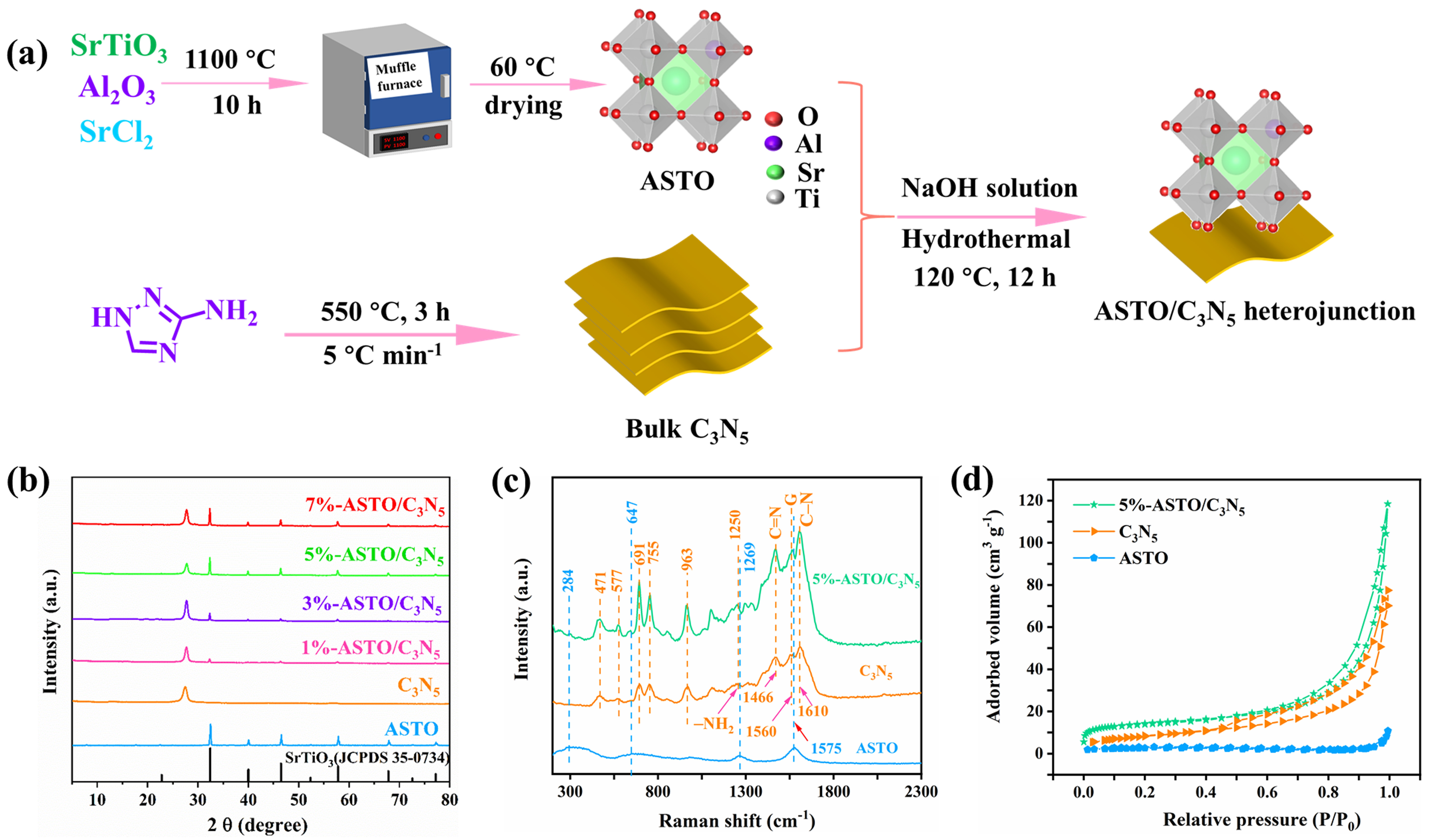
Fig. 1. (a) The proposed procedure for the preparation of ASTO/C3N5 heterojunction. (b) XRD patterns of all as-prepared samples. Raman spectra (c) and N2 adsorption isotherms (d) tested at 77 K of C3N5, ASTO, and 5%-ASTO/C3N5.

Fig. 2. High-resolution XPS spectra comparing C3N5 and the 5%-ASTO/C3N5 heterojunction: C 1s (a) and N 1s (b) regions. High-resolution XPS spectra comparing ASTO and the 5%-ASTO/C3N5 heterojunction: O 1s (c), Al 2p (d), Sr 3d (e), and Ti 2p (f).
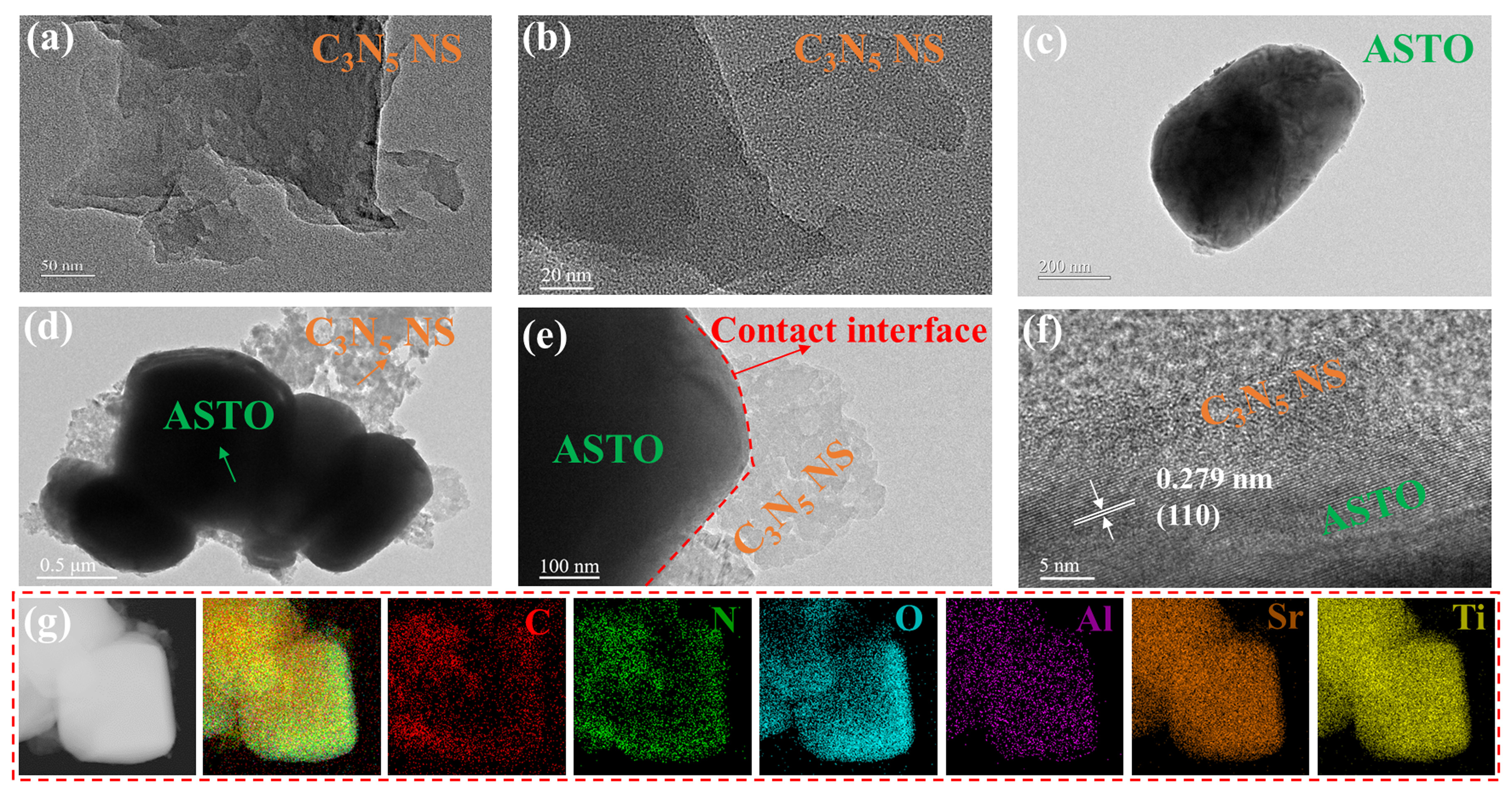
Fig. 3. TEM images of C3N5 (a,b), ASTO (c), and 5%-ASTO/C3N5 (d,e). (f) HRTEM image of 5%-ASTO/C3N5. (g) HAADF-STEM and EDS elemental-mapping images of 5%-ASTO/C3N5.

Fig. 4. (a) Graph showing the time-dependent photocatalytic hydrogen production activity over all the as-prepared catalysts. (b) Histogram of hydrogen production rates of pure C3N5, ASTO, and various ASTO/C3N5 heterojunctions. (c) Photocatalytic stability performance of 5%-ASTO/C3N5. (d) AQE and the corresponding UV-vis DRS spectrum of 5%-ASTO/C3N5. (e) Bar chart of hydrogen production rates with different sacrificial reagents. (f) A comparison of photocatalytic H2 evolution over some reported C3N5-based heterojunction photocatalysts. (g) Water contact angles of C3N5, ASTO, and 5%-ASTO/C3N5.

Fig. 5. (a) Each prepared sample's UV-vis DRS spectra. Tauc plots of ASTO (b) and C3N5 (c). Mott-Schottky plots of ASTO (d) and C3N5 (e). (f) Energy band position diagram of C3N5 and ASTO.

Fig. 6. EIS Nyquist plots (illustration showing the equivalent circuit) (a), photocurrent curves (b), LSV curves (c), steady-state PL spectra (at 370 nm of excitation) (d), and TRPL decay profiles (e)

Fig. 7. AFM (a) and KPFM images of pure C3N5 in the dark (b), in the presence of light (c), and the associated potential distribution curves (d). AFM (e) and KPFM images of pure ASTO in the absence of light (f) and in the presence of light (g), together with the matching potential distribution curves (h). AFM (i) and KPFM images of the 5%-ASTO/C3N5 heterojunction in the absence of light (j), in the presence of light (k), and the associated potential distribution curves (l). (m) A comparison of SPV between pure C3N5 (or ASTO) and C3N5-HJ (or ASTO-HJ). (n) Schematic diagram of charge transfer in the ASTO/C3N5 heterojunction under illumination. (o) Proposed ASTO/C3N5 S-scheme heterojunction with the surface state.
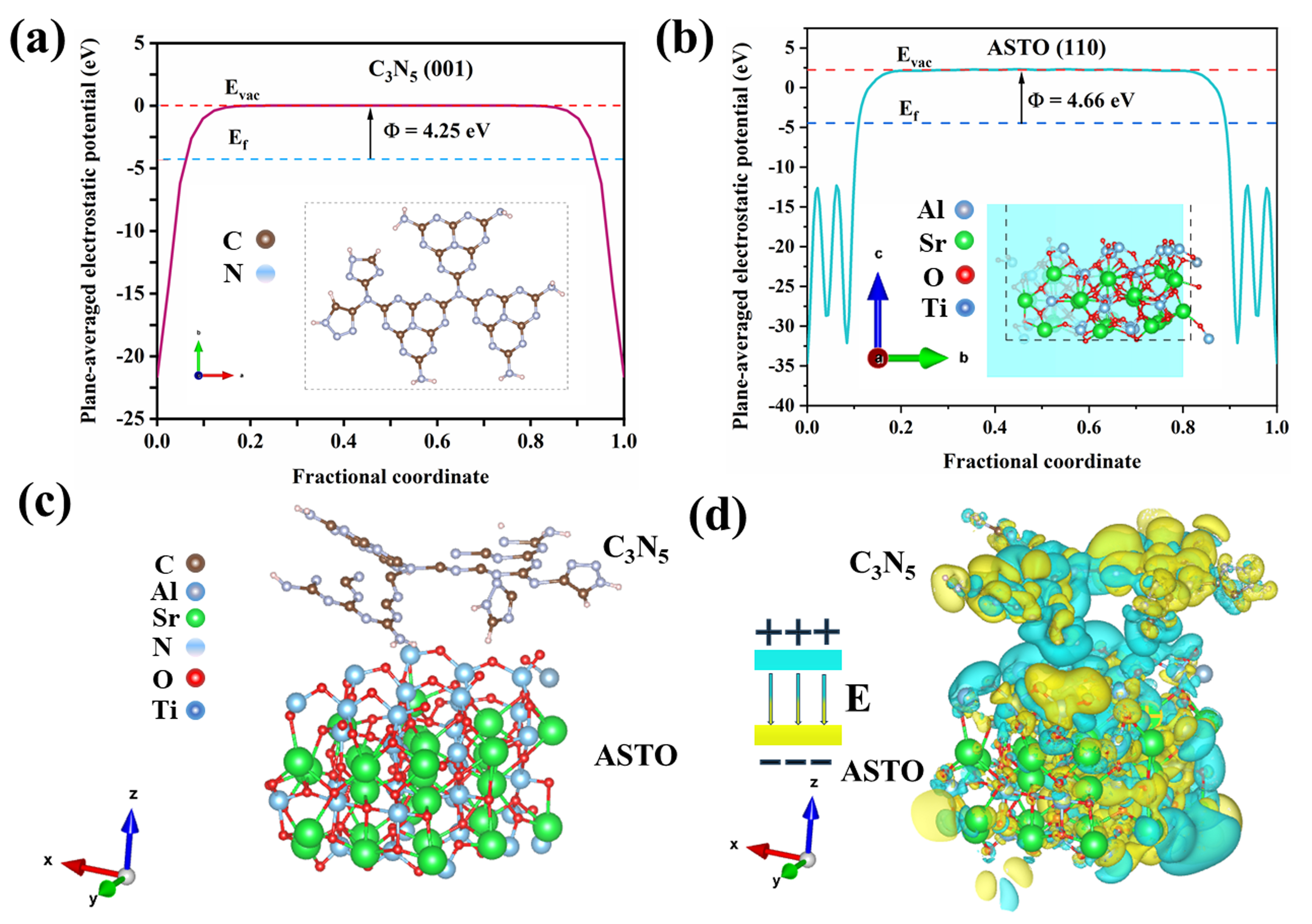
Fig. 8. Plane-averaged electrostatic potential of C3N5 (001) (a) and ASTO (110) (b) surfaces. (c) The fabricated ASTO (110)/C3N5 (001) interface model after geometry optimization. (d) The ASTO (110)/C3N5 (001) interface's computed charge density difference distribution, which has an isosurface value of 0.0008 e Å-3. (Yellow: electron buildup; Cyan: electron depletion).

Fig. 9. DMPO spin-trapping EPR spectra for detecting •O2- (a) and •OH (b) signals over the as-prepared ASTO, C3N5, and 5%-ASTO/C3N5 samples. Schematic representation of type-II (c) and S-scheme (d) mechanisms as two possible pathways for ASTO/C3N5 charge tra

Fig. 10. In-situ XPS spectra for C 1s (a), N 1s (b), O 1s (c), Sr 3d (d), and Ti 2p (e) in the 5%-ASTO/C3N5 sample under dark and Xe lamp irradiation. (f) Schematic diagram of binding energy shift and electron density change. (g) Schematic representation of the charge migration pathways of the S-scheme ASTO/C3N5 heterostructure before and after exposure to dark and under simulated sunlight irradiation.
|
| [1] | 马小龙, 吴之强, 姚惠琴, 刘彬, 靳治良, Paolo Fornasiero. 电荷动力学工程: 量子点诱导的全空间电场协同Ag2S量子点/CoWO4 S型异质结促进光催化析氢[J]. 催化学报, 2026, 88(9): 233-246. |
| [2] | 刘高雄, 陈润东, 夏兵全, 周贤龙, 李来全, 刘善堂. 构建噻二唑功能化CTF基S型异质结用于高效光催化合成H2O2[J]. 催化学报, 2026, 87(8): 170-184. |
| [3] | 吴昊, 曾芯宇, 王往, 程蓓, 程敬招, 许景三, 曹少文. 有机-无机S型异质结增强载流子分离用于光催化产氢耦合亚胺合成[J]. 催化学报, 2026, 87(8): 185-196. |
| [4] | 李世杰, 李蕊, 刘艳萍, 于欣, 马德运, 姜建辉, 周小松, 庄春强, 赵再望, 姜维. Ag/AgBr/C3N5中LSPR增强S型电荷转移促进活性氧物种生成实现高效光催化降解抗生素废水[J]. 催化学报, 2026, 87(8): 126-139. |
| [5] | 马明宇, 刘棕阳, 袁阔, 刘哲源, 王嘉新, 林清清, 钟地长, 鲁统部. 自光敏金属配合物用于光催化析氢[J]. 催化学报, 2026, 86(7): 375-383. |
| [6] | 李晗溪, 罗振东, 薛强, 支云飞, 杜骏, 周旭凯. 基于Povarov环化的共价有机框架孔道与电荷动力学调控及其光催化产氢增强[J]. 催化学报, 2026, 86(7): 363-374. |
| [7] | 李如春, 张留洋. 范德华界面调控的氮化碳S型同质结增强光催化氧化还原性能[J]. 催化学报, 2026, 86(7): 1-4. |
| [8] | 周亚太, 袁成成, 夏伟, 王骏, 朱潇锋, 张勇, 朱必成, 余家国. 通过掺杂优化CdS/ZnO S型异质结界面电子转移和表面氢吸附的理论计算研究[J]. 催化学报, 2026, 86(7): 327-337. |
| [9] | 李萍, 韦良, 夏伟, 袁成成, 艾陈斌, 李猛. 二维/二维g-C3N4/WO3 S型异质结中的超快电子转移及其高效光催化产H2O2机理[J]. 催化学报, 2026, 85(6): 333-345. |
| [10] | 董金涛, 张蕊, 王治帅, 曹胜群, 李利娜, 刘高鹏, 王彬, 高艺轩, 夏杰祥. S型氧化锰/氯氧铋异质结构筑强化光催化低浓度过一硫酸盐活化降解污染物性能[J]. 催化学报, 2026, 85(6): 310-321. |
| [11] | 张宝龙, 孙彬, 刘兴朋, 刘文宇, 顾少楠, 周国伟. 缺陷工程促进TiO2/Zn0.5Cd0.5S S型异质结电荷转移实现高效光催化析氢[J]. 催化学报, 2026, 84(5): 117-129. |
| [12] | 廖紫怡, 蒋岚, 杨扬, 王霖, 杨为佑, 侯慧林. 碱-氰基双调控的g-C3N4/BiOCl S-型异质结用于纯水中高效可见光驱动H2O2光合成[J]. 催化学报, 2026, 83(4): 143-161. |
| [13] | 张洪文, 蔡颖慧, 李秉岳, 山巍, 唐华. Cu单原子与CuO纳米团簇协同增强TiO2光催化析氢性能[J]. 催化学报, 2026, 83(4): 162-171. |
| [14] | R. Kavitha, C. Manjunatha, S. Girish Kumar. 基于氧化锌的S型异质结: 设计原理、制备方法及光催化活性[J]. 催化学报, 2026, 83(4): 54-95. |
| [15] | 许凯强, 朱文君, Mahmoud Sayed, 韩生. 一维S型光催化剂的设计与制备[J]. 催化学报, 2026, 83(4): 24-53. |
| 阅读次数 | ||||||
|
全文 |
|
|||||
|
摘要 |
|
|||||


