
Chinese Journal of Catalysis ›› 2026, Vol. 90: 264-275.DOI: 10.1016/S1872-2067(26)65166-2
• Articles • Previous Articles Next Articles
Guang Yanga,b, Xiliang Gongc, Zeshuo Menga,b, Shuang Houa,b, Minghao Yanga,b, Zhongmiao Gonga,b, Rong Huangb, Yi Cuia,b,*( )
)
Received:2026-02-09
Accepted:2026-03-18
Online:2026-11-18
Published:2026-11-19
Supported by:Guang Yang, Xiliang Gong, Zeshuo Meng, Shuang Hou, Minghao Yang, Zhongmiao Gong, Rong Huang, Yi Cui. Amorphous nickel hydroxide confined noble metal single atoms for enhanced alkaline hydrogen evolution reaction[J]. Chinese Journal of Catalysis, 2026, 90: 264-275.
Add to citation manager EndNote|Ris|BibTeX
URL: https://www.cjcatal.com/EN/10.1016/S1872-2067(26)65166-2
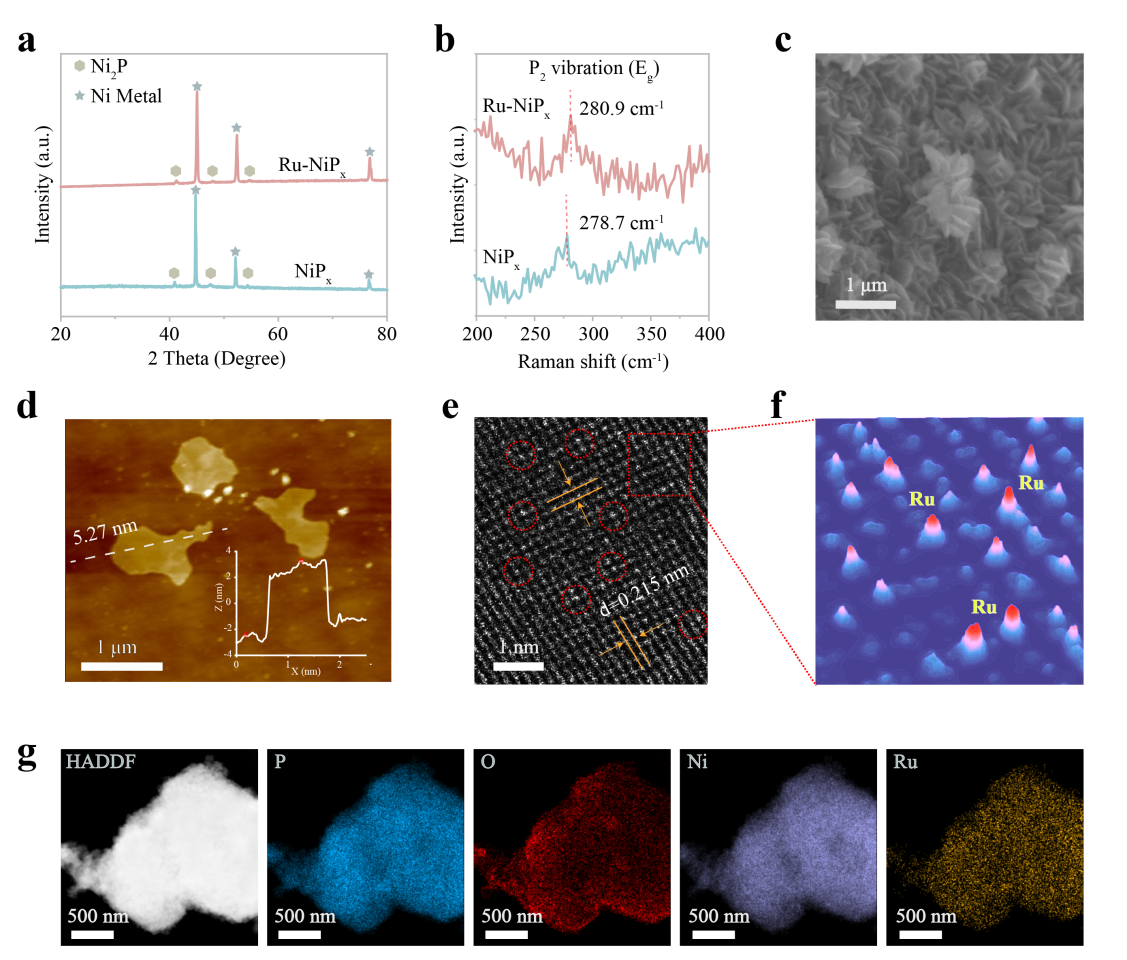
Fig. 1. XRD patterns (a) and Raman spectra (b) of Ru-NiPx and NiPx. SEM image (c) and AFM image (d) of Ru-NiPx. (e) High-resolution STEM image of Ru-NiPx, where the bright spots circled in red represent Ru single atoms. (f) Three-dimensional Gaussian function-fitted atomic image of the region marked by the red box in (e). (g) STEM elemental mapping of P, O, Ni, and Ru.
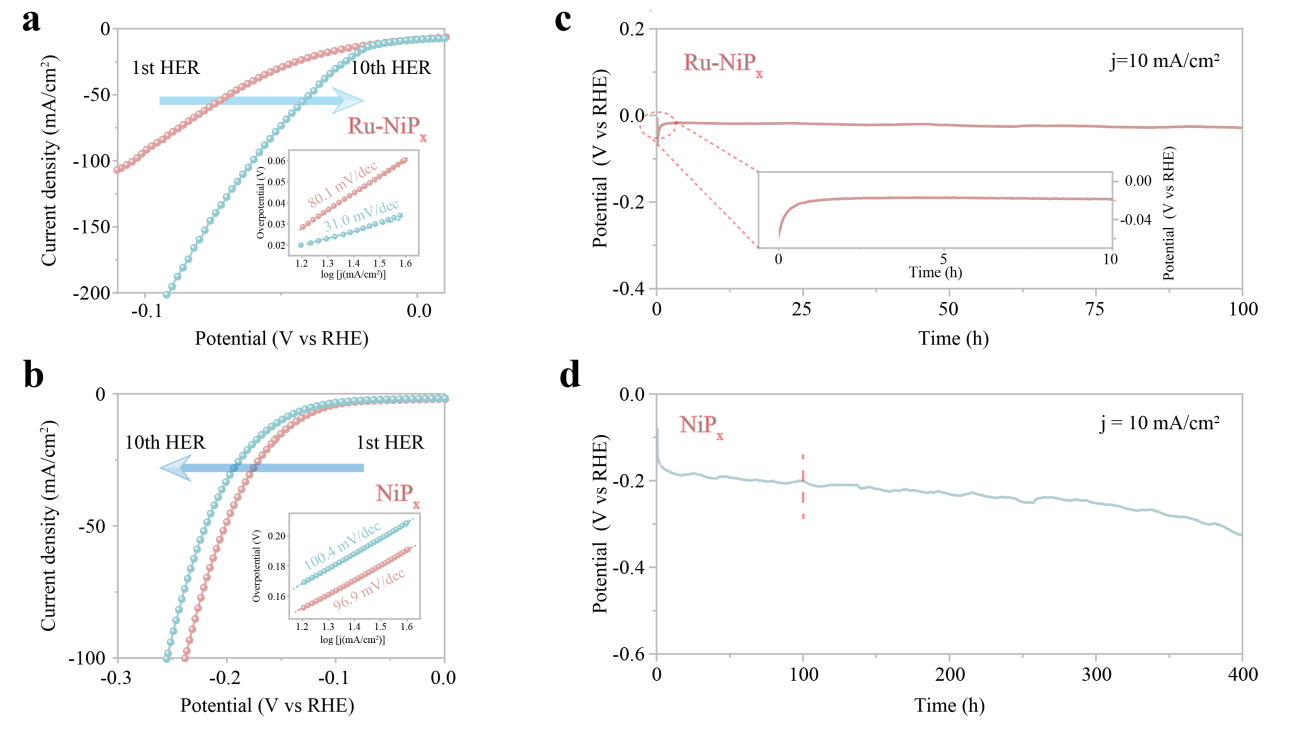
Fig. 2. LSV curves of Ru-NiPx (a) and NiPx (b) after 1st and 10th HER cycles. Inset: Corresponding Tafel plots. (c) Chronopotentiometry curve of Ru-NiPx at 10 mA/cm2 for 100 h. Inset: Initial activation within 10 h. (d) Chronopotentiometry curve of NiPx at 10 mA/cm2 for 400 h.
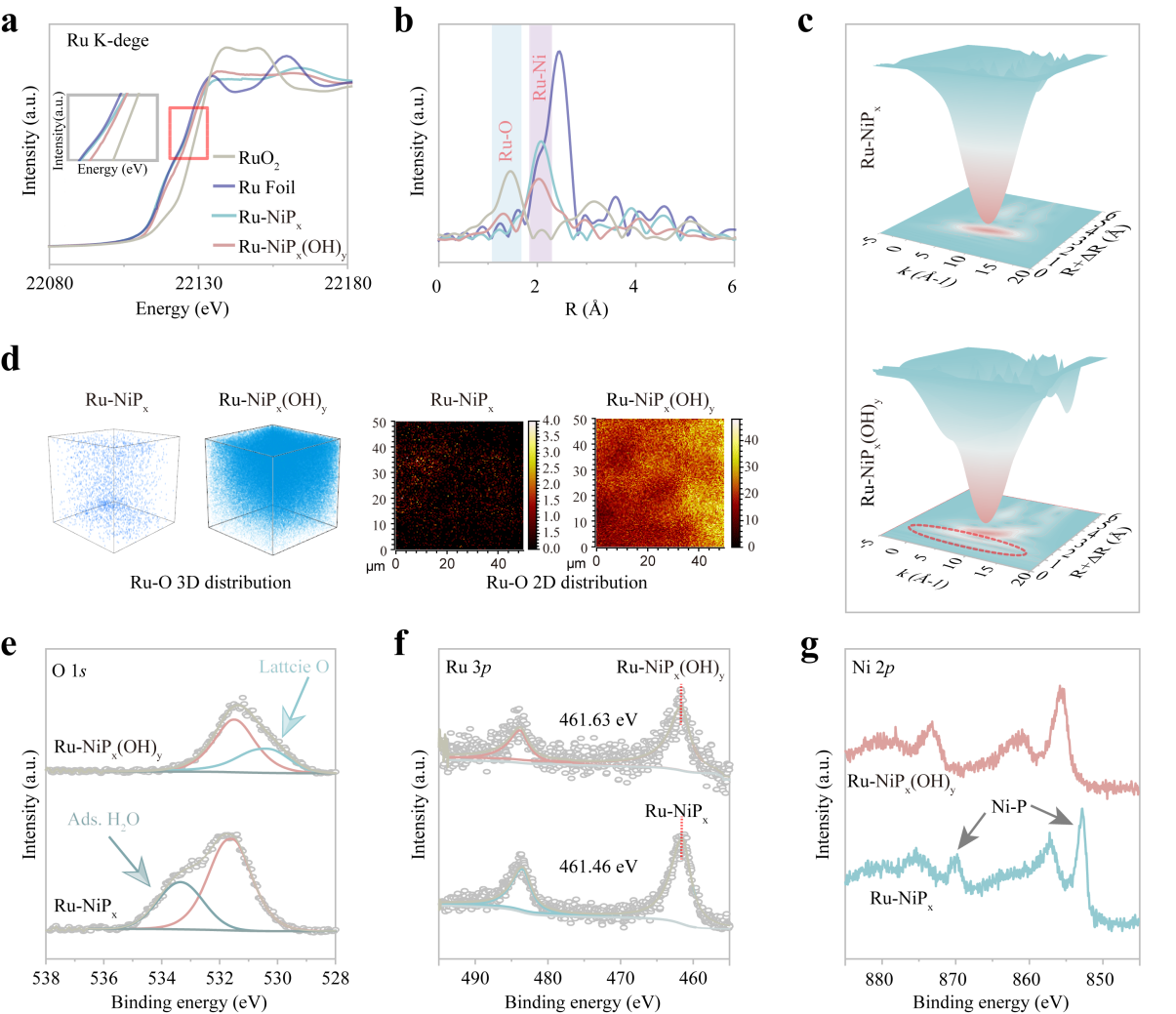
Fig. 3. (a) Ru K-edge XANES spectra of Ru-NiPx, Ru-NiPx(OH)y, and references. Inset: Magnified pre-edge region. (b) Ru K-edge Fourier transform EXAFS spectra in R-space. (c) WT plots of Ru-NiPx and Ru-NiPx(OH)y. (d) TOF-SIMs 3D and 2D distribution maps of Ru-O fragments. (e) O 1s XPS spectra. (f) Ru 3p XPS spectra. (g) Ni 2p XPS spectra.
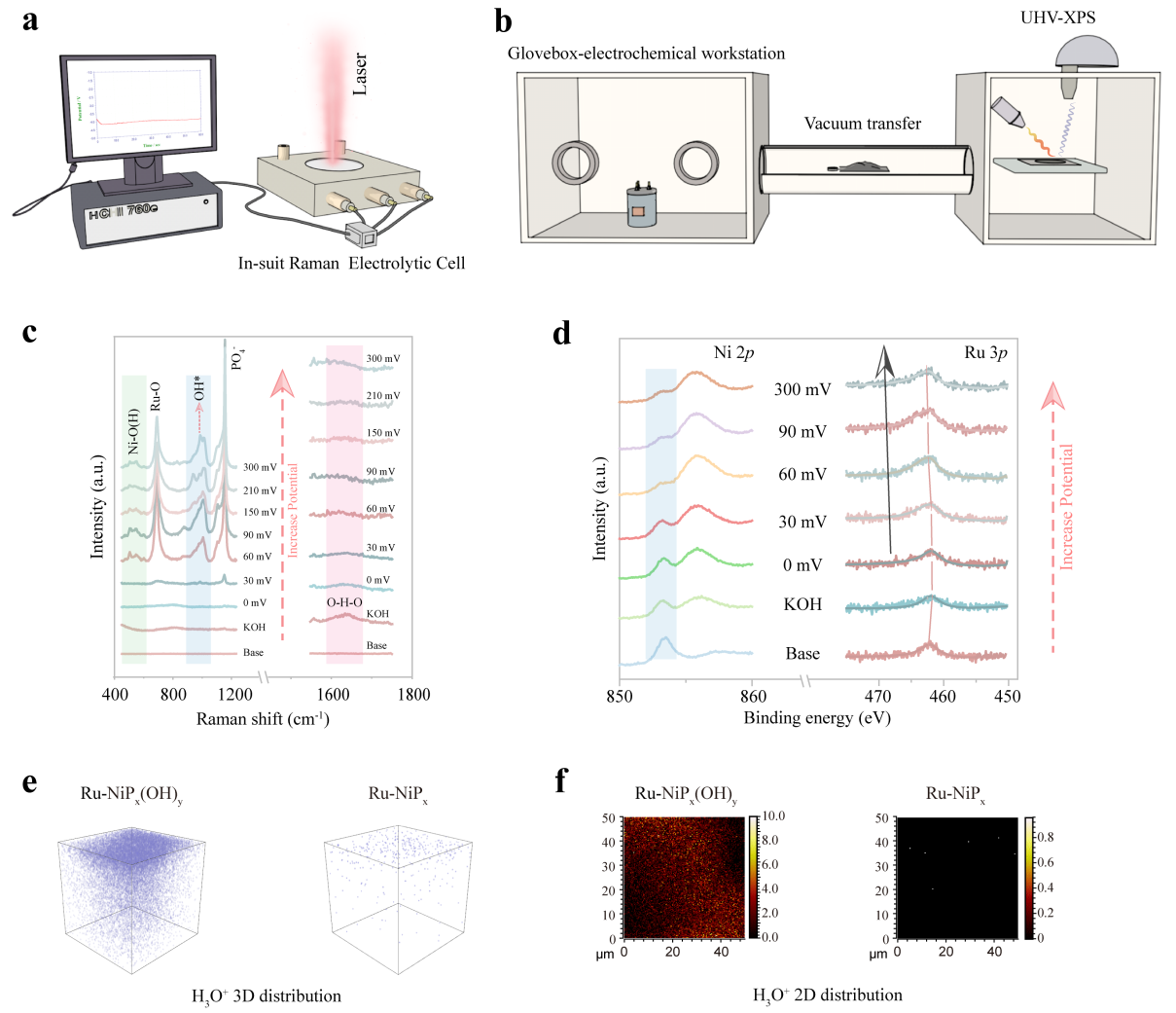
Fig. 4. (a) Schematic illustration of the in-situ Raman electrolytic cell. (b) Schematic illustration of a glovebox-electrochemical workstation and UHV-XPS chamber, connected via a vacuum transfer system. (c) In-situ Raman spectra under different applied potentials. (d) Quasi in-situ XPS spectra (recorded after emersion and transfer from the electrochemical cell under Ar protection) of the Ni 2p and Ru 3p regions for the electrode held at varying potentials. TOF-SIMs 3D (e) and 2D (f) distribution maps of H3O+ fragments.
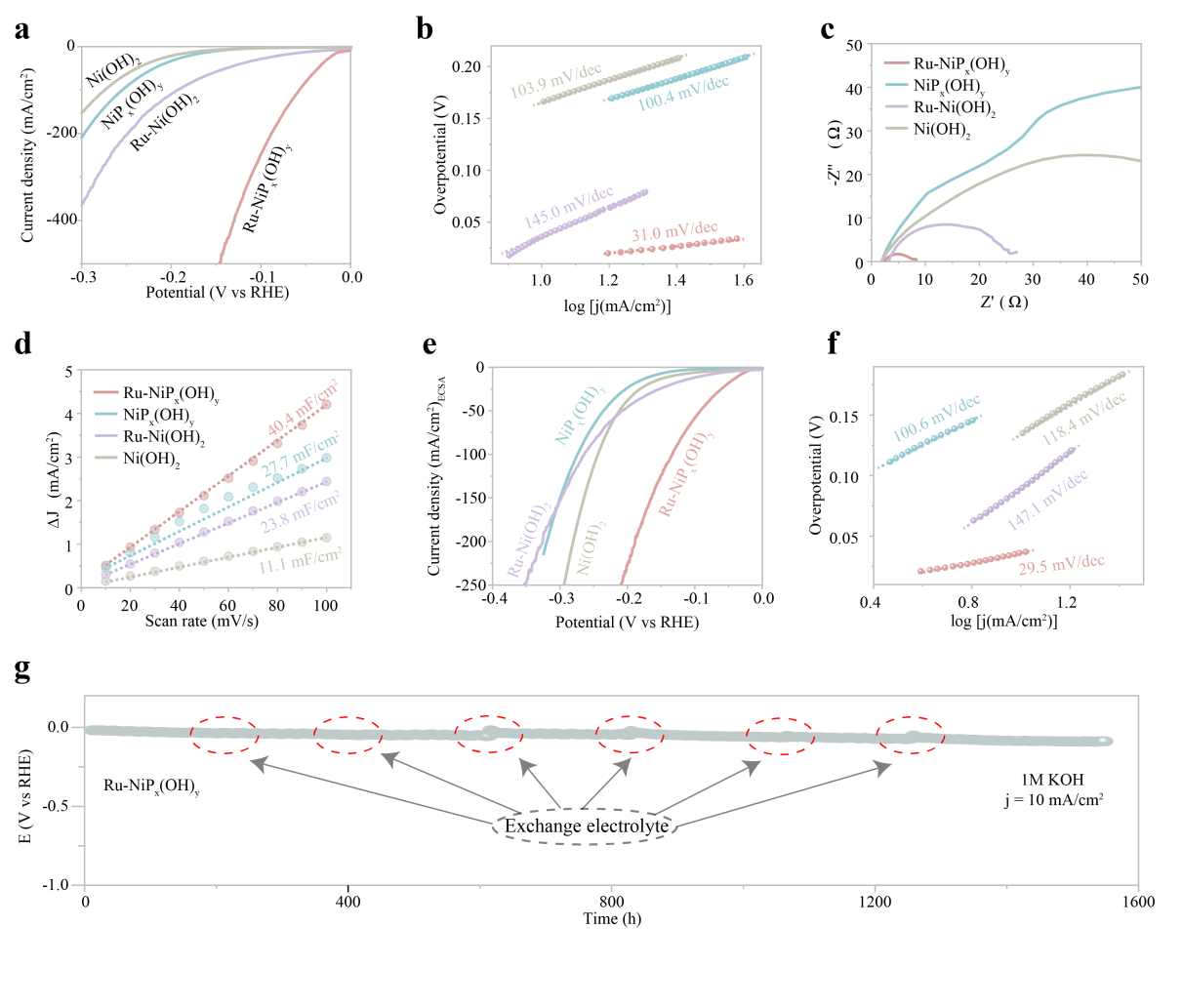
Fig. 5. Polarization curves (a), Tafel slopes (b), Nyquist plots (c), and double-layer capacitance (d) comparisons of Ru-NiPx(OH)y and reference catalysts. (e,f) LSV curves and corresponding Tafel slopes normalized by ECSA. (g) Long-term durability test of Ru-NiPx(OH)y at 10 mA/cm2 in 1 mol/L KOH.
|
| [1] | Yue Zeng, Hongsheng Wang, Jing Xuan, Ping Xiao, Yaoyao Feng, Shuai Lyu, Junjiang Zhu. Size-dependent interfacial interactions in CeO2/Co3O4 catalysts: From single atoms to nanoparticles [J]. Chinese Journal of Catalysis, 2026, 88(9): 478-491. |
| [2] | Bin Yang, Ouardia Akdim, Chengcheng Yuan, Ruina Li, Luo Yu, Hermenegildo García, Jiaguo Yu, Graham J. Hutchings, Panyong Kuang. In-situ reconstructed Cu-In2O3 electron-rich interfaces facilitate high selective CO2-to-CO conversion at low potentials [J]. Chinese Journal of Catalysis, 2026, 85(6): 117-129. |
| [3] | Ruiwen Hu, Zhiyong Guo, Xiaogang Peng, Xiaoqi Shi, Yuben Qiao, Qian Li, Chenghua Gao, Aitao Li. Synergistic integration of ancestral sequence reconstruction and rational design empowers unspecific peroxygenase for efficient steroid core oxyfunctionalization [J]. Chinese Journal of Catalysis, 2026, 84(5): 417-427. |
| [4] | Zhe Deng, Xiandi Ma, Ning Wang, Menggai Jiao, Hao Wan, Li-Li Zhang, Wei Ma, Zhen Zhou. Superficial S atom optimized active sites in NiFe layered double hydroxides for electrocatalytic urea oxidation [J]. Chinese Journal of Catalysis, 2026, 84(5): 189-199. |
| [5] | Zijie Wan, Yuqi Yang, Zhenquan Wang, Linrui Wu, Haipeng Zhang, Qingfang Shi, Xiang Liu, Hanlin Yang, Bohan Kang, Quan Xu, Jiaqing Luo, Jian Liu. Spatial confinement and nitrogenous defect anchoring synergistically enhance Ru nanoparticles catalyst performance for industrial current densities hydrogen evolution [J]. Chinese Journal of Catalysis, 2026, 84(5): 130-143. |
| [6] | Jegon Lee, Do-Hyun Kim, Seulgi Ji, Sangmoon Yoon, Seung Hyun Nam, Jucheol Park, Jin Young Oh, Seung Gyo Jeong, Jong-Seong Bae, Sang A. Lee, Heechae Choi, Woo Seok Choi. Awakening catalytically active surface of BaRuO3 thin film for alkaline hydrogen evolution [J]. Chinese Journal of Catalysis, 2026, 83(4): 341-350. |
| [7] | Xinran Sun, Mengtian Huo, Jianhang Sun, Yu Liang, Kaichi Qin, Haoyang Zhang, Zihao Xing, Jinfa Chang. Sacrificial conversion of metal sulfide precursors into active oxyhydroxide catalysts for enhanced oxygen evolution reaction [J]. Chinese Journal of Catalysis, 2026, 82(3): 84-91. |
| [8] | Haihong Zhong, Qianqian Xu, Weiting Yang, Nicolas Alonso-Vante, Yongjun Feng. Composition regulation of iron-group transition metal chalcogenides for the oxygen electrocatalysis: Electronic structure and surface reconstruction [J]. Chinese Journal of Catalysis, 2026, 81(2): 37-68. |
| [9] | Zhouzhou Wang, Qiancheng Zhou, Li Luo, Yaran Shi, Haoran Li, Chunchun Wang, Kesheng Lin, Chengsi Wang, Libing Zhu, Linyun Han, Zhuo Xing, Ying Yu. Suppressing catalyst reconstruction in neutral electrolyte: stabilizing Co-O-Mo point-to-point connection of cobalt molybdate by tungsten doping for oxygen evolution reaction [J]. Chinese Journal of Catalysis, 2025, 76(9): 146-158. |
| [10] | Jinghan Sun, Zhengrong Xu, Deng Liu, Aiguo Kong, Qichun Zhang, Rui Liu. In-situ distortion of Bi lattice in Bi28O32(SO4)10 cluster boosted electrocatalytic CO2 reduction to formate [J]. Chinese Journal of Catalysis, 2025, 72(5): 199-210. |
| [11] | Chao Feng, Jiaxin Shao, Hanyang Wu, Afaq Hassan, Hengpan Yang, Jiaying Yu, Qi Hu, Chuanxin He. Ultra-high overpotential induces NiS2 deep reconstruction to significantly improve HER performance [J]. Chinese Journal of Catalysis, 2025, 72(5): 230-242. |
| [12] | Jinxin Wang, Jiaqi Zhang, Chen Chen. Electrochemical CO2RR to C2+ products: A vision of dynamic surfaces of Cu-based catalysts [J]. Chinese Journal of Catalysis, 2025, 68(1): 83-102. |
| [13] | Qingyun Lv, Weiwei Zhang, Zhipeng Long, Jiantao Wang, Xingli Zou, Wei Ren, Long Hou, Xionggang Lu, Yufeng Zhao, Xing Yu, Xi Li. Large-current polarization-engineered FeOOH@NiOOH electrocatalyst with stable Fe sites for large-current oxygen evolution reaction [J]. Chinese Journal of Catalysis, 2024, 62(7): 254-264. |
| [14] | Ting Zhao, Bingbing Gong, Guancheng Xu, Jiahui Jiang, Li Zhang. In situ surface reconstruction of heterostructure Ni2P/CoP/FeP4 nanowires network catalyst for high-current-density overall water splitting [J]. Chinese Journal of Catalysis, 2024, 61(6): 269-280. |
| [15] | Bin Chen, Ya-Fei Jiang, Hai Xiao, Jun Li. Bimetallic single-cluster catalysts anchored on graphdiyne for alkaline hydrogen evolution reaction [J]. Chinese Journal of Catalysis, 2023, 50(7): 306-313. |
| Viewed | ||||||
|
Full text |
|
|||||
|
Abstract |
|
|||||


