
Chinese Journal of Catalysis ›› 2026, Vol. 91: 122-134.DOI: 10.1016/S1872-2067(26)65216-3
• Articles • Previous Articles Next Articles
Yi Liua,*( ), Peng Zhanga,b, Yijun Lia,b, Zhihua Hana, Bo Fenga, Xiaowa Niec, Jingyun Chena, Ruonan Hea, Zhoujun Wangd, Lei Shaob, Shaodong Qina,*(), Guanghui Zhangc, Xinwen Guoc,*()
Received:2026-03-30
Accepted:2026-07-06
Online:2026-12-18
Published:2026-10-13
Supported by:Yi Liu, Peng Zhang, Yijun Li, Zhihua Han, Bo Feng, Xiaowa Nie, Jingyun Chen, Ruonan He, Zhoujun Wang, Lei Shao, Shaodong Qin, Guanghui Zhang, Xinwen Guo. Zn-mediated modulation of Fe-Si interactions to achieve a balance between stability and selectivity in CO2 hydrogenation[J]. Chinese Journal of Catalysis, 2026, 91: 122-134.
Add to citation manager EndNote|Ris|BibTeX
URL: https://www.cjcatal.com/EN/10.1016/S1872-2067(26)65216-3
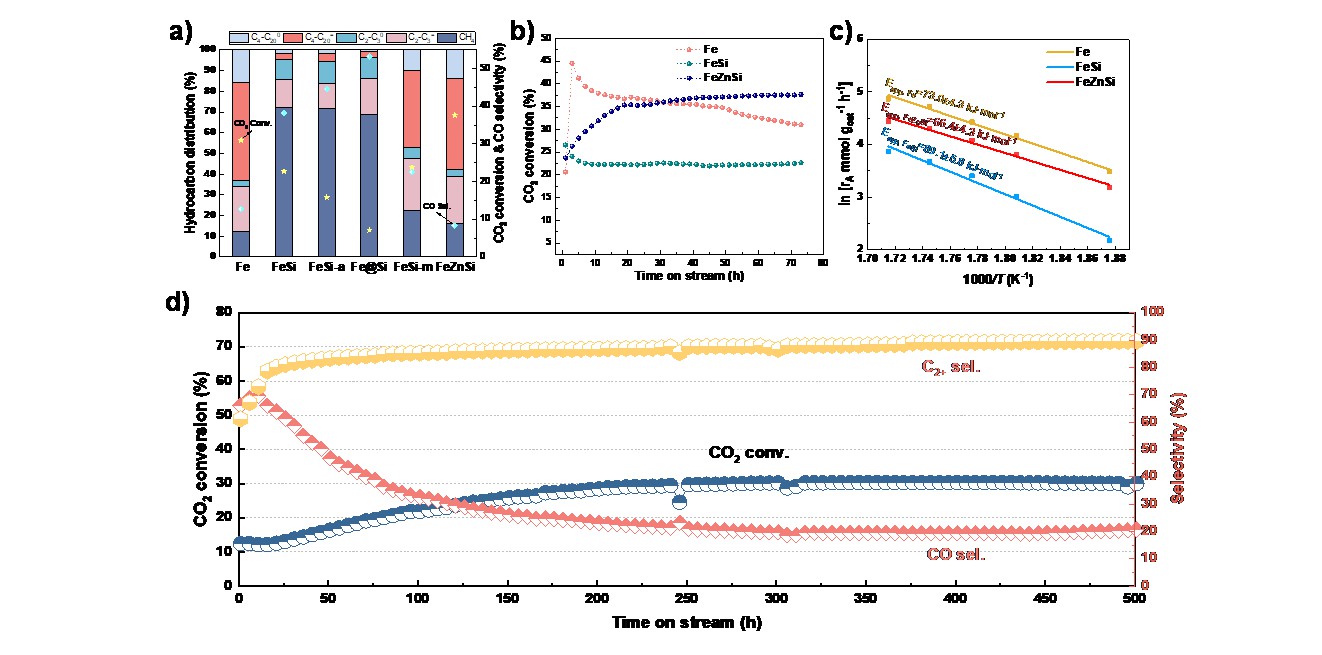
Fig. 1. Catalytic properties toward CO2 hydrogenation under industrially relevant conditions. (a) The products distribution, CO2 conversion, and CO selectivity of various iron-based catalysts. (b) CO2 conversion of Fe, FeSi, and FeZnSi catalysts with time on stream of 75 h. Reaction conditions: 300 °C, 1.5 MPa, 10000 mL·g-1·h-1. (c) Kinetic studies for CO2 hydrogenation over Fe, FeSi, and FeZnSi catalysts. Reaction conditions: 260-310 °C, 1.5 MPa, 56000 mL·g-1·h-1. The reaction rate (r) is expressed as the amount of converted CO2 (mmol) per gram of catalyst per hour. (d) Long-term stability test of FeZnSi catalyst. Reaction conditions: 320 °C, 1.5 MPa, 50000 mL·g-1·h-1.
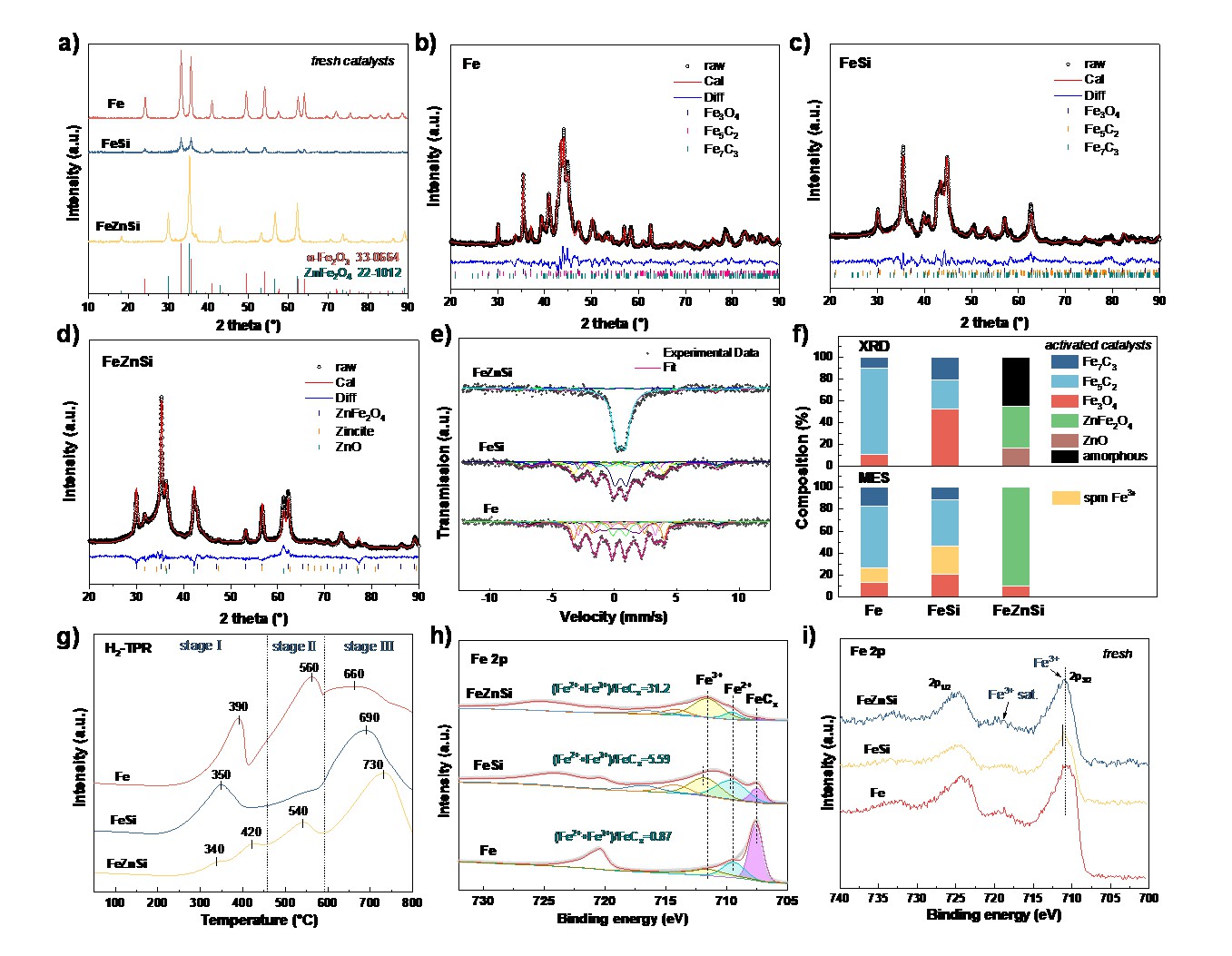
Fig. 2. Structural characterizations of fresh and activated catalysts. (a) XRD patterns of all fresh catalysts. (b-d) Results from refinement of the XRD patterns of activated Fe, FeSi, and FeZnSi catalysts. (e) MES spectra of activated Fe, FeSi, and FeZnSi catalysts. (f) Quantitative results of XRD and MES characterizations of activated catalysts. The low-content and indistinguishable Fe3O4 phase in quantitative XRD of FeZnSi sample are included in ZnFe2O4. (g) H2-TPR profiles of all iron-based catalysts. (h) Quasi-in-situ XPS Fe 2p spectra of all iron-based catalysts. (i) XPS Fe 2p spectra of all fresh catalysts.
| Catalyst | Phases | Mössbauer parameters a | Content (%) | |||
|---|---|---|---|---|---|---|
| IS (mm s-1) | QS (mm s-1) | Hhf (T) | Area b (%) | |||
| Fe | Fe3O4(A) | 0.25 | 0.17 | 49.2 | 5.9 | 13.1 |
| Fe3O4(B) | 0.83 | -0.10 | 46.8 | 7.2 | ||
| Fe5C2(I) | 0.33 | 0.06 | 22.5 | 23.5 | 73.8 | |
| Fe5C2(II) | 0.38 | 0.13 | 19.6 | 9.5 | ||
| Fe5C2(III) | 0.24 | -0.11 | 11.4 | 23.6 | ||
| Fe7C3(I) | 0.30 | -0.00 | 17.3 | 2.2 | ||
| Fe7C3(II) | 0.26 | -0.16 | 19.2 | 15.0 | ||
| spm Fe3+ | 0.39 | 1.06 | — | 13.1 | 13.1 | |
| FeSi | Fe3O4(A) | 0.36 | 0.02 | 49.2 | 10.2 | 20.5 |
| Fe3O4(B) | 0.85 | -0.11 | 45.9 | 10.3 | ||
| Fe5C2(I) | 0.33 | 0.07 | 22.5 | 22.3 | 53.7 | |
| Fe5C2(II) | 0.40 | 0.17 | 19.3 | 10.7 | ||
| Fe5C2(III) | 0.33 | -0.14 | 9.4 | 9.1 | ||
| Fe7C3(I) | 0.18 | 0.14 | 16.5 | 3.8 | ||
| Fe7C3(II) | 0.25 | -0.16 | 19.1 | 7.8 | ||
| spm Fe3+ | 0.49 | 0.93 | — | 25.8 | 25.8 | |
| FeZnSi | Fe3O4(A) | 0.22 | 0.02 | 49.1 | 6.6 | 10.2 |
| Fe3O4(B) | 0.78 | -0.09 | 45.8 | 3.6 | ||
| ZnxFe3-xO4 | 0.54 | 0.67 | — | 89.8 | 89.8 | |
Table 1 Mössbauer parameters of the activated catalysts after reduction at T=340 °C, P=0.1 MPa and H2/CO ratio of 1.
| Catalyst | Phases | Mössbauer parameters a | Content (%) | |||
|---|---|---|---|---|---|---|
| IS (mm s-1) | QS (mm s-1) | Hhf (T) | Area b (%) | |||
| Fe | Fe3O4(A) | 0.25 | 0.17 | 49.2 | 5.9 | 13.1 |
| Fe3O4(B) | 0.83 | -0.10 | 46.8 | 7.2 | ||
| Fe5C2(I) | 0.33 | 0.06 | 22.5 | 23.5 | 73.8 | |
| Fe5C2(II) | 0.38 | 0.13 | 19.6 | 9.5 | ||
| Fe5C2(III) | 0.24 | -0.11 | 11.4 | 23.6 | ||
| Fe7C3(I) | 0.30 | -0.00 | 17.3 | 2.2 | ||
| Fe7C3(II) | 0.26 | -0.16 | 19.2 | 15.0 | ||
| spm Fe3+ | 0.39 | 1.06 | — | 13.1 | 13.1 | |
| FeSi | Fe3O4(A) | 0.36 | 0.02 | 49.2 | 10.2 | 20.5 |
| Fe3O4(B) | 0.85 | -0.11 | 45.9 | 10.3 | ||
| Fe5C2(I) | 0.33 | 0.07 | 22.5 | 22.3 | 53.7 | |
| Fe5C2(II) | 0.40 | 0.17 | 19.3 | 10.7 | ||
| Fe5C2(III) | 0.33 | -0.14 | 9.4 | 9.1 | ||
| Fe7C3(I) | 0.18 | 0.14 | 16.5 | 3.8 | ||
| Fe7C3(II) | 0.25 | -0.16 | 19.1 | 7.8 | ||
| spm Fe3+ | 0.49 | 0.93 | — | 25.8 | 25.8 | |
| FeZnSi | Fe3O4(A) | 0.22 | 0.02 | 49.1 | 6.6 | 10.2 |
| Fe3O4(B) | 0.78 | -0.09 | 45.8 | 3.6 | ||
| ZnxFe3-xO4 | 0.54 | 0.67 | — | 89.8 | 89.8 | |
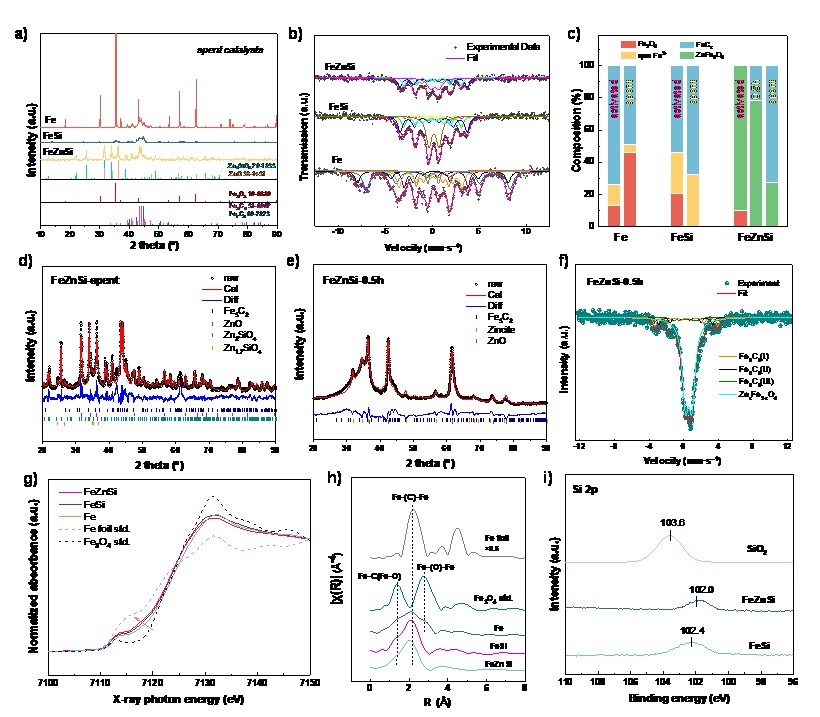
Fig. 3. Structural characterizations of spent catalysts. (a) XRD patterns of all spent catalysts (TOS=75 h). (b) MES of spent Fe, FeSi, and FeZnSi catalysts (TOS=75 h). (c) Quantitative results of MES characterizations of activated and spent catalysts. (d) Results from refinement of the XRD patterns of spent FeZnSi catalyst. (e) Results from refinement of the XRD patterns of spent FeZnSi catalyst after TOS=0.5 h. (f) MES spectra of spent FeZnSi catalyst after TOS=0.5 h. (g) XANES at Fe K-edge of Fe, FeSi and FeZnSi catalysts after reaction (TOS=75 h), in comparison with references for Fe foil and Fe3O4. (h) The nonphase corrected, k3 weighted Fourier-transformed EXAFS spectra at the Fe K-edge of Fe, FeSi and FeZnSi catalysts after reaction (TOS=75 h). (i) XPS Si 2p spectra of all spent catalysts (TOS=75 h).
| Catalyst | Phases | Mössbauer parameters a | Content (%) | |||
|---|---|---|---|---|---|---|
| IS (mm s-1) | QS (mm s-1) | Hhf (T) | Area b (%) | |||
| Fe | Fe5C2(I) | 0.30 | 0.01 | 22.5 | 22.6 | 49.2 |
| Fe5C2(II) | 0.14 | 0.14 | 18.8 | 12.2 | ||
| Fe5C2(III) | 0.19 | 0.08 | 11.1 | 14.4 | ||
| Fe3O4(A) | 0.29 | -0.20 | 49.8 | 15.5 | 46.3 | |
| Fe3O4(B) | 0.73 | 0.04 | 47.6 | 30.8 | ||
| spm Fe3+ | 0.20 | 1.15 | — | 4.5 | 4.5 | |
| FeSi | Fe5C2(I) | 0.28 | -0.03 | 22.2 | 29.6 | 67.9 |
| Fe5C2(II) | 0.12 | 0.04 | 19.1 | 18.9 | ||
| Fe5C2(III) | 0.20 | -0.02 | 11.7 | 13.9 | ||
| Fe7C3(I) | 0.22 | 0.01 | 16.7 | 2.3 | ||
| Fe7C3(II) | 0.22 | 0.03 | 18.6 | 3.2 | ||
| spm Fe3+ | 0.30 | 1.08 | — | 32.1 | 32.1 | |
| FeZnSi | Fe5C2(I) | 0.11 | 0.07 | 22.3 | 31.7 | 72.7 |
| Fe5C2(II) | 0.02 | 0.03 | 18.9 | 21.8 | ||
| Fe5C2(III) | 0.03 | 0.15 | 11.1 | 19.2 | ||
| ZnxFe3-xO4 | 0.26 | 0.89 | — | 27.3 | 27.3 | |
| FeZnSi-0.5h | Fe5C2(I) | 0.26 | 0.06 | 22.5 | 9.3 | 21.4 |
| Fe5C2(II) | 0.21 | 0.02 | 19.3 | 7.6 | ||
| Fe5C2(III) | 0.24 | -0.10 | 8.6 | 4.5 | ||
| ZnxFe3-xO4 | 0.57 | 0.75 | — | 78.6 | 78.6 | |
Table 2 Mössbauer parameters of the spent catalysts after 75 h on stream at T=300 °C, P =1.5 MPa and H2/CO2 ratio of 3.
| Catalyst | Phases | Mössbauer parameters a | Content (%) | |||
|---|---|---|---|---|---|---|
| IS (mm s-1) | QS (mm s-1) | Hhf (T) | Area b (%) | |||
| Fe | Fe5C2(I) | 0.30 | 0.01 | 22.5 | 22.6 | 49.2 |
| Fe5C2(II) | 0.14 | 0.14 | 18.8 | 12.2 | ||
| Fe5C2(III) | 0.19 | 0.08 | 11.1 | 14.4 | ||
| Fe3O4(A) | 0.29 | -0.20 | 49.8 | 15.5 | 46.3 | |
| Fe3O4(B) | 0.73 | 0.04 | 47.6 | 30.8 | ||
| spm Fe3+ | 0.20 | 1.15 | — | 4.5 | 4.5 | |
| FeSi | Fe5C2(I) | 0.28 | -0.03 | 22.2 | 29.6 | 67.9 |
| Fe5C2(II) | 0.12 | 0.04 | 19.1 | 18.9 | ||
| Fe5C2(III) | 0.20 | -0.02 | 11.7 | 13.9 | ||
| Fe7C3(I) | 0.22 | 0.01 | 16.7 | 2.3 | ||
| Fe7C3(II) | 0.22 | 0.03 | 18.6 | 3.2 | ||
| spm Fe3+ | 0.30 | 1.08 | — | 32.1 | 32.1 | |
| FeZnSi | Fe5C2(I) | 0.11 | 0.07 | 22.3 | 31.7 | 72.7 |
| Fe5C2(II) | 0.02 | 0.03 | 18.9 | 21.8 | ||
| Fe5C2(III) | 0.03 | 0.15 | 11.1 | 19.2 | ||
| ZnxFe3-xO4 | 0.26 | 0.89 | — | 27.3 | 27.3 | |
| FeZnSi-0.5h | Fe5C2(I) | 0.26 | 0.06 | 22.5 | 9.3 | 21.4 |
| Fe5C2(II) | 0.21 | 0.02 | 19.3 | 7.6 | ||
| Fe5C2(III) | 0.24 | -0.10 | 8.6 | 4.5 | ||
| ZnxFe3-xO4 | 0.57 | 0.75 | — | 78.6 | 78.6 | |
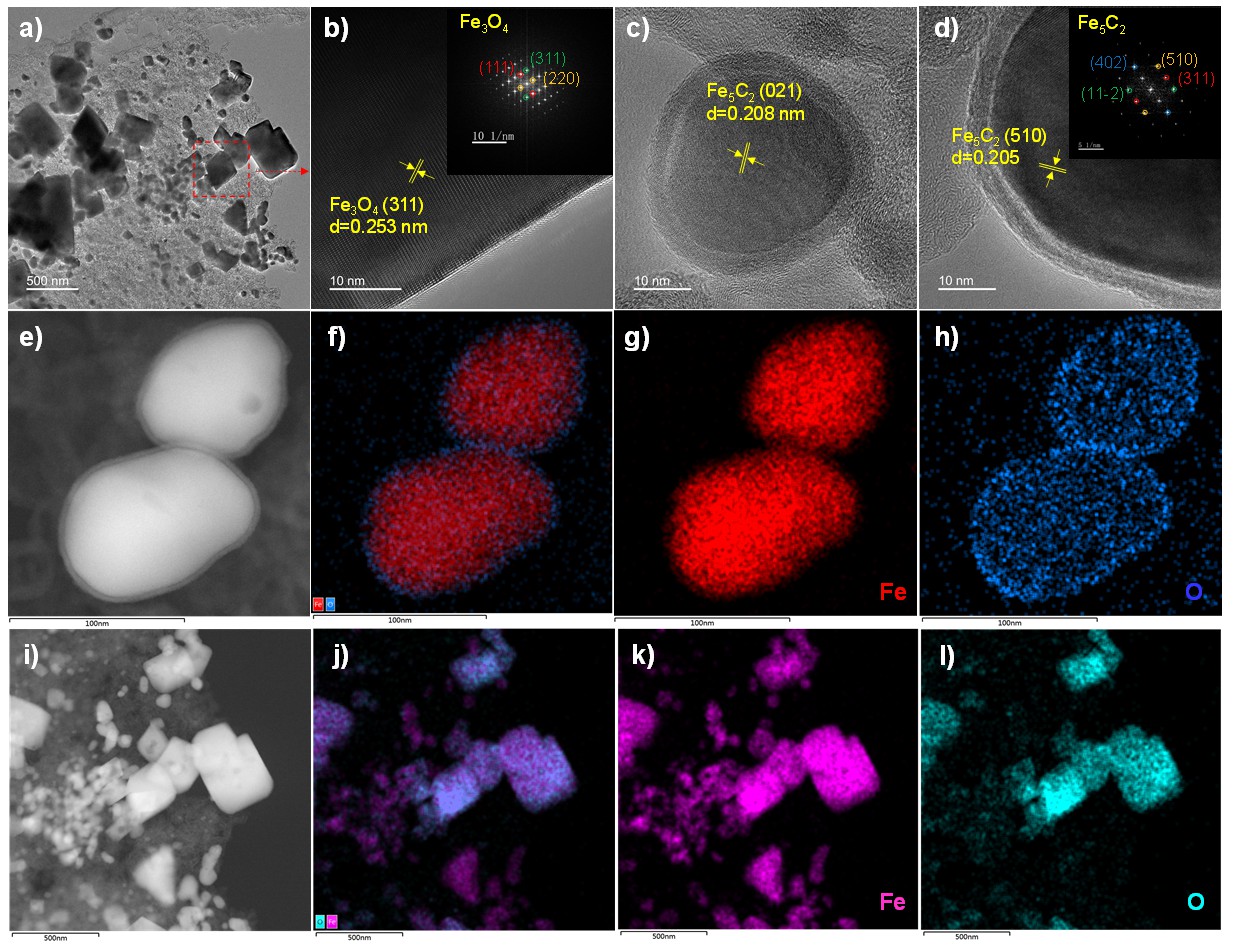
Fig. 4. Morphology characterizations of spent Fe catalysts. (a-d) HR-TEM patterns of the spent Fe catalyst (insets: FFT patterns extracted from HR-TEM images). Original HAADF-STEM image of the spent Fe catalyst (e,i) and corresponding STEM/EDX elemental mapping (f-h, j-l) of Fe and O elements on the catalyst.
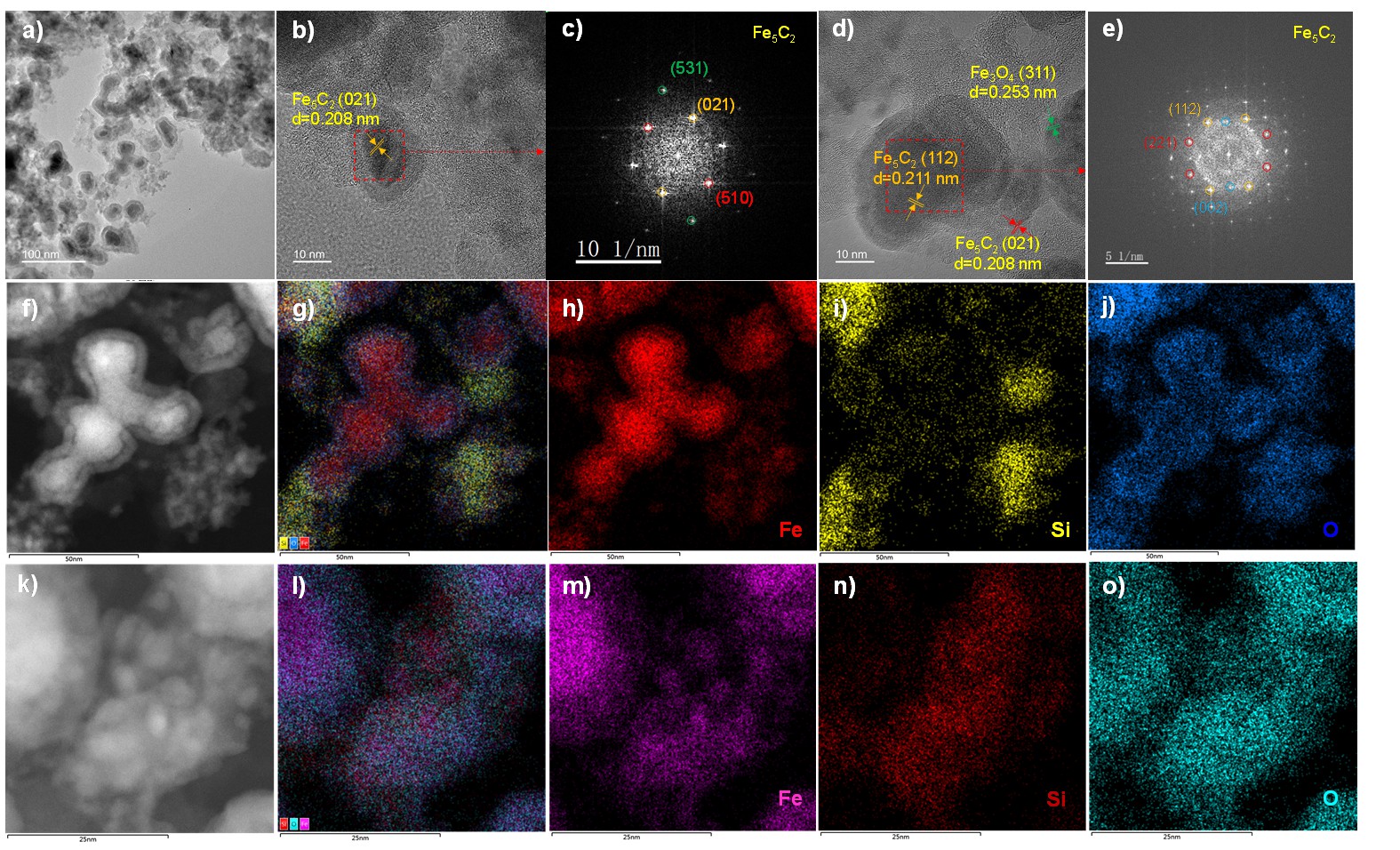
Fig. 5. Morphology characterizations of spent FeSi catalysts. (a-e) HR-TEM and FFT patterns of the spent FeSi catalyst. Original HAADF-STEM image of the spent FeSi catalyst (f,k) and corresponding STEM/EDX elemental mapping (g-j, l-o) of Fe, Si and O elements on the catalyst.
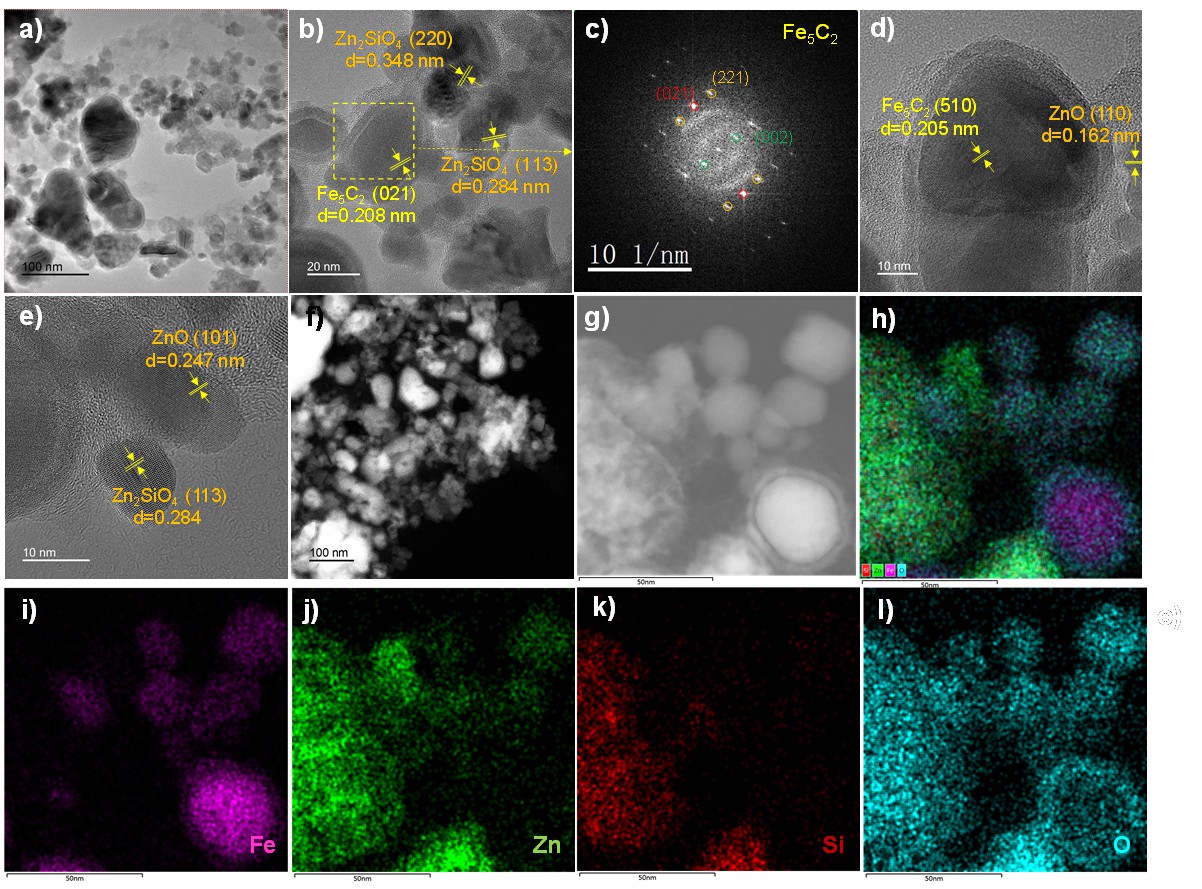
Fig. 6. Morphology characterizations of spent FeZnSi catalysts. (a-e) HR-TEM and FFT patterns of the spent FeZnSi catalyst. Original HAADF-STEM image of the spent FeZnSi catalyst (f,g) and corresponding STEM/EDX elemental mapping (h-l) of Fe, Zn, Si and O elements on the catalyst.
|
| [1] | Dongpo Li, Qianqian Mao, Chao Xiong, Luying Xi, Yu Nie, Xiaotian Xu, Hongbing Ji. Constructing Ru-porphyrin COF for catalyzing air oxidation of adamantane C-H bonds to relay olefin epoxidation [J]. Chinese Journal of Catalysis, 2026, 88(9): 442-456. |
| [2] | Jiyeon Lee, Muhammad Irshad, Wonjoong Yoon, Jaehoon Kim. High-pressure switch: Redirecting CO2 hydrogenation from hydrocarbons to carboxylic acids and alcohols [J]. Chinese Journal of Catalysis, 2026, 87(8): 70-86. |
| [3] | Sen Wang, Shiying Li, Rui Geng, Bo Zhou, Pengfei Wang, Zhangfeng Qin, Mei Dong, Jianguo Wang, Unni Olsbye, Weibin Fan. The smallest Ni species triggering selective hydrogenation of CO2 to methane: Ni dimer embedded in MFI and enhancement of MnOx [J]. Chinese Journal of Catalysis, 2026, 87(8): 113-125. |
| [4] | Jianwei Jiang, Minji Kang, Jeongcheol Shin, Kiyoung Park, Sungho Yoon. Cobalt nanoparticle catalyst with magnetic recoverability for high-performance epoxide carbonylation to β-lactones with high selectivity [J]. Chinese Journal of Catalysis, 2026, 86(7): 89-98. |
| [5] | Xiaojie Liu, Zhifu Yu, Qi Li, Yang Wang, Xinze Bi, Kaixuan Huo, Dingyao Li, Zhiang Yuan, Yifan Yan, Shibin Li, Yiwu Lu, Qiang Liu, Wenhang Wang, Mingbo Wu. Fe-based catalyst for thermo-catalytic CO2 hydrogenation into ethanol: The essential role of water management and Fe-based carbide/oxide ratio [J]. Chinese Journal of Catalysis, 2026, 86(7): 112-124. |
| [6] | Lei Yuan, Zhiwen Gao, Libin Shi, Cuishi Guan, Dongyue Peng, Shuhui Fang, Wei Zhang, Yue Liu. Solvent-free chemical recycling of polyolefins and polystyrene under mild conditions via GaCl3-based molten catalysts [J]. Chinese Journal of Catalysis, 2026, 86(7): 137-148. |
| [7] | Lanlan Chen, Li Sheng, Yanan Zhou, Qiquan Luo, Zhenyu Li, Wenhua Zhang, Jinlong Yang. Unraveling the superiority of Ni1-MoS2 single-atom catalyst in CO2 hydrogenation to methanol: A DFT combined microkinetic study [J]. Chinese Journal of Catalysis, 2026, 85(6): 143-152. |
| [8] | Ksenia A. Kokina, Anton S. Konopatsky, Ekaterina S. Chikanova, Danil V. Barilyuk, Tatyana O. Teplakova, Denis V. Leybo, Ekaterina V. Sukhanova, Zakhar I. Popov, Alexey Y. Antonov, Olga A. Boeva, Sergey A. Efimov, Dmitry V. Shtansky. Does high-entropy oxide (CrMnFeCoNi)3O4 catalyst require support to improve performance in CO2 hydrogenation? [J]. Chinese Journal of Catalysis, 2026, 85(6): 168-181. |
| [9] | Syeda Sidra Bibi, Sheraz Ahmed, Heuntae Jo, Jaehoon Kim. Turning methanation into chain growth: Na-induced mechanistic bifurcation on Co-ZrOx catalyst [J]. Chinese Journal of Catalysis, 2026, 85(6): 394-411. |
| [10] | Fleur A. E. Bruekers, Tess I. van Benthem, Rajamohanan Sobhana Anju, N. Raveendran Shiju. Phase to performance: The advancing role of molybdenum carbides in reverse water-gas shift reaction [J]. Chinese Journal of Catalysis, 2026, 85(6): 1-12. |
| [11] | Zhiyao Liu, Tangkang Liu, Chuan Qin, Guoliang Liu, Anmin Zheng. Zirconia-mediated interfacial catalysis for CO2 hydrogenation [J]. Chinese Journal of Catalysis, 2026, 84(5): 1-24. |
| [12] | Shican Jiang, Mingyu Yi, Zuozheng Liu, Abhishek Dutta Chowdhury. Linking catalyst synthesis strategies to CO2-modified Fischer-Tropsch performance in iron-carbon systems [J]. Chinese Journal of Catalysis, 2026, 84(5): 236-249. |
| [13] | Run Pan, Abubakar Yusuf, Chengjun Wang, Jianrong Li, Zhiyu Xiao, Shuai Liu, Yidong Zhong, Yong Ren, Zheng Wang, Hainam Do, John L. Zhou, George Zheng Chen, Jun He. Core-shell Pd@CeO2/γ‐Al2O3 catalysts: Boosting efficiency and durability in stoichiometric natural gas vehicle exhaust treatment [J]. Chinese Journal of Catalysis, 2026, 82(3): 348-362. |
| [14] | Feng Li, Ye Ma, Mingyu Wan, Yating Lv, Jiamin Yuan, Shichao Han, Houyu Ma, Liang Wang, Xiangju Meng, Anmin Zheng, Yanhang Ma, Feng-Shou Xiao. Pure silica Beta zeolite supported Ag-Mn catalyst for efficient ozone decomposition [J]. Chinese Journal of Catalysis, 2026, 82(3): 292-300. |
| [15] | Xinyi Wang, Chaoqi Wang, Miao Yang, Xiaoguang Wang, Yuezhong Zuo, Zhuangzhuang Zhang, Yimo Wu, Jingfeng Han, Bing Li, Wei Huang, Limin Ren, Yingxu Wei, Xinmei Liu, Peng Tian, Zhongmin Liu. Machine-learning-aided discovery of methanol-to-olefins zeolite catalysts with ultra-high initial selectivity [J]. Chinese Journal of Catalysis, 2026, 81(2): 124-135. |
| Viewed | ||||||
|
Full text |
|
|||||
|
Abstract |
|
|||||


