
Chinese Journal of Catalysis ›› 2027, Vol. 92: 316-327.DOI: 10.1016/S1872-2067(26)65168-6
• Articles • Previous Articles Next Articles
Jie Zhaoa,b, Guangyuan Xua,b, Si Chena,b, Huan Yana,b,*( )
Received:2026-02-11
Accepted:2026-03-16
Online:2027-01-02
Published:2026-10-30
Contact:
*E-mail: yanhuan1@ustc.edu.cn (H. Yan).Supported by:Jie Zhao, Guangyuan Xu, Si Chen, Huan Yan. Precise tailoring of Cu-ZrO2 interfaces for CO2 hydrogenation to methanol[J]. Chinese Journal of Catalysis, 2027, 92: 316-327.
Add to citation manager EndNote|Ris|BibTeX
URL: https://www.cjcatal.com/EN/10.1016/S1872-2067(26)65168-6
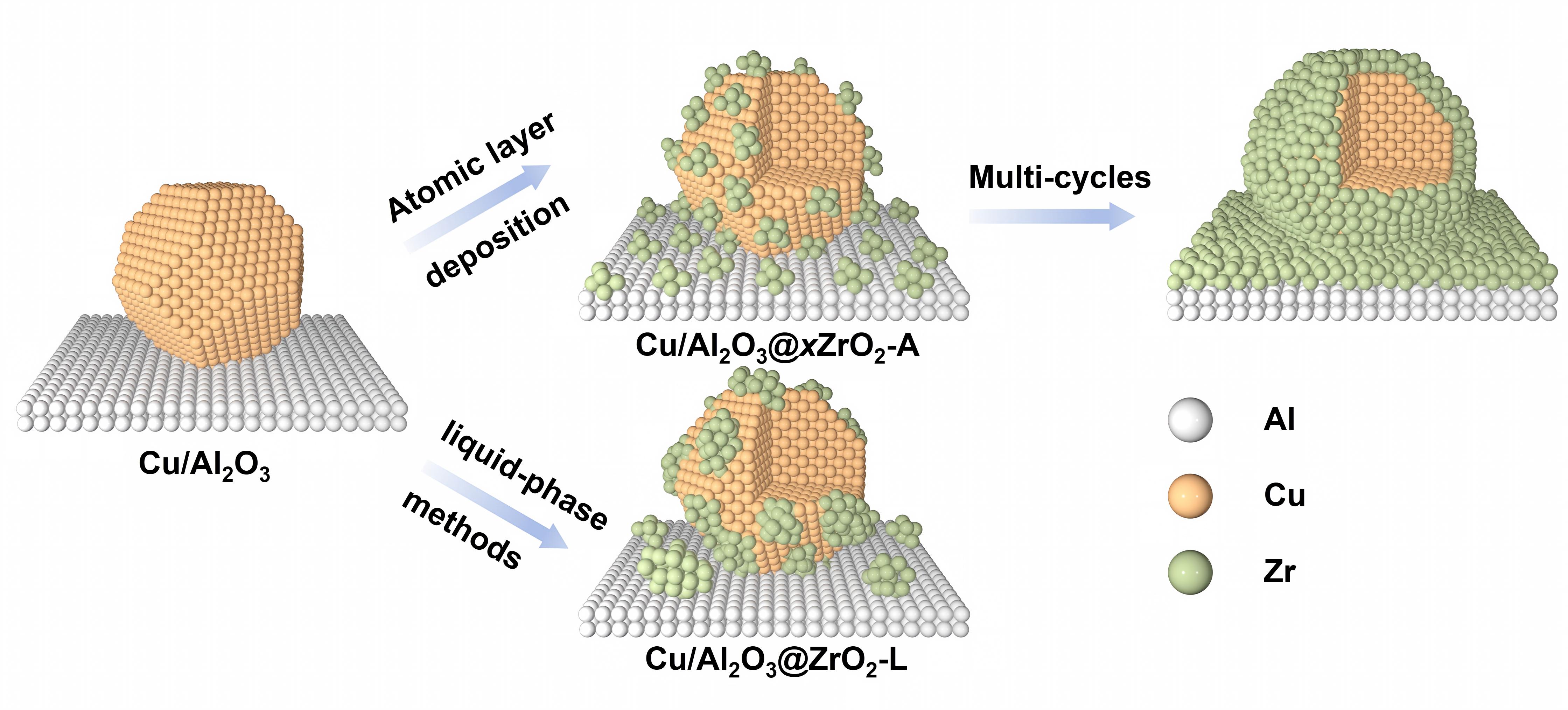
Scheme 1. Schematic illustration of the catalyst preparation procedure
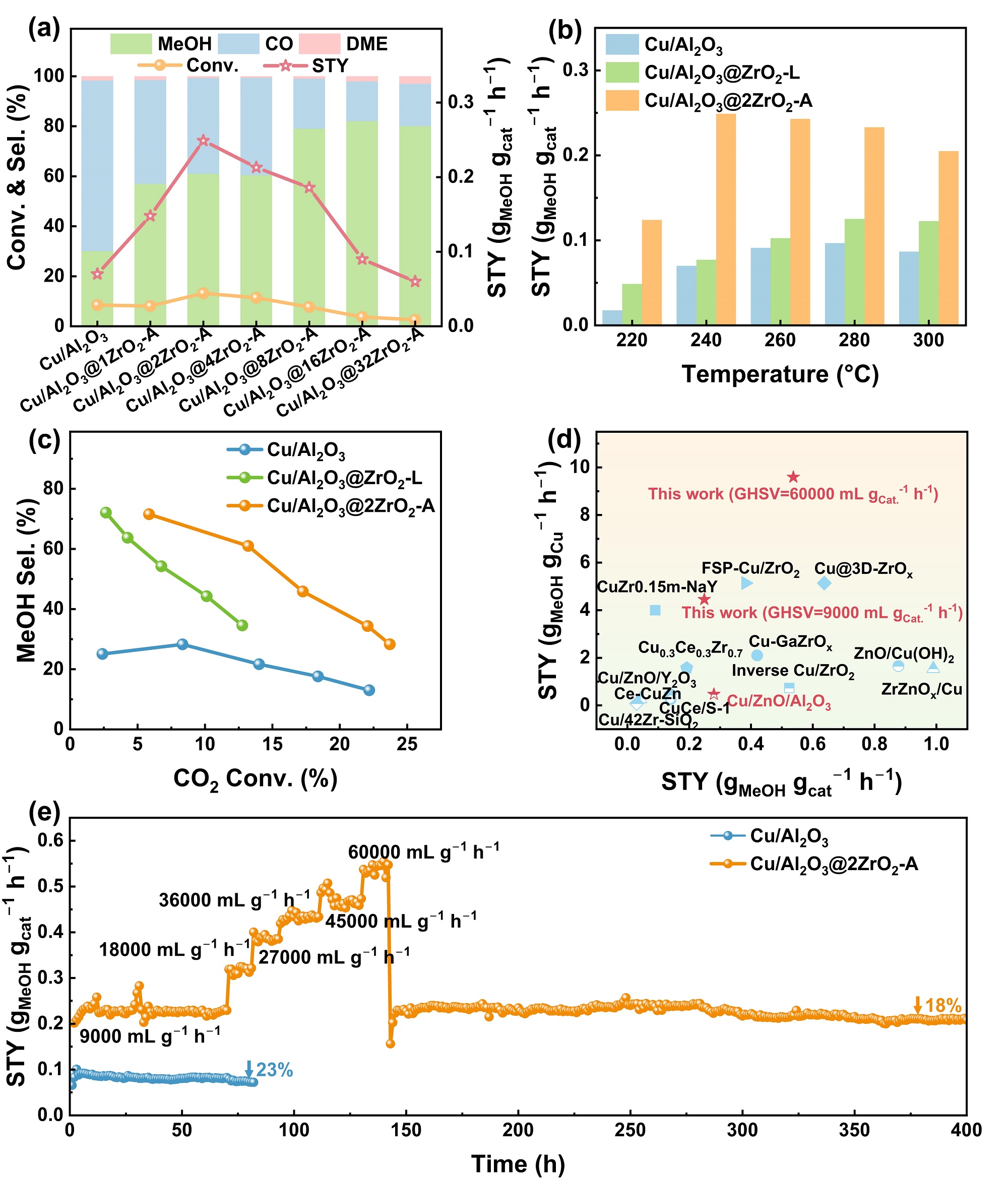
Fig. 1. (a) Catalytic performance of Cu/Al2O3@xZrO2-A catalysts with different ALD cycles in CO2 hydrogenation to methanol. (b) Comparison of the methanol STY over the Cu/Al2O3, Cu/Al2O3@ZrO2-L and Cu/Al2O3@2ZrO2-A catalysts at 220-300 °C. (c) Methanol selectivity as a function of CO2 conversion at different reaction temperatures over Cu/Al2O3, Cu/Al2O3@ZrO2-L and Cu/Al2O3@2ZrO2-A. (d) Comparison of the catalytic performance of the optimized Cu/Al2O3@2ZrO2-A catalyst with representative Cu-based catalysts reported in the literature under their optimum conditions. (e) Long-term stability of Cu/Al2O3 and Cu/Al2O3@2ZrO2-A. Standard reaction conditions: T = 240 °C, p = 5.0 MPa, CO2:H2 = 1:3, GHSV = 9000 mL g-1 h-1.

Fig. 2. HR-TEM images of Cu/Al2O3@2ZrO2-A (a), Cu/Al2O3@8ZrO2-A (b), and Cu/Al2O3@16ZrO2-A (c). (d) XRD patterns of the prepared catalysts. HAADF-STEM and EDS elemental mapping of Cu/Al2O3@2ZrO2-A (e) and Cu/Al2O3@ZrO2-L (f).
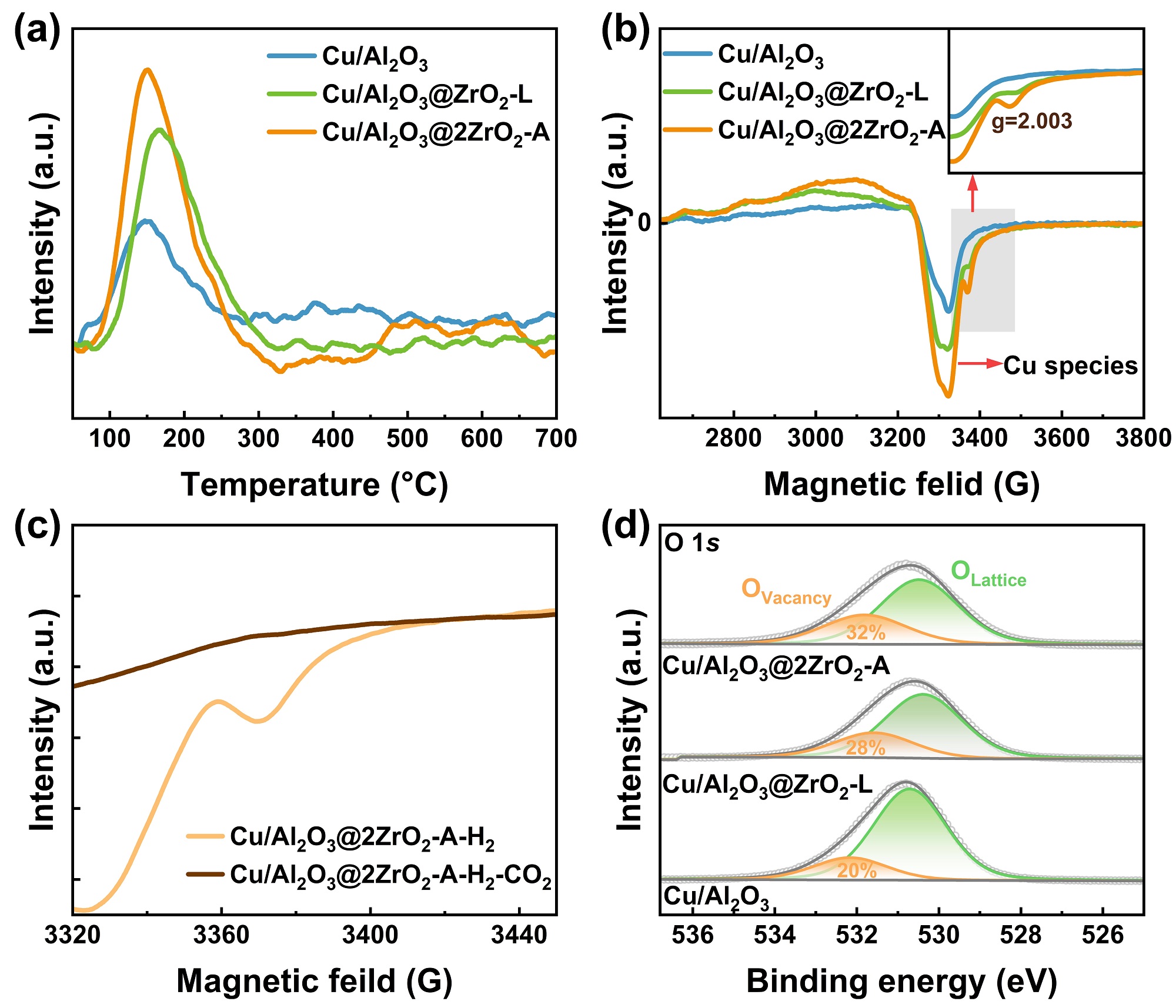
Fig. 3. CO2-TPD profiles (a) and EPR spectra (b) of Cu/Al2O3, Cu/Al2O3@ZrO2-L and Cu/Al2O3@2ZrO2-A after H2 reduction at 300 °C for 2 h. (c) EPR spectra of Cu/Al2O3@2ZrO2-A after H2 reduction followed by CO2 exposure. (d) O 1s XPS spectra of Cu/Al2O3, Cu/Al2O3@ZrO2-L and Cu/Al2O3@2ZrO2-A after H2 reduction at 300 °C for 2 h.
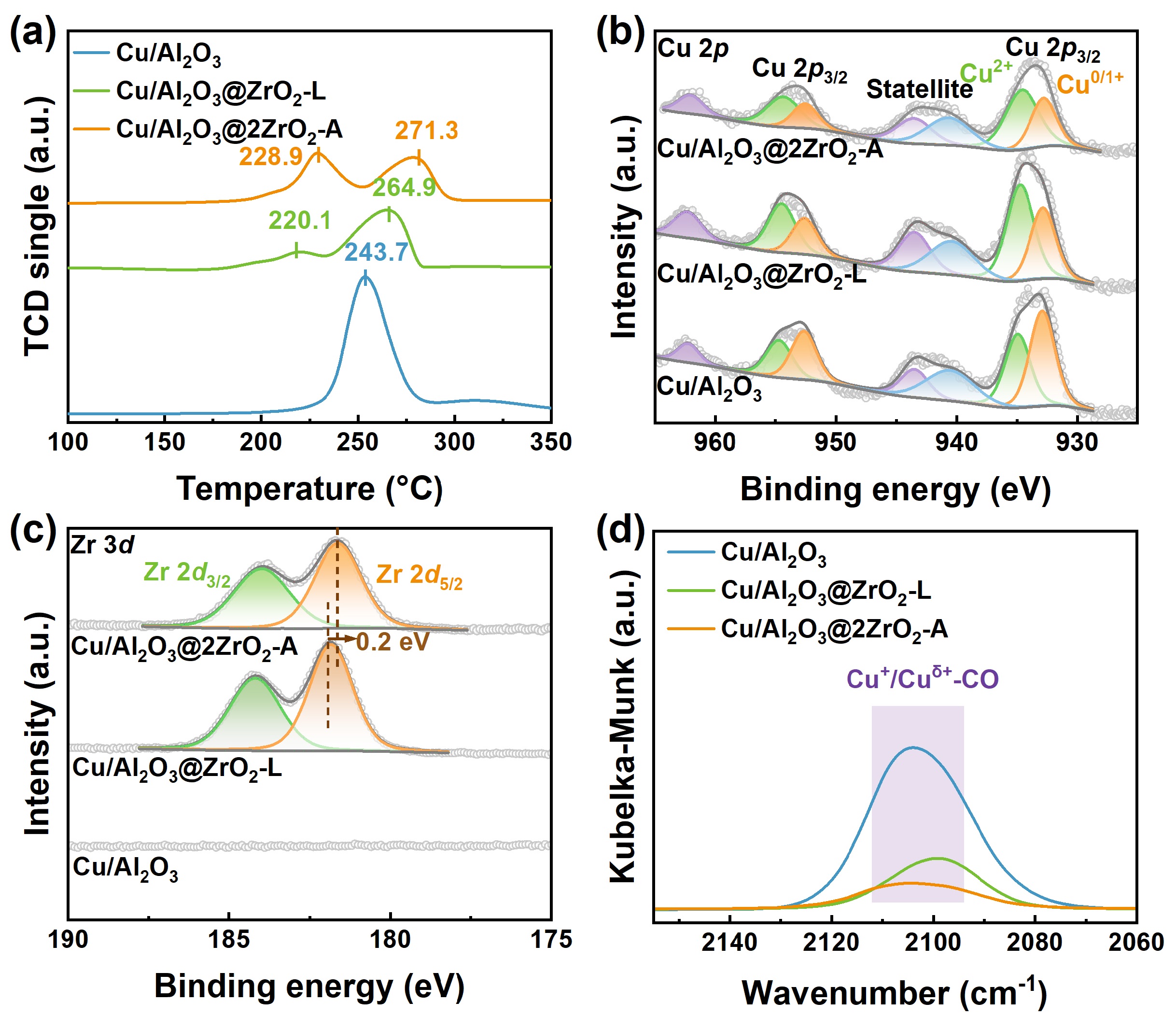
Fig. 4. H2-TPR profiles (a), Cu 2p (b), and Zr 3d (c) XPS spectra of Cu/Al2O3, Cu/Al2O3@ZrO2-L and Cu/Al2O3@2ZrO2-A. (d) In-situ CO-DRIFTS of reduced catalysts obtained upon CO adsorption at 25 °C and following Ar purge.

Fig. 5. In-situ DRIFTS analysis of the reaction pathway and surface intermediate evolution during CO2 hydrogenation. Time-dependent DRIFTS spectra collected over Cu/Al2O3@2ZrO2-A under reaction conditions (240 °C, 0.1 MPa, CO2:H2 = 1:3) for 45 min (a,b), Cu/Al2O3@ZrO2-L (c,d), and Cu/Al2O3 (e,f).
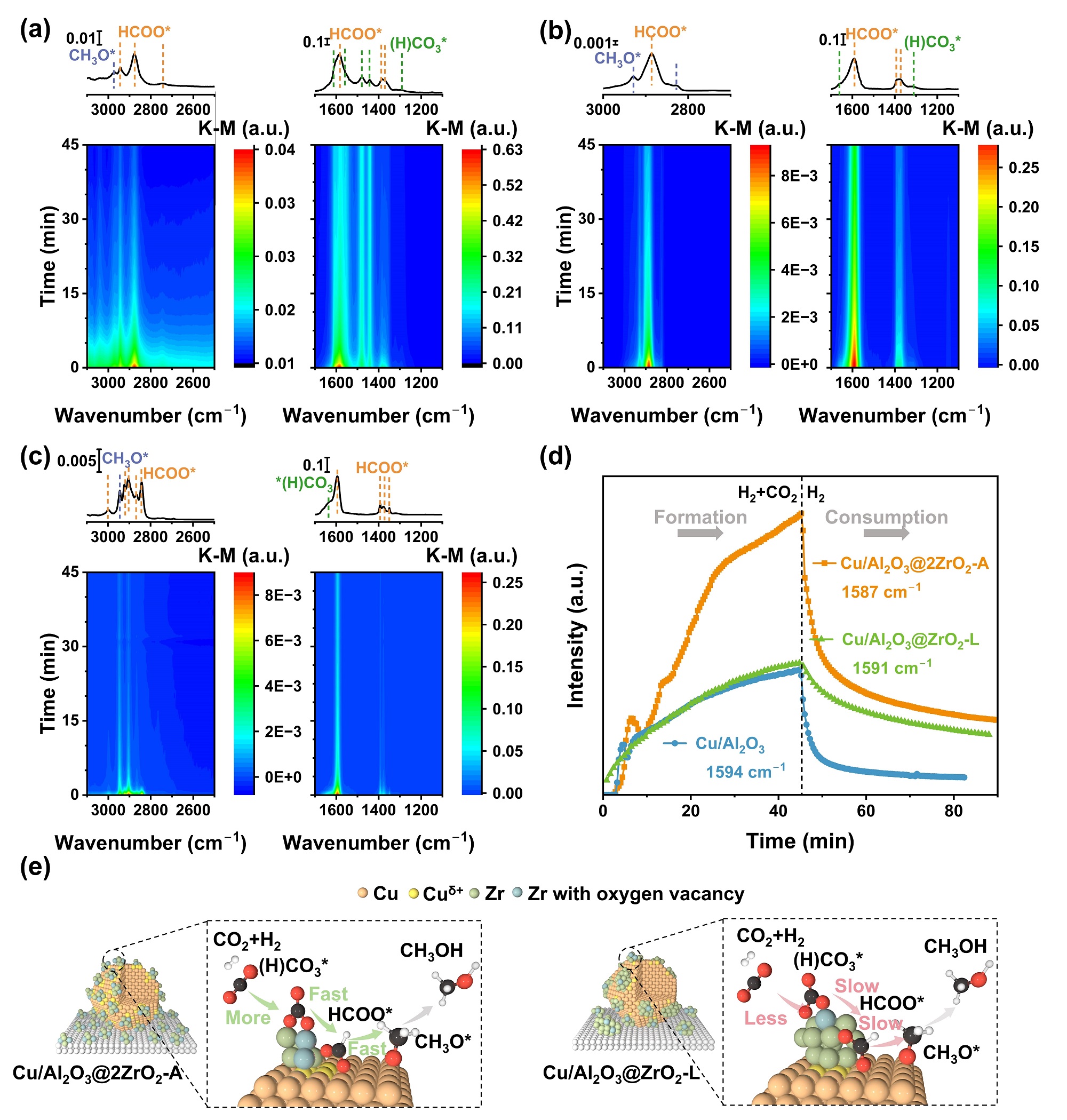
Fig. 6. In-situ DRIFTS spectra recorded after switching the feed gas from reaction mixture (CO2:H2 = 1:3) to 10% H2/Ar for 45 min over Cu/Al2O3@2ZrO2-A (a), Cu/Al2O3@ZrO2-L (b), and Cu/Al2O3 (c). (d) Temporal evolution of the formate band intensity (≈ 1590 cm-1). (e) Proposed reaction mechanism illustrating the synergistic role of oxygen-vacancy-rich ZrO2 and the interfacial electronic modulation at the Cu-ZrO2 interface
|
| [1] | Lisheng Guo, Liru Zheng, Xinyu Zhang, Xin Wang, Jie Cheng, Mengdie Cai, Na Liu, Kaige Wang, Youfeng Tian, Jie Li, Song Sun. Enhanced CO2 hydrogenation to heavy hydrocarbons through diffusion-limited intermediate enrichment: Semi-open vs. open systems [J]. Chinese Journal of Catalysis, 2027, 92(1): 300-315. |
| [2] | Yanyan Chen, Sen Wang, Shanhui Zhu, He Wang, Mei Dong, Zhangfeng Qin, Jianguo Wang, Weibin Fan. Mechanistic switch in methane combustion on PdOₓ catalysts mediated by oxygen vacancies [J]. Chinese Journal of Catalysis, 2027, 92(1): 387-396. |
| [3] | Zhen Zhang, Xiangya Zhang, Mai Zhang, Yifei Yang, Yitong Wu, Linlin Zhang, Jianjun Liao, Chunfeng Song. Nano-confinement and hydrophobic ionic-liquid engineering for methanol-selective CO2 electroreduction from dilute streams [J]. Chinese Journal of Catalysis, 2027, 92(1): 328-339. |
| [4] | Jiayu Zhang, Kun Wang, Jinglu Yu, Kaiyang Xu, Lu Yang, Jiali Rao, Shuqin Song, Yi Wang. Modulating active sites via Mn-doping in NiCo LDH for energy-saving paired electrosynthesis of H2O2 and formate [J]. Chinese Journal of Catalysis, 2026, 88(9): 307-321. |
| [5] | Xinyi Zhang, Weichen Dong, Yi Cao, Caixia Zhou, Jiaxiu Guo, Hailong Zhang. Efficient continuous synthesis of methanol by direct methane conversion on Cu-KFI zeolite catalysts [J]. Chinese Journal of Catalysis, 2026, 88(9): 369-381. |
| [6] | Songling Wang, Anhua Huang, Fengxing Yin, Ruixiang Lu, Wengang Liu, Yun Zhang, Botao Qiao. In-situ synthesis of hydrogen peroxide for highly selective oxidation of methane to methanol over noble-metal-free catalyst [J]. Chinese Journal of Catalysis, 2026, 88(9): 347-355. |
| [7] | Jiyeon Lee, Muhammad Irshad, Wonjoong Yoon, Jaehoon Kim. High-pressure switch: Redirecting CO2 hydrogenation from hydrocarbons to carboxylic acids and alcohols [J]. Chinese Journal of Catalysis, 2026, 87(8): 70-86. |
| [8] | Sen Wang, Shiying Li, Rui Geng, Bo Zhou, Pengfei Wang, Zhangfeng Qin, Mei Dong, Jianguo Wang, Unni Olsbye, Weibin Fan. The smallest Ni species triggering selective hydrogenation of CO2 to methane: Ni dimer embedded in MFI and enhancement of MnOx [J]. Chinese Journal of Catalysis, 2026, 87(8): 113-125. |
| [9] | Xiaojie Liu, Zhifu Yu, Qi Li, Yang Wang, Xinze Bi, Kaixuan Huo, Dingyao Li, Zhiang Yuan, Yifan Yan, Shibin Li, Yiwu Lu, Qiang Liu, Wenhang Wang, Mingbo Wu. Fe-based catalyst for thermo-catalytic CO2 hydrogenation into ethanol: The essential role of water management and Fe-based carbide/oxide ratio [J]. Chinese Journal of Catalysis, 2026, 86(7): 112-124. |
| [10] | Jiahao Wang, Qiliang Gao, Chao Li, Xiujuan Gao, Jian Gong, Faen Song, Junfeng Zhang, Yizhuo Han, Qingde Zhang. A Cu-incorporated NASICON catalyst executing one-step conversion of methanol and acetic acid to acrylic acid and its esters [J]. Chinese Journal of Catalysis, 2026, 85(6): 356-370. |
| [11] | Lanlan Chen, Li Sheng, Yanan Zhou, Qiquan Luo, Zhenyu Li, Wenhua Zhang, Jinlong Yang. Unraveling the superiority of Ni1-MoS2 single-atom catalyst in CO2 hydrogenation to methanol: A DFT combined microkinetic study [J]. Chinese Journal of Catalysis, 2026, 85(6): 143-152. |
| [12] | Ksenia A. Kokina, Anton S. Konopatsky, Ekaterina S. Chikanova, Danil V. Barilyuk, Tatyana O. Teplakova, Denis V. Leybo, Ekaterina V. Sukhanova, Zakhar I. Popov, Alexey Y. Antonov, Olga A. Boeva, Sergey A. Efimov, Dmitry V. Shtansky. Does high-entropy oxide (CrMnFeCoNi)3O4 catalyst require support to improve performance in CO2 hydrogenation? [J]. Chinese Journal of Catalysis, 2026, 85(6): 168-181. |
| [13] | Syeda Sidra Bibi, Sheraz Ahmed, Heuntae Jo, Jaehoon Kim. Turning methanation into chain growth: Na-induced mechanistic bifurcation on Co-ZrOx catalyst [J]. Chinese Journal of Catalysis, 2026, 85(6): 394-411. |
| [14] | Fleur A. E. Bruekers, Tess I. van Benthem, Rajamohanan Sobhana Anju, N. Raveendran Shiju. Phase to performance: The advancing role of molybdenum carbides in reverse water-gas shift reaction [J]. Chinese Journal of Catalysis, 2026, 85(6): 1-12. |
| [15] | Zhiyao Liu, Tangkang Liu, Chuan Qin, Guoliang Liu, Anmin Zheng. Zirconia-mediated interfacial catalysis for CO2 hydrogenation [J]. Chinese Journal of Catalysis, 2026, 84(5): 1-24. |
| Viewed | ||||||
|
Full text |
|
|||||
|
Abstract |
|
|||||


