
Chinese Journal of Catalysis ›› 2027, Vol. 92: 387-396.DOI: 10.1016/S1872-2067(26)65197-2
• Articles • Previous Articles Next Articles
Yanyan Chena, Sen Wanga, Shanhui Zhua, He Wanga, Mei Donga,*( ), Zhangfeng Qina, Jianguo Wanga,b, Weibin Fana,*()
Received:2026-02-04
Accepted:2026-04-01
Online:2027-01-02
Published:2026-10-30
Contact:
*E-mail: fanwb@sxicc.ac.cn (W. Fan),Supported by:Yanyan Chen, Sen Wang, Shanhui Zhu, He Wang, Mei Dong, Zhangfeng Qin, Jianguo Wang, Weibin Fan. Mechanistic switch in methane combustion on PdOₓ catalysts mediated by oxygen vacancies[J]. Chinese Journal of Catalysis, 2027, 92: 387-396.
Add to citation manager EndNote|Ris|BibTeX
URL: https://www.cjcatal.com/EN/10.1016/S1872-2067(26)65197-2
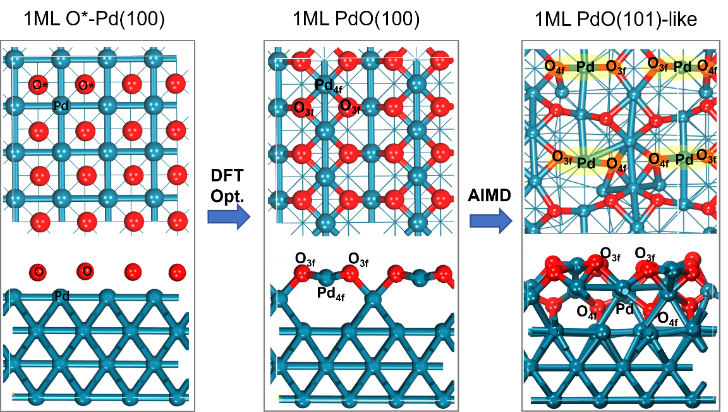
Fig. 1. Surface evolution of Pd(100) → PdO(100) → PdO(101) transitions. Structural evolution of 16 oxygen atoms (1 ML) adsorbed on the Pd(100) surface, including the initial configuration before optimization (1 ML O*-Pd(100)), optimized structure showing the formation of 1 ML PdO(100), and the AIMD simulation snapshot after 46 ps at 1000 K, revealing the emergence of O3f-Pd-O4f-like structural motifs (yellow areas). Atomic colors: Pd (blue), O (red). Surface Pd and O atoms are labelled as 3f or 4f, indicating 3- or 4-fold coordination, respectively.
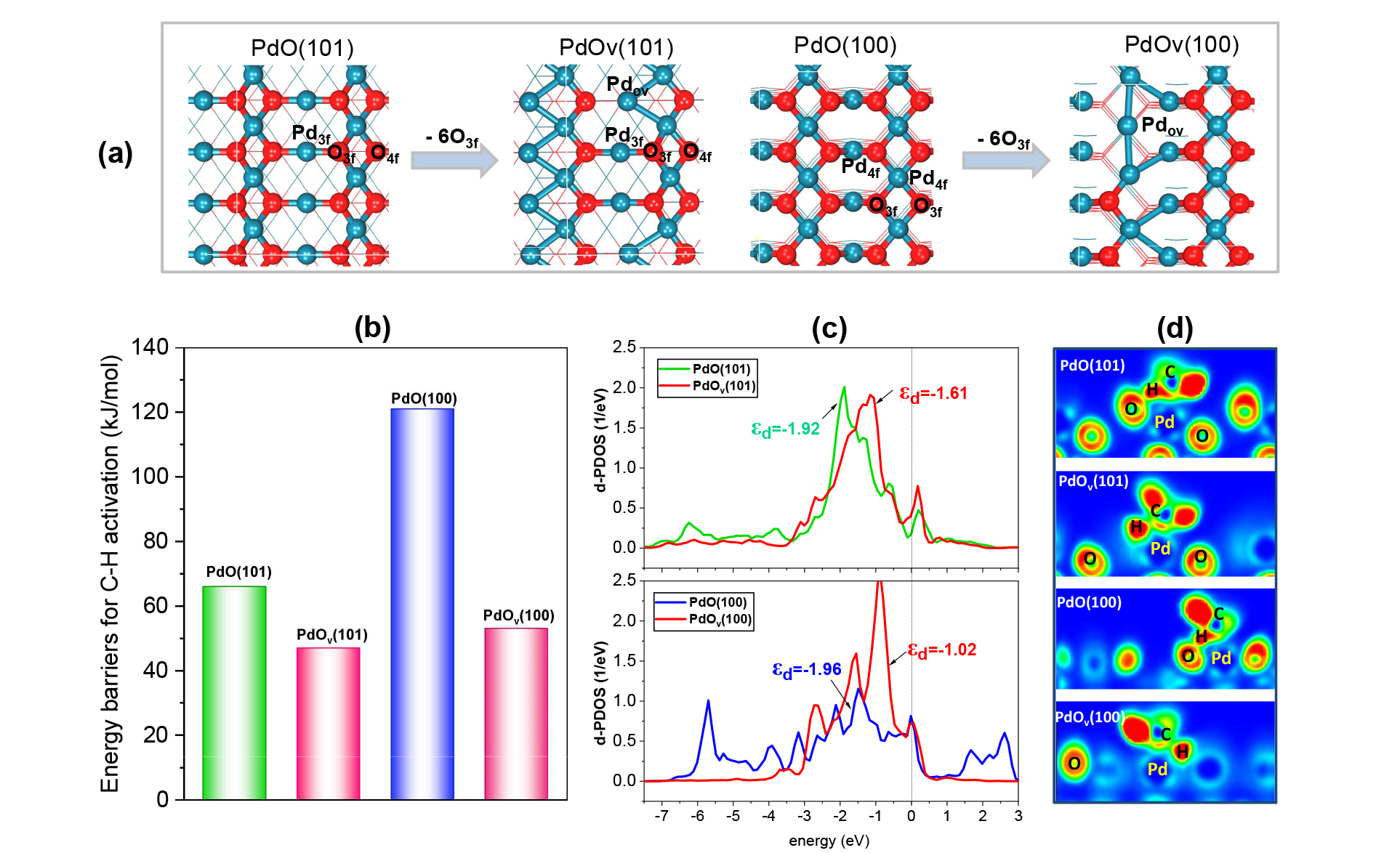
Fig. 2. High reactivity of PdOᵥ surfaces. (a) Top-view structures of the PdO(101), PdOᵥ(101), PdO(100) and PdOᵥ(100) facets. (b) Energy barriers for the C-H bond activation of methane. (c) d-PDOS of a surface Pd3f or Pd4f and Pdov atoms. (d) ELF map of the transition state (C-H-Pd) plane on the four surfaces. d-PDOS plots are referenced to the Fermi energy. In the ELF map, the isosurface color represents the degree of electron localization; blue and red indicate that the electron is randomly delocalized and strongly localized, respectively. Atomic color scheme: Pd (blue), O (red).
| Reactions | PdO(101): (Pd3f-O3f site) | PdOv(101): (Pdov site) | ||
|---|---|---|---|---|
| CHx path | Ea | ∆Er | Ea | ∆Er |
| (1) CH4 → CH3 + H | 66 | -41 | 47 | -3 |
| (2) CH3 → CH2 + H | 122 | 47 | 49 | 10 |
| (3) CH2 → CH + H | 95 | 71 | 45 | -26 |
| (4) CH-O(lat) → CO(lat) + H | 11 | -77 | 27 (Pdov-O3f) | -8 |
| CHxO path | ||||
| (5) CH4 + O → CH3 + OH | 64 | -151 | 102 | -87 |
| (6) CH3 + O → CH2OH | 83 | -165 | 139 | -113 |
| (7) CH2OH → CH2O +H | 26 | 2 | 13 | -14 |
| (8) CH2O + O → CHO + OH | 90 | -151 | 68 | -187 |
| (9) CHO + OH → CO + H2O | 2 | -125 | 69 | -88 |
Table 1 Energy barriers (Ea, kJ/mol) and reaction energies (∆Er, kJ/mol) for CH4 complete oxidation via CHx and CHxO paths on PdO(101) (Pd3f-O3f as the active site) and PdOv(101) (Pdov as the active site).
| Reactions | PdO(101): (Pd3f-O3f site) | PdOv(101): (Pdov site) | ||
|---|---|---|---|---|
| CHx path | Ea | ∆Er | Ea | ∆Er |
| (1) CH4 → CH3 + H | 66 | -41 | 47 | -3 |
| (2) CH3 → CH2 + H | 122 | 47 | 49 | 10 |
| (3) CH2 → CH + H | 95 | 71 | 45 | -26 |
| (4) CH-O(lat) → CO(lat) + H | 11 | -77 | 27 (Pdov-O3f) | -8 |
| CHxO path | ||||
| (5) CH4 + O → CH3 + OH | 64 | -151 | 102 | -87 |
| (6) CH3 + O → CH2OH | 83 | -165 | 139 | -113 |
| (7) CH2OH → CH2O +H | 26 | 2 | 13 | -14 |
| (8) CH2O + O → CHO + OH | 90 | -151 | 68 | -187 |
| (9) CHO + OH → CO + H2O | 2 | -125 | 69 | -88 |
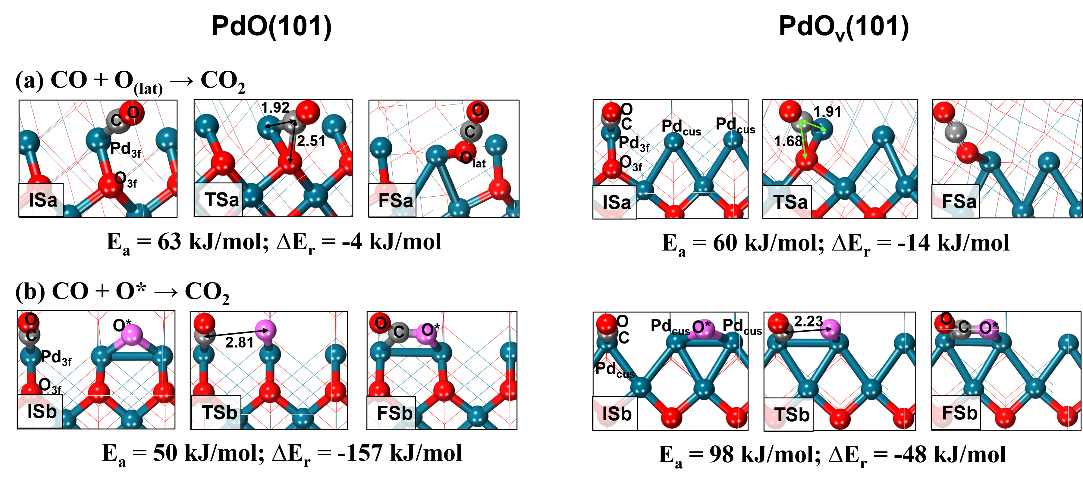
Fig. 3. Structures of the initial states (IS), transition states (TS), and final states (FS) as well as the energy barriers (Ea) and reaction energies (∆Er) of CO oxidation on PdO(101) and PdOv(101).
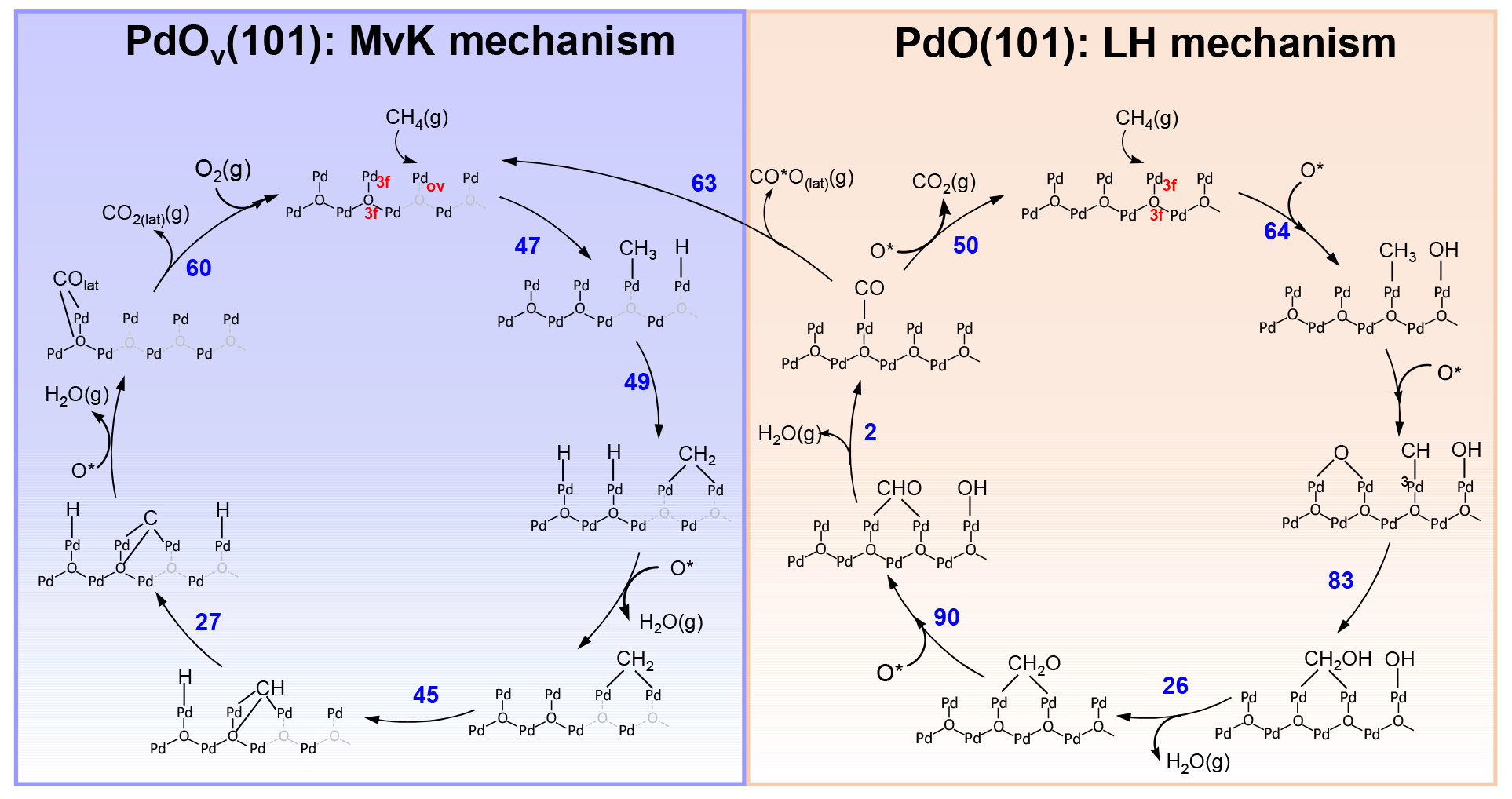
Fig. 4. The complete catalytic mechanism of methane combustion on PdOx surface.
| Reactions on PdOv(100) | Ea | ∆Er |
|---|---|---|
| (1) CH4 → CH3 + H | 53 | -4 |
| (2) CH3 → CH2 + H | 65 | -7 |
| (3) CH2 → CH + H | 16 | -78 |
| (4) CH-O(lat) → CO(lat) + H | 44 (Pdov-O3f) | -131 |
| (5) CO + O(lat) → CO2 | 82 (Pdov-O3f) | -38 |
Table 2 Energy barriers (Ea, kJ/mol) and reaction energies (∆Er, kJ/mol) for CH4 complete oxidation on PdOv(100).
| Reactions on PdOv(100) | Ea | ∆Er |
|---|---|---|
| (1) CH4 → CH3 + H | 53 | -4 |
| (2) CH3 → CH2 + H | 65 | -7 |
| (3) CH2 → CH + H | 16 | -78 |
| (4) CH-O(lat) → CO(lat) + H | 44 (Pdov-O3f) | -131 |
| (5) CO + O(lat) → CO2 | 82 (Pdov-O3f) | -38 |
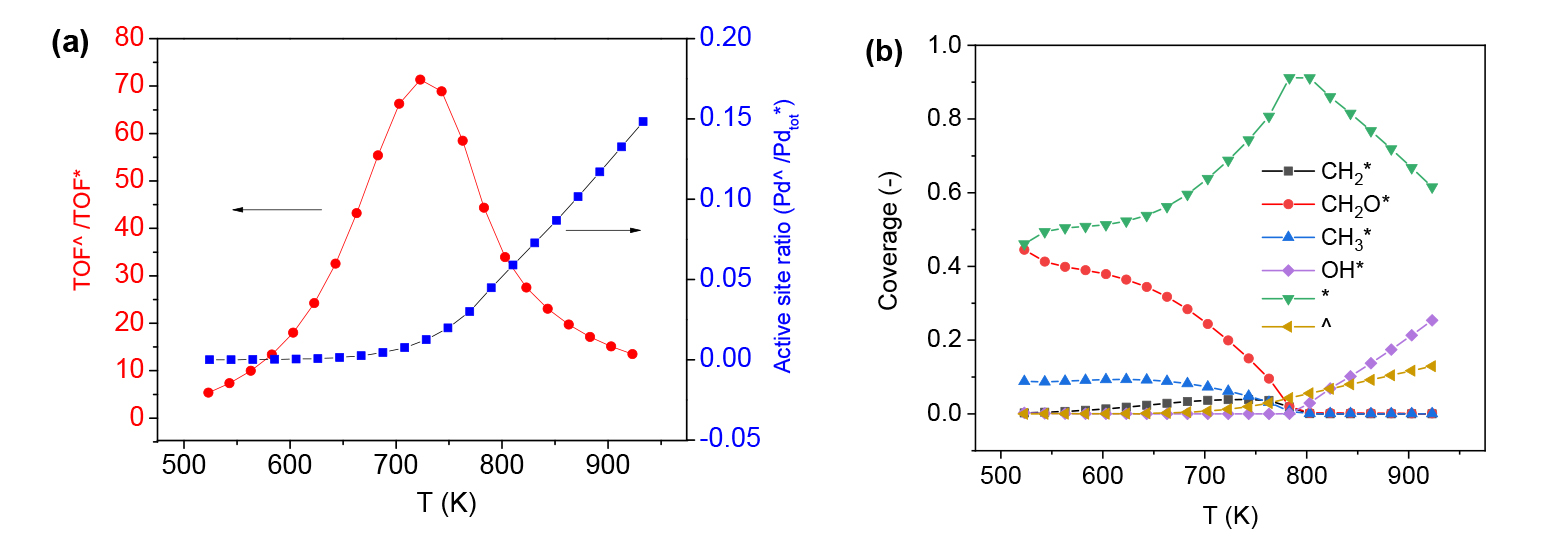
Fig. 5. Temperature-dependent kinetics and surface species evolution during methane oxidation. (a) Ratios of turnover frequencies on Pd3f (Pd*) and Pdov (Pd^) and the relative abundance of active sites (Pdov and Pd3f). (b) Coverages of relevant adsorbates as a function of temperature. The reaction conditions were 0.01 bar CH4 and 0.1 bar O2.
|
| [1] | Jie Zhao, Guangyuan Xu, Si Chen, Huan Yan. Precise tailoring of Cu-ZrO2 interfaces for CO2 hydrogenation to methanol [J]. Chinese Journal of Catalysis, 2027, 92(1): 316-327. |
| [2] | Piracha Sanwal, Jingjing Zhang, Rashid Mehmood, Linkun Sun, Xu Hu, Wen Dai, Gao Li. Dopant-enabled RuO2(110)-dominant architecture for boosting sustainable acidic oxygen evolution [J]. Chinese Journal of Catalysis, 2027, 92(1): 182-191. |
| [3] | Miao Wang, Tianyu Shen, Heng Zhou, Shuaikang Yang, Fengkun Hao, Chaohui Wang, Mohan Kumar, Zuoxiu Tie, Shuangming Chen, Zhanxi Fan, Zhong Jin. Direct electrosynthesis of ammonia from nitrate reduction using atomically precise carbonyl-rich metal clusters in neutral media [J]. Chinese Journal of Catalysis, 2026, 88(9): 259-268. |
| [4] | Jiaxiang Qin, Songpei Zhang, Xingju Li, Xintai Chen, Jia Zhao, Xiaoling Mou, Xiangen Song, Li Yan, Ronghe Lin, Yunjie Ding. Decoding structure-selectivity interplay in Pd-Ag nanocatalysts for butadiene semi-hydrogenation [J]. Chinese Journal of Catalysis, 2026, 87(8): 342-352. |
| [5] | Zhaochun He, Chunli Liu, Yonghua Liu, Tao Wang. Boosting homogeneous ammonia synthesis by balancing N≡N activation and N-H formation [J]. Chinese Journal of Catalysis, 2026, 87(8): 316-326. |
| [6] | Yatai Zhou, Chengcheng Yuan, Wei Xia, Jun Wang, Xiaofeng Zhu, Yong Zhang, Bicheng Zhu, Jiaguo Yu. Synergistic optimization of interfacial electron transfer and surface hydrogen adsorption in a CdS/ZnO S-scheme heterojunction by site-specific doping: A DFT study [J]. Chinese Journal of Catalysis, 2026, 86(7): 327-337. |
| [7] | Lanlan Chen, Li Sheng, Yanan Zhou, Qiquan Luo, Zhenyu Li, Wenhua Zhang, Jinlong Yang. Unraveling the superiority of Ni1-MoS2 single-atom catalyst in CO2 hydrogenation to methanol: A DFT combined microkinetic study [J]. Chinese Journal of Catalysis, 2026, 85(6): 143-152. |
| [8] | Yihan Ye, Yilun Ding, Tao Peng, Cheng Liu, Xinzhe Li, Yongzhi Zhao, Jianping Xiao, Feng Jiao, Xiulian Pan. Role of accumulated carbonaceous species on dynamic confinement in zeolite catalysis [J]. Chinese Journal of Catalysis, 2026, 84(5): 74-79. |
| [9] | Jinwei Wu, Junfei Chen, Mingkang Zhang, Zebao Rui. Engineering isolated Al2O3 island enables adjacent TiO2-supported Ir@Pt nanoparticles for efficient and sulfur-resistant lean methane oxidation [J]. Chinese Journal of Catalysis, 2026, 83(4): 400-410. |
| [10] | Runlin Ma, Xiandi Ma, Hejing Wang, Xu Zhang, Yongzheng Fang, Menggai Jiao, Zhen Zhou. Bifunctional electrocatalysis of hydrazine oxidation and hydrogen evolution reactions on 2D CoX (X = P, S, As, Se): Insights from DFT calculations [J]. Chinese Journal of Catalysis, 2026, 82(3): 115-124. |
| [11] | Xingshuai Lv, Pei Zhao, Yan Liang, Thomas Frauenheim, Liangzhi Kou. Quantitative insights into the critical role of potential-dependent (electro)chemical steps in ammonia electrosynthesis via constant-potential microkinetic simulations [J]. Chinese Journal of Catalysis, 2026, 81(2): 148-158. |
| [12] | Xiong Wang, Chao Peng, Yongkang Xiao, Ziye Zhang, Huiping Zheng, Wenjie Yue, Sheng Tian, Xingsheng Hu, Weifan Shao, Guanghui Chen, Binghao Wang, Huijuan Wang, Mingming Yin, Jinxin Li, Yang Li, Lang Chen, Shuangfeng Yin. Surface engineering enhancing activity and stability of Bi2WO6-x for selective C-H bond photooxidation [J]. Chinese Journal of Catalysis, 2026, 81(2): 246-258. |
| [13] | Kexin Ma, Mifeng Xue, Yuhan Wang, Maohong Fan, Lixia Ling, Riguang Zhang. Unraveling the surface structural evolution and single-atom doping effect in CO2-assisted ethane dehydrogenation over TiO2-based catalysts [J]. Chinese Journal of Catalysis, 2026, 91(12): 147-162. |
| [14] | Deng Min, Sebastian Cisneros, Abdallah I. M. Rabee, Thanh Huyen Vuong, Jiadong Xiao, Yaoyuan Zhang, Rongsheng Cai, Feng Shi, Jabor Rabeah. Low CeO2 content with superior performance: In-situ spectroscopic insights into multicomponent CuFeCe/γ-Al2O3 catalysts for mild-temperature reverse water-gas shift [J]. Chinese Journal of Catalysis, 2026, 91(12): 176-191. |
| [15] | Xiao-Li Liang, Zhao-Yu Wang, Shi-Lin Yan, Ting-Ting Yin, Wei Zhang, Hao Zhang, Xiaohong Liu, Liu-Bin Zhao. Machine learning-accelerated electrocatalytic microkinetic model for global reaction network simulation of CO2 reduction reaction [J]. Chinese Journal of Catalysis, 2026, 91(12): 163-175. |
| Viewed | ||||||
|
Full text |
|
|||||
|
Abstract |
|
|||||


