
Chinese Journal of Catalysis ›› 2027, Vol. 92: 376-386.DOI: 10.1016/S1872-2067(26)65212-6
• Articles • Previous Articles Next Articles
Zejing Weia,1, Kunkun Weia,1, Xutao Chena,*( ), Yang Panb, Chengyuan Liub, Liping Xiaoa, Yifeng Shia,*(), Shihui Zouc,*(), Jie Fana,*()
Received:2026-01-08
Accepted:2026-04-11
Online:2027-01-02
Published:2026-10-30
Contact:
*E-mail: jfan@zju.edu.cn (J. Fan),About author:First author contact:1 Contributed equally to this work.
Supported by:Zejing Wei, Kunkun Wei, Xutao Chen, Yang Pan, Chengyuan Liu, Liping Xiao, Yifeng Shi, Shihui Zou, Jie Fan. Revisiting the catalytic role of supported Na2WO4 for oxidative coupling of methane reaction[J]. Chinese Journal of Catalysis, 2027, 92: 376-386.
Add to citation manager EndNote|Ris|BibTeX
URL: https://www.cjcatal.com/EN/10.1016/S1872-2067(26)65212-6

Fig. 1. XRD patterns and Raman spectra of fresh Na2WO4/SiO2 (a,c), fresh Na2WO4/ZrO2 (b,d), spent Na2WO4/SiO2 (e,g) and spent Na2WO4/ZrO2 (f,h) catalysts with different Na2WO4 loadings.
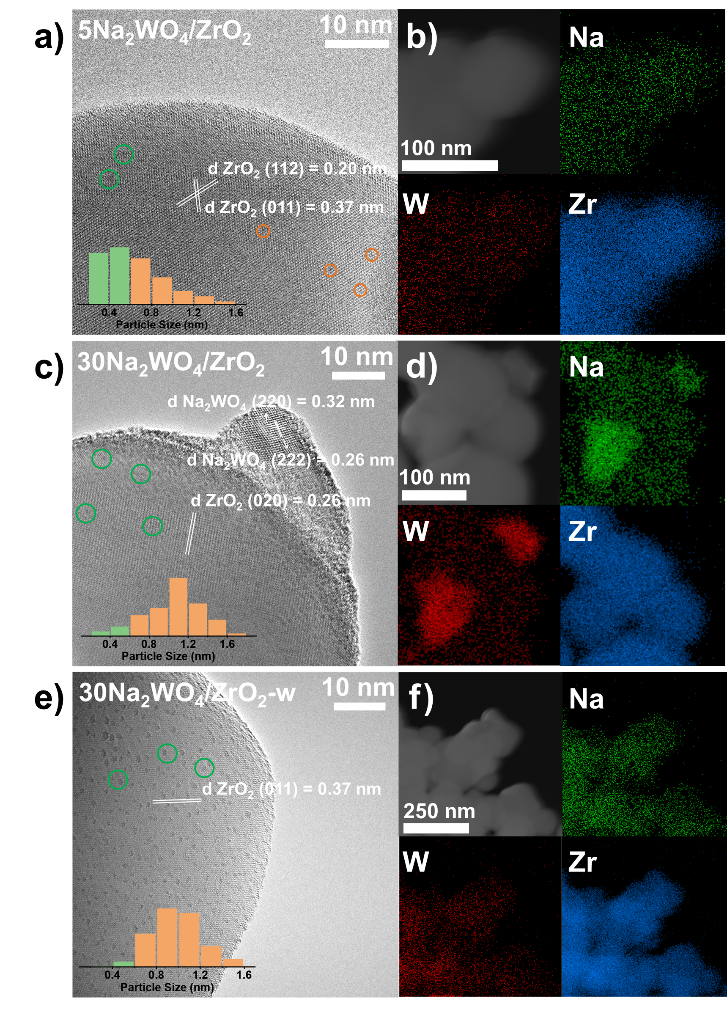
Fig. 2. HRTEM images (a,c,e) and EDS elemental mappings (b,d,f) of Na2WO4/ZrO2 with different loadings. (a,b) 5Na2WO4/ZrO2; (c,d) 30Na2WO4/ZrO2; (e,f) 30Na2WO4/ZrO2-w. Typical Na-WOx and Na2WO4 clusters are marked by orange and green circles, respectively. The inset shows the size distribution of the tungstate species.
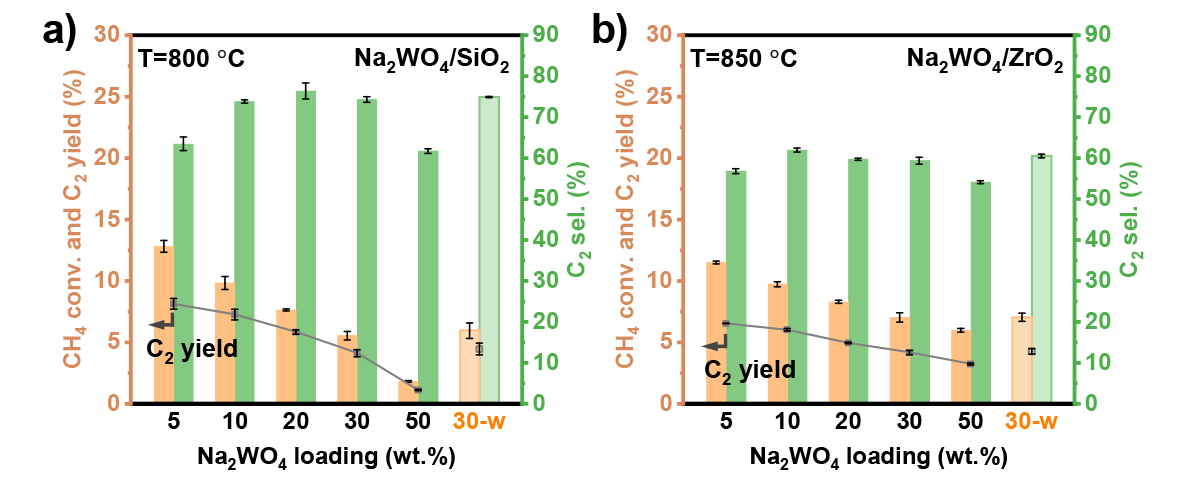
Fig. 3. OCM performances of Na2WO4/SiO2 (a) and Na2WO4/ZrO2 (b) catalysts under oxygen-lean atmosphere. Reaction conditions: 300 mg catalyst, total gas flow rate 67 mL min-1, CH4:O2:N2 = 30:10:27, GHSV = 13400 mL gcatalyst-1 h-1.
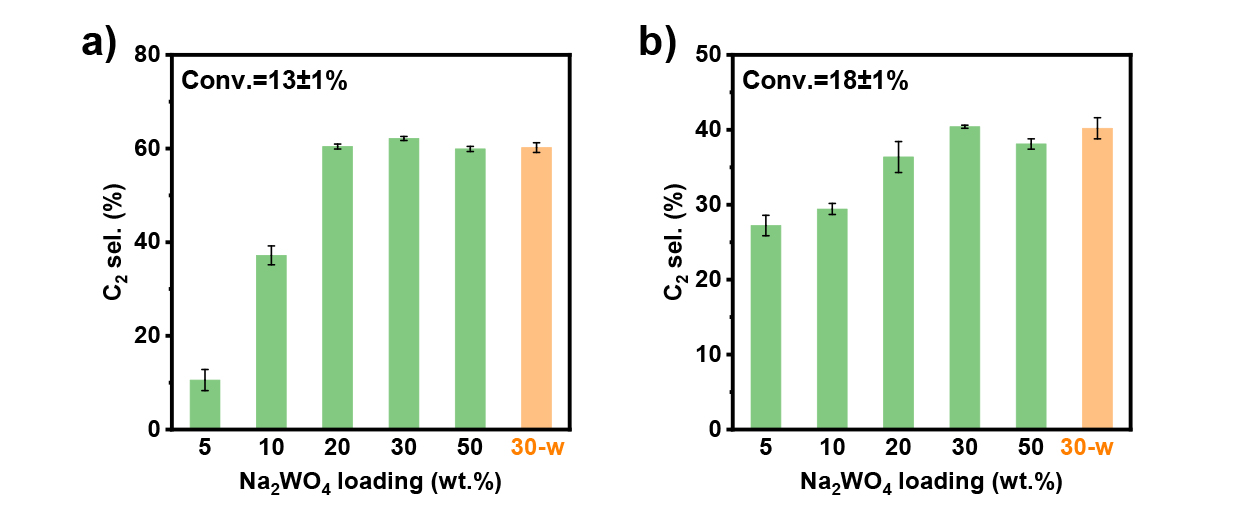
Fig. 4. Comparison of C2 selectivity of Na2WO4/SiO2 (a) and Na2WO4/ZrO2 (b) catalysts at a fixed CH4 conversion under oxygen-rich atmosphere. Reaction conditions: 300 mg catalyst, total gas flow rate 67 mL min-1, CH4:O2:N2 = 2:8:60, GHSV = 13400 mL gcatalyst-1 h-1.
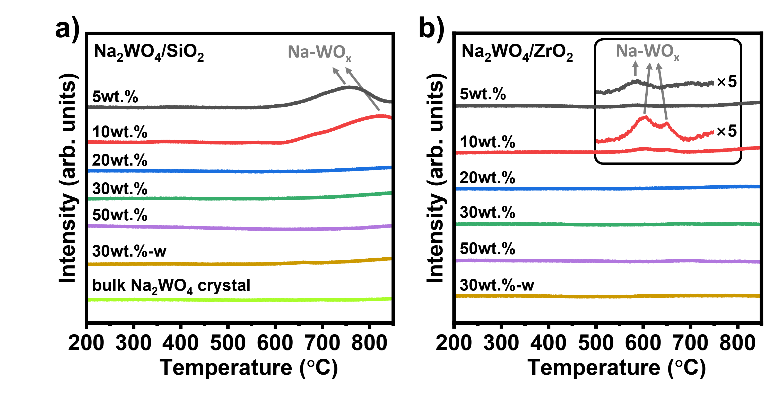
Fig. 5. H2-TPR profiles of Na2WO4/SiO2 (a) and Na2WO4/ZrO2 (b) with different loadings. 30 wt%-w represents the corresponding catalysts (30 wt% Na2WO4/SiO2 or 30 wt% Na2WO4/ZrO2) after the ammonia-washing treatment. The reduction was performed using 50 mg of catalyst under a 10% H2/He flow (30 mL min-1) with a heating rate of 10 °C min-1.
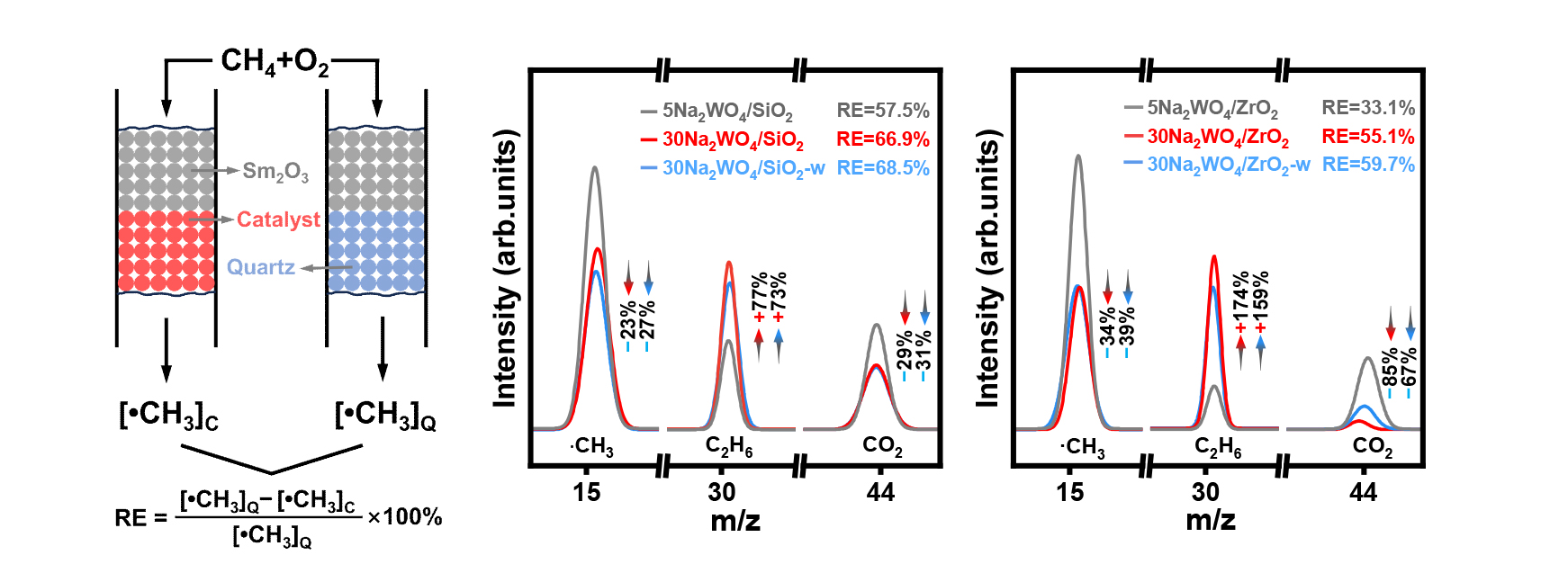
Fig. 6. Schematic illustration and the results of in-situ SVUV‐PIMS studies of Na2WO4/SiO2 and Na2WO4/ZrO2. [CH3]Q and [CH3]C denote the signal intensities of methyl radicals detected downstream of the Quartz control bed and the Catalyst bed, respectively. Reaction conditions: 200 mg of Sm2O3 was placed upstream and 200 mg catalyst was placed downstream separately, CH4:O2 = 30:10, pressure equaled to 2 Torr.
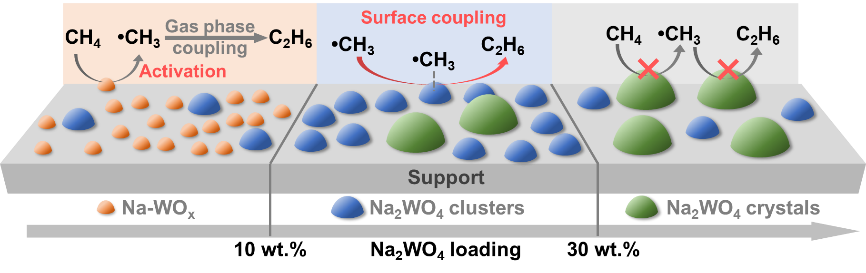
Fig. 7. Schematic illustration of loading-dependent structural evolution and catalytic behaviors of Na2WO4 in the oxidative coupling of methane.
|
| [1] | Yanyan Chen, Sen Wang, Shanhui Zhu, He Wang, Mei Dong, Zhangfeng Qin, Jianguo Wang, Weibin Fan. Mechanistic switch in methane combustion on PdOₓ catalysts mediated by oxygen vacancies [J]. Chinese Journal of Catalysis, 2027, 92(1): 387-396. |
| [2] | Shangchun Li, Beibei Xu, Jingyu Lu, Shijie Zhao, Qingqing Zhang, Rengui Li, Jing Zhang. Uniform cobalt sub-nanometer clusters catalysts for nitrate-to-ammonia electrosynthesis under industrial conditions [J]. Chinese Journal of Catalysis, 2027, 92(1): 355-364. |
| [3] | Daniël P. C. van Eck, Suzan E. Schoemaker, Stefan Bismeijer, Erik Betz-Güttner, Tom A. J. Welling, Petra E. de Jongh. Dopant-induced particle size control governs carbon yield in methane pyrolysis [J]. Chinese Journal of Catalysis, 2027, 92(1): 397-409. |
| [4] | Yaowen Wei, Jianwei Wang, Hao Guo, Tao Ban, Yufeng Yue, Di Hu, Haibao Huang. Highly selective oxidation of methane to acetic acid enabled by deficient UiO-66 under mild conditions [J]. Chinese Journal of Catalysis, 2026, 88(9): 356-368. |
| [5] | Chunlei Zhang, Hanyu Tan, Chaoyang Sui, Ying Feng, Xinyu Chen, Xiaoqiang Fan, Xuehua Yu, Zhen Zhao. Efficient methane combustion by engineering surface oxygen vacancies on MOF-derived multi-shell Pd@Co3O4 [J]. Chinese Journal of Catalysis, 2026, 88(9): 492-505. |
| [6] | Xinyi Zhang, Weichen Dong, Yi Cao, Caixia Zhou, Jiaxiu Guo, Hailong Zhang. Efficient continuous synthesis of methanol by direct methane conversion on Cu-KFI zeolite catalysts [J]. Chinese Journal of Catalysis, 2026, 88(9): 369-381. |
| [7] | Songling Wang, Anhua Huang, Fengxing Yin, Ruixiang Lu, Wengang Liu, Yun Zhang, Botao Qiao. In-situ synthesis of hydrogen peroxide for highly selective oxidation of methane to methanol over noble-metal-free catalyst [J]. Chinese Journal of Catalysis, 2026, 88(9): 347-355. |
| [8] | Miao Wang, Tianyu Shen, Heng Zhou, Shuaikang Yang, Fengkun Hao, Chaohui Wang, Mohan Kumar, Zuoxiu Tie, Shuangming Chen, Zhanxi Fan, Zhong Jin. Direct electrosynthesis of ammonia from nitrate reduction using atomically precise carbonyl-rich metal clusters in neutral media [J]. Chinese Journal of Catalysis, 2026, 88(9): 259-268. |
| [9] | Yun Huang, Qi Chen, Yueling Chen, Zefeng Yang, Jionghua Wu, Jimmy C. Yu, Ling Wu. Effective generation of active hydrogen species for nitrogen fixation on Pt/DUT-67(Zr) [J]. Chinese Journal of Catalysis, 2026, 88(9): 247-258. |
| [10] | Zhongchen Ma, Meiyi Yin, Run Xu, Rongjun Zhang, Tian Lan, Wenli Gu, Guoqing Chen, Yong Lu. Coking-resistant CeAlO3-Socketed Nickel Nanocatalysts for dry reforming of methane [J]. Chinese Journal of Catalysis, 2026, 87(8): 363-375. |
| [11] | Yang Wang, Lei He, Fan Tang, Wen-Cui Li, Bowen He, Xi Liu, Liwei Chen, Dongqi Wang, Wenjie Shen, An-Hui Lu. Electron-deficient nickel tailored by boron for coke-free methane dry reforming [J]. Chinese Journal of Catalysis, 2026, 87(8): 353-362. |
| [12] | Bowen Li, Changlin Lin, Qi Wang, Yongfeng Lun, Jun Fang, Shuqin Song, Yi Wang. Ligand-shell engineering of a Au25 nanocluster boosting CO2 electroreduction to syngas with tunable range proportion [J]. Chinese Journal of Catalysis, 2026, 87(8): 396-409. |
| [13] | Shahla Karimi, Mehran Rezaei, Jiguang Deng, Hongxing Dai, Ali Rastegarpanah. Recent advances in noble metal-based catalysts for methane decomposition: Performance, mechanism, and optimization [J]. Chinese Journal of Catalysis, 2026, 86(7): 9-48. |
| [14] | Qingxi Zhai, Yiqi Tian, Hao Wang, Shisi Tang, Qiang Yuan, Xu Liu, Weiping Ding, Fan Tian, Yan Zhu. Molecular adaptability and reactivity in Ni6(SR)12-catalyzed adipic acid synthesis [J]. Chinese Journal of Catalysis, 2026, 86(7): 225-235. |
| [15] | Polina Lavrik, Jurjen Cazemier, Mohamed N. Hedhili, Sudheesh K. Veeranmaril, Abdallah Nassereddine, Antonio Aguilar-Tapia, Marina Chernova, Jean-Louis Hazemann, Alla Dikhtiarenko, Javier Ruiz-Martínez. Relationship between palladium nuclearity and catalytic activity and selectivity in acetylene semi-hydrogenation [J]. Chinese Journal of Catalysis, 2026, 85(6): 384-393. |
| Viewed | ||||||
|
Full text |
|
|||||
|
Abstract |
|
|||||


