
Chinese Journal of Catalysis ›› 2027, Vol. 92: 365-375.DOI: 10.1016/S1872-2067(26)65241-2
• Articles • Previous Articles Next Articles
Ruihan Zhoua, Tixuan Xiaa, Yingchen Yanga, Dongbo Xua,b,*( ), Weidong Shia,c,*()
Received:2026-02-28
Accepted:2026-05-15
Online:2027-01-02
Published:2026-10-30
Contact:
*E-mail: xudb39@ujs.edu.cn (D. Xu),Supported by:Ruihan Zhou, Tixuan Xia, Yingchen Yang, Dongbo Xu, Weidong Shi. Co(OH)2/Cu NWs with interface modification of hypophosphite ions for sustainable ammonia synthesis from nitrate at ~2.8 A·cm-2[J]. Chinese Journal of Catalysis, 2027, 92: 365-375.
Add to citation manager EndNote|Ris|BibTeX
URL: https://www.cjcatal.com/EN/10.1016/S1872-2067(26)65241-2
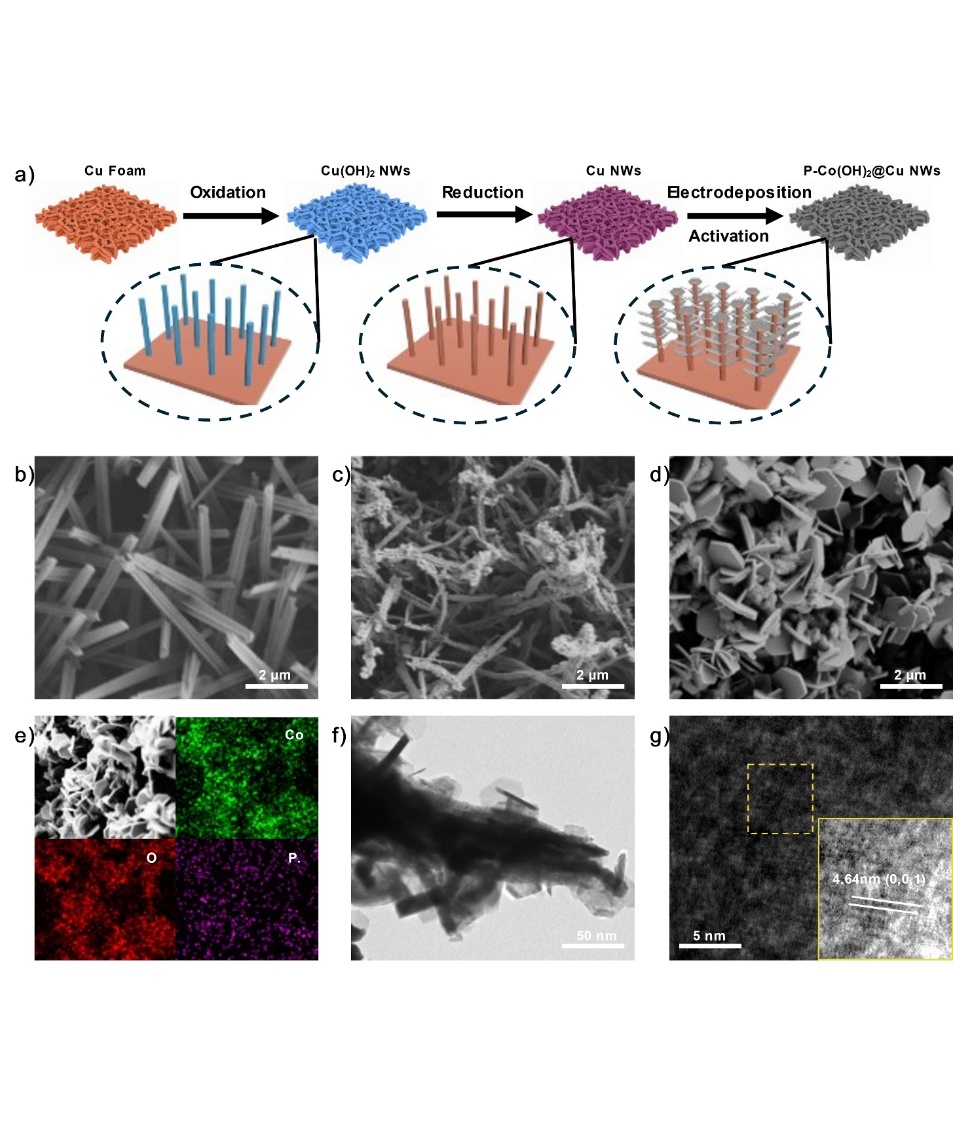
Fig. 1. (a) Schematic diagram depicting the preparation of P-Co(OH)2. SEM image of Cu(OH)2 NWs (b), Cu NWs (c), and P-Co(OH)2/Cu NWs (d). EDS mapping images (e), TEM images (f), and HRTEM images (g) of P-Co(OH)2/Cu NWs.
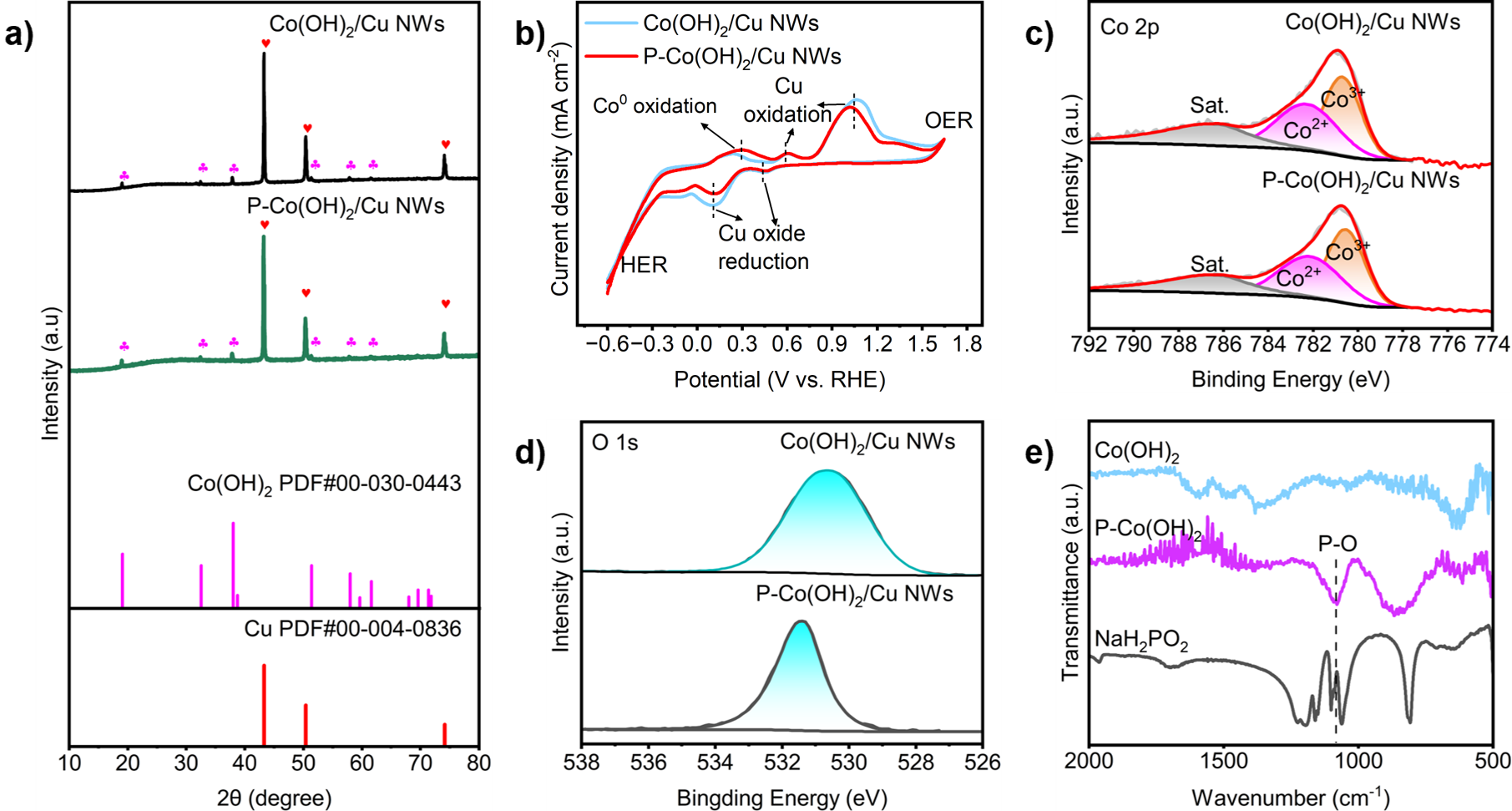
Fig. 2. XRD pattern (a), CV curves (b), Co 2p (c), O 1s (d) XPS spectra, and FT-IR spectra (e) of P-Co(OH)2/Cu NWs and Co(OH)2/Cu NWs.
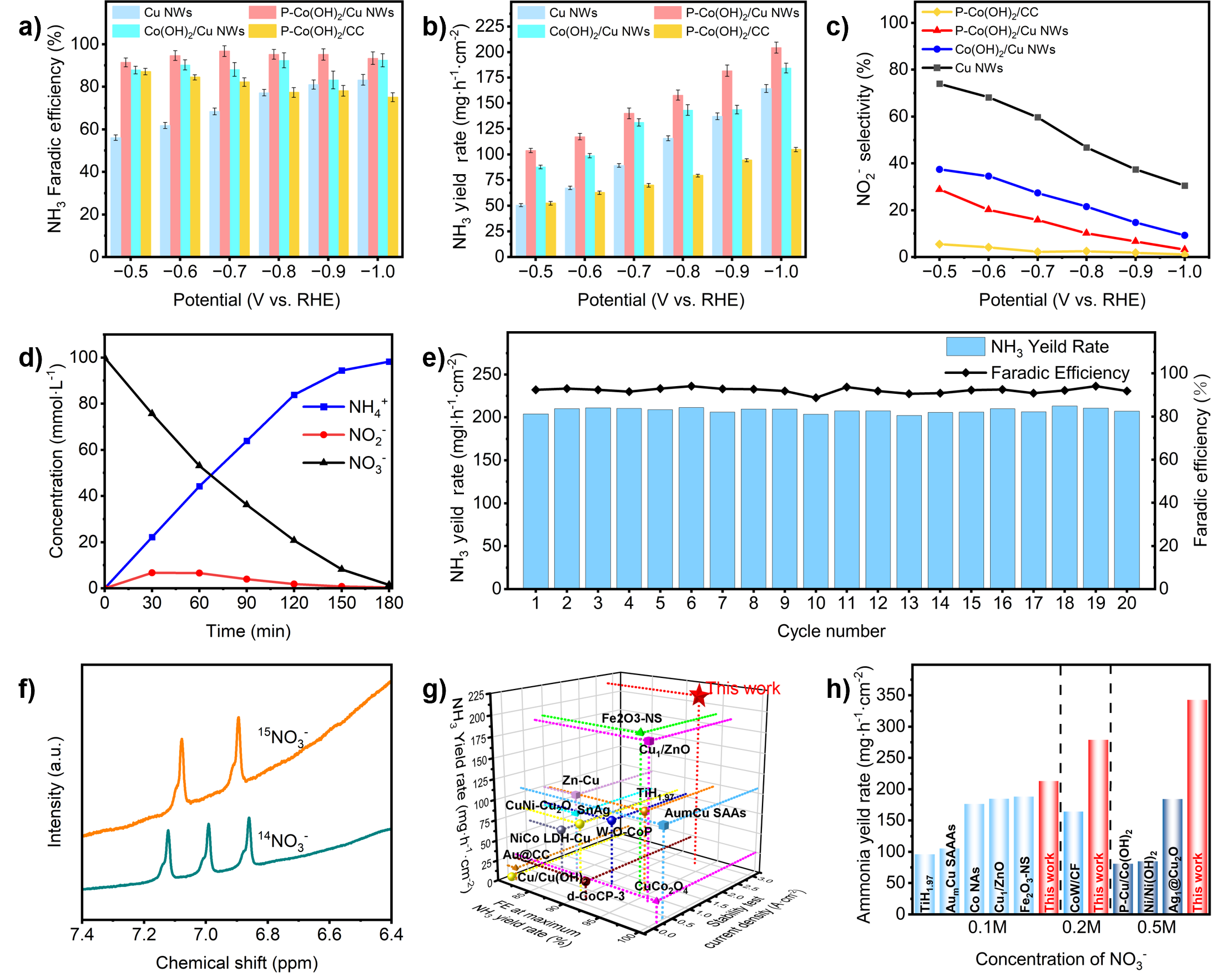
Fig. 3. The potential-dependent FE of ammonia (a), The ammonia yield rate (b), and the selectivity of NO2- (c) for Cu NWs, Co(OH)2/Cu NWs, P-Co(OH)2/Cu NWs and P-Co(OH)2/CC in 0.1 mol·L-1 NaNO3 and 1 mol·L-1 NaOH. (d) NO3- removal of catalysts measured in a 1 mol·L-1 NaOH with 0.1 mol·L-1 NO3- electrolyte at -0.7 V vs. RHE. (e) The NH3 yield rate and FE of P-Co(OH)2/Cu NWs at -1 V vs. RHE in cycling tests conducted continuously for 20 h. (f) 1H NMR spectra using 15NO3- and 14NO3- over P-Co(OH)2/Cu NWs. (g) comparison of NO3RR performance of P-Co(OH)2/Cu NWs with reported state-of-the-art electrocatalysts in 0.1 mol·L-1 NO3-. (h) comparison of NH3 yield rate for recently reported state-of-the-art electrocatalysts with different concentrations of NO3-.
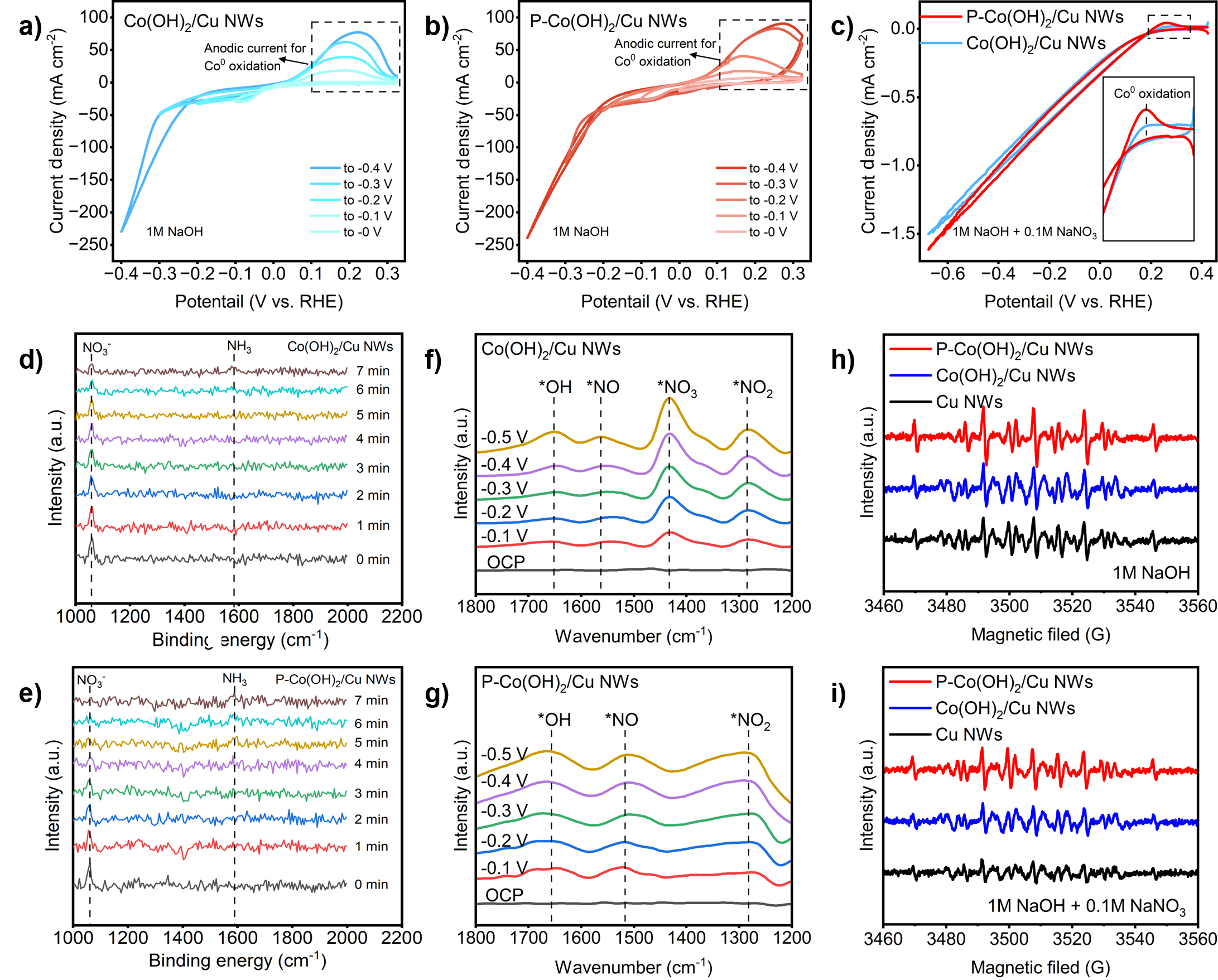
Fig. 4. (a,b) CV curves in 1 mol·L-1 NaOH. (c) CV curves in 1 mol·L-1 NaOH + 0.1 mol·L-1 NaNO3. In-situ Raman spectra (d,e), in-situ ATR-IR spectra (f,g), and EPR spectra (h,i) in 1 mol·L-1 NaOH with and without 0.1 mol·L-1 NaNO3 of P-Co(OH)2/Cu NWs, Co(OH)2/Cu NWs and Cu NWs.
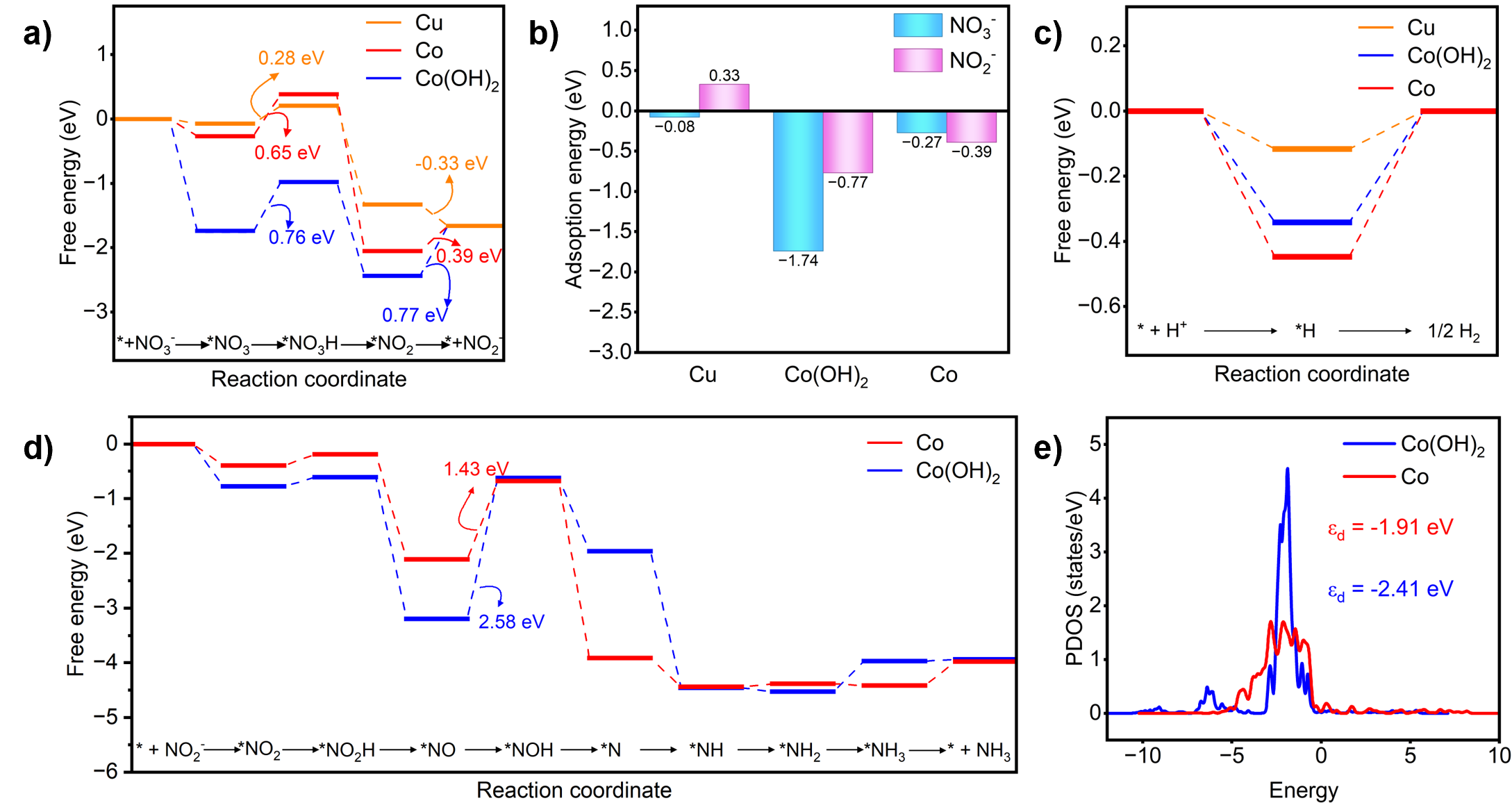
Fig. 5. (a) Gibbs free energy diagram of NO3- to NO2- generated during NO3RR. (b) Adsorption energy of NO3- and NO2-. (c) The hydrogen evolution reaction pathways on Cu (111), Co(OH)2 (101), and Co(101). (d) Gibbs free energy diagram of NO2- to NH3 generated during NO3RR. (e) PDOS along with d-band center for Co(OH)2 and Co.
|
| [1] | Shangchun Li, Beibei Xu, Jingyu Lu, Shijie Zhao, Qingqing Zhang, Rengui Li, Jing Zhang. Uniform cobalt sub-nanometer clusters catalysts for nitrate-to-ammonia electrosynthesis under industrial conditions [J]. Chinese Journal of Catalysis, 2027, 92(1): 355-364. |
| [2] | Bo Zhang, Yuye Jiao, Huijie Cheng, Jungang Hou. Recent advances in metal-organic framework-based electrocatalysts for electrochemical reduction of nitrate to ammonia [J]. Chinese Journal of Catalysis, 2027, 92(1): 87-114. |
| [3] | Panyong Kuang, Zhenrui Ni, Sihan Chen, Weilai Yu. Engineering electrocatalysts for industrial-current-density alkaline hydrogen evolution: Design principles and future perspectives [J]. Chinese Journal of Catalysis, 2027, 92(1): 65-86. |
| [4] | Shijian Luo, Hao Chen, Yuran Yang, Yang Song, Yongduo Liu, Daojun Long, Siguo Chen, Zidong Wei. Hydride-enhanced plasma catalysis enables ultrahigh-rate ammonia synthesis at room temperature and atmospheric pressure [J]. Chinese Journal of Catalysis, 2026, 88(9): 269-278. |
| [5] | Haoye Wang, Bingjie Qiu, Richard, Jr L. Smith, Xinhua Qi. Electrocatalytic nitrate reduction systems for chemical production: Mechanisms, process engineering and challenges [J]. Chinese Journal of Catalysis, 2026, 88(9): 129-182. |
| [6] | Miao Wang, Tianyu Shen, Heng Zhou, Shuaikang Yang, Fengkun Hao, Chaohui Wang, Mohan Kumar, Zuoxiu Tie, Shuangming Chen, Zhanxi Fan, Zhong Jin. Direct electrosynthesis of ammonia from nitrate reduction using atomically precise carbonyl-rich metal clusters in neutral media [J]. Chinese Journal of Catalysis, 2026, 88(9): 259-268. |
| [7] | Fengjuan Guo, Chunyao Ma, Yue Huang, Sitong Hang, Junwei Ma, Hongtao Gao. Unveiling the dominant distal-alternating hybrid mechanism in B-modulated Mo2TiC2Tx/MoO2 MXene for highly selective ambient NRR [J]. Chinese Journal of Catalysis, 2026, 87(8): 269-281. |
| [8] | Kefu Zhang, Luxiao Zhang, Jianyi Chu, Cenyu Mei, Siyuan Liu, Guilan Fan, Fenrong Liu, Youngkook Kwon, Fenghua Bai, Wenhao Luo. Species heterogeneity for efficient electrocatalytic nitrate reduction to ammonia [J]. Chinese Journal of Catalysis, 2026, 85(6): 247-257. |
| [9] | Peng Liu, Lian Duan, Baopeng Yang, Mingwei Sun, Gen Chen, Xiaohe Liu, Min Liu, Ning Zhang. Tuning surface electronic structure of (CuGa)xZn1‒2xGa2S4 photocatalyst for efficient nitrate-to-ammonia conversion [J]. Chinese Journal of Catalysis, 2026, 83(4): 172-182. |
| [10] | Xuanbei Peng, Mengqi An, Ruishao Mao, Yanliang Zhou, Ming Chen, Dongya Huang, Kailin Su, Shiyong Zhang, Jun Ni, Xiuyun Wang, Lilong Jiang. Scheelite-type alkali metal perrhenates supported Co-based catalysts for highly efficient ammonia synthesis [J]. Chinese Journal of Catalysis, 2026, 83(4): 432-443. |
| [11] | Donghua Li, Hongyin Hu, Jinye Zhou, Hanyun Miao, Yu Wu, Jinyan Wang, Baochun Guo, Mingliang Du, Shuanglong Lu. Steering product selectivity via metallic site-dependent pathways in porphyrin-based covalent organic frameworks for electrocatalytic nitrite reduction [J]. Chinese Journal of Catalysis, 2026, 83(4): 258-270. |
| [12] | Miao-Miao Shi, Yue-Xuan He, Ning Zhang, Di Bao, Da-Ming Zhao, Hai-Xia Zhong, Jun-Min Yan, Qing Jiang. Direct electrochemical liquid ammonia splitting for onsite hydrogen generation under room temperature [J]. Chinese Journal of Catalysis, 2026, 81(2): 310-318. |
| [13] | Yachuan Wang, Runan Lei, Wei Wang, Qixuan Wu, Kaiwen Kang, Dachao Yuan, Zhibo Zhang, Yuan Tang, Linjie Gao, Yaguang Li, Jinhua Ye. Coordination reconfigured Ni single-atoms for scaled photothermal COx free hydrogen production from ammonia [J]. Chinese Journal of Catalysis, 2026, 91(12): 365-375. |
| [14] | Shuchang Fan, Peize Li, Tianyu Sun, Yan Wei, Zhaoshi Yu, Jiandong Zhang, Mingkui Wang, Yan Shen. Efficient urea synthesis via electrocatalytic CO2 reduction reaction coupled with nucleophilic addition reaction of NH3 [J]. Chinese Journal of Catalysis, 2026, 91(12): 135-146. |
| [15] | Zhihao Wang, Yuang Zhang, Xu Zhang, Yuting Jiang, Xinyue Li, Ying Xie, Zhiyu Ren, Zhimin Chen. Gradient energy alignment drives catalytic cascades for synergistic nitrate-to-ammonia electro-conversion [J]. Chinese Journal of Catalysis, 2026, 90(11): 287-297. |
| Viewed | ||||||
|
Full text |
|
|||||
|
Abstract |
|
|||||


