
Chinese Journal of Catalysis ›› 2027, Vol. 92: 355-364.DOI: 10.1016/S1872-2067(26)65199-6
• Articles • Previous Articles Next Articles
Shangchun Lia,1, Beibei Xua,1, Jingyu Lua, Shijie Zhaoc, Qingqing Zhanga, Rengui Lib, Jing Zhanga,*( )
Received:2026-02-07
Accepted:2026-04-01
Online:2027-01-02
Published:2026-10-30
Contact:
*E-mail: jingzhang_dicp@njust.edu.cn (J. Zhang).About author:First author contact:1 Contributed equally to this work.
Supported by:Shangchun Li, Beibei Xu, Jingyu Lu, Shijie Zhao, Qingqing Zhang, Rengui Li, Jing Zhang. Uniform cobalt sub-nanometer clusters catalysts for nitrate-to-ammonia electrosynthesis under industrial conditions[J]. Chinese Journal of Catalysis, 2027, 92: 355-364.
Add to citation manager EndNote|Ris|BibTeX
URL: https://www.cjcatal.com/EN/10.1016/S1872-2067(26)65199-6
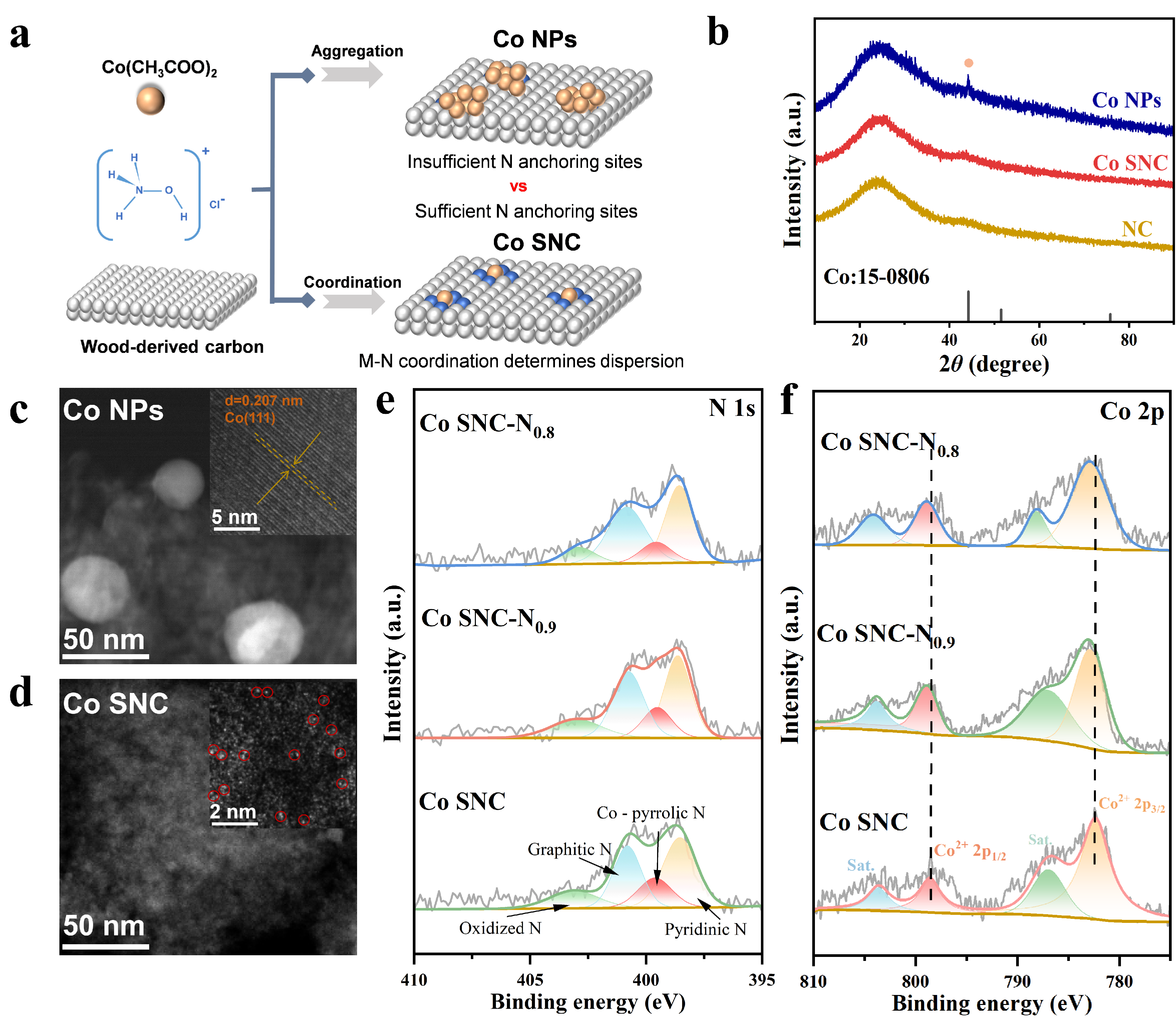
Fig. 1. (a) Schematic synthesis of Co SNC and Co NPs. (b) XRD patterns of Co NPs, Co SNC and NC. (c) HRTEM image of Co NPs. (d) HAADF-STEM image of Co SNC. (e) N 1s XPS spectra of Co SNC-N0.8, Co SNC-N0.9 and Co SNC. (f) Co 2p XPS spectra of Co SNC-N0.8, Co SNC-N0.9 and Co SNC.
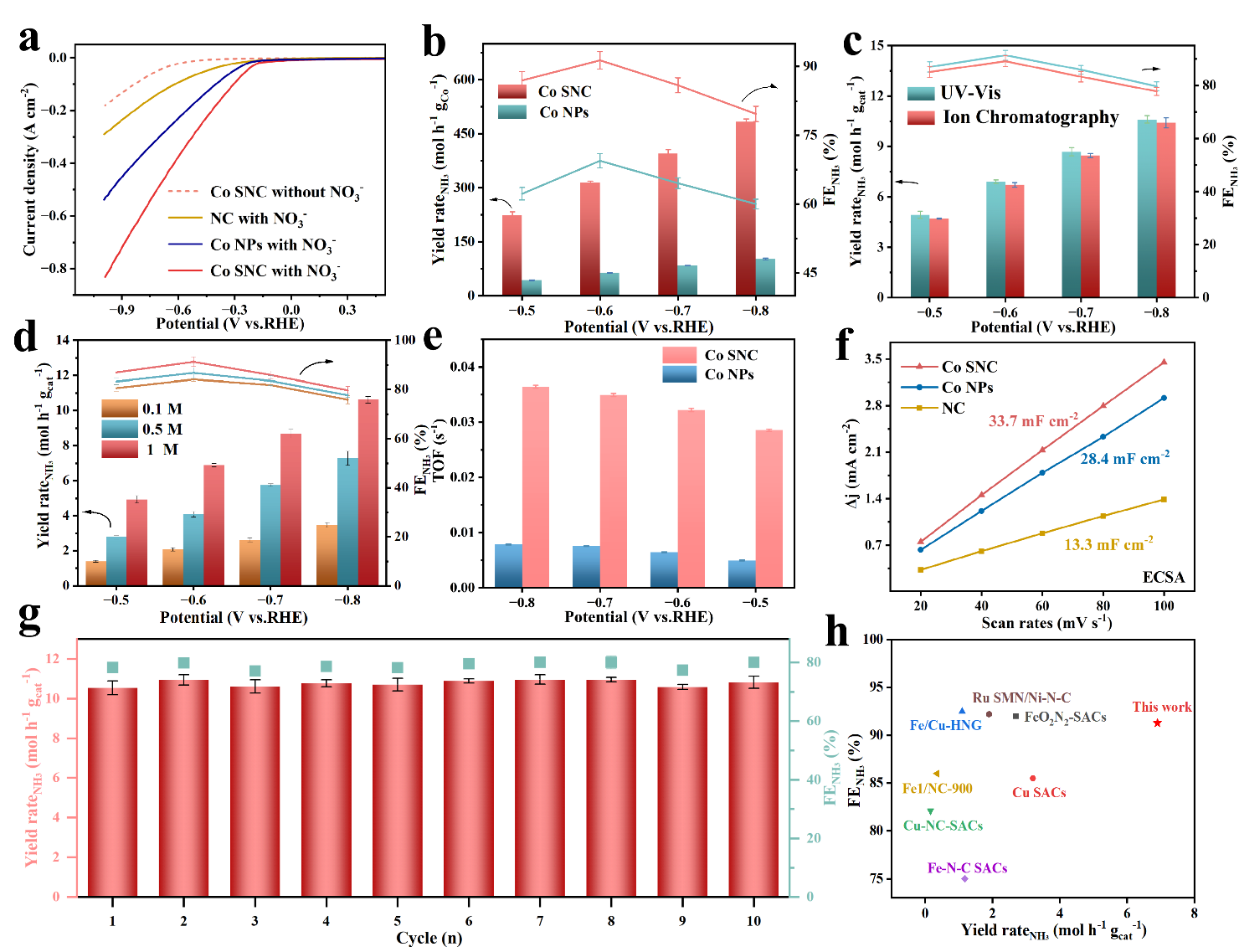
Fig. 2. (a) LSV curves comparing the electrochemical performance of different catalysts in the presence and absence of 1 mol L-1 NO3-. (b) FENH3 and NH3 yield of Co SNC and Co NPs. (c) FENH3 and NH3 yield rates of Co SNC under different potentials in UV-vis and ion chromatography tests. (d) FENH3 and NH3 yield rates of Co SNC with different potentials and different concentrations of KNO3. (e) TOF of Co SNC and Co NPs in 1 mol L-1 NO3-. (f) ECSA of NC, Co SNC and Co NPs. (g) Cycling tests of Co SNC in 1 mol L-1 KOH and 1 mol L-1 KNO3 electrolyte at -0.8 V vs. RHE. (h) Comparison with recently reported NO3RR electrocatalysts.
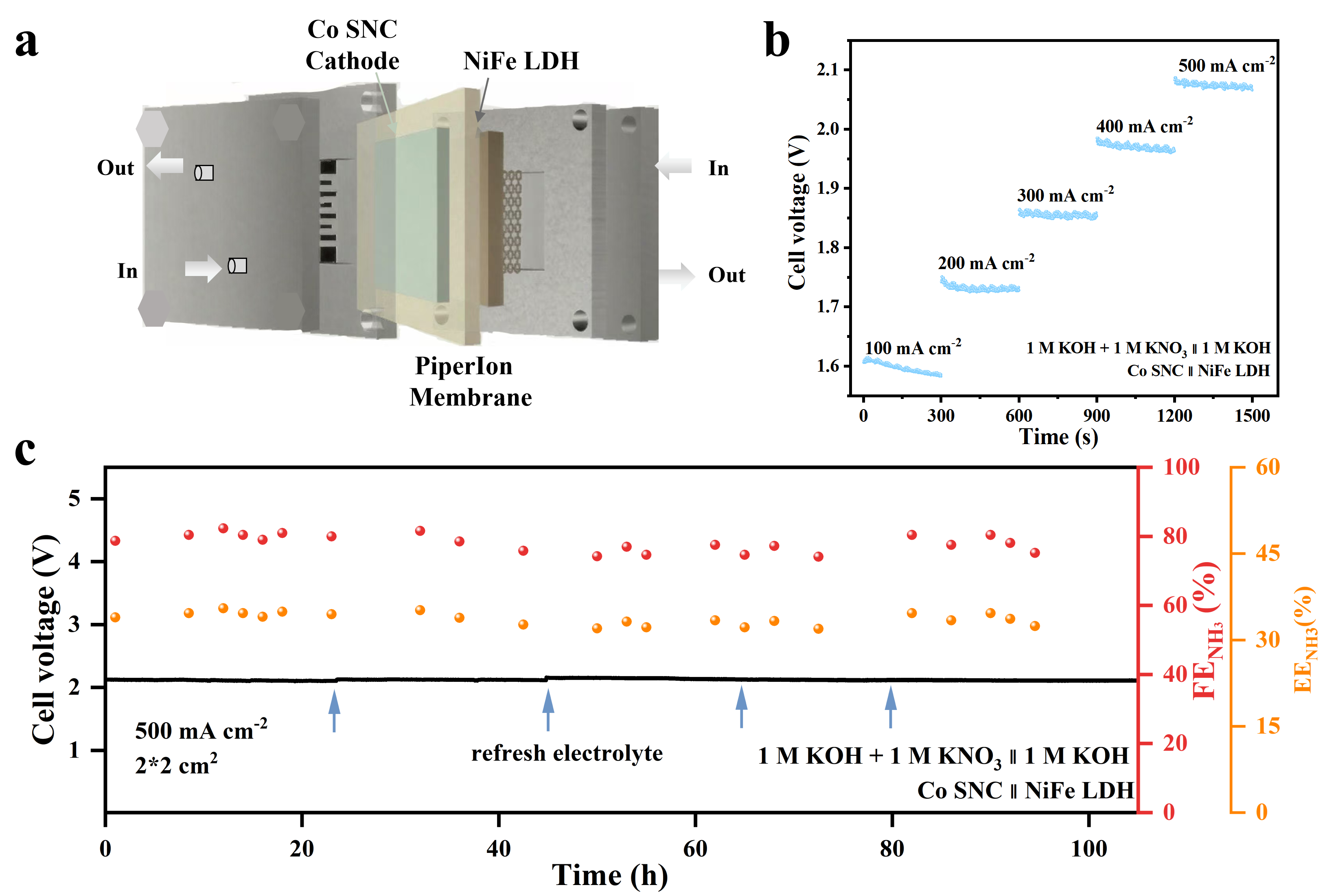
Fig. 3. (a) Schematic illustration of AEM configuration. (b) Activation curves of the AEM. (c) Stability of the Co SNC electrode in the AEM device at 500 mA cm-2.
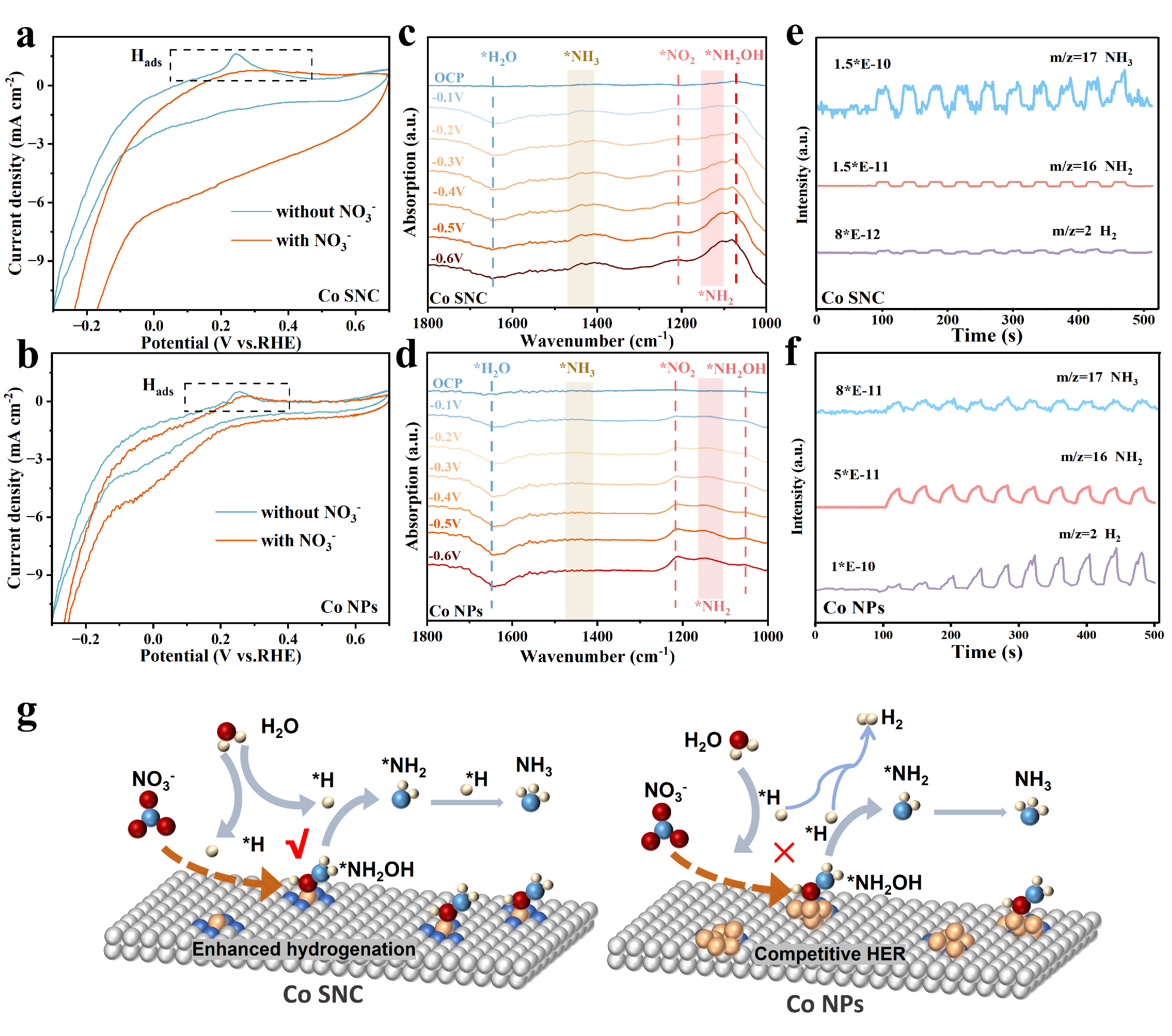
Fig. 4. (a) CV curves of Co SNC in 1 mol L-1 KOH with and without NO3-. (b) CV curves of Co NPs in 1 mol L-1 KOH with and without NO3-. (c) Potential-dependent in-situ FTIR spectra of Co SNC catalyst. (d) Potential-dependent in-situ FTIR spectra of Co NPs catalyst. (e) In-situ DEMS results of Co SNC catalyst. (f) In-situ DEMS results of Co NPs catalyst. (g) Proposed reaction mechanisms on Co SNC and Co NPs catalysts.
|
| [1] | Ruihan Zhou, Tixuan Xia, Yingchen Yang, Dongbo Xu, Weidong Shi. Co(OH)2/Cu NWs with interface modification of hypophosphite ions for sustainable ammonia synthesis from nitrate at ~2.8 A·cm-2 [J]. Chinese Journal of Catalysis, 2027, 92(1): 365-375. |
| [2] | Anqi Li, Yusen Chen, Xiaoli Pan, Yujing Ren, Hongchen Cao, Guiyue Bi, Xiaofeng Yang, Aiqin Wang, Tao Zhang. Pt1/FeOx single-atom catalyst with dual-valent Pt sites for water-promoted hydrogenation of nitroarenes [J]. Chinese Journal of Catalysis, 2027, 92(1): 410-419. |
| [3] | Bashir Adegbemiga Yusuf, Hennayaka Mudiyanselage Charitha Madusanka Jayawardana, Waleed Yaseen, Jimin Xie, Yilin Deng, Suci Meng, Yongming Li, Abdussamad Mukhtar Mohammed, Aminu Magaji, Min Chen, Meng Xie, Yuanguo Xu. Vacancy-engineered Ru-based CNT electrocatalysts for ampere-level water splitting in alkaline and anion-exchange membrane water electrolyzers [J]. Chinese Journal of Catalysis, 2026, 88(9): 279-294. |
| [4] | Haoye Wang, Bingjie Qiu, Richard, Jr L. Smith, Xinhua Qi. Electrocatalytic nitrate reduction systems for chemical production: Mechanisms, process engineering and challenges [J]. Chinese Journal of Catalysis, 2026, 88(9): 129-182. |
| [5] | Miao Wang, Tianyu Shen, Heng Zhou, Shuaikang Yang, Fengkun Hao, Chaohui Wang, Mohan Kumar, Zuoxiu Tie, Shuangming Chen, Zhanxi Fan, Zhong Jin. Direct electrosynthesis of ammonia from nitrate reduction using atomically precise carbonyl-rich metal clusters in neutral media [J]. Chinese Journal of Catalysis, 2026, 88(9): 259-268. |
| [6] | Fengjuan Guo, Chunyao Ma, Yue Huang, Sitong Hang, Junwei Ma, Hongtao Gao. Unveiling the dominant distal-alternating hybrid mechanism in B-modulated Mo2TiC2Tx/MoO2 MXene for highly selective ambient NRR [J]. Chinese Journal of Catalysis, 2026, 87(8): 269-281. |
| [7] | Jiaxiang Qin, Songpei Zhang, Xingju Li, Xintai Chen, Jia Zhao, Xiaoling Mou, Xiangen Song, Li Yan, Ronghe Lin, Yunjie Ding. Decoding structure-selectivity interplay in Pd-Ag nanocatalysts for butadiene semi-hydrogenation [J]. Chinese Journal of Catalysis, 2026, 87(8): 342-352. |
| [8] | Wenxin He, Yuanhong Lu, Chenxi Guan, Xiaohui Hou, Rui Huang, Dehui Deng. Boehmite lattice hydroxyl-mediated selective hydrogenation of cinnamaldehyde via water as hydrogen source [J]. Chinese Journal of Catalysis, 2026, 87(8): 386-395. |
| [9] | Chao Wang, Kun Feng, Liangshuyu Tang, Wujun Zhang, Muyu Zhou, Jialu Li, Tianyu Shao, Flemming Besenbacher, Yanbin Shen, Jun Zhong, Ren Su. In-situ developed active sites of MOFs in aqueous electrocatalytic ammoxidation [J]. Chinese Journal of Catalysis, 2026, 86(7): 171-180. |
| [10] | Xiaohu Liu, Shoujie Li, Jianing Mao, Aohui Chen, Xiao Dong, Yiheng Wei, Jiayu Xia, Huanyi Zhu, Xiaotong Wang, Ziran Xu, Guihua Li, Yanfang Song, Wei Wei, Wei Chen. Engineering substitutional AgZn3 on penetration electrodes via in-situ reconstruction for ampere-level CO2 electroreduction [J]. Chinese Journal of Catalysis, 2026, 86(7): 201-211. |
| [11] | Quan Zhang, Hejin Ma, Ruobing Han, Tonglin Yang, Zhenhui Chen, Miaoyang Zhu, Jiawei Shi, Weiwei Cai, Fangqi Yang, Zehui Yang. Lattice-expanded NiSe catalyst via lanthanum incorporation for accelerating urea electrooxidation in assisting water electrolysis [J]. Chinese Journal of Catalysis, 2026, 86(7): 254-264. |
| [12] | Xiang Wang, Min Zhou, Xiaobin Liao, Xu Han, Congcong Xing, René Bes, Simo Huotari, Jordi Arbiol, Andreu Cabot. Enhanced oxygen evolution and reduction by phosphorus-doped Co9S8 derived from MOFs: Toward high-performance zinc-air batteries [J]. Chinese Journal of Catalysis, 2026, 85(6): 204-215. |
| [13] | Kefu Zhang, Luxiao Zhang, Jianyi Chu, Cenyu Mei, Siyuan Liu, Guilan Fan, Fenrong Liu, Youngkook Kwon, Fenghua Bai, Wenhao Luo. Species heterogeneity for efficient electrocatalytic nitrate reduction to ammonia [J]. Chinese Journal of Catalysis, 2026, 85(6): 247-257. |
| [14] | Peng Liu, Lian Duan, Baopeng Yang, Mingwei Sun, Gen Chen, Xiaohe Liu, Min Liu, Ning Zhang. Tuning surface electronic structure of (CuGa)xZn1‒2xGa2S4 photocatalyst for efficient nitrate-to-ammonia conversion [J]. Chinese Journal of Catalysis, 2026, 83(4): 172-182. |
| [15] | Xin Liu, Yezhou Yang, Jingru Yang, Maodi Wang, Qihua Yang. Promotion effect of Fe in the selective hydrogenation of furfural with bimetallic NiFe catalysts [J]. Chinese Journal of Catalysis, 2026, 83(4): 411-418. |
| Viewed | ||||||
|
Full text |
|
|||||
|
Abstract |
|
|||||


