
Chinese Journal of Catalysis ›› 2027, Vol. 92: 87-114.DOI: 10.1016/S1872-2067(26)65269-2
• Reviews • Previous Articles Next Articles
Bo Zhanga, Yuye Jiaob, Huijie Chengb,*( ), Jungang Houb,*()
Received:2026-05-09
Accepted:2026-06-29
Online:2027-01-02
Published:2026-10-30
Contact:
*E-mail: hjcheng@dlut.edu.cn (H. Cheng),About author:Jungang Hou (School of Chemical Engineering, Dalian University of Technology) received his PhD degree from Tianjin University in 2010. He joined the faculty of University of Science and Technology Beijing and was promoted to associate professor in 2013. He worked in Tohoku University as a fellow of Japan Society for the Promotion of Science (JSPS) from 2014 to 2015. Since 2015, he became a full professor in Dalian University of Technology. His research interests focus on photo(electro)catalytic and electrolytic water splitting and CO2 conversion using renewable energy.
Supported by:Bo Zhang, Yuye Jiao, Huijie Cheng, Jungang Hou. Recent advances in metal-organic framework-based electrocatalysts for electrochemical reduction of nitrate to ammonia[J]. Chinese Journal of Catalysis, 2027, 92: 87-114.
Add to citation manager EndNote|Ris|BibTeX
URL: https://www.cjcatal.com/EN/10.1016/S1872-2067(26)65269-2
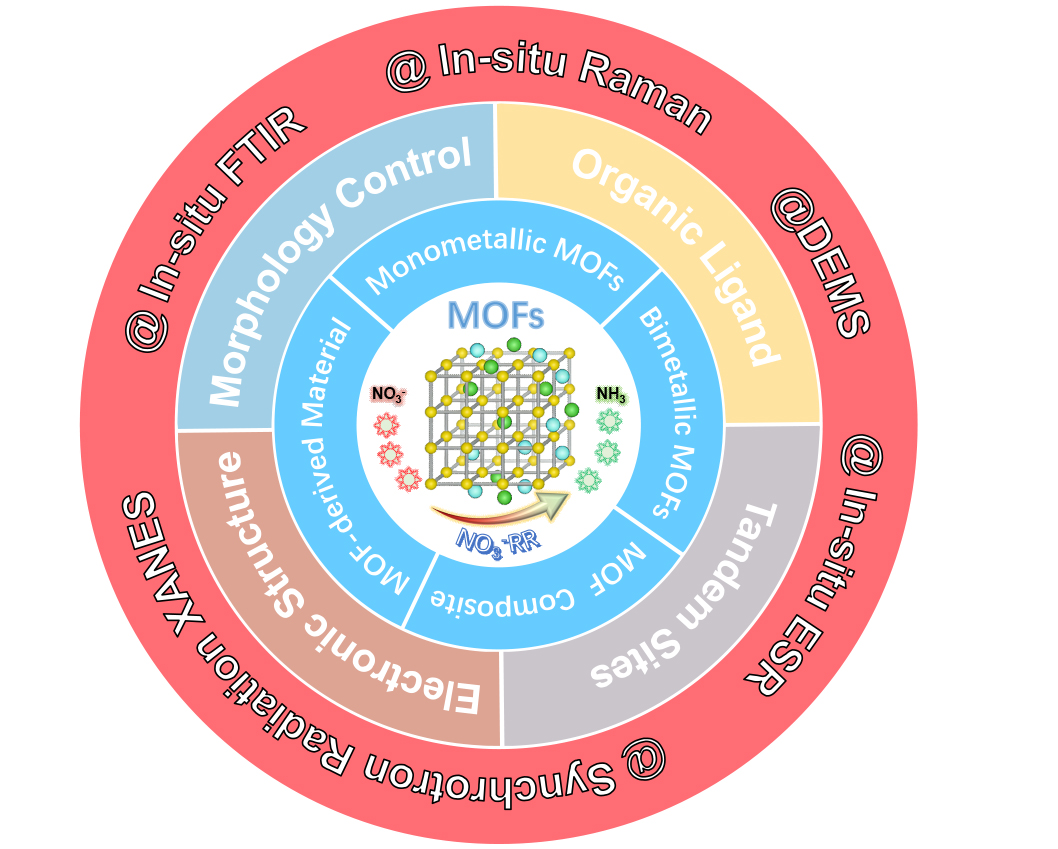
Fig. 1. Schematic illustration of the MOF-based materials for NO3-RR.
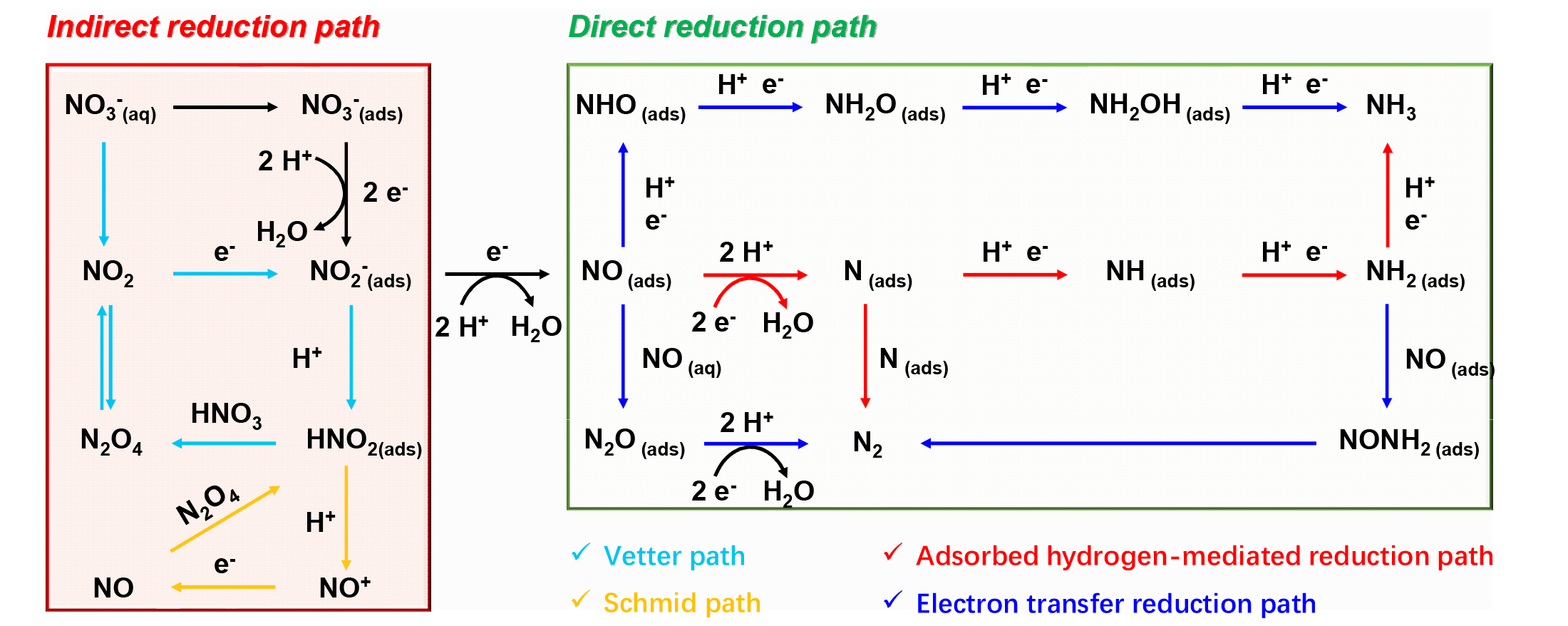
Fig. 2. Schematic diagram of NO3-RR mechanism.
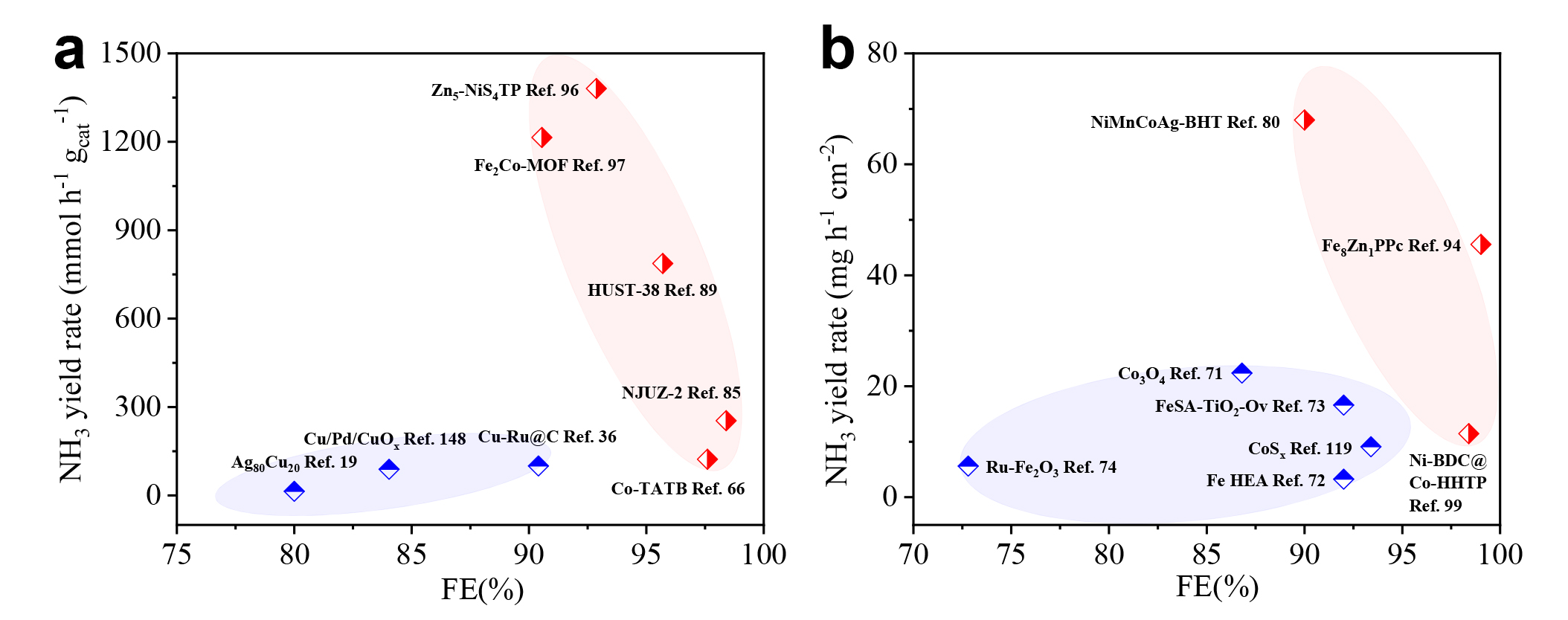
Fig. 3. (a) Comparation of representative MOF catalysts with Cu-based catalysts. (b) Comparation of representative MOF catalysts with Fe- and Co-based catalysts.
| Electrocatalyst | Electrolyte | Potential (V vs. RHE) | NH3 yield | FE (%) | Stability | Ref. |
|---|---|---|---|---|---|---|
| NiCoBDC@HsGDY | 1 mol L‒1 KOH +0.1 mol L‒1 NO3- | -0.34 | 0.56 mmol h-1 cm-2 | 99.1 | 16 cycles | [ |
| Co-TATB | 0.1 mol L‒1 Na2SO4 + 0.1 mol L‒1 KNO3 | -0.7 | 122.7 mmol h-1 gcat-1 | 97.6 | 8 cycles | [ |
| NiMnCoAg-BHT | 1 mol L‒1 KOH + 1 mol L‒1 KNO3 | -0.8 | 68 mg h-1 cm-2 | 90.0 | 15 cycles | [ |
| Cu-CA | 0.1 mol L‒1 Na2SO4 + 0.1 mol L‒1 KNO3 | -0.9 | 286.00 ug h-1 mg-1 | 90.3 | 10 cycles | [ |
| NJUZ-2 | 0.1 mol L‒1 Na2SO4 + 0.1 mol L‒1 KNO3 | -0.8 | 253.7 mmol h-1 gcat-1 | 98.4 | 70 h | [ |
| HUST-38 | 0.5 mol L‒1 K2SO4 + 0.1 mol L‒1 NO3- | -0.6 | 13.38 mg h-1 mgcat-1 | 95.7 | 32 cycles | [ |
| FeCo PBA HCAs | 0.1 mol L‒1 PBS + 0.1 mol L‒1 NaNO3 | -0.6 | 0.105 mmol h-1 cm-2 | 81.01 | 5 cycles | [ |
| Fe8Zn1PPc | 1 mol L‒1 NaOH + 0.5 mol L‒1 NaNO3 | -0.85 | 2.68 mmol h-1 cm-2 | 99.02 | 120 h | [ |
| Cu1Co1HHTP | 0.5 mol L‒1 Na2SO4 + 0.1 mol L‒1 NaNO3 | -0.6 | 299.9 μmol h-1 cm-2 | 96.4 | 7 cycles | [ |
| Zn5-NiS4TP | 0.05 mol L‒1 K2SO4 + 0.5 mol L‒1 KNO3 | -1.2 | 23477.59 ug h-1 mgcat-1 | 92.87 | 20 cycles | [ |
| Ni-BDC@Co-HHTP | 1 mol L‒1 NaOH + 0.1 mol L‒1 NaNO3 | -0.7 | 11.46 mg h-1 cm-2 | 98.4 | 10 cycles | [ |
| 1-Cu’ | 0.5 mol L‒1 Na2SO4 + 5 mmol L‒1 NaNO3 | -0.9 | 66 μmol h-1 cm-2 | 85.5 | 12 cycles | [ |
| CoP/Zn-ZIF | 0.5 mol L‒1 Na2SO4 + 0.1 mol L‒1 NaNO3 | -1 | 0.89 mmol h-1 cm-2 | 97.2 | 30 cycles | [ |
| Cu@C-800 | 0.1 mol L‒1 Na2SO4+500 ppm NO3- | -0.9 | 51.7 mmol h-1 cm-2 | 78 | — | [ |
| CoSx | 1 mol L‒1 NaOH + 0.1 mol L‒1 NaNO3 | -0.5 | 9.1 mg h-1 cm-2 | 93.4 | 5 cycles | [ |
| Cu/Co0.85SeVSe | 0.1 mol L‒1 KOH + 0.01 mol L‒1 NO3- | -0.6 | 2360 ug h-1 cm-2 | 93.5 | 600 h | [ |
| Co-TPA-E | 1 mol L‒1 KOH + 0.1 mol L‒1 KNO3 | -0.326 | 1.12 mmol h-1 cm-2 | 99.62 | 15 cycles | [ |
| Cu/NC | 0.5 mol L‒1 Na2SO4+200 ppm NO3- | -0.7 | 32300 ug h-1 mgcat-1 | 100 | 20 cycles | [ |
| Fe-N/P-C | 0.1 mol L‒1 KOH + 0.1 mol L‒1 KNO3 | -0.4 | 17980 ug h-1 mgcat-1 | 90.3 | 20 cycles | [ |
| CoRu/Pd/PCNFs | 0.1 mol L‒1 KOH + 0.1 mol L‒1 KNO3 | -0.6 | 78 umol h-1 mgcat-1 | 98.69 | 100 h | [ |
| Fe-cyano NSs | 1 mol L‒1 KOH + 0.1 mol L‒1 KNO3 | -0.5 | 42.1 mg h-1 mgcat-1 | 90.2 | 8 cycles | [ |
| Cu99Ni1-DBCO | 0.1 mol L‒1 KHCO3 + 0.05 mol L‒1 KNO3 | -1.1 | 159.4 ug h-1 mgcat-1 | 80 | 60 h | [ |
Table 1 Summary of recently reported pristine MOFs, MOF composites, and MOF derivatives for NO3-RR.
| Electrocatalyst | Electrolyte | Potential (V vs. RHE) | NH3 yield | FE (%) | Stability | Ref. |
|---|---|---|---|---|---|---|
| NiCoBDC@HsGDY | 1 mol L‒1 KOH +0.1 mol L‒1 NO3- | -0.34 | 0.56 mmol h-1 cm-2 | 99.1 | 16 cycles | [ |
| Co-TATB | 0.1 mol L‒1 Na2SO4 + 0.1 mol L‒1 KNO3 | -0.7 | 122.7 mmol h-1 gcat-1 | 97.6 | 8 cycles | [ |
| NiMnCoAg-BHT | 1 mol L‒1 KOH + 1 mol L‒1 KNO3 | -0.8 | 68 mg h-1 cm-2 | 90.0 | 15 cycles | [ |
| Cu-CA | 0.1 mol L‒1 Na2SO4 + 0.1 mol L‒1 KNO3 | -0.9 | 286.00 ug h-1 mg-1 | 90.3 | 10 cycles | [ |
| NJUZ-2 | 0.1 mol L‒1 Na2SO4 + 0.1 mol L‒1 KNO3 | -0.8 | 253.7 mmol h-1 gcat-1 | 98.4 | 70 h | [ |
| HUST-38 | 0.5 mol L‒1 K2SO4 + 0.1 mol L‒1 NO3- | -0.6 | 13.38 mg h-1 mgcat-1 | 95.7 | 32 cycles | [ |
| FeCo PBA HCAs | 0.1 mol L‒1 PBS + 0.1 mol L‒1 NaNO3 | -0.6 | 0.105 mmol h-1 cm-2 | 81.01 | 5 cycles | [ |
| Fe8Zn1PPc | 1 mol L‒1 NaOH + 0.5 mol L‒1 NaNO3 | -0.85 | 2.68 mmol h-1 cm-2 | 99.02 | 120 h | [ |
| Cu1Co1HHTP | 0.5 mol L‒1 Na2SO4 + 0.1 mol L‒1 NaNO3 | -0.6 | 299.9 μmol h-1 cm-2 | 96.4 | 7 cycles | [ |
| Zn5-NiS4TP | 0.05 mol L‒1 K2SO4 + 0.5 mol L‒1 KNO3 | -1.2 | 23477.59 ug h-1 mgcat-1 | 92.87 | 20 cycles | [ |
| Ni-BDC@Co-HHTP | 1 mol L‒1 NaOH + 0.1 mol L‒1 NaNO3 | -0.7 | 11.46 mg h-1 cm-2 | 98.4 | 10 cycles | [ |
| 1-Cu’ | 0.5 mol L‒1 Na2SO4 + 5 mmol L‒1 NaNO3 | -0.9 | 66 μmol h-1 cm-2 | 85.5 | 12 cycles | [ |
| CoP/Zn-ZIF | 0.5 mol L‒1 Na2SO4 + 0.1 mol L‒1 NaNO3 | -1 | 0.89 mmol h-1 cm-2 | 97.2 | 30 cycles | [ |
| Cu@C-800 | 0.1 mol L‒1 Na2SO4+500 ppm NO3- | -0.9 | 51.7 mmol h-1 cm-2 | 78 | — | [ |
| CoSx | 1 mol L‒1 NaOH + 0.1 mol L‒1 NaNO3 | -0.5 | 9.1 mg h-1 cm-2 | 93.4 | 5 cycles | [ |
| Cu/Co0.85SeVSe | 0.1 mol L‒1 KOH + 0.01 mol L‒1 NO3- | -0.6 | 2360 ug h-1 cm-2 | 93.5 | 600 h | [ |
| Co-TPA-E | 1 mol L‒1 KOH + 0.1 mol L‒1 KNO3 | -0.326 | 1.12 mmol h-1 cm-2 | 99.62 | 15 cycles | [ |
| Cu/NC | 0.5 mol L‒1 Na2SO4+200 ppm NO3- | -0.7 | 32300 ug h-1 mgcat-1 | 100 | 20 cycles | [ |
| Fe-N/P-C | 0.1 mol L‒1 KOH + 0.1 mol L‒1 KNO3 | -0.4 | 17980 ug h-1 mgcat-1 | 90.3 | 20 cycles | [ |
| CoRu/Pd/PCNFs | 0.1 mol L‒1 KOH + 0.1 mol L‒1 KNO3 | -0.6 | 78 umol h-1 mgcat-1 | 98.69 | 100 h | [ |
| Fe-cyano NSs | 1 mol L‒1 KOH + 0.1 mol L‒1 KNO3 | -0.5 | 42.1 mg h-1 mgcat-1 | 90.2 | 8 cycles | [ |
| Cu99Ni1-DBCO | 0.1 mol L‒1 KHCO3 + 0.05 mol L‒1 KNO3 | -1.1 | 159.4 ug h-1 mgcat-1 | 80 | 60 h | [ |
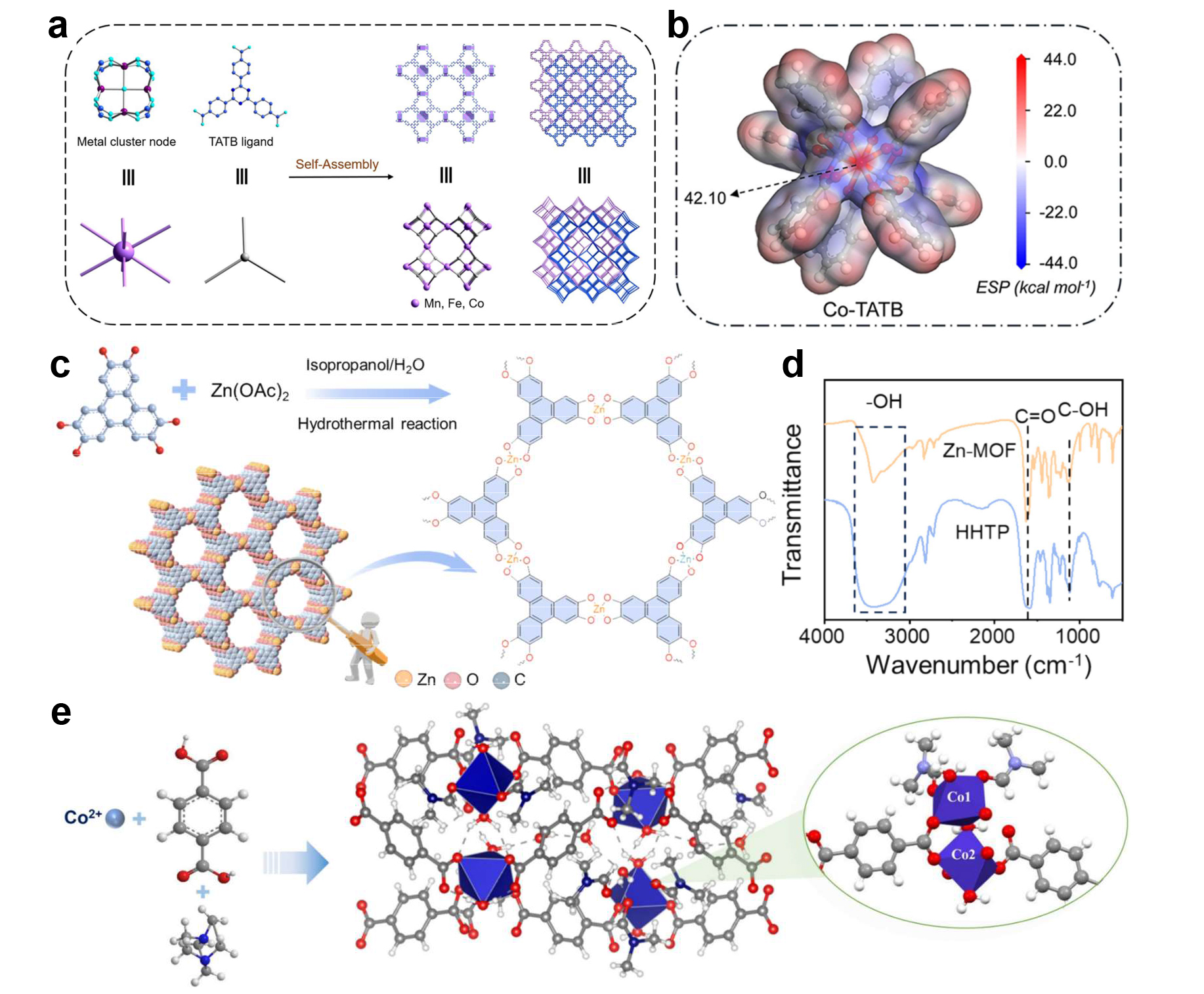
Fig. 4. (a) Schematic representation of the structural assembly process and crystal structures of the high-symmetry coordination MOPs (M = Mn, Fe, or Co). (b) Electrostatic potential (ESP) surface of the Co-TATB model. Reprinted with permission from Ref. [66]. Copyright 2025, American Chemical Society. (c) Schematic illustration of Zn-MOF sample synthesis. (d) Infrared spectra of Zn-MOF and HHTP samples. Reprinted with permission from Ref. [88]. Copyright 2026, Elsevier. (e) Schematic representation of the synthesis, molecular structure, and coordination network within the crystal lattice of HUST-38. Reprinted with permission from Ref. [89]. Copyright 2025, American Chemical Society.
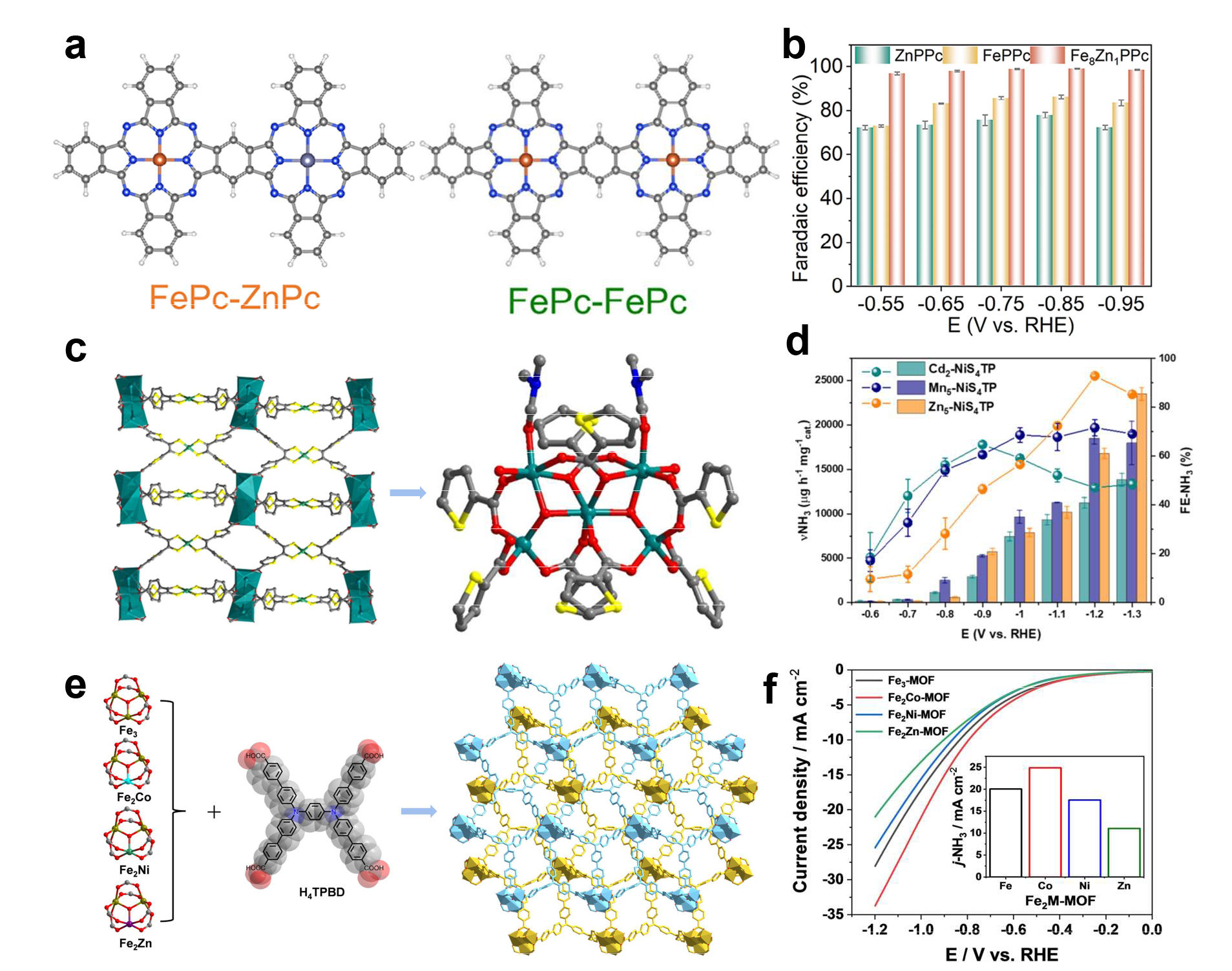
Fig. 5. (a) The computational structure models of FePc-FePc and FePc-ZnPc. (b) FENH3 of FePPc, ZnPPc and Fe8Zn1PPC. Reprinted with permission from Ref. [94], Copyright 2025, John Wiley and Sons. (c) Crystal structure of the ligand and view of the three-dimensional structure in the bc plane and coordination environments of Zn5-NiS4TP. (d) NH3 yield rates and the corresponding FEs-NH3 of the Zn5-NiS4TP, Mn5-NiS4TP and Cd2-NiS4TP at selected potentials in 0.05 mol L-1 K2SO4 with 0.5 mol L-1 KNO3. Reprinted with permission from Ref. [96]. Copyright 2025, John Wiley and Sons. (e) 3D framework of Fe2M-MOF with different trinuclear metal clusters and the H4TPBD ligand. (f) LSV curves of Fe2M-MOFs in 0.05 mol L-1 (pH = 1) H2SO4 with 50 g L-1 KNO3 electrolytes. Reprinted with permission from Ref. [97]. Copyright 2023, John Wiley and Sons.
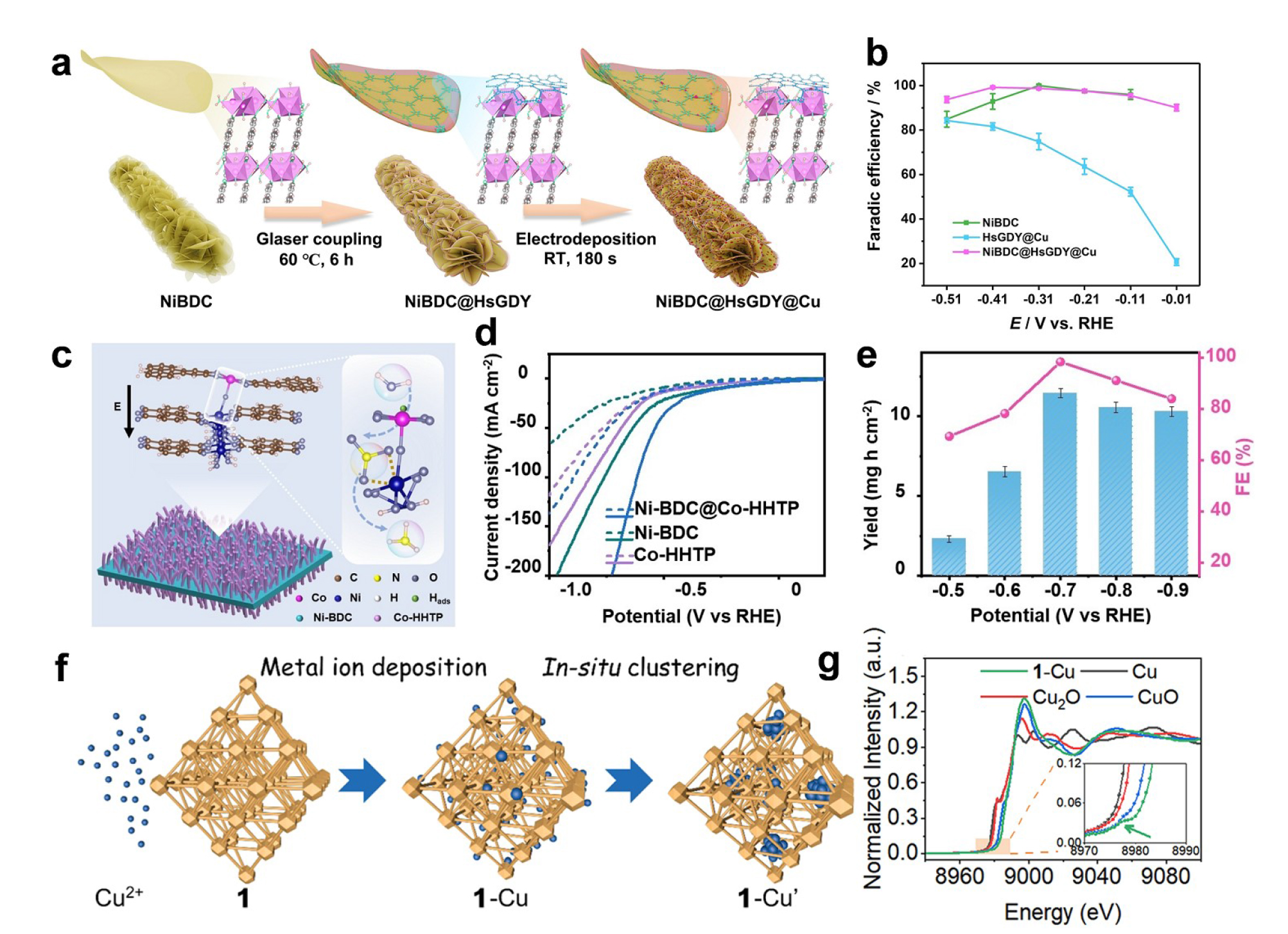
Fig. 6. (a) Schematic illustration of the joining of ultrathin Ni-MOF nanosheets with few-layered HsGDY-supported Cu single atoms and clusters. (b) FENH3 of NiBDC, HsGDY@Cu and NiBDC@HsGDY@Cu. Reprinted with permission from Ref. [98]. Copyright 2024, John Wiley and Sons. (c) Illustration of NO3‒RR to NH3 production over Ni-BDC@Co-HHTP heterostructured MOF-on-MOF electrocatalyst. (d) LSV curves in 1 mol L‒1 KOH electrolyte with and without NO3‒. (e) The NH3 yield rate and FE of Ni-BDC@Co-HHTP at different potentials. Reprinted with permission from Ref. [99]. Copyright 2024, John Wiley and Sons. (f) Preparation and evolution of the host-guest Cu catalyst through metal ion deposition and in-situ clustering routes. (g) Normalized XANES of 1-Cu’. Reprinted with permission from Ref. [104]. Copyright 2022, American Chemical Society.
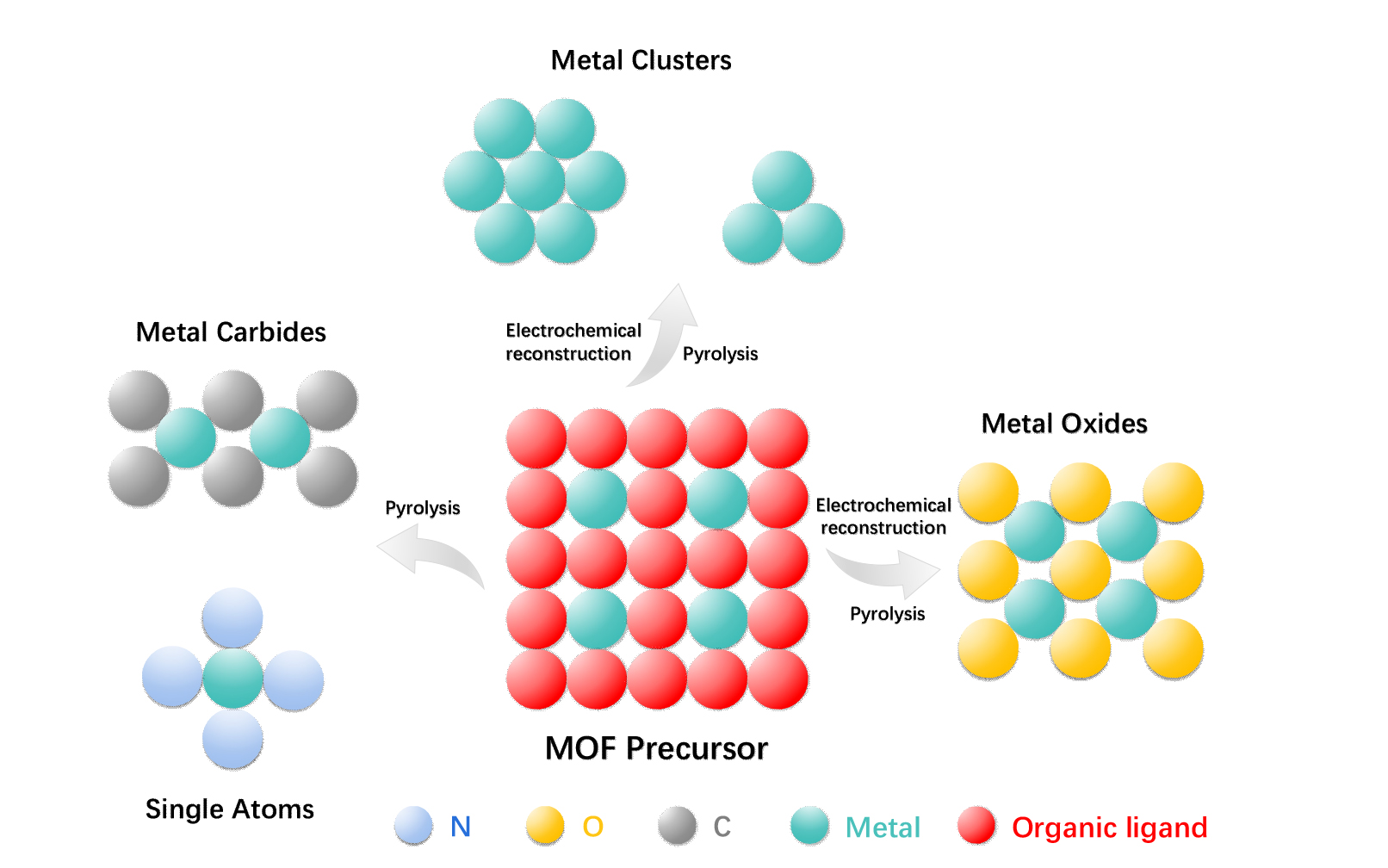
Fig. 7. Schematic illustration of taking MOF materials as precursor to prepare metal clusters, metal oxides, metal carbides and single-atom catalysts by means of electrochemical reconstruction or pyrolysis.
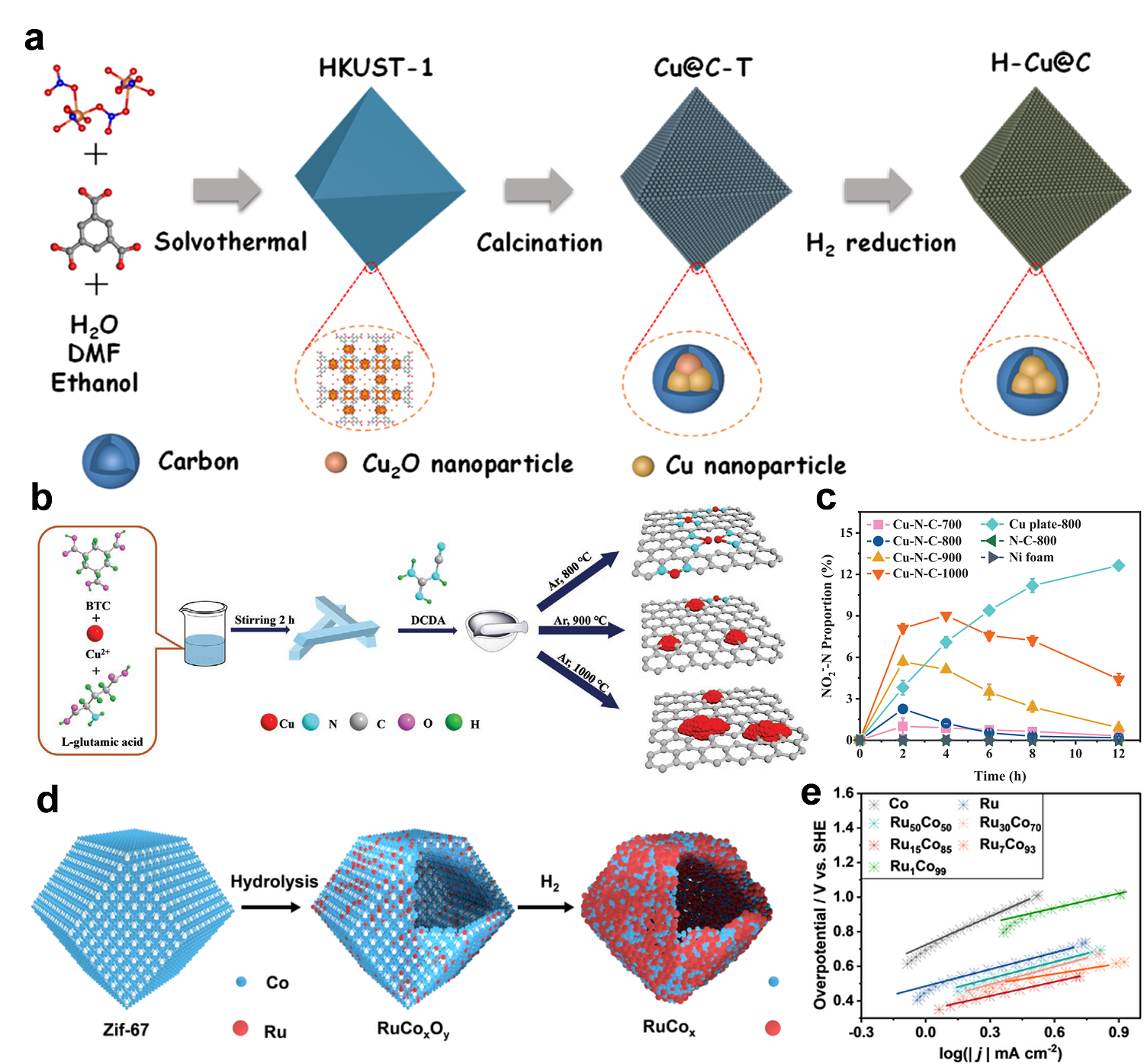
Fig. 8. (a) Schematic illustration of the preparation of HKUST-1. Reprinted with permission from Ref. [112], Copyright 2022, American Chemical Society. (b) Schematic illustration of the synthesis process for Cu-N-C-T. (c) Time-course NO2--N proportion. Reprinted with permission from Ref. [114]. Copyright 2020, John Wiley and Sons. (d) Schematic illustration of RuxCoy HNDs synthesis. (e) Tafel slopes of NO3-RR over RuxCoy HNDs. Reprinted with permission from Ref. [117]. Copyright 2023, Springer Nature.
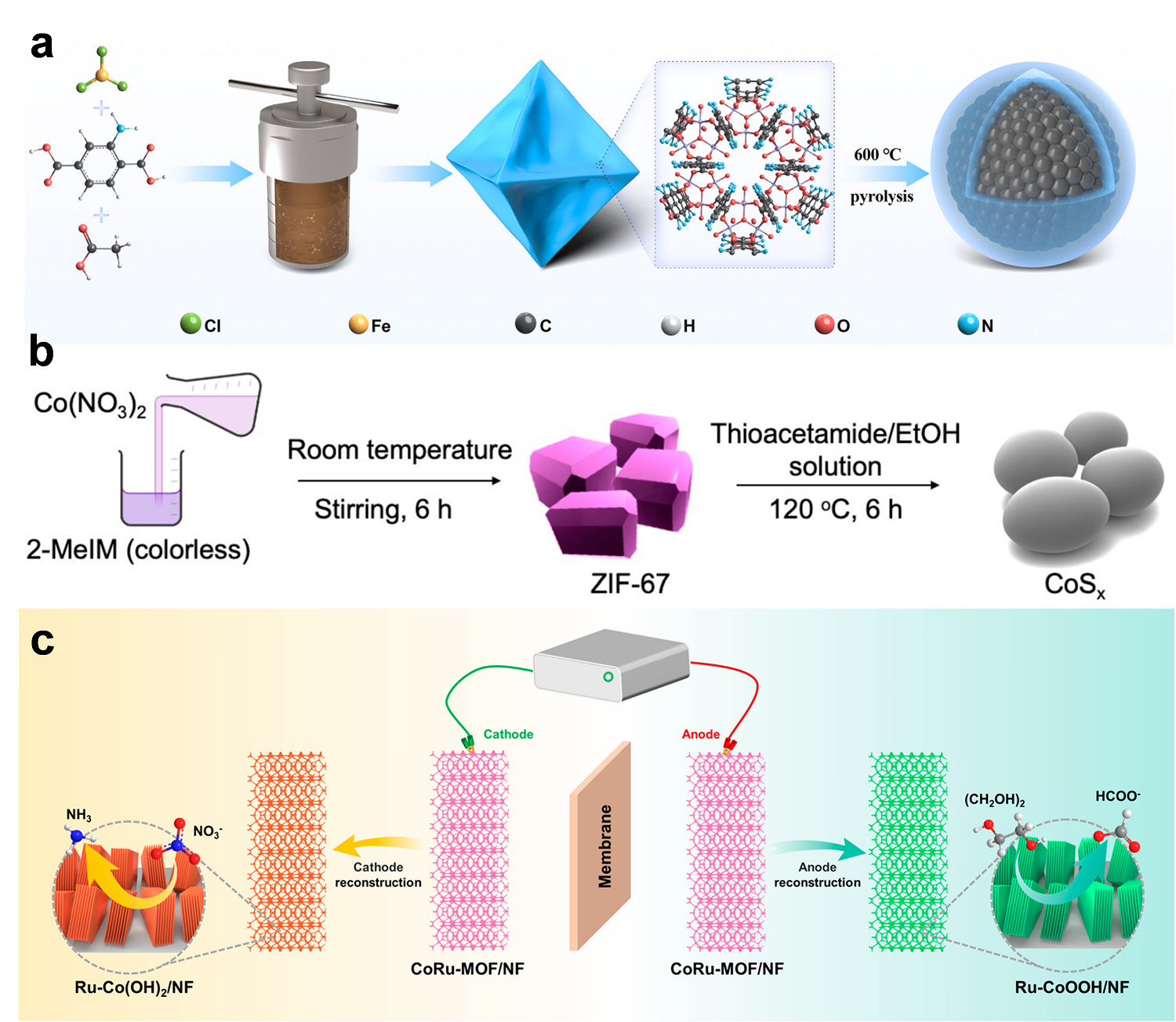
Fig. 9. (a) Synthetic route of Fe3O4@NC-600. Reprinted with permission from Ref. [118]. Copyright 2025, Elsevier. (b) Schematic representation of the synthesis process of cobalt sulfides derived from ZIF-67. Reprinted with permission from Ref. [119]. Copyright 2025, Royal Society of Chemistry. (c) Schematic illustration of the electrocatalytic system for NO3-RR and PET hydrolysate upcycling. Reprinted with permission from Ref. [126]. Copyright 2023, American Chemical Society.

Fig. 10. (a) Schematic illustration of the formation of Cu SACs. (b) The Cu K-edge EXAFS fitting curves of Cu(0.1wt%)/NC. Reprinted with permission from Ref. [131]. Copyright 2023, American Chemical Society. (c) Synthesis and structural characterizations of Fe-N/P-C catalyst. (d) The EDS elemental mappings of Fe-N/P-C. Reprinted with permission from Ref. [133]. Copyright 2023, John Wiley and Sons. (e) Schematic diagram of the EMOFs general synthesis strategy for preparing dual-atom platforms. (f) The 2D atomic resolution map of the Zn-Mn dual-site. Reprinted with permission from Ref. [135]. Copyright 2025, John Wiley and Sons.
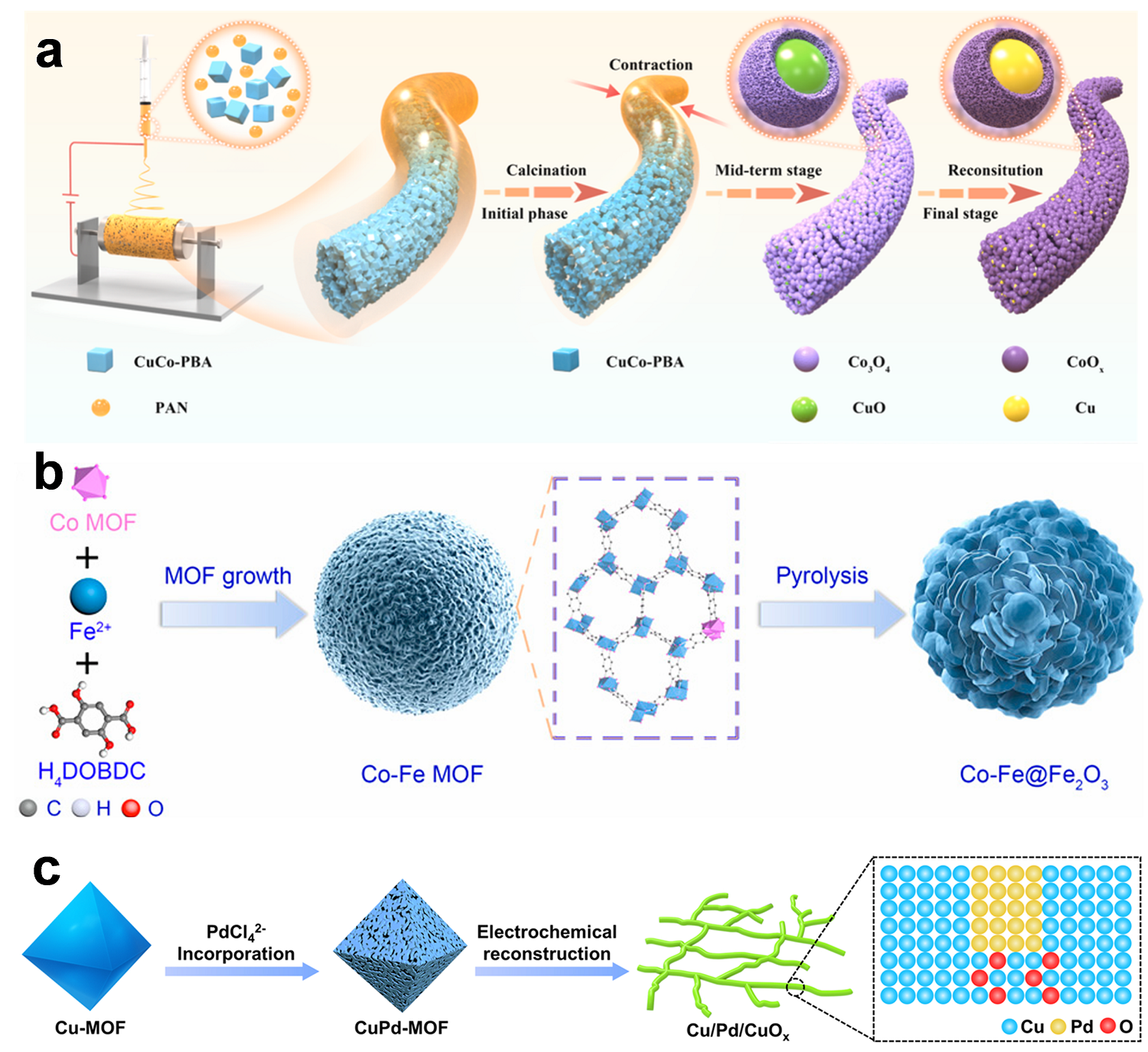
Fig. 11. (a) Schematic of the synthesis process for the rich Cu/CoOx@NFs heterogeneous active electrocatalyst. Reprinted with permission from Ref. [144]. Copyright 2024, Elsevier. (b) Synthetic procedure of Co-Fe@Fe2O3. Reprinted with permission from Ref. [147]. Copyright 2022, National Academy of Sciences. (c) Schematic illustration of the preparation of Cu/Pd/CuOx. Reprinted with permission from Ref. [148]. Copyright 2022, Elsevier.
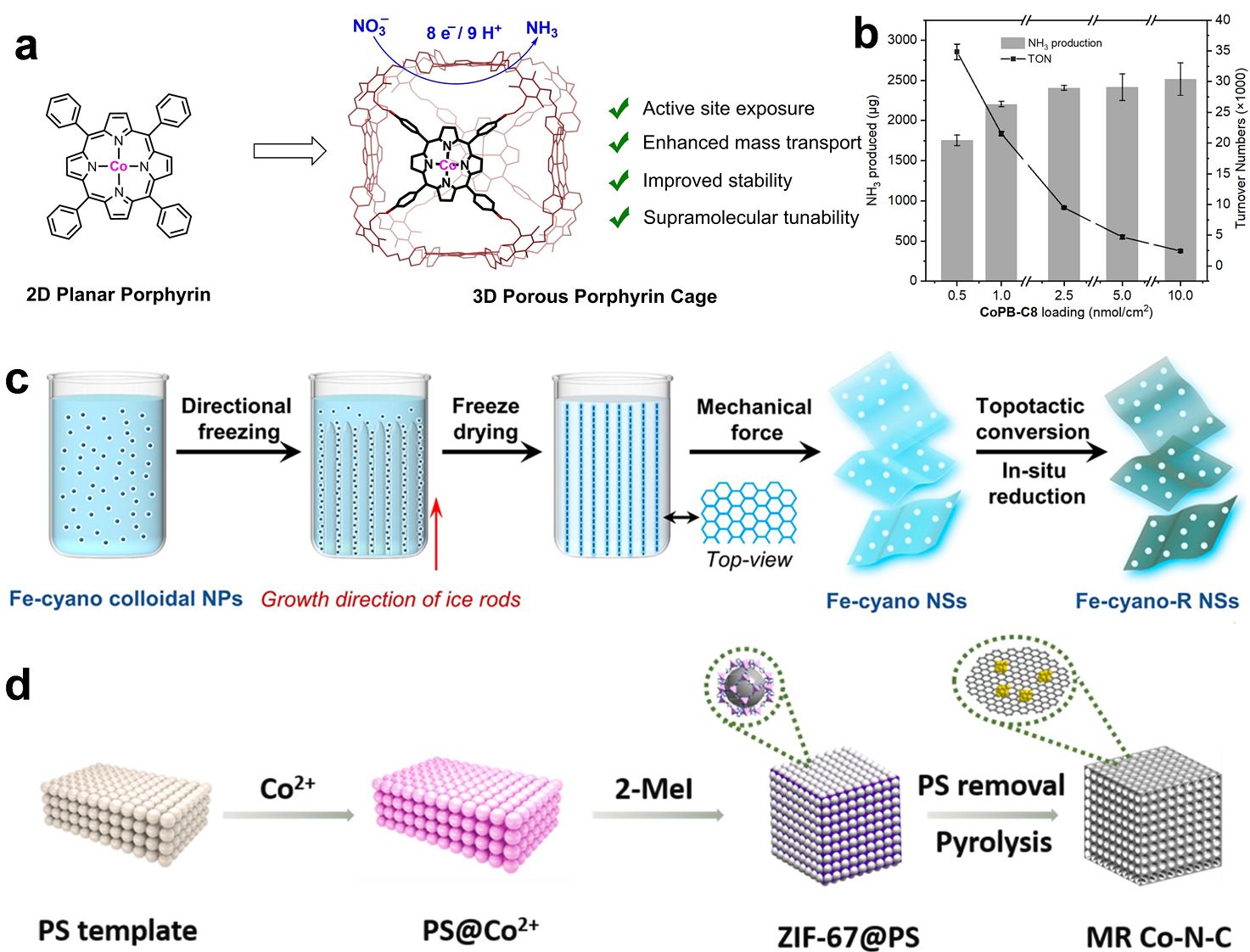
Fig. 12. (a) Supramolecular enhancement of electrochemical NO3-RR catalyzed by embedding 2D molecular cobalt porphyrin into a 3D porous organic cage architecture. (b) NH3 production and TON for various amounts of CoPB-C8 loading at -1.54 V vs. SCE. Reprinted with permission from Ref. [150]. Copyright 2023, John Wiley and Sons. (c) Fe-cyano-R NSs electrocatalysts via directional freezing. Reprinted with permission from Ref. [152]. Copyright 2022, American Chemical Society. (d) Schematic illustration of the synthesis process of MR Co-NC. Reprinted with permission from Ref. [154]. Copyright 2023, Elsevier.
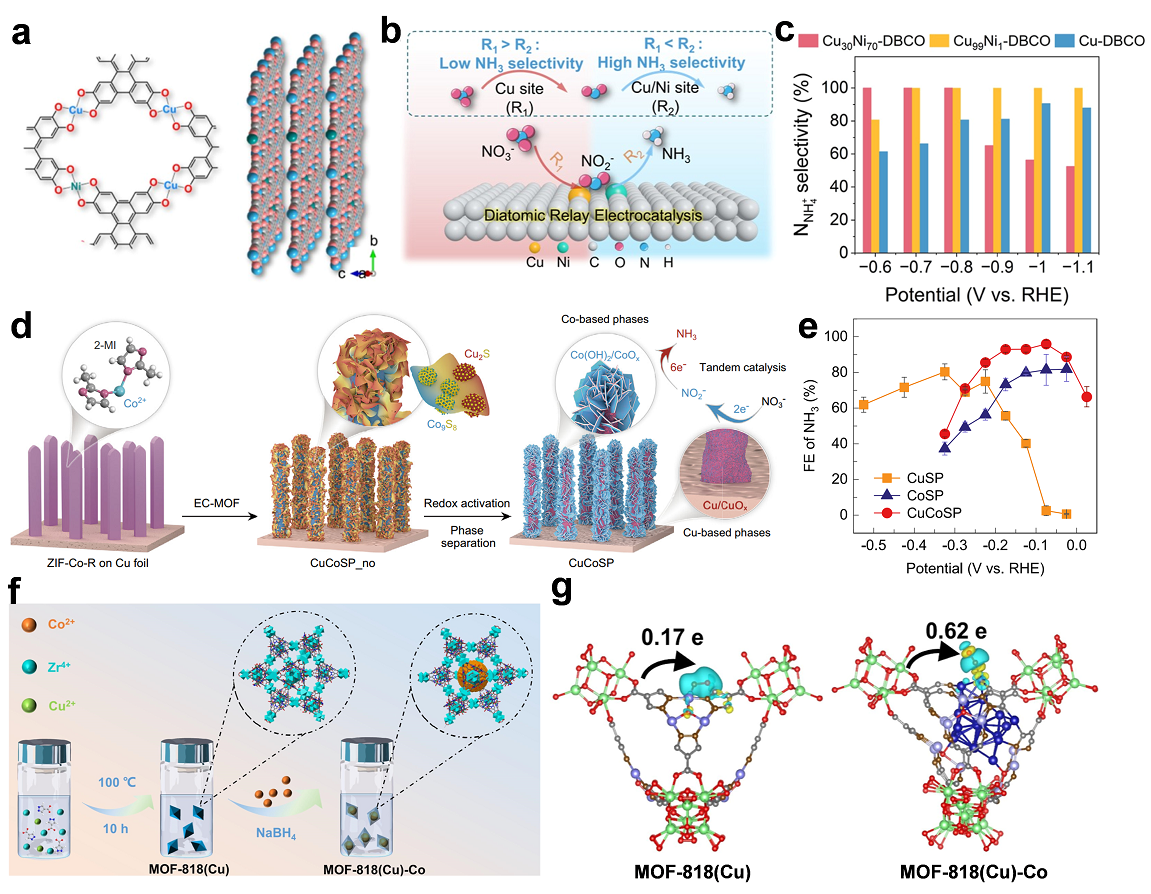
Fig. 13. (a) Top view, and side view of the layer showing the CuO4 and NiO4 nodes. (b) Schematic illustration of NO3-RR selectivity determined by R1 and R2 via the relay electrocatalysis mechanism. (c) NNH4 selectivity over typical samples in Ar-saturated 0.1 mol L‒1 KHCO3 + 0.05 mol L‒1 KNO3 solutions. Reprinted with permission from Ref. [158], Copyright 2025, American Chemical Society. (d) Schematic illustration of the preparation of a Cu/Co-based binary ‘tandem catalyst’. (e) Faradaic efficiencies (FE) for NH3 on CuSP, CoSP and CuCoSP in 0.01 mol L‒1 NO3- and 0.1 mol L‒1 KOH (pH = 13) at various applied potentials. Reprinted with permission from Ref. [159]. Copyright 2022, Springer Nature. (f) Schematic synthesis and structure of MOF-818(Cu)-Co. (g) Charge density difference of *NO adsorbed on MOF-818(Cu) and MOF-818(Cu)-Co. Reprinted with permission from Ref. [160], Copyright 2025, American Chemical Society.
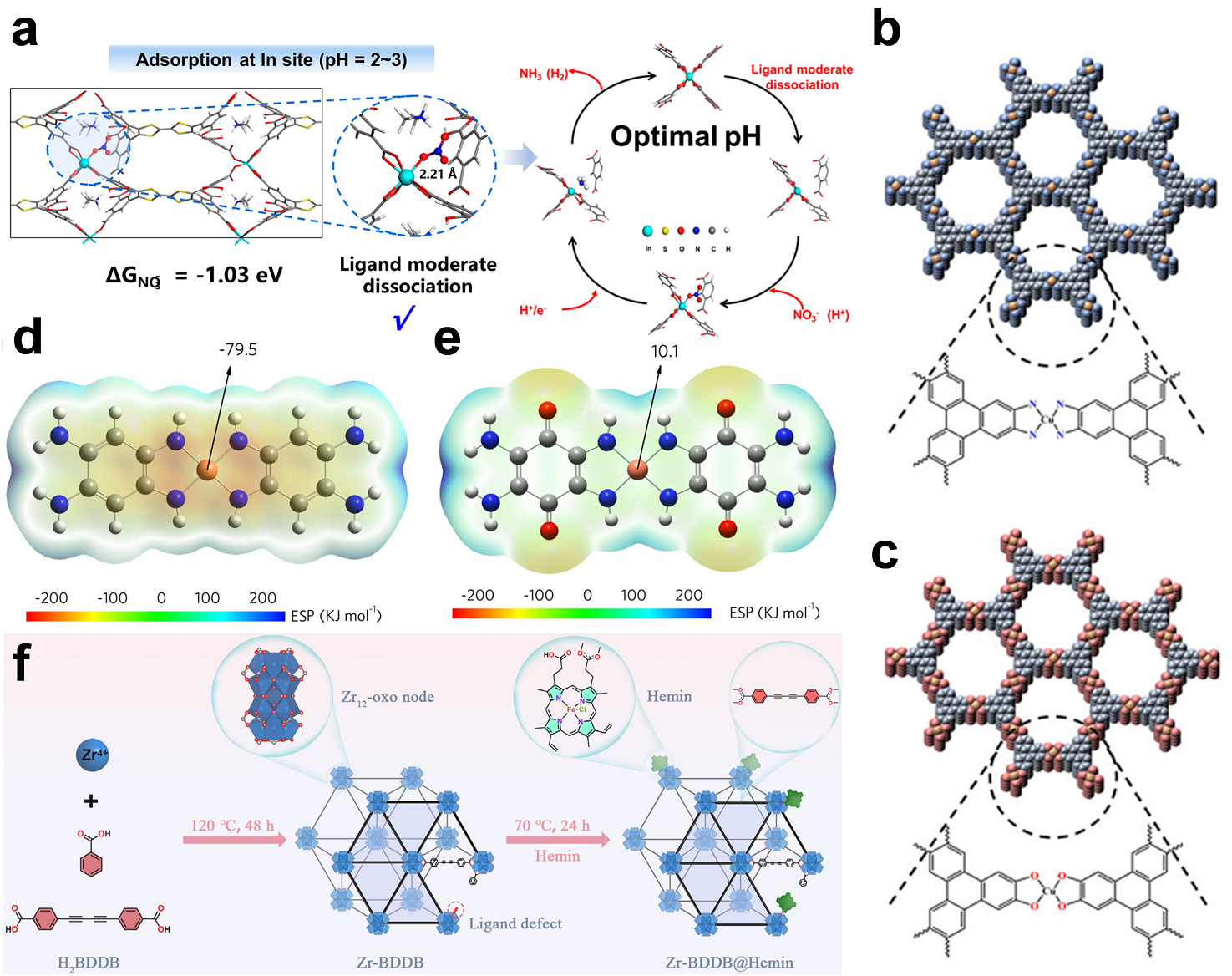
Fig. 14. (a) Schematic diagram of the dynamic dissociation catalytic mechanism for In8 at pH = 2‒3. Reprinted with permission from Ref. [161]. Copyright 2022, American Chemical Society. Crystal structure of Cu3(HITP)2 (b) and Cu3(HHTP)2 (c). Reprinted with permission from Ref. [163]. Copyright 2025, John Wiley and Sons. The ESP for CuBTA (d) and CuTABQ (e). Reprinted with permission from Ref. [165]. Copyright 2023, John Wiley and Sons. (f) Schematic illustration for the preparation of the Zr-BDDB@Hemin. Reprinted with permission from Ref. [168]. Copyright 2025, John Wiley and Sons.
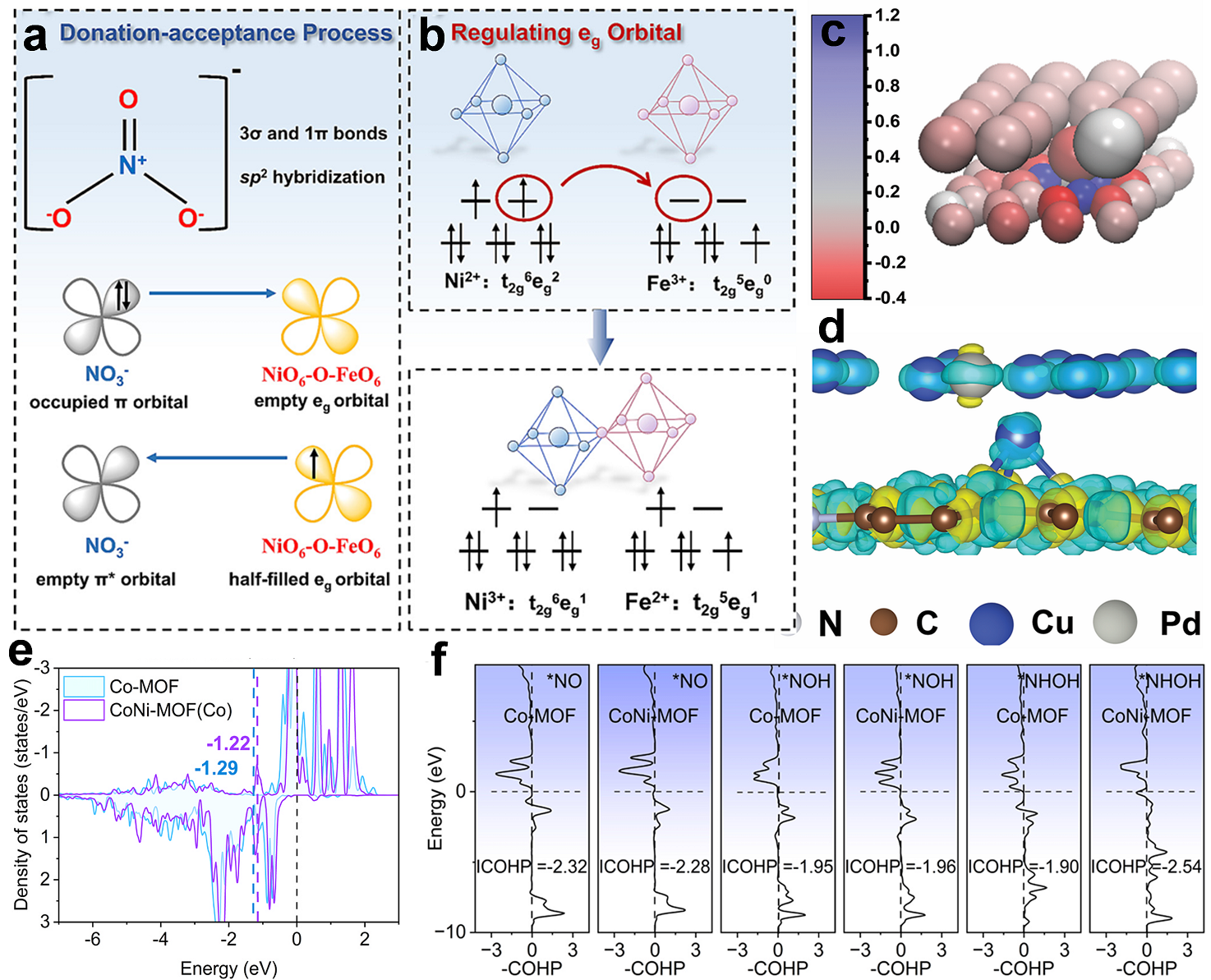
Fig. 15. (a) The structure of nitrate ions and ideal catalytic site following electron back-donation process during N-O activation. (b) Schematic diagram of electron repulsion in eg orbitals. Reprinted with permission from Ref. [169]. Copyright 2025, Elsevier. (c) Bader charge plot of CuPd/CN. (d) Side-view of electron density difference on CuPd/CN. Reprinted with permission from Ref. [170]. Copyright 2022, John Wiley and Sons. (e) PDOS curves of Co 3d in CoNi-MOF and Co-MOF, and the corresponding d-band center values (εd, eV). (f) Projected crystal orbital Hamilton populations for the *NO, *NOH and *NHOH intermediates bonded on the Co site over CoNi-MOF and Co-MOF. Reprinted with permission from Ref. [172]. Copyright 2026, Elsevier.
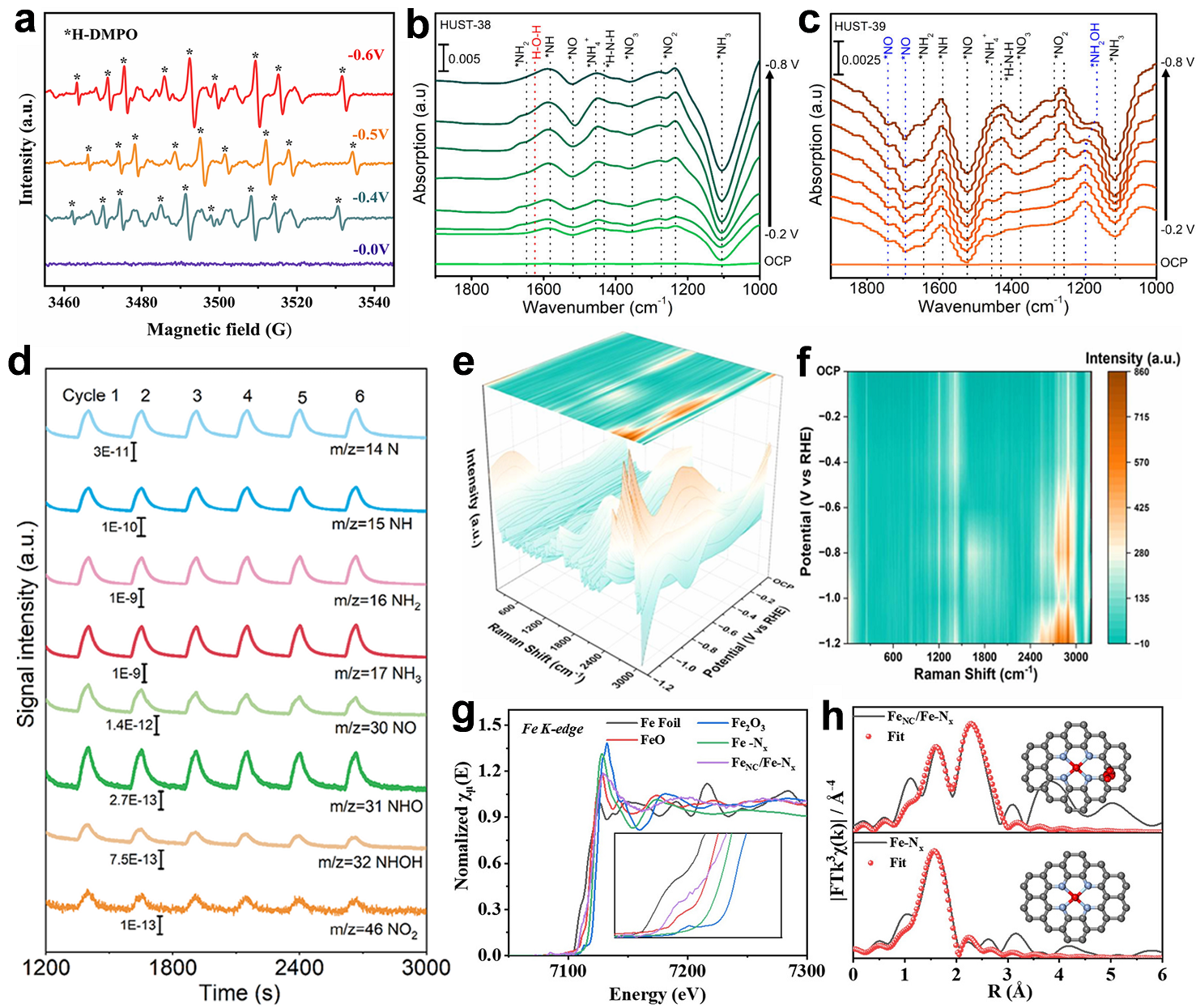
Fig. 16. (a) Generation of *H on Cu-MOF/Co-MOF@NF surface during EPR detection. Reprinted with permission from Ref. [174]. Copyright 2025, American Chemical Society. In-situ FT-IR spectra for HUST-38 (b) and HUST-39 (c). Reprinted with permission from Ref. [89]. Copyright 2025, American Chemical Society. (d) Online DEMS spectra of Fe8Zn1PPc under different applied potentials in NO3-RR. Reprinted with permission from Ref. [94]. Copyright 2025, John Wiley and Sons. (e,f) In-situ Raman plots of Cu-TCPP/Cu2O/CF with a potential change in pH = 7 environment. Reprinted with permission from Ref. [175]. Copyright 2025, American Chemical Society. (g) XANES spectra of the Fe K-edge. (h) Fitting results of the EXAFS spectra at R space. Reprinted with permission from Ref. [141]. Copyright 2025, Elsevier.
|
| [1] | Shijian Luo, Hao Chen, Yuran Yang, Yang Song, Yongduo Liu, Daojun Long, Siguo Chen, Zidong Wei. Hydride-enhanced plasma catalysis enables ultrahigh-rate ammonia synthesis at room temperature and atmospheric pressure [J]. Chinese Journal of Catalysis, 2026, 88(9): 269-278. |
| [2] | Chunlei Zhang, Hanyu Tan, Chaoyang Sui, Ying Feng, Xinyu Chen, Xiaoqiang Fan, Xuehua Yu, Zhen Zhao. Efficient methane combustion by engineering surface oxygen vacancies on MOF-derived multi-shell Pd@Co3O4 [J]. Chinese Journal of Catalysis, 2026, 88(9): 492-505. |
| [3] | Fengjuan Guo, Chunyao Ma, Yue Huang, Sitong Hang, Junwei Ma, Hongtao Gao. Unveiling the dominant distal-alternating hybrid mechanism in B-modulated Mo2TiC2Tx/MoO2 MXene for highly selective ambient NRR [J]. Chinese Journal of Catalysis, 2026, 87(8): 269-281. |
| [4] | Junyan Liu, Tao Shao, Xun Peng, Shengwei Liu. Ligand-defect synergistic catalyst for localized CO2 concentration enhancement in electrochemical reduction of low concentration CO2 [J]. Chinese Journal of Catalysis, 2026, 86(7): 265-276. |
| [5] | Biao Zhou, Jianwei Chen, Yanan Chong, Keyou Yan. Full-space electric field-mediated charge migration in mixed-valence MIL-88A(Fe)@BiOBr heterostructures for efficient photocatalytic pollutant removal [J]. Chinese Journal of Catalysis, 2026, 86(7): 338-349. |
| [6] | Yixin Li, Jianhao Qiu, Guanglu Xia, Qiying Liu, Biyao Fang, Meng Liu, Chen Chen, Jianfeng Yao. Hollow tubular In2O3 modified carbon nitride for photocatalytic high-yield cleavage of lignin C-C bonds under 395 nm light [J]. Chinese Journal of Catalysis, 2026, 83(4): 209-218. |
| [7] | Xuanbei Peng, Mengqi An, Ruishao Mao, Yanliang Zhou, Ming Chen, Dongya Huang, Kailin Su, Shiyong Zhang, Jun Ni, Xiuyun Wang, Lilong Jiang. Scheelite-type alkali metal perrhenates supported Co-based catalysts for highly efficient ammonia synthesis [J]. Chinese Journal of Catalysis, 2026, 83(4): 432-443. |
| [8] | Xiaoyan Fu, Dong Luan, Chenyu Yang, Jianping Xiao. Electrochemical ammonia synthesis over copper oxide derived catalysts studied by electric field dependent machine learning potential [J]. Chinese Journal of Catalysis, 2026, 89(10): 410-421. |
| [9] | Yang Fei, Qingjuan Lei, Liming Fan, Tuoping Hu, Qi-Pin Qin, Xiutang Zhang. Organic-site-dominated cooperative catalysis in defect-tolerant 2D lanthanide MOFs for direct CO2 valorization and DFT calculations [J]. Chinese Journal of Catalysis, 2026, 89(10): 353-366. |
| [10] | Xu Xinmeng, Xi Zuoshuai, Gao Hongyi, Zhao Danfeng, Liu Zhiyuan, Ban Tao, Wang Jingjing, Zhao Shunzheng, Wang Ge. Microenvironment modulation around frustrated Lewis pairs in Ce-based metal-organic frameworks for efficient catalytic hydrogenation [J]. Chinese Journal of Catalysis, 2025, 75(8): 59-72. |
| [11] | Xiaochun Hu, Longgang Tao, Kun Lei, Zhiqiang Sun, Mingwu Tan. Unraveling TiO2 phase effects on Pt single-atom catalysts for efficient CO2 conversion [J]. Chinese Journal of Catalysis, 2025, 73(6): 186-195. |
| [12] | Yun Ling, Hui Su, Ru-Yu Zhou, Qingyun Feng, Xuan Zheng, Jing Tang, Yi Li, Maosheng Zhang, Qingxiang Wang, Jian-Feng Li. Neighboring effect in PtCuSnCo alloy catalysts for precisely regulating nitrate adsorption and deoxidation to achieve 100% faradaic efficiency in ammonia synthesis [J]. Chinese Journal of Catalysis, 2025, 73(6): 347-357. |
| [13] | Rushuo Li, Tao Ban, Danfeng Zhao, Fajie Hu, Jing Lin, Xiubing Huang, Zhiping Tao, Ge Wang. Defective UiO-66(Ce) supported Ni nanoparticles with optimized microenvironment and electronic state for efficient olefin hydrogenation reaction [J]. Chinese Journal of Catalysis, 2025, 72(5): 344-358. |
| [14] | Xue-Feng Cheng, Qing Liu, Qi-Meng Sun, Huilong Dong, Dong-Yun Chen, Ying Zheng, Qing-Feng Xu, Jian-Mei Lu. Proximity electronic effect of adjacent Ni Site enhances compatibility of hydrogenation and deoxygenation over Cu Site to boost nitrate electroreduction to ammonia [J]. Chinese Journal of Catalysis, 2025, 70(3): 285-298. |
| [15] | Zhaoyang Chen, Qingtian Zhong, Qiqige Wulan, Yuan Ji, Chunxiao Liu, Xu Li, Tingting Zheng, Qiu Jiang, Chuan Xia. Commercialization of electrochemical CO2 reduction: HCOOH pathway versus CO pathway [J]. Chinese Journal of Catalysis, 2025, 69(2): 52-57. |
| Viewed | ||||||
|
Full text |
|
|||||
|
Abstract |
|
|||||


