
Chinese Journal of Catalysis ›› 2027, Vol. 92: 65-86.DOI: 10.1016/S1872-2067(26)65280-1
• Reviews • Previous Articles Next Articles
Panyong Kuanga,c,*( ), Zhenrui Nia, Sihan Chena, Weilai Yub,*()
Received:2026-07-14
Accepted:2026-09-14
Online:2026-12-05
Published:2026-10-30
Contact:
*E-mail: kuangpanyong@cug.edu.cn (P. Kuang),About author:Panyong Kuang (China University of Geosciences) received his Ph.D. degree in 2019 and completed his postdoctoral research in 2021 at Wuhan University of Technology under the supervision of Prof. Jiaguo Yu. In 2021, he joined the Laboratory of Solar Fuel at China University of Geosciences (Wuhan). From 2023 to 2024, he was a visiting scholar at Cardiff University, under the supervision of Prof. Graham J. Hutchings. His research focuses on the precise synthesis and structural regulation of supported, heterostructured, and low-loading noble-metal-based catalysts for electrochemical energy conversion, including water splitting and carbon dioxide reduction. He has published more than 50 SCI-indexed papers and has been recognized among the World’s Top 2% Scientists (2023-2025). He serves as a young editorial board member of Rare Metals, Acta Physico-Chimica Sinica, and Chinese Journal of Rare Metals, and is a member of the Chinese Energy Society and the Energy Conversion and Storage Committee of the Wuhan Energy Society.Supported by:Panyong Kuang, Zhenrui Ni, Sihan Chen, Weilai Yu. Engineering electrocatalysts for industrial-current-density alkaline hydrogen evolution: Design principles and future perspectives[J]. Chinese Journal of Catalysis, 2027, 92: 65-86.
Add to citation manager EndNote|Ris|BibTeX
URL: https://www.cjcatal.com/EN/10.1016/S1872-2067(26)65280-1
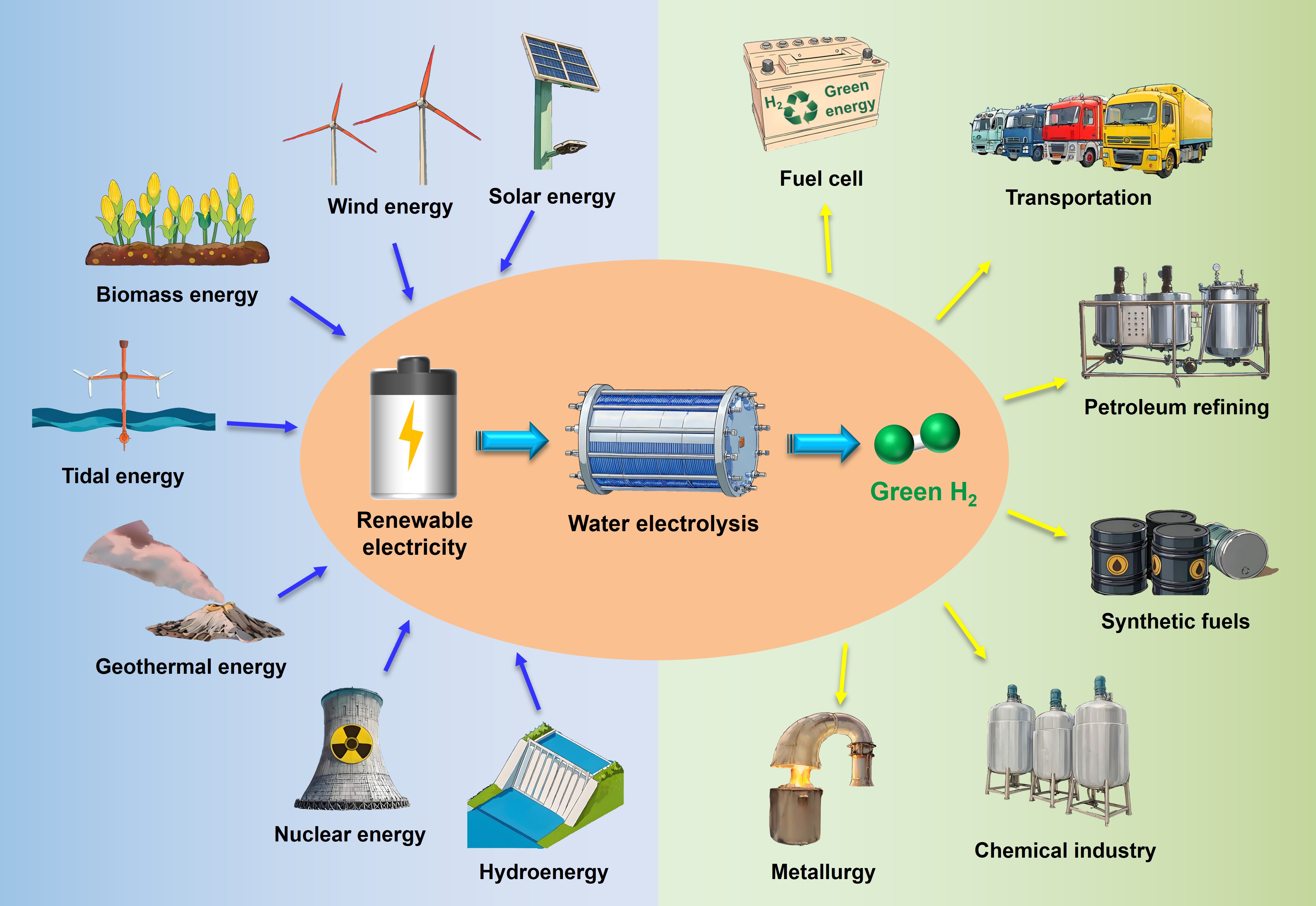
Fig. 1. Overview of renewable energy-powered water electrolysis for green H2 production. This schematic illustrates green H2 production using water electrolysis technology powered by electricity from diverse renewable energy sources, while highlighting the wide-ranging applications of H2 across different sectors.
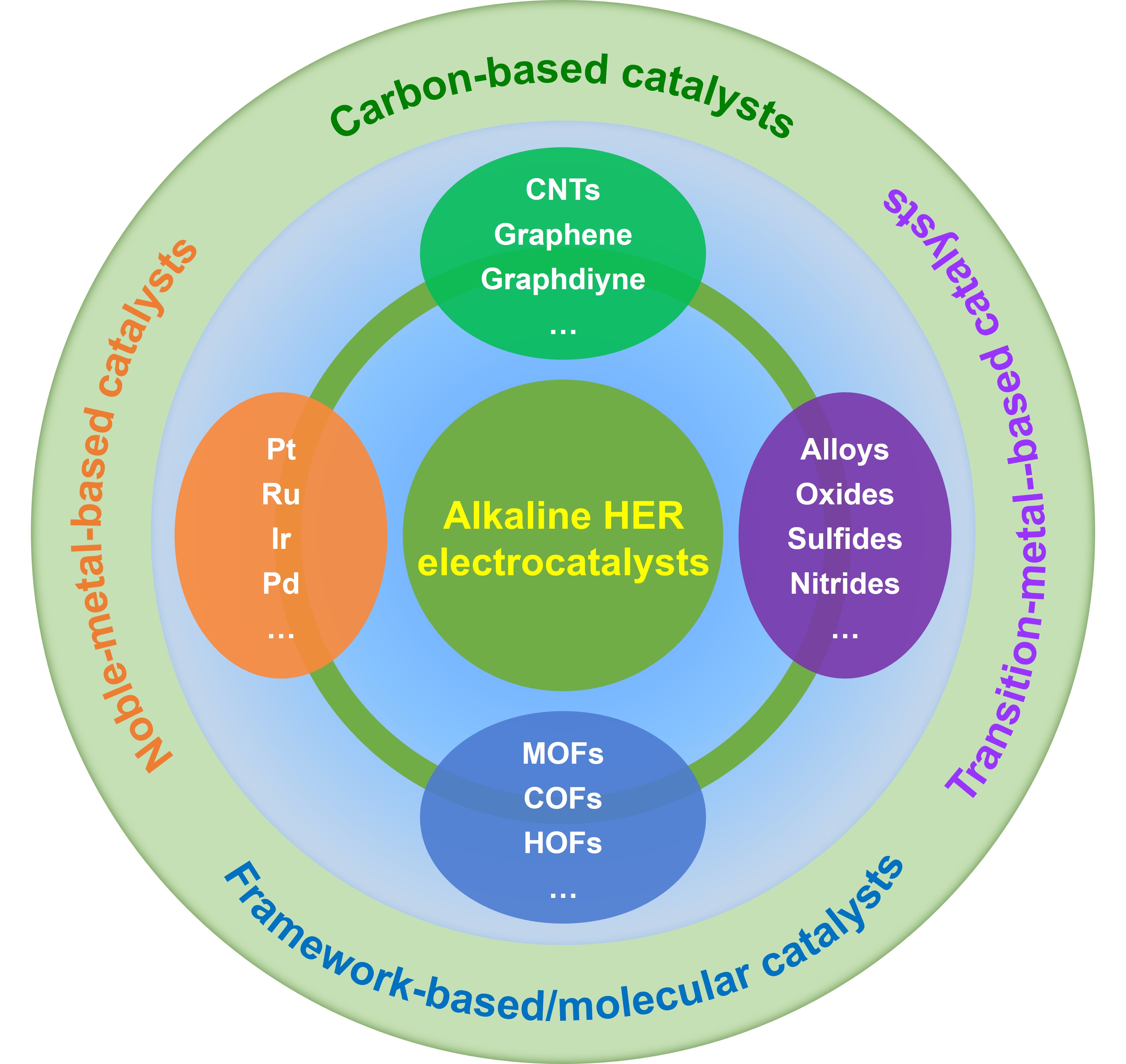
Fig. 2. Overview of major HER electrocatalyst classes and representative material systems.
| Category | Strategy | Main function | Advantage | Limitation |
|---|---|---|---|---|
| Morphological and interfacial engineering | self-supported electrodes | electron transfer mechanical stability | binder-free electrode | substrate limitation |
| Morphological and interfacial engineering | hierarchical porous structures | mass transport | electrolyte penetration bubble release | structural complexity |
| Morphological and interfacial engineering | surface wettability: hydrophilicity and aerophobicity | interfacial regulation | hydrophilicity/aerophobicity optimization | dynamic surface evolution |
| Intrinsic activity engineering | dual active site | H2O dissociation | kinetic acceleration | site optimization |
| Intrinsic activity engineering | element doping | electronic structure modulation | electronic tuning | dopant stability |
| Intrinsic activity engineering | defect | active site generation | electronic regulation | defect instability |
| Durability engineering | mechanical stability enhancement | catalyst retention | robust catalyst- substrate interaction | limited structural flexibility |
| Durability engineering | chemical stability enhancement | active phase stabilization | corrosion/reconstruction suppression | stability-activity trade-off |
Table 1 Representative engineering strategies for industrial-current-density HER electrocatalysts.
| Category | Strategy | Main function | Advantage | Limitation |
|---|---|---|---|---|
| Morphological and interfacial engineering | self-supported electrodes | electron transfer mechanical stability | binder-free electrode | substrate limitation |
| Morphological and interfacial engineering | hierarchical porous structures | mass transport | electrolyte penetration bubble release | structural complexity |
| Morphological and interfacial engineering | surface wettability: hydrophilicity and aerophobicity | interfacial regulation | hydrophilicity/aerophobicity optimization | dynamic surface evolution |
| Intrinsic activity engineering | dual active site | H2O dissociation | kinetic acceleration | site optimization |
| Intrinsic activity engineering | element doping | electronic structure modulation | electronic tuning | dopant stability |
| Intrinsic activity engineering | defect | active site generation | electronic regulation | defect instability |
| Durability engineering | mechanical stability enhancement | catalyst retention | robust catalyst- substrate interaction | limited structural flexibility |
| Durability engineering | chemical stability enhancement | active phase stabilization | corrosion/reconstruction suppression | stability-activity trade-off |
| Descriptor | Significance |
|---|---|
| Overpotential | potential required to drive HER |
| Overpotential at 500-1000 mA cm-2 | practical industrial-current-density activity |
| Tafel slope | reaction kinetics |
| Exchange current density | intrinsic catalytic activity |
| TOF | activity per active site |
| Mass activity | activity normalized by catalyst mass |
| ECSA | electrochemically accessible active area |
| Faradaic efficiency | H2 generation efficiency |
| Stability duration | long-term operational durability |
| Potential/current degradation rate | catalyst degradation behavior |
| Operating temperature | industrial relevance |
| Electrolyte concentration | realistic operating environment |
| Bubble behavior (coverage/release) | gas-transport efficiency |
| Electrolyzer performance (cell voltage) | device-level evaluation |
Table 2 Key performance descriptors for industrial-current-density HER electrocatalysts.
| Descriptor | Significance |
|---|---|
| Overpotential | potential required to drive HER |
| Overpotential at 500-1000 mA cm-2 | practical industrial-current-density activity |
| Tafel slope | reaction kinetics |
| Exchange current density | intrinsic catalytic activity |
| TOF | activity per active site |
| Mass activity | activity normalized by catalyst mass |
| ECSA | electrochemically accessible active area |
| Faradaic efficiency | H2 generation efficiency |
| Stability duration | long-term operational durability |
| Potential/current degradation rate | catalyst degradation behavior |
| Operating temperature | industrial relevance |
| Electrolyte concentration | realistic operating environment |
| Bubble behavior (coverage/release) | gas-transport efficiency |
| Electrolyzer performance (cell voltage) | device-level evaluation |
| Key strategy | Catalyst | Electrode | Electrolyte | η (mV) @500 mA cm-2 | η (mV) @1000 mA cm-2 | Stability | Stability configuration | Ref. |
|---|---|---|---|---|---|---|---|---|
| Self-supported electrodes | Ru-LC-Ni(OH)2 | Ni foam | 1.0 mol L-1 KOH | 102 | 136 | 500 h@500 mA cm-2 RT, 1.0 mol L-1 KOH + seawater | AEMWE | [ |
| Self-supported electrodes | NiFe2O4-HCOO- | Ni foam | 1.0 mol L-1 KOH + seawater | 397 | 435 | 120 h@500 mA cm-2 70 ℃, 1.0 mol L-1 KOH + seawater | AEMWE | [ |
| Self-supported electrodes | D-Ni3Mo/NF | Ni foam | 1.0 mol L-1 KOH | 208 | 232 | 100 h@500 mA cm-2, RT, 1.0 mol L-1 KOH + seawater | Half-cell HER | [ |
| Self-supported electrodes | RH-Ni9S8/RuS2 | Ni foam | 1.0 mol L-1 KOH | — | 180 | 500 h@1000 mA cm-2 RT, 1.0 mol L-1 KOH | Half-cell HER | [ |
| Self-supported electrodes | NiFeCoCuTi | Ni skeleton | 1.0 mol L-1 KOH | — | 134 | 240 h@-0.08 V RT, 1.0 mol L-1 KOH | Half-cell HER | [ |
| Self-supported electrodes | Cu NWs@NiFe-Pt3Ir | Cu foam | 1.0 mol L-1 KOH | 210 | 239 | 168 h@500 mA cm-2 RT, 1.0 mol L-1 KOH | Half-cell HER | [ |
| Self-supported electrodes | FeCoP/CF | Cu foam | 1.0 mol L-1 KOH | — | — | 14 h@1000 mA cm-2 RT, 1.0 mol L-1 KOH | AEMWE | [ |
| Self-supported electrodes | Mo2C(O)/MoO2 | Mo2C-based ceramics | 1.0 mol L-1 KOH | — | 212@1500 mA cm-2 | 260 h@50-1500 mA cm-2 RT, 1.0 mol L-1 KOH | Half-cell HER | [ |
| Self-supported electrodes | NiMo/Mo2N/ NC(500-R) | Ni foam | 1.0 mol L-1 KOH | 117 | 200.6 | 1000 h@1000 mA cm-2 RT, 1.0 mol L-1 KOH | Half-cell HER | [ |
| Self-supported electrodes | Ru-CoP/CC | Carbon cloth | 1.0 mol L-1 KOH | — | 357 | 60 h@100 mA cm-2 RT, 1.0 mol L-1 KOH | Half-cell HER | [ |
| Hierarchical porous structures | Ni4Mo@PDA | Ni foam | 1.0 mol L-1 KOH | 125 | 176@1500 mA cm-2 | 500 h@500 mA cm-2 70 ℃, 1.0 mol L-1 KOH | AEMWE | [ |
| Hierarchical porous structures | NiW | Ni mesh | 1.0 mol L-1 KOH | 198 | 264 | 200 h@500 mA cm-2 RT, 1.0 mol L-1 KOH | AEMWE | [ |
| Hierarchical porous structures | Ru-Ni2P/Fe2P | Ni foam | 1.0 mol L-1 KOH | — | 270 | 100 h@500 mA cm-2, 60 ℃, 1.0 mol L-1 KOH + seawater | AEMWE | [ |
| Hierarchical porous structures | NiCoP@FeNi LDH/NF | Ni foam | 1.0 mol L-1 KOH | 181 | 195 | 30 h@100 mA cm-2 RT, 1.0 mol L-1 KOH | OWS | [ |
| Hierarchical porous structures | Ni@NCW | carbonized wood | 1.0 mol L-1 KOH | 385 | — | 16 h@1000 mA cm-2 RT, 1.0 mol L-1 KOH | AEMWE | [ |
| Hierarchical porous structures | MoNi/NiMoOx | Ni foam | 1.0 mol L-1 KOH | — | 139@1900 mA cm-2 | 1600 h@200 mA cm-2 RT, 1.0 mol L-1 KOH | AEMWE | [ |
| Hierarchical porous structures | C-Ni1-xO | 3D printed Ni | 1.0 mol L-1 KOH | — | 245 | 16 h@2.2 V 80 ℃, 1.0 mol L-1 KOH | OWS | [ |
| Hierarchical porous structures | Fe-NiWB/PW | wood skeleton | 1.0 mol L-1 KOH | 270 | — | 2000 h@500 mA cm-2, 60 ℃, 1.0 mol L-1 KOH + seawater | AEMWE | [ |
| Hierarchical porous structures | MoNi4@NiO/PN | Ni mesh | 1.0 mol L-1 KOH | — | 329 | 400 h@500 mA cm-2 RT, 1.0 mol L-1 KOH | AEMWE | [ |
| Hierarchical porous structures | Ni/NixSy | Ni foam | 1.0 mol L-1 KOH | 121 | — | 120 h@500 mA cm-2 85 ℃, 30% KOH | OWS | [ |
| Surface wettability: hydrophilicity and aerophobicity | Ru/(Fe,Ni)(OH)2/NF | Ni foam | 1.0 mol L-1 KOH | — | 152 | 20 h@500 mA cm-2 RT, 1.0 mol L-1 KOH | OWS | [ |
| Surface wettability: hydrophilicity and aerophobicity | Ni(OH)x/Ni3S2 | Ni foam | 1.0 mol L-1 KOH | 193 | 238 | 1000 h@360 mA cm-2 RT, 1.0 mol L-1 KOH | half-cell HER | [ |
| Surface wettability: hydrophilicity and aerophobicity | NiP2@MoO2/ Co(Ni)MoO4 | Ni foam | 1.0 mol L-1 KOH | — | 297 | 650 h@200 mA cm-2 RT, 1.0 mol L-1 KOH | half-cell HER | [ |
| Surface wettability: hydrophilicity and aerophobicity | PBSCF-Ni3S2 | Ni foam | 1.0 mol L-1 KOH | — | 249 | 500 h@500 mA cm-2 RT, 1.0 mol L-1 KOH | OWS | [ |
| Surface wettability: hydrophilicity and aerophobicity | F-CoxFey(POn)z/IF | Fe foam | 1.0 mol L-1 KOH | — | 276 | 500 h@1000 mA cm-2 RT, 1.0 mol L-1 KOH | OWS | [ |
| Surface wettability: hydrophilicity and aerophobicity | Pt@NMO-N2 | Ni foam | 1.0 mol L-1 KOH + seawater | 122 | 180 | 300 h@500 mA cm-2 60 ℃, 1.0 mol L-1 KOH | AEMWE | [ |
| Surface wettability: hydrophilicity and aerophobicity | Ni/(Ni,Co)3Nv | Ni foam | 1.0 mol L-1 KOH + seawater | — | 297 | 100 h@500 mA cm-2, RT, 1.0 mol L-1 KOH + seawater | AEMWE | [ |
| Surface wettability: hydrophilicity and aerophobicity | LC-Mn2Mo3O8 @Ni/NF | Ni foam | 1.0 mol L-1 KOH | — | 310.6 | 140 h@500 mA cm-2 30 ℃, 1.0 mol L-1 KOH | half-cell HER | [ |
| Surface wettability: hydrophilicity and aerophobicity | NiFeP/Ni3S2 | Ni foam | 1.0 mol L-1 KOH | — | — | 270 h@100 mA cm-2 RT, 1.0 M KOH + seawater | AEMWE | [ |
| Surface wettability: hydrophilicity and aerophobicity | NiFe-O NAs | Fe foam | 1.0 mol L-1 KOH + seawater | 252.4 | 311.2 | 200 h@1000 mA cm-2, 60 ℃, 6.0 mol L-1 KOH + seawater | OWS | [ |
| Dual active site | S-NiBDC | Ni foam | 1.0 mol L-1 KOH | 285 | 310 | 150 h@1000 mA cm-2 RT, 1.0 mol L-1 KOH | half-cell HER | [ |
| Dual active site | Ni3S2/Cr2S3 | Ni foam | 1.0 mol L-1 KOH | — | 227 | 35 h@1000 mA cm-2 60 ℃, 3.0 M KOH | AEMWE | [ |
| Dual active site | RuCo@RuSACoSA-NMC | carbon cloth | 1.0 mol L-1 KOH | — | 225 | 576 h@1000 mA cm-2 RT, 1.0 mol L-1 KOH | half-cell HER | [ |
| Dual active site | Ag(S)@NiO/NF | Ni foam | 1.0 mol L-1 KOH | 157.2 | 167 | 120 h@1490 mA cm-2 RT, 1.0 mol L-1 KOH | half-cell HER | [ |
| Dual active site | PtNiFe-D15 | Ni foam | 1.0 mol L-1 KOH + seawater | 130 | 217 | 120 h@1000 mA cm-2, RT, 1.0 mol L-1 KOH + seawater | AEMWE | [ |
| Dual active site | Ni@CF16 | Cu foam | 1.0 mol L-1 KOH | ~265 | — | 200 h@1000 mA cm-2 RT, 1.0 mol L-1 KOH | AEMWE | [ |
| Dual active site | Ru1-Mo2C | Ni foam | 1.0 mol L-1 KOH | — | — | 200 h@500 mA cm-2 65 ℃, 1.0 mol L-1 KOH | AEMWE | [ |
| Dual active site | Ru-Ni3N | Ni foam | 1.0 mol L-1 KOH | — | ~200 | 550 h@500 mA cm-2 RT, 1.0 mol L-1 KOH | AEMWE | [ |
| Dual active site | Pt-HEA-cluster/CeO2/C | Porous carbon | 1.0 mol L-1 KOH | — | ~90 | 500 h@500 mA cm-2 RT, 1.0 mol L-1 KOH | AEMWE | [ |
| Dual active site | HEANS | — | 1.0 mol L-1 KOH | — | — | 2500 h@1000 mA cm-2 80 ℃, 1.0 mol L-1 KOH | AEMWE | [ |
| Element doping | F-Co2P/Fe2P/IF | Fe form | 1.0 mol L-1 KOH | 229.8 | 260.5 | 1 h@2000 mA cm-2 RT, 6.0 mol L-1 KOH | half-cell HER | [ |
| Element doping | P-Fe3O4/IF | Fe foam | 1.0 mol L-1 KOH | 200@409 mA cm-2 | — | 1000 h@1000 mA cm-2 RT, 1.0 mol L-1 KOH | OWS | [ |
| Element doping | NiCoCu-Mo0.078/CF | Cu foam | 1.0 mol L-1 KOH | — | 212 | 100 h@1000 mA cm-2 RT, 1.0 mol L-1 KOH | half-cell HER | [ |
| Element doping | Ru/P-Fe3O4@IF | Fe foam | 1.0 mol L-1 KOH + seawater | — | 144 | 115 h@500 mA cm-2, 60 ℃, 1.0 mol L-1 KOH + seawater | AEMWE | [ |
| Element doping | Ru/S-Co3O4 | Ni foam | 1.0 mol L-1 KOH | 200 | 287 | 1300 h@1000 mA cm-2 70 ℃, 1.0 mol L-1 KOH | AEMWE | [ |
| Element doping | Y2O3-Co3O4/PCC | Carbon cloth | 1.0 mol L-1 KOH + seawater | — | 346 | 350 h@300 mA cm-2, RT, 1.0 mol L-1 KOH + seawater | AEMWE | [ |
| Element doping | NFA-CA | Ni plate | 1.0 mol L-1 KOH | — | — | 1000 h@1000 mA cm-2 RT, 1.0 mol L-1 KOH | AEMWE | [ |
| Element doping | Ru-NiV LDH | Ni foam | 1.0 mol L-1 KOH | 195 | — | 500 h@500 mA cm-2 RT, 1.0 mol L-1 KOH | AEMWE | [ |
| Element doping | S-NiFe-LDH/NF | Ni foam | 1.0 mol L-1 KOH + seawater | — | 362 | 150 h@100-1000 mA cm-2 RT, 1.0 mol L-1 KOH | OWS | [ |
| Element doping | Mo,P-CoS2/CW | carbonized wood | 1.0 mol L-1 KOH | — | 289 | 100 h@1000 mA cm-2 RT, 1.0 mol L-1 KOH | half-cell HER | [ |
| Defect | CoxPv@NC | Ni foam | 1.0 mol L-1 KOH | — | 260 | 100 h@1000 mA cm-2, 60 ℃, 6.0 mol L-1 KOH + seawater | OWS | [ |
| Defect | HSD-PtNi/NF | Ni foam | 1.0 mol L-1 KOH | 46 | 63 | 300 h@1000 mA cm-2 RT, 1.0 mol L-1 KOH | half-cell HER | [ |
| Defect | MCu0.10-BNiMo | Ni foam | 1.0 mol L-1 KOH | 366 | 444 | 10 h@2000 mA cm-2 RT, 1.0 mol L-1 KOH | AEMWE | [ |
| Defect | Ru/NiMoO4-x | Ni foam | 1.0 mol L-1 KOH + seawater | — | 206 @3000 mA cm-2 | 750 h@500 mA cm-2, RT, 1.0 mol L-1 KOH + seawater | OWS | [ |
| Defect | Ru/MEOx/NC | carbon paper | 1.0 mol L-1 KOH | — | — | 1000 h@700 mA cm-2 RT, 1.0 mol L-1 KOH | AEMWE | [ |
| Defect | Ru/MoB-Bv | Ni foam | 1.0 mol L-1 KOH + seawater | ~100 | — | 100 h@500 mA cm-2, RT, 1.0 mol L-1 KOH + seawater | AEMWE | [ |
| Defect | Y2O2.13@GP | graphite plate | 1.0 mol L-1 KOH | 266 | — | 100 h@1000 mA cm-2 60 ℃, 6.0 mol L-1 KOH | AEMWE | [ |
| Defect | NiMoFe@MoO2 | Ni foam | 1.0 mol L-1 KOH | 175 | 272 | 1000 h@500 mA cm-2 60 ℃, 1.0 mol L-1 KOH | AEMWE | [ |
| Defect | Fe9Ni9S16-(Ni,Fe)S/PNFF | carbon cloth | 1.0 mol L-1 KOH | — | 420 @2000 mA cm-2 | 200 h@1000 mA cm-2 60 ℃, 6.0 mol L-1 KOH | AEMWE | [ |
| Defect | (FeCoNiB0.75)97Pt3 | Cu foil | 1.0 mol L-1 KOH | — | 104 | 200 h@100 mA cm-2 RT, 1.0 mol L-1 KOH | AEMWE | [ |
| Mechanical stability enhancement | CuMo6S8/Cu | Cu foam | 1.0 mol L-1 KOH | — | 320 | 300 h@500-2500 mA cm-2 RT, 1.0 mol L-1 KOH | half-cell HER | [ |
| Mechanical stability enhancement | Mo2C/MoC/CNT | CNT film | 1.0 mol L-1 KOH | 201 | 233 | 336 h@1000 mA cm-2 RT, 1.0 mol L-1 KOH | half-cell HER | [ |
| Mechanical stability enhancement | CAPist-L1 | Ni foam | 1.0 mol L-1 KOH | — | — | 1500 h@1000 mA cm-2 80 ℃, 1.0 mol L-1 KOH | AEMWE | [ |
| Mechanical stability enhancement | Ru NPs/TiN | carbon fiber paper | 1.0 mol L-1 KOH | — | — | 1000 h@5000 mA cm-2 80 ℃, 30% KOH | AEMWE | [ |
| Mechanical stability enhancement | h-Ni/MoO2 | Ni foam | 1.0 mol L-1 KOH | — | 70.9 ± 4.5 | 2500 h@1000 mA cm-2 80 ℃, 1.0 mol L-1 KOH | AEMWE | [ |
| Mechanical stability enhancement | porous Co-P | Co foam | 1.0 mol L-1 KOH | 243 | 290 | 4000 h@1000 mA cm-2 RT, 1.0 mol L-1 KOH | AEMWE | [ |
| Mechanical stability enhancement | 3D AEI-CEI-NiFe /Nf | Ni foam | 1.0 mol L-1 KOH | — | — | 800 h@10000 mA cm-2 80 ℃, 1.0 mol L-1 KOH | AEMWE | [ |
| Mechanical stability enhancement | P-Pt/NiMoO4@NF | Ni foam | 1.0 mol L-1 KOH + seawater | — | 80 | 120 h@500 mA cm-2, 60 ℃, 1.0 mol L-1 KOH + seawater | AEMWE | [ |
| Mechanical stability enhancement | NiMo/Int/NF | Ni foam | 1.0 mol L-1 KOH | — | 80.2 ± 3.53 | 3000 h@1000 mA cm-2 RT, 1.0 mol L-1 KOH | AEMWE | [ |
| Mechanical stability enhancement | Int-Ni/MoO2 | Ni foam | 1.0 mol L-1 KOH | — | 73.2 ± 14.2 | 1000 h@1000 mA cm-2 60 ℃, 1.0 mol L-1 KOH | AEMWE | [ |
| Chemical stability enhancement | Ru98Ir2-350 | carbon paper | 1.0 mol L-1 KOH | 94 | 121 | 1500 h@1000 mA cm-2 RT, 1.0 mol L-1 KOH | half-cell HER | [ |
| Chemical stability enhancement | Mn0.05Ru0.95O2 | carbon paper | 1.0 mol L-1 KOH | — | 269 | 500 h@1000 mA cm-2 RT, 1.0 mol L-1 KOH | half-cell HER | [ |
| Chemical stability enhancement | NiCoP/NiCoSx /NF | Ni foam | 1.0 mol L-1 KOH | 222 | — | 40 h@500 mA cm-2 40-70 ℃, 30% KOH | half-cell HER | [ |
| Chemical stability enhancement | MoOx/A-Ni3S2 | Ni foam | 1.0 mol L-1 KOH | — | 145 | 2500 h@2000 mA cm-2 40 ℃, 1.0 mol L-1 KOH | AEMWE | [ |
| Chemical stability enhancement | UP-RuNiSAs/C | carbon fiber paper | 1.0 mol L-1 KOH | — | 253 | 250 h@1000 mA cm-2 RT, 1.0 mol L-1 KOH | AEMWE | [ |
| Chemical stability enhancement | Os-Ni4Mo/MoO2 | Ni foam | 1.0 mol L-1 KOH + seawater | 113 | 150 | 1100 h@500 mA cm-2, RT, 1.0 mol L-1 KOH + seawater | OWS | [ |
| Chemical stability enhancement | Ni9.5Co0.5-S-FeOx | Cu foam | 1.0 mol L-1 KOH | 169 | 230 | 325 h@1000 mA cm-2, RT, 1.0 mol L-1 KOH + seawater | OWS | [ |
| Chemical stability enhancement | NA-Ru3Ni | Gas diffusion layer | 1.0 mol L-1 KOH | — | 168 | 2000 h@1000 mA cm-2 60 ℃, 1.0 mol L-1 KOH | AEMWE | [ |
| Chemical stability enhancement | Cu-Co-P/NF | Ni foam | 1.0 mol L-1 KOH | 196 | — | 220 h@500 mA cm-2 80 ℃, 6.0 mol L-1 KOH | OWS | [ |
| Chemical stability enhancement | Ni2P-NiMoOx/NF | Ni foam | 1.0 mol L-1 KOH | 297 | — | 100 h@400 mA cm-2 65 ℃, 30% KOH | AEMWE | [ |
Table 3 Representative electrocatalysts for industrial-current-density alkaline HER classified by different engineering strategies.
| Key strategy | Catalyst | Electrode | Electrolyte | η (mV) @500 mA cm-2 | η (mV) @1000 mA cm-2 | Stability | Stability configuration | Ref. |
|---|---|---|---|---|---|---|---|---|
| Self-supported electrodes | Ru-LC-Ni(OH)2 | Ni foam | 1.0 mol L-1 KOH | 102 | 136 | 500 h@500 mA cm-2 RT, 1.0 mol L-1 KOH + seawater | AEMWE | [ |
| Self-supported electrodes | NiFe2O4-HCOO- | Ni foam | 1.0 mol L-1 KOH + seawater | 397 | 435 | 120 h@500 mA cm-2 70 ℃, 1.0 mol L-1 KOH + seawater | AEMWE | [ |
| Self-supported electrodes | D-Ni3Mo/NF | Ni foam | 1.0 mol L-1 KOH | 208 | 232 | 100 h@500 mA cm-2, RT, 1.0 mol L-1 KOH + seawater | Half-cell HER | [ |
| Self-supported electrodes | RH-Ni9S8/RuS2 | Ni foam | 1.0 mol L-1 KOH | — | 180 | 500 h@1000 mA cm-2 RT, 1.0 mol L-1 KOH | Half-cell HER | [ |
| Self-supported electrodes | NiFeCoCuTi | Ni skeleton | 1.0 mol L-1 KOH | — | 134 | 240 h@-0.08 V RT, 1.0 mol L-1 KOH | Half-cell HER | [ |
| Self-supported electrodes | Cu NWs@NiFe-Pt3Ir | Cu foam | 1.0 mol L-1 KOH | 210 | 239 | 168 h@500 mA cm-2 RT, 1.0 mol L-1 KOH | Half-cell HER | [ |
| Self-supported electrodes | FeCoP/CF | Cu foam | 1.0 mol L-1 KOH | — | — | 14 h@1000 mA cm-2 RT, 1.0 mol L-1 KOH | AEMWE | [ |
| Self-supported electrodes | Mo2C(O)/MoO2 | Mo2C-based ceramics | 1.0 mol L-1 KOH | — | 212@1500 mA cm-2 | 260 h@50-1500 mA cm-2 RT, 1.0 mol L-1 KOH | Half-cell HER | [ |
| Self-supported electrodes | NiMo/Mo2N/ NC(500-R) | Ni foam | 1.0 mol L-1 KOH | 117 | 200.6 | 1000 h@1000 mA cm-2 RT, 1.0 mol L-1 KOH | Half-cell HER | [ |
| Self-supported electrodes | Ru-CoP/CC | Carbon cloth | 1.0 mol L-1 KOH | — | 357 | 60 h@100 mA cm-2 RT, 1.0 mol L-1 KOH | Half-cell HER | [ |
| Hierarchical porous structures | Ni4Mo@PDA | Ni foam | 1.0 mol L-1 KOH | 125 | 176@1500 mA cm-2 | 500 h@500 mA cm-2 70 ℃, 1.0 mol L-1 KOH | AEMWE | [ |
| Hierarchical porous structures | NiW | Ni mesh | 1.0 mol L-1 KOH | 198 | 264 | 200 h@500 mA cm-2 RT, 1.0 mol L-1 KOH | AEMWE | [ |
| Hierarchical porous structures | Ru-Ni2P/Fe2P | Ni foam | 1.0 mol L-1 KOH | — | 270 | 100 h@500 mA cm-2, 60 ℃, 1.0 mol L-1 KOH + seawater | AEMWE | [ |
| Hierarchical porous structures | NiCoP@FeNi LDH/NF | Ni foam | 1.0 mol L-1 KOH | 181 | 195 | 30 h@100 mA cm-2 RT, 1.0 mol L-1 KOH | OWS | [ |
| Hierarchical porous structures | Ni@NCW | carbonized wood | 1.0 mol L-1 KOH | 385 | — | 16 h@1000 mA cm-2 RT, 1.0 mol L-1 KOH | AEMWE | [ |
| Hierarchical porous structures | MoNi/NiMoOx | Ni foam | 1.0 mol L-1 KOH | — | 139@1900 mA cm-2 | 1600 h@200 mA cm-2 RT, 1.0 mol L-1 KOH | AEMWE | [ |
| Hierarchical porous structures | C-Ni1-xO | 3D printed Ni | 1.0 mol L-1 KOH | — | 245 | 16 h@2.2 V 80 ℃, 1.0 mol L-1 KOH | OWS | [ |
| Hierarchical porous structures | Fe-NiWB/PW | wood skeleton | 1.0 mol L-1 KOH | 270 | — | 2000 h@500 mA cm-2, 60 ℃, 1.0 mol L-1 KOH + seawater | AEMWE | [ |
| Hierarchical porous structures | MoNi4@NiO/PN | Ni mesh | 1.0 mol L-1 KOH | — | 329 | 400 h@500 mA cm-2 RT, 1.0 mol L-1 KOH | AEMWE | [ |
| Hierarchical porous structures | Ni/NixSy | Ni foam | 1.0 mol L-1 KOH | 121 | — | 120 h@500 mA cm-2 85 ℃, 30% KOH | OWS | [ |
| Surface wettability: hydrophilicity and aerophobicity | Ru/(Fe,Ni)(OH)2/NF | Ni foam | 1.0 mol L-1 KOH | — | 152 | 20 h@500 mA cm-2 RT, 1.0 mol L-1 KOH | OWS | [ |
| Surface wettability: hydrophilicity and aerophobicity | Ni(OH)x/Ni3S2 | Ni foam | 1.0 mol L-1 KOH | 193 | 238 | 1000 h@360 mA cm-2 RT, 1.0 mol L-1 KOH | half-cell HER | [ |
| Surface wettability: hydrophilicity and aerophobicity | NiP2@MoO2/ Co(Ni)MoO4 | Ni foam | 1.0 mol L-1 KOH | — | 297 | 650 h@200 mA cm-2 RT, 1.0 mol L-1 KOH | half-cell HER | [ |
| Surface wettability: hydrophilicity and aerophobicity | PBSCF-Ni3S2 | Ni foam | 1.0 mol L-1 KOH | — | 249 | 500 h@500 mA cm-2 RT, 1.0 mol L-1 KOH | OWS | [ |
| Surface wettability: hydrophilicity and aerophobicity | F-CoxFey(POn)z/IF | Fe foam | 1.0 mol L-1 KOH | — | 276 | 500 h@1000 mA cm-2 RT, 1.0 mol L-1 KOH | OWS | [ |
| Surface wettability: hydrophilicity and aerophobicity | Pt@NMO-N2 | Ni foam | 1.0 mol L-1 KOH + seawater | 122 | 180 | 300 h@500 mA cm-2 60 ℃, 1.0 mol L-1 KOH | AEMWE | [ |
| Surface wettability: hydrophilicity and aerophobicity | Ni/(Ni,Co)3Nv | Ni foam | 1.0 mol L-1 KOH + seawater | — | 297 | 100 h@500 mA cm-2, RT, 1.0 mol L-1 KOH + seawater | AEMWE | [ |
| Surface wettability: hydrophilicity and aerophobicity | LC-Mn2Mo3O8 @Ni/NF | Ni foam | 1.0 mol L-1 KOH | — | 310.6 | 140 h@500 mA cm-2 30 ℃, 1.0 mol L-1 KOH | half-cell HER | [ |
| Surface wettability: hydrophilicity and aerophobicity | NiFeP/Ni3S2 | Ni foam | 1.0 mol L-1 KOH | — | — | 270 h@100 mA cm-2 RT, 1.0 M KOH + seawater | AEMWE | [ |
| Surface wettability: hydrophilicity and aerophobicity | NiFe-O NAs | Fe foam | 1.0 mol L-1 KOH + seawater | 252.4 | 311.2 | 200 h@1000 mA cm-2, 60 ℃, 6.0 mol L-1 KOH + seawater | OWS | [ |
| Dual active site | S-NiBDC | Ni foam | 1.0 mol L-1 KOH | 285 | 310 | 150 h@1000 mA cm-2 RT, 1.0 mol L-1 KOH | half-cell HER | [ |
| Dual active site | Ni3S2/Cr2S3 | Ni foam | 1.0 mol L-1 KOH | — | 227 | 35 h@1000 mA cm-2 60 ℃, 3.0 M KOH | AEMWE | [ |
| Dual active site | RuCo@RuSACoSA-NMC | carbon cloth | 1.0 mol L-1 KOH | — | 225 | 576 h@1000 mA cm-2 RT, 1.0 mol L-1 KOH | half-cell HER | [ |
| Dual active site | Ag(S)@NiO/NF | Ni foam | 1.0 mol L-1 KOH | 157.2 | 167 | 120 h@1490 mA cm-2 RT, 1.0 mol L-1 KOH | half-cell HER | [ |
| Dual active site | PtNiFe-D15 | Ni foam | 1.0 mol L-1 KOH + seawater | 130 | 217 | 120 h@1000 mA cm-2, RT, 1.0 mol L-1 KOH + seawater | AEMWE | [ |
| Dual active site | Ni@CF16 | Cu foam | 1.0 mol L-1 KOH | ~265 | — | 200 h@1000 mA cm-2 RT, 1.0 mol L-1 KOH | AEMWE | [ |
| Dual active site | Ru1-Mo2C | Ni foam | 1.0 mol L-1 KOH | — | — | 200 h@500 mA cm-2 65 ℃, 1.0 mol L-1 KOH | AEMWE | [ |
| Dual active site | Ru-Ni3N | Ni foam | 1.0 mol L-1 KOH | — | ~200 | 550 h@500 mA cm-2 RT, 1.0 mol L-1 KOH | AEMWE | [ |
| Dual active site | Pt-HEA-cluster/CeO2/C | Porous carbon | 1.0 mol L-1 KOH | — | ~90 | 500 h@500 mA cm-2 RT, 1.0 mol L-1 KOH | AEMWE | [ |
| Dual active site | HEANS | — | 1.0 mol L-1 KOH | — | — | 2500 h@1000 mA cm-2 80 ℃, 1.0 mol L-1 KOH | AEMWE | [ |
| Element doping | F-Co2P/Fe2P/IF | Fe form | 1.0 mol L-1 KOH | 229.8 | 260.5 | 1 h@2000 mA cm-2 RT, 6.0 mol L-1 KOH | half-cell HER | [ |
| Element doping | P-Fe3O4/IF | Fe foam | 1.0 mol L-1 KOH | 200@409 mA cm-2 | — | 1000 h@1000 mA cm-2 RT, 1.0 mol L-1 KOH | OWS | [ |
| Element doping | NiCoCu-Mo0.078/CF | Cu foam | 1.0 mol L-1 KOH | — | 212 | 100 h@1000 mA cm-2 RT, 1.0 mol L-1 KOH | half-cell HER | [ |
| Element doping | Ru/P-Fe3O4@IF | Fe foam | 1.0 mol L-1 KOH + seawater | — | 144 | 115 h@500 mA cm-2, 60 ℃, 1.0 mol L-1 KOH + seawater | AEMWE | [ |
| Element doping | Ru/S-Co3O4 | Ni foam | 1.0 mol L-1 KOH | 200 | 287 | 1300 h@1000 mA cm-2 70 ℃, 1.0 mol L-1 KOH | AEMWE | [ |
| Element doping | Y2O3-Co3O4/PCC | Carbon cloth | 1.0 mol L-1 KOH + seawater | — | 346 | 350 h@300 mA cm-2, RT, 1.0 mol L-1 KOH + seawater | AEMWE | [ |
| Element doping | NFA-CA | Ni plate | 1.0 mol L-1 KOH | — | — | 1000 h@1000 mA cm-2 RT, 1.0 mol L-1 KOH | AEMWE | [ |
| Element doping | Ru-NiV LDH | Ni foam | 1.0 mol L-1 KOH | 195 | — | 500 h@500 mA cm-2 RT, 1.0 mol L-1 KOH | AEMWE | [ |
| Element doping | S-NiFe-LDH/NF | Ni foam | 1.0 mol L-1 KOH + seawater | — | 362 | 150 h@100-1000 mA cm-2 RT, 1.0 mol L-1 KOH | OWS | [ |
| Element doping | Mo,P-CoS2/CW | carbonized wood | 1.0 mol L-1 KOH | — | 289 | 100 h@1000 mA cm-2 RT, 1.0 mol L-1 KOH | half-cell HER | [ |
| Defect | CoxPv@NC | Ni foam | 1.0 mol L-1 KOH | — | 260 | 100 h@1000 mA cm-2, 60 ℃, 6.0 mol L-1 KOH + seawater | OWS | [ |
| Defect | HSD-PtNi/NF | Ni foam | 1.0 mol L-1 KOH | 46 | 63 | 300 h@1000 mA cm-2 RT, 1.0 mol L-1 KOH | half-cell HER | [ |
| Defect | MCu0.10-BNiMo | Ni foam | 1.0 mol L-1 KOH | 366 | 444 | 10 h@2000 mA cm-2 RT, 1.0 mol L-1 KOH | AEMWE | [ |
| Defect | Ru/NiMoO4-x | Ni foam | 1.0 mol L-1 KOH + seawater | — | 206 @3000 mA cm-2 | 750 h@500 mA cm-2, RT, 1.0 mol L-1 KOH + seawater | OWS | [ |
| Defect | Ru/MEOx/NC | carbon paper | 1.0 mol L-1 KOH | — | — | 1000 h@700 mA cm-2 RT, 1.0 mol L-1 KOH | AEMWE | [ |
| Defect | Ru/MoB-Bv | Ni foam | 1.0 mol L-1 KOH + seawater | ~100 | — | 100 h@500 mA cm-2, RT, 1.0 mol L-1 KOH + seawater | AEMWE | [ |
| Defect | Y2O2.13@GP | graphite plate | 1.0 mol L-1 KOH | 266 | — | 100 h@1000 mA cm-2 60 ℃, 6.0 mol L-1 KOH | AEMWE | [ |
| Defect | NiMoFe@MoO2 | Ni foam | 1.0 mol L-1 KOH | 175 | 272 | 1000 h@500 mA cm-2 60 ℃, 1.0 mol L-1 KOH | AEMWE | [ |
| Defect | Fe9Ni9S16-(Ni,Fe)S/PNFF | carbon cloth | 1.0 mol L-1 KOH | — | 420 @2000 mA cm-2 | 200 h@1000 mA cm-2 60 ℃, 6.0 mol L-1 KOH | AEMWE | [ |
| Defect | (FeCoNiB0.75)97Pt3 | Cu foil | 1.0 mol L-1 KOH | — | 104 | 200 h@100 mA cm-2 RT, 1.0 mol L-1 KOH | AEMWE | [ |
| Mechanical stability enhancement | CuMo6S8/Cu | Cu foam | 1.0 mol L-1 KOH | — | 320 | 300 h@500-2500 mA cm-2 RT, 1.0 mol L-1 KOH | half-cell HER | [ |
| Mechanical stability enhancement | Mo2C/MoC/CNT | CNT film | 1.0 mol L-1 KOH | 201 | 233 | 336 h@1000 mA cm-2 RT, 1.0 mol L-1 KOH | half-cell HER | [ |
| Mechanical stability enhancement | CAPist-L1 | Ni foam | 1.0 mol L-1 KOH | — | — | 1500 h@1000 mA cm-2 80 ℃, 1.0 mol L-1 KOH | AEMWE | [ |
| Mechanical stability enhancement | Ru NPs/TiN | carbon fiber paper | 1.0 mol L-1 KOH | — | — | 1000 h@5000 mA cm-2 80 ℃, 30% KOH | AEMWE | [ |
| Mechanical stability enhancement | h-Ni/MoO2 | Ni foam | 1.0 mol L-1 KOH | — | 70.9 ± 4.5 | 2500 h@1000 mA cm-2 80 ℃, 1.0 mol L-1 KOH | AEMWE | [ |
| Mechanical stability enhancement | porous Co-P | Co foam | 1.0 mol L-1 KOH | 243 | 290 | 4000 h@1000 mA cm-2 RT, 1.0 mol L-1 KOH | AEMWE | [ |
| Mechanical stability enhancement | 3D AEI-CEI-NiFe /Nf | Ni foam | 1.0 mol L-1 KOH | — | — | 800 h@10000 mA cm-2 80 ℃, 1.0 mol L-1 KOH | AEMWE | [ |
| Mechanical stability enhancement | P-Pt/NiMoO4@NF | Ni foam | 1.0 mol L-1 KOH + seawater | — | 80 | 120 h@500 mA cm-2, 60 ℃, 1.0 mol L-1 KOH + seawater | AEMWE | [ |
| Mechanical stability enhancement | NiMo/Int/NF | Ni foam | 1.0 mol L-1 KOH | — | 80.2 ± 3.53 | 3000 h@1000 mA cm-2 RT, 1.0 mol L-1 KOH | AEMWE | [ |
| Mechanical stability enhancement | Int-Ni/MoO2 | Ni foam | 1.0 mol L-1 KOH | — | 73.2 ± 14.2 | 1000 h@1000 mA cm-2 60 ℃, 1.0 mol L-1 KOH | AEMWE | [ |
| Chemical stability enhancement | Ru98Ir2-350 | carbon paper | 1.0 mol L-1 KOH | 94 | 121 | 1500 h@1000 mA cm-2 RT, 1.0 mol L-1 KOH | half-cell HER | [ |
| Chemical stability enhancement | Mn0.05Ru0.95O2 | carbon paper | 1.0 mol L-1 KOH | — | 269 | 500 h@1000 mA cm-2 RT, 1.0 mol L-1 KOH | half-cell HER | [ |
| Chemical stability enhancement | NiCoP/NiCoSx /NF | Ni foam | 1.0 mol L-1 KOH | 222 | — | 40 h@500 mA cm-2 40-70 ℃, 30% KOH | half-cell HER | [ |
| Chemical stability enhancement | MoOx/A-Ni3S2 | Ni foam | 1.0 mol L-1 KOH | — | 145 | 2500 h@2000 mA cm-2 40 ℃, 1.0 mol L-1 KOH | AEMWE | [ |
| Chemical stability enhancement | UP-RuNiSAs/C | carbon fiber paper | 1.0 mol L-1 KOH | — | 253 | 250 h@1000 mA cm-2 RT, 1.0 mol L-1 KOH | AEMWE | [ |
| Chemical stability enhancement | Os-Ni4Mo/MoO2 | Ni foam | 1.0 mol L-1 KOH + seawater | 113 | 150 | 1100 h@500 mA cm-2, RT, 1.0 mol L-1 KOH + seawater | OWS | [ |
| Chemical stability enhancement | Ni9.5Co0.5-S-FeOx | Cu foam | 1.0 mol L-1 KOH | 169 | 230 | 325 h@1000 mA cm-2, RT, 1.0 mol L-1 KOH + seawater | OWS | [ |
| Chemical stability enhancement | NA-Ru3Ni | Gas diffusion layer | 1.0 mol L-1 KOH | — | 168 | 2000 h@1000 mA cm-2 60 ℃, 1.0 mol L-1 KOH | AEMWE | [ |
| Chemical stability enhancement | Cu-Co-P/NF | Ni foam | 1.0 mol L-1 KOH | 196 | — | 220 h@500 mA cm-2 80 ℃, 6.0 mol L-1 KOH | OWS | [ |
| Chemical stability enhancement | Ni2P-NiMoOx/NF | Ni foam | 1.0 mol L-1 KOH | 297 | — | 100 h@400 mA cm-2 65 ℃, 30% KOH | AEMWE | [ |
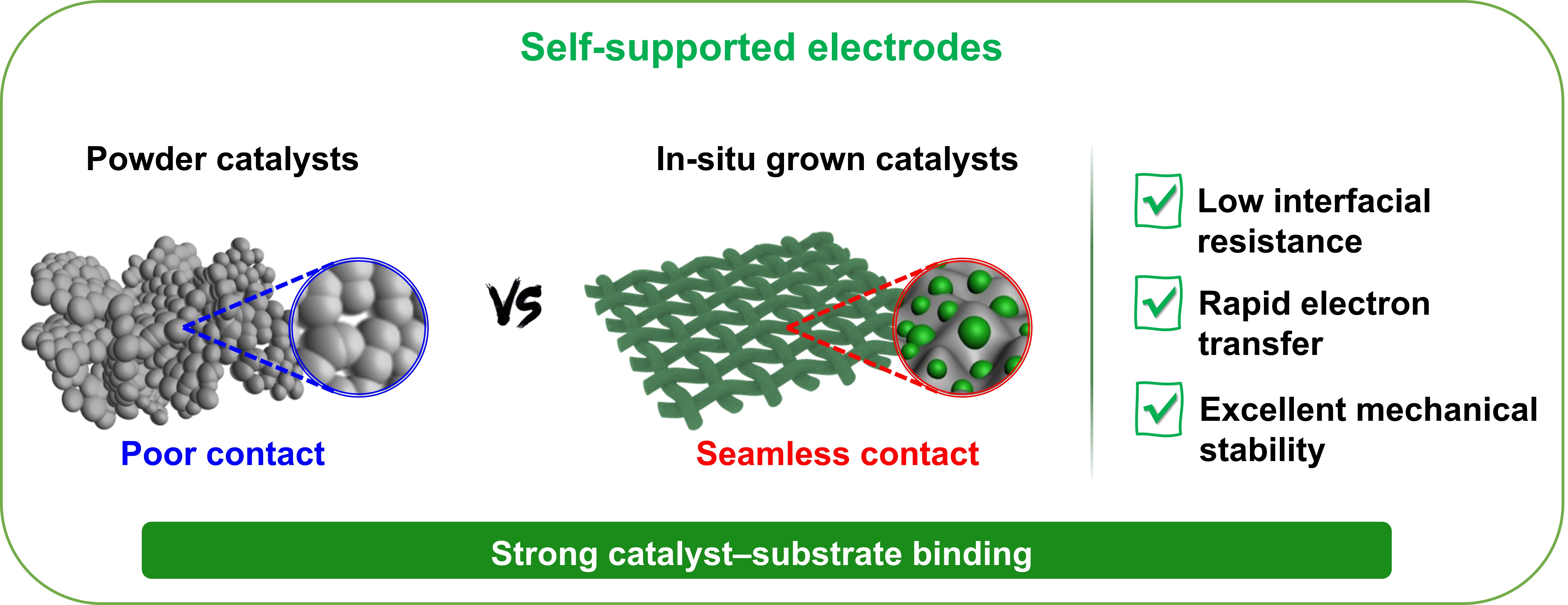
Fig. 3. Self-supported electrodes engineering for industrial-current-density HER. In-situ growth of electrocatalysts on conductive substrates enables seamless catalyst-substrate contact, low interfacial resistance, rapid electron transfer, and excellent mechanical stability.
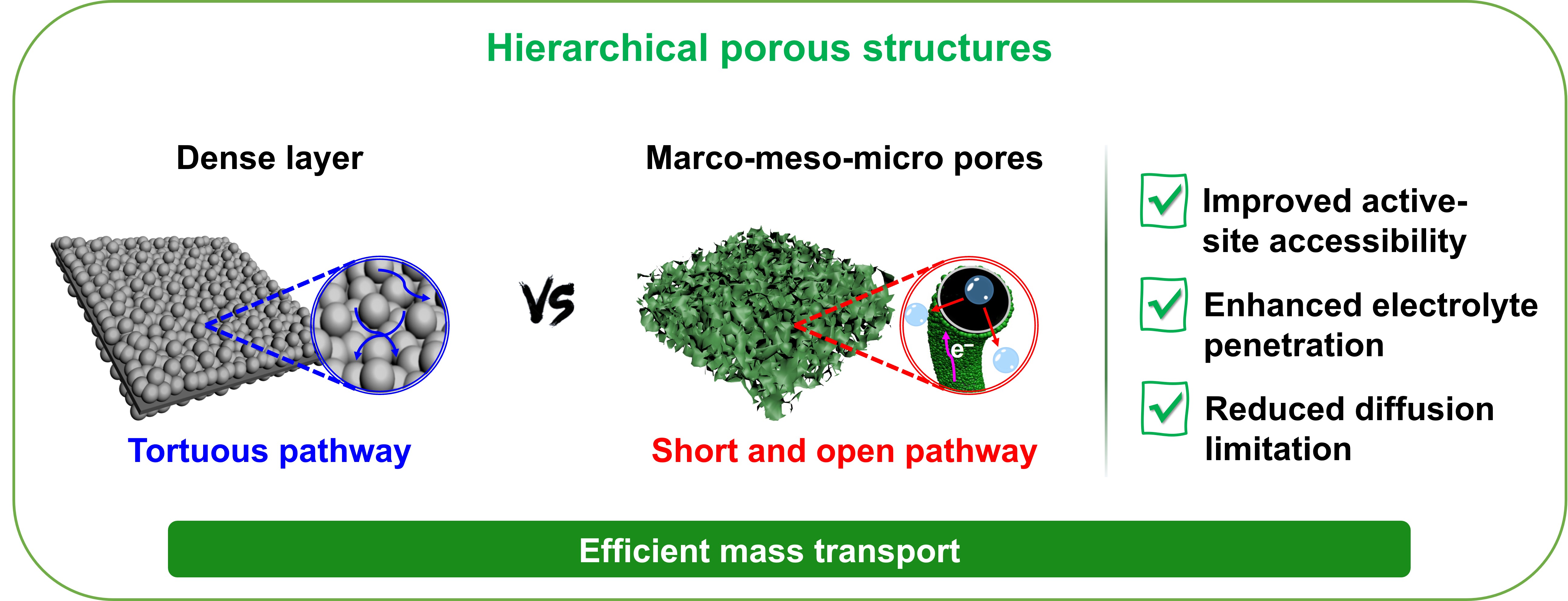
Fig. 4. Hierarchical porous structures engineering for industrial-current-density HER. The construction of interconnected macro-/meso-/microporous structures improves active site accessibility, enhances electrolyte penetration, and reduces diffusion limitation.
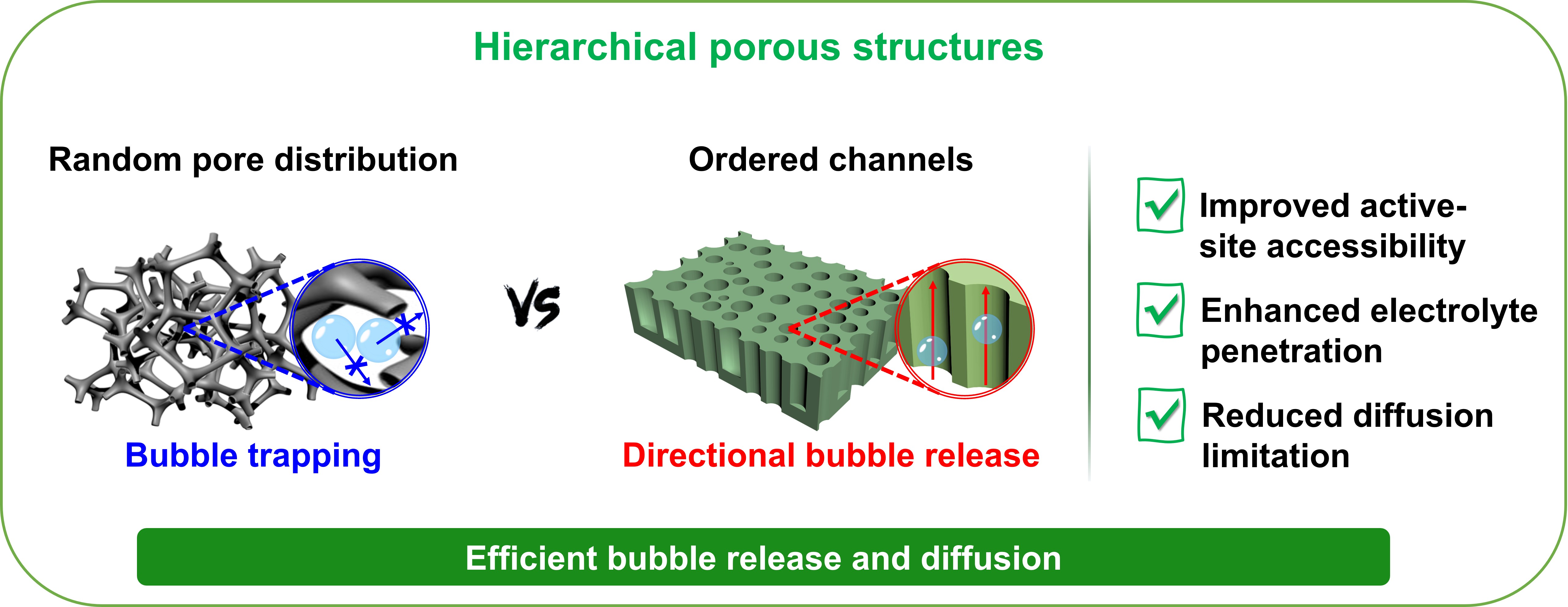
Fig. 5. Hierarchical porous structures engineering for industrial-current-density HER. Compared with randomly distributed pores, ordered flow channels provide directed pathways for bubble release and diffusion.
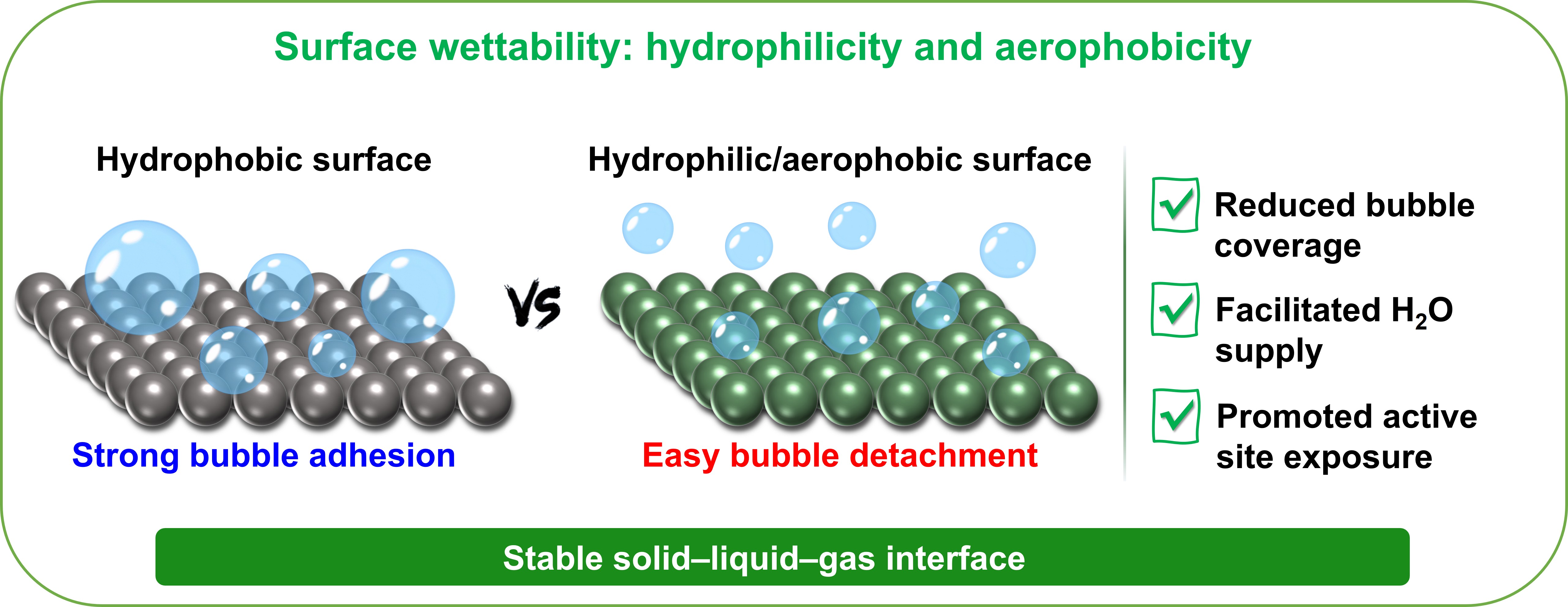
Fig. 6. Hydrophilic and aerophobic surface engineering for industrial-current-density HER. Surface wettability regulation creates hydrophilic and aerophobic surfaces that reduce bubble coverage, facilitate H2O supply, and promote active site exposure.
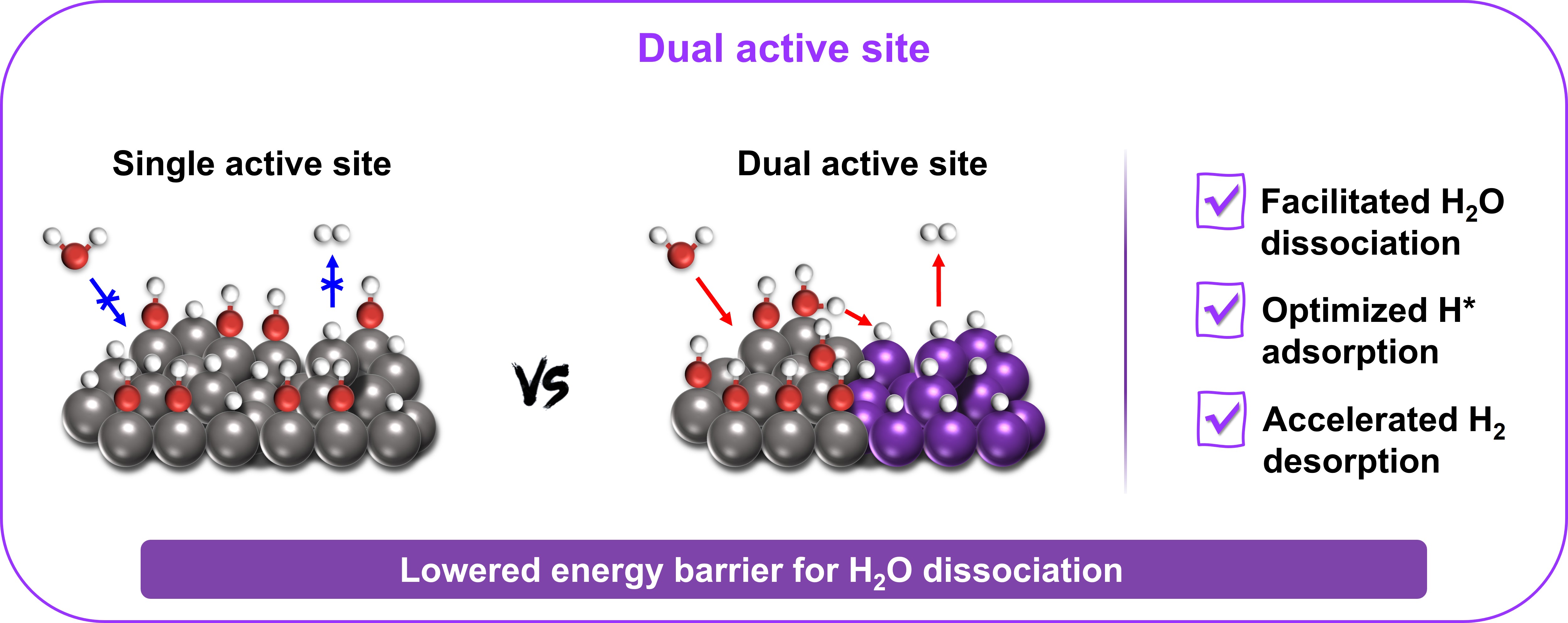
Fig. 7. Dual active site engineering for industrial-current-density HER. Distinct active sites are designed to simultaneously facilitate H2O dissociation and H2 evolution processes to accelerate Volmer-Heyrovsky/ Tafel kinetics.
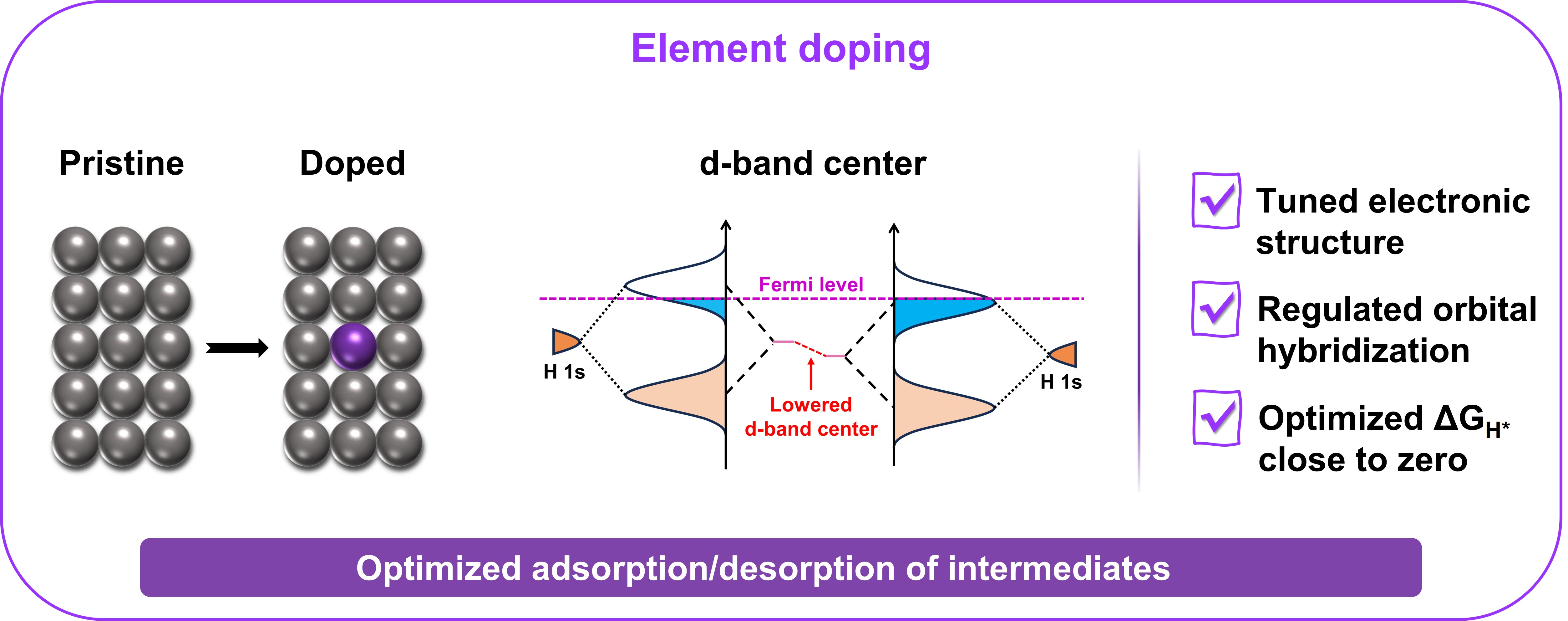
Fig. 8. Element doping engineering for industrial-current-density HER. Incorporation of foreign metal atoms tunes the electronic structure of catalytic centers, regulates orbital hybridization, and optimizes ΔGH*.
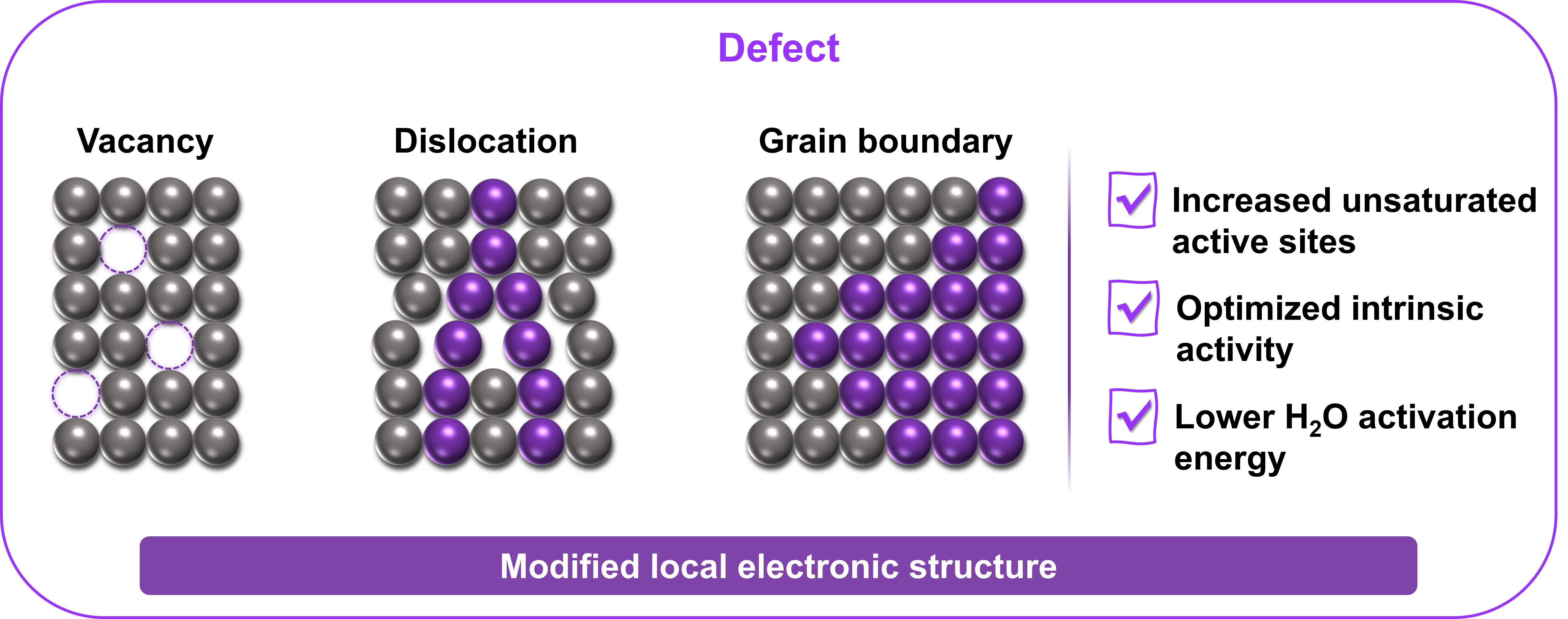
Fig. 9. Defect engineering for industrial-current-density HER. The generation of vacancy, dislocation, and grain boundary creates abundant unsaturated active sites, optimizes intrinsic activity, and lowers the activation energy for H2O dissociation.
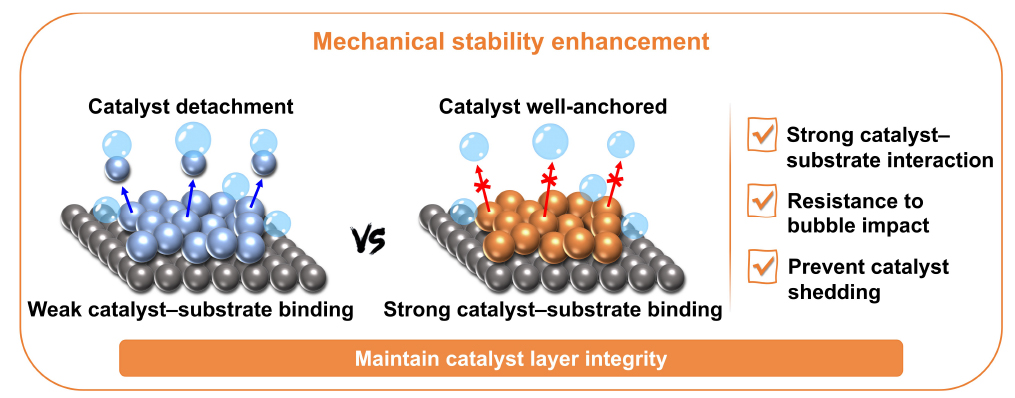
Fig. 10. Mechanical stability enhancement engineering for industrial-current-density HER. Strengthening catalyst-substrate interactions suppresses catalyst detachment induced by vigorous H2 evolution and prolonged operation.
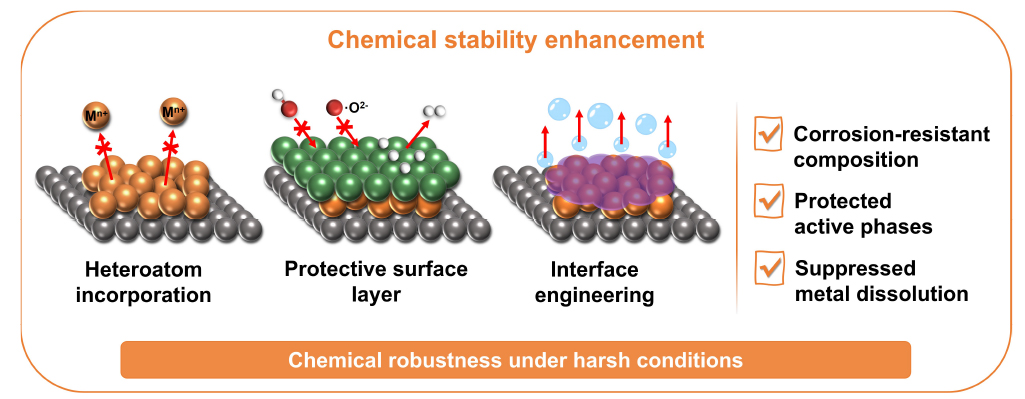
Fig. 11. Chemical stability enhancement engineering for industrial-current-density HER. Rational catalyst design including heteroatom incorporation, protective surface layer, and interface engineering enhance the chemical robustness under harsh conditions.
|
| [1] | Ruihan Zhou, Tixuan Xia, Yingchen Yang, Dongbo Xu, Weidong Shi. Co(OH)2/Cu NWs with interface modification of hypophosphite ions for sustainable ammonia synthesis from nitrate at ~2.8 A·cm-2 [J]. Chinese Journal of Catalysis, 2027, 92(1): 365-375. |
| [2] | Dezhi Wang, Songhua Yang, Yiyi Yangliu, Xufa Peng, Fangyang Liu, Hao Fei, Zhuangzhi Wu. Decoupling competitive reactions by their differential orbital-coupling response to vacancy engineering for efficient electrocatalytic nitrogen reduction [J]. Chinese Journal of Catalysis, 2026, 86(7): 181-190. |
| [3] | Yuxi Ren, Baorong Xu, Yu Jin, Hang Xiao, Ranran Niu, Wei Liu, Honghui Ou, Guidong Yang. Homojunction-driven d-band engineering in NiMoO4 for selective electrochemical nitrogen reduction to ammonia [J]. Chinese Journal of Catalysis, 2026, 85(6): 216-225. |
| [4] | Zijie Wan, Yuqi Yang, Zhenquan Wang, Linrui Wu, Haipeng Zhang, Qingfang Shi, Xiang Liu, Hanlin Yang, Bohan Kang, Quan Xu, Jiaqing Luo, Jian Liu. Spatial confinement and nitrogenous defect anchoring synergistically enhance Ru nanoparticles catalyst performance for industrial current densities hydrogen evolution [J]. Chinese Journal of Catalysis, 2026, 84(5): 130-143. |
| [5] | Mingtao Chu, Huimin Zhang, Bianqing Ren, Jing Cao, Teng Zhang, Ping Song, Zizhun Wang, Ce Han, Weilin Xu. Amorphous-crystalline heterostructured RuMoNiN/Ni-MoO2 for highly efficient and stable alkaline hydrogen evolution reaction [J]. Chinese Journal of Catalysis, 2026, 84(5): 96-105. |
| [6] | Peilin Liu, Xiaqing Zhuang, Tianze Cui, Zisen Wei, Hua Xu, Ruolin Zhang, Yuqi Yang, Jiaqing Luo, Weiyu Song, Yunpeng Liu, Yu Kong, Zhenxing Li, Zhen Zhao, Jian Liu, Yuanqing Sun. Dual-engine active centers of Ru single atoms and nanoclusters synergistically enhancing hydrogen evolution reaction [J]. Chinese Journal of Catalysis, 2026, 84(5): 80-95. |
| [7] | Hongwen Zhang, Yinghui Cai, Bingyue Li, Wei Shan, Hua Tang. Isolated Cu atoms and CuO nanoclusters synergistically boost hydrogen evolution over TiO2 [J]. Chinese Journal of Catalysis, 2026, 83(4): 162-171. |
| [8] | Jegon Lee, Do-Hyun Kim, Seulgi Ji, Sangmoon Yoon, Seung Hyun Nam, Jucheol Park, Jin Young Oh, Seung Gyo Jeong, Jong-Seong Bae, Sang A. Lee, Heechae Choi, Woo Seok Choi. Awakening catalytically active surface of BaRuO3 thin film for alkaline hydrogen evolution [J]. Chinese Journal of Catalysis, 2026, 83(4): 341-350. |
| [9] | Shihao Yu, Yueying Yan, Yang Yang, Bohan Yao, Ziwen Zhu, Dewen Wang, Zhicai Xing, Xiurong Yang. Interfacial engineering of an advanced NiV-LDH@MoS2 heterostructure electrocatalyst for efficient alkaline hydrogen evolution [J]. Chinese Journal of Catalysis, 2026, 91(12): 222-231. |
| [10] | Guang Yang, Xiliang Gong, Zeshuo Meng, Shuang Hou, Minghao Yang, Zhongmiao Gong, Rong Huang, Yi Cui. Amorphous nickel hydroxide confined noble metal single atoms for enhanced alkaline hydrogen evolution reaction [J]. Chinese Journal of Catalysis, 2026, 90(11): 264-275. |
| [11] | Jiaxuan Zhou, Yaodong Yu, Jiani Han, Yanxue Chao, Jianping Lai, Lei Wang. Proton hydrogenation reaction in neutral media: Mechanisms, challenges, and performance enhancement strategies [J]. Chinese Journal of Catalysis, 2026, 90(11): 27-51. |
| [12] | Ting Li, Xiaohui Chen, Xiaolin Li, Qi Xiao, Hongqun Luo, Nianbing Li. Autogenous force-mediated assembly: A general strategy for constructing single-atom architectures in hierarchical hybrid electrocatalysts [J]. Chinese Journal of Catalysis, 2026, 89(10): 232-245. |
| [13] | Yufeng Jiang, Shaobin Li, Li Zhang, Yang Yang, Kun Cheng, Fengbo Li, Xiaoqing Lv. MXene quantum dots induced Ni site d-band center self-optimization for advanced photovoltaic-driven urea-assisted water splitting [J]. Chinese Journal of Catalysis, 2026, 89(10): 207-217. |
| [14] | Xin Song, Zhonghua Li, Li Sheng, Yang Liu. Spin density symmetry breaking-mediated hydrogen evolution in single-atom catalysts [J]. Chinese Journal of Catalysis, 2026, 80(1): 213-226. |
| [15] | Yao Yao, Juping Xu, Minhua Shao. Competitions between hydrogen evolution reaction and oxygen reduction reaction on an Au surface [J]. Chinese Journal of Catalysis, 2025, 73(6): 271-278. |
| Viewed | ||||||
|
Full text |
|
|||||
|
Abstract |
|
|||||


