
Chinese Journal of Catalysis ›› 2026, Vol. 89: 207-217.DOI: 10.1016/S1872-2067(26)65152-2
• Article • Previous Articles Next Articles
Yufeng Jianga, Shaobin Lia,*( ), Li Zhanga,*(), Yang Yanga, Kun Chenga, Fengbo Lib, Xiaoqing Lva
Received:2026-01-06
Accepted:2026-02-21
Online:2026-10-18
Published:2026-09-01
Contact:
*E-mail:shaobinli1985@qqhru.edu.cn(S. Li),Supported by:Yufeng Jiang, Shaobin Li, Li Zhang, Yang Yang, Kun Cheng, Fengbo Li, Xiaoqing Lv. MXene quantum dots induced Ni site d-band center self-optimization for advanced photovoltaic-driven urea-assisted water splitting[J]. Chinese Journal of Catalysis, 2026, 89: 207-217.
Add to citation manager EndNote|Ris|BibTeX
URL: https://www.cjcatal.com/EN/10.1016/S1872-2067(26)65152-2

Fig. 1. (a) Schematic diagram of the synthesis of NiMoO4/MQDs. (b) SEM image of NiMoO4. SEM image (c), TEM image (d), HRTEM image (e), and SAED pattern (f) of NiMoO4/MQDs. Contact angle photographs (g) and EDS mapping plot (h) of NiMoO4/MQDs.
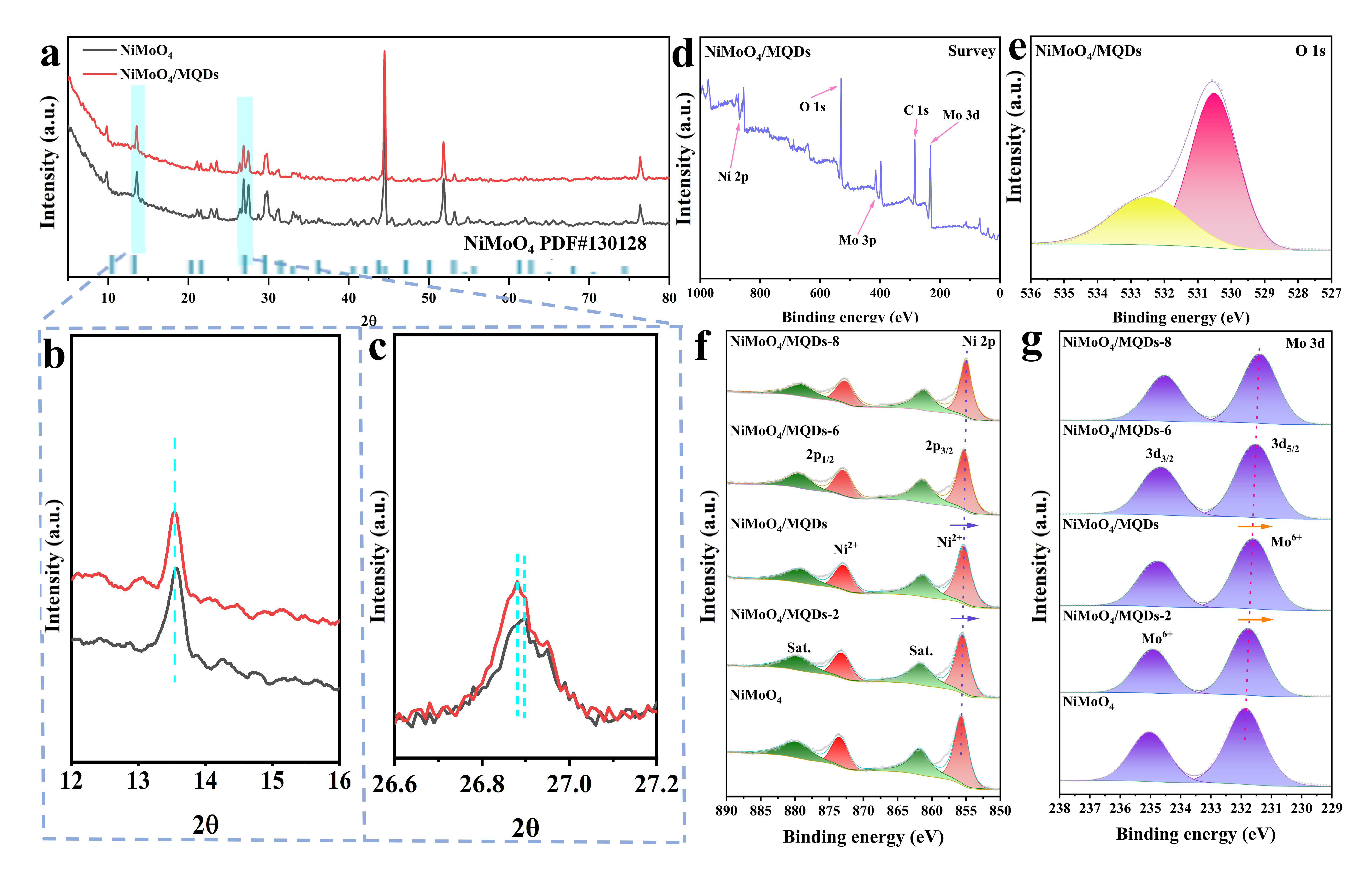
Fig. 2. (a-c) The XRD patterns of NiMoO4 and NiMoO4/MQDs. XPS survey (d) spectra and O 1s (e) of NiMoO4/MQDs. Ni 2p (f) and Mo 3d (g) XPS spectra of NiMoO4/MQDs.
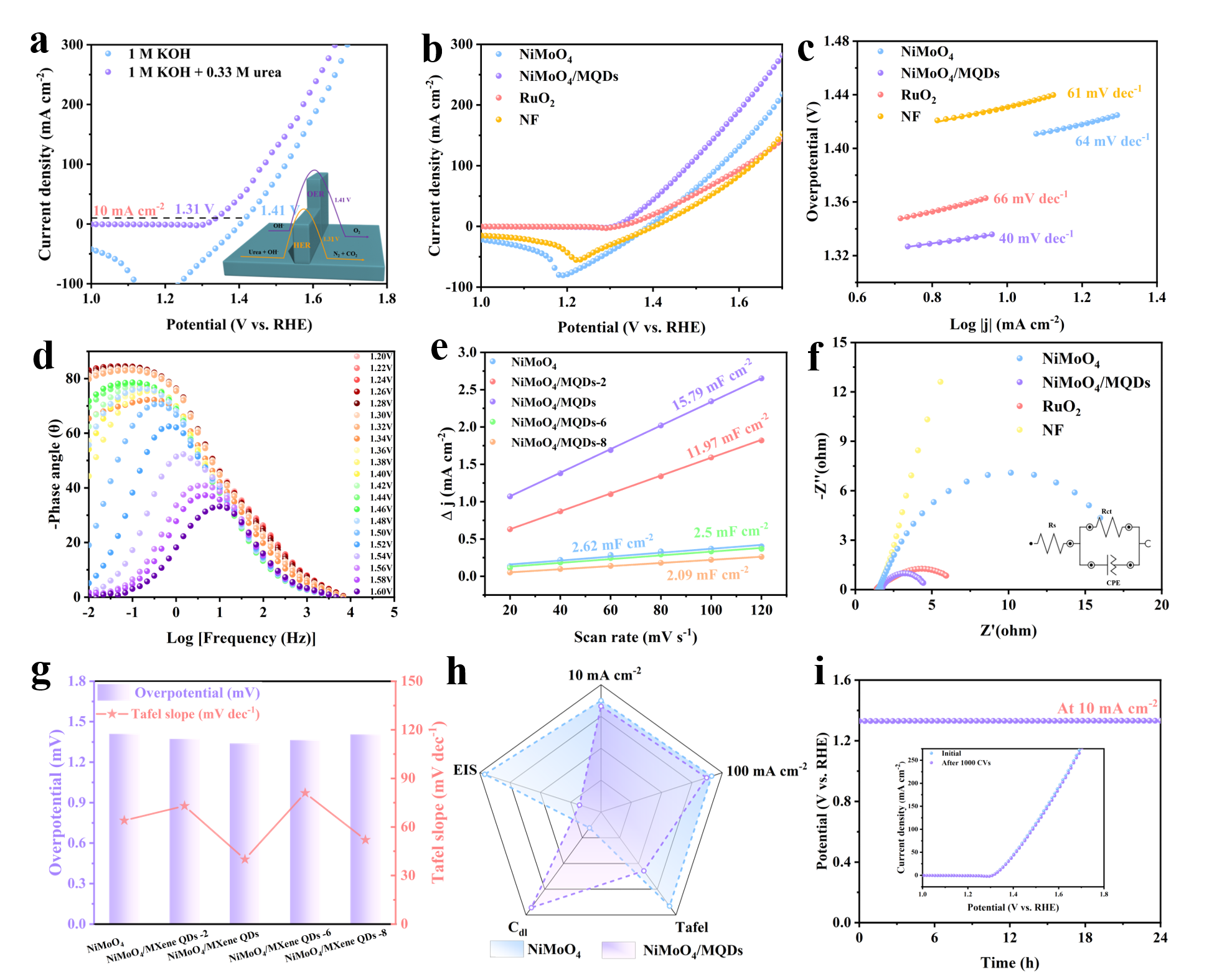
Fig. 3. (a) Polarization curves of NiMoO4/MQDs in UOR and OER. (b) LSV curves for various catalysts. (c) Tafel slopes. (d) Bode-phase plots of NiMoO4/MQDs measured at different anodic polarization potentials. (e) Calculated Cdl values for the electrode. (f) EIS spectra obtained at a fixed overpotential of 10 mA cm-2. (g) Comparative analysis of overpotentials and Tafel slopes. (h) Property comparison between NiMoO4/MQDs and NiMoO4. (i) Chronopotentiometry curve recorded at 10 mA cm-2 (without iR compensation); inset: LSV curves before and after 1000 CV cycles.
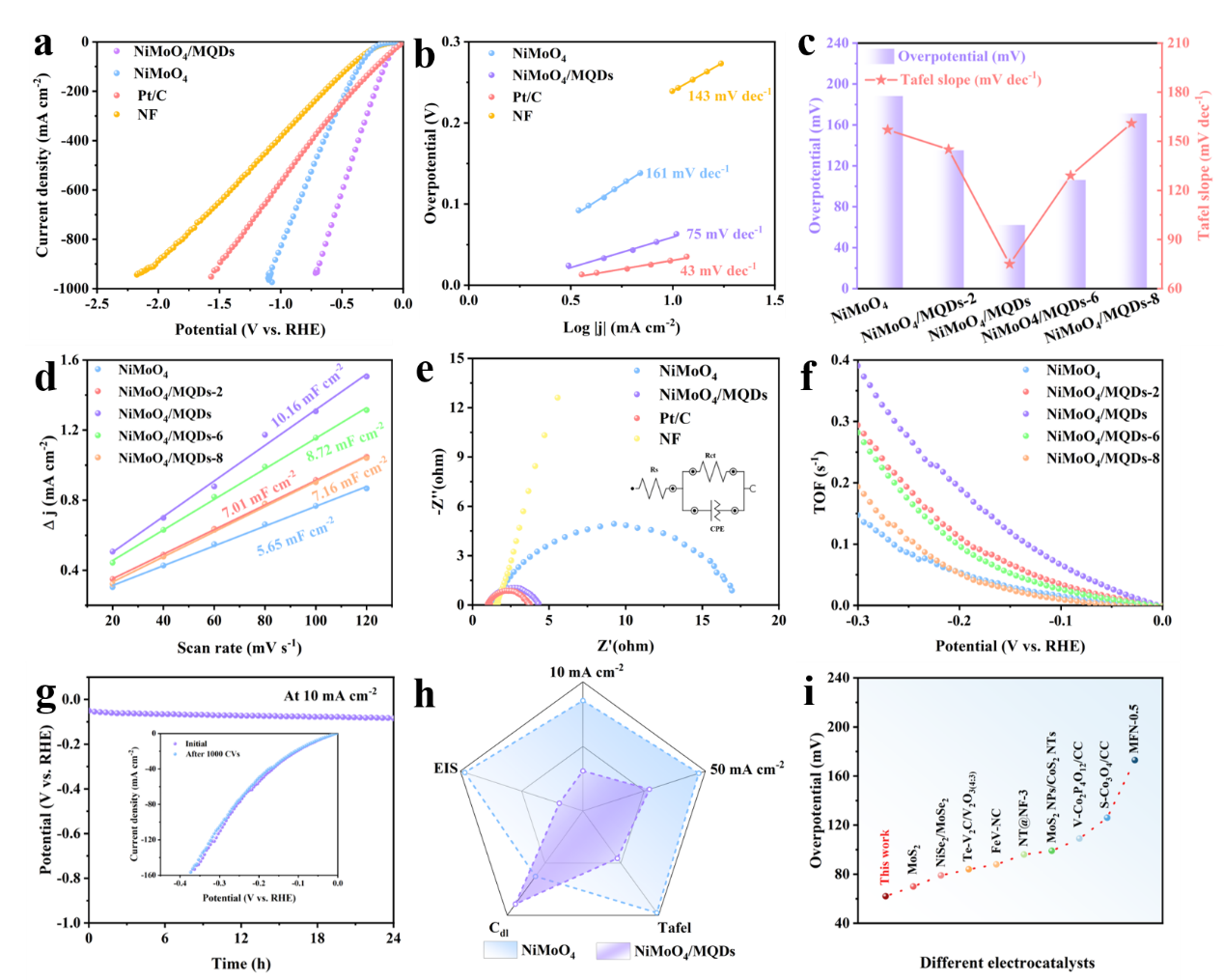
Fig. 4. LSV curves (a) and Tafel plots (b) of NiMoO4/MQDs, NiMoO4, Pt/C and NF in 1 mol L-1 KOH. (c) Comparison of overpotentials of different catalysts at 10 mA cm-2 and Tafel plots. (d) The calculated value of Cdl for the relevant electrode. (e) Nyquist plot. (f) The TOF value of catalysts of NiMoO4, NiMoO4/MQDs-2, NiMoO4 /MQDs, NiMoO4 /MQDs-6 and NiMoO4/MQDs-8. (g) The time-potential curve of the HER NiMoO4/MQDs at 10 mA cm-2 (inset): LSV curves before and after 1000 CVs stability test. (h) Comparison of different electrochemical properties of NiMoO4/MQDs and NiMoO4. (i) Some recent reports on the comparison of electrocatalysts with NiMoO4/MQDs 10 mA cm-2 overpotential and Tafel electrocatalysts for HER.
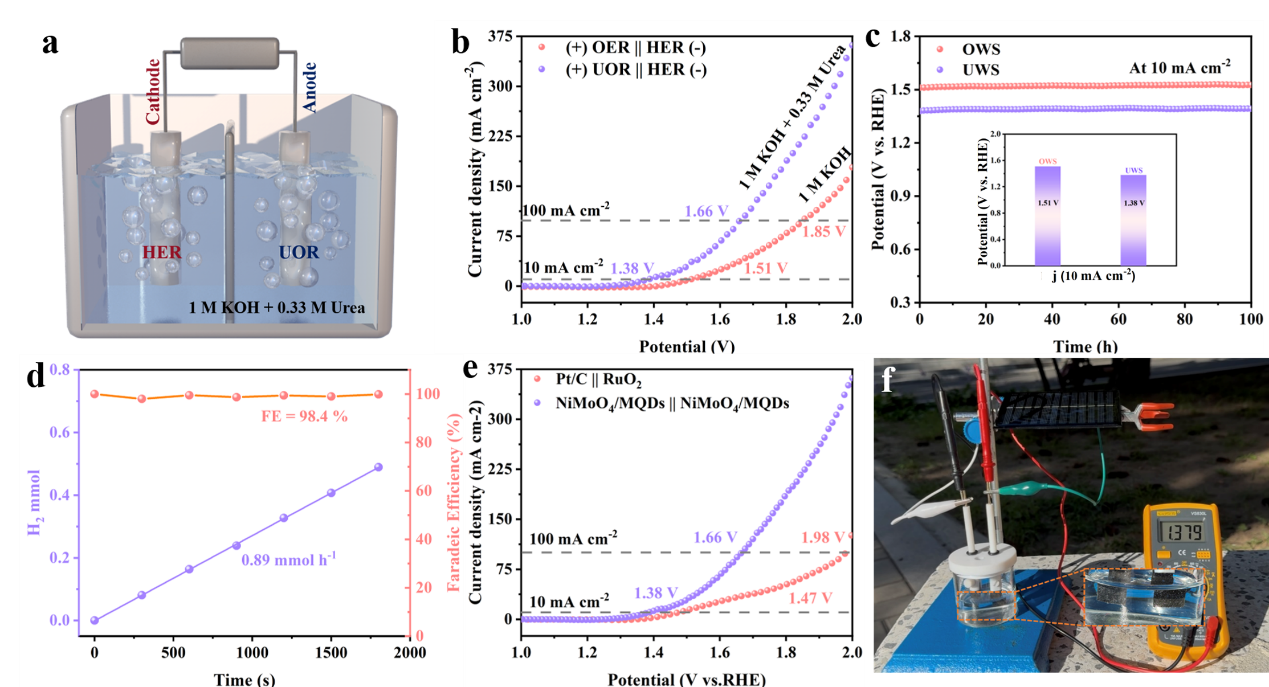
Fig. 5. (a) Schematic illustration of the urea electrolysis cell employing NiMoO4/MQDs as both the anode and cathode catalysts. (b) LSV curves comparing the UOR and OER. (c) Time-dependent potential profiles for both processes at a current density of 10 mA cm-2. (d) The Faradaic efficiency for hydrogen generation as a function of operation time in the urea electrolysis system. (e) LSV curves of NiMoO4/MQDs and the noble-metal benchmark (Pt/C||RuO2) in 1.0 mol L-1 KOH with 0.33 mol L-1 urea. (f) Schematic of urea-assisted water splitting powered by a solar cell.
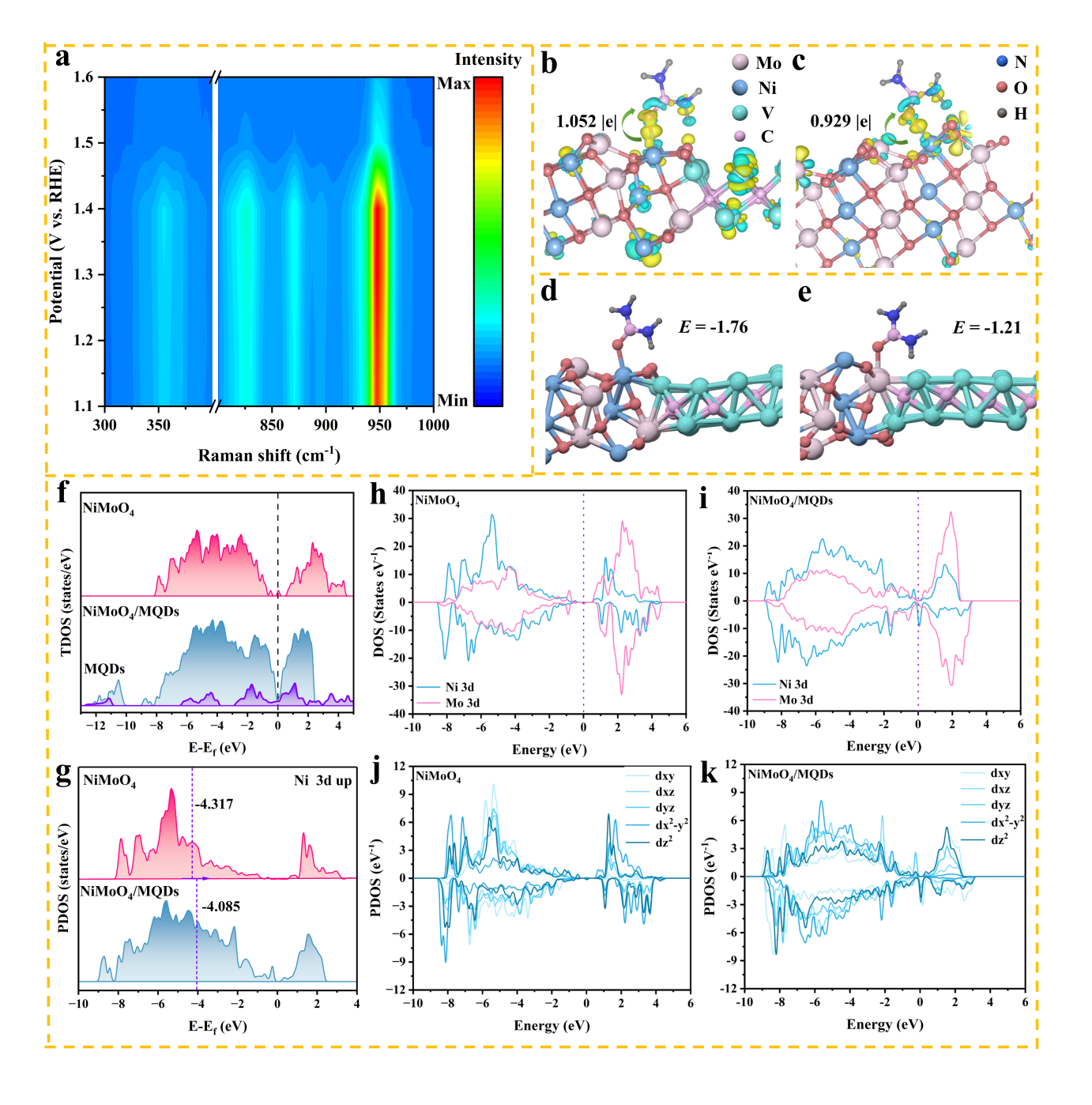
Fig. 6. (a) In-situ Raman spectrum of NiMoO4/MQDs in 1 mol L-1 KOH + 0.33 mol L-1 urea. NiMoO4 (b) and NiMoO4/MQDs (c) of differential charge density at the NiMoO4/MQDs heterostructure. The side view and top view models of urea adsorption at different sites: Ni site (d) and Mo site (e). (f) The DOS of the pristine and NiMoO4/MQDs unit cell. (g) PDOS of Ni 3d. The corresponding d-orbital occupancy of NiMoO4 (h) and NiMoO4/MQDs (i). PDOS of Ni 3d in NiMoO4 (j) and NiMoO4/MQDs (k).
|
| [1] | Yingzhen Zhang, Wei Zhang, Zhangzheng Huang, Weilong Cai, Yun Hau Ng, Jianying Huang, Yuekun Lai. Mn-triggered dynamic phase transition in NiSe2 catalyst via doping engineering for boosted urea electrolysis [J]. Chinese Journal of Catalysis, 2026, 88(9): 335-346. |
| [2] | Dezhi Wang, Songhua Yang, Yiyi Yangliu, Xufa Peng, Fangyang Liu, Hao Fei, Zhuangzhi Wu. Decoupling competitive reactions by their differential orbital-coupling response to vacancy engineering for efficient electrocatalytic nitrogen reduction [J]. Chinese Journal of Catalysis, 2026, 86(7): 181-190. |
| [3] | Yuxi Ren, Baorong Xu, Yu Jin, Hang Xiao, Ranran Niu, Wei Liu, Honghui Ou, Guidong Yang. Homojunction-driven d-band engineering in NiMoO4 for selective electrochemical nitrogen reduction to ammonia [J]. Chinese Journal of Catalysis, 2026, 85(6): 216-225. |
| [4] | Zhe Deng, Xiandi Ma, Ning Wang, Menggai Jiao, Hao Wan, Li-Li Zhang, Wei Ma, Zhen Zhou. Superficial S atom optimized active sites in NiFe layered double hydroxides for electrocatalytic urea oxidation [J]. Chinese Journal of Catalysis, 2026, 84(5): 189-199. |
| [5] | Zijie Wan, Yuqi Yang, Zhenquan Wang, Linrui Wu, Haipeng Zhang, Qingfang Shi, Xiang Liu, Hanlin Yang, Bohan Kang, Quan Xu, Jiaqing Luo, Jian Liu. Spatial confinement and nitrogenous defect anchoring synergistically enhance Ru nanoparticles catalyst performance for industrial current densities hydrogen evolution [J]. Chinese Journal of Catalysis, 2026, 84(5): 130-143. |
| [6] | Mingtao Chu, Huimin Zhang, Bianqing Ren, Jing Cao, Teng Zhang, Ping Song, Zizhun Wang, Ce Han, Weilin Xu. Amorphous-crystalline heterostructured RuMoNiN/Ni-MoO2 for highly efficient and stable alkaline hydrogen evolution reaction [J]. Chinese Journal of Catalysis, 2026, 84(5): 96-105. |
| [7] | Peilin Liu, Xiaqing Zhuang, Tianze Cui, Zisen Wei, Hua Xu, Ruolin Zhang, Yuqi Yang, Jiaqing Luo, Weiyu Song, Yunpeng Liu, Yu Kong, Zhenxing Li, Zhen Zhao, Jian Liu, Yuanqing Sun. Dual-engine active centers of Ru single atoms and nanoclusters synergistically enhancing hydrogen evolution reaction [J]. Chinese Journal of Catalysis, 2026, 84(5): 80-95. |
| [8] | Hongwen Zhang, Yinghui Cai, Bingyue Li, Wei Shan, Hua Tang. Isolated Cu atoms and CuO nanoclusters synergistically boost hydrogen evolution over TiO2 [J]. Chinese Journal of Catalysis, 2026, 83(4): 162-171. |
| [9] | Jegon Lee, Do-Hyun Kim, Seulgi Ji, Sangmoon Yoon, Seung Hyun Nam, Jucheol Park, Jin Young Oh, Seung Gyo Jeong, Jong-Seong Bae, Sang A. Lee, Heechae Choi, Woo Seok Choi. Awakening catalytically active surface of BaRuO3 thin film for alkaline hydrogen evolution [J]. Chinese Journal of Catalysis, 2026, 83(4): 341-350. |
| [10] | Xinran Sun, Mengtian Huo, Jianhang Sun, Yu Liang, Kaichi Qin, Haoyang Zhang, Zihao Xing, Jinfa Chang. Sacrificial conversion of metal sulfide precursors into active oxyhydroxide catalysts for enhanced oxygen evolution reaction [J]. Chinese Journal of Catalysis, 2026, 82(3): 84-91. |
| [11] | Rui Yang, Zimin Han, Yin Gao, Guoqing Feng, Huaizhi Liu, Yiyin Huang, Zhongkai Wang, Yaobing Wang. Charge-mediated cyclohexanone enrichment and intermediate stabilization at MoNi4/MoO2 heterostructures enable paired cyclohexanone electrooxidation-hydrogen production at ampere-level current [J]. Chinese Journal of Catalysis, 2026, 81(2): 344-354. |
| [12] | Ting Li, Xiaohui Chen, Xiaolin Li, Qi Xiao, Hongqun Luo, Nianbing Li. Autogenous force-mediated assembly: A general strategy for constructing single-atom architectures in hierarchical hybrid electrocatalysts [J]. Chinese Journal of Catalysis, 2026, 89(10): 232-245. |
| [13] | Zhirong Ren, Haihan Zhou, Tanyuan Wang, Hua-Jin Zhai, Qing Li. Hierarchical nitride/phosphide heterostructure for efficient and ultrastable Ampere-level hydrogen production [J]. Chinese Journal of Catalysis, 2026, 89(10): 184-195. |
| [14] | Xin Song, Zhonghua Li, Li Sheng, Yang Liu. Spin density symmetry breaking-mediated hydrogen evolution in single-atom catalysts [J]. Chinese Journal of Catalysis, 2026, 80(1): 213-226. |
| [15] | Xiong Qi, Shi Quanquan, Wang Binli, Baiker Alfons, Li Gao. Facet-induced reduction directed AgBr/Ag0/TiO2{100} Z-scheme heterojunction for tetracycline removal [J]. Chinese Journal of Catalysis, 2025, 75(8): 164-179. |
| Viewed | ||||||
|
Full text |
|
|||||
|
Abstract |
|
|||||


