
Chinese Journal of Catalysis ›› 2026, Vol. 91: 135-146.DOI: 10.1016/S1872-2067(26)65213-8
• Articles • Previous Articles Next Articles
Shuchang Fan, Peize Li, Tianyu Sun, Yan Wei, Zhaoshi Yu, Jiandong Zhang, Mingkui Wang, Yan Shen*( )
)
Received:2025-12-07
Accepted:2026-03-14
Online:2026-12-18
Published:2026-10-13
Supported by:Shuchang Fan, Peize Li, Tianyu Sun, Yan Wei, Zhaoshi Yu, Jiandong Zhang, Mingkui Wang, Yan Shen. Efficient urea synthesis via electrocatalytic CO2 reduction reaction coupled with nucleophilic addition reaction of NH3[J]. Chinese Journal of Catalysis, 2026, 91: 135-146.
Add to citation manager EndNote|Ris|BibTeX
URL: https://www.cjcatal.com/EN/10.1016/S1872-2067(26)65213-8
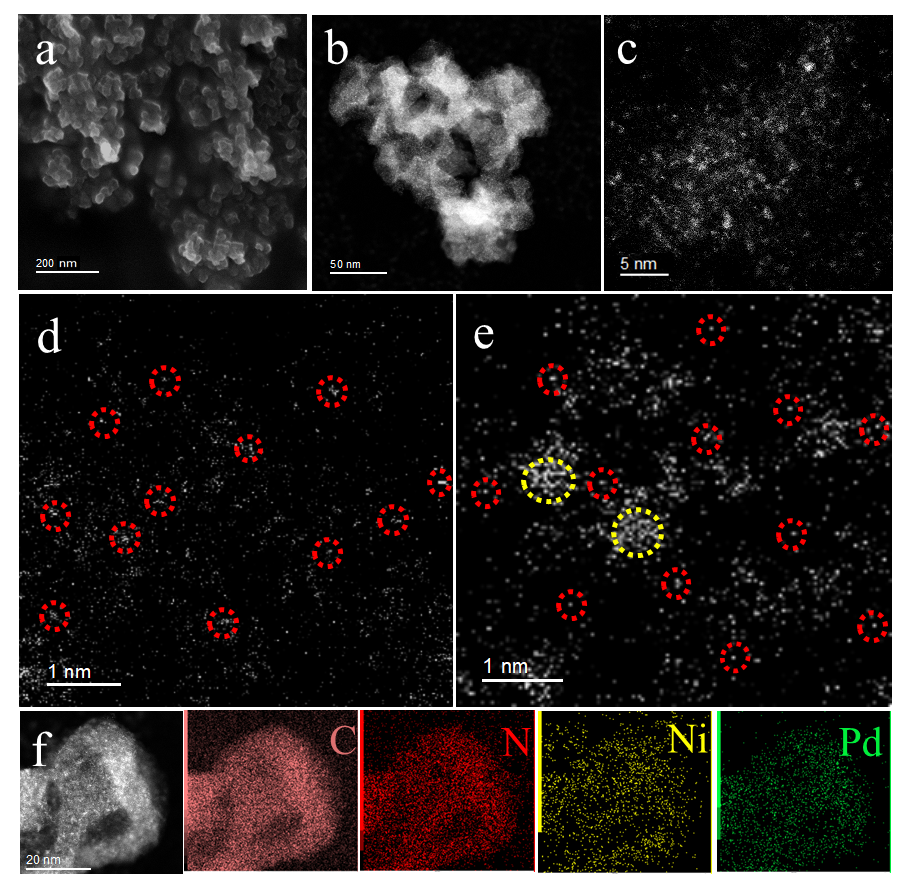
Fig. 1. (a) SEM image of Pd1.0/NiSAs-N-C. (b) HAADF-STEM image of Pd1.0/NiSAs-N-C at 50 nm. (c) HAADF-STEM image of Pd1.0/NiSAs-N-C at 5 nm. AC-STEM images of NiSAs-N-C (d) and Pd1.0/NiSAs-N-C (e) (Ni single atoms are marked by red circles, and Pd clusters were marked by yellow circles). (f) HAADF-STEM image and corresponding EDS mapping of Pd1.0/NiSAs-N-C.
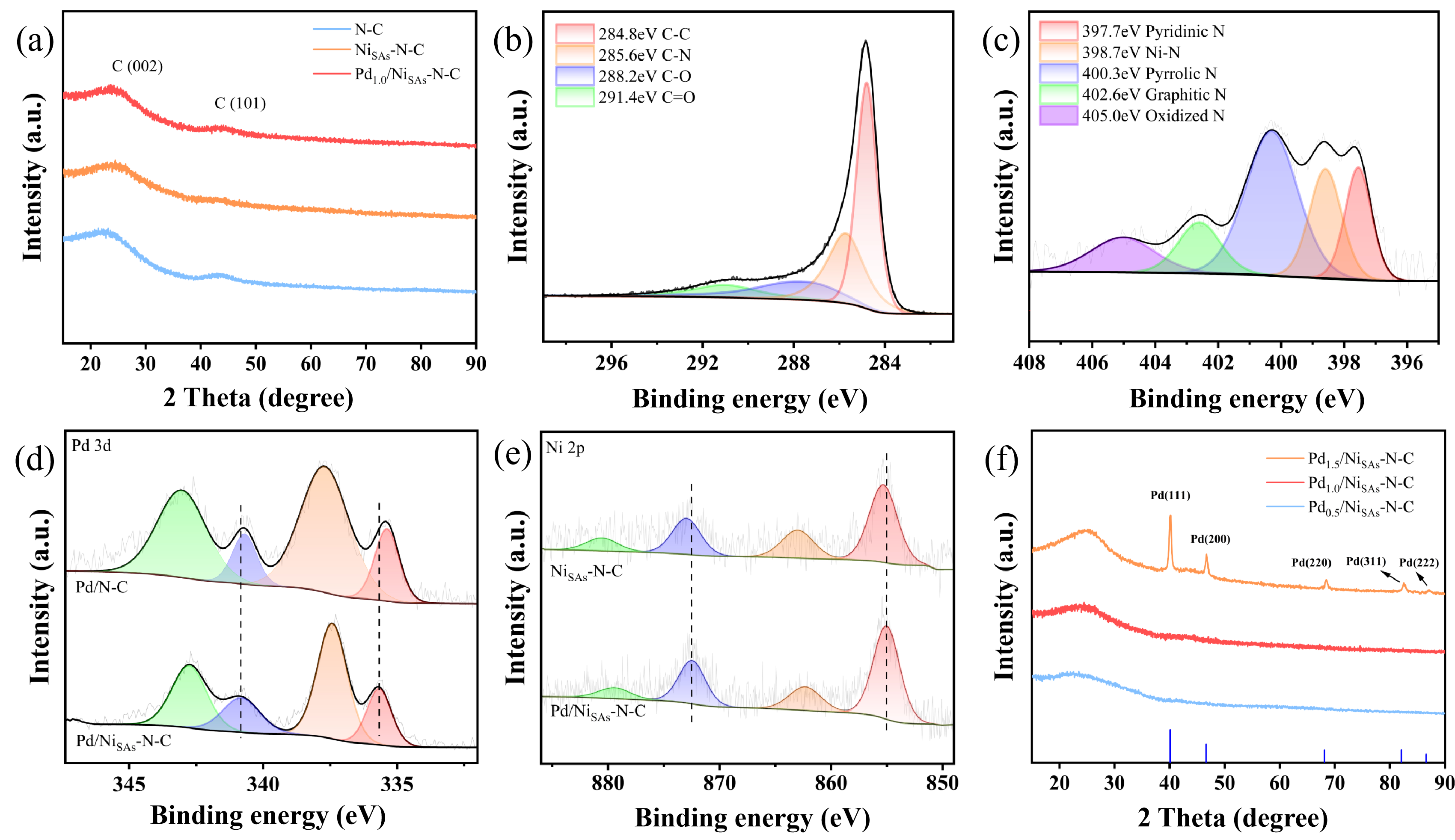
Fig. 2. (a) XRD patterns of N-C, NiSAs-N-C, and Pd1.0/NiSAs-N-C. (b) C 1s XPS spectrum of Pd1.0/NiSAs-N-C. (c) N 1s XPS spectrum of Pd1.0/NiSAs-N-C. (d) Ni 2p XPS spectra of NiSAs-N-C and Pd1.0/NiSAs-N-C. (e) Pd 3d XPS spectra of Pd1.0/N-C and Pd1.0/NiSAs-N-C. (f) XRD patterns of Pd0.5/NiSAs-N-C, Pd1.0/NiSAs-N-C, and Pd1.5/NiSAs-N-C.
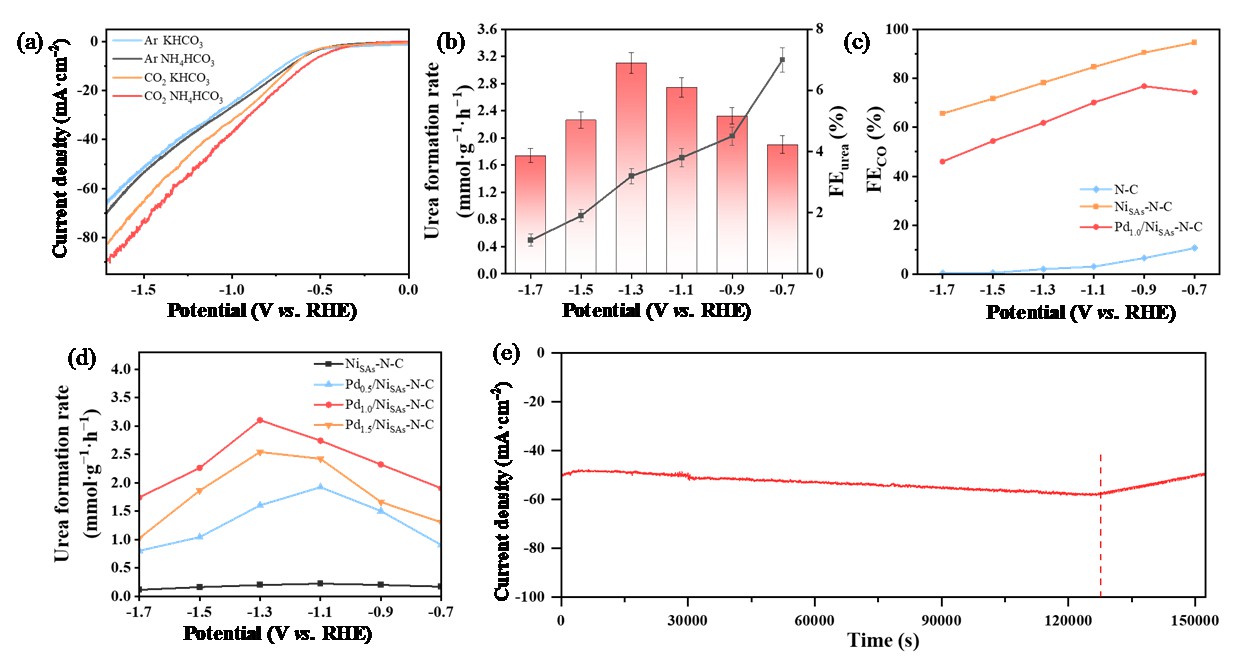
Fig. 3. Electrochemical tests. (a) LSV curves of the Pd1.0/NiSAs-N-C electrode in different solutions. (b) Urea production rate and FEurea of the Pd1.0/NiSAs-N-C electrode at each potential. (c) The FECO comparison of the Pd1.0/NiSAs-N-C, NiSAs-N-C, N-C electrodes in a CO2-saturated 0.5 mol·L-1 NH4HCO3 solution from -0.7 to -1.7 V (vs. RHE). (d) Urea production rates of Pdx/NiSAs-N-C electrodes (x=0.5, 1.0, 1.5) at -0.7 to -1.7 V (vs. RHE). (e) Stability test of the Pd1.0/NiSAs-N-C electrode at -1.3 V vs. RHE.
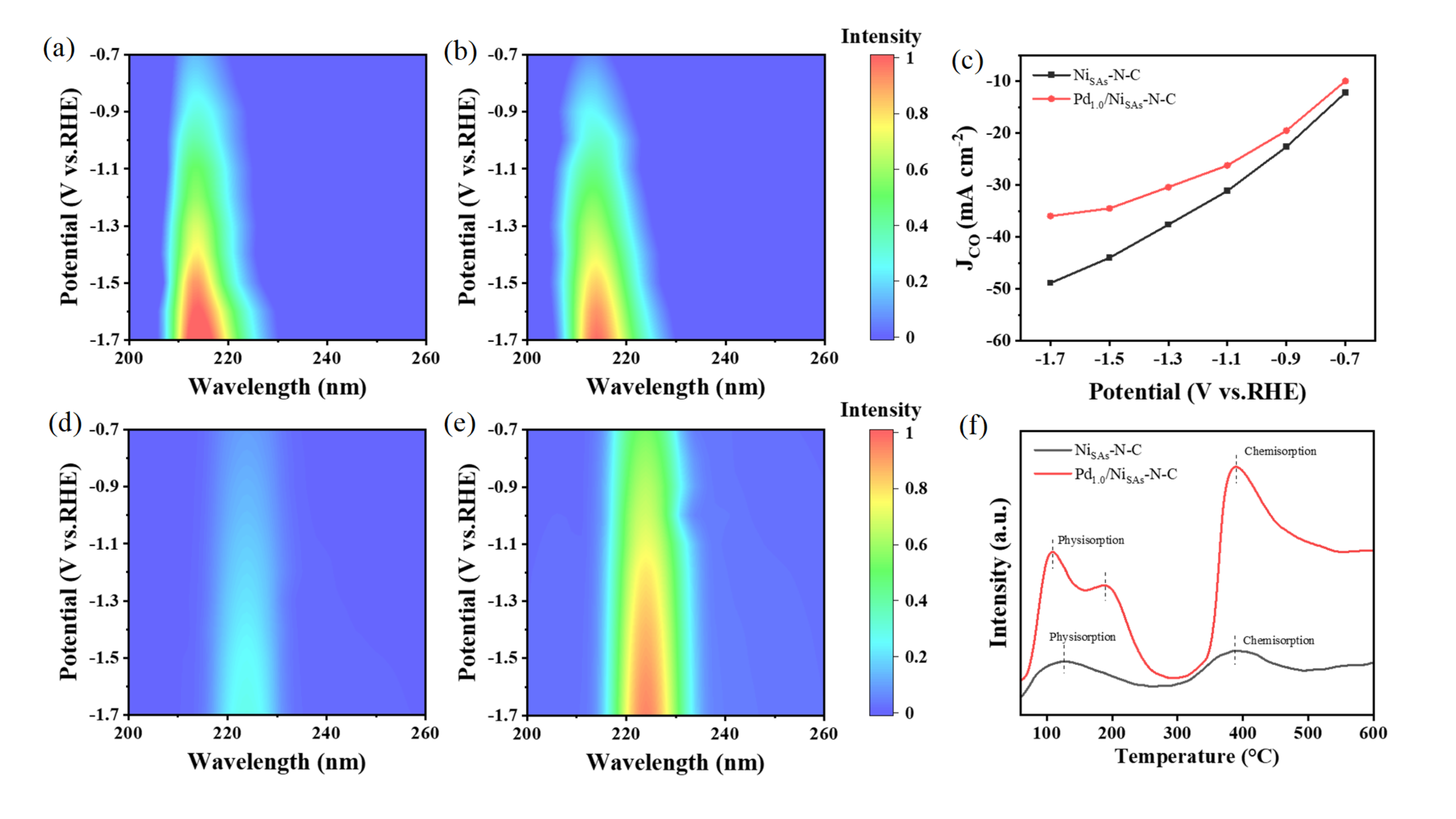
Fig. 4. UV-Vis in situ absorption spectra of the NiSAs-N-C electrode (a) and Pd1.0/NiSAs-N-C electrode (b) in a CO2-saturated 0.5 mol·L-1 KHCO3 solution at -0.7 to -1.7 V (vs. RHE). (c) JCO for NiSAs-N-C, Pd1.0/NiSAs-N-C electrodes in CO2 saturated 0.5 mol·L-1 NH4HCO3 solutions at -0.7 to -1.7 V (vs. RHE). (d) UV-vis in-situ absorption spectra of the NiSAs-N-C electrode and (e) Pd1.0/NiSAs-N-C electrode in an Ar-saturated 0.5 mol·L-1 NH4HCO3 solution at -0.7 to -1.7 V (vs. RHE). (f) NH3-TPD spectra of NiSAs-N-C and Pd1.0/NiSAs-N-C.
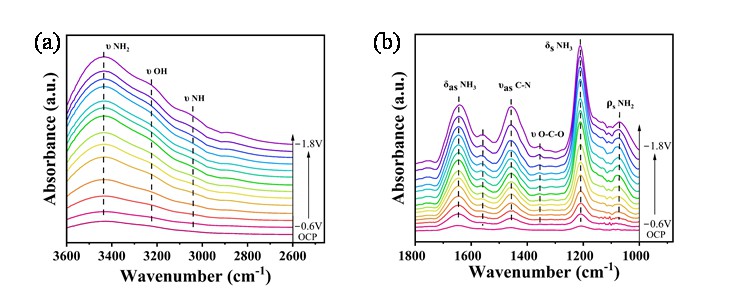
Fig. 5. In-situ FT-IR test of the Pd1.0/NiSAs-N-C electrode in a CO2-saturated 0.5 mol·L-1 NH4HCO3 solution within the potential range of -0.6 to -1.8 V (vs. RHE) was conducted, with tests in the wavenumber ranges of 2600-3600 cm-1 (a) and 1000-1800 cm-1 (b).
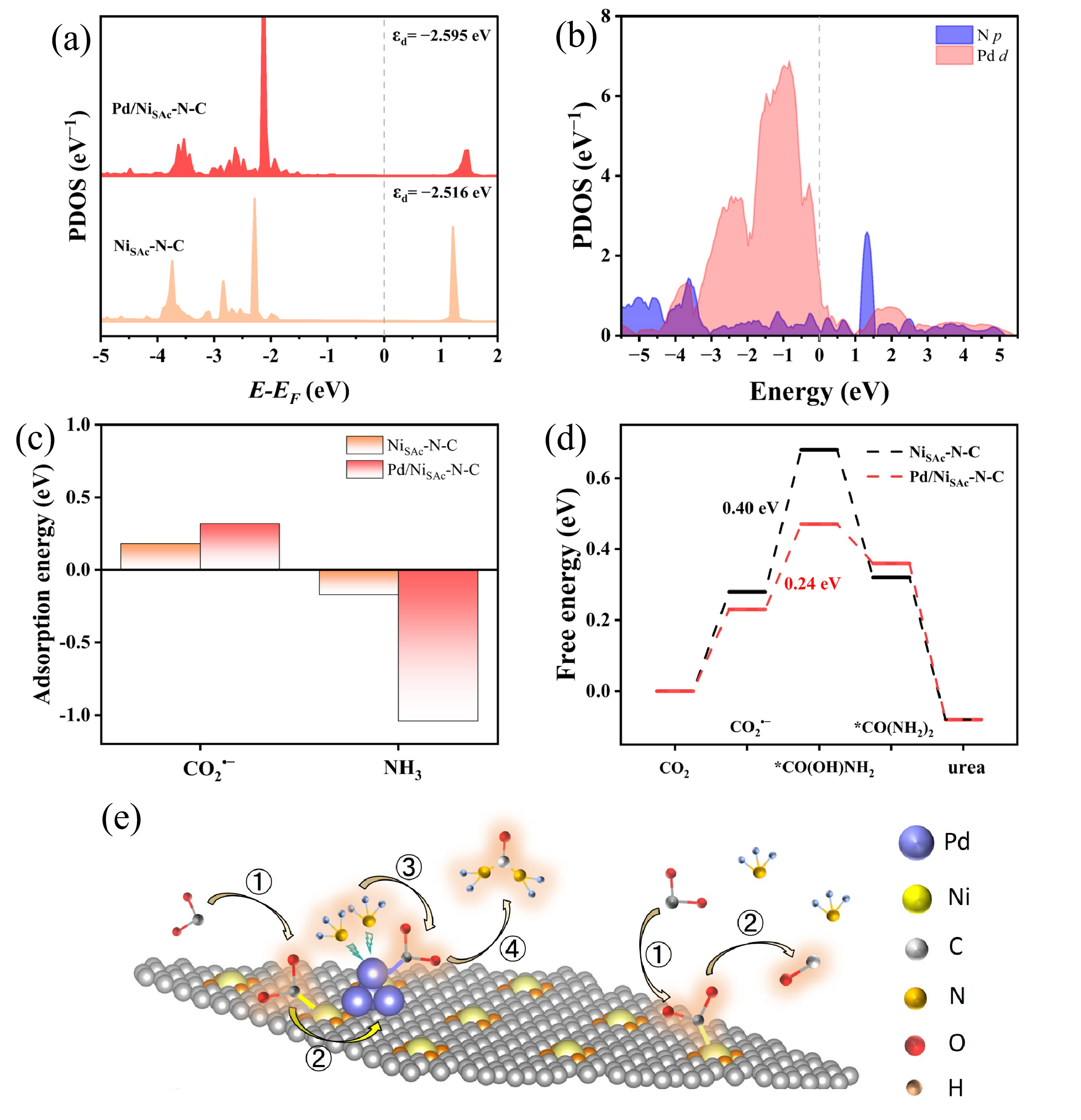
Fig. 6. DFT calculations of electronic property and reaction free energy. (a) PDOS of Ni in NiSAs-N-C and Pd1.0/NiSAs-N-C. (b) After introducing NH3 into Pd1.0/NiSAs-N-C, the PDOS of Pd (d) and N (p). (c) The adsorption energies of CO2•- and NH3 on NiSAs-N-C, as well as those of CO2•- on the Ni sites of Pd1.0/NiSAs-N-C and NH3 on the Pd sites of Pd1.0/NiSAs-N-C. (d) Free energy diagrams of ECRR/NARN on NiSAs-N-C and Pd1.0/NiSAs-N-C. (e) ECRR/NARN reaction mechanism diagram.
|
| [1] | Yingzhen Zhang, Wei Zhang, Zhangzheng Huang, Weilong Cai, Yun Hau Ng, Jianying Huang, Yuekun Lai. Mn-triggered dynamic phase transition in NiSe2 catalyst via doping engineering for boosted urea electrolysis [J]. Chinese Journal of Catalysis, 2026, 88(9): 335-346. |
| [2] | Quan Zhang, Hejin Ma, Ruobing Han, Tonglin Yang, Zhenhui Chen, Miaoyang Zhu, Jiawei Shi, Weiwei Cai, Fangqi Yang, Zehui Yang. Lattice-expanded NiSe catalyst via lanthanum incorporation for accelerating urea electrooxidation in assisting water electrolysis [J]. Chinese Journal of Catalysis, 2026, 86(7): 254-264. |
| [3] | Wei Guo, Zhenlin Mo, Laiji Xu, Yu Zhang, Minghui Yang, Baojun Liu. High-entropy alloy FeCoNiCuPt with donor-bridge effect for enhancing urea electrosynthesis from CO2 and nitrate [J]. Chinese Journal of Catalysis, 2026, 84(5): 159-174. |
| [4] | Zhe Deng, Xiandi Ma, Ning Wang, Menggai Jiao, Hao Wan, Li-Li Zhang, Wei Ma, Zhen Zhou. Superficial S atom optimized active sites in NiFe layered double hydroxides for electrocatalytic urea oxidation [J]. Chinese Journal of Catalysis, 2026, 84(5): 189-199. |
| [5] | Yufeng Jiang, Shaobin Li, Li Zhang, Yang Yang, Kun Cheng, Fengbo Li, Xiaoqing Lv. MXene quantum dots induced Ni site d-band center self-optimization for advanced photovoltaic-driven urea-assisted water splitting [J]. Chinese Journal of Catalysis, 2026, 89(10): 207-217. |
| [6] | Lin-Xing Zhang, Chang-Long Tan, Ming-Yu Qi, Zi-Rong Tang, Yi-Jun Xu. Photocatalyzed C-N coupling reactions of small molecules [J]. Chinese Journal of Catalysis, 2026, 80(1): 7-19. |
| [7] | Borong Lu, Chunmei Lv, Ying Xie, Kai Zhu, Ke Ye, Xiaojin Li. Construction of Ni2P/CoP interface for highly efficient electrolysis of urea-assisted hydrogen production at industrial current densities [J]. Chinese Journal of Catalysis, 2025, 69(2): 163-175. |
| [8] | Jiaxin Li, Yan Lv, Xueyan Wu, Xinyu Guo, Zhuojun Yang, Jixi Guo, Tianhua Zhou, Dianzeng Jia. Surface confinement of sub-1 nm Pt nanoclusters on 1D/2D NiO nanotubes/nanosheets as an effective electrocatalyst for urea-assisted energy-saving hydrogen production [J]. Chinese Journal of Catalysis, 2025, 69(2): 203-218. |
| [9] | Shuanglong Zhou, Yue Shi, Yu Dai, Tianrong Zhan, Jianping Lai, Lei Wang. Continuous-flow electrosynthesis of urea and oxalic acid by CO2-nitrate reduction and glycerol oxidation [J]. Chinese Journal of Catalysis, 2024, 63(8): 270-281. |
| [10] | Zhichao Wang, Mengfan Wang, Yunfei Huan, Tao Qian, Jie Xiong, Chengtao Yang, Chenglin Yan. Defect and interface engineering for promoting electrocatalytic N-integrated CO2 co-reduction [J]. Chinese Journal of Catalysis, 2024, 57(2): 1-17. |
| [11] | Junbao Peng, Jin Xie, Zelong Li, Can Li. Photon-induced regeneration of Pd catalyst for carbonylation of amines to ureas [J]. Chinese Journal of Catalysis, 2024, 66(11): 146-151. |
| [12] | Zuo-Shu Sun, Xue-Yan Xiang, Qiu-Ping Zhao, Zhao Tang, Shi-Yi Jiang, Tong-Bu Lu, Zhi-Ming Zhang, Baifan Wang, Hua-Qing Yin. Efficient electrocatalytic urea synthesis from CO2 and nitrate over the scale-up produced FeNi alloy-decorated nanoporous carbon [J]. Chinese Journal of Catalysis, 2024, 65(10): 153-162. |
| [13] | Chun Yin, Fulin Yang, Shuli Wang, Ligang Feng. Heterostructured NiSe2/MoSe2 electronic modulation for efficient electrocatalysis in urea assisted water splitting reaction [J]. Chinese Journal of Catalysis, 2023, 51(8): 225-236. |
| [14] | Chenxin Chen, Suqi He, Kamran Dastafkan, Zehua Zou, Qingxiang Wang, Chuan Zhao. Sea urchin-like NiMoO4 nanorod arrays as highly efficient bifunctional catalysts for electrocatalytic/photovoltage-driven urea electrolysis [J]. Chinese Journal of Catalysis, 2022, 43(5): 1267-1276. |
| [15] | Zizhan Liang, Rongchen Shen, Peng Zhang, Youji Li, Neng Li, Xin Li. All-organic covalent organic frameworks/perylene diimide urea polymer S-scheme photocatalyst for boosted H2 generation [J]. Chinese Journal of Catalysis, 2022, 43(10): 2581-2591. |
| Viewed | ||||||
|
Full text |
|
|||||
|
Abstract |
|
|||||


