
Chinese Journal of Catalysis ›› 2027, Vol. 92: 397-409.DOI: 10.1016/S1872-2067(26)65277-1
• Articles • Previous Articles Next Articles
Daniël P. C. van Ecka, Suzan E. Schoemakerb, Stefan Bismeijera, Erik Betz-Güttnerb,c, Tom A. J. Wellingb,d, Petra E. de Jongha,b,*( )
Received:2026-06-29
Accepted:2026-09-01
Online:2027-01-02
Published:2026-10-30
Contact:
*E-mail: p.e.dejongh@uu.nl (P. E. de Jongh).Daniël P. C. van Eck, Suzan E. Schoemaker, Stefan Bismeijer, Erik Betz-Güttner, Tom A. J. Welling, Petra E. de Jongh. Dopant-induced particle size control governs carbon yield in methane pyrolysis[J]. Chinese Journal of Catalysis, 2027, 92: 397-409.
Add to citation manager EndNote|Ris|BibTeX
URL: https://www.cjcatal.com/EN/10.1016/S1872-2067(26)65277-1
| Dopant | Catalyst | Ni content a (wt%) | Dopant content a (wt%) | Dopant/Ni a (at%) | BET surface area b (m2/g) | Total pore volume b (cm3/g) | dn ± σn c (nm) | ds ± σs c (nm) | Ni crystallite size d (nm) |
|---|---|---|---|---|---|---|---|---|---|
| Ni/C | 14.1 | — | — | 302 | 0.49 | 6.5 ± 1.8 | 7.6 ± 2.1 | 4.0 | |
| Na | 4Na-Ni/C | 14.0 | 0.29 | 5.3 | 301 | 0.48 | — | — | — |
| 5Na-Ni/C | 13.9 | 0.37 | 6.8 | 299 | 0.49 | 5.4 ± 1.2 | 5.9 ± 1.2 | 4.8 | |
| 10Na-Ni/C | 13.8 | 0.63 | 12 | 290 | 0.52 | 6.7 ± 1.7 | 7.6 ± 1.9 | — | |
| 20Na-Ni/C | 13.7 | 1.2 | 22 | 245 | 0.49 | — | — | — | |
| Mg | 4Mg-Ni/C | 14.0 | 0.22 | 3.8 | 344 | 0.60 | — | — | — |
| 5Mg-Ni/C | 13.9 | 0.32 | 5.5 | 315 | 0.49 | 5.6 ± 1.4 | 6.3 ± 1.4 | 4.6 | |
| 10Mg-Ni/C | 13.6 | 0.61 | 11 | 284 | 0.45 | 6.5 ± 1.7 | 7.4 ± 2.0 | — | |
| 20Mg-Ni/C | 13.3 | 1.2 | 21 | 290 | 0.45 | — | — | — | |
| K | 1K-Ni/C | 13.8 | 0.13 | 1.4 | — | — | — | — | — |
| 2K-Ni/C | 13.6 | 0.23 | 2.4 | — | — | — | — | — | |
| 4K-Ni/C | 13.6 | 0.27 | 3.0 | 292 | 0.48 | — | — | — | |
| 5K-Ni/C | 13.7 | 0.45 | 5.0 | 295 | 0.48 | 5.2 ± 1.7 | 6.4 ± 2.4 | 4.4 |
Table 1 Metal contents and structural properties of the reduced-passivated catalysts.
| Dopant | Catalyst | Ni content a (wt%) | Dopant content a (wt%) | Dopant/Ni a (at%) | BET surface area b (m2/g) | Total pore volume b (cm3/g) | dn ± σn c (nm) | ds ± σs c (nm) | Ni crystallite size d (nm) |
|---|---|---|---|---|---|---|---|---|---|
| Ni/C | 14.1 | — | — | 302 | 0.49 | 6.5 ± 1.8 | 7.6 ± 2.1 | 4.0 | |
| Na | 4Na-Ni/C | 14.0 | 0.29 | 5.3 | 301 | 0.48 | — | — | — |
| 5Na-Ni/C | 13.9 | 0.37 | 6.8 | 299 | 0.49 | 5.4 ± 1.2 | 5.9 ± 1.2 | 4.8 | |
| 10Na-Ni/C | 13.8 | 0.63 | 12 | 290 | 0.52 | 6.7 ± 1.7 | 7.6 ± 1.9 | — | |
| 20Na-Ni/C | 13.7 | 1.2 | 22 | 245 | 0.49 | — | — | — | |
| Mg | 4Mg-Ni/C | 14.0 | 0.22 | 3.8 | 344 | 0.60 | — | — | — |
| 5Mg-Ni/C | 13.9 | 0.32 | 5.5 | 315 | 0.49 | 5.6 ± 1.4 | 6.3 ± 1.4 | 4.6 | |
| 10Mg-Ni/C | 13.6 | 0.61 | 11 | 284 | 0.45 | 6.5 ± 1.7 | 7.4 ± 2.0 | — | |
| 20Mg-Ni/C | 13.3 | 1.2 | 21 | 290 | 0.45 | — | — | — | |
| K | 1K-Ni/C | 13.8 | 0.13 | 1.4 | — | — | — | — | — |
| 2K-Ni/C | 13.6 | 0.23 | 2.4 | — | — | — | — | — | |
| 4K-Ni/C | 13.6 | 0.27 | 3.0 | 292 | 0.48 | — | — | — | |
| 5K-Ni/C | 13.7 | 0.45 | 5.0 | 295 | 0.48 | 5.2 ± 1.7 | 6.4 ± 2.4 | 4.4 |
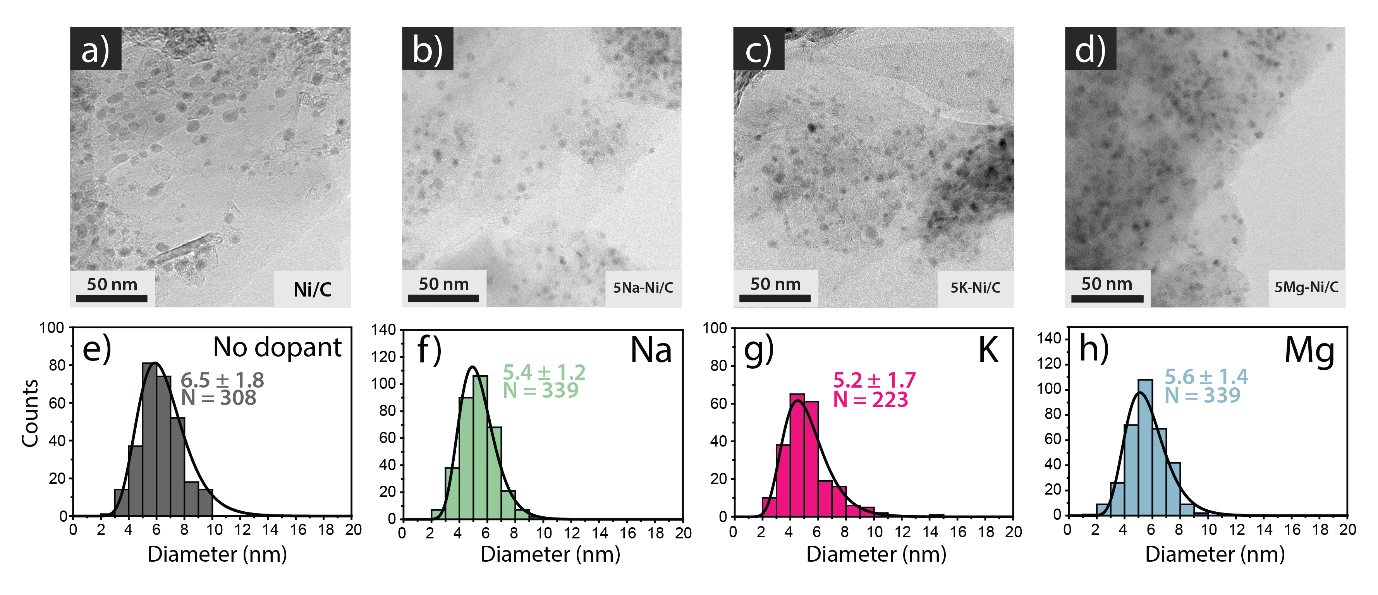
Fig. 1. TEM images and corresponding particle size distributions of the reduced-passivated Ni/C and 5X-Ni/C (X = Na, K, Mg) catalysts.
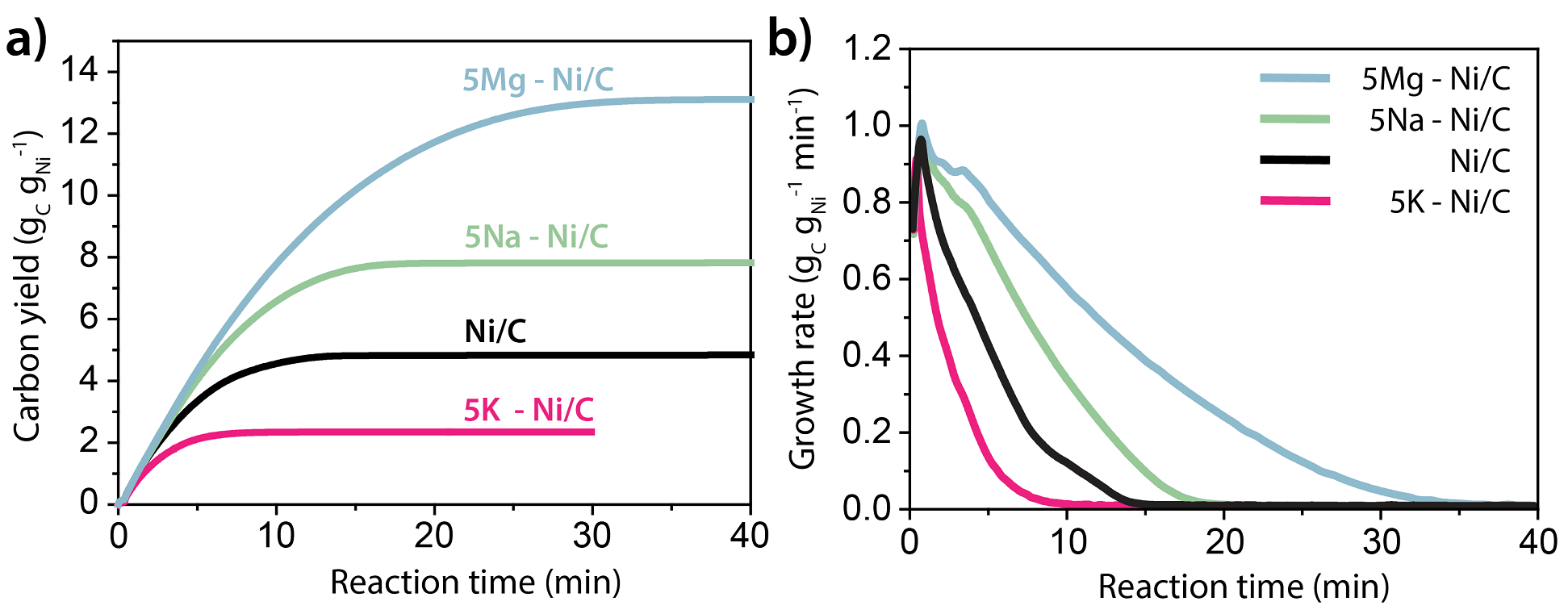
Fig. 2. Influence of 5 at% doping of Ni/C on carbon yield and lifetime in methane pyrolysis using TGA. (a) Nickel weight-normalized carbon evolution of a Ni/C catalyst and 5 at% doped X-Ni/C (X = Mg, Na, K) catalysts. (b) Corresponding growth rate curves. Reaction conditions: 500 °C in 34% CH4/ Ar (50 mL/min).
| Catalyst | Yield (gc/gNi) | Lifetime (min) | Deactivation rate constant (rd) |
|---|---|---|---|
| 5Mg-Ni/C | 13.1 ± 1.0 | 33.6 | 0.053 ± 1.9E-5 |
| 5Na-Ni/C | 7.83 ± 0.46 | 18.8 | 0.094 ± 1.4E-4 |
| Ni/C | 4.84 ± 1.26 | 14.0 | 0.13 ± 5.7E-4 |
| 5K-Ni/C | 2.35 ± 0.55 | 8.7 | 0.29 ± 4.1E-3 |
Table 2 Key parameters from catalytic evaluation of undoped and 5 at% doped X-Ni/C (X = Mg, Na, K) catalysts. The deactivation order is assumed to be 0.5. The parameter rd reflects the rate of deactivation but is dependent on temperature and partial pressures of H2 and CH4. It is reported here using the standard conditions: 1 mg catalyst, 34% CH4/Ar (50 mL/ min), T = 500 °C.
| Catalyst | Yield (gc/gNi) | Lifetime (min) | Deactivation rate constant (rd) |
|---|---|---|---|
| 5Mg-Ni/C | 13.1 ± 1.0 | 33.6 | 0.053 ± 1.9E-5 |
| 5Na-Ni/C | 7.83 ± 0.46 | 18.8 | 0.094 ± 1.4E-4 |
| Ni/C | 4.84 ± 1.26 | 14.0 | 0.13 ± 5.7E-4 |
| 5K-Ni/C | 2.35 ± 0.55 | 8.7 | 0.29 ± 4.1E-3 |
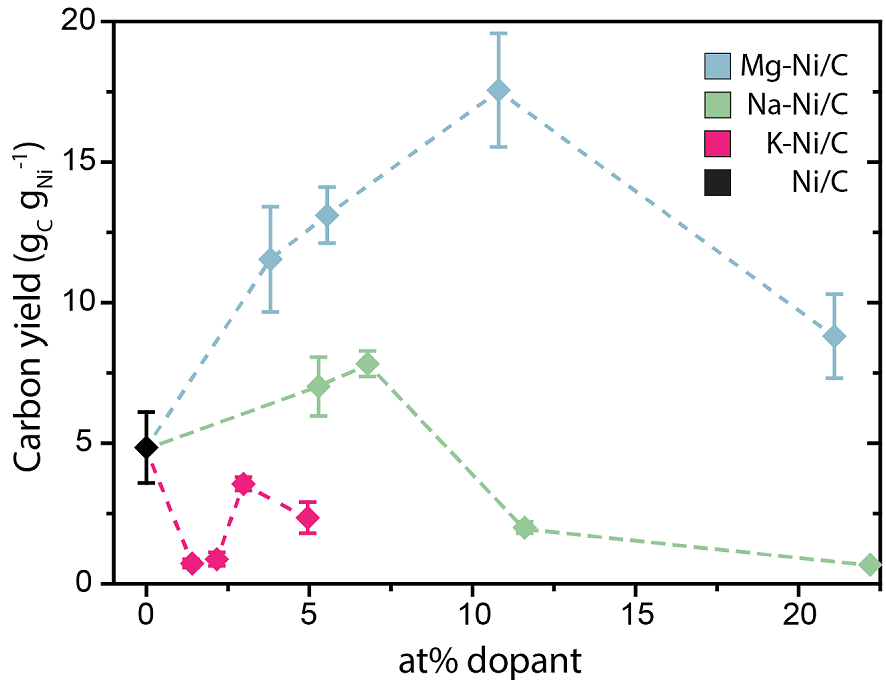
Fig. 3. Effect of dopant concentration on the total carbon yield of Ni/C catalysts. Reaction conditions: 500 °C in 34% CH4/Ar (50 mL/min). Carbon yield measured after deactivation to <1% of initial growth rate.
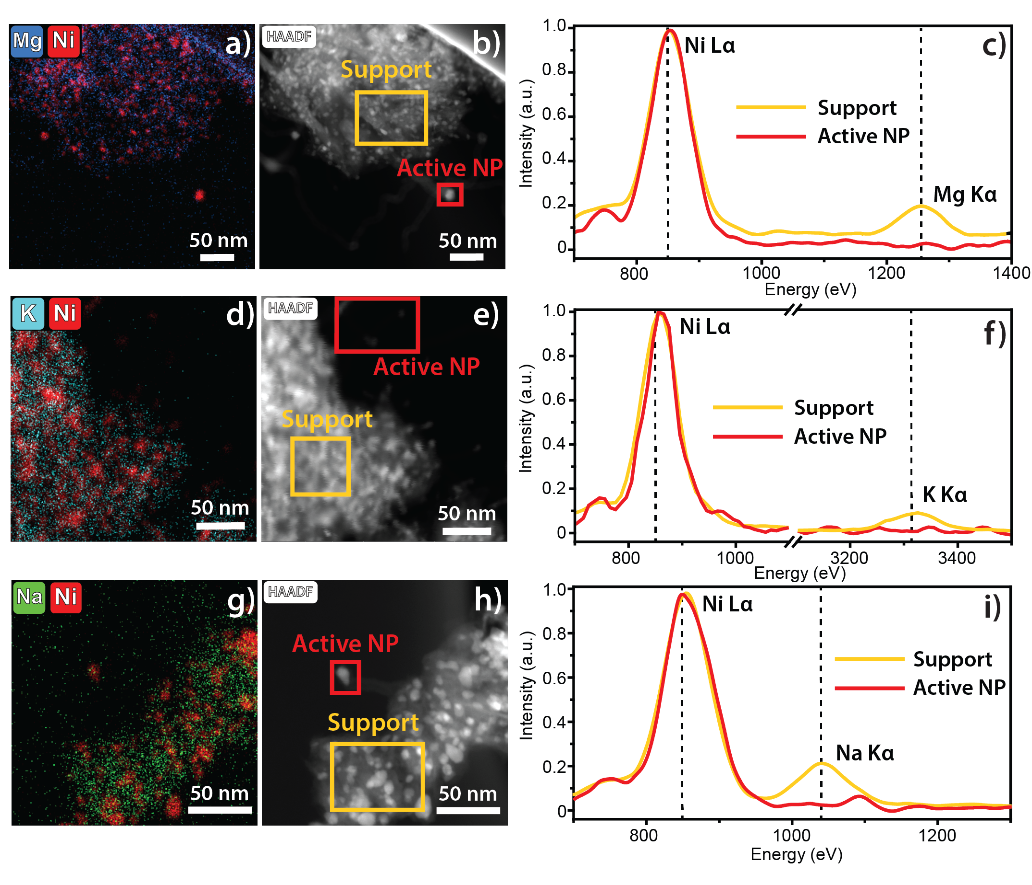
Fig. 4. Distribution of metals in the spent Ni/C catalysts doped with Mg (a‒c), K (d‒f) and Na (g‒i) species. For each sample the elemental map with Ni and the dopant, and the HAADF image are shown. EDX spectra from active NP and support aggregates were extracted from the highlighted areas in the HAADF images. The EDX spectra are normalized to the Ni-Lα signal.
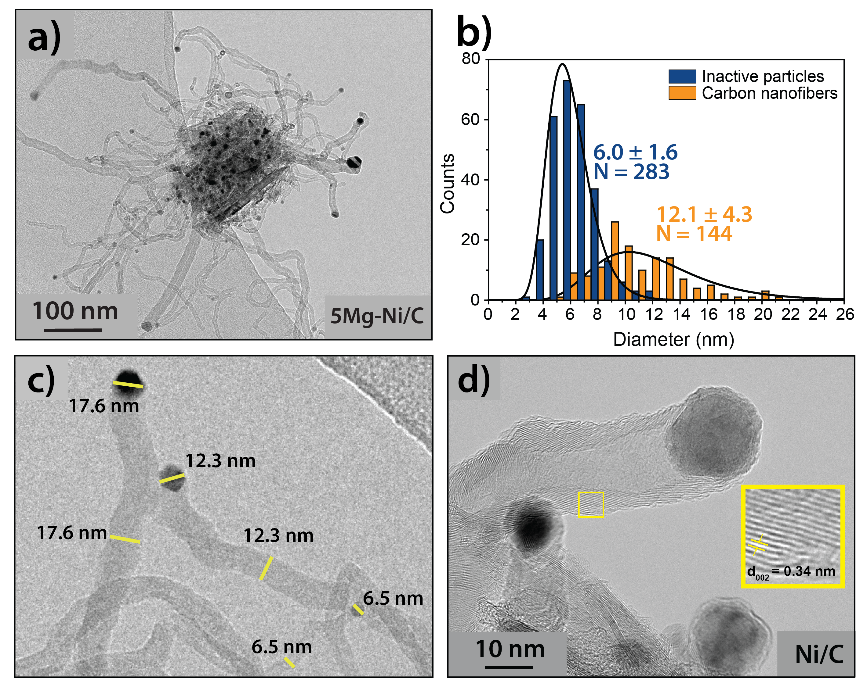
Fig. 5. Particle size analysis on a spent catalyst. (a) Representative TEM image of a spent 5Mg-Ni/C catalyst showing inactive Ni particles and grown carbon nanofibers. (b) Corresponding size distribution, distinguishing inactive particles and carbon nanofibers. (c) Equivalence of active Ni particle size and carbon nanofiber diameter on three nanofibers of different sizes: 6.5, 12.3 and 17.6 nm. (d) Close-up of carbon structures grown using Ni/C, showing a hollow fishbone-type carbon nanofiber morphology and carbon-encapsulated Ni particles.
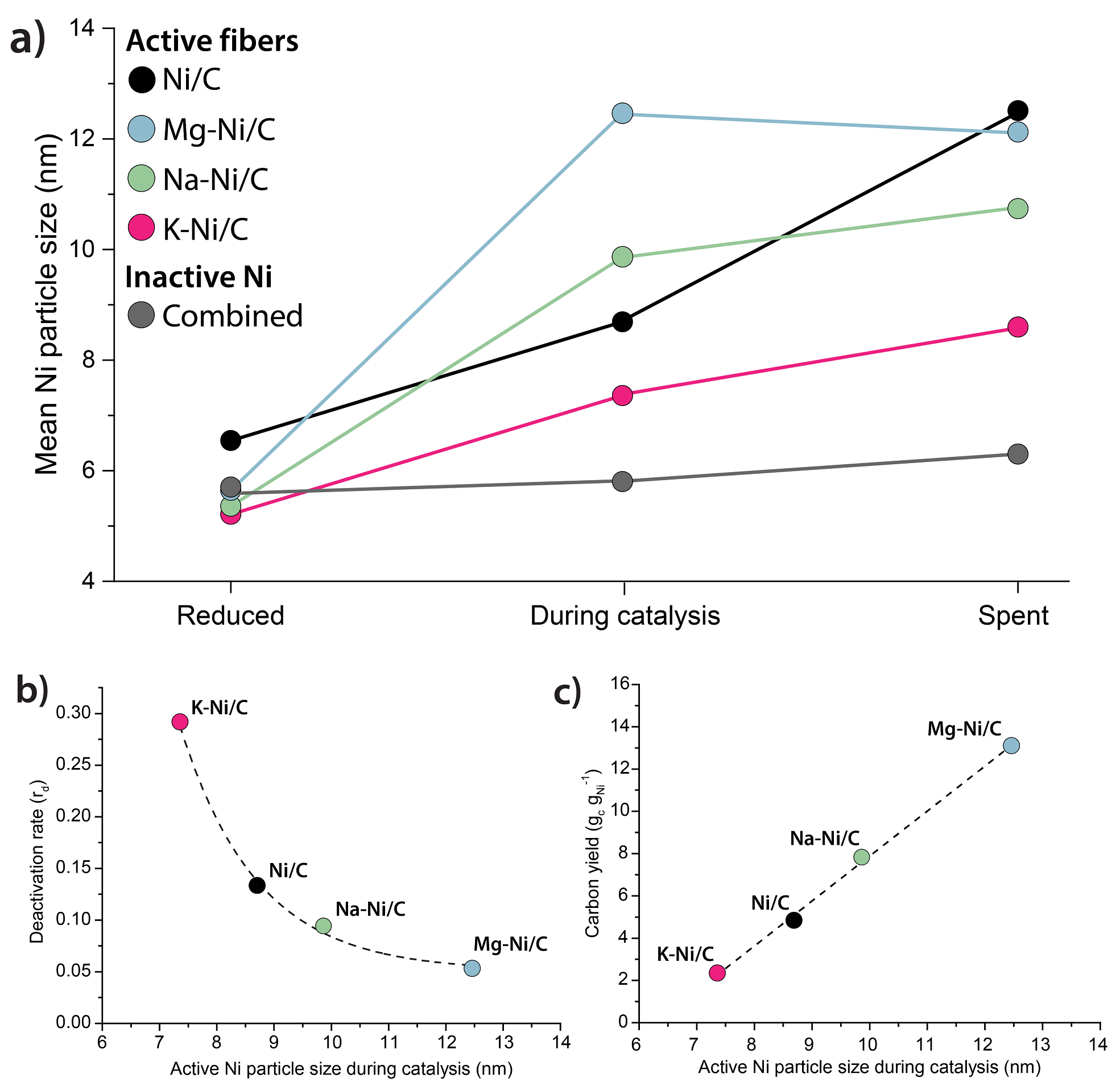
Fig. 6. Particle size evolution during catalysis. (a) Mean Ni particle size of undoped and 5 at% doped Ni/C catalysts at different stages of the reaction. Reduced: After reduction-passivation. During: After 5 min under reaction conditions. Spent: After complete deactivation under reaction conditions. Active fibers of each catalyst are plotted separately from the inactive Ni particles of all catalysts combined (grey trace). (b) Correlation of active Ni particle sizes during catalysis and the deactivation rate constant rd, assuming half-order deactivation and under the standard reaction conditions. (c) Correlation of active Ni particle sizes during catalysis and the final carbon yield.
|
| [1] | Zhongchen Ma, Meiyi Yin, Run Xu, Rongjun Zhang, Tian Lan, Wenli Gu, Guoqing Chen, Yong Lu. Coking-resistant CeAlO3-Socketed Nickel Nanocatalysts for dry reforming of methane [J]. Chinese Journal of Catalysis, 2026, 87(8): 363-375. |
| [2] | Yang Wang, Lei He, Fan Tang, Wen-Cui Li, Bowen He, Xi Liu, Liwei Chen, Dongqi Wang, Wenjie Shen, An-Hui Lu. Electron-deficient nickel tailored by boron for coke-free methane dry reforming [J]. Chinese Journal of Catalysis, 2026, 87(8): 353-362. |
| [3] | Sen Wang, Shiying Li, Rui Geng, Bo Zhou, Pengfei Wang, Zhangfeng Qin, Mei Dong, Jianguo Wang, Unni Olsbye, Weibin Fan. The smallest Ni species triggering selective hydrogenation of CO2 to methane: Ni dimer embedded in MFI and enhancement of MnOx [J]. Chinese Journal of Catalysis, 2026, 87(8): 113-125. |
| [4] | Wei Zuo, Mingyu Liu, Shengjun Sun, Yu Yang, Zixiao Li, Xixi Zhang, Chaoxin Yang, Hefeng Wang, Imran Shakir, Xuefei Liu, Qian Liu, Xuping Sun, Bo Tang. Synergistic chloride resistance via hydrogen‒bond network dynamic optimization and electrostatic repulsion for alkaline seawater oxidation [J]. Chinese Journal of Catalysis, 2026, 87(8): 295-304. |
| [5] | Quan Zhang, Hejin Ma, Ruobing Han, Tonglin Yang, Zhenhui Chen, Miaoyang Zhu, Jiawei Shi, Weiwei Cai, Fangqi Yang, Zehui Yang. Lattice-expanded NiSe catalyst via lanthanum incorporation for accelerating urea electrooxidation in assisting water electrolysis [J]. Chinese Journal of Catalysis, 2026, 86(7): 254-264. |
| [6] | Xu Yu, Han Tian, Ziyi Yu, Fantao Kong, Min Wang, Ruxiang Shen, Xiangzhi Cui, Jianlin Shi. WO2.72-modulated Ru cluster boosting dual-site adsorption for efficient and CO-resistant anion exchange membrane fuel cells [J]. Chinese Journal of Catalysis, 2026, 86(7): 302-314. |
| [7] | Zheng Li, Ziang Zhao, Yihui Li, Yuan Lyu, Li Yan, Wenhao Cui, Shunbin Zhu, Yu Meng, Hejun Zhu, Yunjie Ding. Direct synthesis of long-chain primary alcohols from syngas over Na-driven Co2C-Co catalyst [J]. Chinese Journal of Catalysis, 2026, 85(6): 371-383. |
| [8] | Polina Lavrik, Jurjen Cazemier, Mohamed N. Hedhili, Sudheesh K. Veeranmaril, Abdallah Nassereddine, Antonio Aguilar-Tapia, Marina Chernova, Jean-Louis Hazemann, Alla Dikhtiarenko, Javier Ruiz-Martínez. Relationship between palladium nuclearity and catalytic activity and selectivity in acetylene semi-hydrogenation [J]. Chinese Journal of Catalysis, 2026, 85(6): 384-393. |
| [9] | Syeda Sidra Bibi, Sheraz Ahmed, Heuntae Jo, Jaehoon Kim. Turning methanation into chain growth: Na-induced mechanistic bifurcation on Co-ZrOx catalyst [J]. Chinese Journal of Catalysis, 2026, 85(6): 394-411. |
| [10] | Qianqian Xu, Haihong Zhong, Chunli Li, Rong Jiang, Yongjun Feng, Luis Alberto Estudillo-Wong. O-bridged NiSe2/CQDs composite synergistically triggers interfacial electrons transfer to promote H2O2 electrosynthesis [J]. Chinese Journal of Catalysis, 2026, 85(6): 258-271. |
| [11] | Jieqi Zou, Qian He, Lei Liu, Binbin Zhao, Jinxiang Dong. Precise construction of Pt-O-W active sites via atom replacement on CuWOx nanoislands for efficient glycerol hydrogenolysis to 1,3-propanediol [J]. Chinese Journal of Catalysis, 2026, 84(5): 347-358. |
| [12] | Luyuan Yang, Yitao Yang, Min Yang, Yucai Qin, Xiaoxin Zhang, Saeed Soltanali, Jian Liu, Weiyu Song. Boosting CO2-mediated aromatic cycle via mesoporous design in propane aromatization catalysis [J]. Chinese Journal of Catalysis, 2026, 84(5): 226-235. |
| [13] | Xintao Zhu, Qiuling Xia, Yue Hu, Yinjun Xie. Highly efficient upgrading of 1-butanol into 2‐ethyl‐1‐hexanol catalyzed by nickel pincer complexes [J]. Chinese Journal of Catalysis, 2026, 84(5): 368-374. |
| [14] | Zijie Wan, Yuqi Yang, Zhenquan Wang, Linrui Wu, Haipeng Zhang, Qingfang Shi, Xiang Liu, Hanlin Yang, Bohan Kang, Quan Xu, Jiaqing Luo, Jian Liu. Spatial confinement and nitrogenous defect anchoring synergistically enhance Ru nanoparticles catalyst performance for industrial current densities hydrogen evolution [J]. Chinese Journal of Catalysis, 2026, 84(5): 130-143. |
| [15] | Alexey S. Galushko, Ilya V. Chepkasov, Ruslan R. Shaydullin, Daniil A. Boiko, Alexander G. Kvashnin, Artem M. Abakumov, Valentine P. Ananikov. Reactive gas modulation alters metal nanostructures nuclearity and boosts catalytic activity [J]. Chinese Journal of Catalysis, 2026, 84(5): 324-336. |
| Viewed | ||||||
|
Full text |
|
|||||
|
Abstract |
|
|||||


