
Chinese Journal of Catalysis ›› 2027, Vol. 92: 410-419.DOI: 10.1016/S1872-2067(26)65240-0
• Articles • Previous Articles Next Articles
Anqi Lia,b, Yusen Chena,b, Xiaoli Pana, Yujing Renc, Hongchen Caoa,b, Guiyue Bia, Xiaofeng Yanga,*( ), Aiqin Wanga,*(), Tao Zhanga,b,*()
Received:2026-07-06
Accepted:2026-08-19
Online:2027-01-02
Published:2026-10-30
Contact:
*E-mail: yangxf2003@dicp.ac.cn (X. Yang),Supported by:Anqi Li, Yusen Chen, Xiaoli Pan, Yujing Ren, Hongchen Cao, Guiyue Bi, Xiaofeng Yang, Aiqin Wang, Tao Zhang. Pt1/FeOx single-atom catalyst with dual-valent Pt sites for water-promoted hydrogenation of nitroarenes[J]. Chinese Journal of Catalysis, 2027, 92: 410-419.
Add to citation manager EndNote|Ris|BibTeX
URL: https://www.cjcatal.com/EN/10.1016/S1872-2067(26)65240-0
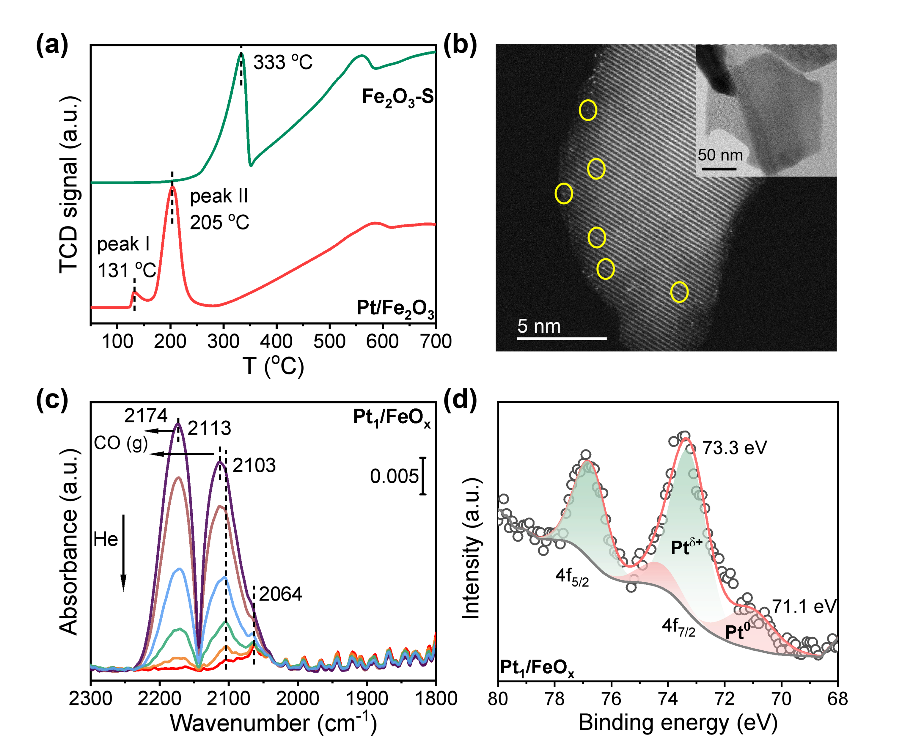
Fig. 1. (a) H2-TPR profiles of Fe2O3 nanosheet and Pt/Fe2O3 catalyst. (b) HAADF-STEM image, (c) CO-DRIFTS and (d) in-situ XPS of Pt1/FeOx.
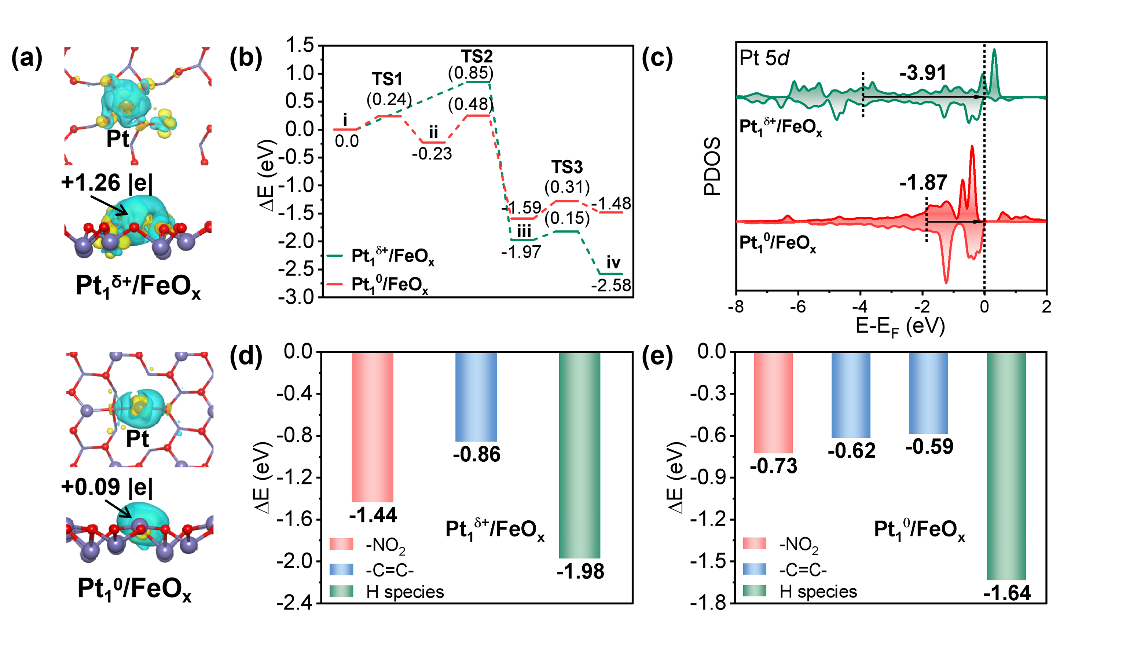
Fig. 2. (a) Top and side views of the geometry and charge density difference for the two Pt1/FeOx(001) models. The values for the calculated bader charges on the Pt1 are indicated. Charge accumulation and depletion are colored yellow and cyan, respectively, with the isosurface value of 0.01 e Å‒3. (b) The potential energy profiles for H2 dissociation and H species diffusion process on the two Pt1/FeOx(001) models. (c) PDOS of Pt atoms in the two Pt1/FeOx(001) models, the zero-energy corresponds to the Fermi level, and the d-band centers are shown with the dotted short lines. (d,e) The adsorption energies of H2, ‒NO2 and ‒C=C‒ group of 3-nitrostyrene on the different sites of Pt1/FeOx(001).
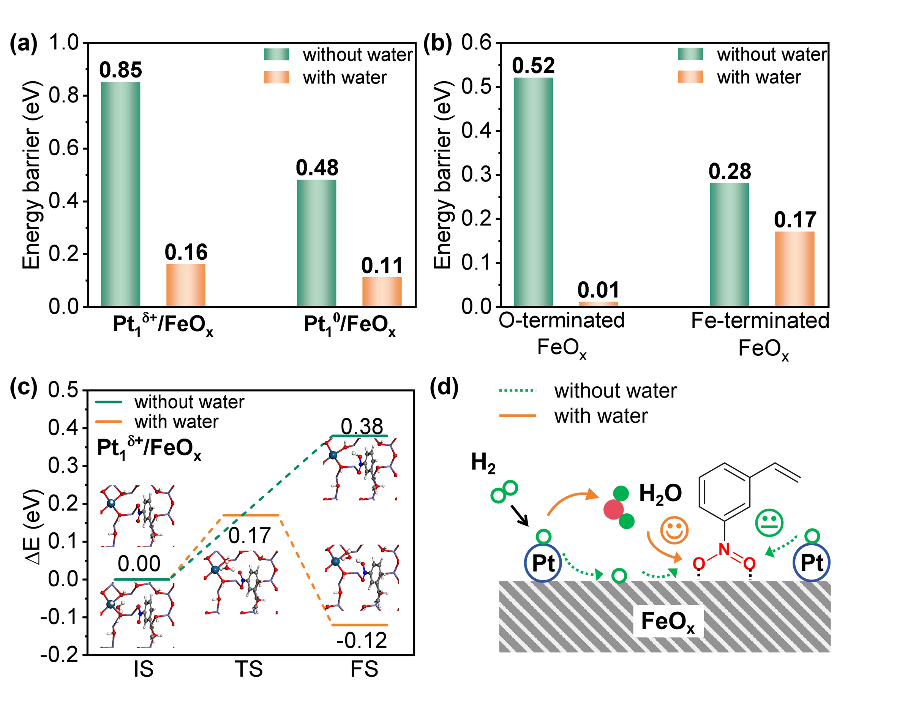
Fig. 3. (a) The energy barrier for H2 dissociation and H* spillover over the Pt1δ+/FeOx and Pt10/FeOx models, respectively, in the absence and presence of water. (b) The energy barrier for H* species diffusion over the O/Fe-terminated FeOx models in the absence and presence of water, respectively. (c,d) The potential energy profiles and schematic model for the H* species transferring from Pt1δ+ sites to the ‒NO2 group in the presence and absence of water. Color code: O-red; Fe-purple; Pt-blue; H-white; C-grey; N-dark blue.
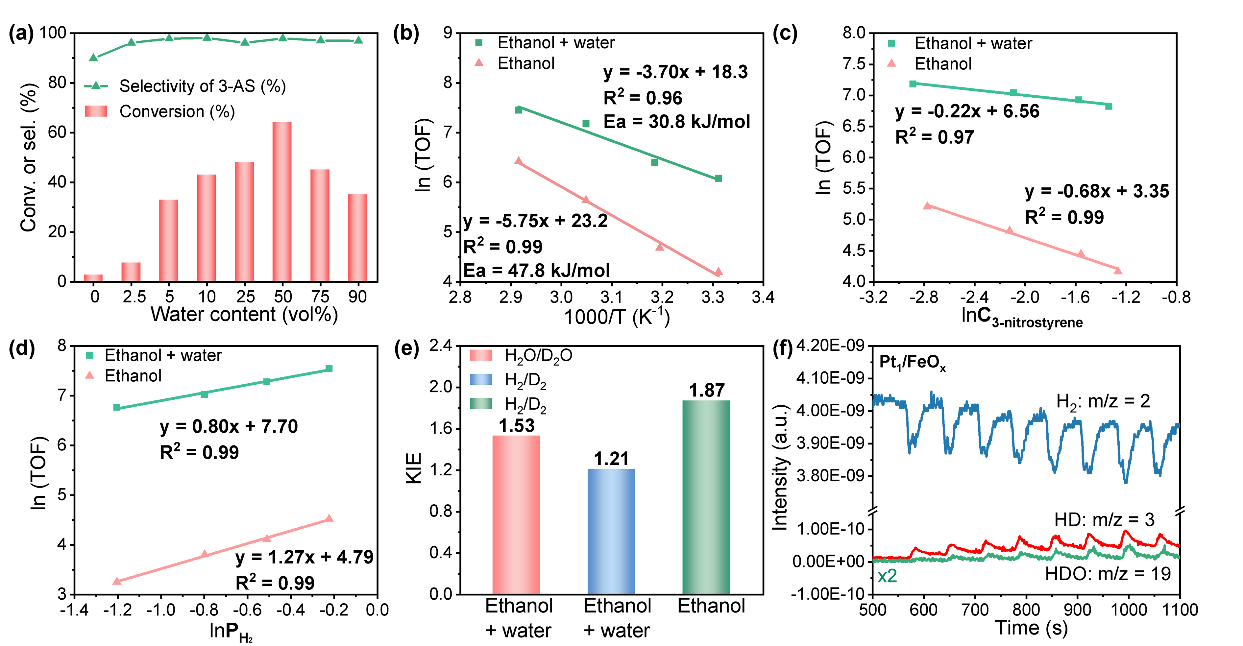
Fig. 4. (a) Hydrogenation performance of 3-nitrostyrene as a function of added water content. 0.55 mmol 3-nitrostyrene, 40 mg Pt1/FeOx as catalyst, 100 μL n-octanol as internal standard, (x) mL H2O + (2‒x) mL ethanol as solvent in total. Reaction conditions: 40 °C, 0.4 MPa H2. 50 vol% water, x = 1 mL. The 3-nitrostyrene hydrogenation apparent activation energy (b), reaction order of 3-nitrostyrene (c) and H2 (d). (e) Kinetic isotope effect of H2/D2 and H2O/D2O in the hydrogenation of 3-nitrostyrene over Pt1/FeOx in ethanol or a mixture of ethanol and water (50 vol%). (f) H2-D2O isotopic exchange experiment results over Pt1/FeOx at 100 °C.
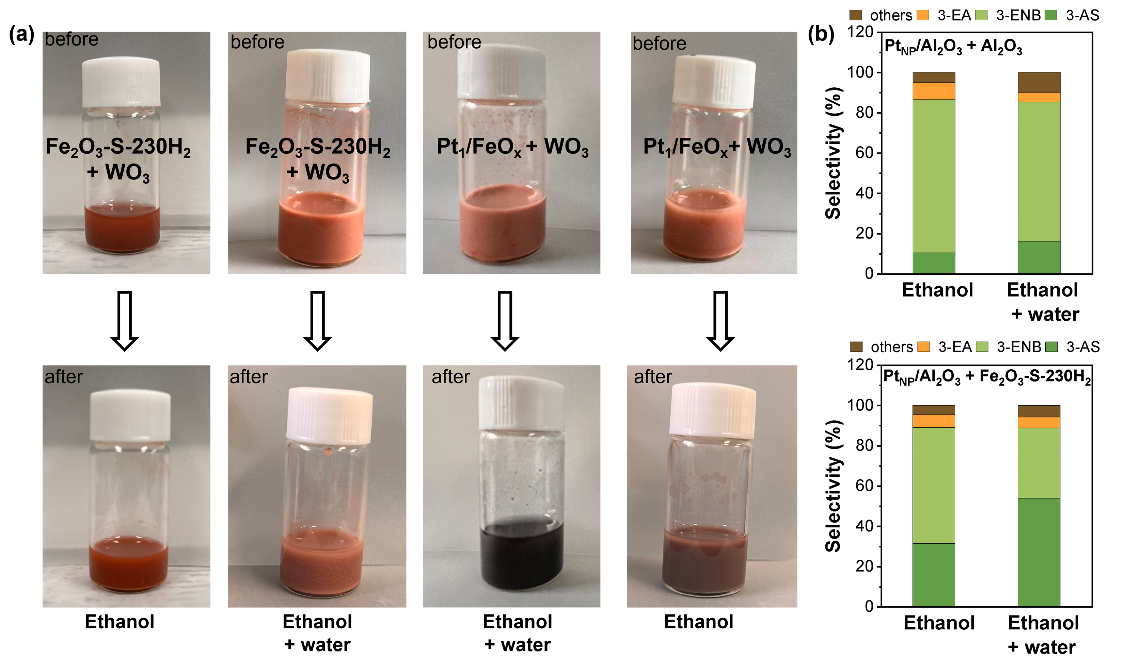
Fig. 5. (a) The mixing experiment of catalyst and WO3. Reaction conditions: 10 mg catalyst, 100 mg WO3, 2 mL solvent in total (2 mL ethanol or 1 mL ethanol + 1 mL water), 40 °C, 0.4 MPa H2, 20 min. (b) 3-Nitrostyrene hydrogenation performance over physical mixtures of PtNP/Al2O3 with Al2O3 or Fe2O3-S-230H2. Reaction conditions: 0.55 mmol 3-nitrostyrene, 30 mg PtNP/Al2O3 mixed with 30 mg support as catalyst, 100 μL n-octanol as internal standard, 2 mL ethanol or 1 mL ethanol + 1 mL water as solvent; 40 °C, 0.4 MPa H2.
|
| [1] | Shangchun Li, Beibei Xu, Jingyu Lu, Shijie Zhao, Qingqing Zhang, Rengui Li, Jing Zhang. Uniform cobalt sub-nanometer clusters catalysts for nitrate-to-ammonia electrosynthesis under industrial conditions [J]. Chinese Journal of Catalysis, 2027, 92(1): 355-364. |
| [2] | Yuxing Xu, Yin Li, Hengwei Wang, Botao Teng, Junling Lu. Frontier orbital insights into the stability and activity of zero-valent single-atom catalysts [J]. Chinese Journal of Catalysis, 2027, 92(1): 123-129. |
| [3] | Yang Wang, Cun-Feng Fan, Yang Liu, Xiao-Qin Zheng, Xuan-Yi Liu, Kai Zhang, Jiahui Kou, Hengming Huang, Lin-Bing Sun. Iron single-atom catalysts created in constrained space with in-situ-formed carbon layers for efficient Fenton reaction [J]. Chinese Journal of Catalysis, 2026, 88(9): 432-441. |
| [4] | Sathi Chatterjee, Hongmei Li, Kang Liu, Zhang Lin, Liyuan Chai, Min Liu. Single-atom catalysts on two-dimensional (2D) materials for photocatalytic CO2 reduction: Fundamentals, design, and emerging strategies [J]. Chinese Journal of Catalysis, 2026, 88(9): 86-128. |
| [5] | Yueling Chen, Yuling Lin, Ziyan Chen, Xiangyu Kong, Jinhong Bi, Guocheng Huang, Ling Wu. Asymmetric N-Ru-S dipole within covalent organic framework enhances internal electric field for efficient CO2 photoreduction [J]. Chinese Journal of Catalysis, 2026, 87(8): 59-69. |
| [6] | Jiaxiang Qin, Songpei Zhang, Xingju Li, Xintai Chen, Jia Zhao, Xiaoling Mou, Xiangen Song, Li Yan, Ronghe Lin, Yunjie Ding. Decoding structure-selectivity interplay in Pd-Ag nanocatalysts for butadiene semi-hydrogenation [J]. Chinese Journal of Catalysis, 2026, 87(8): 342-352. |
| [7] | Wenxin He, Yuanhong Lu, Chenxi Guan, Xiaohui Hou, Rui Huang, Dehui Deng. Boehmite lattice hydroxyl-mediated selective hydrogenation of cinnamaldehyde via water as hydrogen source [J]. Chinese Journal of Catalysis, 2026, 87(8): 386-395. |
| [8] | Xingchen He, Junhui Shao, Najun Li, Dongyun Chen, Hua Li, Qingfeng Xu, Haozhi Wang, Jianmei Lu. Metal-free fluorinated carbon nitride with piezo-boosted hydrogen-bonding networks enable 100% CO selectivity in CO2 reduction [J]. Chinese Journal of Catalysis, 2026, 85(6): 130-142. |
| [9] | Yi-Wen Han, Run-Yu Liu, Yu-Xin Zhang, Lei Ye, Phuc T. T. Nguyen, Tian-Jun Gong, Xue-Bin Lu, Yao Fu, Ning Yan. Establishing built-in electric field within single-atom-anchored hollow architectures for efficient solar-thermal regulation in plastic photoreforming [J]. Chinese Journal of Catalysis, 2026, 84(5): 301-313. |
| [10] | Xin Liu, Yezhou Yang, Jingru Yang, Maodi Wang, Qihua Yang. Promotion effect of Fe in the selective hydrogenation of furfural with bimetallic NiFe catalysts [J]. Chinese Journal of Catalysis, 2026, 83(4): 411-418. |
| [11] | Peikun Li, Jinghui Lyu, Yiyong Zhao, Han Wu, Xianghao Zhang, Qiannan Lu, Yizhi Xiang, Blaž Likozar, Matej Huš, Adriana Zaleska-Medynska, Xiaonian Li. Towards highly efficient selective hydrogenation: The role of single-atom catalysts [J]. Chinese Journal of Catalysis, 2026, 81(2): 69-96. |
| [12] | Ting Li, Xiaohui Chen, Xiaolin Li, Qi Xiao, Hongqun Luo, Nianbing Li. Autogenous force-mediated assembly: A general strategy for constructing single-atom architectures in hierarchical hybrid electrocatalysts [J]. Chinese Journal of Catalysis, 2026, 89(10): 232-245. |
| [13] | Jieting He, Yu Liang, Binbin Zhao, Lei Liu, Qian He, Dingsheng Wang, Jinxiang Dong. Isomorphous substitution in CaAl-hydrotalcite to construct high density single-atom catalysts for selective N-Heteroarene hydrogenation [J]. Chinese Journal of Catalysis, 2025, 70(3): 353-362. |
| [14] | Xi-Lai Liu, Wei Zhong, Yu-Fan Jin, Tian-Jiao Wang, Xue Xiao, Pei Chen, Yu Chen, Xuan Ai. Pd-Pt bimetallene for the energy-saving electrochemical hydrogenation of 5-hydroxymethylfurfural [J]. Chinese Journal of Catalysis, 2025, 69(2): 241-248. |
| [15] | Tianyou Zhao, Fengming Hu, Meiqi Zhu, Chang-Jie Yang, Xin-Yu Wang, Yong-Zhou Pan, Jiarui Yang, Xia Zhang, Wen-Hao Li, Dingsheng Wang. Future development of single-atom catalysts in portable energy and sensor technologies [J]. Chinese Journal of Catalysis, 2025, 78(11): 100-137. |
| Viewed | ||||||
|
Full text |
|
|||||
|
Abstract |
|
|||||


