
Chinese Journal of Catalysis ›› 2026, Vol. 90: 52-81.DOI: 10.1016/S1872-2067(26)65171-6
• Reviews • Previous Articles Next Articles
Mingyi Zhaoa,1, Zhengyang Liua,1, Cong Yanga,1, Zhaodi Hea, Yujun Guoa, Rui Caia, Xiangqian Yinc, Jianwei Wangc, Xueqin Mua, Suli Liua,*( ), Dingsheng Wangb,*(), Zhihui Daia
Received:2026-02-08
Accepted:2026-03-22
Online:2026-11-05
Published:2026-09-09
About author:Sui Liu (School of Chemistry and Molecular Engineering, Nanjing Tech University) received her PhD from the Nanjing Normal University in 2014. She joined Nanjing Xiaozhuang University where she became a full professor. Currently, she works at the School of Chemistry and Molecular Engineering, Nanjing Tech University. Her research focuses on new energy materials, water-splitting electrocatalysts, and other related fields of electrochemical catalysis.1Contributed equally to this work.
Supported by:Mingyi Zhao, Zhengyang Liu, Cong Yang, Zhaodi He, Yujun Guo, Rui Cai, Xiangqian Yin, Jianwei Wang, Xueqin Mu, Suli Liu, Dingsheng Wang, Zhihui Dai. Multiscale optimization design of porphyrin electrocatalysts for redox reactions under operational conditions[J]. Chinese Journal of Catalysis, 2026, 90: 52-81.
Add to citation manager EndNote|Ris|BibTeX
URL: https://www.cjcatal.com/EN/10.1016/S1872-2067(26)65171-6
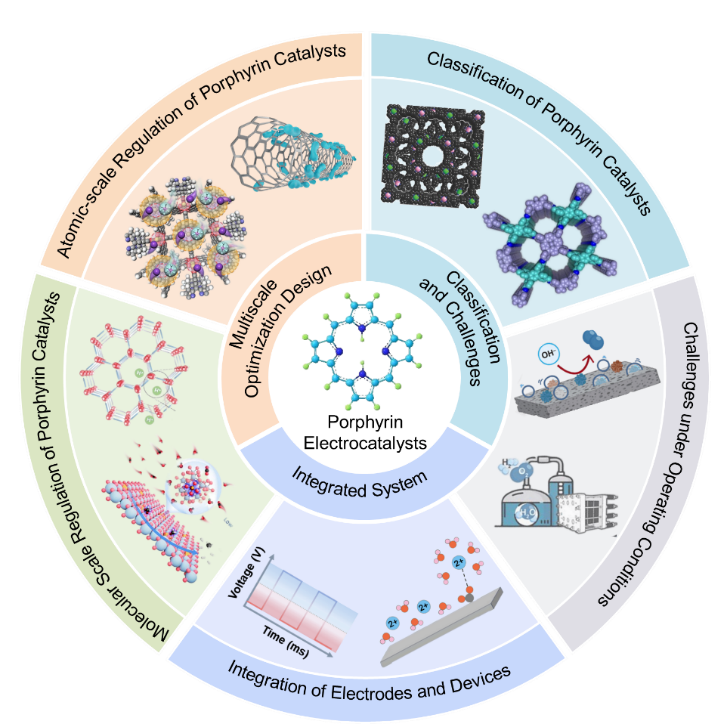
Fig. 1. Schematic diagram of multi-scale optimization design of porphyrin electrocatalysts for redox reactions.
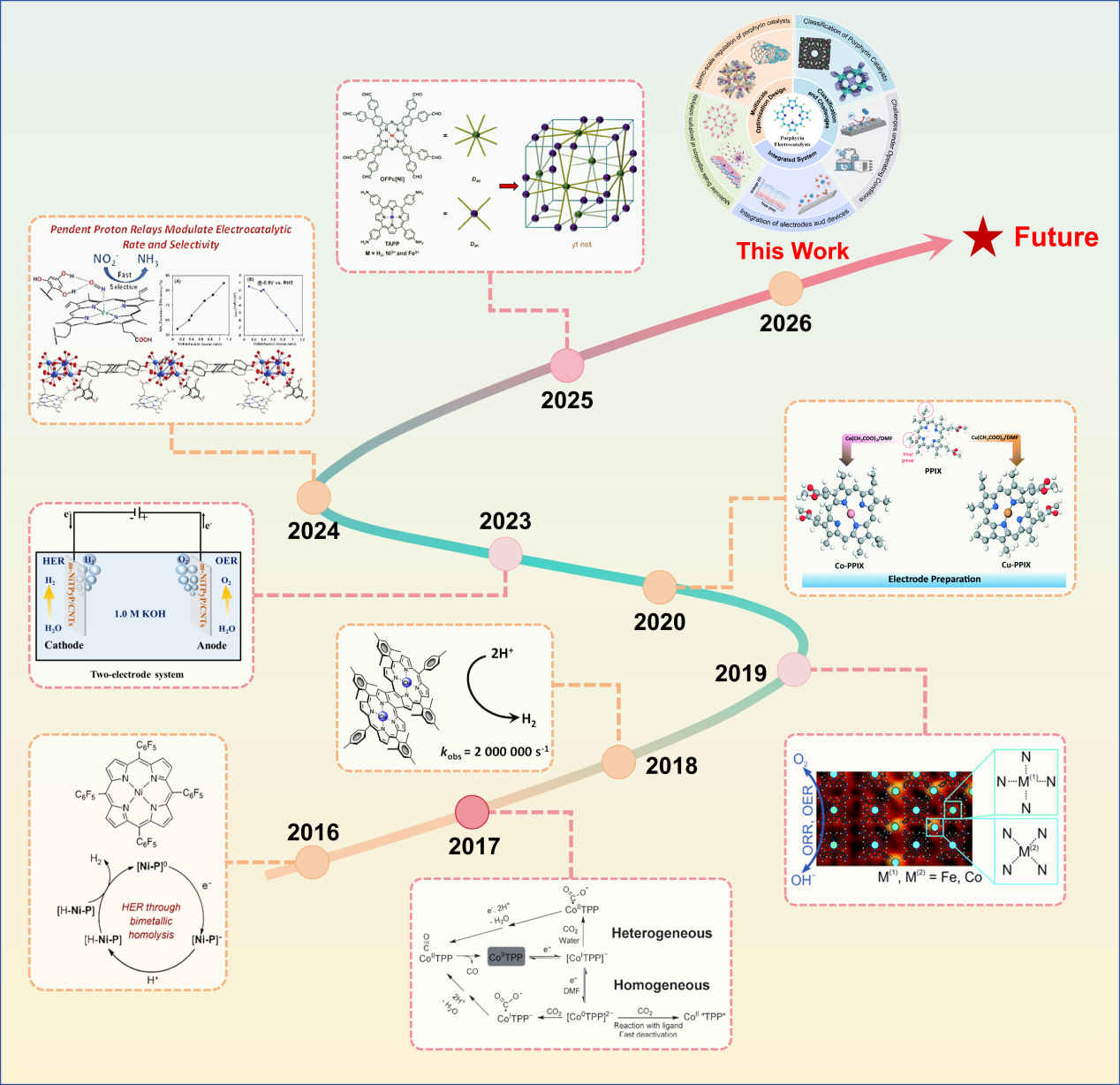
Fig. 2. Progress chart on the application of porphyrin catalysts. Reproduced with permission: Copyright, 2016, Wiley-VCH Verlag GmbH [102]; Copyright, 2017, Wiley‐VCH Verlag GmbH [103]; Copyright, 2018, American Chemical Society [104]; Copyright, 2019, Phys. Chem. Phys [105]; Copyright, 2020 Royal Society of Chemistry [106]; Copyright, 2023 Wiley‐VCH GmbH [107]; Copyright, 2024, Wiley-VCH GmbH [108]; Copyright, 2025 Wiley‐VCH GmbH [109].
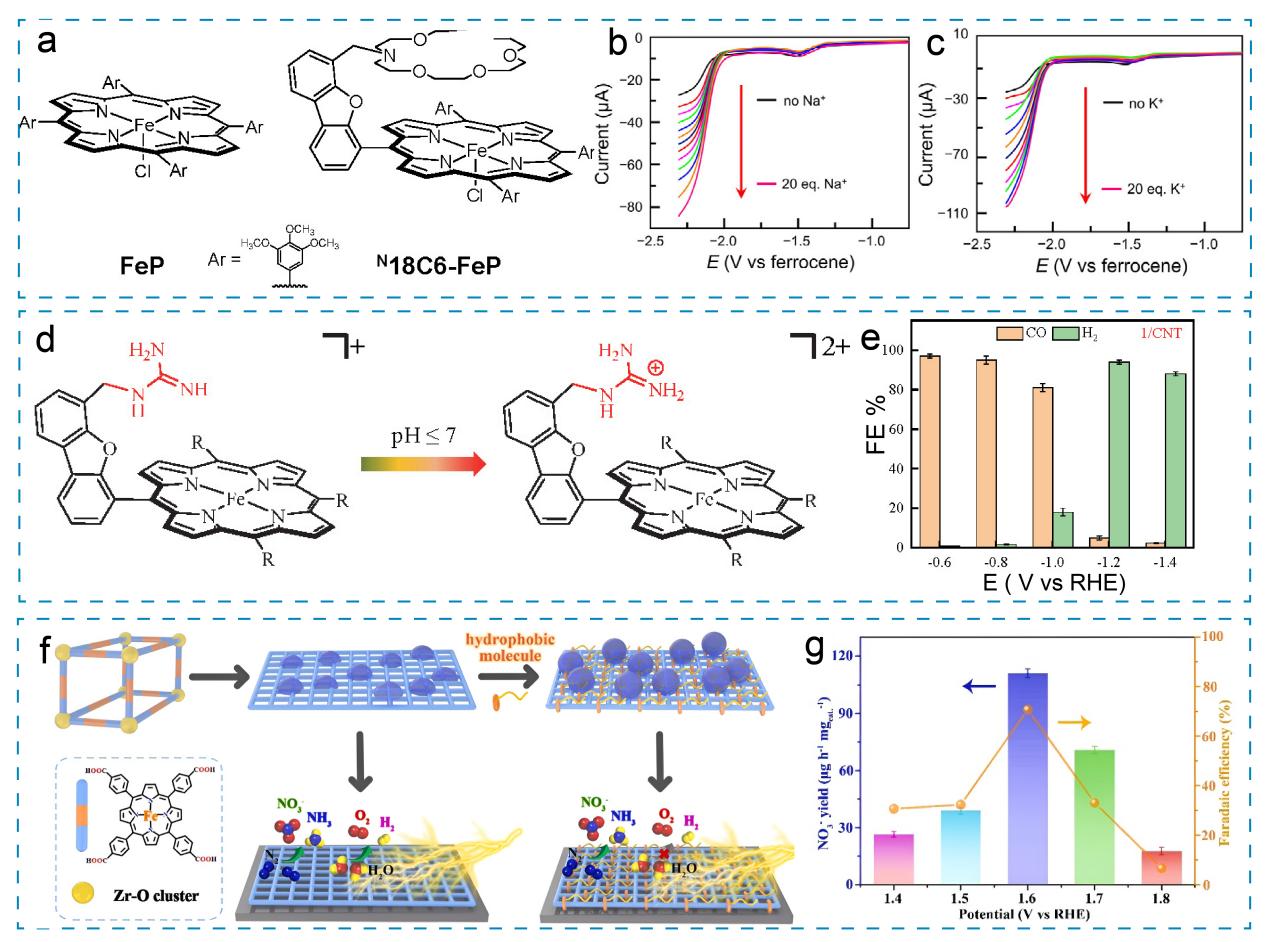
Fig. 3. (a) The molecular structures of FeP and N18C6-FeP. (b) LSVs of 0.5 mmol L-1 N18C6-FeP in DMF under CO2 with the addition of Na. (c) LSVs of 0.5 mmol L-1 N18C6-FeP in DMF under CO2 with the addition of K. Ref. [122], Copyright, 2021, Chinese Journal of Catalysis. (d) Protonation of the appended guanidyl group of 1 in pH ≤ 7 aqueous solutions. (e) FE for the production of CO and H2. Ref. [123], Copyright, 2023. Chinese Journal of Catalysis. (f) Illustration of the fabrication process. (g) Yields and FEs. Ref. [125], Copyright, 2022 Elsevier.
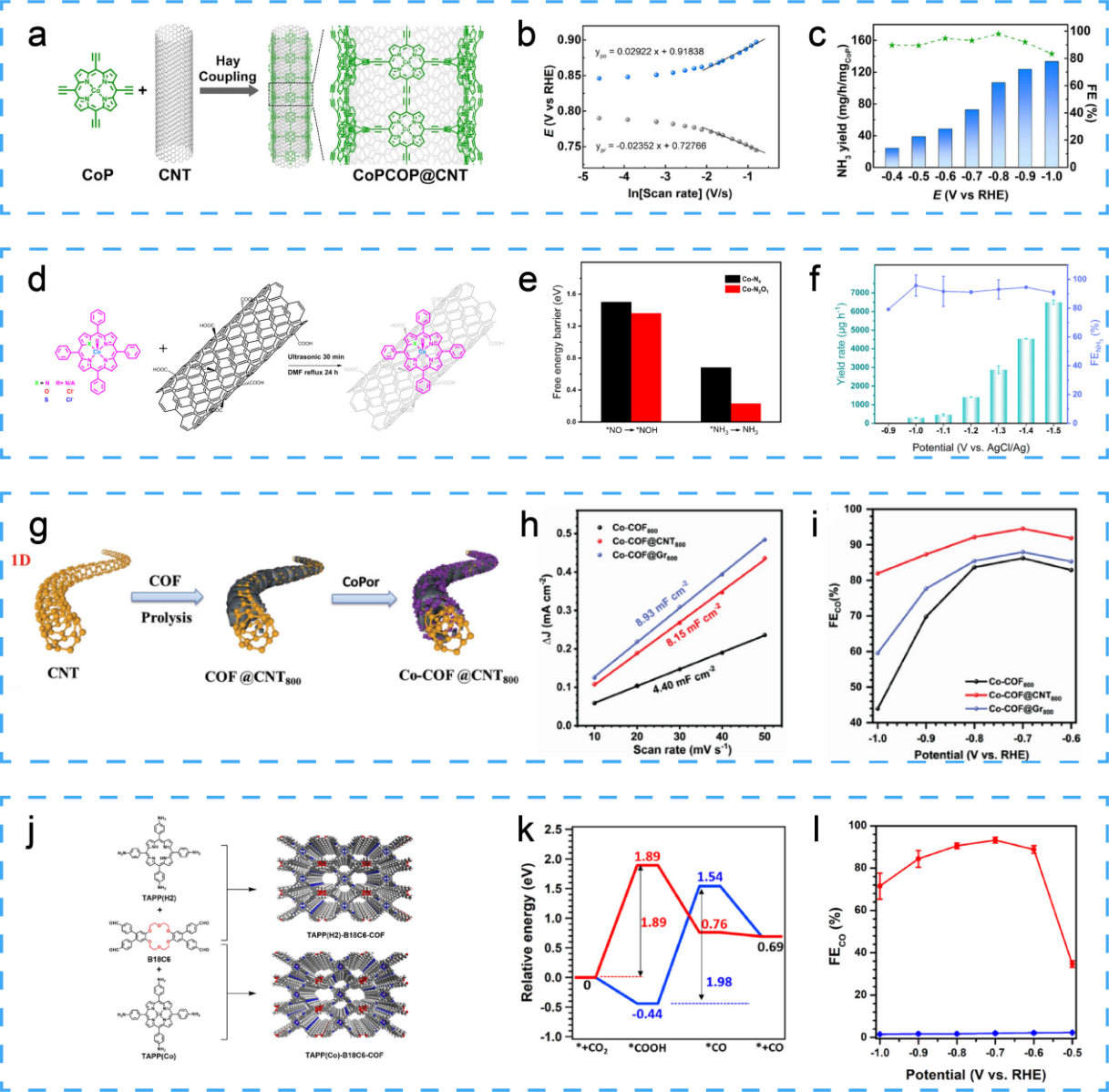
Fig. 4. (a) Schematic diagram. (b) The plot of the oxidation peak and reduction peak potentials versus the logarithm of scan rates on CoPCOP@CNT. (c) Yields and Fes. Reprinted with permission from Ref. [59]. Copyright, 2021, Elsevier. (d) The structure of CoTPP (X = N), CoOTPP (X = O), and CoSTPP (X = S), and the process of compounding them with composite CNTs. (e) Free energy barrier in key steps. Ref. [128]. Copyright, 2022, Elsevier. (f) Potential-dependent NH3 yield rate and FE. (g) Synthesis of the template-pyrolysis method. (h) FECO. (i) ECSA curves. Ref. [129]. Copyright, 2022, Elsevier. (j) Synthesis diagrams of different catalysts. (k) The relative energy diagrams. (l) FE of carbon monoxide calculated. Ref. [130]. Copyright, 2021, American Chemical Society.
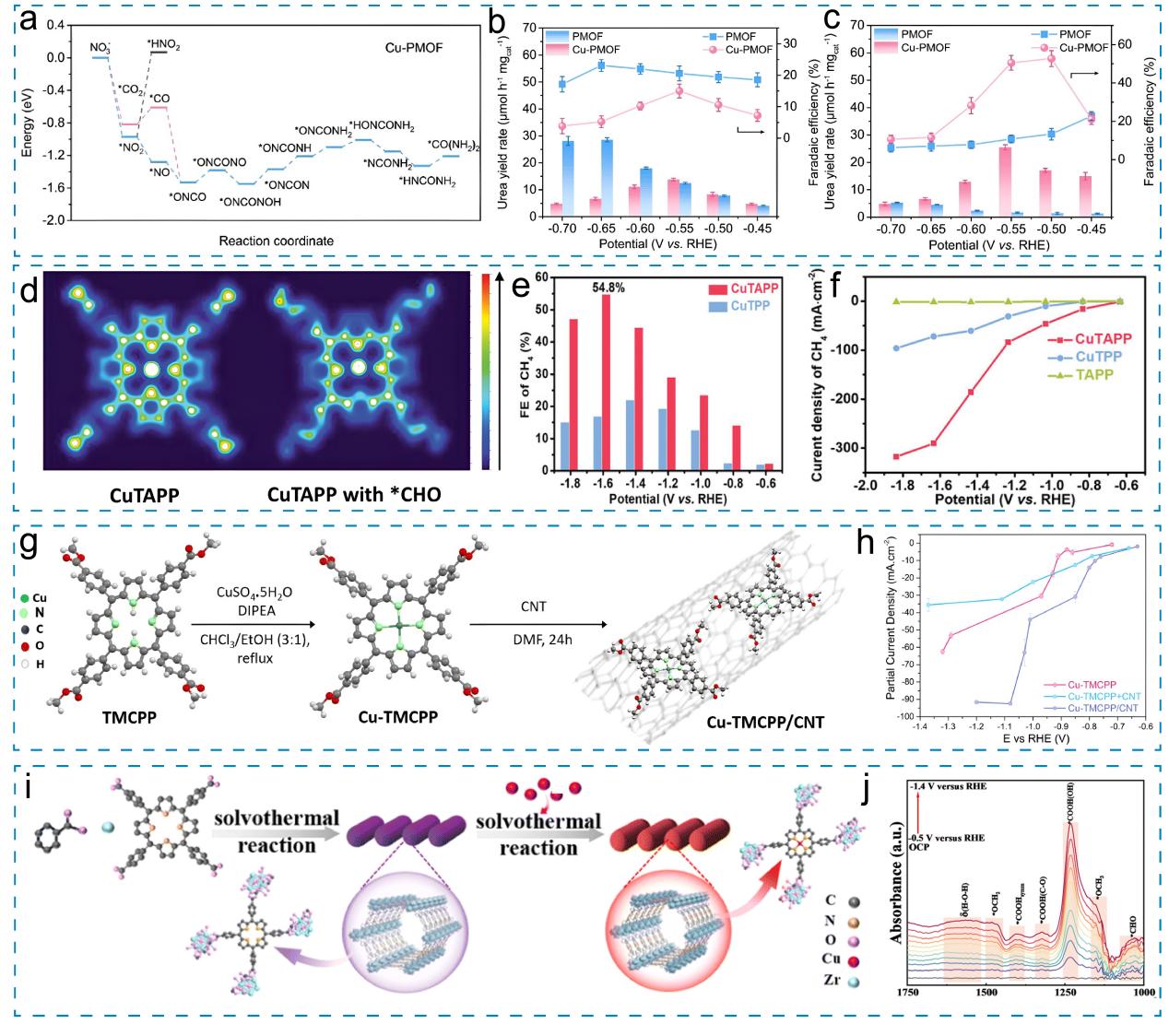
Fig. 5. (a) Free-energy diagram. (b) Yield rates and FEs. (c) Yield rates and FEs. Ref. [136]. Copyright, 2025, John Wiley and Sons. (d) Plots of electron density. (e) FEs. (f) Partial current densities. Ref. [137]. Copyright, 2024, John Wiley and Sons. (g) Schematic representation of the synthesis method. (h) Partial current density. Ref. [138]. Copyright, 2025, Royal Society of Chemistry. (i) Synthesis process. (j) In situ ATR-SEIRAS spectra. Ref. [140]. Copyright, 2021, American Chemical Society.
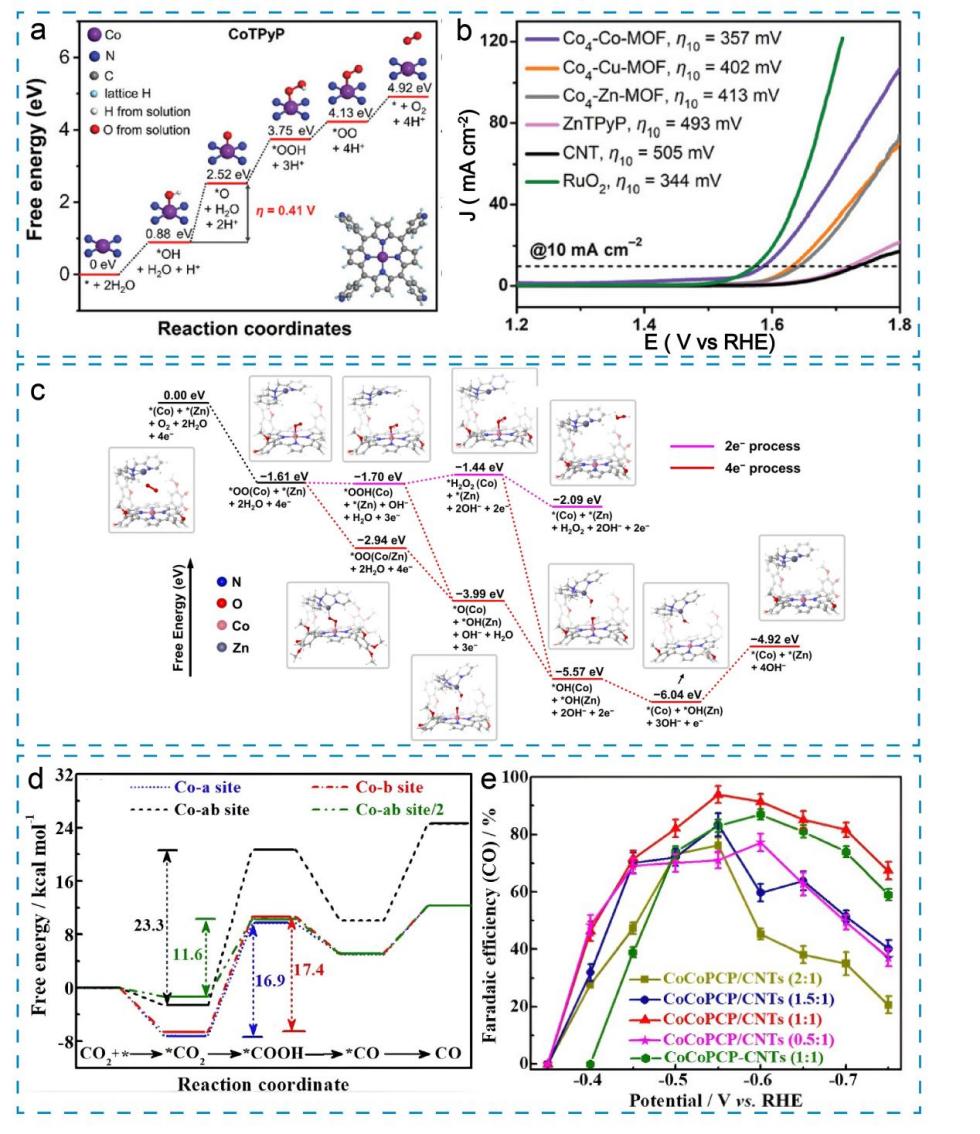
Fig. 6. (a) Free energy diagrams. (b) OER LSV data. Ref. [145]. Copyright, 2024, John Wiley and Sons. (c) Calculated relative Gibbs free energy profile. Ref. [146]. Copyright, 2024, John Wiley and Sons. (d) The free energy diagram. (e) CO faradaic efficiencies. Ref. [148]. Copyright, 2021, Elsevier.
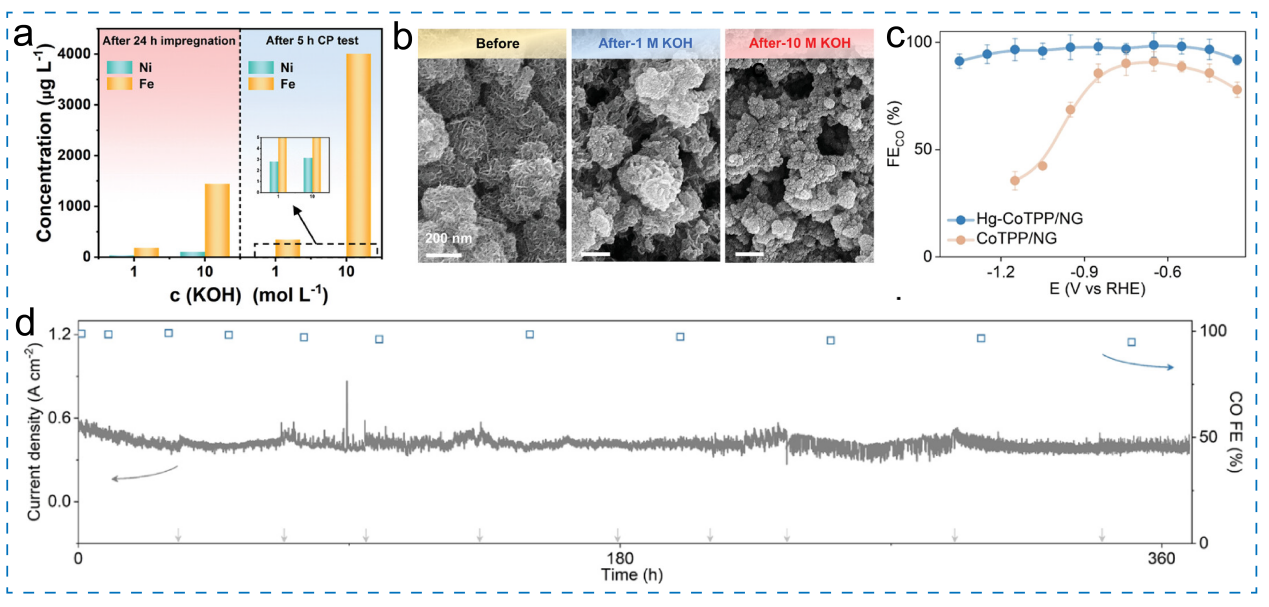
Fig. 7. (a) Ion concentrations pre- (left) and post-CP test (right), following 24-h impregnation. (b) Initial morphology (left) vs. final morphologies post-CP test in 1 mol L-1 KOH (middle) and 10 m KOH (right). Ref. [39], Copyright, 2024 Wiley‐VCH GmbH. (c) FECO: Hg-CoTPP/NG vs. CoTPP/NG at varied potentials. (d) Stability test at 420 mA cm-2. Ref. [152], Copyright, 2022, American Chemical Society.
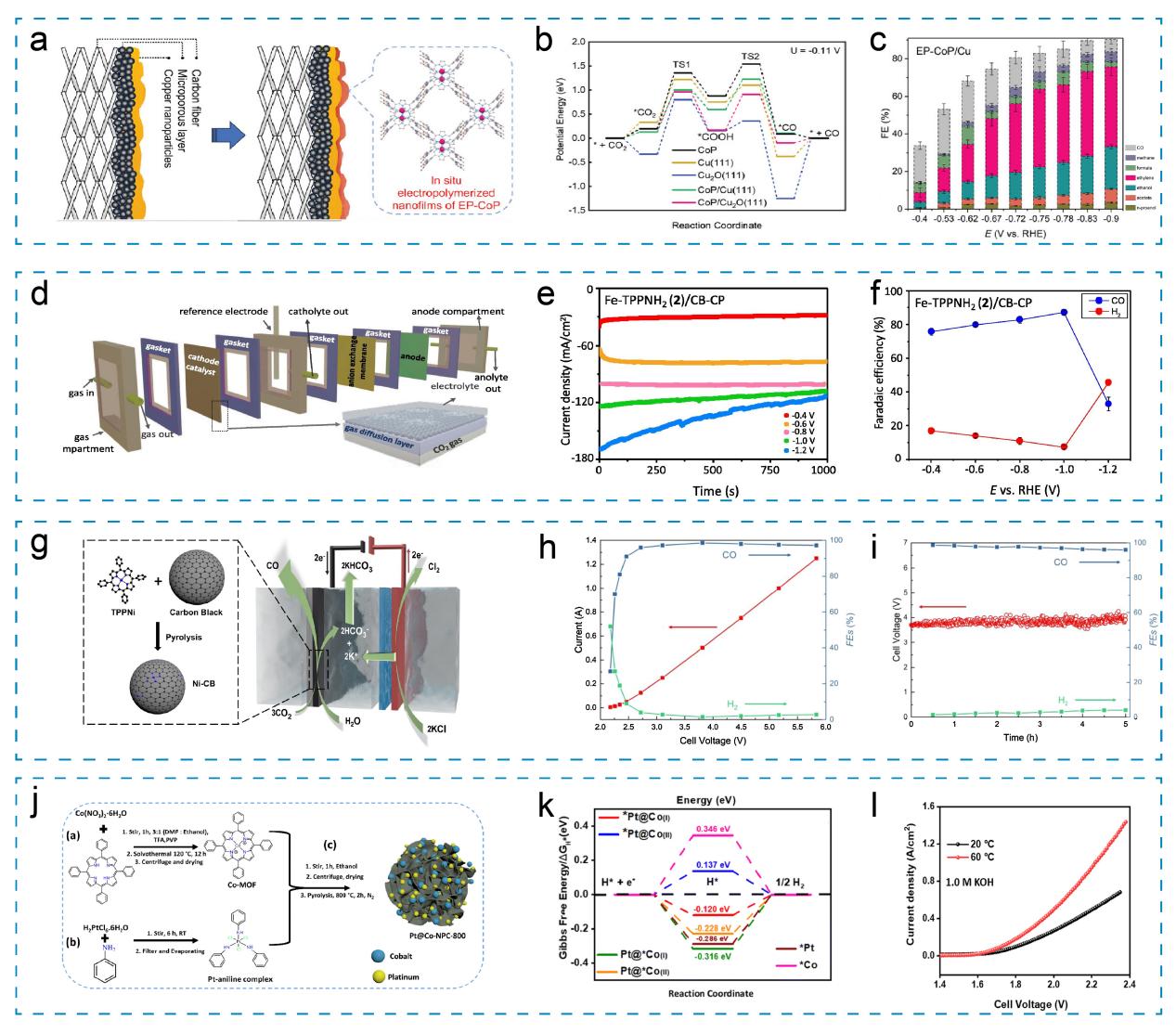
Fig. 8. (a) Schematic illustration. (b) Potential energy curves. (c) Electrocatalytic CO2RR performances. Ref. [161], Copyright, 2024, John Wiley and Sons. (d) Schematic of the flow cell fitted with an ion-exchange membrane. (e) Chronoamperometry of Fe-TPPNH2. (f) CO2RR product selectivity of Fe-TPPNH2. Ref. [162], Copyright, 2021, Elsevier. (g) Schematic illustration. (h) Polarization curve. (i) Voltage, FECO, and FEH2 as functions of time when the system operated with 0.5 A current. Ref. [163], Copyright, 2020, Elsevier. (j)Schematic illustration. (k) Gibbs free energy of Pt and Co active sites. (l) LSV graph. Ref. [164], Copyright, 2024, Royal Society of Chemistry.
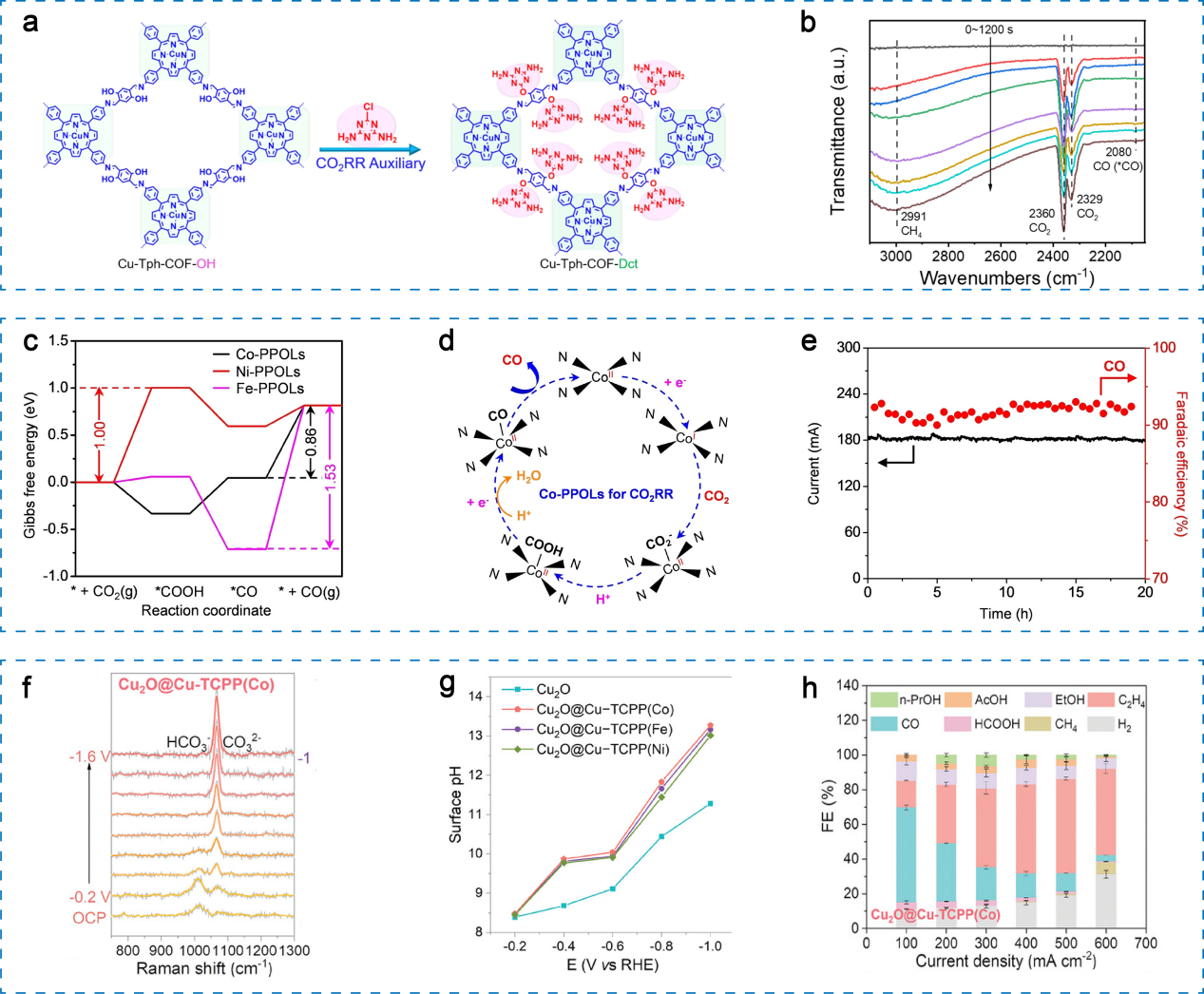
Fig. 9. (a) The Scheme. (b) In-situ ATR-FTIR spectra of Cu-Tph-COF-Dct during the electrochemical CO2RR. Ref. [165], Copyright, 2021, John Wiley and Sons. (c) Gibbs free energy diagrams. (d) Proposed mechanistic scheme. (e) Long-term stability. Ref. [60], Copyright, 2023, John Wiley and Sons. (f) Operando Raman spectra. (g) Plots of the calibrated surface pH against the applied potential based on the Raman results. (h) FE of Cu2O@Cu-TCPP(Co). Ref. [40], Copyright, 2024, John Wiley and Sons.
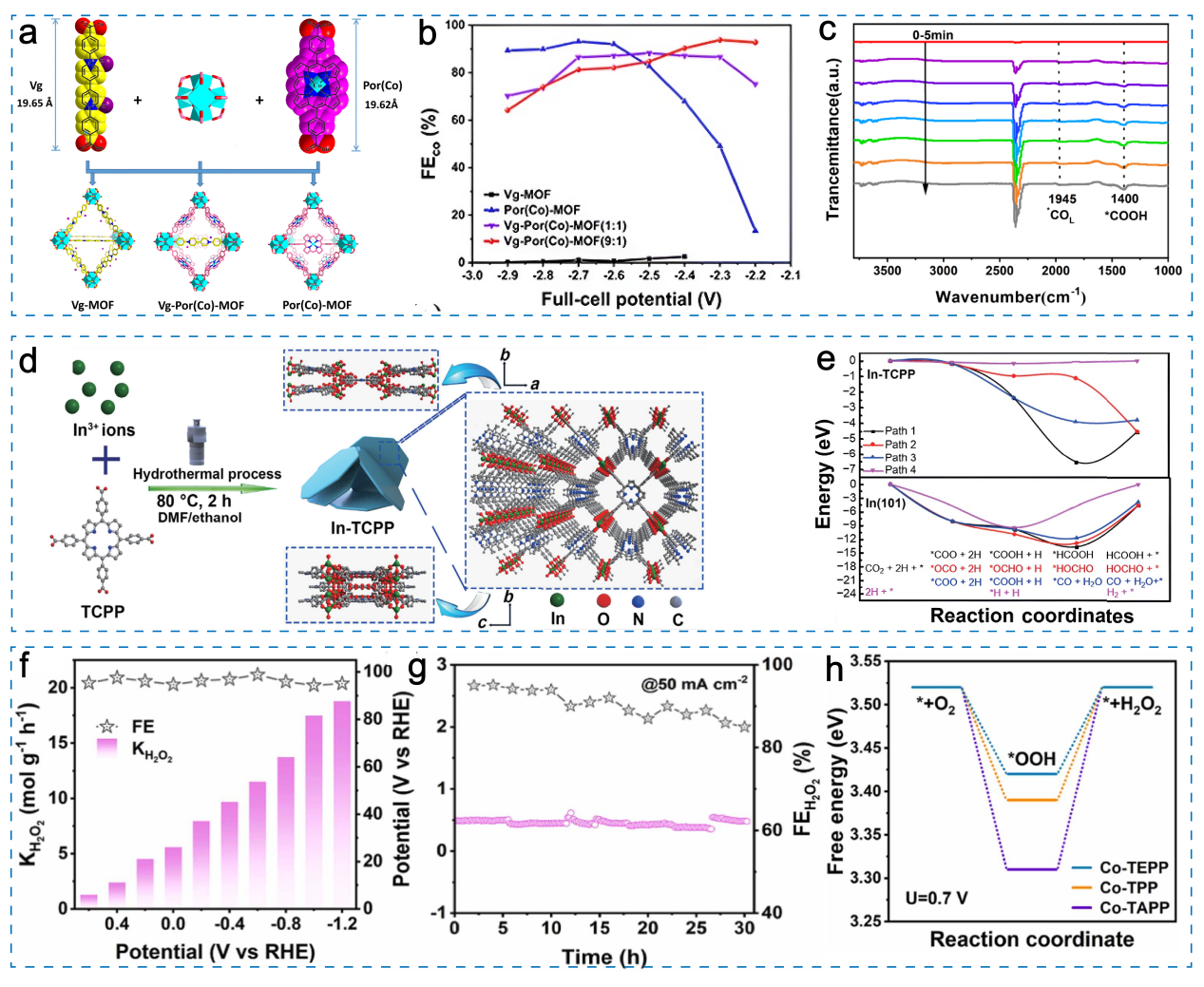
Fig. 10. (a) Schematic synthesis diagram. (b) FECO. (c) In-situ ATR-IR. Ref. [181], Copyright, 2023, Royal Society of Chemistry. (d) Schematic illustration. (e) The corresponding energy profles. Ref. [182], Copyright, 2023, Tsinghua University Press. (f) Potential-dependent FEH2O2 and H2O2 production rate in 1.0 mol L-1 KOH in flow cell. (g) Long-term stability. (h) Free energy diagram. Ref. [183], Copyright, 2020, Elsevier.
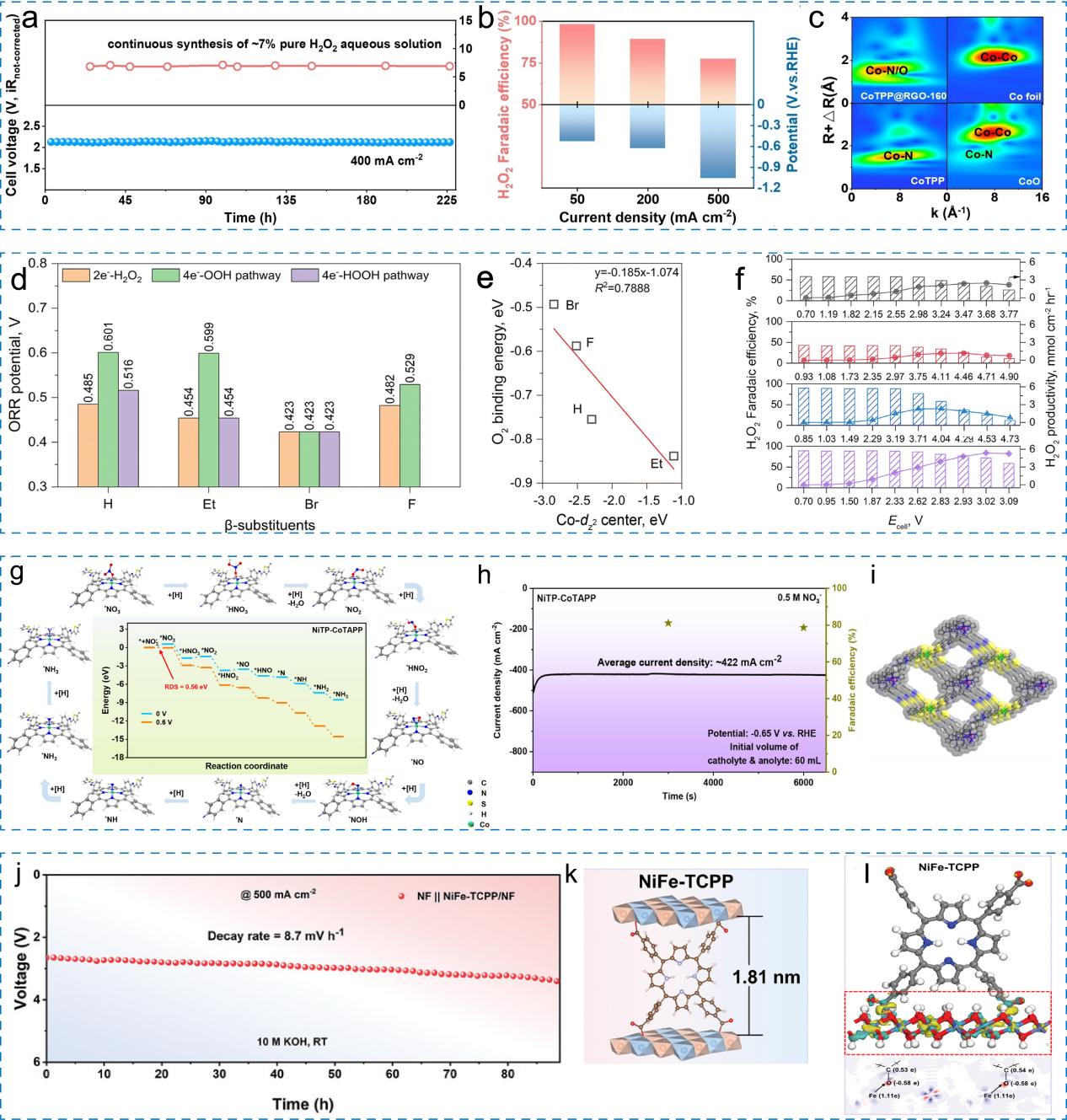
Fig. 11. (a) Stability of MEA. (b) FEH2O2. (c) WTs for CoTPP@RGO-160 and the reference catalysts. Ref. [184], Copyright, 2024, John Wiley and Sons. (d) Theoretical ORR potentials along different reaction pathways. (e) FEH2O2 and productivity. (f) Relationship between calculated Co-dz2 orbital centre and the *O2 binding energy (EO2) on different HMC models. Ref. [168], Copyright, 2022, Royal Society of Chemistry. (g) Free energy diagram. (h)Time-dependent industrially relevant current density curve. (i) Extended structures of NiTP-CoTAPP (c-axis) and view along the a-axis. Ref. [185], Copyright, 2025, John Wiley and Sons. (j) CP curve. (k) Structure diagrams. (l) Electron density difference diagrams and 2D contour plots of NiFe-TCPP. Ref. [39], Copyright, 2024, John Wiley and Sons.
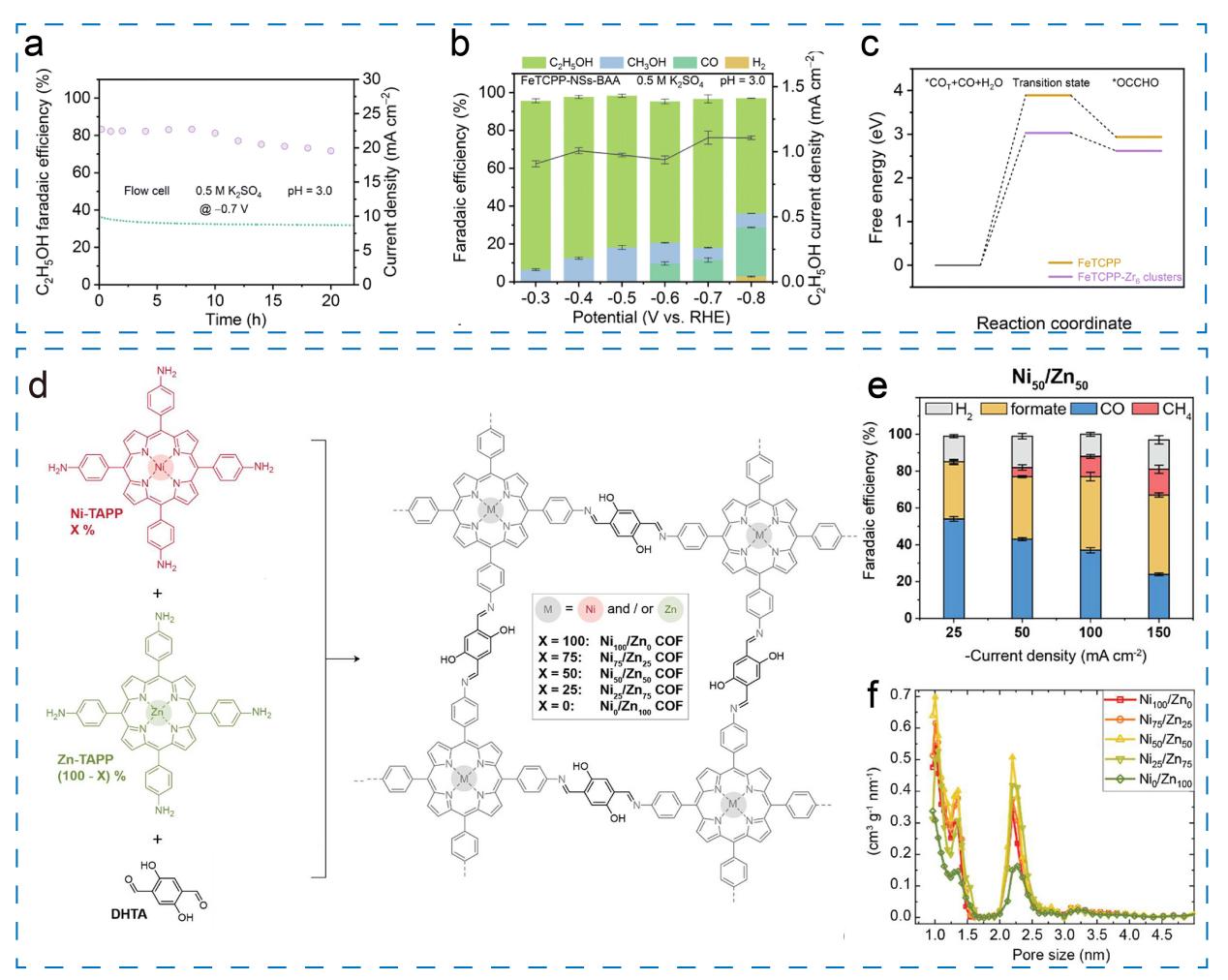
Fig. 12. (a) FE and current density during the long-term stability test. (b) FEs of different products. (c) Energy barriers for the hydrogenation of *OCCO to *OCCHO. Ref. [204], Copyright, 2025, Royal Society of Chemistry. (d) Chemical structure of Ni/Zn-porphyrin COFs and their monomers. (e) FEs of Ni50/Zn50. (f) Pore size distributions. Ref. [205], Copyright, 2024, American Chemical Society.
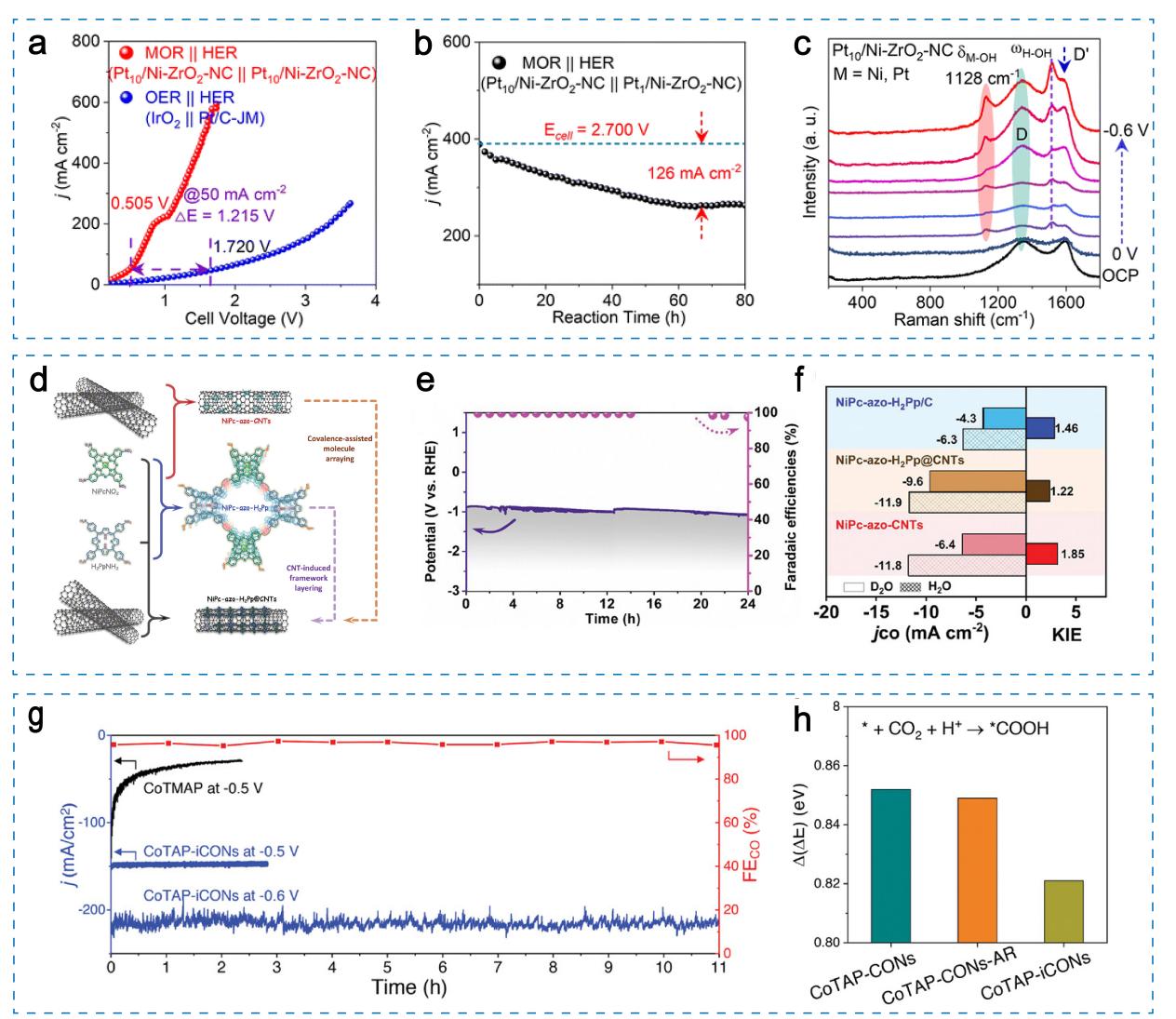
Fig. 13. (a) Performance of OER||HER and MOR||HER. (b) The stability of Pt10/Ni-ZrO2-NC. (c) Operando Raman spectra at the OCP and different applied potentials. Ref. [210], Copyright, 2025, Royal Society of Chemistry. (d) Schematic illustration of design and synthesis. (e) Stability of NiPc-azo-H2Pp@CNTs in flow cell at 200 mA cm-2 (f) KIE values. Ref. [211], Copyright, 2024, John Wiley and Sons. (g) Chronoamperometry tests. (h) Density functional theory calculated energy for the formation of *COO adsorbed on CoTAP-CONs, CoTAP-CONs-AR, and CoTAP-iCONs. Ref. [212], Copyright, 2022, John Wiley and Sons.
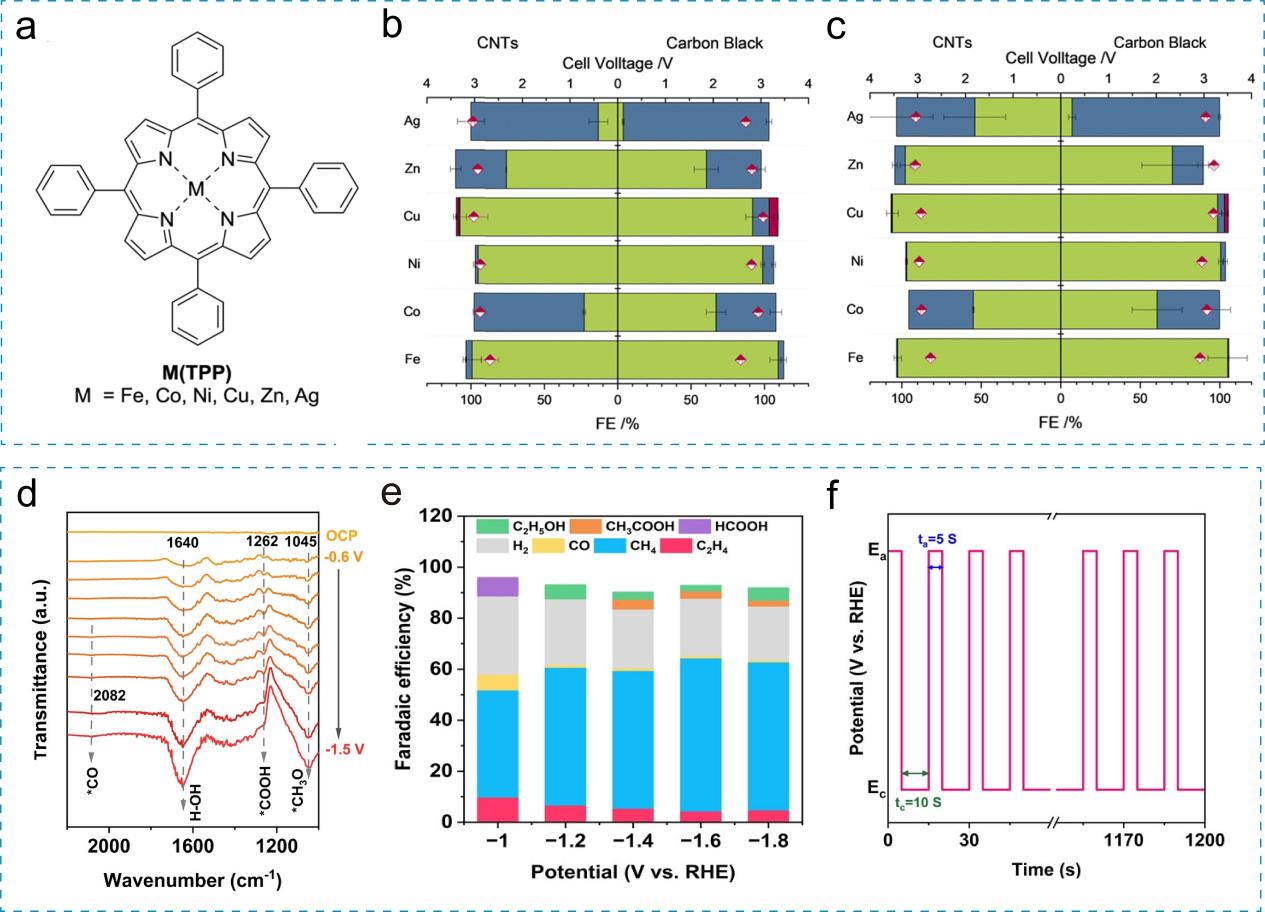
Fig. 14. (a) Scheme of the structure of the used complexes M(TPP). (b,c) Observed averaged cell voltages (pink diamonds) and FEs for H2 (green), CO (blue) and CH4 (pink) with either MWCNTs (left half of graph) or CB (right half of graph) as carbon support after 1 h of electrolysis at 50 mA cm-2 or 100 mA cm-2. Ref. [217], Copyright, 2024, Royal Society of Chemistry. (d) In-situ ATR-SEIRAS spectra. (e) CO2RR product distribution and the corresponding FE. (f) Illustration of Ec, Ea, tc, ta in an exemplary waveform of PPE. Ref. [219], Copyright, 2024, John Wiley and Sons.
| Porphyrin catalyst | Types of catalysts | Applications | Catalytic performance | Stability | Ref. | Porphyrin catalyst | Types of catalyst | Applications | Catalytic performance | Stability | Ref. | |
|---|---|---|---|---|---|---|---|---|---|---|---|---|
| Cu2O@Cu- TCPP(Co) | Cu/Co- based | CO2RR | 500 mA cm-2 FEC2H4: 54 ± 2% FEC2+: 69 ± 4% | >20 h@300 mA cm-2 | [ | Pt@Co- NPC-800 | Co-based | HER | 1.32 A cm-2 @60 °C 2.34 V | 22 h @1.9 V | [ | |
| DAE-BPy- CoPor | Co-based | CO2RR | 20.1 mA cm-2 @-1.0 V vs. RHE FECO : 90.5% | 24 h@-0.9 V vs. RHE FE> 80% | [ | CoT-sp2C-P- COF-COOH | Co-based | HER | 0.75 V @57.49 mA cm-2 | — | [ | |
| Co-PPOLs | Co-based | CO2RR | -0.9 V vs. RHE FECO > 94.2% | >20 h@200 mA cm-2 | [ | Co-N3C1-COF | Co-based | 4e-ORR | η: 0.338 V E1/2:0.794 V | — | [ | |
| Co-TQCOF | Co-based | CO2RR | -1.0 V @-20 mA cm-2 FE: 93.9% | 12 h@FE>80% | [ | Co-Nx | Co-based | 2e-ORR | FEH2O2: 85% @500 mA cm-2 | 12 h @50 mA cm-2 | [ | |
| CoPc/ppy/ GDE | Co-based | CO2RR | — | — | [ | 1-CoZn | Zn/ Co-based | ORR | — | 10h@0.44V | [ | |
| CoCoPCP/ CNT | Co-based | CO2RR | FECO: 94% @0.44 V | 24 h@0.55 V | [ | CoPorF/CNT | Co-based | ORR | 464 mA cm-2@3.32 V | 48 h @50mA cm-2 | [ | |
| EP-CoP/Cu | Co-based | CO2RR | 726 mA cm-2 @0.9 V | — | [ | Co-TEPP-COP/rGO | Co-based | ORR | 1.2V FEH2O2 > 95% | 30 h @50 mA cm-2 | [ | |
| Vg-Por(Co)-MOF | Co-based | CO2RR | FECO :93.8%@2.3 V | 22 h@58 mA cm-2 | [ | CoTPP@RGO-T | Co-based | ORR | 50 mol h-1 g cat-1 @500 mA cm-2 | 200 h @40 0mA cm-2 | [ | |
| CoN4-Por- COF | Co-based | CO2RR | — | — | [ | PFC-72-Co | Co-based | ORR | 0.68 V @FEH2O2 :> 90% | — | [ | |
| CoPCOP@ CNT | Co-based | NOxRR | -0.8 V vs. RHE FE: 98%, -1.0 V vs. RHE, 5.34 mW cm-2 FE > 90% | — | [ | NiFe-TCPP | Ni/ Fe-based | OER | 290.2 mV @1000 mA cm-2 | 1000 h @500 mA cm-2 | [ | |
| CoPB--C8 | Co-based | NO3-RR | FENH3 > 90% @1.04-1.54 V | — | [ | FeTMA/CNTs | Fe-based | NOxRR | -1.5 V vs. Ag/AgCl FENH3 > 90% | — | [ | |
| CoTMA/ CNTs | Co-based | NO3-RR | 1.5 V @ FENH3: 94.7% | — | [ | m-NiTPyP | Ni-based | OER, HER | 10 mA cm-2@267/138 mV | 60 h @1.65 V | [ | |
| PBIPorCo/ 3D-G | Co-based | OER/ORR | OER 290 mV @10 mA cm-2 ; ORR (E1/2) 0.90 V vs. RHE | L-ZAB >200 h@356.8 mW-2 | [ | Fe-porphyrin | Fe-based | NO2RR | FENH3 :90% @1.09 V | — | [ | |
| Metal porphyrin 1-M (M = Co, Fe) | Co/Fe- based | OER | 430 mV @10 mA cm-2 | — | [ | TAPP-OFPc[Ni]-COF | Fe/ Ni-based | UOR | 10mA cm-2@1.37V | — | [ | |
| CoPc-DEG MDE@CC | Co-based | HER | — | 25 h@1000 mA cm-2 | [ | ++N18C6-FeP | Fe-based | CO2RR | FECO: 95% @2.25 V | — | [ | |
| guanidino- functionalized Fe-porphyrins | Fe-based | CO2RR | FECO: 98% @ 2.1 V | — | [ | CuPOF-Bpy/ Cu2O@CNT | Cu-based | CO2RR | FEC2H4: 71% @1.1 V | 16 h @1.1V | [ | |
| OPA-PCN-222(Fe) | Fe-based | NOR, NRR | FE: 70.7% @ 1.6 V | — | [ | CuTphCOF- Dct | Cu-based | CO2RR | FECH4: 68% @0.8 ~1.0 V | 5 h @0.9V | [ | |
| Fe-TPPNH2 | Fe-based | CO2RR | 105 mA cm-2 @ 0.8 V | — | [ | CuNCP | Cu-based | CO2RR | -1.8 V @170 mA cm-2 | — | [ | |
| Zr-BDDB MOF | Fe-based | NO3- RR | 0.5 V @FENH3:95.6% | 24 h @ 0.5 V | [ | NiTPP | Ni-based | CO2RR | FECO: 98.3% @500 mA cm-2 | — | [ | |
| FeTCPP-NSs-BAA | Fe-based | CO2RR | 0.3 V@FEC2H5OH: 89.2% | 20 h @ 0.7 V | [ | m-NiTPyP | Ni-based | OER、HER | 10 mA cm-2 @267/138 mV | 60 h @1.65 V | [ | |
| FeTCPP | Fe-based | CO2RR | — | — | [ | TPPNi | Ni-based | CO2RR | FECO: 99.3% @1.10 V | — | [ | |
| PCN-222(Fe) | Fe-based | CO2RR | — | — | [ | Ni50/ Zn50-COF | Ni/ Zn-based | CO2RR | 0.6 V @CO2RR FECO: 79% | — | [ | |
| o-Cu-Por-Sa(αβαβ) | Cu-based | CO2RR | 45.76 mA cm-2 @-0.8 V vs. RHE FECH4: 84% | — | [ | Pt10/ Ni-ZrO2-NC | Ni/ Pt-based | HER | 57.5 mV @100 mA cm-2 | 230 h @100 mA cm-2 | [ | |
| Cu-PMOF | Cu-based | NH2CONH2 | 25.5 μmol h-1 mgcat-1@0.55 V | 36 h @0.55 V | [ | NiPc-azo- H2Pp@CNTs | Ni-based | CO2RR | 1.48 V @370 mA cm-2 | 24 h @200 mA cm-2 | [ | |
| Cu porphyrins to afford analogues 1-4 | Cu-based | HER | — | — | [ | Hg-MTPP | Hg-based | CO2RR | FECO: 100% @1.2 A cm-2 | 360 h @420 mA cm-2 | [ | |
| Cu-TMCPP/ CNT | Cu-based | CO2RR | 91.8 mA cm-2 @1.08 V | 9 h @ 1.08 V | [ | In-TCPP | In-based | CO2RR | FEHCOOH >80% @25 mA cm-2 | 50 h @25 mA cm-2 | [ | |
| Cu-PMOF | Cu-based | CO2RR | 337.5 mA cm-2 @1.23 V | — | [ |
Table 1 Classification of types, performances and applications of porphyrin catalysts discussed in this review.
| Porphyrin catalyst | Types of catalysts | Applications | Catalytic performance | Stability | Ref. | Porphyrin catalyst | Types of catalyst | Applications | Catalytic performance | Stability | Ref. | |
|---|---|---|---|---|---|---|---|---|---|---|---|---|
| Cu2O@Cu- TCPP(Co) | Cu/Co- based | CO2RR | 500 mA cm-2 FEC2H4: 54 ± 2% FEC2+: 69 ± 4% | >20 h@300 mA cm-2 | [ | Pt@Co- NPC-800 | Co-based | HER | 1.32 A cm-2 @60 °C 2.34 V | 22 h @1.9 V | [ | |
| DAE-BPy- CoPor | Co-based | CO2RR | 20.1 mA cm-2 @-1.0 V vs. RHE FECO : 90.5% | 24 h@-0.9 V vs. RHE FE> 80% | [ | CoT-sp2C-P- COF-COOH | Co-based | HER | 0.75 V @57.49 mA cm-2 | — | [ | |
| Co-PPOLs | Co-based | CO2RR | -0.9 V vs. RHE FECO > 94.2% | >20 h@200 mA cm-2 | [ | Co-N3C1-COF | Co-based | 4e-ORR | η: 0.338 V E1/2:0.794 V | — | [ | |
| Co-TQCOF | Co-based | CO2RR | -1.0 V @-20 mA cm-2 FE: 93.9% | 12 h@FE>80% | [ | Co-Nx | Co-based | 2e-ORR | FEH2O2: 85% @500 mA cm-2 | 12 h @50 mA cm-2 | [ | |
| CoPc/ppy/ GDE | Co-based | CO2RR | — | — | [ | 1-CoZn | Zn/ Co-based | ORR | — | 10h@0.44V | [ | |
| CoCoPCP/ CNT | Co-based | CO2RR | FECO: 94% @0.44 V | 24 h@0.55 V | [ | CoPorF/CNT | Co-based | ORR | 464 mA cm-2@3.32 V | 48 h @50mA cm-2 | [ | |
| EP-CoP/Cu | Co-based | CO2RR | 726 mA cm-2 @0.9 V | — | [ | Co-TEPP-COP/rGO | Co-based | ORR | 1.2V FEH2O2 > 95% | 30 h @50 mA cm-2 | [ | |
| Vg-Por(Co)-MOF | Co-based | CO2RR | FECO :93.8%@2.3 V | 22 h@58 mA cm-2 | [ | CoTPP@RGO-T | Co-based | ORR | 50 mol h-1 g cat-1 @500 mA cm-2 | 200 h @40 0mA cm-2 | [ | |
| CoN4-Por- COF | Co-based | CO2RR | — | — | [ | PFC-72-Co | Co-based | ORR | 0.68 V @FEH2O2 :> 90% | — | [ | |
| CoPCOP@ CNT | Co-based | NOxRR | -0.8 V vs. RHE FE: 98%, -1.0 V vs. RHE, 5.34 mW cm-2 FE > 90% | — | [ | NiFe-TCPP | Ni/ Fe-based | OER | 290.2 mV @1000 mA cm-2 | 1000 h @500 mA cm-2 | [ | |
| CoPB--C8 | Co-based | NO3-RR | FENH3 > 90% @1.04-1.54 V | — | [ | FeTMA/CNTs | Fe-based | NOxRR | -1.5 V vs. Ag/AgCl FENH3 > 90% | — | [ | |
| CoTMA/ CNTs | Co-based | NO3-RR | 1.5 V @ FENH3: 94.7% | — | [ | m-NiTPyP | Ni-based | OER, HER | 10 mA cm-2@267/138 mV | 60 h @1.65 V | [ | |
| PBIPorCo/ 3D-G | Co-based | OER/ORR | OER 290 mV @10 mA cm-2 ; ORR (E1/2) 0.90 V vs. RHE | L-ZAB >200 h@356.8 mW-2 | [ | Fe-porphyrin | Fe-based | NO2RR | FENH3 :90% @1.09 V | — | [ | |
| Metal porphyrin 1-M (M = Co, Fe) | Co/Fe- based | OER | 430 mV @10 mA cm-2 | — | [ | TAPP-OFPc[Ni]-COF | Fe/ Ni-based | UOR | 10mA cm-2@1.37V | — | [ | |
| CoPc-DEG MDE@CC | Co-based | HER | — | 25 h@1000 mA cm-2 | [ | ++N18C6-FeP | Fe-based | CO2RR | FECO: 95% @2.25 V | — | [ | |
| guanidino- functionalized Fe-porphyrins | Fe-based | CO2RR | FECO: 98% @ 2.1 V | — | [ | CuPOF-Bpy/ Cu2O@CNT | Cu-based | CO2RR | FEC2H4: 71% @1.1 V | 16 h @1.1V | [ | |
| OPA-PCN-222(Fe) | Fe-based | NOR, NRR | FE: 70.7% @ 1.6 V | — | [ | CuTphCOF- Dct | Cu-based | CO2RR | FECH4: 68% @0.8 ~1.0 V | 5 h @0.9V | [ | |
| Fe-TPPNH2 | Fe-based | CO2RR | 105 mA cm-2 @ 0.8 V | — | [ | CuNCP | Cu-based | CO2RR | -1.8 V @170 mA cm-2 | — | [ | |
| Zr-BDDB MOF | Fe-based | NO3- RR | 0.5 V @FENH3:95.6% | 24 h @ 0.5 V | [ | NiTPP | Ni-based | CO2RR | FECO: 98.3% @500 mA cm-2 | — | [ | |
| FeTCPP-NSs-BAA | Fe-based | CO2RR | 0.3 V@FEC2H5OH: 89.2% | 20 h @ 0.7 V | [ | m-NiTPyP | Ni-based | OER、HER | 10 mA cm-2 @267/138 mV | 60 h @1.65 V | [ | |
| FeTCPP | Fe-based | CO2RR | — | — | [ | TPPNi | Ni-based | CO2RR | FECO: 99.3% @1.10 V | — | [ | |
| PCN-222(Fe) | Fe-based | CO2RR | — | — | [ | Ni50/ Zn50-COF | Ni/ Zn-based | CO2RR | 0.6 V @CO2RR FECO: 79% | — | [ | |
| o-Cu-Por-Sa(αβαβ) | Cu-based | CO2RR | 45.76 mA cm-2 @-0.8 V vs. RHE FECH4: 84% | — | [ | Pt10/ Ni-ZrO2-NC | Ni/ Pt-based | HER | 57.5 mV @100 mA cm-2 | 230 h @100 mA cm-2 | [ | |
| Cu-PMOF | Cu-based | NH2CONH2 | 25.5 μmol h-1 mgcat-1@0.55 V | 36 h @0.55 V | [ | NiPc-azo- H2Pp@CNTs | Ni-based | CO2RR | 1.48 V @370 mA cm-2 | 24 h @200 mA cm-2 | [ | |
| Cu porphyrins to afford analogues 1-4 | Cu-based | HER | — | — | [ | Hg-MTPP | Hg-based | CO2RR | FECO: 100% @1.2 A cm-2 | 360 h @420 mA cm-2 | [ | |
| Cu-TMCPP/ CNT | Cu-based | CO2RR | 91.8 mA cm-2 @1.08 V | 9 h @ 1.08 V | [ | In-TCPP | In-based | CO2RR | FEHCOOH >80% @25 mA cm-2 | 50 h @25 mA cm-2 | [ | |
| Cu-PMOF | Cu-based | CO2RR | 337.5 mA cm-2 @1.23 V | — | [ |
|
| No related articles found! |
| Viewed | ||||||
|
Full text |
|
|||||
|
Abstract |
|
|||||


