
Chinese Journal of Catalysis ›› 2026, Vol. 90: 27-51.DOI: 10.1016/S1872-2067(26)65188-1
• Reviews • Previous Articles Next Articles
Jiaxuan Zhoua, Yaodong Yua, Jiani Hana,b, Yanxue Chaoa, Jianping Laia,*( ), Lei Wanga,*()
Received:2026-01-05
Accepted:2026-03-16
Online:2026-11-05
Published:2026-09-09
About author:Jianping Lai (Qingdao University of Science and Technology) received his PhD degree in 2017 from Changchun Institute of Applied Chemistry, Chinese Academy of Sciences. From 2017 to 2019, he did postdoctoral research at Peking University. He currently leads a research team focusing on advanced electrocatalytic materials for clean energy conversion and storage. He has coauthored more than 140 peer-reviewed papers.J.L and L.W supervised the manuscript. J.L conceived the manuscript. J.Z. wrote the manuscript. Y.Y., J.H. and Y.C. contributed to the conception and direction of the manuscript, discussion of content and editing of the manuscript.
Supported by:Jiaxuan Zhou, Yaodong Yu, Jiani Han, Yanxue Chao, Jianping Lai, Lei Wang. Proton hydrogenation reaction in neutral media: Mechanisms, challenges, and performance enhancement strategies[J]. Chinese Journal of Catalysis, 2026, 90: 27-51.
Add to citation manager EndNote|Ris|BibTeX
URL: https://www.cjcatal.com/EN/10.1016/S1872-2067(26)65188-1
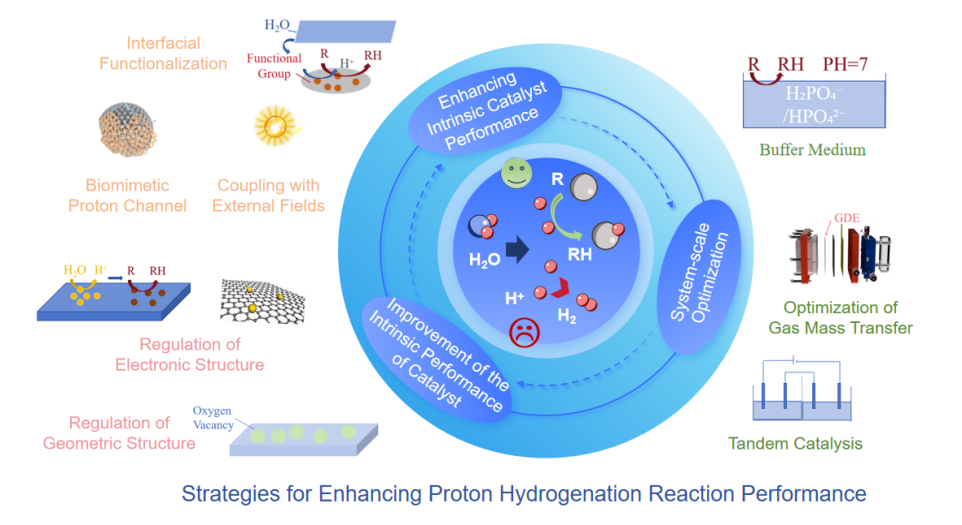
Fig. 1. A summary schematic diagram of the transformation of restrictive factors into constructive drivers for the performance enhancement of proton hydrogenation in neutral media and the corresponding multi-dimensional optimization strategies.
| Comparison dimension | Acidic media | Neutral media | Alkaline media |
|---|---|---|---|
| Primary proton source | H3O+ (high concentration) | H2O surface dissociation (virtually the sole source) | H₂O dissociation (buffered by OH-) |
| Proton concentration/M | 100-10-2 | ~10-7 (very low in bulk, no effective buffering) | 10-14-10-7 (very low in bulk, regulated by buffering at interface) |
| Proton supply mechanism | fast Volmer step (H3O+ + e- → H + H2O) | H2O dissociation as the primary pathway, slow kinetics | H2O dissociation and OH- buffering/consumption |
| Mass transport characteristics | fast proton transfer, moderate gas solubility | low gas solubility, significant mass transfer limitations; local pH prone to severe fluctuation | low gas solubility, OH- accumulation may affect interface stability |
| Key focus of catalyst design | fast proton transfer, moderate gas solubility | simultaneously promoting water splitting and suppressing HER, enhancing directed proton transfer, stabilizing dynamic interface | promoting water splitting, managing OH- accumulation, stabilizing interfacial environment |
| Major challenges | equipment corrosion, environmental burden, complex product separation | severely insufficient proton supply, intense HER competition, mass transfer limitations, dynamic instability of interfacial microenvironment | high initial energy barrier for water splitting, need to manage interfacial alkalinity |
Table 1 Characteristic comparison of proton hydrogenation reactions under different media environments.
| Comparison dimension | Acidic media | Neutral media | Alkaline media |
|---|---|---|---|
| Primary proton source | H3O+ (high concentration) | H2O surface dissociation (virtually the sole source) | H₂O dissociation (buffered by OH-) |
| Proton concentration/M | 100-10-2 | ~10-7 (very low in bulk, no effective buffering) | 10-14-10-7 (very low in bulk, regulated by buffering at interface) |
| Proton supply mechanism | fast Volmer step (H3O+ + e- → H + H2O) | H2O dissociation as the primary pathway, slow kinetics | H2O dissociation and OH- buffering/consumption |
| Mass transport characteristics | fast proton transfer, moderate gas solubility | low gas solubility, significant mass transfer limitations; local pH prone to severe fluctuation | low gas solubility, OH- accumulation may affect interface stability |
| Key focus of catalyst design | fast proton transfer, moderate gas solubility | simultaneously promoting water splitting and suppressing HER, enhancing directed proton transfer, stabilizing dynamic interface | promoting water splitting, managing OH- accumulation, stabilizing interfacial environment |
| Major challenges | equipment corrosion, environmental burden, complex product separation | severely insufficient proton supply, intense HER competition, mass transfer limitations, dynamic instability of interfacial microenvironment | high initial energy barrier for water splitting, need to manage interfacial alkalinity |
| Core challenge | Corresponding optimization strategies and primary mechanisms | Section |
|---|---|---|
| Limited proton supply | single-atom catalysts: Enable efficient water dissociation sites through precisely designed coordination environments, fundamentally enhancing proton generation efficiency. | 3.1, 3.2 |
| defect engineering: Create unsaturated coordination sites (e.g., O/S vacancies) to strengthen water molecule adsorption and activation. | ||
| interfacial functionalization: Introduce surface functional groups (e.g., -OH) to serve as proton relays, facilitating rapid interfacial proton transfer. | ||
| biomimetic proton transport channels: Construct directed and efficient proton conduction pathways (e.g., hydrogen-bond networks) within the material for rapid bulk proton supply. | ||
| Competitive reaction (HER) | single-atom catalysts: Finely tune the electronic structure (e.g., d-band center) of active sites via coordination engineering to optimize the hydrogen adsorption free energy (ΔG*H), steering it away from the optimal value for HER. | 3.1, 3.2 |
| defect engineering: Alter the local charge environment via defects to construct a proton fence, spatially or energetically hindering the HER pathway. | ||
| dual-site synergy: Spatially decouple proton generation (e.g., Fe sites) from substrate hydrogenation (e.g., Cu sites). The hydrogen spillover mechanism directs *H consumption, cutting off the feedstock supply for HER. | ||
| interfacial functionalization: Guide proton flow via surface functional groups to prioritize arrival at hydrogenation sites, reducing the accumulation of free *H. | ||
| Reagent mass transfer limitation | GDEs strategy: Establish a gas-liquid-solid three-phase interface, allowing gaseous reactants like CO₂ and N₂ to bypass the slow dissolution-diffusion process in the liquid phase and directly reach the catalyst surface, drastically increasing local concentration. | 3.3 |
| Complexity of reaction pathways | intrinsic catalyst design (e.g., single-atom/dual-site/defect engineering): Precisely modulate the adsorption strength for different reaction intermediates, breaking scaling relationships to steer the reaction along the desired pathway. | 3.1, 3.3 |
| intrinsic catalyst design (e.g., single-atom/dual-site/defect engineering): Precisely modulate the adsorption strength for different reaction intermediates, breaking scaling relationships to steer the reaction along the desired pathway. | ||
| system integration strategy (e.g., Tandem catalysis): Decompose multi-step complex reactions into sequential steps performed by different catalysts or in different reactors, simplifying control at each stage and enhancing final selectivity. | ||
| Dynamic instability of the interfacial microenvironment | introduction of buffer media: Utilize the proton buffering capacity of buffer pairs to promptly neutralize generated OH⁻, suppressing drastic local pH fluctuations. | 3.2, 3.3 |
| system integration strategy (e.g., Membrane electrode assembly): Employ ion-exchange membranes to precisely control ion transport, preventing OH- accumulation at the cathode interface and fundamentally stabilizing the microenvironment. | ||
| biomimetic proton transport channels: Establish efficient proton conduction networks to rapidly balance interfacial proton concentration, mitigating polarization effects caused by proton consumption. |
Table 2 Correspondence between core challenges and performance optimization strategies for proton hydrogenation in neutral media.
| Core challenge | Corresponding optimization strategies and primary mechanisms | Section |
|---|---|---|
| Limited proton supply | single-atom catalysts: Enable efficient water dissociation sites through precisely designed coordination environments, fundamentally enhancing proton generation efficiency. | 3.1, 3.2 |
| defect engineering: Create unsaturated coordination sites (e.g., O/S vacancies) to strengthen water molecule adsorption and activation. | ||
| interfacial functionalization: Introduce surface functional groups (e.g., -OH) to serve as proton relays, facilitating rapid interfacial proton transfer. | ||
| biomimetic proton transport channels: Construct directed and efficient proton conduction pathways (e.g., hydrogen-bond networks) within the material for rapid bulk proton supply. | ||
| Competitive reaction (HER) | single-atom catalysts: Finely tune the electronic structure (e.g., d-band center) of active sites via coordination engineering to optimize the hydrogen adsorption free energy (ΔG*H), steering it away from the optimal value for HER. | 3.1, 3.2 |
| defect engineering: Alter the local charge environment via defects to construct a proton fence, spatially or energetically hindering the HER pathway. | ||
| dual-site synergy: Spatially decouple proton generation (e.g., Fe sites) from substrate hydrogenation (e.g., Cu sites). The hydrogen spillover mechanism directs *H consumption, cutting off the feedstock supply for HER. | ||
| interfacial functionalization: Guide proton flow via surface functional groups to prioritize arrival at hydrogenation sites, reducing the accumulation of free *H. | ||
| Reagent mass transfer limitation | GDEs strategy: Establish a gas-liquid-solid three-phase interface, allowing gaseous reactants like CO₂ and N₂ to bypass the slow dissolution-diffusion process in the liquid phase and directly reach the catalyst surface, drastically increasing local concentration. | 3.3 |
| Complexity of reaction pathways | intrinsic catalyst design (e.g., single-atom/dual-site/defect engineering): Precisely modulate the adsorption strength for different reaction intermediates, breaking scaling relationships to steer the reaction along the desired pathway. | 3.1, 3.3 |
| intrinsic catalyst design (e.g., single-atom/dual-site/defect engineering): Precisely modulate the adsorption strength for different reaction intermediates, breaking scaling relationships to steer the reaction along the desired pathway. | ||
| system integration strategy (e.g., Tandem catalysis): Decompose multi-step complex reactions into sequential steps performed by different catalysts or in different reactors, simplifying control at each stage and enhancing final selectivity. | ||
| Dynamic instability of the interfacial microenvironment | introduction of buffer media: Utilize the proton buffering capacity of buffer pairs to promptly neutralize generated OH⁻, suppressing drastic local pH fluctuations. | 3.2, 3.3 |
| system integration strategy (e.g., Membrane electrode assembly): Employ ion-exchange membranes to precisely control ion transport, preventing OH- accumulation at the cathode interface and fundamentally stabilizing the microenvironment. | ||
| biomimetic proton transport channels: Establish efficient proton conduction networks to rapidly balance interfacial proton concentration, mitigating polarization effects caused by proton consumption. |
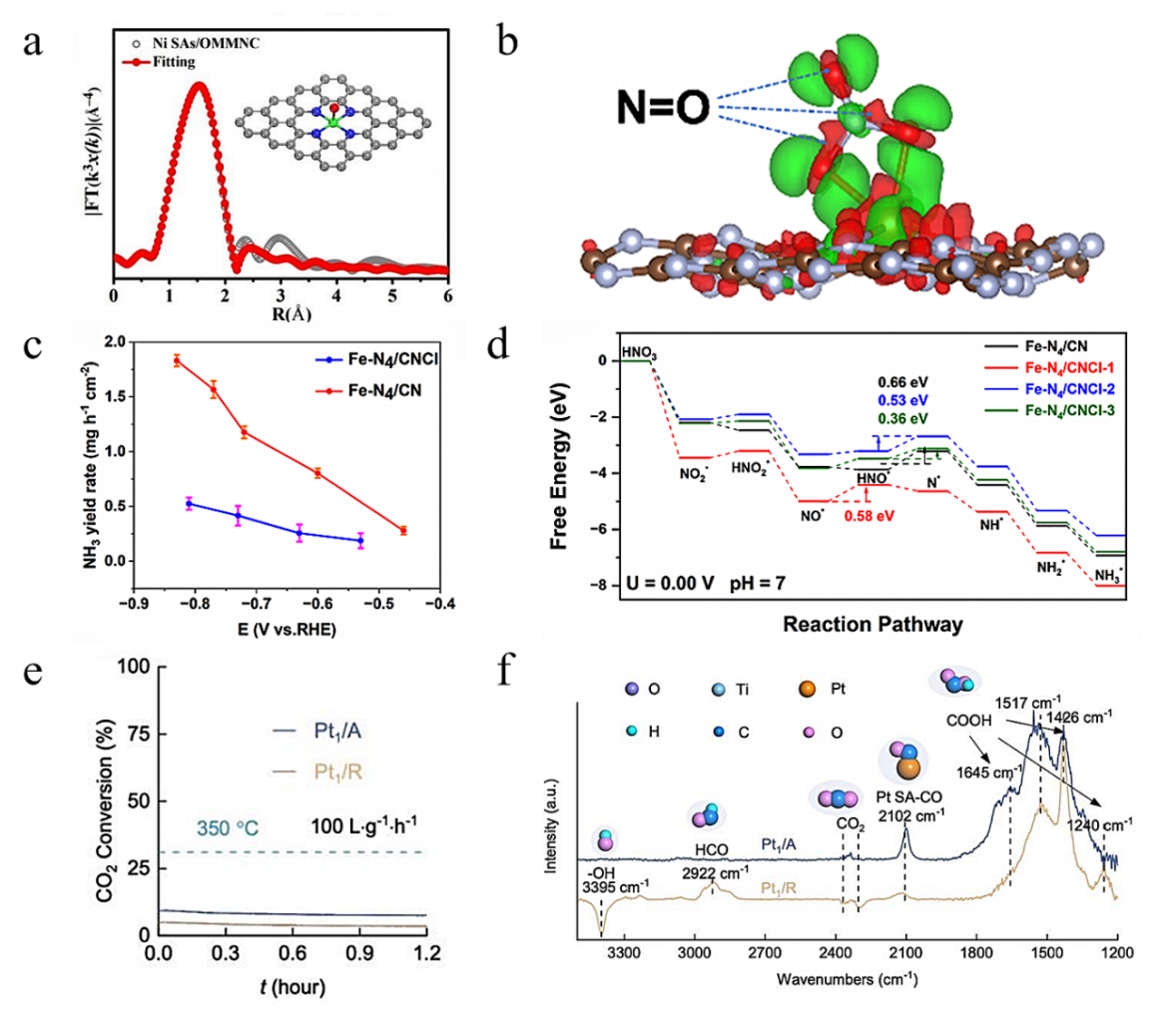
Fig. 2. (a) FT-EXAFS spectrum fitting of Ni SAs/OMMNC and the optimized configuration for Ni in the inset (the green, blue, red and gray spheres represent Ni, N,O and C atoms). Reprinted with permission from Ref. [67]. Copyright 2022, RSC Publishing. (b) Differential charge density of NO3- adsorbed on FeSAs/g-C3N4. Reprinted with permission from Ref. [68]. Copyright 2022, Elsevier. (c) Comparison of the NH3 yield rates (mg h−1 cm−2) of Fe-N4/CNCl and Fe-N4/CN catalysts. (d) Density functional theory calculations of reaction pathways for the NO3RR on Fe-N4 sites of Fe-N4/CN, Fe-N4/CNCl-1, Fe-N4/CN-2, and Fe-N4/CN-3. Reprinted with permission from Ref. [69]. Copyright 2025, American Chemical Society. (e) CO2 conversion at 350 °C. Reaction conditions: CO2:H2 = 1:4, weight hourly space velocity = 100 L g−1 h−1. (f) In-situ diffuse reflectance infrared Fourier transform spectroscopy over 30 min of TOS at 350 °C. Non situ and in-situ XPS spectra over 30 min of TOS at 350 °C. Reprinted with permission from Ref. [70]. Copyright 2025, Elsevier.
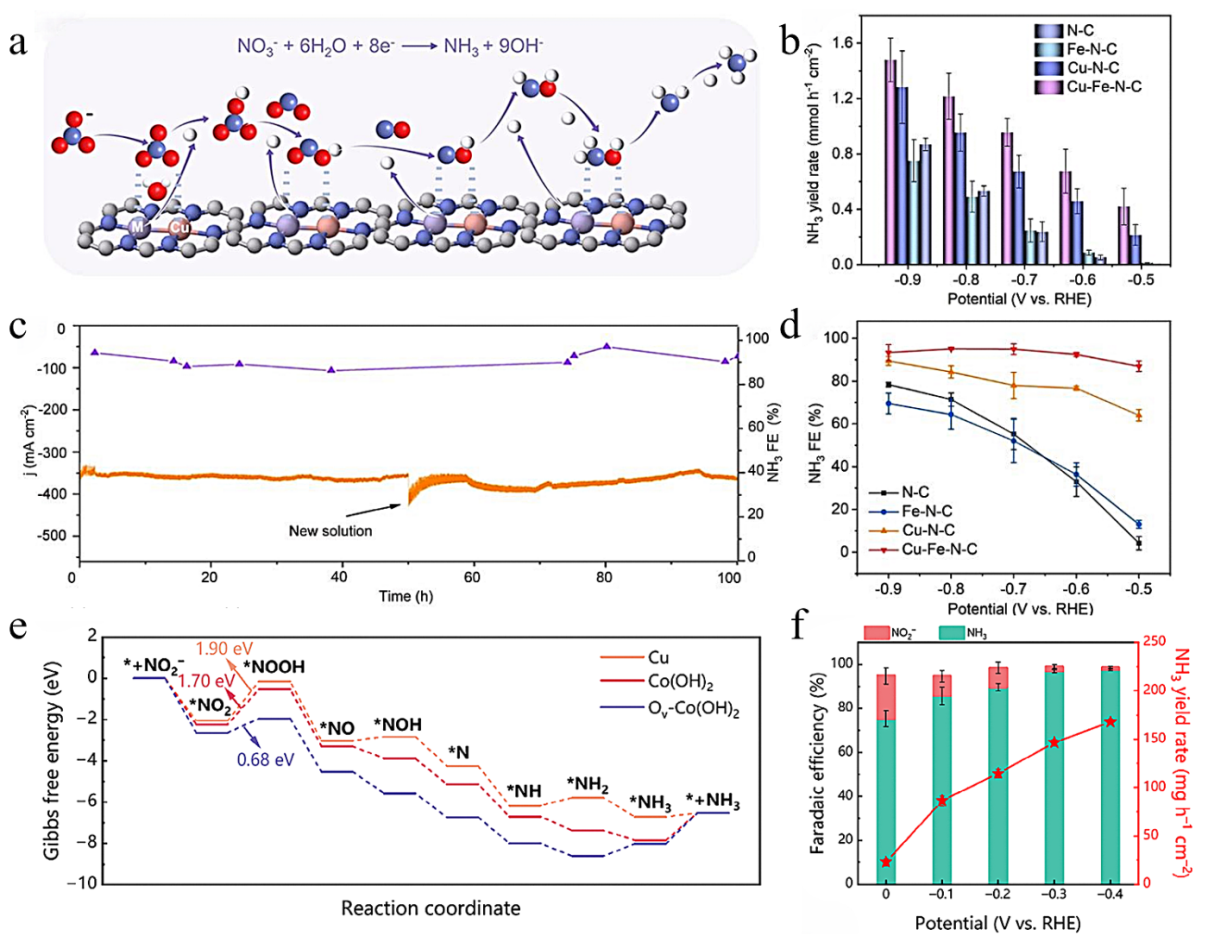
Fig. 3. (a) Conceptual diagram of the Cu-M-N-C structure to promote NO3RR activity. (b) NH3 yield rate of ammonia yield with electrolysis time for N-C, Cu-N-C, Fe-N-C, and Cu-Fe-NC. (c) Long-term NO3RR electrolysis and corresponding FE of NH3 for Cu-Fe-N-C. (d) The NH3 FE of ammonia yield with electrolysis time for N-C, Cu-N-C, Fe-N-C, and Cu-Fe-N-C. Reprinted with permission from Ref. [72]. Copyright 2024, RSC Publishing. (e) Free energy diagram of NO2RR. (f) NH3 yield rate and corresponding FE of NH3 for Ov-Co(OH)2/Cu at different electrode potentials. Reprinted with permission from Ref. [74]. Copyright 2025, John Wiley and Sons.
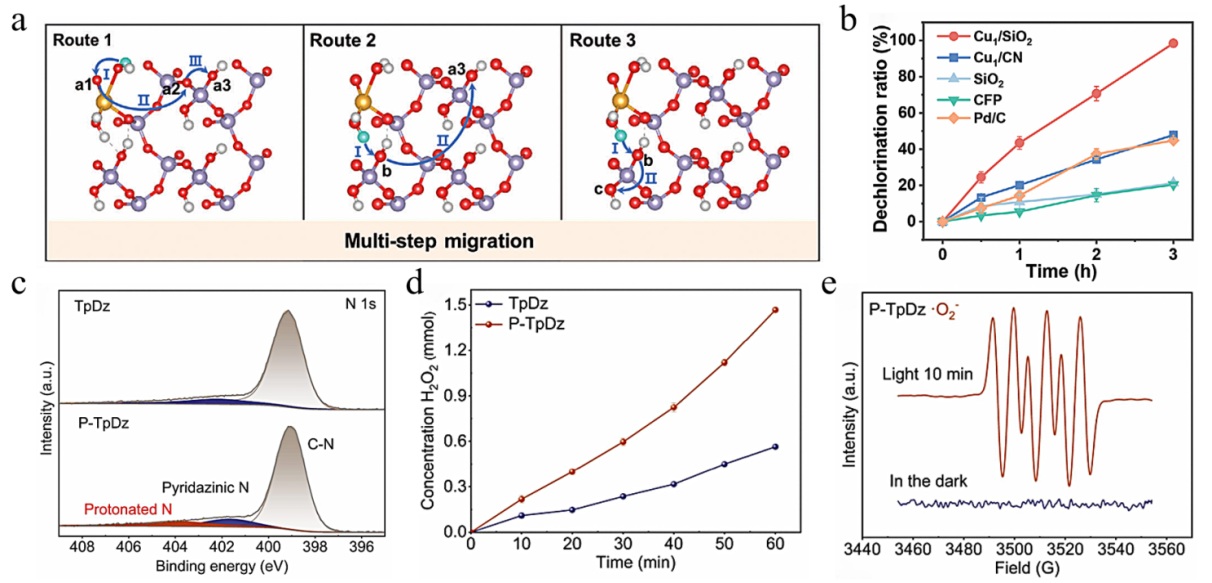
Fig. 4. (a) Possible migration routes of hydrogen spillover process for Cu1/SiO2 with surface hydroxyls. The yellow ball, purple ball, red ball, white ball, and cyan ball represent Cu, Si, O, H, and H*, respectively. (b) Corresponding CAP dechlorination ratio of CAP on various catalysts after 3 h electrolysis at −1.0 V vs. Ag/AgCl. Reprinted with permission from Ref. [78]. Copyright 2025, John Wiley and Sons. (c) XPS N 1s spectra of TpDz and P-TpDz. (d) Temporal H2O2 generation over TpDz and P-TpDz. (e) Electron spin resonance of O2−. Reprinted with permission from Ref. [79]. Copyright 2025, American Chemical Society.
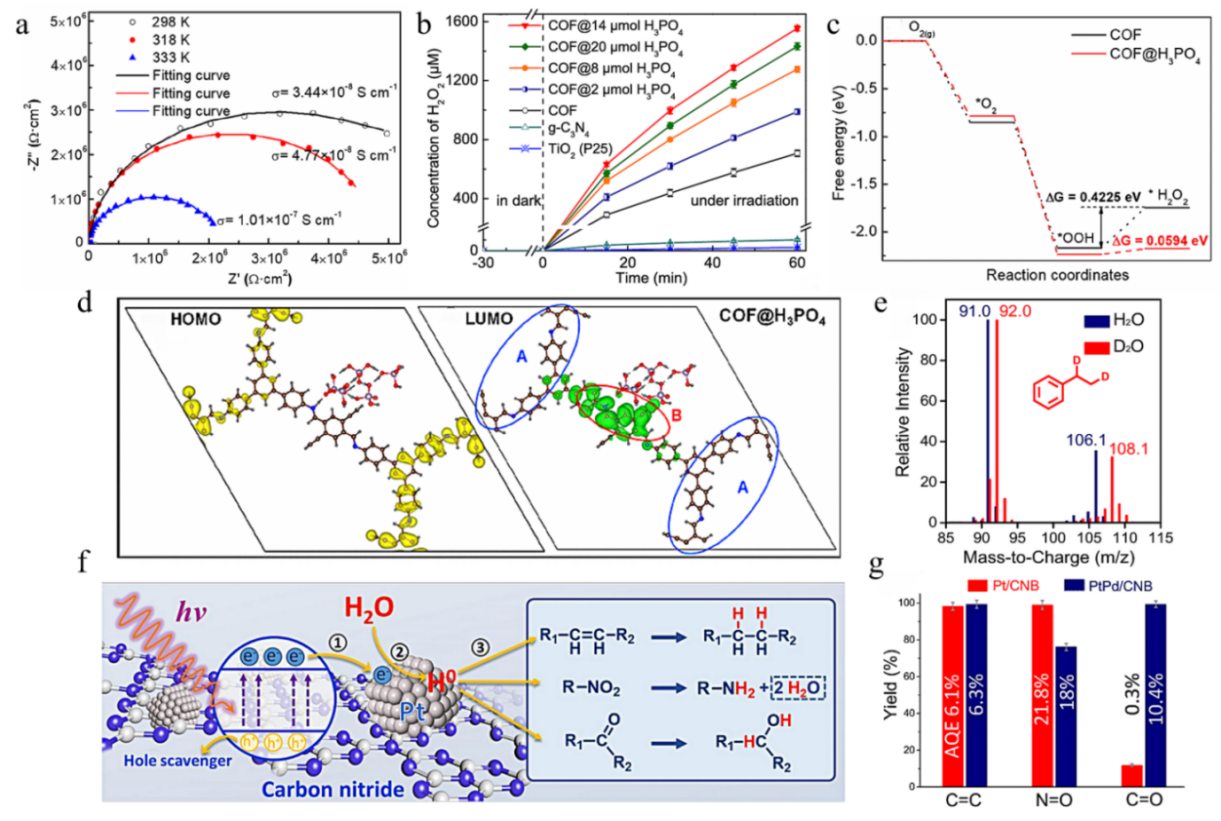
Fig. 5. (a) Nyquist plots for COF@H3PO4 at different temperatures. (b) Photocatalytic performance of H2O2 production using visible light for different catalysts (10 mg catalyst in 20 mL pure water, λ > 420 nm Xe lamp). (c) Free energy diagram for the two-electron ORR on the COF and COF@H3PO4. (d) The band charge density distributions of the HOMO and LUMO of COF@H3PO4 with an isovalue of 0.0004 e Å-3; the yellow and green colors represent the charge density distribution with and without electron occupation. Reprinted with permission from Ref. [80]. Copyright 2024, American Chemical Society. (e) Mass spectrometry spectra of the hydrogenation product (ethylbenzene) from using H2O or D2O. (f) Schematic illustration of the PWDTH process over the Pt/CN catalyst. Step 1: CN is light excited with the generated electrons transferring to the loaded Pt nanoparticles and holes being captured by scavenger (triethanolamine). Step 2: H2O is reduced to hydrogen (H0) over the Pt nanoparticles. Step 3: Organic molecules containing unsaturated double bonds (C=C, N=O and C=O) are in-situ hydrogenized at the Pt sites. (g) The yield and Apparent Quantum Efficiency (on columns) of the hydrogenation of styrene (C=C), nitrobenzene (N=O) and benzaldehyde (C=O) catalyzed by Pt/CNB and PtPd/CNB; light source: 380 nm LED, 20 mW cm-2. Reprinted with permission from Ref. [82]. Copyright 2020, American Chemical Society.
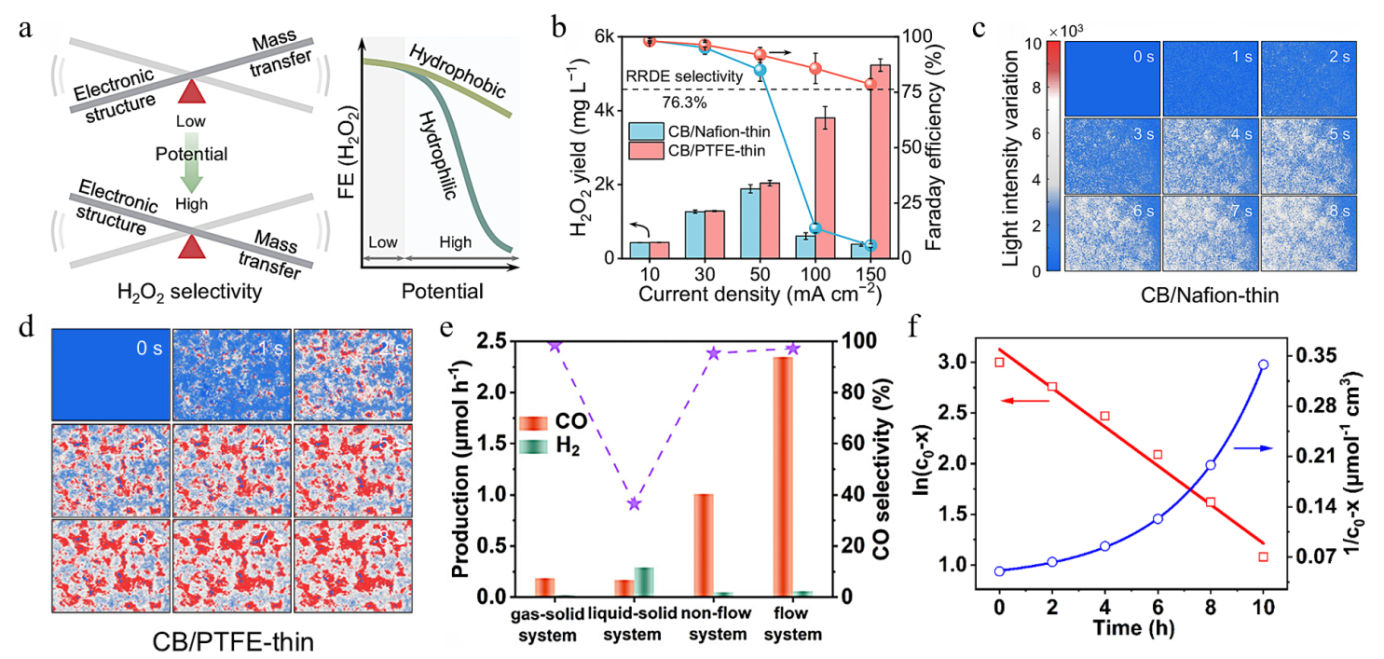
Fig. 6. (a) Schematic of species transfer governing H2O2 selectivity at the electrode scale. Red and white spheres represent oxygen and hydrogen, respectively. (b) H2O2 production performance of carbon black (CB)/Nafon-thin and CB/PTFE-thin at different current densities in 1 h. Mapping of surface absorbed light intensity (representing OH− concentration) as a function of electrolysis time for hydrophilic CB/Nafion-thin (c) and hydrophobic CB/PTFE-thin (d) at 100 m Acm−2. Reprinted with permission from Ref. [87]. Copyright 2024, Springer Nature. (e) Photocatalytic CO2RR activity and selectivity of Co-NGO under different reaction systems. (f) Plot of ln(c0 - x) and 1/c0 - x vs. time in non-flow system. Reprinted with permission from Ref. [89]. Copyright 2025, John Wiley and Sons.
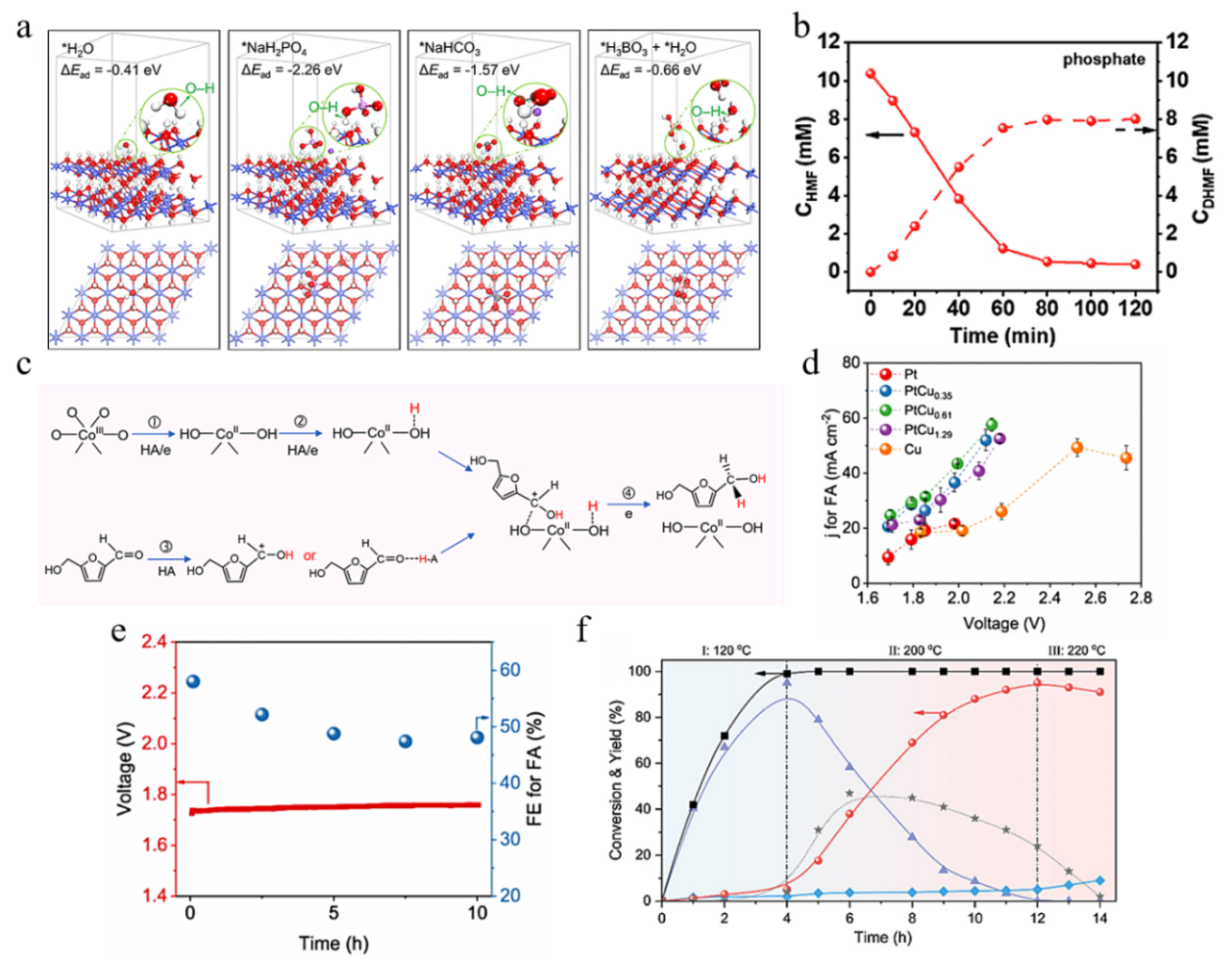
Fig. 7. (a) Energy-minimized configurations of different proton donors (H2O, NaH2PO4, NaHCO3, and H3BO3 + H2O) adsorption on the (001) surface of Co(OH)2. The ΔEad is the adsorption energy of the proton donors on Co(OH)2. Isosurfaces are 0.03 eV Å-3. (b) Concentration changes of HMF and DHMF in 0.1 mol L-1 phosphate during the chronoamperometry test at 1.2 V vs. Ag/AgCl. (c) The proposed reaction pathway in the real condition of the buffer-promoting electrocatalytic hydrogenation (ECH) process. Reprinted with permission from Ref. [90]. Copyright 2023, Elsevier. (d) Voltage-dependent current density for FA production of the Pt, PtCu0.35, PtCu0.61, PtCu1.29 and Cu electrodes in the MEA systems. (e) Cell voltage profile for the PtCu0.61 MEA system operative at 50 mA cm−2 for 10 h. Reprinted with permission from Ref. [92]. Copyright 2024, American Chemical Society. (f) Reaction profile of PET conversion over dual catalysts of Pd/r-GO and og-CuZn in temperature-programed mode. Reaction conditions: 100 mg PET, 50 mg og-CuZn and 50 mg of Pd/r-GO, 5 mL 1,4dioxane, 120 °C for 4 h, 200 °C for 8 h and 220 °C for 2 h, 6 MPa H2. Reprinted with permission from Ref. [95]. Copyright 2024, John Wiley and Sons.
|
| [1] | Yu Gu, Shujia Zhang, Minglu Xu, Hao Yan, Minghao Zhou, Lei Wang, Hui Shi. Dehydroaromatization of methane and methane co-aromatization process with propane: Reaction mechanism, catalyst design, carbon deposition and process optimization [J]. Chinese Journal of Catalysis, 2026, 84(5): 25-60. |
| [2] | Peikun Li, Jinghui Lyu, Yiyong Zhao, Han Wu, Xianghao Zhang, Qiannan Lu, Yizhi Xiang, Blaž Likozar, Matej Huš, Adriana Zaleska-Medynska, Xiaonian Li. Towards highly efficient selective hydrogenation: The role of single-atom catalysts [J]. Chinese Journal of Catalysis, 2026, 81(2): 69-96. |
| [3] | Mansurbek Urol ugli Abdullaev, Woosong Jeon, Yun Kang, Juhwan Noh, Jung Ho Shin, Hee-Joon Chun, Hyun Woo Kim, Yong Tae Kim. Data-driven framework based on machine learning and optimization algorithms to predict oxide-zeolite-based composite and reaction conditions for syngas-to-olefin conversion [J]. Chinese Journal of Catalysis, 2025, 74(7): 211-227. |
| [4] | Li-Li Zhang, Zhen Zhou. Electrosynthesis of value-added chemicals: Challenges from laboratory research to industrial application [J]. Chinese Journal of Catalysis, 2025, 73(6): 1-7. |
| [5] | Pengxiang Zhang, Jiawen Wang, Tianyu Yang, Ruizhe Wang, Ruofan Shen, Zhikun Peng, Yanyan Liu, Xianli Wu, Jianchun Jiang, Baojun Li. Unveiling complexities: Reviews on insights into the mechanism of oxygen evolution reaction [J]. Chinese Journal of Catalysis, 2025, 72(5): 48-83. |
| [6] | Liyuan Gong, Li Tao, Lei Wang, Xian-Zhu Fu, Shuangyin Wang. Focus on the catalysts to resist the phosphate poisoning in high-temperature proton exchange membrane fuel cells [J]. Chinese Journal of Catalysis, 2025, 68(1): 155-176. |
| [7] | Zichao Huang, Tinghui Yang, Yingbing Zhang, Chaoqun Guan, Wenke Gui, Min Kuang, Jianping Yang. Enhancing selectivity in acidic CO2 electrolysis: Cation effects and catalyst innovation [J]. Chinese Journal of Catalysis, 2024, 63(8): 61-80. |
| [8] | Hong-Rui Zhu, Hui-Min Xu, Chen-Jin Huang, Zhi-Jie Zhang, Qi-Ni Zhan, Ting-Yu Shuai, Gao-Ren Li. Recent advances of the catalysts for photoelectrocatalytic oxygen evolution and CO2 reduction reactions [J]. Chinese Journal of Catalysis, 2024, 62(7): 53-107. |
| [9] | Dmitry Yu. Murzin. Synergy between heterogeneous catalysis and homogeneous radical reactions for pharmaceutical waste destruction: Perspective [J]. Chinese Journal of Catalysis, 2024, 58(3): 7-14. |
| [10] | Ya-Fei Jiang, Jin-Cheng Liu, Cong-Qiao Xu, Jun Li, Hai Xiao. Breaking the scaling relations for efficient N2-to-NH3 conversion by a bowl active site design: Insight from LaRuSi and isostructural electrides [J]. Chinese Journal of Catalysis, 2022, 43(8): 2183-2192. |
| [11] | Ernest Pahuyo Delmo, Yian Wang, Jing Wang, Shangqian Zhu, Tiehuai Li, Xueping Qin, Yibo Tian, Qinglan Zhao, Juhee Jang, Yinuo Wang, Meng Gu, Lili Zhang, Minhua Shao. Metal organic framework-ionic liquid hybrid catalysts for the selective electrochemical reduction of CO2 to CH4 [J]. Chinese Journal of Catalysis, 2022, 43(7): 1687-1696. |
| [12] | Mengru Wang, Yi Wang, Xiaoling Mou, Ronghe Lin, Yunjie Ding. Design strategies and structure-performance relationships of heterogeneous catalysts for selective hydrogenation of 1,3-butadiene [J]. Chinese Journal of Catalysis, 2022, 43(4): 1017-1041. |
| [13] | Xiao Chen, Chuang Shi, Changhai Liang. Highly selective catalysts for the hydrogenation of alkynols: A review [J]. Chinese Journal of Catalysis, 2021, 42(12): 2105-2121. |
| [14] | Anders B. Laursen, Jens Sehested, Ib Chorkendorff, Peter C. K. Vesborg. Availability of elements for heterogeneous catalysis: Predicting the industrial viability of novel catalysts [J]. Chinese Journal of Catalysis, 2018, 39(1): 16-26. |
| [15] | Xiang Li, Sixie Yang, Ningning Feng, Ping He, Haoshen Zhou. Progress in research on Li-CO2 batteries: Mechanism, catalyst and performance [J]. Chinese Journal of Catalysis, 2016, 37(7): 1016-1024. |
| Viewed | ||||||
|
Full text |
|
|||||
|
Abstract |
|
|||||


