
Chinese Journal of Catalysis ›› 2026, Vol. 89: 184-195.DOI: 10.1016/S1872-2067(26)65173-X
• Article • Previous Articles Next Articles
Zhirong Rena, Haihan Zhoua,*( ), Tanyuan Wangb, Hua-Jin Zhaia, Qing Lib,*()
Received:2026-02-09
Accepted:2026-03-28
Online:2026-10-18
Published:2026-09-01
Contact:
E-mail: Supported by:Zhirong Ren, Haihan Zhou, Tanyuan Wang, Hua-Jin Zhai, Qing Li. Hierarchical nitride/phosphide heterostructure for efficient and ultrastable Ampere-level hydrogen production[J]. Chinese Journal of Catalysis, 2026, 89: 184-195.
Add to citation manager EndNote|Ris|BibTeX
URL: https://www.cjcatal.com/EN/10.1016/S1872-2067(26)65173-X
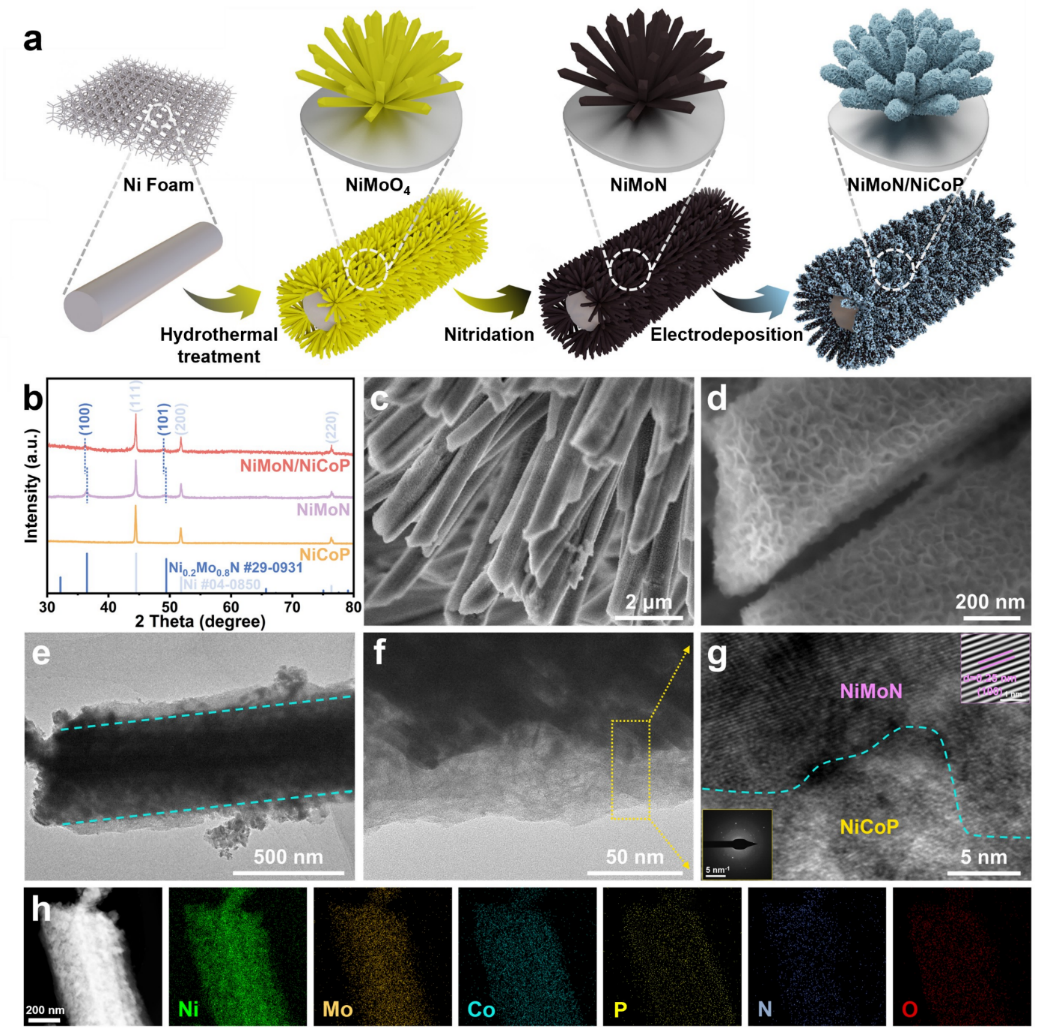
Fig. 1. (a) Schematic diagram of the preparation process for NiMoN/NiCoP catalyst. (b) XRD patterns for NiCoP, NiMoN, and NiMoN/NiCoP. SEM (c,d) and TEM (e,f) images of NiMoN/NiCoP. (g) HR-TEM image and (inset) SAED pattern of NiMoN/NiCoP. (h) HAADF-STEM image and the corresponding EDS mappings of NiMoN/NiCoP.

Fig. 2. High-resolution XPS spectra of Ni 2p (a), Mo 3d (b), Co 2p (c), P 2p (d), and N 1s (e) for the as-prepared catalysts. (f) Nitrogen adsorption-desorption isotherm and (inset) pore-size distribution curve of NiMoN/NiCoP. (g) 1 mol L-1 KOH droplets wetting process (the upper section) and underwater gas-bubble contact angles (the lower section) on NiMoN/NiCoP, NiMoN, NiCoP, and pristine NF.
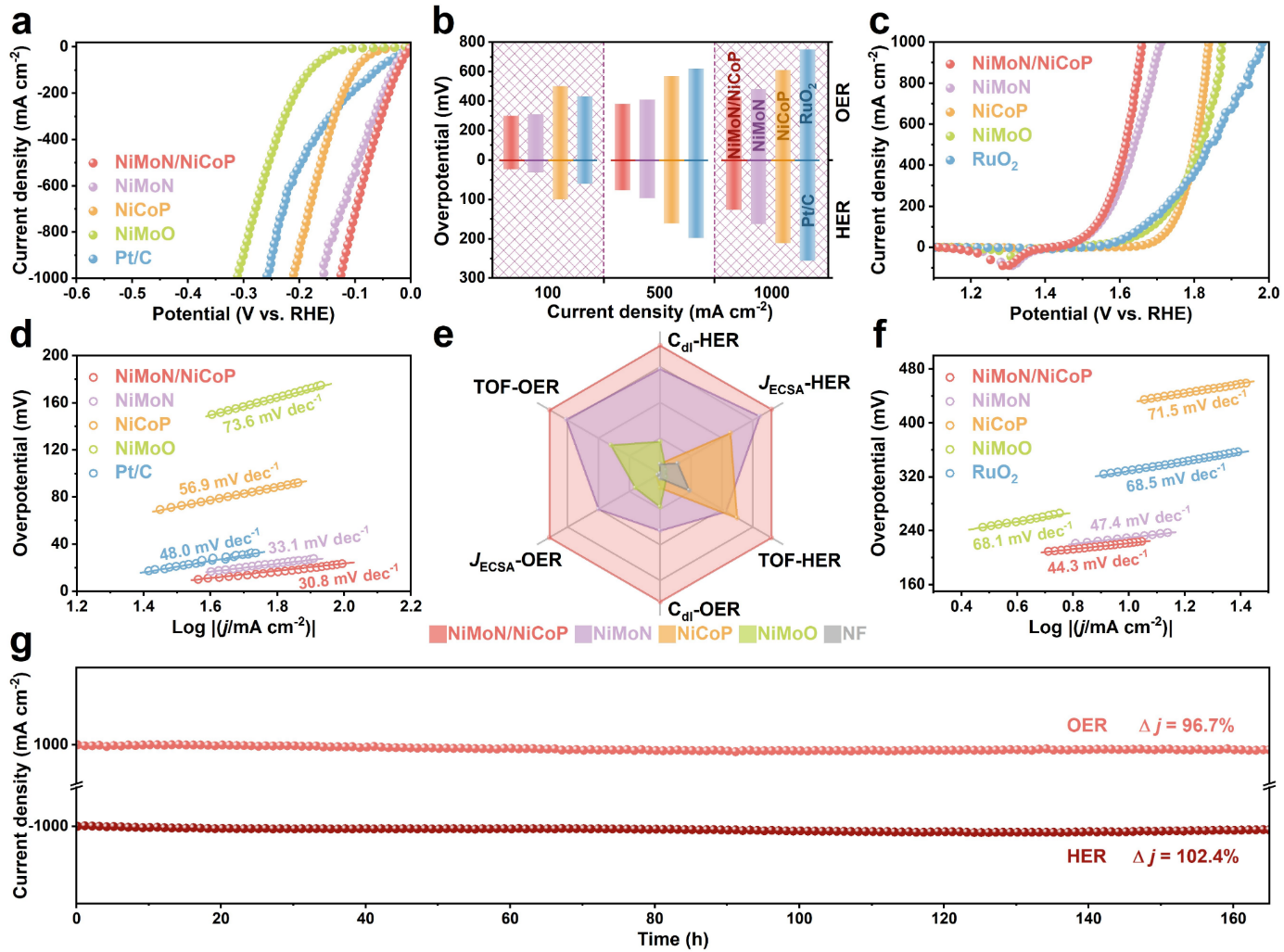
Fig. 3. Electrocatalytic performance in 1 mol L-1 KOH for various catalysts. (a) LSV curves for HER. (b) Comparison of overpotentials at various current densities. (c) LSV curves for OER. (d) Tafel plots for HER. (e) Comprehensive comparisons of the HER and OER performance. (f) Tafel plots for OER. (g) Chronoamperometry curves for stability test of NiMoN/NiCoP towards HER and OER.
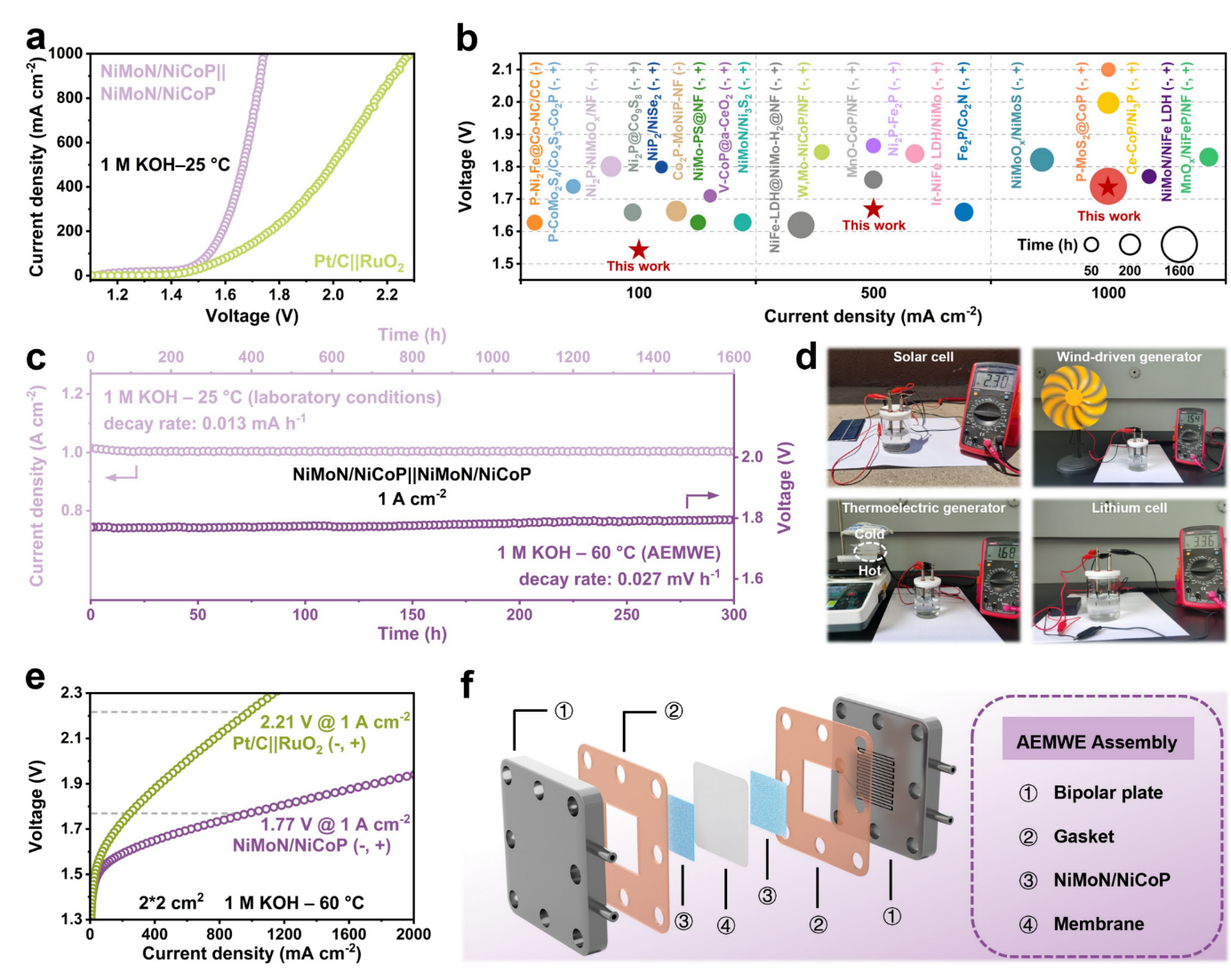
Fig. 4. Electrocatalytic performance of overall water splitting and AEMWE. (a) Polarization curves with iR compensation of NiMoN/NiCoP || NiMoN/NiCoP and Pt/C || RuO2 under laboratory conditions. (b) Comparison of the electrocatalytic performance between NiMoN/NiCoP and other advanced electrocatalysts at the current densities of 100, 500, and 1000 mA cm-2 under laboratory conditions. In this bubble chart, the x-axis is divided into three equal segments representing different current densities, and the y-axis denotes the voltage. The bubbles of various colors correspond to different catalysts, with the bubble area representing the operational duration at the corresponding current density. (c) Stability tests for laboratory conditions and AEMWE. (d) Operation diagram of green energy-driven hydrogen production systems via water splitting with NiMoN/NiCoP electrocatalyst, including solar cell, wind-driven generator, thermoelectric generator, and lithium cells. (e) Polarization curves without iR compensation for the AEMWE with NiMoN/NiCoP || NiMoN/NiCoP and Pt/C || RuO2. (f) Schematic illustration of the AEMWE.

Fig. 5. (a) Optimized structure of NiMoN/NiCoP, in which bluish violet, magenta, bluish green, deep grey, and light blue balls represent the Mo, Co, Ni, P, and N atoms, respectively. (b) PDOS of NiMoN/NiCoP, NiMoN, and NiCoP. (c,d) Charge density difference diagrams of NiMoN/NiCoP with side view. Calculated H2O dissociation (e) and *H adsorption free energy (f) diagrams for NiMoN/NiCoP, NiMoN, and NiCoP.
|
| [1] | Bashir Adegbemiga Yusuf, Hennayaka Mudiyanselage Charitha Madusanka Jayawardana, Waleed Yaseen, Jimin Xie, Yilin Deng, Suci Meng, Yongming Li, Abdussamad Mukhtar Mohammed, Aminu Magaji, Min Chen, Meng Xie, Yuanguo Xu. Vacancy-engineered Ru-based CNT electrocatalysts for ampere-level water splitting in alkaline and anion-exchange membrane water electrolyzers [J]. Chinese Journal of Catalysis, 2026, 88(9): 279-294. |
| [2] | Chen Cao, Shirui Cui, Feng Shi, Yanqin Li, Chunyang Zhao, Wei Hu, Zelong Li, Yu Tang. Lanthanum-mediated single-atom dispersion of Ir and Dynamic oxygen replenishment in acidic water oxidation [J]. Chinese Journal of Catalysis, 2026, 86(7): 236-243. |
| [3] | Wei Zhong, Yiyao Gan, Jingtao Wang, Peiyi Yang, Aiyun Meng, Yaorong Su. Achieving near-equilibrium Had adsorption/desorption by introducing asymmetric S-Re-Se modules in a-ReSxSe2-x cocatalysts for enhanced photocatalytic H2 evolution [J]. Chinese Journal of Catalysis, 2026, 85(6): 322-332. |
| [4] | Puyu Du, Yi Shen, Tao Peng, Zisheng Yu, Tingting Du, Meng Ma, Hongyu He, Zhilin Jia, Yang Liu, Shaohua Shen. Steering adsorption behavior of 5-hydroxymethylfurfural at CuAu alloys for one-electron dehydrogenation electrocatalysis pairing anodic 5-hydroxymethyl-2-furancarboxylic acid and bipolar hydrogen production [J]. Chinese Journal of Catalysis, 2026, 85(6): 226-236. |
| [5] | Runlin Ma, Xiandi Ma, Hejing Wang, Xu Zhang, Yongzheng Fang, Menggai Jiao, Zhen Zhou. Bifunctional electrocatalysis of hydrazine oxidation and hydrogen evolution reactions on 2D CoX (X = P, S, As, Se): Insights from DFT calculations [J]. Chinese Journal of Catalysis, 2026, 82(3): 115-124. |
| [6] | Wenfeng Li, Guocheng Lv, Meng Liu, Fanyue Zhao, Zetian He, Guihong Li, Wenping Wang, Libing Liao, Daimei Chen. Innovative strategies and perspectives for enhancing photoelectrochemical water splitting: Physical field engineering [J]. Chinese Journal of Catalysis, 2026, 81(2): 9-36. |
| [7] | Rui Yang, Zimin Han, Yin Gao, Guoqing Feng, Huaizhi Liu, Yiyin Huang, Zhongkai Wang, Yaobing Wang. Charge-mediated cyclohexanone enrichment and intermediate stabilization at MoNi4/MoO2 heterostructures enable paired cyclohexanone electrooxidation-hydrogen production at ampere-level current [J]. Chinese Journal of Catalysis, 2026, 81(2): 344-354. |
| [8] | Xuan Zhang, Lin Zhou, Teng Yan, Xiaohu Zhang, Hao Chen. Fabrication of S-scheme heterojunction between covalent organic frameworks and Ni-ZIF-8 and its photocatalytic hydrogen production performance [J]. Chinese Journal of Catalysis, 2026, 80(1): 200-212. |
| [9] | Shenghui Zhou, Zheng Wang, Voon Huey Lim, Chi Cheng Chong, Hossein Akhoundzadeh, Chao Wu, Mohammadreza Kosari, Shibo Xi, Markus Kraft, Rong Xu. Subnanometer molybdenum oxide-stabilized platinum nanocatalysts enable efficient hydrogen production from methylcyclohexane [J]. Chinese Journal of Catalysis, 2026, 80(1): 347-357. |
| [10] | Xinlong Zheng, Yiming Song, Chongtai Wang, Qizhi Gao, Zhongyun Shao, Jiaxin Lin, Jiadi Zhai, Jing Li, Xiaodong Shi, Daoxiong Wu, Weifeng Liu, Wei Huang, Qi Chen, Xinlong Tian, Yuhao Liu. Properties, applications, and challenges of copper- and zinc-based multinary metal sulfide photocatalysts for photocatalytic hydrogen evolution [J]. Chinese Journal of Catalysis, 2025, 74(7): 22-70. |
| [11] | Zihao Zhang, Jiaming Zhang, Haifeng Wang, Meng Liu, Yao Xu, Kaiwei Liu, Boyang Zhang, Ke Shi, Jifang Zhang, Guijun Ma. Facet-oriented surface modification for enhancing photocatalytic hydrogen production on Sm2Ti2O5S2 nanosheets [J]. Chinese Journal of Catalysis, 2025, 74(7): 341-351. |
| [12] | Xuelu He, Wenyan Ma, Siteng Zhu, Dan Li, Jia-Xing Jiang. The effect of electronic structure matching between building blocks in conjugated porous polymers on photocatalytic hydrogen evolution activity [J]. Chinese Journal of Catalysis, 2025, 73(6): 279-288. |
| [13] | Yihan Zheng, Yuxin Wang, Ruitao Li, Haoran Yang, Yuanyuan Dai, Qiang Niu, Tiejun Lin, Kun Gong, Liangshu Zhong. CO2-free hydrogen production from solar-driven photothermal catalytic decomposition of methane [J]. Chinese Journal of Catalysis, 2025, 73(6): 289-299. |
| [14] | Guohao Na, Hongshun Zheng, Mingpeng Chen, Huachuan Sun, Yuewen Wu, Dequan Li, Yun Chen, Boran Zhao, Bo Zhao, Tong Zhou, Tianwei He, Yuxiao Zhang, Jianhong Zhao, Yumin Zhang, Jin Zhang, Feng Liu, Hao Cui, Qingju Liu. In-situ Pt reduction induced topological transformation of NiFe-MOF for industrial seawater splitting [J]. Chinese Journal of Catalysis, 2025, 72(5): 211-221. |
| [15] | Qisen Jia, Yanan Wang, Yan Zhao, Zhenming Tian, Luyao Ren, Xuejing Cui, Guangbo Liu, Xin Chen, Wenzhen Li, Luhua Jiang. Driving selective photoelectrocatalytic oxidation of seawater to oxygen via regulating interfacial water structures on titanium oxides [J]. Chinese Journal of Catalysis, 2025, 72(5): 154-163. |
| Viewed | ||||||
|
Full text |
|
|||||
|
Abstract |
|
|||||


