
催化学报 ›› 2026, Vol. 89: 1-39.DOI: 10.1016/S1872-2067(26)65122-4
• 综述 • 下一篇
杨春杰a,b, 魏娜a,*( ), 王舒a, 张琪a, 刘曦阳a, 徐文超a, 侯克克b, 张宁强c, 李伶聪a,*(), 赵震a,b,*()
收稿日期:2025-12-31
接受日期:2026-02-22
出版日期:2026-10-18
发布日期:2026-09-01
通讯作者:
*电子信箱: wwweina@126.com (魏娜),基金资助:
Chunjie Yanga,b, Na Weia,*(), Shu Wanga, Qi Zhanga, Xiyang Liua, Wenchao Xua, Keke Houb, Ningqiang Zhangc, Lingcong Lia,*(), Zhen Zhaoa,b,*()
Received:2025-12-31
Accepted:2026-02-22
Online:2026-10-18
Published:2026-09-01
Contact:
*E-mail:wwweina@126.com(N. Wei),lilingcong@synu.edu.cn(L. Li),zhenzhao@cup.edu.cn(Z. Zhao).
About author:Na Wei (College of Chemistry and Chemical Engineering, Shenyang Normal University) received her Ph.D. degree from Liaoning University in 2017. In the same year, she joined the Institute of Catalysis for Energy and Environment, College of Chemistry and Chemical Engineering, Shenyang Normal University as a faculty member. Her current research interests focus on novel materials, heterogeneous catalysis and thermocatalysis with emphasis on design of new MOFs and their derivative catalysts, and the control of their morphology and microstructure, together with the study of reaction mechanisms for the efficient capture and catalytic conversion of CO2.Supported by:摘要:
工业革命以来, 二氧化碳(CO2)大规模排放引发全球变暖, 严重威胁生态环境与可持续发展. 2024年全球能源相关CO2排放量达37.8 Gt, 尽管可再生能源实现了有效减排, 但化石燃料仍主导能源结构. CO2捕集与加氢还原(CCR)技术可将CO2转化为甲烷、甲醇等高附加值化学品, 是实现碳中和的关键路径. 传统CCR技术中捕集与转化分步进行, 存在设备成本高、能耗大等问题, 而双功能材料(DFMs)能在单一体系中同步完成CO2捕集与原位加氢, 为解决上述难题提供了新方向.
本文围绕DFMs在CCR反应中的催化机理与应用展开系统综述, 从反应路径、表征技术、催化剂分类进行全面梳理. 在反应路径方面, 详细解析了CO2加氢生成甲烷、一氧化碳、甲醇、乙醇及C2-C4低碳烯烃的关键路径与中间体演化规律, 明确了甲酸盐(*HCOO)和羰基(*CO)为核心中间体, 阐明了不同路径的热力学与动力学差异. 其中, 甲烷化反应存在甲酸盐和羰基两条竞争路径; 低碳烯烃合成则通过CO2改性费托合成或甲醇介导路径实现; 甲醇合成主要遵循甲酸盐路径与羧基路径; 而乙醇合成则涉及CO插入、CHx-CHxO耦合及CHx-HCOO耦合三种机制. 在表征技术上, 重点突出原位振动光谱、X-射线吸收光谱等原位/操作表征手段与密度泛函理论计算的协同作用, 这些技术为揭示金属与吸附剂协同效应、活性位点动态演化及反应机理提供了关键支撑. 另外, 根据活性金属类型系统评述了Ni, Ru, Cu和Fe基及其他类型DFMs的研究进展, 明确了各类DFMs核心协同规律. 其中, Ni基DFMs依赖双金属合金化与助剂调控实现高效甲烷化及稳定性提升, Ru基DFMs通过碱金属修饰与活性相调控强化低温甲烷化选择性, Cu基DFMs借助界面工程与多组分耦合适配多反应路径, Fe基DFMs通过相演变与助剂调控实现低碳烯烃高效合成的核心协同规律. 通过深入剖析活性金属、吸附剂、助剂与载体间的协同机制, 针对性的提出通过微结构设计、界面耦合、粒径调控等优化方案来解决烧结、失活等工业核心难题. 通过分析DFMs在等温和变温操作下的动力学匹配规律, 揭示了速率决定步骤的动态迁移特性, 给出适配的结构优化方案, 保障DFMs在不同反应条件下的高效稳定运行.
未来, DFMs的发展需聚焦结构稳定性提升、抗干扰能力强化、成本降低及量化机理模型构建等方向. 本文通过系统梳理DFMs的催化机理与协同关系, 为开发高效、低耗、工业化可行的CCR材料提供了重要理论指导, 助力推动碳中和技术的实际应用与发展.
杨春杰, 魏娜, 王舒, 张琪, 刘曦阳, 徐文超, 侯克克, 张宁强, 李伶聪, 赵震. 二氧化碳捕集与还原双功能材料的机理研究进展[J]. 催化学报, 2026, 89: 1-39.
Chunjie Yang, Na Wei, Shu Wang, Qi Zhang, Xiyang Liu, Wenchao Xu, Keke Hou, Ningqiang Zhang, Lingcong Li, Zhen Zhao. Progress in unraveling the mechanisms of dual functional materials for CO2 capture and reduction[J]. Chinese Journal of Catalysis, 2026, 89: 1-39.
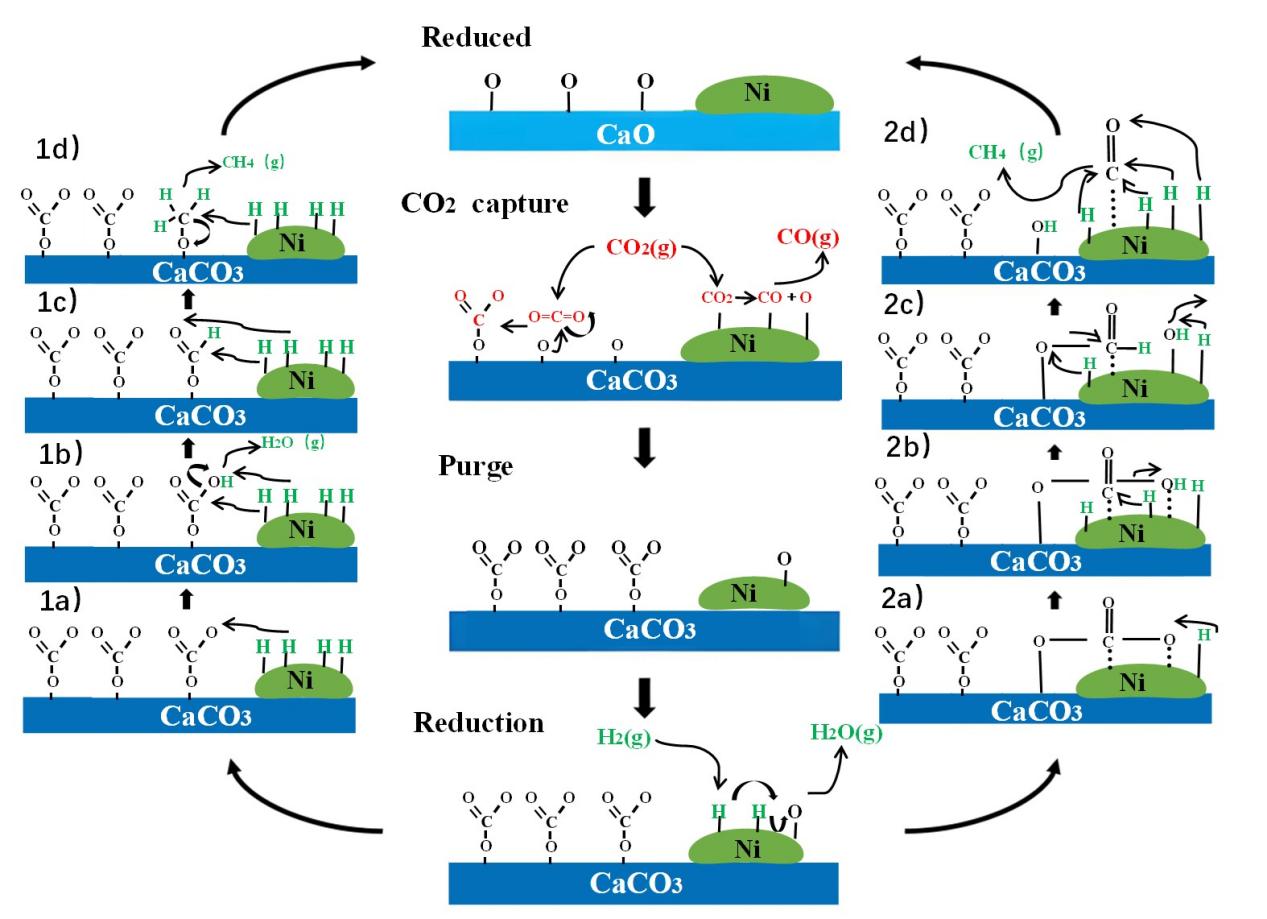
Fig. 1. Proposed integrated CO2 capture and direct methanation over Ni/CaO DFM. Reproduced with permission from Ref. [35]. Copyright 2023, American Chemical Society.
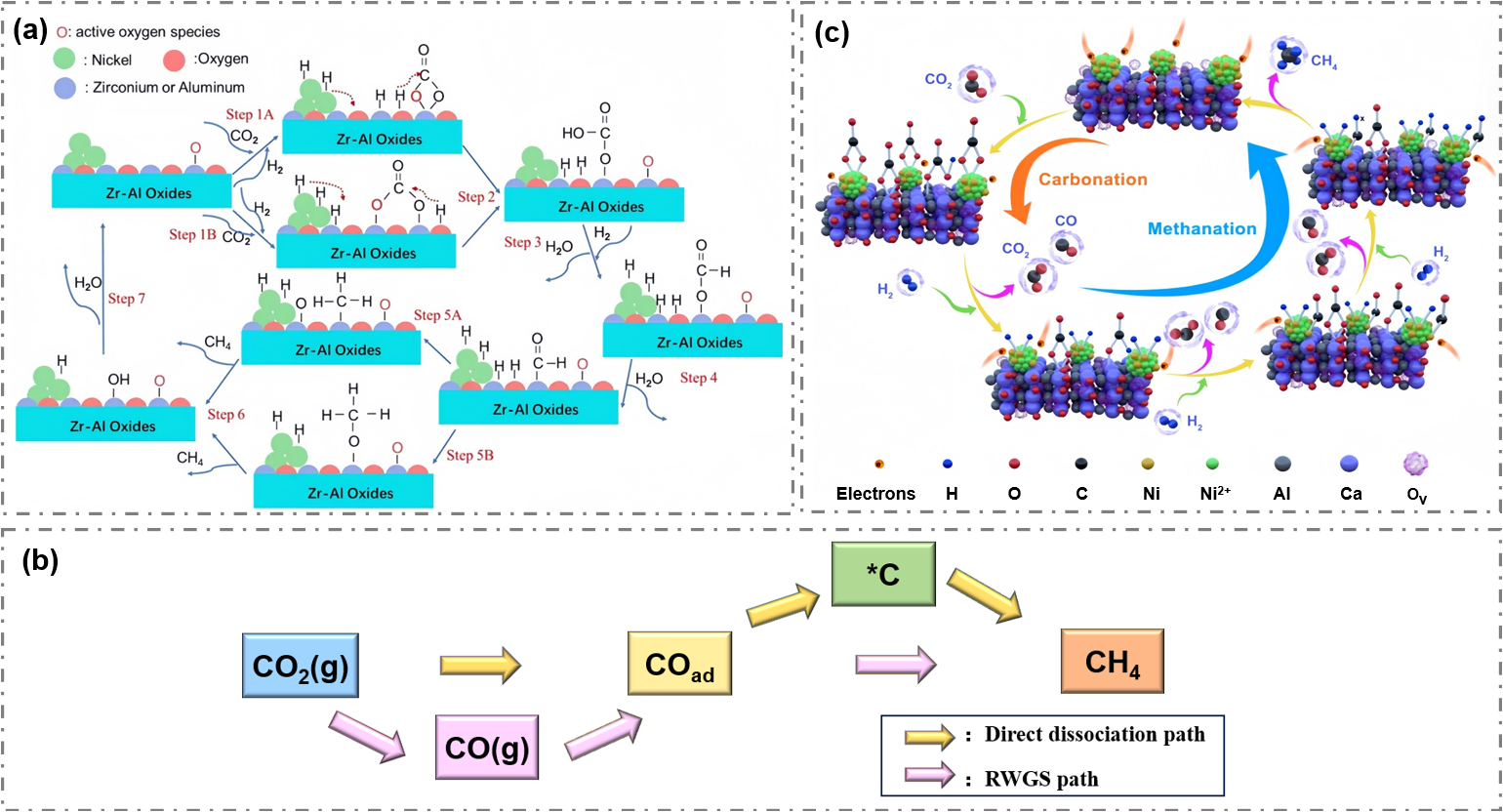
Fig. 2. CO2 capture and methanation reaction pathway: (a) *HCOO mechanism of Ni-Zr-Al ternary hydrotalcite DFM. Reproduced with permission from Ref. [46]. Copyright 2021, Elsevier. (b) Schematic of two competing pathways for the formation of *CO intermediate from CO2 on DFMs. (c) Schematic diagram of the carbonation and hydrogenation reaction mechanism for Ni/AlCaOx DFMs. Reproduced with permission from Ref. [47]. Copyright 2024, American Chemical Society.
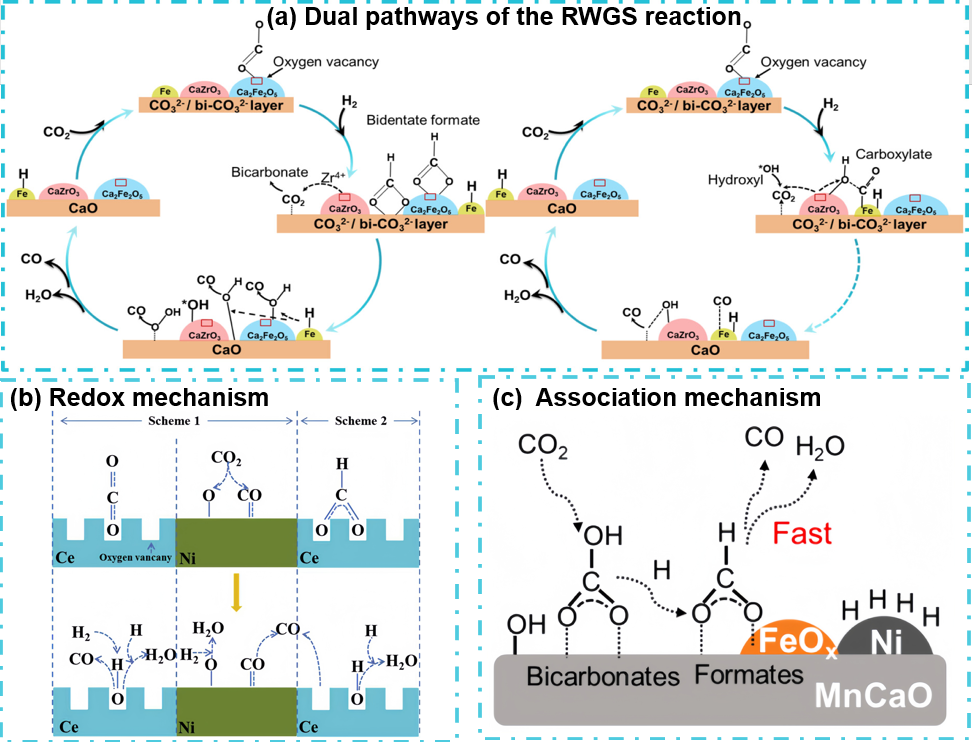
Fig. 3. Reaction mechanism of RWGS: (a) Proposed mechanism of CaZrO3 promoted Fe-CaO dual functional material for CO2 hydrogenation reduction pathway: *b-HCOO mechanism and *COOH and hydroxyl synergistic promotions during CaL-RWGS reaction. Reproduced with permission from Ref. [59]. Copyright 2024, American Chemical Society. (b) Reaction mechanism of the RWGS reaction over Ca1Ni0.1Ce0.033 DFM. Reproduced with permission from Ref. [32]. Copyright 2019, Elsevier. (c) Mechanistic diagram of associative *HCOO on Fe2.5Ni2.5MnCaO DFM for the RWGS reaction. Reproduced with permission from Ref. [57]. Copyright 2024, Elsevier.
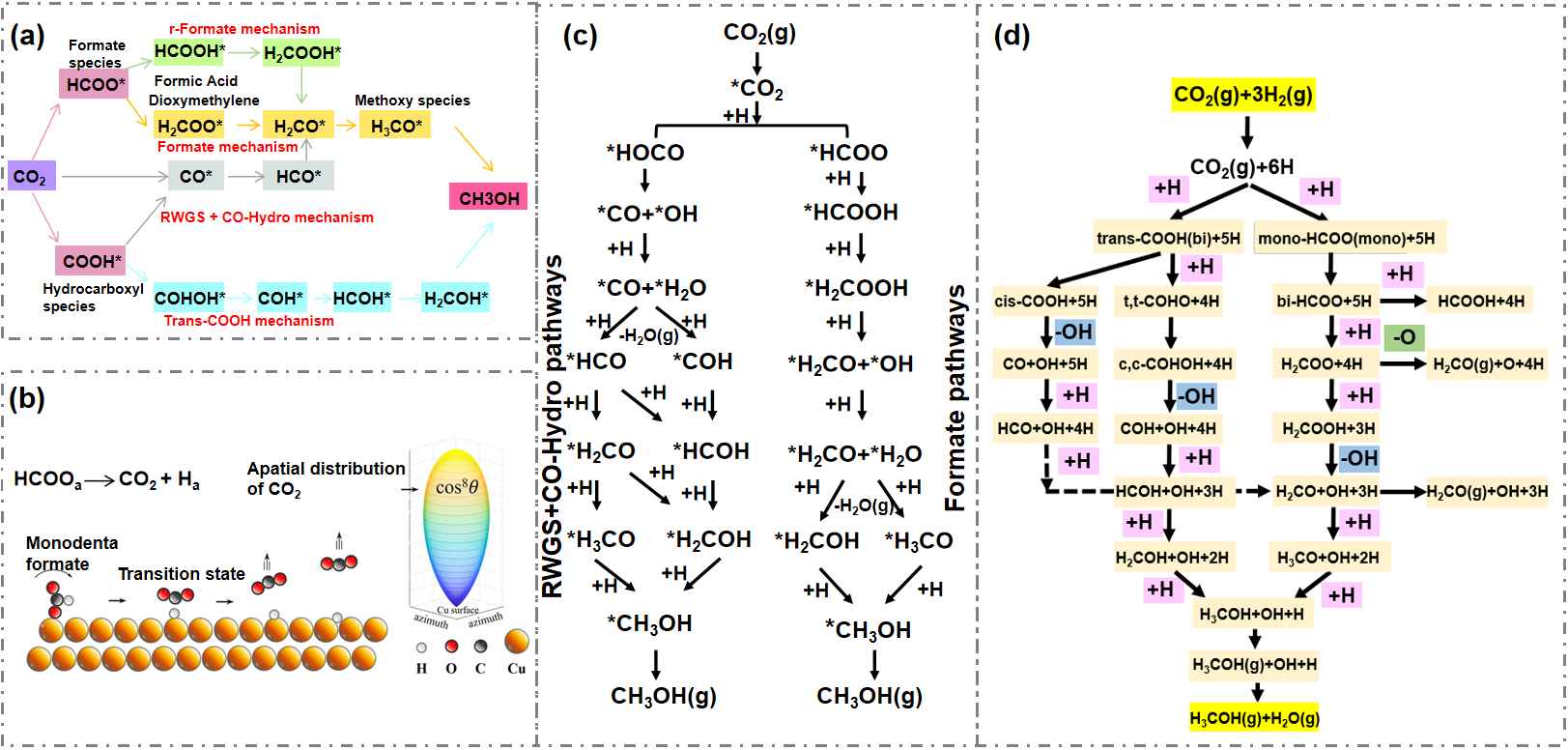
Fig. 4. Pathways of CO2 hydrogenation to CH3OH reaction: (a) Classification of CH3OH reaction pathways. Reproduced with permission from Ref. [64]. Copyright 2020, Royal Society of Chemistry. (b) Reaction pathway of *HCOO intermediates. Reproduced with permission from Ref. [69]. Copyright 2024, American Chemical Society. (c) Reaction scheme for CO2 hydrogenation to CH3OH via the RWGS + CO-Hydro and formate pathways. Reproduced with permission from Ref. [72]. Copyright 2025, American Chemical Society. (d) Reaction mechanism network of CH3OH synthesis on Cu (111).
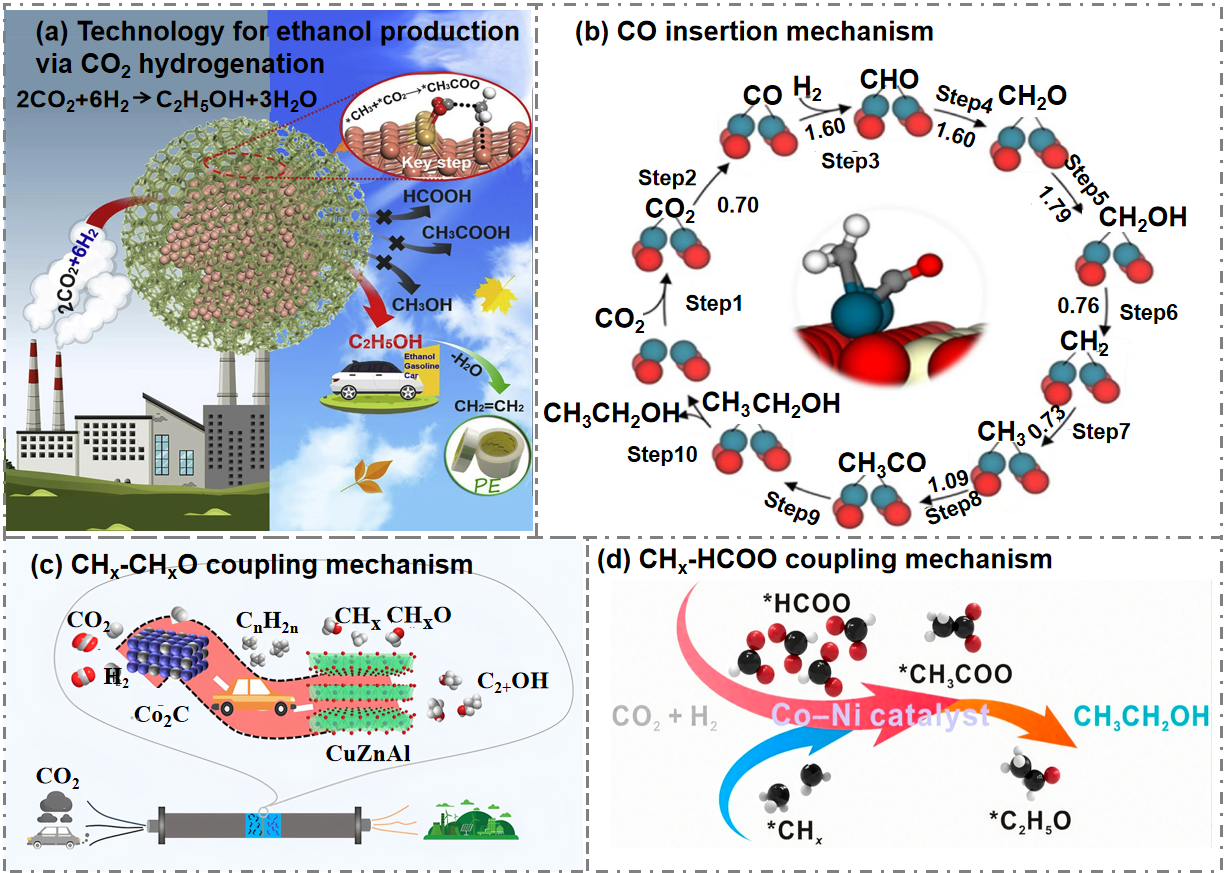
Fig. 5. Pathways and mechanism of C2H5OH synthesis via CO2 hydrogenation: (a) Technology for C2H5OH production via CO2 hydrogenation. Reproduced with permission from Ref. [84]. Copyright 2020, Elsevier. (b) Activation barriers (in eV) of elementary steps involved in the catalytic cycle for the formation of C2H5OH over Pd2/CeO2 (110), with red spheres denoting the O atoms and blue spheres indicating Pd atoms. The inserted figure shows the transition state structure of *CH3 and *CO coupling. Reproduced with permission from Ref. [86]. Copyright 2021, Elsevier. (c) CHx-CHxO coupling mechanism in CO2 hydrogenation via Co2C-CuZnAl DFM. Reproduced with permission from Ref. [79]. Copyright 2023, American Chemical Society. (d) Schematic diagram of the intermediate conversion mechanism for CO2 hydrogenation to C2H5OH over Co-Ni catalysts. Reproduced with permission from Ref. [92]. Copyright 2019, American Chemical Society.
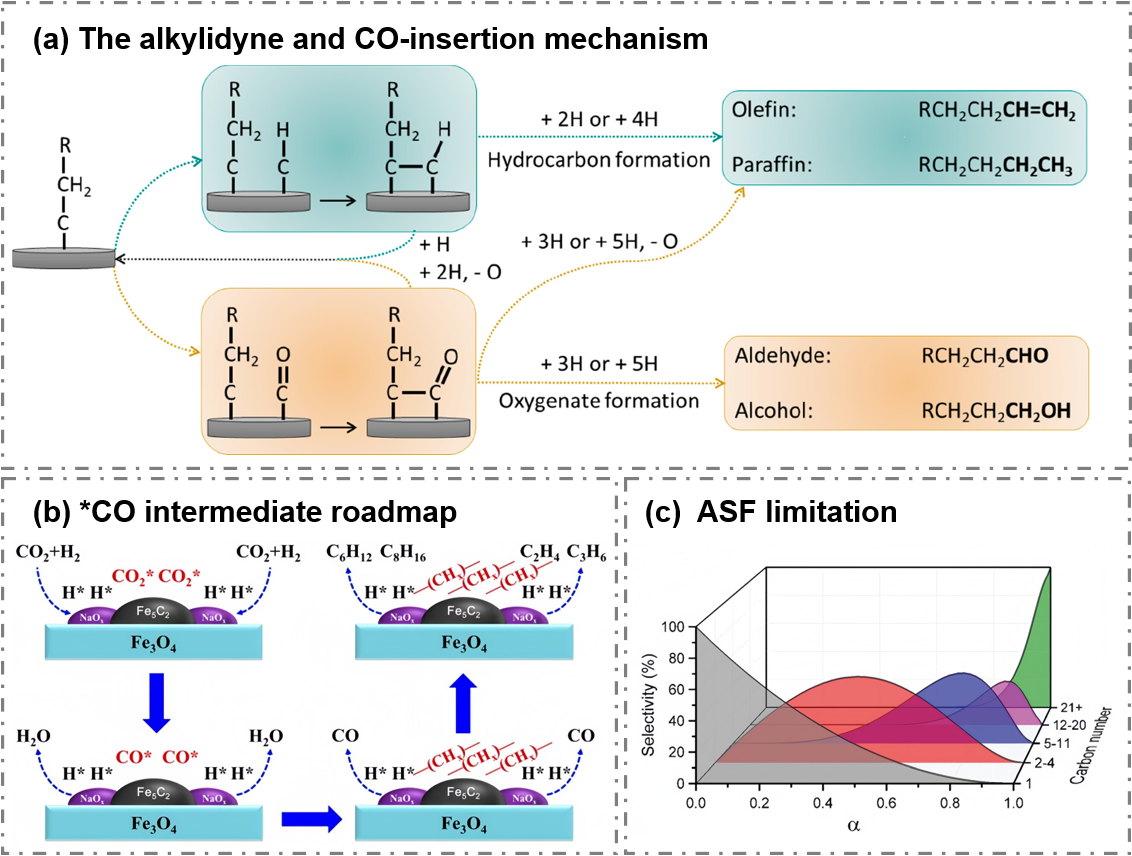
Fig. 6. CO2-FTS reaction mechanisms and product distribution limitation: (a) The alkylidyne and *CO-insertion mechanism. Reproduced with permission from Ref. [95]. Copyright 2023, American Chemical Society. (b) *CO intermediate roadmap for CO2 hydrogenation to C2-C4 olefins. Reproduced with permission from Ref. [100]. Copyright 2019, American Chemical Society. (c) Change of selectivity of hydrocarbon products in different ranges with chain growth probability (α). Reproduced with permission from Ref. [94]. Copyright 2019, Royal Society of Chemistry.
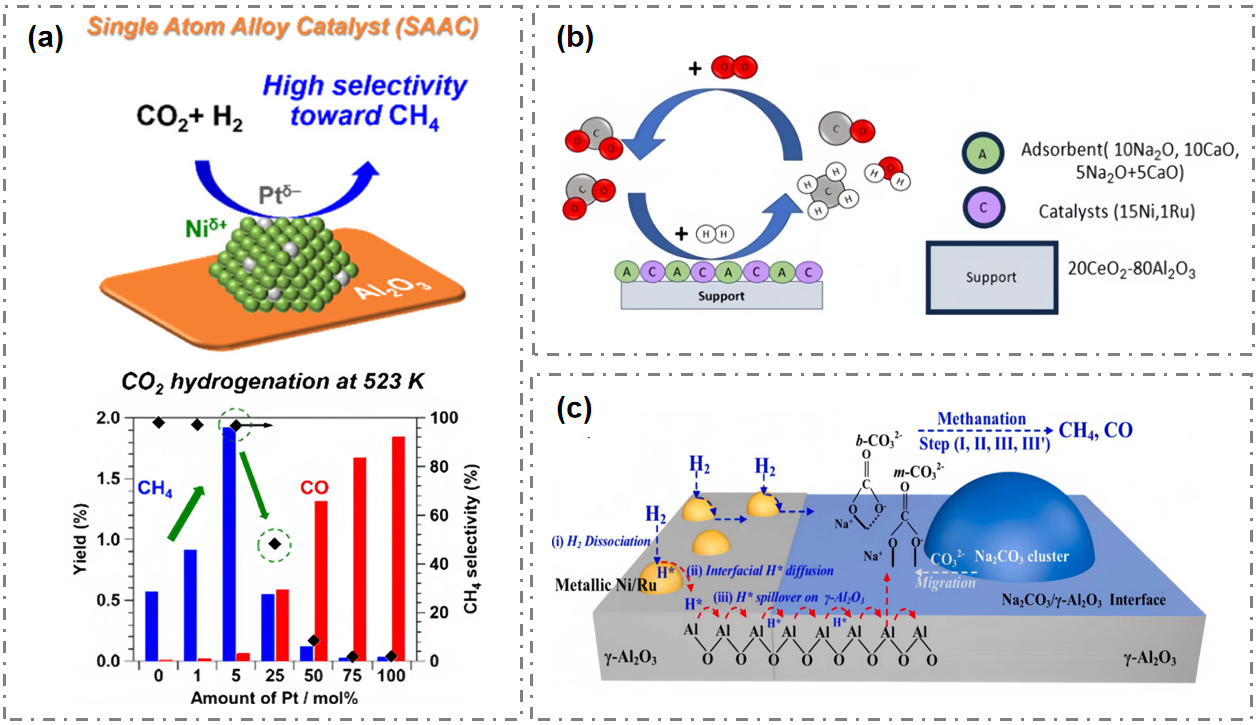
Fig. 7. CO2-to-C2-C4 olefins FTS/MTO mechanisms and DFT: (a) A possible mechanism for the synthesis of C2-C4 ole?ns via CO2 hydrogenation on Na0.02Co0.4ZnFe2O4. Reproduced with permission from Ref. [102]. Copyright 2025, Wiley-VCH. (b) Possible hydrogenation mechanism of the 0.05Na/CaFe2O4 catalyst. Reproduced with permission from Ref. [107]. Copyright 2025, Elsevier. (c) Schematic illustration of structure-performance correlation for CO2 hydrogenation over the Fe-Co catalysts. Reproduced with permission from Ref. [108]. Copyright 2024, American Chemical Society. (d) DFT calculations. Reaction diagram [energy (E) at a typical reaction temperature of 593 K] of the hydrogenation of CO2 on the (101) surface of the tetragonal ZnZrOx model. Reproduced with permission from Ref. [109]. Copyright 2024, Wiley-VCH.
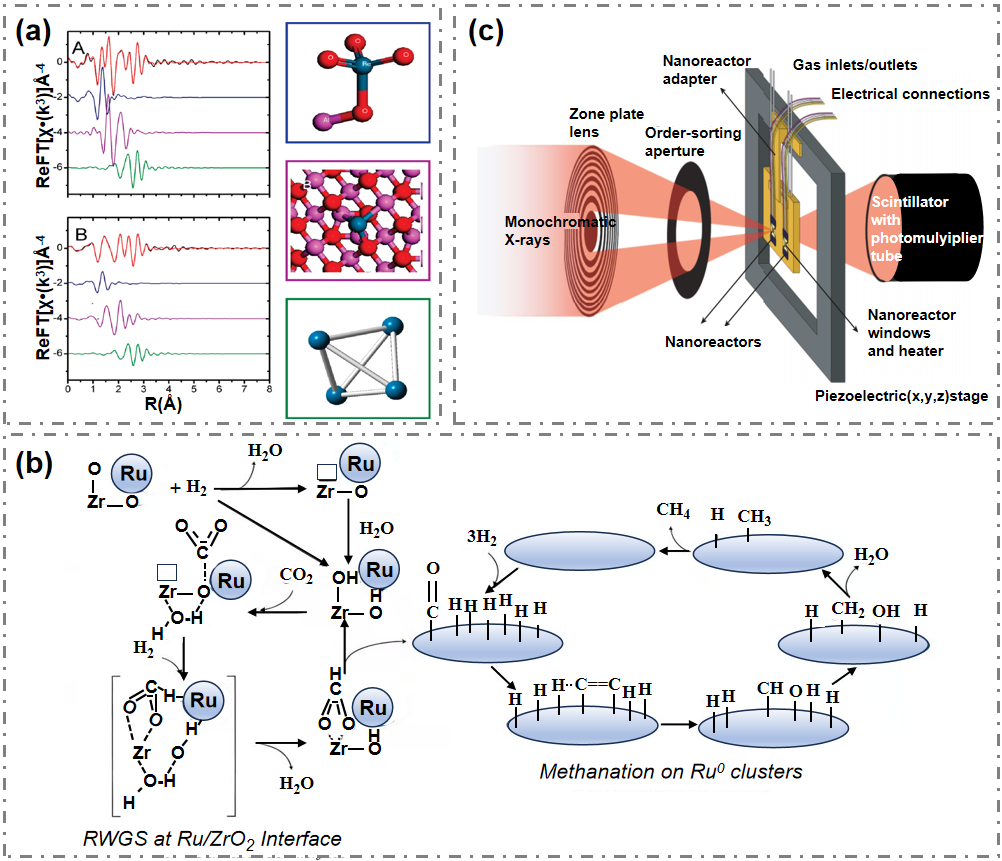
Fig. 8. Application of in-situ synchrotron radiation techniques can be summarized as follows: (a) Real part of the Fourier transform of 500 °C (A) and 700 °C (B) EXAFS data (black) and model (red). The components in the model for the oxidic Re (blue), Re atoms on the alumina surface at min2 (purple), and Re clusters (green) are shown offset beneath the data and model. The insets show a representation of these different Re species. From top to bottom, they are: oxidic Re, min2, and Re clusters. The blue, red, and purple spheres represent Re, O, and Al atoms. Reproduced with permission from Ref. [142]. Copyright 2025, American Chemical Society. (b) Proposed CO2 hydrogenation mechanism over Ru/ZrO2 DFM. (c) In-situ STXM uses a Fresnel zone plate to focus soft X-rays on the sample in a nanoreactor; an order-sorting aperture removes higher diffraction orders, and the adaptor with piezo-controlled translation enables high-precision raster scans. Reproduced with permission from Ref. [145]. Copyright 2008, Springer Nature.
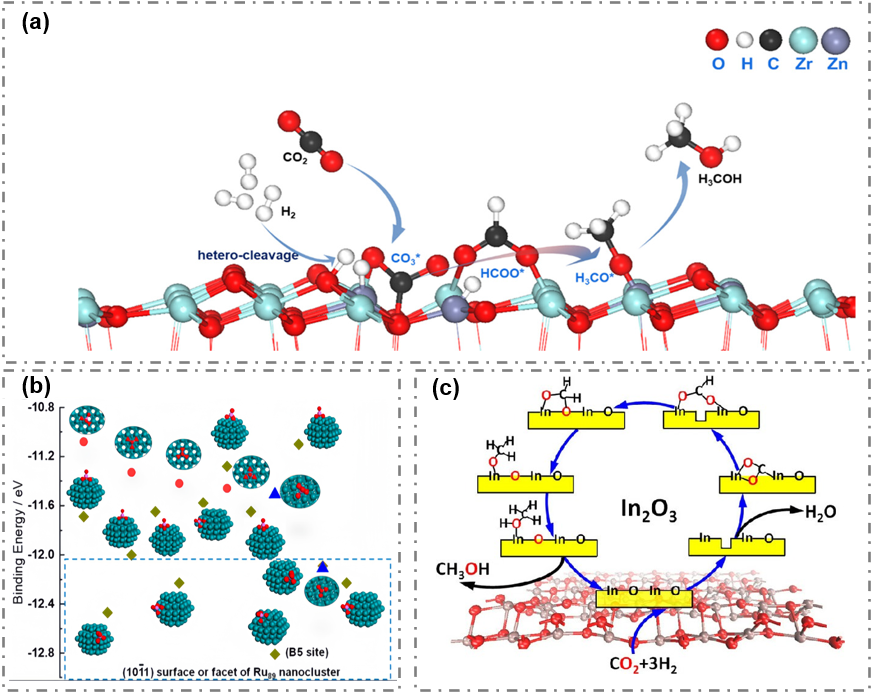
Fig. 9. Application of DFT: (a) The schematic diagram of the atomic-level reaction pathway of CO2 hydrogenation to CH3OH on the surface of a metal oxide catalyst. Reproduced with permission from Ref. [172]. Copyright 2023, American Chemical Society. (b) DFT calculations of the binding energy of AlO4 molecular cluster on Ru(0001) and Ru(101-1) surfaces, as well as on the Ru89 nanocluster. Reproduced with permission from Ref. [130]. Copyright 2023, American Chemical Society. (c) The reaction pathway for CO2 hydrogenation to CH3OH on oxygen vacancies of the In2O3(110) surface. Reproduced with permission from Ref. [67]. Copyright 2013, American Chemical Society.
| Adsorbents/promoter components | Catalyticlly active components | Support materials | key intermediates | Reaction mechanisms | Target reactions | Representative literatures |
|---|---|---|---|---|---|---|
| K | Cu | Al2O3 | *CO3, *HCOO | associative | RWGS | [ |
| Li | Ru | Al2O3 | *HCOO, *CO | associative | Met | [ |
| Na | Ru | γ-Al2O3 | *HCOO, *CO | associative | Met | [ |
| Li + Na | Ru | γ-Al2O3 | *HCOO, *CO | associative | Met | [ |
| SrO | Ni | SiO2 | *HCOO, *CO | associative | Met | [ |
| BaO | Ni | SiO2 | *HCOO, *CO | associative | Met | [ |
| CaO | Ni | γ-Al2O3 | *CO, *HCOO | redox and associative | RWGS | [ |
| CaO + CeO2 | Ni | CeO2 | *CO, *HCOO | redox and associative | RWGS | [ |
| Na2O/Na2CO3 | Ru | γ-Al2O3 | *CO | associative | Met | [ |
| Na2O + Yb2O3 | Ni | γ-Al2O3 | *HCOO, *CO | associative | Met | [ |
| MgO + LiNO3/NaNO3/KNO3 | Ni | CeO2 + MgO | *HCOO, *CO | associative | Met | [ |
| Na2CO3 | Ni | γ-Al2O3 | *HCOO, *CO | associative | Met | [ |
| Na2CO3 | Ru | γ-Al2O3 | *HCOO, *CO | associative | Met | [ |
| Al | Cu | γ-Al2O3 | *CO, *HCOO | redox and associative | RWGS | [ |
| Na2CO3 | Ni-Ru | γ-Al2O3 | *HCOO, *CO | associative | Met | [ |
| Li-Na | Ru | γ-Al2O3 | *HCOO, *CO | associative | Met | [ |
| Li/Na/K | Ru | ZrO2 | *CO | associative | Met | [ |
| CaO + Na2CO3 | Ru | γ-Al2O3 | *HCOO, *CO | associative | Met | [ |
| Li/Na/K/Cs | Ru | TiO2 | *HCOO, *CO | associative | Met | [ |
| BaO | Ru | γ-Al2O3 | *HCOO, *CO | associative | Met | [ |
| K2CO3 | Ru | γ-Al2O3 | *CO | associative | Met | [ |
| MgO | Ru | CeO2 | *HCOO, *CO | associative | Met | [ |
| Na2O | Ru | γ-Al2O3 | *HCOO, *CO | associative | Met | [ |
| CeO2 + ZrO2 | Cu | γ-Al2O3 | *HCOO, *COOH | associative | MS | [ |
| ZnO, ZrO2, MgO | Cu | γ-Al2O3 | *HCOO | associative | MS | [ |
| ZnO-Al2O3 | Cu | Al2O3 | *HCOO | associative | MS | [ |
| α-ZrO2/γ-ZrO2/m-ZrO2 | Cu | ZrO2 | *HCOO | associative | MS | [ |
| Na2CO3-CaO | Cu | γ-Al2O3 | *CO | redox | RWGS | [ |
| CeO2-Al2O3 | Fe-Cu | CeO2-Al2O3 | *CO | redox | RWGS | [ |
| ZnO-ZnSiO4 | Cu-Zn-Zr | ZnSiO4 | *CO | RWGS + CO-Hydro | MS | [ |
| ZrO2 | Cu | ZrO2 | *CO | redox | RWGS | [ |
| ZrO2 | Fe-Co | ZrO2 | *CO | CO2-FTS | OS | [ |
| K | Fe | CaO | *CO | CO2-FTS | OS | [ |
| Na2CO3 | Ni | γ-Al2O3 | *HCOO | associative | Met | [ |
| Na | Pt | Al2O3 | *CO3, *HCOO | associative | RWGS | [ |
| ZrO2 | Rh-Pt | ZrO2 | *HCOO, *CO | associative | Met | [ |
| CaO | Ru | CeO2 | *HCOO | associative | Met | [ |
| CeO2-CaO | CeO2 | CaO | *CO3, *HCOO | associative | RWGS | [ |
| CaO | Ni-Fe | (Mg,Al)Ox | *HCOO | associative | Met | [ |
| ZrO2 | ZnO-ZrO2 | ZrO2 | *HCOO | associative | MS | [ |
| Mn | Co-Mn | Co3O4 | *CO | RWGS + CO-Hydro | MS | [ |
| Ga | Cu | ZnO-ZrO2 | *HCOO | associative | MS | [ |
| K2CO3 | Cu | γ-Al2O3 | *HCOO | associative | RWGS | [ |
| ZnGa2O4 | ZnGa2O4 | SAPO-34 | *CH3OH | CO2-MTO | OS | [ |
| ZrO2 | In2O3 | ZrO2 | *COOH | associative | MS | [ |
| BaO | Ni | SiO2-Al2O3 | *HCOO | associative | Met | [ |
| CaO-MgO | Ni | CaO | *CO, *HCOO | associative and redox | Met/RWGS | [ |
| CeO2 | Ni | Al2O3 | *HCOO | associative | Met | [ |
Table 1 Key components, target reactions, and representative literature of different types of DFMs.
| Adsorbents/promoter components | Catalyticlly active components | Support materials | key intermediates | Reaction mechanisms | Target reactions | Representative literatures |
|---|---|---|---|---|---|---|
| K | Cu | Al2O3 | *CO3, *HCOO | associative | RWGS | [ |
| Li | Ru | Al2O3 | *HCOO, *CO | associative | Met | [ |
| Na | Ru | γ-Al2O3 | *HCOO, *CO | associative | Met | [ |
| Li + Na | Ru | γ-Al2O3 | *HCOO, *CO | associative | Met | [ |
| SrO | Ni | SiO2 | *HCOO, *CO | associative | Met | [ |
| BaO | Ni | SiO2 | *HCOO, *CO | associative | Met | [ |
| CaO | Ni | γ-Al2O3 | *CO, *HCOO | redox and associative | RWGS | [ |
| CaO + CeO2 | Ni | CeO2 | *CO, *HCOO | redox and associative | RWGS | [ |
| Na2O/Na2CO3 | Ru | γ-Al2O3 | *CO | associative | Met | [ |
| Na2O + Yb2O3 | Ni | γ-Al2O3 | *HCOO, *CO | associative | Met | [ |
| MgO + LiNO3/NaNO3/KNO3 | Ni | CeO2 + MgO | *HCOO, *CO | associative | Met | [ |
| Na2CO3 | Ni | γ-Al2O3 | *HCOO, *CO | associative | Met | [ |
| Na2CO3 | Ru | γ-Al2O3 | *HCOO, *CO | associative | Met | [ |
| Al | Cu | γ-Al2O3 | *CO, *HCOO | redox and associative | RWGS | [ |
| Na2CO3 | Ni-Ru | γ-Al2O3 | *HCOO, *CO | associative | Met | [ |
| Li-Na | Ru | γ-Al2O3 | *HCOO, *CO | associative | Met | [ |
| Li/Na/K | Ru | ZrO2 | *CO | associative | Met | [ |
| CaO + Na2CO3 | Ru | γ-Al2O3 | *HCOO, *CO | associative | Met | [ |
| Li/Na/K/Cs | Ru | TiO2 | *HCOO, *CO | associative | Met | [ |
| BaO | Ru | γ-Al2O3 | *HCOO, *CO | associative | Met | [ |
| K2CO3 | Ru | γ-Al2O3 | *CO | associative | Met | [ |
| MgO | Ru | CeO2 | *HCOO, *CO | associative | Met | [ |
| Na2O | Ru | γ-Al2O3 | *HCOO, *CO | associative | Met | [ |
| CeO2 + ZrO2 | Cu | γ-Al2O3 | *HCOO, *COOH | associative | MS | [ |
| ZnO, ZrO2, MgO | Cu | γ-Al2O3 | *HCOO | associative | MS | [ |
| ZnO-Al2O3 | Cu | Al2O3 | *HCOO | associative | MS | [ |
| α-ZrO2/γ-ZrO2/m-ZrO2 | Cu | ZrO2 | *HCOO | associative | MS | [ |
| Na2CO3-CaO | Cu | γ-Al2O3 | *CO | redox | RWGS | [ |
| CeO2-Al2O3 | Fe-Cu | CeO2-Al2O3 | *CO | redox | RWGS | [ |
| ZnO-ZnSiO4 | Cu-Zn-Zr | ZnSiO4 | *CO | RWGS + CO-Hydro | MS | [ |
| ZrO2 | Cu | ZrO2 | *CO | redox | RWGS | [ |
| ZrO2 | Fe-Co | ZrO2 | *CO | CO2-FTS | OS | [ |
| K | Fe | CaO | *CO | CO2-FTS | OS | [ |
| Na2CO3 | Ni | γ-Al2O3 | *HCOO | associative | Met | [ |
| Na | Pt | Al2O3 | *CO3, *HCOO | associative | RWGS | [ |
| ZrO2 | Rh-Pt | ZrO2 | *HCOO, *CO | associative | Met | [ |
| CaO | Ru | CeO2 | *HCOO | associative | Met | [ |
| CeO2-CaO | CeO2 | CaO | *CO3, *HCOO | associative | RWGS | [ |
| CaO | Ni-Fe | (Mg,Al)Ox | *HCOO | associative | Met | [ |
| ZrO2 | ZnO-ZrO2 | ZrO2 | *HCOO | associative | MS | [ |
| Mn | Co-Mn | Co3O4 | *CO | RWGS + CO-Hydro | MS | [ |
| Ga | Cu | ZnO-ZrO2 | *HCOO | associative | MS | [ |
| K2CO3 | Cu | γ-Al2O3 | *HCOO | associative | RWGS | [ |
| ZnGa2O4 | ZnGa2O4 | SAPO-34 | *CH3OH | CO2-MTO | OS | [ |
| ZrO2 | In2O3 | ZrO2 | *COOH | associative | MS | [ |
| BaO | Ni | SiO2-Al2O3 | *HCOO | associative | Met | [ |
| CaO-MgO | Ni | CaO | *CO, *HCOO | associative and redox | Met/RWGS | [ |
| CeO2 | Ni | Al2O3 | *HCOO | associative | Met | [ |
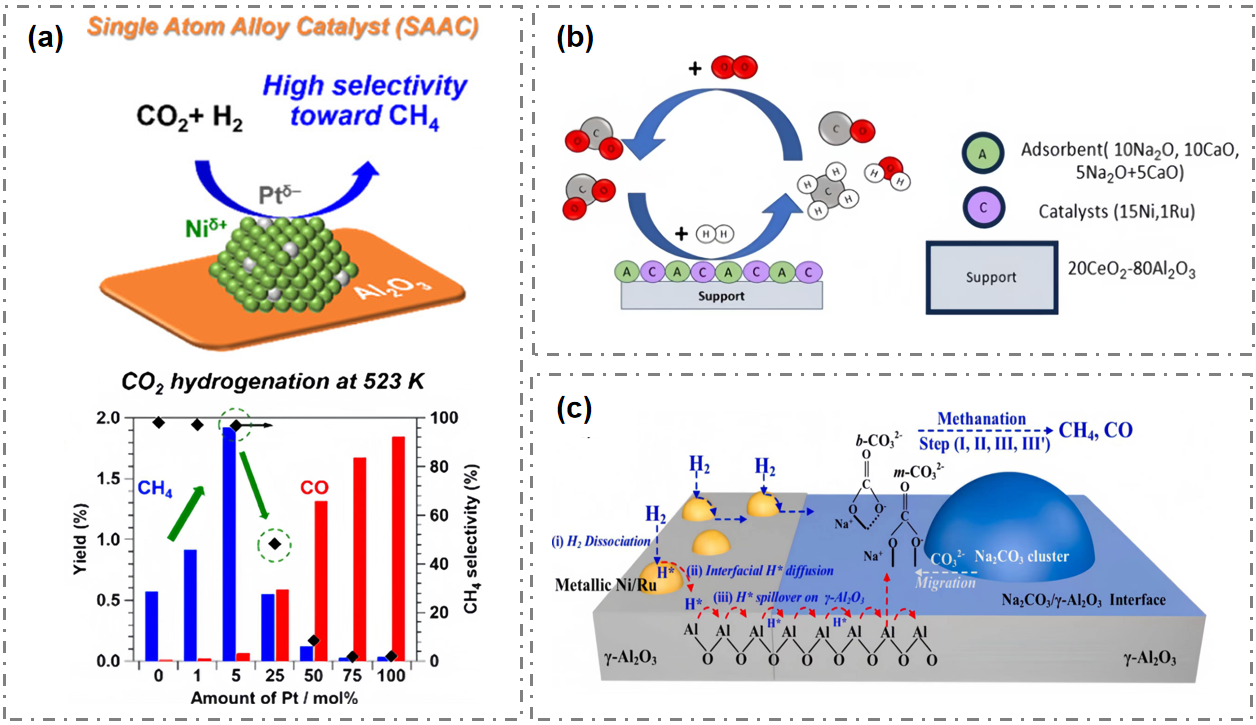
Fig. 10. Ni-based DFMs CO2 hydrogenation catalytic structures reactions and pathways: (a) Structure-property relationship of Ni95Pt5/Al2O3 single-atom alloy catalyst. Reproduced with permission from Ref. [224]. Copyright 2019, American Chemical Society. (b) Alternating Na2O-CaO adsorbent and Ni-Ru catalyst loading on DFMs and its reaction cycle. Reproduced with permission from Ref. [55]. Copyright 2024, American Chemical Society. (c) Proposed pathways and stepwise hydrogenation of b-CO3 and m-CO3 in co-extruded DFMs. Reproduced with permission from Ref. [195]. Copyright 2025, Elsevier.
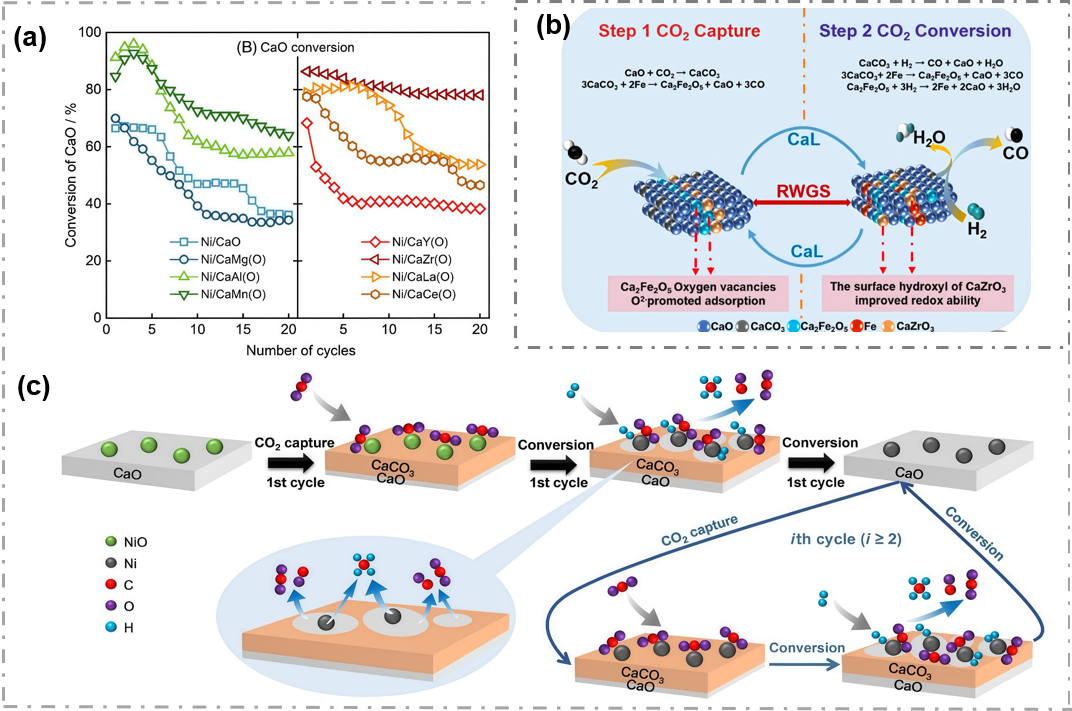
Fig. 11. Key performances and mechanisms of Ni-based DFMs in RWGS: (a) CaO conversion of different DFMs in 20 cycles (CO2 capture at 600 °C in 15% CO2/N2 for 25 min; conversion at 600 °C in 66.7% H2 /N2). Reproduced with permission from Ref. [62]. Copyright 2021, Wiley-Blackwell. (b) Schematic illustration of the CO2 capture and integrated conversion mechanism over Zr/Fe-modified Ni-based DFMs. Reproduced with permission from Ref. [59]. Copyright 2024, American Chemical Society. (c) Illustration of the CO2 capture and conversion process over Ni/CaO DFMs. Reproduced with permission from Ref. [62]. Copyright 2021, Wiley-Blackwell.
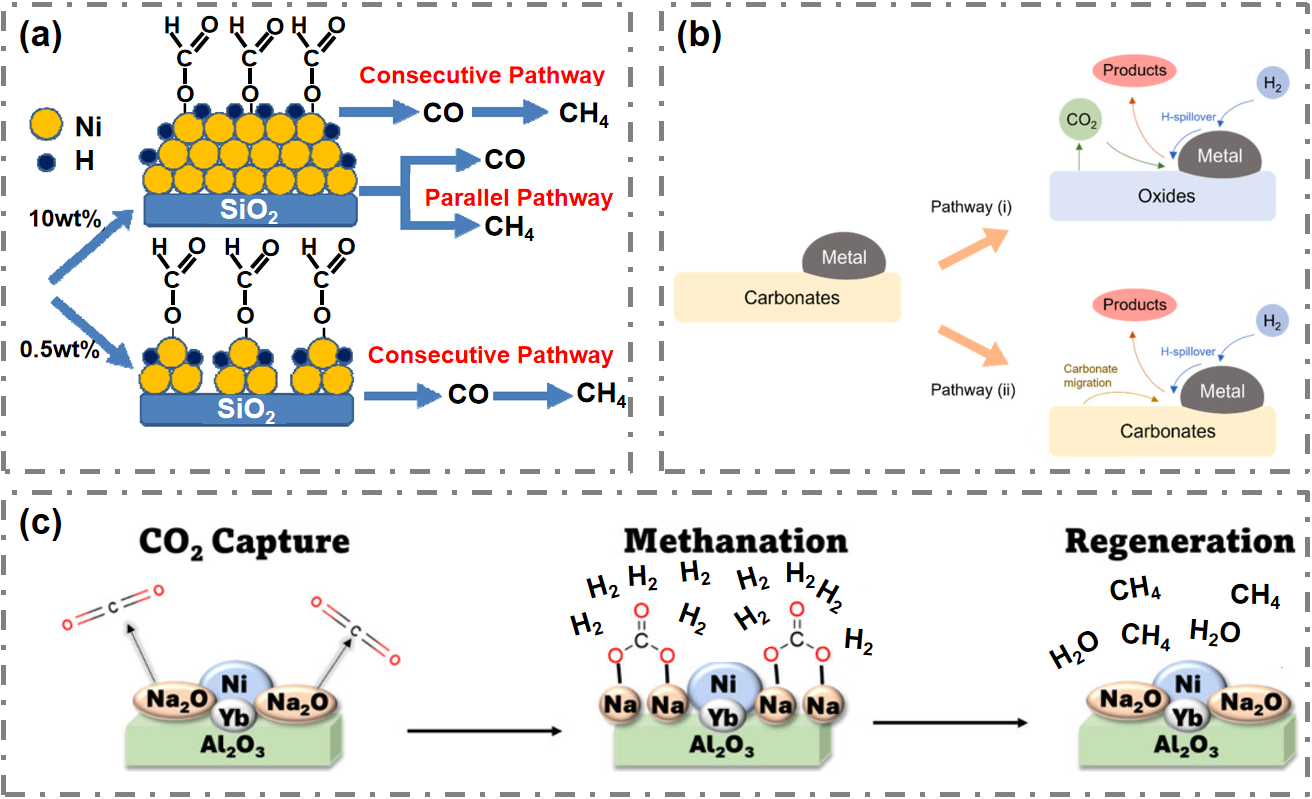
Fig. 12. Regulation of CO2 hydrogenation pathways over Ni-based DFMs. (a) Proposed mechanism on Ni/SiO2. Reproduced with permission from Ref. [231]. Copyright 2015, Royal Society of Chemistry. (b) Two possible pathways for immobilized CO2 during CCR cycles. Reproduced with permission from Ref. [232]. Copyright 2023, Elsevier. (c) CO2 capture and conversion to CH4 over a Yb-promoted Ni-based DFM. Reproduced with permission from Ref. [37]. Copyright 2025, Elsevier.
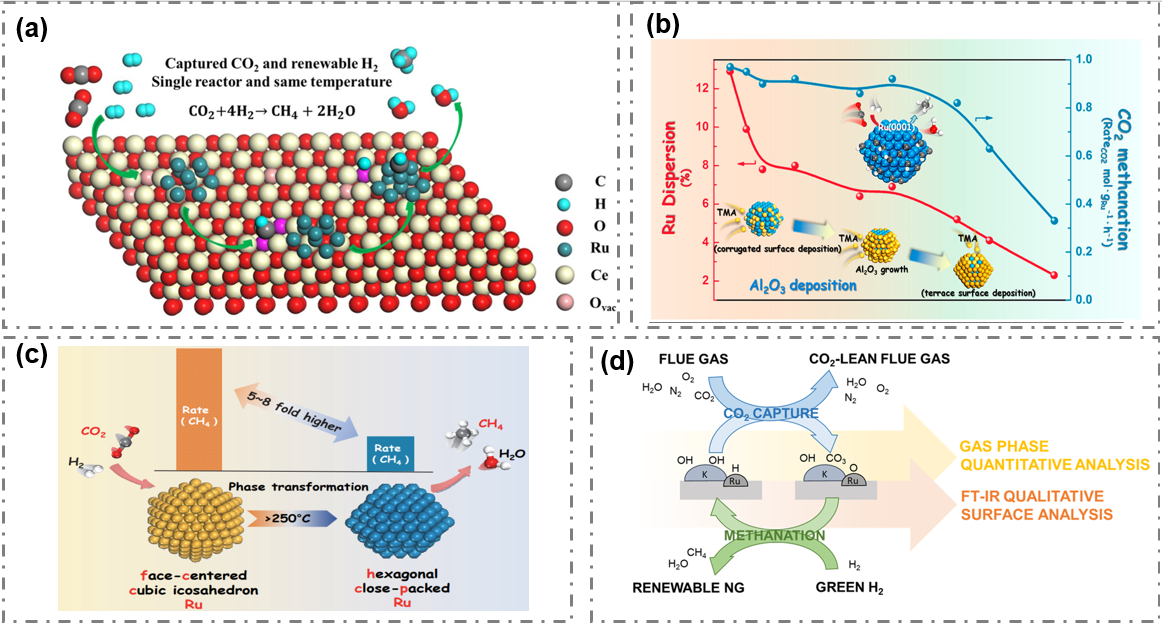
Fig. 13. Schematic representation of key mechanisms, structure-activity relationships, and integrated CO2 methanation in Ru-based DFMs. (a) Conversion of captured CO2 via the formate route over Ru/CeO2. Reproduced with permission from Ref. [26] Copyright 2020, Elsevier. (b) Influence of Al2O3 deposition on Ru dispersion and CO2 methanation activity. Reproduced with permission from Ref. [130]. Copyright 2023, American Chemical Society. (c) Effect of Ru crystal phase transformation on methanation performance. Reproduced with permission from Ref. [240]. Copyright 2024, Elsevier. (d) Integrated CO2 capture-methanation system and analysis of Ru-K/Ba DFMs. Reproduced with permission from Ref. [202]. Copyright 2023, American Chemical Society.
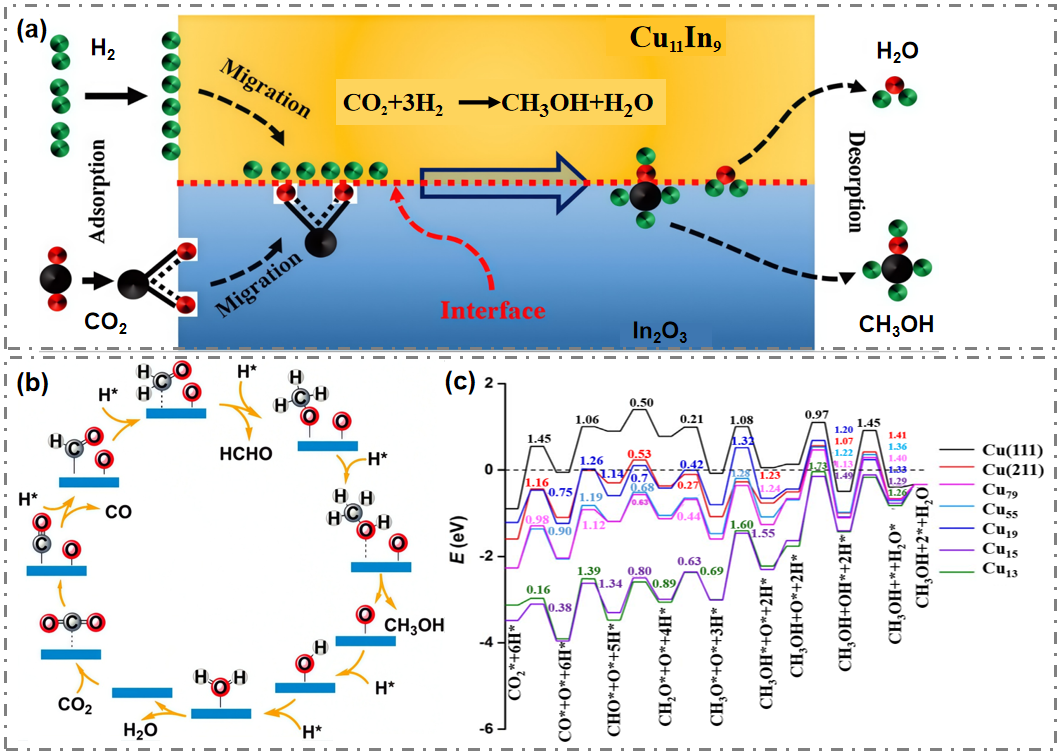
Fig. 14. Charts of reaction mechanisms and energy profiles for CO2 hydrogenation to CH3OH over Cu-based catalysts. (a) CH3OH synthesis mechanism on intermetallic Cu-In catalysts. Reproduced with permission from Ref. [244]. Copyright 2019, Elsevier. (b) Reaction pathways on Cu clusters and extended surfaces. Reproduced with permission from Ref. [245]. Copyright 2018, Elsevier. (c) Potential energy surface with elementary reaction barriers (eV) for CO2 reduction on Cu clusters and extended surfaces. Reproduced with permission from Ref. [245]. Copyright 2018, Elsevier.
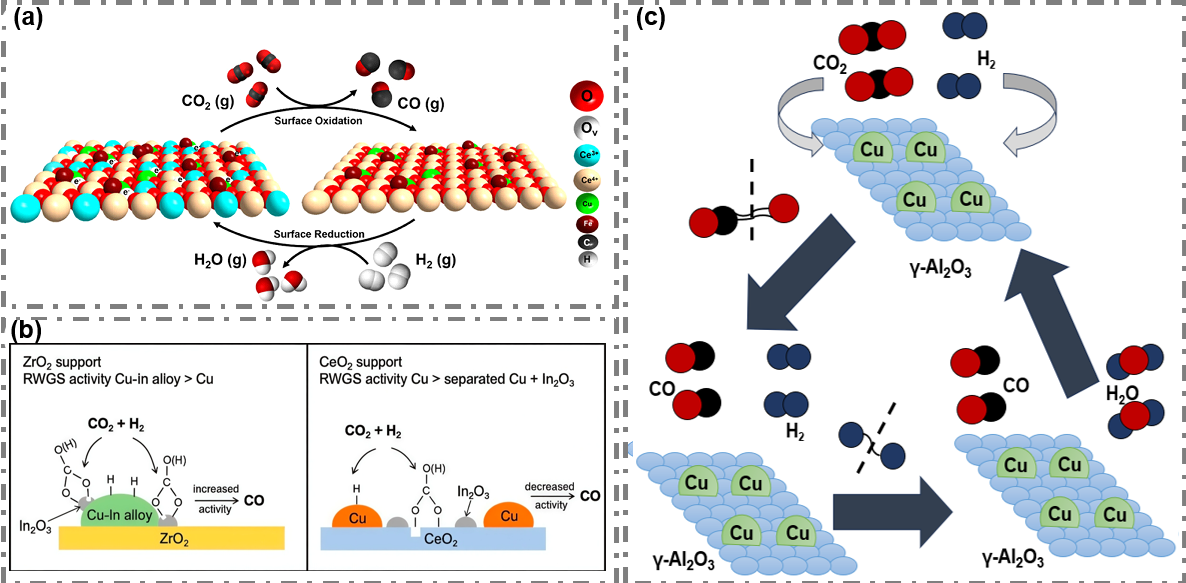
Fig. 15. Mechanisms and performance characteristics of Cu-based catalysts for the RWGS reaction are illustrated as follows: (a) Redox mechanism and surface structure evolution of Fe/CuCeO2 during RWGS. Reproduced with permission from Ref. [210]. Copyright 2024, American Chemical Society. (b) Dependence of active phases, surface properties, intermediates, and RWGS activity on different supports for Cu10/ZrO2, Cu5In5/ZrO2, Cu10/CeO2, and Cu5In5/CeO2. Reproduced with permission from Ref. [248]. Copyright 2022, American Chemical Society. (c) Redox process of CO2 hydrogenation on xCuAl catalyst.
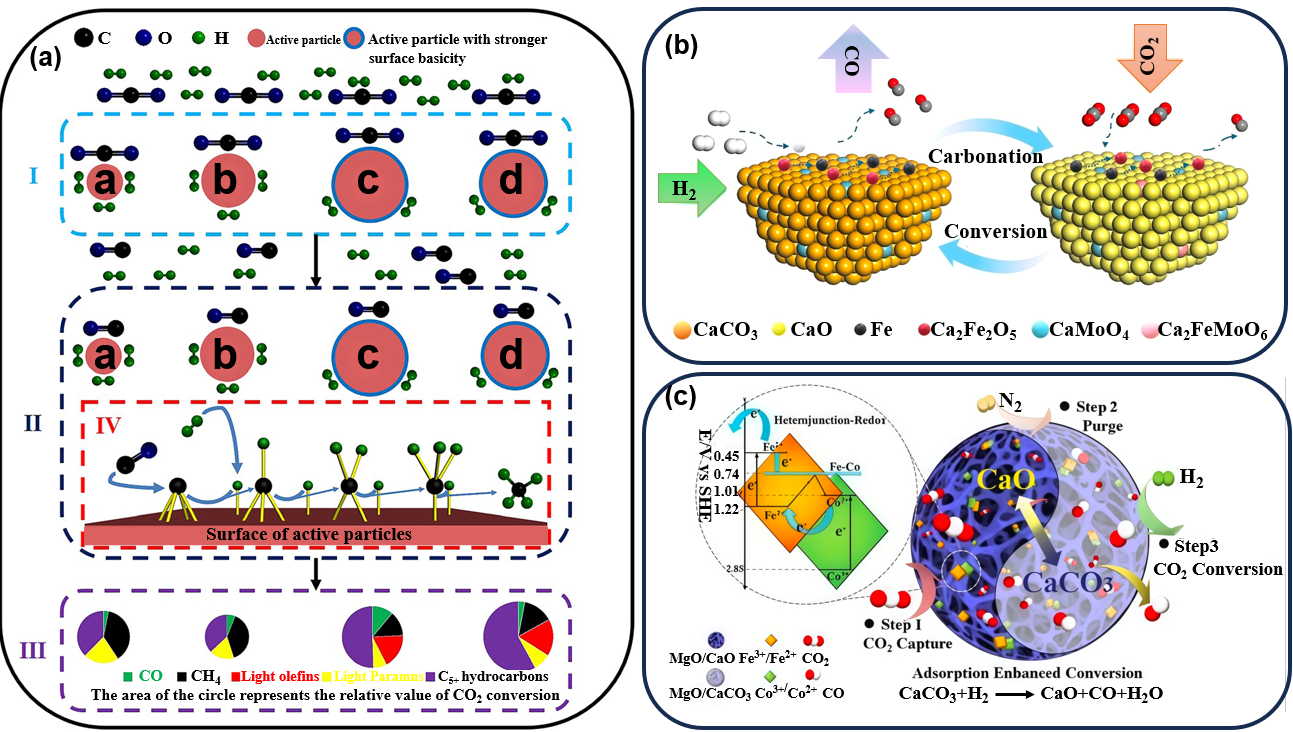
Fig. 16. Mechanism of CO2 capture and conversion over Fe-based DFMs in RWGS: (a) Scheme of the CO2 hydrogenation process. (I) RWGS reaction, (II) FTS reaction, (III) product distribution, and (IV) process to produce CH4 via FTS reaction. Catalysts: a: 5Zn-Fe/Al, b: Fe/Al, c: 10K-Fe/Al, and d: 2Zn-10K-Fe/Al. Reproduced with permission from Ref. [105]. Copyright 2024, Royal Society of Chemistry. (b) Core mechanism diagram of Mo/Fe-CaO DFM for CO2 capture and conversion in RWGS. Reproduced with permission from Ref. [249]. Copyright 2025, American Chemical Society. (c) Heterojunction-redox mechanism of bimetallic catalyst Fe5Co5Mg10CaO for the adsorption-enhanced in-situ conversion. Reproduced with permission from Ref. [257]. Copyright 2012, Royal Society of Chemistry.
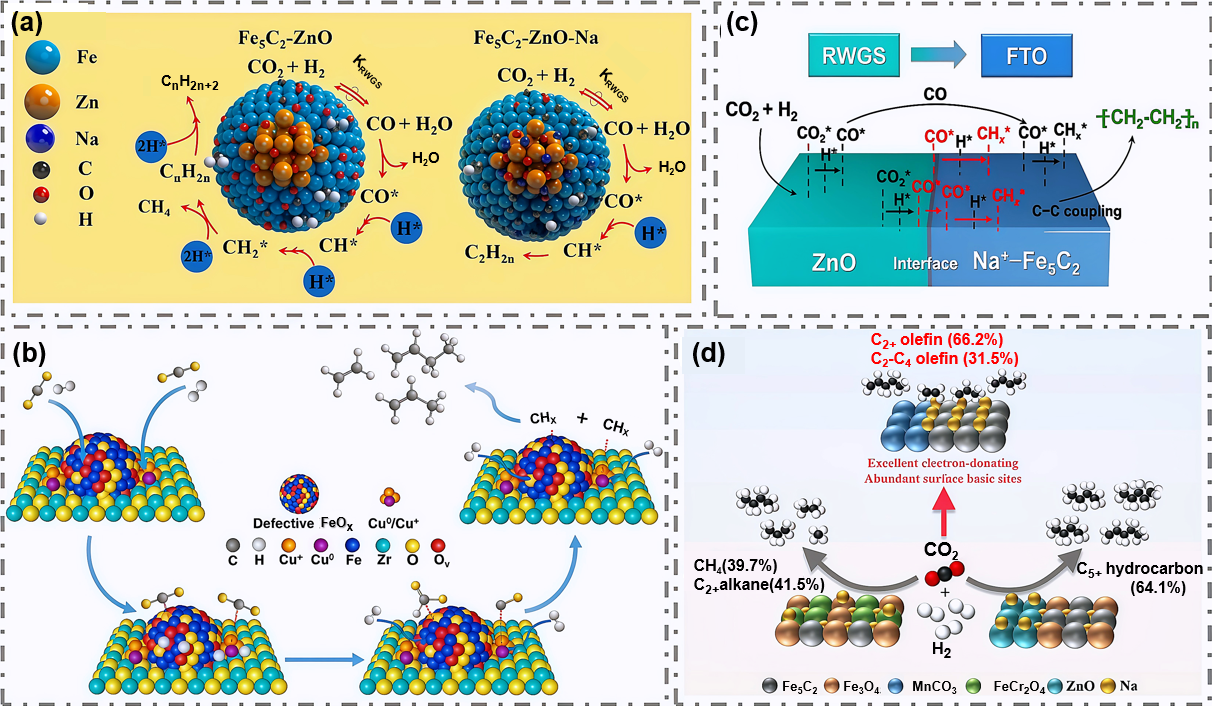
Fig. 17. Schematic diagram of the CO2 hydrogenation reaction over Fe-based DFMs and the regulatory mechanism of promoters: (a) Plausible mechanism of Na effects on Fe5C2 for CO2 hydrogenation. Reproduced with permission from Ref. [259]. Copyright 2021, Elsevier. (b) Schematic diagram of CO2 hydrogenation on supported Cu-decorated Fe catalysts. Reproduced with permission from Ref. [110]. Copyright 2024, American Chemical Society. (c) Reaction mechanism for CO2 hydrogenation to ole?ns over the Na-Zn-Fe catalyst. Reproduced with permission from Ref. [263]. Copyright 2024, Elsevier. (d) Schematic of CO2 hydrogenation reaction over Fe-based catalysts. Reproduced with permission from Ref. [264]. Copyright 2025, Elsevier.
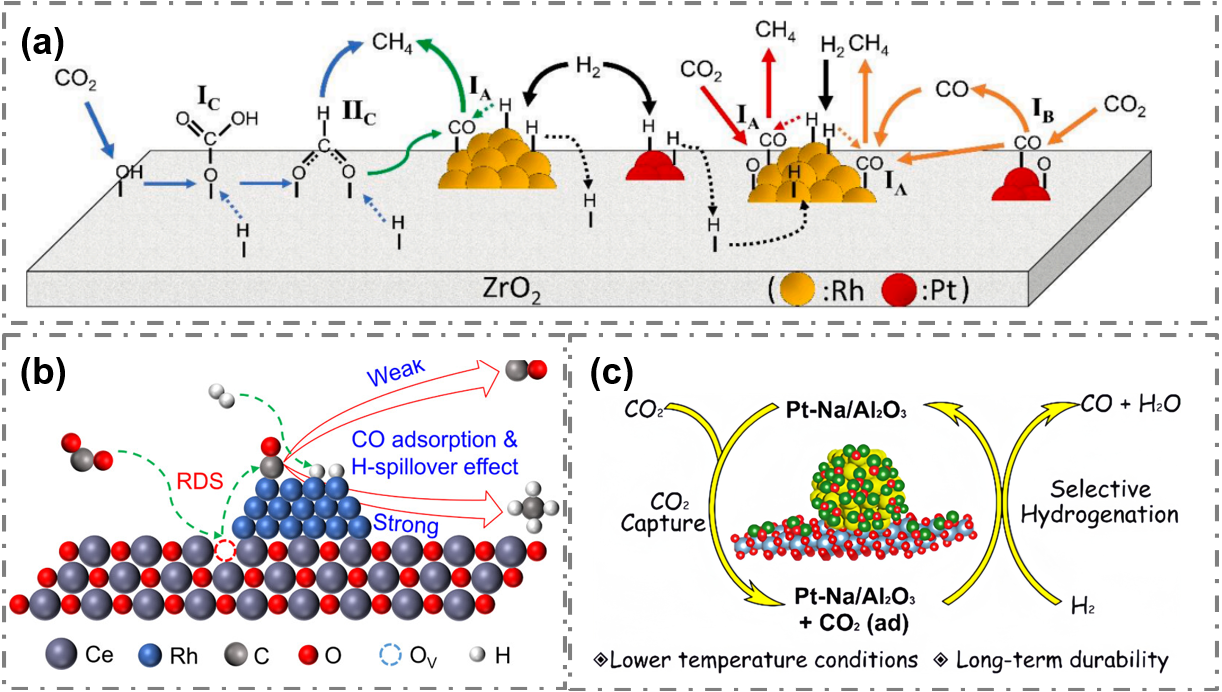
Fig. 18. CCR reaction mechanisms of noble metal-based DFMs: (a) Proposed reaction route for CO2 methanation on the ZrO2-supported bimetallic sample (75Rh25Pt). Where IA: Rh0-CO species, IB: Pt0-CO species, IC: *HCO3 species on ZrO2, IIC: *HCOO species on ZrO2. Reproduced with permission from Ref. [214]. Copyright 2022, Elsevier. (b) Mechanism of Rh-CeO2 DFM. Reproduced with permission from Ref. [280]. Copyright 2023, American Chemical Society. (c) CCR reaction mechanisms and low-temperature long-term durability of Pt-Na/Al2O3 DFM. Reproduced with permission from Ref. [213]. Copyright 2022, American Chemical Society.
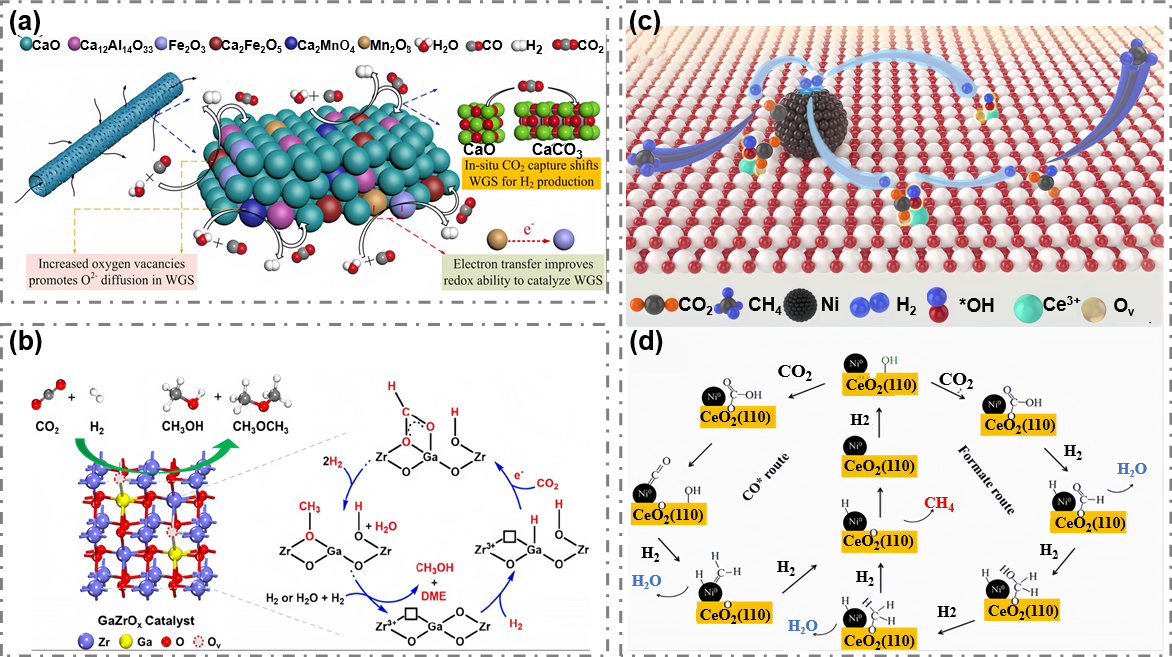
Fig. 19. Key mechanisms and performances of non-noble metal-based DFMs (excluding Ni, Cu, Fe) in CO2 conversion. (a) Mechanism diagram of microtubular Fe/Mn-promoted CaO-Ca12Al14O33 in RWGS process. Reproduced with permission from Ref. [31] Copyright 2022, Elsevier. (b) Crystal structure of metal oxide catalysts and the reaction cycle mechanism of CO2 conversion to CH3OH/dimethyl ether. Reproduced with permission from Ref. [292]. Copyright 2021, American Chemical Society. (c) Schematic diagram of the formation of FLPs (with yellow light); formate route and carbonyl route for low-temperature CO2 methanation over Ni/CeO2-R. Reproduced with permission from Ref. [285]. Copyright 2022, American Chemical Society. (d) Possible reaction pathway. Reproduced with permission from Ref. [285]. Copyright 2022, American Chemical Society.
|
| [1] | 高梓皓, 黄凯, 徐庆玲, 王鑫, 刘志成, 邵斌, 胡军. 催化微环境调控促进高效CO2捕集与原位乙烷氧化脱氢制乙烯[J]. 催化学报, 2026, 88(9): 322-334. |
| [2] | Fleur A. E. Bruekers, Tess I. van Benthem, Rajamohanan Sobhana Anju, N. Raveendran Shiju. 物相到性能: 碳化钼在逆水煤气变换反应中的先进作用[J]. 催化学报, 2026, 85(6): 1-12. |
| [3] | 刘芷瑶, 刘唐康, 秦川, 刘国亮, 郑安民. 氧化锆介导界面催化在CO2加氢反应中的研究进展[J]. 催化学报, 2026, 84(5): 1-24. |
| [4] | 郑芒, 李琪, 刘倩茜, 谷慧泉, 刘明阳, 刘琦, 蒋保江. 不对称双位点Bi-In氧桥用于高效光热催化二氧化碳甲烷化[J]. 催化学报, 2026, 83(4): 351-362. |
| [5] | 任宪轩, Rozemarijn D. E. Krösschell, 门卓武, 王鹏, Ivo A. W. Filot, Emiel J. M. Hensen. K对Hägg碳化物逆水煤气变换反应作用的理论研究[J]. 催化学报, 2025, 72(5): 289-300. |
| [6] | 班涛, 王建伟, 余希阳, 田海阔, 高新, 黄正清, 常春然. 机器学习辅助筛选SA-FLP双活性位催化剂用于甲烷与水共转化制甲醇反应[J]. 催化学报, 2025, 70(3): 311-321. |
| [7] | 杨冲亚, 王玮珏, 卓红英, 沈铮, 张天雨, 杨小峰, 黄延强. 晶相设计钌基纳米催化剂提高CO2甲烷化活性[J]. 催化学报, 2024, 61(6): 226-236. |
| [8] | 沙峰, 唐珊, 汤驰洲, 冯振东, 王集杰, 李灿. ZnZrOx固溶体催化剂表面羟基在CO2加氢制甲醇中的作用[J]. 催化学报, 2023, 45(2): 162-173. |
| [9] | 李龙泰, 杨彬, 高彪, 王逸夫, 张玲霞, 石原达已, 齐伟, 郭利民. In-Co二元金属氧化物上CO2催化加氢反应的选择性转变: 催化反应的机理和构效关系[J]. 催化学报, 2022, 43(3): 862-876. |
| [10] | 张涛. ZnO-ZrO2固溶体催化剂上CO2高选择性加氢制甲醇[J]. 催化学报, 2017, 38(11): 1781-1783. |
| [11] | J. H. Flores, M. E. H. Maia da Costa, M. I. Pais da Silva. H型镁碱沸石负载对Cu-ZnO-Al2O3催化剂上CO加氢生成烃类的影响[J]. 催化学报, 2016, 37(3): 378-388. |
| [12] | 王丹君, 陶芙蓉, 赵华华, 宋焕玲, 丑凌军. CO2 辅助老化制备的 Cu/ZnO/Al2O3 催化剂上 CO2 加氢制甲醇[J]. 催化学报, 2011, 32(9): 1452-1456. |
| [13] | 李忠;范辉;郑华艳;刘岩. 微波辐射对浆态床合成甲醇Cu/ZnO/Al2O3催化剂前驱体微观结构及催化性能的影响[J]. 催化学报, 2010, 31(4): 471-478. |
| [14] | 林胜达, 唐浩东, 吕兆坡, 刘采来, 岑亚青, 刘化章. 沉淀方法对铜基甲醇合成催化剂前驱体及其性能的影响[J]. 催化学报, 2010, 31(10): 1257-1262. |
| [15] | 左宜赞;张强;韩明汉;王金福;王铁锋;王德峥;金涌. 铜基甲醇催化剂的高温烧结[J]. 催化学报, 2009, 30(7): 624-630. |
| 阅读次数 | ||||||
|
全文 |
|
|||||
|
摘要 |
|
|||||


