
催化学报 ›› 2026, Vol. 90: 52-81.DOI: 10.1016/S1872-2067(26)65171-6
赵明意a,1, 刘正阳a,1, 杨聪a,1, 何招弟a, 郭昱君a, 蔡瑞a, 尹向前c, 王建伟c, 穆雪琴a, 刘苏莉a,*( ), 王定胜b,*(), 戴志晖a
收稿日期:2026-02-08
接受日期:2026-03-22
出版日期:2026-11-18
发布日期:2026-09-09
通讯作者:
*电子信箱: liusl@njtech.edu.cn (刘苏莉),作者简介:1共同第一作者.
基金资助:
Mingyi Zhaoa,1, Zhengyang Liua,1, Cong Yanga,1, Zhaodi Hea, Yujun Guoa, Rui Caia, Xiangqian Yinc, Jianwei Wangc, Xueqin Mua, Suli Liua,*(), Dingsheng Wangb,*(), Zhihui Daia
Received:2026-02-08
Accepted:2026-03-22
Online:2026-11-18
Published:2026-09-09
Contact:
*E-mail:liusl@njtech.edu.cn(S. Liu),wangdingsheng@mail.tsinghua.edu.cn(D. Wang).
About author:Sui Liu (School of Chemistry and Molecular Engineering, Nanjing Tech University) received her PhD from the Nanjing Normal University in 2014. She joined Nanjing Xiaozhuang University where she became a full professor. Currently, she works at the School of Chemistry and Molecular Engineering, Nanjing Tech University. Her research focuses on new energy materials, water-splitting electrocatalysts, and other related fields of electrochemical catalysis.1Contributed equally to this work.
Supported by:摘要:
氧化还原反应是连接化学能与电能的核心反应类型, 在能量转换领域具有关键作用. 其中, 电催化剂的活性、选择性与稳定性直接决定了能量转换技术的效能. 贵金属催化剂虽性能优异, 但受限于稀缺性与长期稳定性不足, 因而开发高性能、低成本的非贵金属催化剂意义重大. 卟啉分子因其独特的共轭结构、高度的可调性及良好的溶解性而备受关注. 然而, 理想化实验室条件与实际工业操作环境存在显著差距, 电解质变化、杂质积累、传质限制及高电流长期运行等因素易引发卟啉催化剂活性位点失活与结构崩溃. 因此, 需开发兼具高活性与高稳定性的卟啉催化剂以满足工业级氧化还原反应需求.
本综述系统分析了基于卟啉的电催化剂. 首先, 讨论了卟啉催化剂的主要类型, 然后在工业背景下探讨了面临的主要挑战. 卟啉催化剂在还原反应(如析氢反应、二氧化碳还原反应、氮氧化物还原反应等)中表现优异, 这主要归因于卟啉大环在阴极电位下的内在电化学稳定性, 其π共轭框架可保持结构与电子完整性, 从而保护活性位点. 然而, 在析氧反应等阳极氧化过程及实际工况下, 苛刻的操作条件会引发金属浸出、大环断裂及金属氧化态不可逆升高等问题, 使分子结构的稳定性面临严峻挑战. 为了解决卟啉催化剂工况条件下的稳定性问题, 本文从两方面分析并探讨了材料设计路径, 并对实际电解环境中的性能进行了验证. 原子尺度上, 通过强耦合载体构建与空间限域效应, 可提升电子传输效率并抑制活性物种迁移; 分子尺度上, 调节大环共轭结构、强化金属-配体键及优化传质通道, 可增加活性位点并调控中间体吸附强度. 但传统单一策略难以协同平衡高反应性、高选择性与高稳定性, 例如强锚定可能破坏大环对称性, 而增强共轭则可能削弱与载体的结合强度. 因此, 急需发展多尺度协同调控方法. 随后, 本文讨论了工业规模的电催化应用过程, 探讨了卟啉催化剂如何集成到宏观电极和器件中, 实现从活性位点到系统效率的过渡. 最后,系统性地总结了卟啉电催化剂在工业化过程中面临的挑战与机遇, 并细致分析了其主要类型及工业应用背景下的关键问题, 进而探讨了适合大规模生产的材料设计、器件集成与电极架构, 并探讨了潜在的技术发展潜力.
综上, 本综述系统总结了卟啉电催化剂的多尺度调控策略, 为高性能卟啉催化剂的设计、性能提升及工业化应用提供了一定的理论依据与技术参考. 未来, 还需进一步探索适用于大规模生产的卟啉催化剂调控路径, 令其真正应用于工业化实际生产.
赵明意, 刘正阳, 杨聪, 何招弟, 郭昱君, 蔡瑞, 尹向前, 王建伟, 穆雪琴, 刘苏莉, 王定胜, 戴志晖. 工况条件下进行氧化还原反应的卟啉电催化剂多尺度优化设计[J]. 催化学报, 2026, 90: 52-81.
Mingyi Zhao, Zhengyang Liu, Cong Yang, Zhaodi He, Yujun Guo, Rui Cai, Xiangqian Yin, Jianwei Wang, Xueqin Mu, Suli Liu, Dingsheng Wang, Zhihui Dai. Multiscale optimization design of porphyrin electrocatalysts for redox reactions under operational conditions[J]. Chinese Journal of Catalysis, 2026, 90: 52-81.
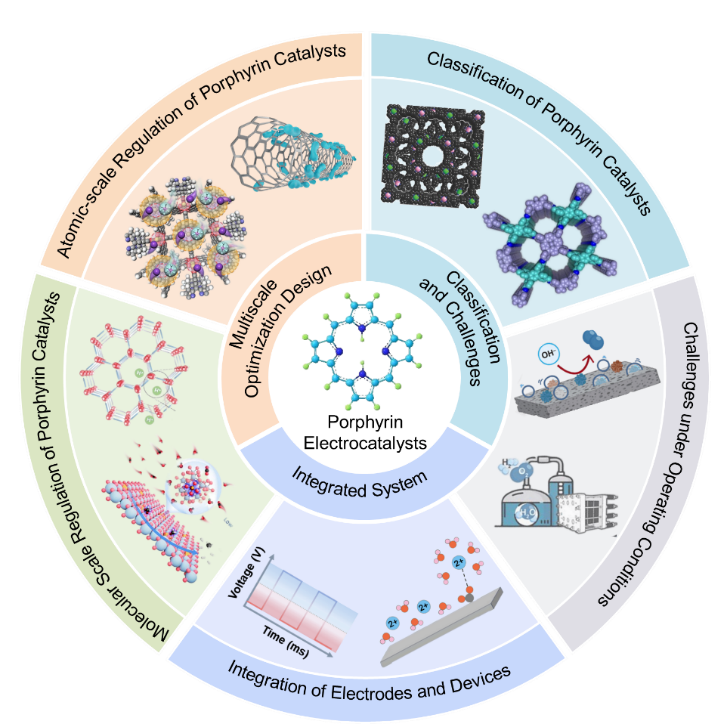
Fig. 1. Schematic diagram of multi-scale optimization design of porphyrin electrocatalysts for redox reactions.
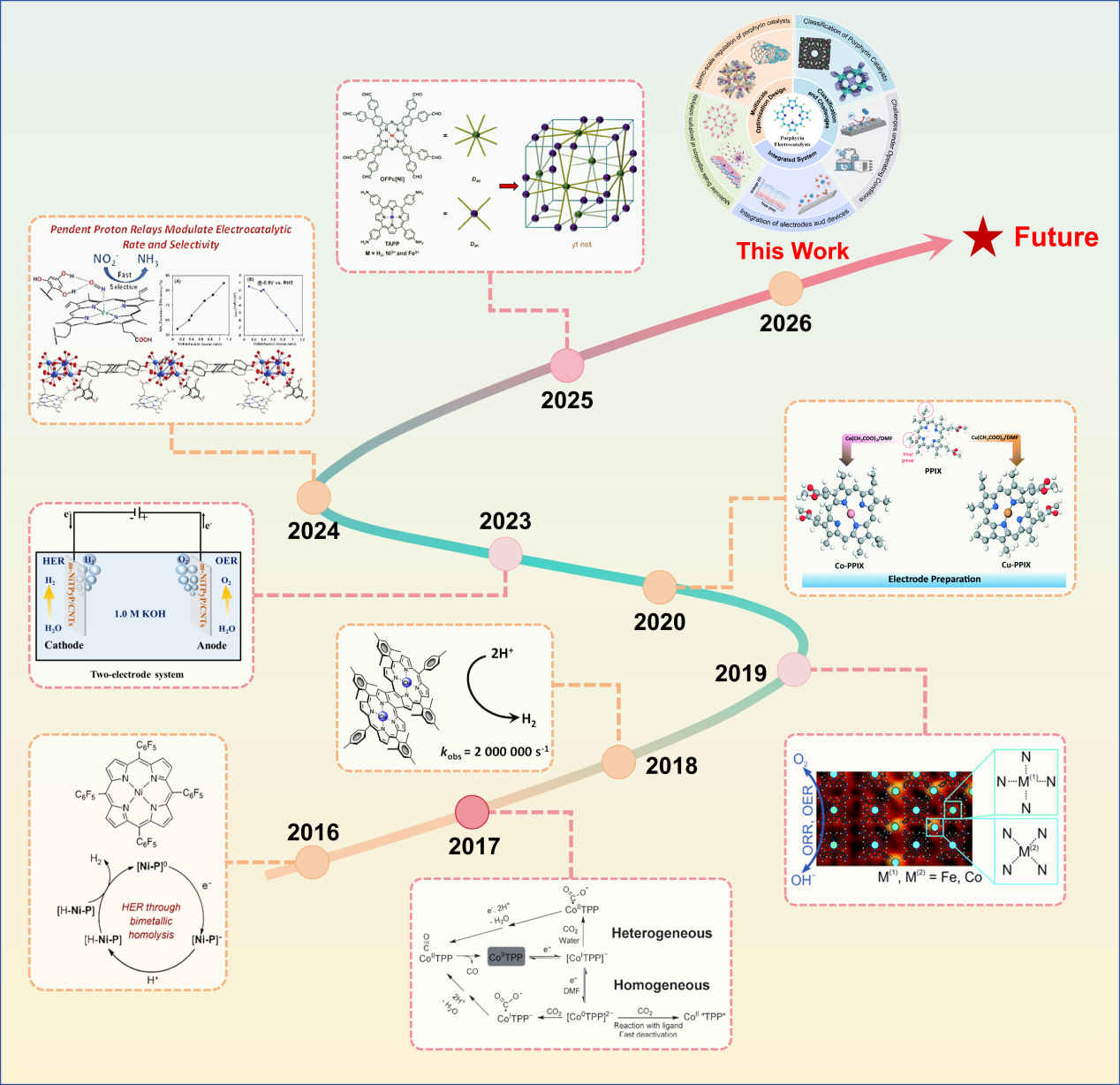
Fig. 2. Progress chart on the application of porphyrin catalysts. Reproduced with permission: Copyright, 2016, Wiley-VCH Verlag GmbH [102]; Copyright, 2017, Wiley‐VCH Verlag GmbH [103]; Copyright, 2018, American Chemical Society [104]; Copyright, 2019, Phys. Chem. Phys [105]; Copyright, 2020 Royal Society of Chemistry [106]; Copyright, 2023 Wiley‐VCH GmbH [107]; Copyright, 2024, Wiley-VCH GmbH [108]; Copyright, 2025 Wiley‐VCH GmbH [109].
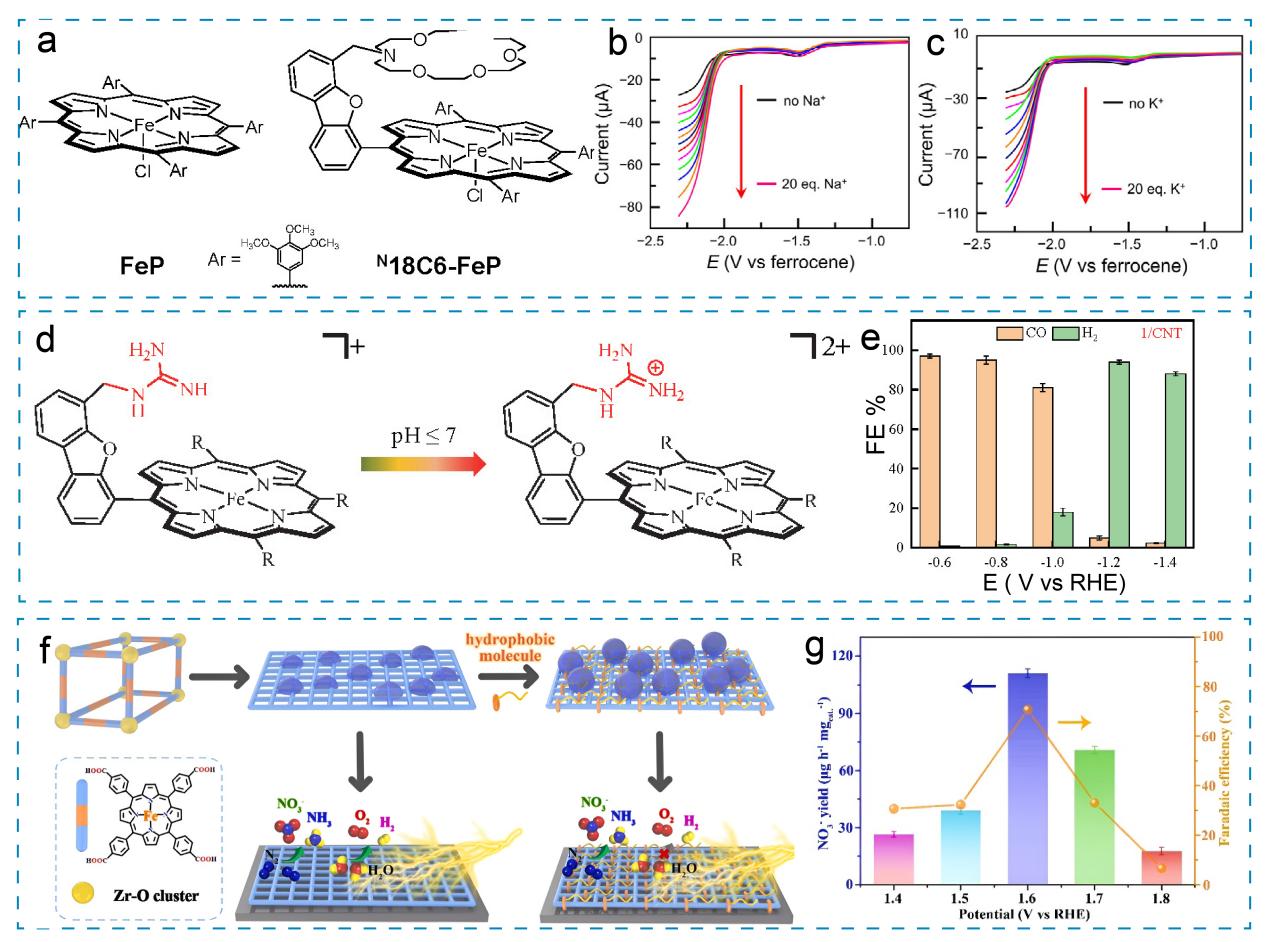
Fig. 3. (a) The molecular structures of FeP and N18C6-FeP. (b) LSVs of 0.5 mmol L-1 N18C6-FeP in DMF under CO2 with the addition of Na. (c) LSVs of 0.5 mmol L-1 N18C6-FeP in DMF under CO2 with the addition of K. Ref. [122], Copyright, 2021, Chinese Journal of Catalysis. (d) Protonation of the appended guanidyl group of 1 in pH ≤ 7 aqueous solutions. (e) FE for the production of CO and H2. Ref. [123], Copyright, 2023. Chinese Journal of Catalysis. (f) Illustration of the fabrication process. (g) Yields and FEs. Ref. [125], Copyright, 2022 Elsevier.
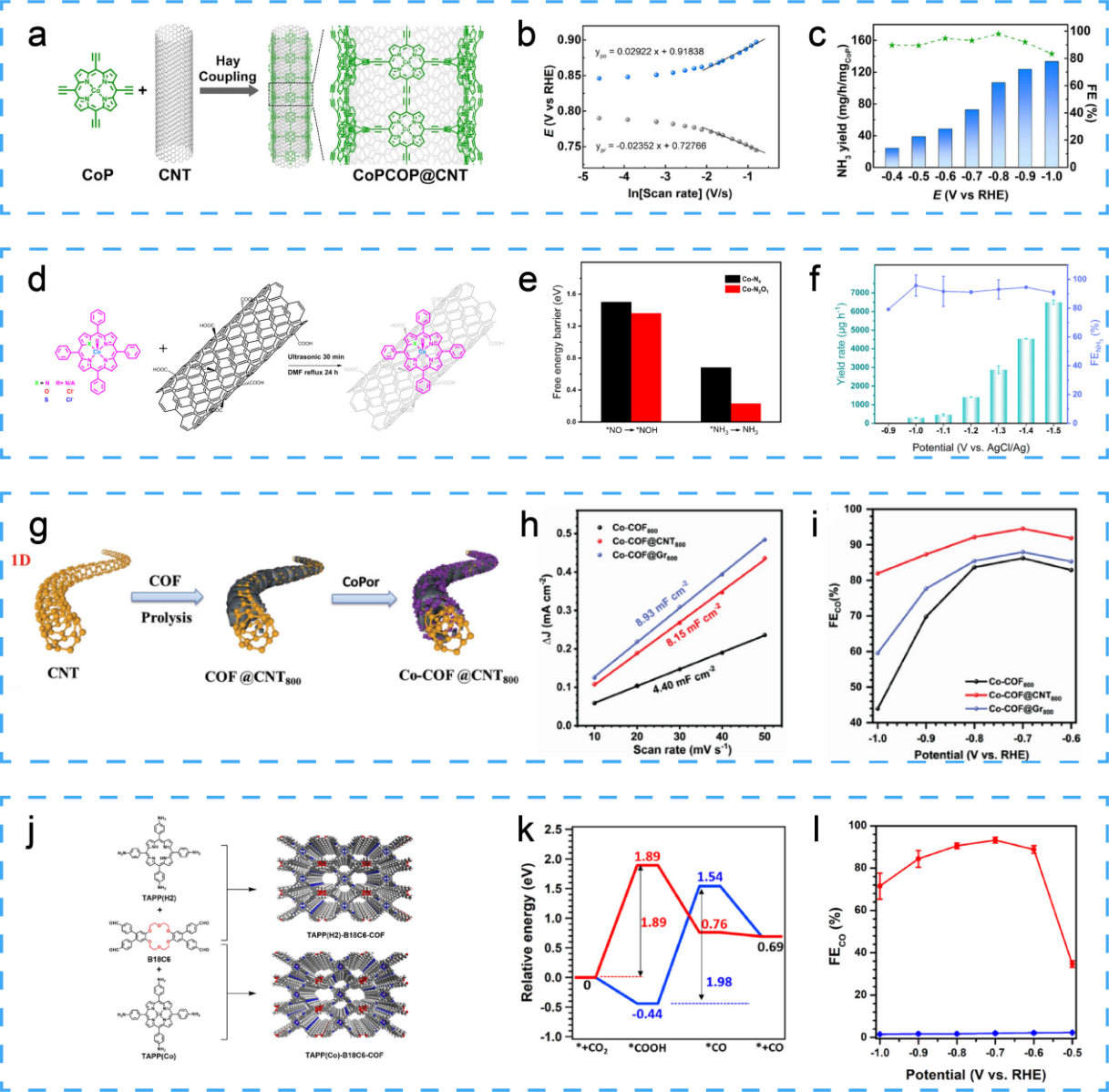
Fig. 4. (a) Schematic diagram. (b) The plot of the oxidation peak and reduction peak potentials versus the logarithm of scan rates on CoPCOP@CNT. (c) Yields and Fes. Reprinted with permission from Ref. [59]. Copyright, 2021, Elsevier. (d) The structure of CoTPP (X = N), CoOTPP (X = O), and CoSTPP (X = S), and the process of compounding them with composite CNTs. (e) Free energy barrier in key steps. Ref. [128]. Copyright, 2022, Elsevier. (f) Potential-dependent NH3 yield rate and FE. (g) Synthesis of the template-pyrolysis method. (h) FECO. (i) ECSA curves. Ref. [129]. Copyright, 2022, Elsevier. (j) Synthesis diagrams of different catalysts. (k) The relative energy diagrams. (l) FE of carbon monoxide calculated. Ref. [130]. Copyright, 2021, American Chemical Society.
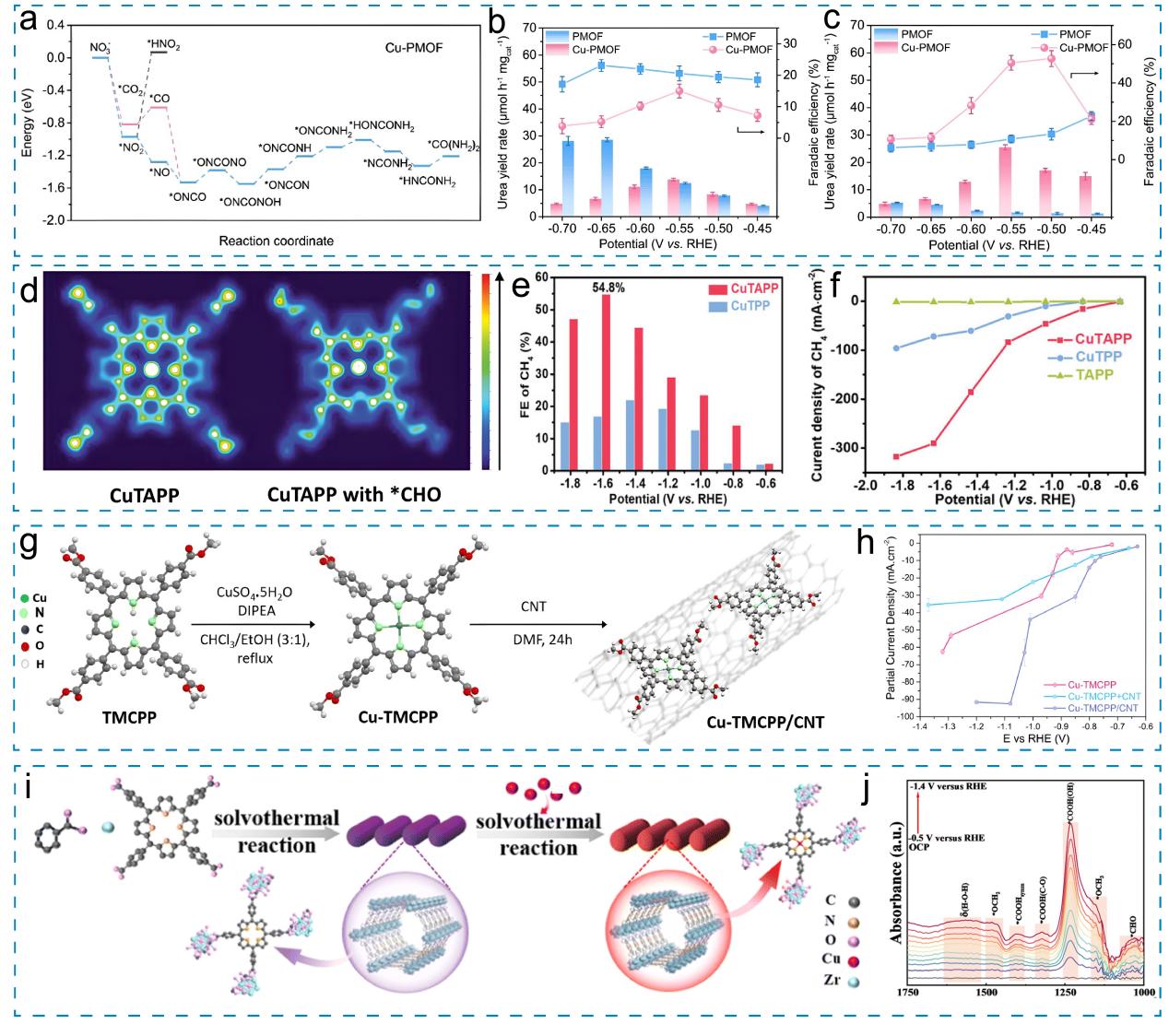
Fig. 5. (a) Free-energy diagram. (b) Yield rates and FEs. (c) Yield rates and FEs. Ref. [136]. Copyright, 2025, John Wiley and Sons. (d) Plots of electron density. (e) FEs. (f) Partial current densities. Ref. [137]. Copyright, 2024, John Wiley and Sons. (g) Schematic representation of the synthesis method. (h) Partial current density. Ref. [138]. Copyright, 2025, Royal Society of Chemistry. (i) Synthesis process. (j) In situ ATR-SEIRAS spectra. Ref. [140]. Copyright, 2021, American Chemical Society.
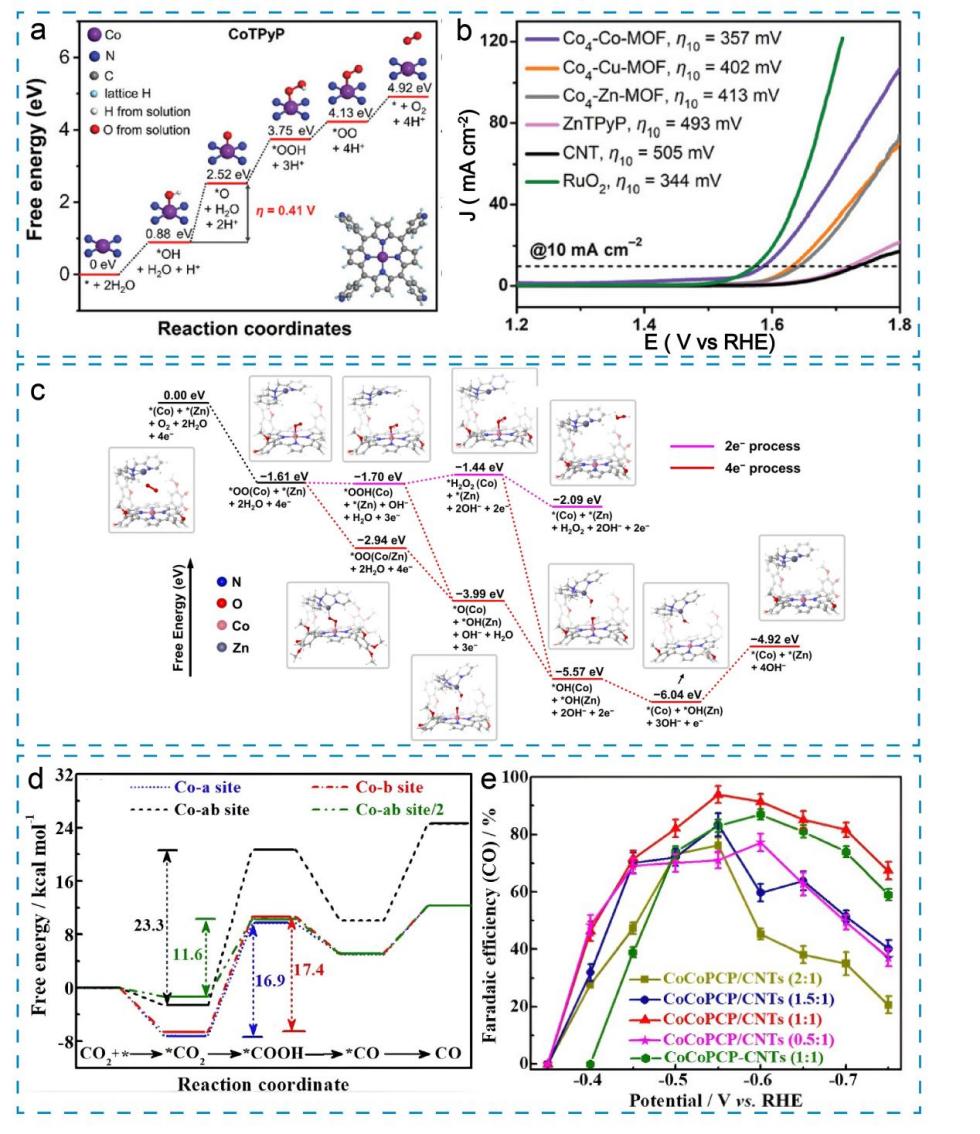
Fig. 6. (a) Free energy diagrams. (b) OER LSV data. Ref. [145]. Copyright, 2024, John Wiley and Sons. (c) Calculated relative Gibbs free energy profile. Ref. [146]. Copyright, 2024, John Wiley and Sons. (d) The free energy diagram. (e) CO faradaic efficiencies. Ref. [148]. Copyright, 2021, Elsevier.
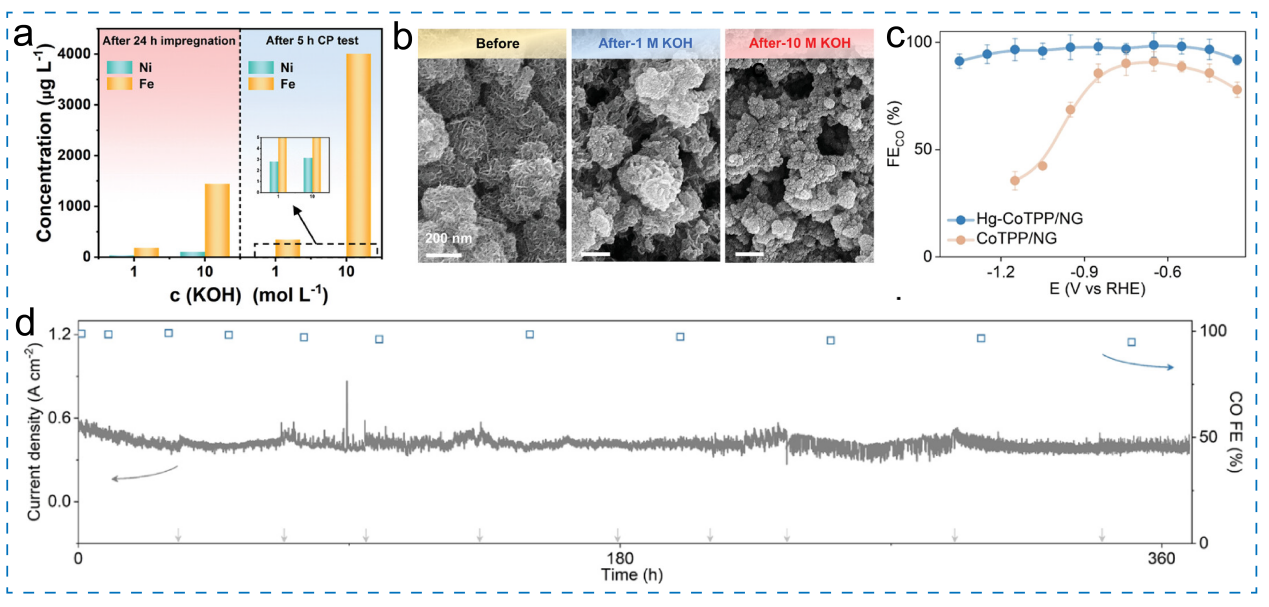
Fig. 7. (a) Ion concentrations pre- (left) and post-CP test (right), following 24-h impregnation. (b) Initial morphology (left) vs. final morphologies post-CP test in 1 mol L-1 KOH (middle) and 10 m KOH (right). Ref. [39], Copyright, 2024 Wiley‐VCH GmbH. (c) FECO: Hg-CoTPP/NG vs. CoTPP/NG at varied potentials. (d) Stability test at 420 mA cm-2. Ref. [152], Copyright, 2022, American Chemical Society.
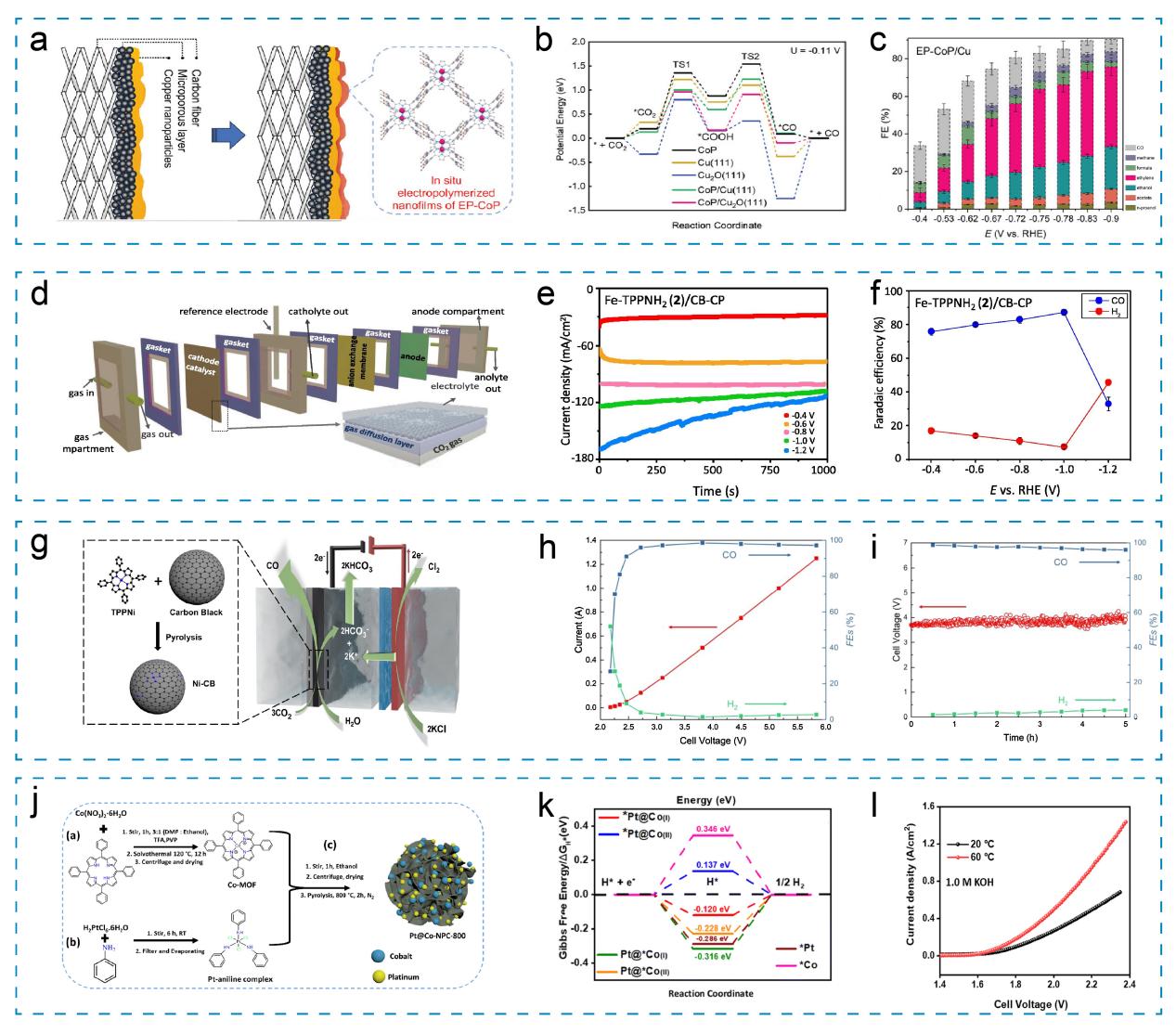
Fig. 8. (a) Schematic illustration. (b) Potential energy curves. (c) Electrocatalytic CO2RR performances. Ref. [161], Copyright, 2024, John Wiley and Sons. (d) Schematic of the flow cell fitted with an ion-exchange membrane. (e) Chronoamperometry of Fe-TPPNH2. (f) CO2RR product selectivity of Fe-TPPNH2. Ref. [162], Copyright, 2021, Elsevier. (g) Schematic illustration. (h) Polarization curve. (i) Voltage, FECO, and FEH2 as functions of time when the system operated with 0.5 A current. Ref. [163], Copyright, 2020, Elsevier. (j)Schematic illustration. (k) Gibbs free energy of Pt and Co active sites. (l) LSV graph. Ref. [164], Copyright, 2024, Royal Society of Chemistry.
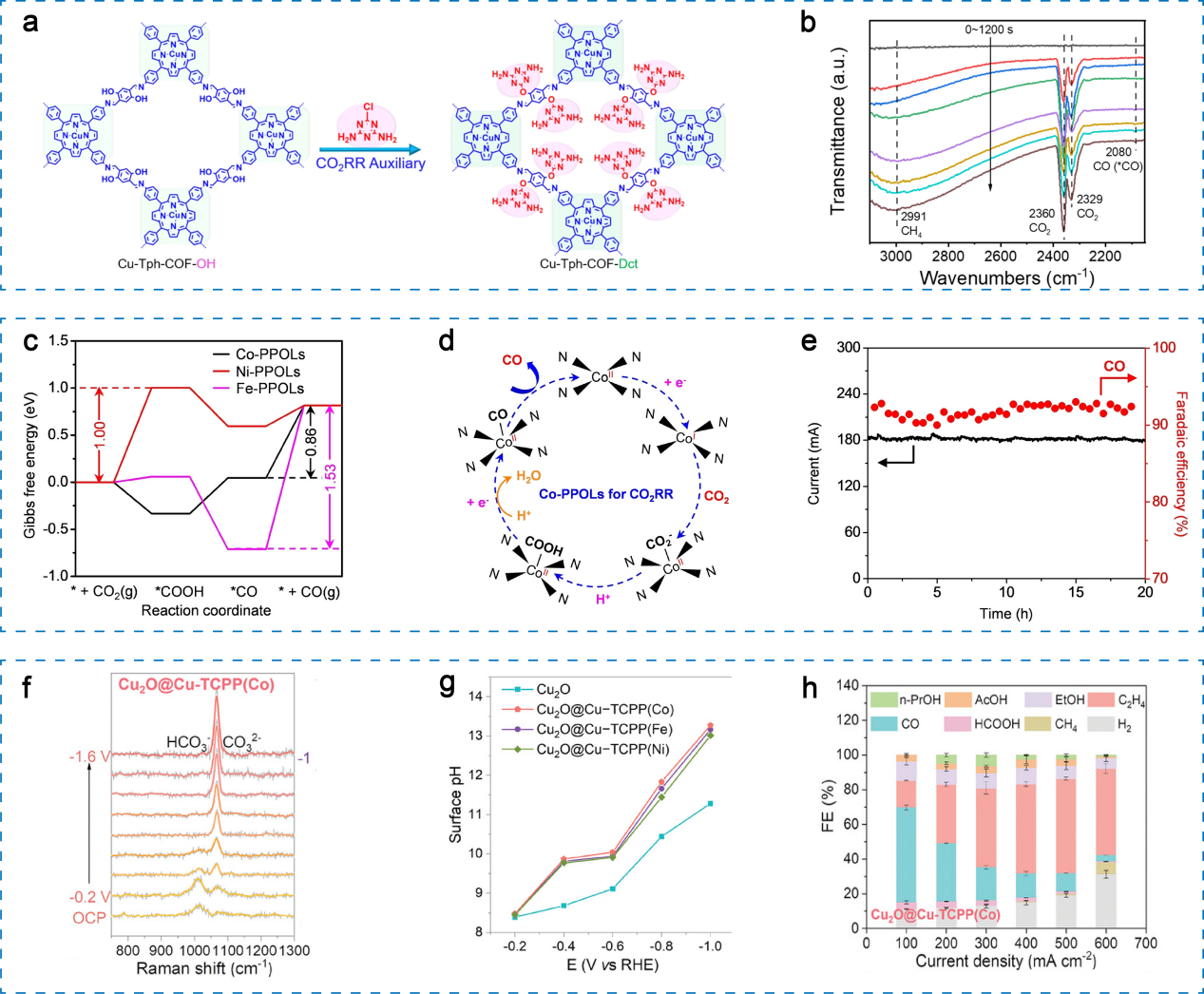
Fig. 9. (a) The Scheme. (b) In-situ ATR-FTIR spectra of Cu-Tph-COF-Dct during the electrochemical CO2RR. Ref. [165], Copyright, 2021, John Wiley and Sons. (c) Gibbs free energy diagrams. (d) Proposed mechanistic scheme. (e) Long-term stability. Ref. [60], Copyright, 2023, John Wiley and Sons. (f) Operando Raman spectra. (g) Plots of the calibrated surface pH against the applied potential based on the Raman results. (h) FE of Cu2O@Cu-TCPP(Co). Ref. [40], Copyright, 2024, John Wiley and Sons.
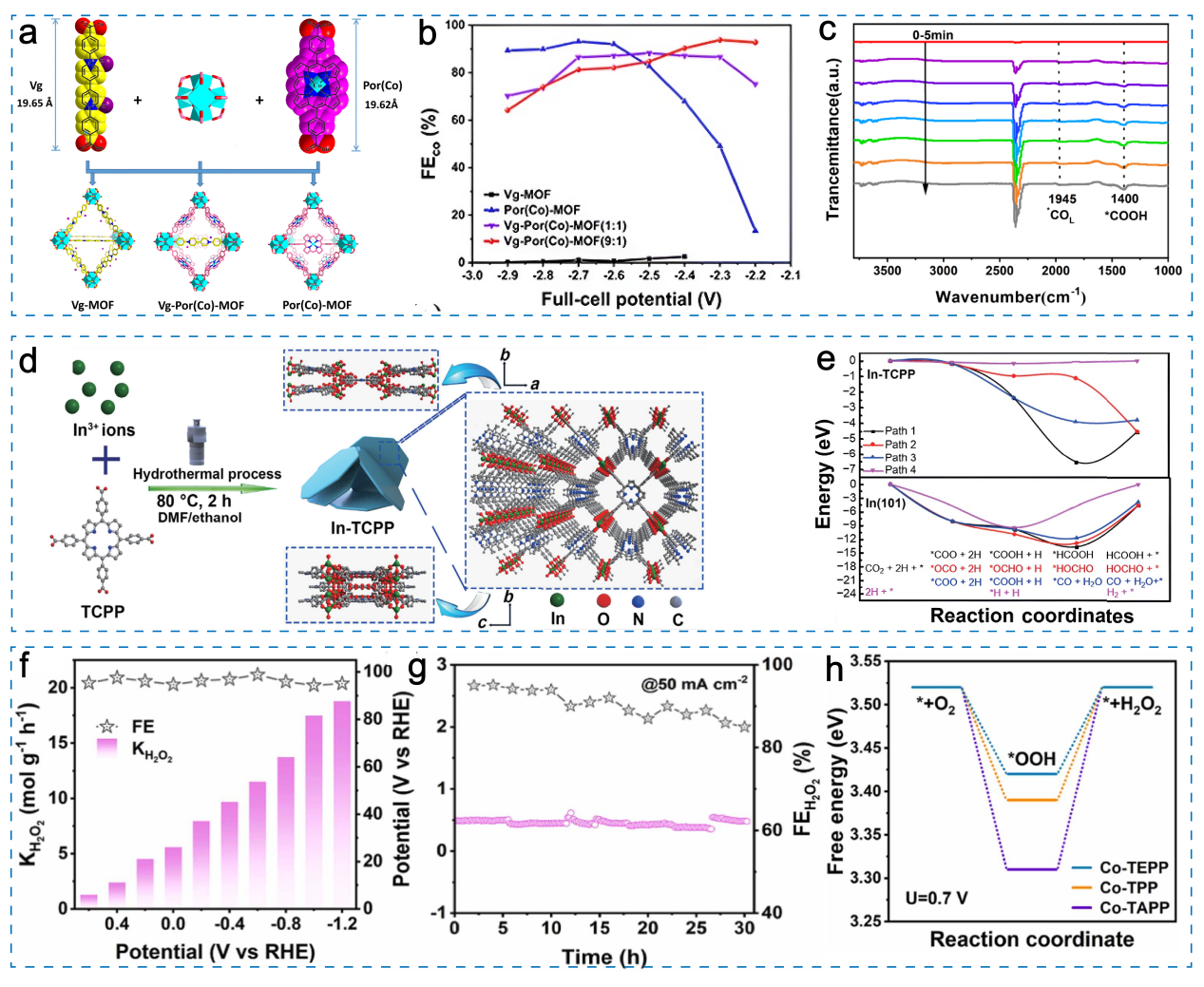
Fig. 10. (a) Schematic synthesis diagram. (b) FECO. (c) In-situ ATR-IR. Ref. [181], Copyright, 2023, Royal Society of Chemistry. (d) Schematic illustration. (e) The corresponding energy profles. Ref. [182], Copyright, 2023, Tsinghua University Press. (f) Potential-dependent FEH2O2 and H2O2 production rate in 1.0 mol L-1 KOH in flow cell. (g) Long-term stability. (h) Free energy diagram. Ref. [183], Copyright, 2020, Elsevier.
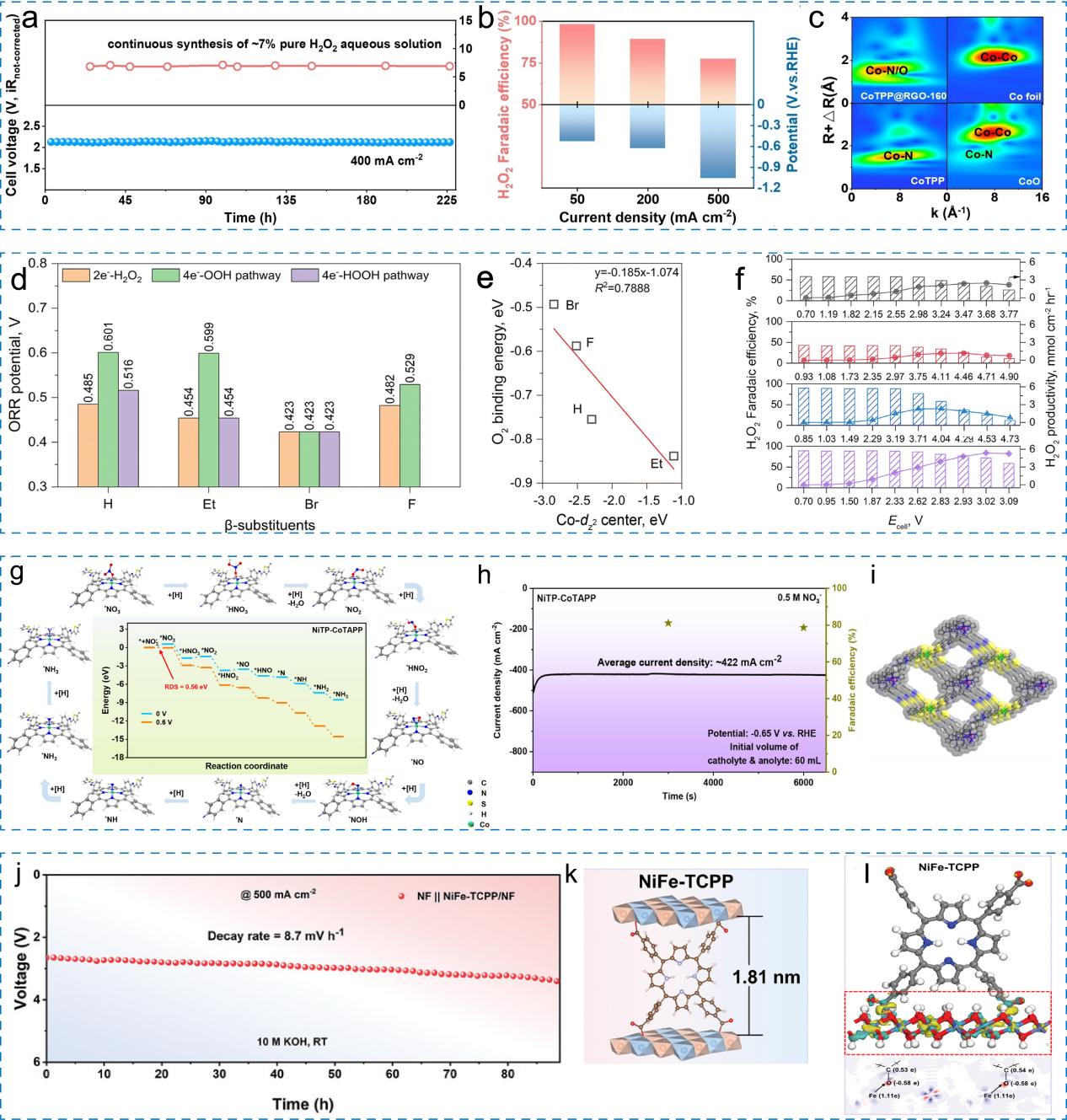
Fig. 11. (a) Stability of MEA. (b) FEH2O2. (c) WTs for CoTPP@RGO-160 and the reference catalysts. Ref. [184], Copyright, 2024, John Wiley and Sons. (d) Theoretical ORR potentials along different reaction pathways. (e) FEH2O2 and productivity. (f) Relationship between calculated Co-dz2 orbital centre and the *O2 binding energy (EO2) on different HMC models. Ref. [168], Copyright, 2022, Royal Society of Chemistry. (g) Free energy diagram. (h)Time-dependent industrially relevant current density curve. (i) Extended structures of NiTP-CoTAPP (c-axis) and view along the a-axis. Ref. [185], Copyright, 2025, John Wiley and Sons. (j) CP curve. (k) Structure diagrams. (l) Electron density difference diagrams and 2D contour plots of NiFe-TCPP. Ref. [39], Copyright, 2024, John Wiley and Sons.
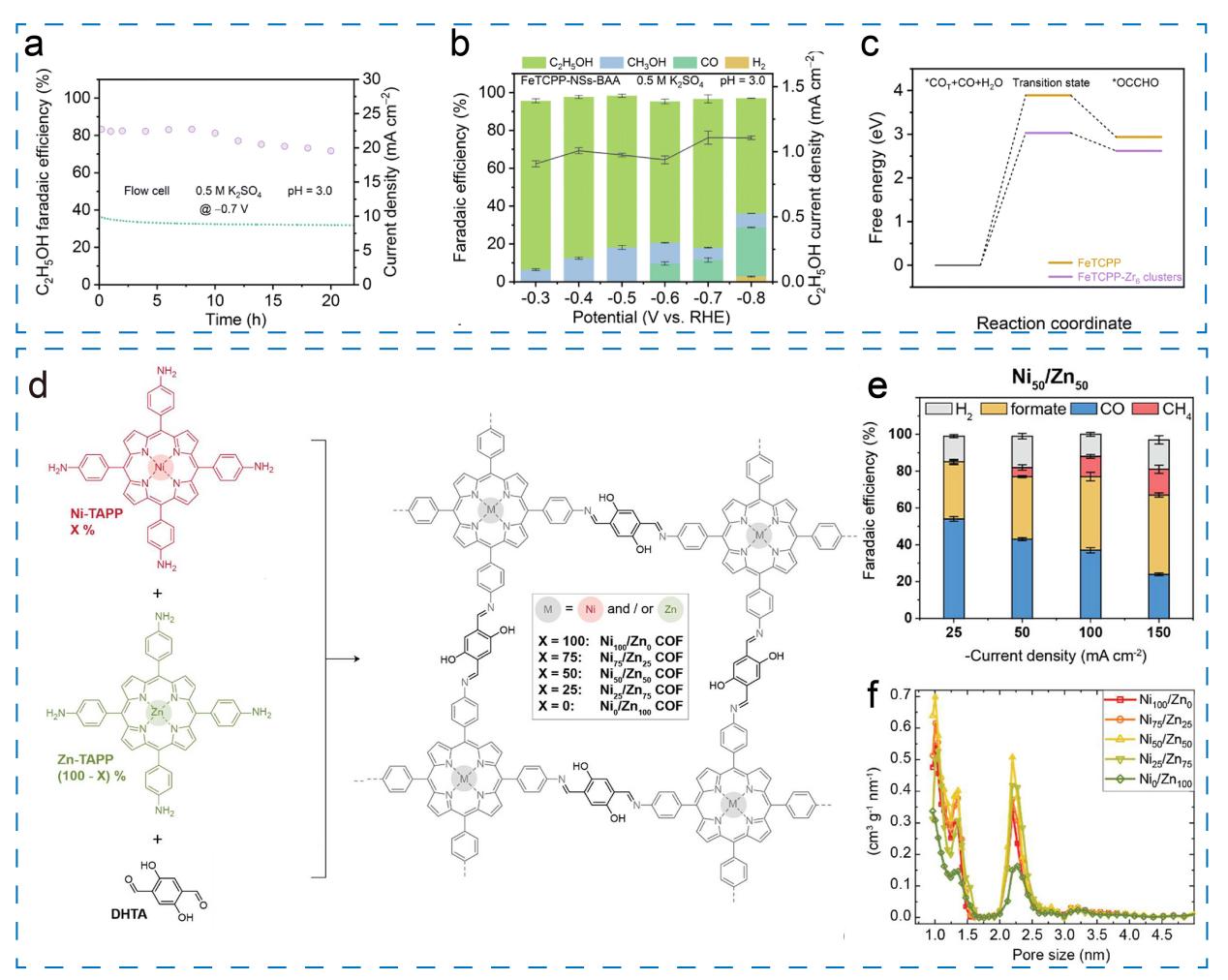
Fig. 12. (a) FE and current density during the long-term stability test. (b) FEs of different products. (c) Energy barriers for the hydrogenation of *OCCO to *OCCHO. Ref. [204], Copyright, 2025, Royal Society of Chemistry. (d) Chemical structure of Ni/Zn-porphyrin COFs and their monomers. (e) FEs of Ni50/Zn50. (f) Pore size distributions. Ref. [205], Copyright, 2024, American Chemical Society.
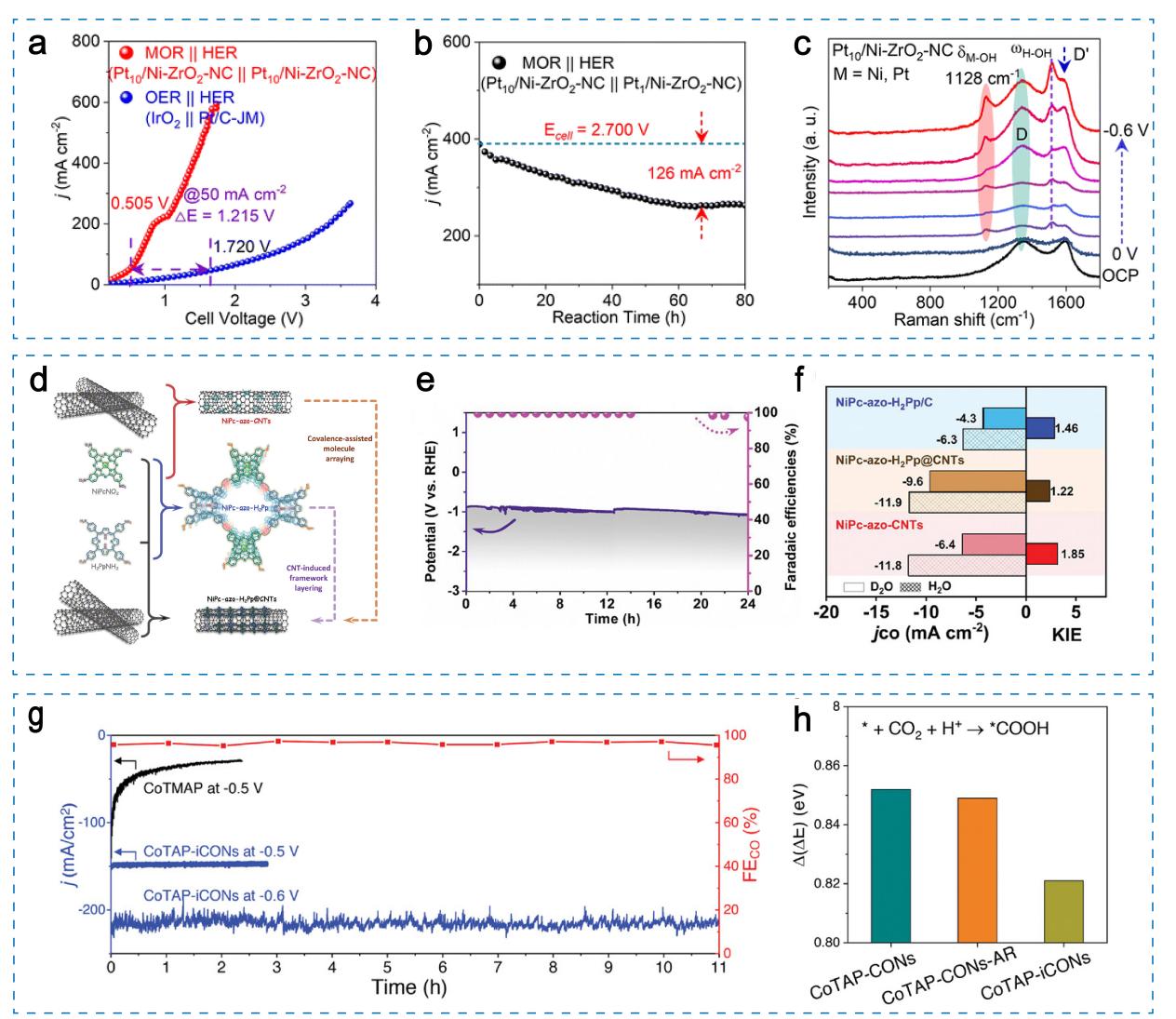
Fig. 13. (a) Performance of OER||HER and MOR||HER. (b) The stability of Pt10/Ni-ZrO2-NC. (c) Operando Raman spectra at the OCP and different applied potentials. Ref. [210], Copyright, 2025, Royal Society of Chemistry. (d) Schematic illustration of design and synthesis. (e) Stability of NiPc-azo-H2Pp@CNTs in flow cell at 200 mA cm-2 (f) KIE values. Ref. [211], Copyright, 2024, John Wiley and Sons. (g) Chronoamperometry tests. (h) Density functional theory calculated energy for the formation of *COO adsorbed on CoTAP-CONs, CoTAP-CONs-AR, and CoTAP-iCONs. Ref. [212], Copyright, 2022, John Wiley and Sons.
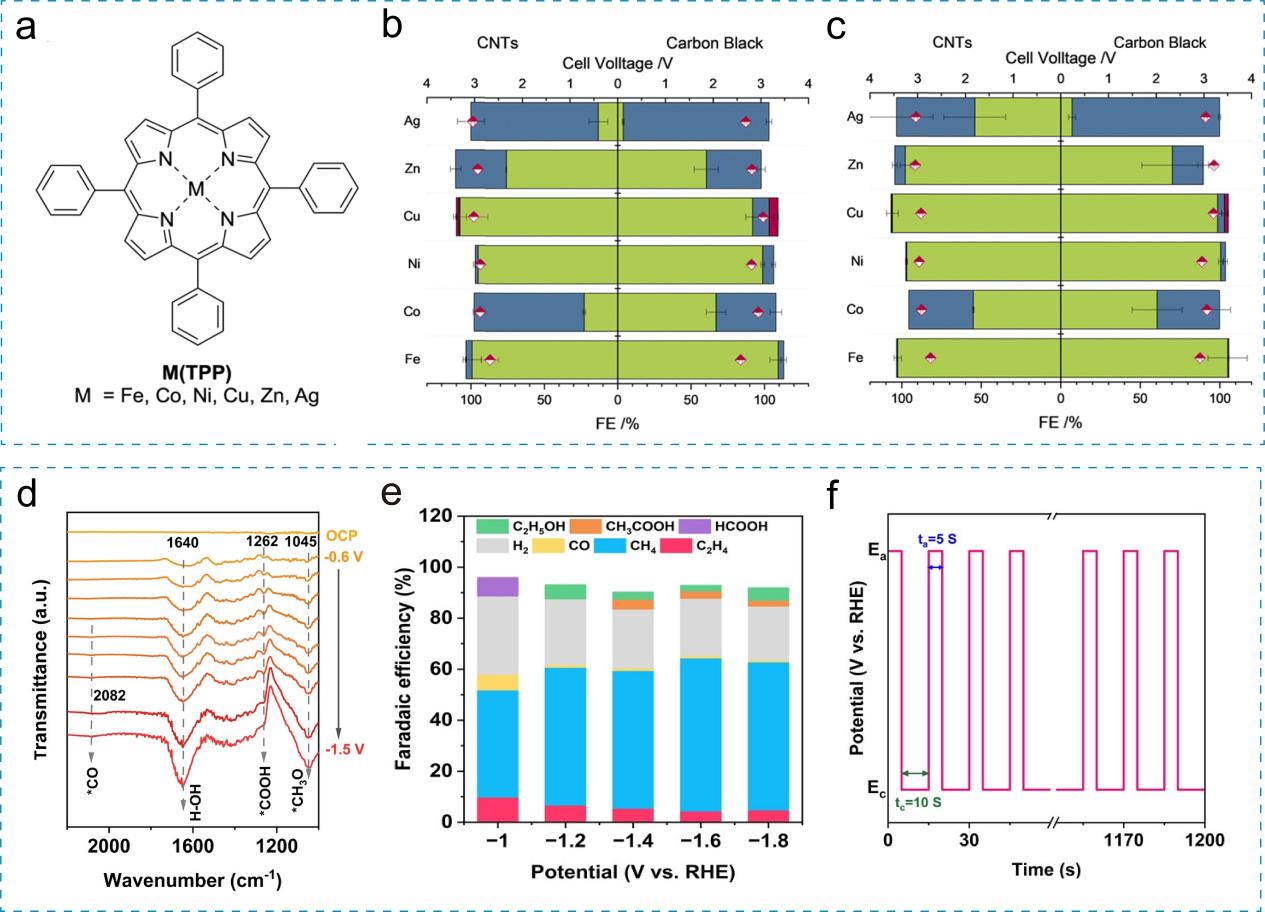
Fig. 14. (a) Scheme of the structure of the used complexes M(TPP). (b,c) Observed averaged cell voltages (pink diamonds) and FEs for H2 (green), CO (blue) and CH4 (pink) with either MWCNTs (left half of graph) or CB (right half of graph) as carbon support after 1 h of electrolysis at 50 mA cm-2 or 100 mA cm-2. Ref. [217], Copyright, 2024, Royal Society of Chemistry. (d) In-situ ATR-SEIRAS spectra. (e) CO2RR product distribution and the corresponding FE. (f) Illustration of Ec, Ea, tc, ta in an exemplary waveform of PPE. Ref. [219], Copyright, 2024, John Wiley and Sons.
| Porphyrin catalyst | Types of catalysts | Applications | Catalytic performance | Stability | Ref. | Porphyrin catalyst | Types of catalyst | Applications | Catalytic performance | Stability | Ref. | |
|---|---|---|---|---|---|---|---|---|---|---|---|---|
| Cu2O@Cu- TCPP(Co) | Cu/Co- based | CO2RR | 500 mA cm-2 FEC2H4: 54 ± 2% FEC2+: 69 ± 4% | >20 h@300 mA cm-2 | [ | Pt@Co- NPC-800 | Co-based | HER | 1.32 A cm-2 @60 °C 2.34 V | 22 h @1.9 V | [ | |
| DAE-BPy- CoPor | Co-based | CO2RR | 20.1 mA cm-2 @-1.0 V vs. RHE FECO : 90.5% | 24 h@-0.9 V vs. RHE FE> 80% | [ | CoT-sp2C-P- COF-COOH | Co-based | HER | 0.75 V @57.49 mA cm-2 | — | [ | |
| Co-PPOLs | Co-based | CO2RR | -0.9 V vs. RHE FECO > 94.2% | >20 h@200 mA cm-2 | [ | Co-N3C1-COF | Co-based | 4e-ORR | η: 0.338 V E1/2:0.794 V | — | [ | |
| Co-TQCOF | Co-based | CO2RR | -1.0 V @-20 mA cm-2 FE: 93.9% | 12 h@FE>80% | [ | Co-Nx | Co-based | 2e-ORR | FEH2O2: 85% @500 mA cm-2 | 12 h @50 mA cm-2 | [ | |
| CoPc/ppy/ GDE | Co-based | CO2RR | — | — | [ | 1-CoZn | Zn/ Co-based | ORR | — | 10h@0.44V | [ | |
| CoCoPCP/ CNT | Co-based | CO2RR | FECO: 94% @0.44 V | 24 h@0.55 V | [ | CoPorF/CNT | Co-based | ORR | 464 mA cm-2@3.32 V | 48 h @50mA cm-2 | [ | |
| EP-CoP/Cu | Co-based | CO2RR | 726 mA cm-2 @0.9 V | — | [ | Co-TEPP-COP/rGO | Co-based | ORR | 1.2V FEH2O2 > 95% | 30 h @50 mA cm-2 | [ | |
| Vg-Por(Co)-MOF | Co-based | CO2RR | FECO :93.8%@2.3 V | 22 h@58 mA cm-2 | [ | CoTPP@RGO-T | Co-based | ORR | 50 mol h-1 g cat-1 @500 mA cm-2 | 200 h @40 0mA cm-2 | [ | |
| CoN4-Por- COF | Co-based | CO2RR | — | — | [ | PFC-72-Co | Co-based | ORR | 0.68 V @FEH2O2 :> 90% | — | [ | |
| CoPCOP@ CNT | Co-based | NOxRR | -0.8 V vs. RHE FE: 98%, -1.0 V vs. RHE, 5.34 mW cm-2 FE > 90% | — | [ | NiFe-TCPP | Ni/ Fe-based | OER | 290.2 mV @1000 mA cm-2 | 1000 h @500 mA cm-2 | [ | |
| CoPB--C8 | Co-based | NO3-RR | FENH3 > 90% @1.04-1.54 V | — | [ | FeTMA/CNTs | Fe-based | NOxRR | -1.5 V vs. Ag/AgCl FENH3 > 90% | — | [ | |
| CoTMA/ CNTs | Co-based | NO3-RR | 1.5 V @ FENH3: 94.7% | — | [ | m-NiTPyP | Ni-based | OER, HER | 10 mA cm-2@267/138 mV | 60 h @1.65 V | [ | |
| PBIPorCo/ 3D-G | Co-based | OER/ORR | OER 290 mV @10 mA cm-2 ; ORR (E1/2) 0.90 V vs. RHE | L-ZAB >200 h@356.8 mW-2 | [ | Fe-porphyrin | Fe-based | NO2RR | FENH3 :90% @1.09 V | — | [ | |
| Metal porphyrin 1-M (M = Co, Fe) | Co/Fe- based | OER | 430 mV @10 mA cm-2 | — | [ | TAPP-OFPc[Ni]-COF | Fe/ Ni-based | UOR | 10mA cm-2@1.37V | — | [ | |
| CoPc-DEG MDE@CC | Co-based | HER | — | 25 h@1000 mA cm-2 | [ | ++N18C6-FeP | Fe-based | CO2RR | FECO: 95% @2.25 V | — | [ | |
| guanidino- functionalized Fe-porphyrins | Fe-based | CO2RR | FECO: 98% @ 2.1 V | — | [ | CuPOF-Bpy/ Cu2O@CNT | Cu-based | CO2RR | FEC2H4: 71% @1.1 V | 16 h @1.1V | [ | |
| OPA-PCN-222(Fe) | Fe-based | NOR, NRR | FE: 70.7% @ 1.6 V | — | [ | CuTphCOF- Dct | Cu-based | CO2RR | FECH4: 68% @0.8 ~1.0 V | 5 h @0.9V | [ | |
| Fe-TPPNH2 | Fe-based | CO2RR | 105 mA cm-2 @ 0.8 V | — | [ | CuNCP | Cu-based | CO2RR | -1.8 V @170 mA cm-2 | — | [ | |
| Zr-BDDB MOF | Fe-based | NO3- RR | 0.5 V @FENH3:95.6% | 24 h @ 0.5 V | [ | NiTPP | Ni-based | CO2RR | FECO: 98.3% @500 mA cm-2 | — | [ | |
| FeTCPP-NSs-BAA | Fe-based | CO2RR | 0.3 V@FEC2H5OH: 89.2% | 20 h @ 0.7 V | [ | m-NiTPyP | Ni-based | OER、HER | 10 mA cm-2 @267/138 mV | 60 h @1.65 V | [ | |
| FeTCPP | Fe-based | CO2RR | — | — | [ | TPPNi | Ni-based | CO2RR | FECO: 99.3% @1.10 V | — | [ | |
| PCN-222(Fe) | Fe-based | CO2RR | — | — | [ | Ni50/ Zn50-COF | Ni/ Zn-based | CO2RR | 0.6 V @CO2RR FECO: 79% | — | [ | |
| o-Cu-Por-Sa(αβαβ) | Cu-based | CO2RR | 45.76 mA cm-2 @-0.8 V vs. RHE FECH4: 84% | — | [ | Pt10/ Ni-ZrO2-NC | Ni/ Pt-based | HER | 57.5 mV @100 mA cm-2 | 230 h @100 mA cm-2 | [ | |
| Cu-PMOF | Cu-based | NH2CONH2 | 25.5 μmol h-1 mgcat-1@0.55 V | 36 h @0.55 V | [ | NiPc-azo- H2Pp@CNTs | Ni-based | CO2RR | 1.48 V @370 mA cm-2 | 24 h @200 mA cm-2 | [ | |
| Cu porphyrins to afford analogues 1-4 | Cu-based | HER | — | — | [ | Hg-MTPP | Hg-based | CO2RR | FECO: 100% @1.2 A cm-2 | 360 h @420 mA cm-2 | [ | |
| Cu-TMCPP/ CNT | Cu-based | CO2RR | 91.8 mA cm-2 @1.08 V | 9 h @ 1.08 V | [ | In-TCPP | In-based | CO2RR | FEHCOOH >80% @25 mA cm-2 | 50 h @25 mA cm-2 | [ | |
| Cu-PMOF | Cu-based | CO2RR | 337.5 mA cm-2 @1.23 V | — | [ |
Table 1 Classification of types, performances and applications of porphyrin catalysts discussed in this review.
| Porphyrin catalyst | Types of catalysts | Applications | Catalytic performance | Stability | Ref. | Porphyrin catalyst | Types of catalyst | Applications | Catalytic performance | Stability | Ref. | |
|---|---|---|---|---|---|---|---|---|---|---|---|---|
| Cu2O@Cu- TCPP(Co) | Cu/Co- based | CO2RR | 500 mA cm-2 FEC2H4: 54 ± 2% FEC2+: 69 ± 4% | >20 h@300 mA cm-2 | [ | Pt@Co- NPC-800 | Co-based | HER | 1.32 A cm-2 @60 °C 2.34 V | 22 h @1.9 V | [ | |
| DAE-BPy- CoPor | Co-based | CO2RR | 20.1 mA cm-2 @-1.0 V vs. RHE FECO : 90.5% | 24 h@-0.9 V vs. RHE FE> 80% | [ | CoT-sp2C-P- COF-COOH | Co-based | HER | 0.75 V @57.49 mA cm-2 | — | [ | |
| Co-PPOLs | Co-based | CO2RR | -0.9 V vs. RHE FECO > 94.2% | >20 h@200 mA cm-2 | [ | Co-N3C1-COF | Co-based | 4e-ORR | η: 0.338 V E1/2:0.794 V | — | [ | |
| Co-TQCOF | Co-based | CO2RR | -1.0 V @-20 mA cm-2 FE: 93.9% | 12 h@FE>80% | [ | Co-Nx | Co-based | 2e-ORR | FEH2O2: 85% @500 mA cm-2 | 12 h @50 mA cm-2 | [ | |
| CoPc/ppy/ GDE | Co-based | CO2RR | — | — | [ | 1-CoZn | Zn/ Co-based | ORR | — | 10h@0.44V | [ | |
| CoCoPCP/ CNT | Co-based | CO2RR | FECO: 94% @0.44 V | 24 h@0.55 V | [ | CoPorF/CNT | Co-based | ORR | 464 mA cm-2@3.32 V | 48 h @50mA cm-2 | [ | |
| EP-CoP/Cu | Co-based | CO2RR | 726 mA cm-2 @0.9 V | — | [ | Co-TEPP-COP/rGO | Co-based | ORR | 1.2V FEH2O2 > 95% | 30 h @50 mA cm-2 | [ | |
| Vg-Por(Co)-MOF | Co-based | CO2RR | FECO :93.8%@2.3 V | 22 h@58 mA cm-2 | [ | CoTPP@RGO-T | Co-based | ORR | 50 mol h-1 g cat-1 @500 mA cm-2 | 200 h @40 0mA cm-2 | [ | |
| CoN4-Por- COF | Co-based | CO2RR | — | — | [ | PFC-72-Co | Co-based | ORR | 0.68 V @FEH2O2 :> 90% | — | [ | |
| CoPCOP@ CNT | Co-based | NOxRR | -0.8 V vs. RHE FE: 98%, -1.0 V vs. RHE, 5.34 mW cm-2 FE > 90% | — | [ | NiFe-TCPP | Ni/ Fe-based | OER | 290.2 mV @1000 mA cm-2 | 1000 h @500 mA cm-2 | [ | |
| CoPB--C8 | Co-based | NO3-RR | FENH3 > 90% @1.04-1.54 V | — | [ | FeTMA/CNTs | Fe-based | NOxRR | -1.5 V vs. Ag/AgCl FENH3 > 90% | — | [ | |
| CoTMA/ CNTs | Co-based | NO3-RR | 1.5 V @ FENH3: 94.7% | — | [ | m-NiTPyP | Ni-based | OER, HER | 10 mA cm-2@267/138 mV | 60 h @1.65 V | [ | |
| PBIPorCo/ 3D-G | Co-based | OER/ORR | OER 290 mV @10 mA cm-2 ; ORR (E1/2) 0.90 V vs. RHE | L-ZAB >200 h@356.8 mW-2 | [ | Fe-porphyrin | Fe-based | NO2RR | FENH3 :90% @1.09 V | — | [ | |
| Metal porphyrin 1-M (M = Co, Fe) | Co/Fe- based | OER | 430 mV @10 mA cm-2 | — | [ | TAPP-OFPc[Ni]-COF | Fe/ Ni-based | UOR | 10mA cm-2@1.37V | — | [ | |
| CoPc-DEG MDE@CC | Co-based | HER | — | 25 h@1000 mA cm-2 | [ | ++N18C6-FeP | Fe-based | CO2RR | FECO: 95% @2.25 V | — | [ | |
| guanidino- functionalized Fe-porphyrins | Fe-based | CO2RR | FECO: 98% @ 2.1 V | — | [ | CuPOF-Bpy/ Cu2O@CNT | Cu-based | CO2RR | FEC2H4: 71% @1.1 V | 16 h @1.1V | [ | |
| OPA-PCN-222(Fe) | Fe-based | NOR, NRR | FE: 70.7% @ 1.6 V | — | [ | CuTphCOF- Dct | Cu-based | CO2RR | FECH4: 68% @0.8 ~1.0 V | 5 h @0.9V | [ | |
| Fe-TPPNH2 | Fe-based | CO2RR | 105 mA cm-2 @ 0.8 V | — | [ | CuNCP | Cu-based | CO2RR | -1.8 V @170 mA cm-2 | — | [ | |
| Zr-BDDB MOF | Fe-based | NO3- RR | 0.5 V @FENH3:95.6% | 24 h @ 0.5 V | [ | NiTPP | Ni-based | CO2RR | FECO: 98.3% @500 mA cm-2 | — | [ | |
| FeTCPP-NSs-BAA | Fe-based | CO2RR | 0.3 V@FEC2H5OH: 89.2% | 20 h @ 0.7 V | [ | m-NiTPyP | Ni-based | OER、HER | 10 mA cm-2 @267/138 mV | 60 h @1.65 V | [ | |
| FeTCPP | Fe-based | CO2RR | — | — | [ | TPPNi | Ni-based | CO2RR | FECO: 99.3% @1.10 V | — | [ | |
| PCN-222(Fe) | Fe-based | CO2RR | — | — | [ | Ni50/ Zn50-COF | Ni/ Zn-based | CO2RR | 0.6 V @CO2RR FECO: 79% | — | [ | |
| o-Cu-Por-Sa(αβαβ) | Cu-based | CO2RR | 45.76 mA cm-2 @-0.8 V vs. RHE FECH4: 84% | — | [ | Pt10/ Ni-ZrO2-NC | Ni/ Pt-based | HER | 57.5 mV @100 mA cm-2 | 230 h @100 mA cm-2 | [ | |
| Cu-PMOF | Cu-based | NH2CONH2 | 25.5 μmol h-1 mgcat-1@0.55 V | 36 h @0.55 V | [ | NiPc-azo- H2Pp@CNTs | Ni-based | CO2RR | 1.48 V @370 mA cm-2 | 24 h @200 mA cm-2 | [ | |
| Cu porphyrins to afford analogues 1-4 | Cu-based | HER | — | — | [ | Hg-MTPP | Hg-based | CO2RR | FECO: 100% @1.2 A cm-2 | 360 h @420 mA cm-2 | [ | |
| Cu-TMCPP/ CNT | Cu-based | CO2RR | 91.8 mA cm-2 @1.08 V | 9 h @ 1.08 V | [ | In-TCPP | In-based | CO2RR | FEHCOOH >80% @25 mA cm-2 | 50 h @25 mA cm-2 | [ | |
| Cu-PMOF | Cu-based | CO2RR | 337.5 mA cm-2 @1.23 V | — | [ |
|
| [1] | 程家威, 王凯, 孟俣翰, 王嘉辰, 刘作政, 王静娟, 刘家旭, 成康, 张庆红, 王野. 二氧化硅限域Cu2O纳米颗粒用于分子氧丙烯环氧化[J]. 催化学报, 2026, 86(7): 77-88. |
| [2] | 余灵辉, 张恒, Luyuan Paul Wang, Samuel Jun Hoong Ong, 席识博, 陈博, 郭瑞, 汪婷, 杜永华, 陈伟, Ovadia Lev, 徐梽川. 含氮/氧双元素碳催化剂调整硫正极在碳酸丙烯酯电解液中的氧化还原路径[J]. 催化学报, 2024, 63(8): 224-233. |
| [3] | 于亚楠, 鲁少杰, 胡一平, 周雨, 岳秦. 新型核壳AuTi@PtNi纳米催化剂: 增强氧还原催化活性及稳定性[J]. 催化学报, 2024, 56(1): 81-87. |
| [4] | 李晓娟, 祁明雨, 李婧宇, 谭昌龙, 唐紫蓉, 徐艺军. PdS修饰的ZnIn2S4复合材料用于可见光催化硫醇偶联制备二硫化物同时产氢[J]. 催化学报, 2023, 51(8): 55-65. |
| [5] | 周鹤洋, 唐海涛, 何卫民. 有机电化学-电流驱动未来[J]. 催化学报, 2023, 46(3): 4-10. |
| [6] | 张洁, 龚学庆, 卢冠忠. CeO2(110)负载Au纳米颗粒催化CO+NOx反应的DFT+U研究[J]. 催化学报, 2014, 35(8): 1305-1317. |
| [7] | 代小平;余长春;吴琼. 无气相氧条件下La0.8Sr0.2Fe0.9Co0.1O3钙钛矿氧化物的氧物种直接氧化甲烷[J]. 催化学报, 2008, 29(10): 954-956. |
| 阅读次数 | ||||||
|
全文 |
|
|||||
|
摘要 |
|
|||||


