
催化学报 ›› 2026, Vol. 89: 127-141.DOI: 10.1016/S1872-2067(26)65172-8
郭美君a, Elhussein M. Hashema, Jaenudin Ridwana, 陈恬a, 周鹏b,*( ), 冉景润a,*()
收稿日期:2026-02-02
接受日期:2026-04-17
出版日期:2026-10-18
发布日期:2026-09-01
通讯作者:
*电子信箱: pengzhou1209@pku.edu.cn (周鹏),
Meijun Guoa, Elhussein M. Hashema, Jaenudin Ridwana, Tian Chena, Peng Zhoub,*(), Jingrun Rana,*()
Received:2026-02-02
Accepted:2026-04-17
Online:2026-10-18
Published:2026-09-01
Contact:
E-mail: About author:Peng Zhou (Peking University Shenzhen Graduate School) joined Peking University Shenzhen Graduate School as an Assistant Professor in 2023. His research focuses on the controlled synthesis of emerging inorganic semiconductor photocatalysts and their photochemical energy-conversion properties, including photocatalytic overall water splitting for hydrogen production, the preparation of single-atom photocatalysts, and photocatalytic synthesis of value-added organic compounds. According to Web of Science, his work has received over 15000 citations with an h-index of 56. He was awarded the Excellent Young Scientists Fund (Overseas) of National Natural Science Foundation of China in 2023 and was selected for Stanford University’s 2025 World’s Top 2% Scientists and Career-long Impact Ranking lists.摘要:
在全球能源需求持续增长、化石能源消耗加剧以及气候变化问题日益突出的背景下, 利用太阳能驱动化学反应的光催化技术受到广泛关注. 传统光催化材料普遍存在光吸收范围窄、载流子复合严重或氧化还原能力不足等问题, 难以同时满足全光谱响应、高效电荷分离、足够表面反应活性和长期稳定性等要求. 铜族硫属化合物, 尤其是富含铜空位的Cu2-xS、Cu2-xSe及相关多元体系, 因具有可调带结构、丰富缺陷化学、较低缺陷形成能以及可见至近红外响应能力, 近年来在光催化领域展现出独特优势. 本文系统综述了铜族硫属化合物的结构特征、制备方法、性能调控与应用进展,旨在为缺陷容忍和全光谱响应光催化材料的理性设计提供参考.
本文首先从材料本征特征出发, 梳理了二元亏铜体系、三元及多元铜族硫属化合物与异质结构体系中铜空位的形成、调控及其对电子结构和催化行为的影响. 结果表明, 适量铜空位可引入受主态、提高空穴载流子浓度、调节费米能级, 并在部分亏铜体系中诱导局域表面等离激元响应, 从而增强可见至近红外光吸收、促进电荷迁移并降低表面催化势垒, 但过高的空位浓度也可能形成深能级陷阱, 加剧电子-空穴复合, 因此空位调控需要在活性提升与复合抑制之间取得平衡. 围绕这一认识, 文章进一步总结了水热/溶剂热、热注入、离子交换及其他制备方法的特点, 指出水热/溶剂热法适合获得高结晶度和可调形貌材料, 但反应时间较长且放大受限; 热注入法有利于精确调控粒径、组成和晶相, 但依赖高温有机体系, 不利于规模化; 离子交换法则在构筑空心、多壳和异质结构方面具有独特优势. 基于缺陷工程与异质结构筑的协同设计, 铜族硫属化合物已在光催化析氢、CO2还原、污染物降解及其他光驱动反应中取得代表性进展. 铜族硫属化合物的光催化性能已不应简单归因于窄带隙特征, 而应从铜空位、局域配位环境、界面内建电场及等离激元相关载流子行为的协同作用来理解. 进一步地, 作者提出“空位-界面耦合”概念, 用于解释真实反应条件下空位、异质界面、局域应变和表面重构之间的动态联系, 并指出未来高性能体系的发展将更加依赖成分调控、缺陷结构和界面电荷转移的协同优化, 而非单一带隙调节.
总体来看, 铜族硫属化合物凭借可调缺陷化学、宽光谱吸收和多尺度界面可设计性, 在太阳燃料转化、环境净化和选择性光催化反应中具有重要发展潜力. 但其实际应用仍受到稳定性不足、机理证据缺乏和规模化制备困难等问题制约. 未来研究应加强原位表征, 跟踪空位在反应过程中的动态演化, 建立原子尺度缺陷调控、纳米尺度界面设计与介观传输行为之间的系统联系, 并推动长期稳定性评价和标准化测试体系建设. 本文从缺陷、界面与应用协同调控的角度梳理了该领域的发展脉络, 可为后续铜族硫属光催化剂的高效化、稳定化和实用化设计提供有价值的参考.
郭美君, Elhussein M. Hashem, Jaenudin Ridwan, 陈恬, 周鹏, 冉景润. 铜族硫属化合物在光催化中的研究进展[J]. 催化学报, 2026, 89: 127-141.
Meijun Guo, Elhussein M. Hashem, Jaenudin Ridwan, Tian Chen, Peng Zhou, Jingrun Ran. Research progress on copper chalcogenide compounds in photocatalysis[J]. Chinese Journal of Catalysis, 2026, 89: 127-141.
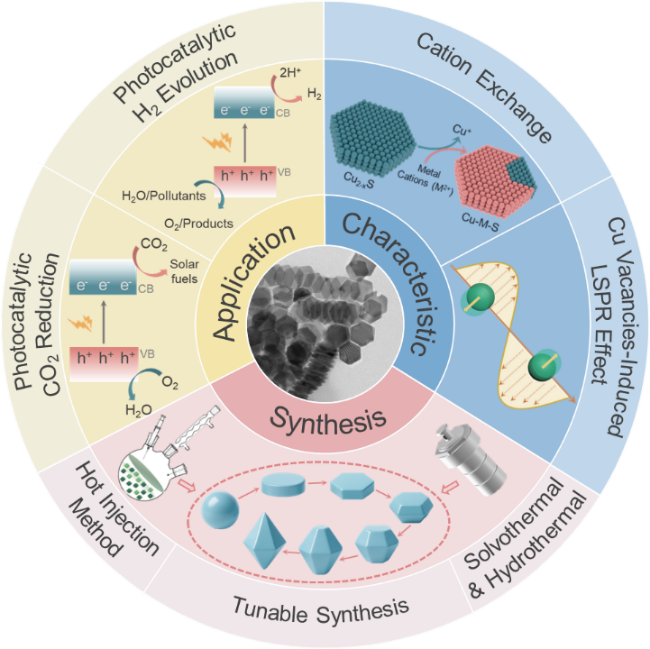
Fig. 1. Schematic summary of the aspects covered in this review.
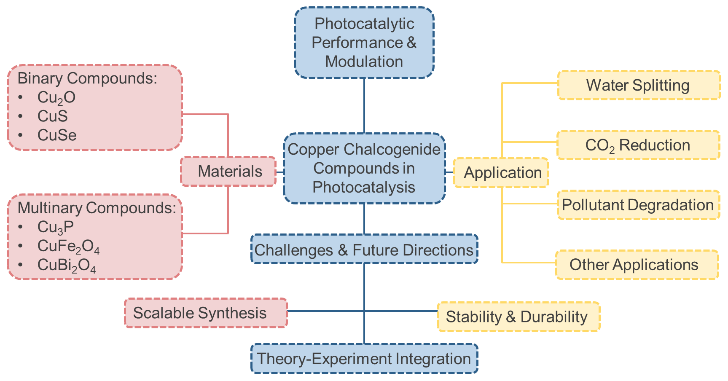
Fig. 2. Schematic overview of copper chalcogenide compounds in photocatalysis.
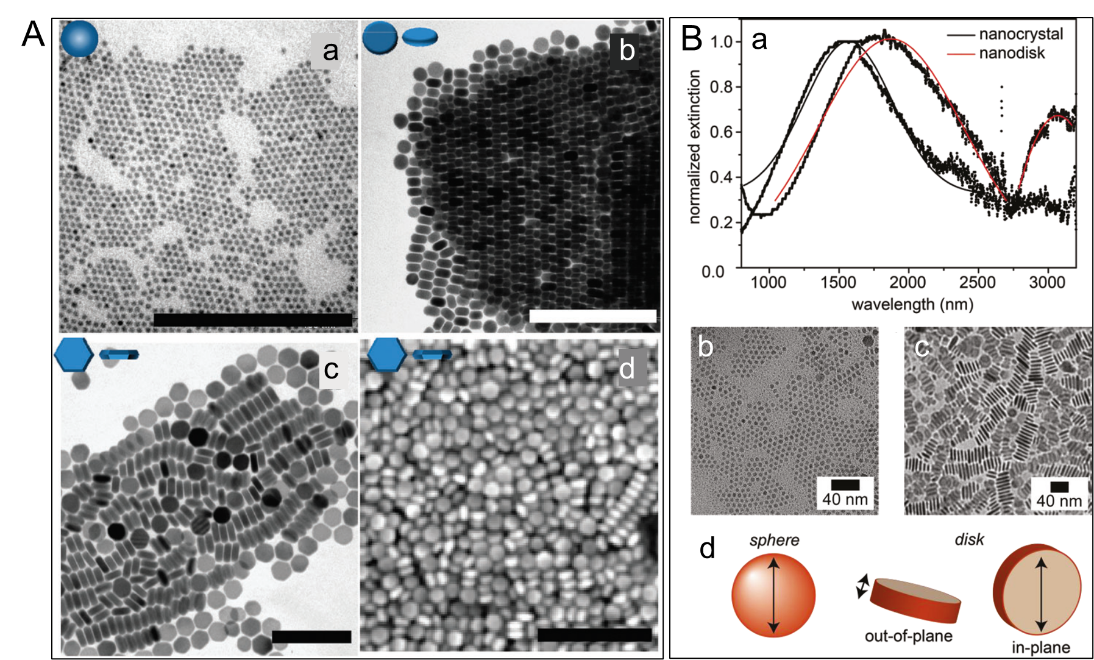
Fig. 3. (A) TEM (a-c) and SEM (d) images of Cu2-xS nanoparticles with various morphologies. Scale bars = 200 nm. Reprinted with permission from Ref. [53]. Copyright 2011, Royal Society of Chemistry. (B) Shape-dependent LSPRs of Cu2-xS nanocrystals. (a) NIR extinction spectra (black dots) for colloidal dispersions of spherical nanocrystals and nanodisks. TEM image of spherical nanocrystals (b) and nanodisks (c). (d) Schematic of LSPR polarizations for spherical and disk-shaped nanocrystals. Reprinted with permission from Ref. [54]. Copyright 2011, American Chemical Society.
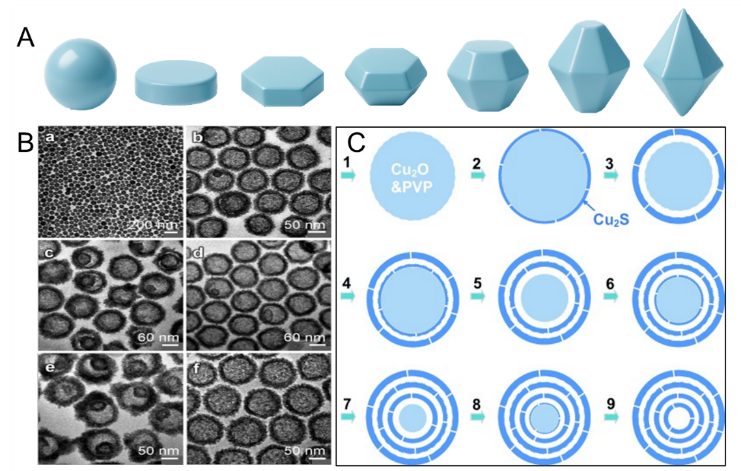
Fig. 4. Morphological evolution and structural transformation of Cu2O-Cu2S nanostructures. (A) Schematic illustration of different possible nanocrystal morphologies formed during growth, showing the evolution from spherical particles to faceted polyhedral structures with increasing structural complexity. (B) TEM image of various core-shell structures at different transformation stages. (C) Proposed schematic mechanism for the formation of Cu2S shells on Cu2O-PVP nanocrystals. The process involves the initial formation of a Cu2S layer on the Cu2O surface followed by gradual shell growth and structural reconstruction, ultimately leading to multi-shell or hollow architectures through sequential diffusion and interfacial conversion. Reprinted with permission from Ref. [100]. Copyright 2012, John Wiley and Sons.
| Phase category | Structural/compositional characteristics | Dominant vacancy features | Representative photocatalytic applications | Ref. |
|---|---|---|---|---|
| Binary copper sulfides (Cu2-xS) | non-stoichiometric, phase-rich, Cu-deficient structures common | intrinsic Cu vacancies dominate | H2 evolution, pollutant degradation, organic oxidation | [ |
| Binary copper selenides (Cu2-xSe) | Cu-deficient, electronically delocalized Se-based lattice | tunable Cu vacancies with strong electronic impact | H2 evolution, pollutant removal, photothermal-assisted catalysis | [ |
| Ternary copper chalcogenides (e.g., CuInS2, CuGaS2) | more ordered cation framework | Cu vacancies plus antisite defects | H2 production, CO2 reduction, pollutant removal | [ |
| Alloyed/multinary systems | compositionally tunable lattice | coupled composition-vacancy regulation | biomass conversion, selective redox reactions | [ |
| Heterostructured systems | vacancy-containing copper chalcogenides integrated with secondary semiconductors | interfacial defect redistribution | H2 evolution, CO2 reduction, environmental remediation | [ |
Table 1 Representative copper chalcogenide phases discussed in this review, with comparison of their structural characteristics, vacancy features, key properties, and typical photocatalytic applications.
| Phase category | Structural/compositional characteristics | Dominant vacancy features | Representative photocatalytic applications | Ref. |
|---|---|---|---|---|
| Binary copper sulfides (Cu2-xS) | non-stoichiometric, phase-rich, Cu-deficient structures common | intrinsic Cu vacancies dominate | H2 evolution, pollutant degradation, organic oxidation | [ |
| Binary copper selenides (Cu2-xSe) | Cu-deficient, electronically delocalized Se-based lattice | tunable Cu vacancies with strong electronic impact | H2 evolution, pollutant removal, photothermal-assisted catalysis | [ |
| Ternary copper chalcogenides (e.g., CuInS2, CuGaS2) | more ordered cation framework | Cu vacancies plus antisite defects | H2 production, CO2 reduction, pollutant removal | [ |
| Alloyed/multinary systems | compositionally tunable lattice | coupled composition-vacancy regulation | biomass conversion, selective redox reactions | [ |
| Heterostructured systems | vacancy-containing copper chalcogenides integrated with secondary semiconductors | interfacial defect redistribution | H2 evolution, CO2 reduction, environmental remediation | [ |
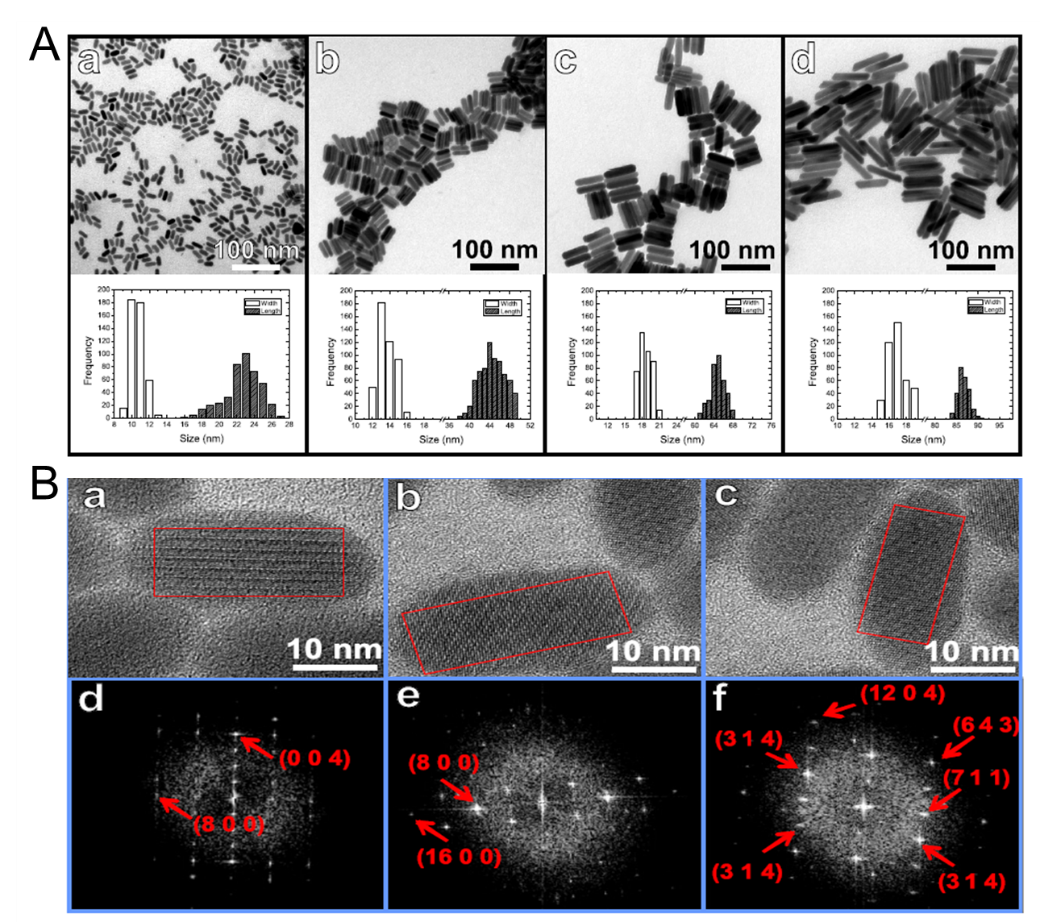
Fig. 5. Structural characterization of copper chalcogenide nanorods with tunable sizes. (A) TEM images of the nanorods synthesized under different reaction conditions: (a-d) representative TEM micrographs showing the morphology and size evolution of the nanorods. The corresponding size distribution histograms are shown below each image, indicating gradual changes in particle length and diameter. (B) HRTEM images and corresponding FFT analyses of representative nanorods. (a-c) HRTEM images highlighting the well-resolved lattice fringes in selected regions (red boxes). (d-f) Corresponding FFT patterns revealing the crystalline nature and indexed diffraction spots of the nanorods, confirming their well-defined crystal structure. Reprinted with permission from Ref. [101]. Copyright 2012, American Chemical Society.
|
| [1] | 朱君江, 许凯强. CdS/NiPc S-型光催化剂及其增强的光催化产过氧化氢性能[J]. 催化学报, 2026, 88(9): 5-8. |
| [2] | 孙宇航, 李旭, 曾众天, 魏华, 赵宇龙, 蔡晓燕, 毛梁, 谭昌龙, 沈博, 徐艺军. 硫诱导电荷位点重构与原位生成ZnO2保护层实现稳定高效的太阳能制备H2O2[J]. 催化学报, 2026, 88(9): 207-217. |
| [3] | 魏耀文, 王建伟, 郭皓, 班涛, 岳玉峰, 胡地, 黄海保. 缺陷UiO-66催化剂在温和条件下实现甲烷高选择性氧化制乙酸[J]. 催化学报, 2026, 88(9): 356-368. |
| [4] | Sathi Chatterjee, 李红梅, 刘康, 林璋, 柴立元, 刘敏. 二维(2D)材料上的单原子催化剂用于光催化CO2还原: 基础、设计与新兴策略[J]. 催化学报, 2026, 88(9): 86-128. |
| [5] | 刘淑芳, 陈锋宇, 李思媛, 叶宇昕, 欧阳钢锋. 氧中心有机自由基最新研究进展: 表征、合成及应用[J]. 催化学报, 2026, 88(9): 183-206. |
| [6] | 马小龙, 吴之强, 姚惠琴, 刘彬, 靳治良, Paolo Fornasiero. 电荷动力学工程: 量子点诱导的全空间电场协同Ag2S量子点/CoWO4 S型异质结促进光催化析氢[J]. 催化学报, 2026, 88(9): 233-246. |
| [7] | 雷文敏, 张艳, 孙大琳, 班林, 周恒, 杨松, 景立权, 胡劲光, 张衡. 过渡金属光催化剂用于木质素可持续转化生产生物燃料[J]. 催化学报, 2026, 88(9): 35-85. |
| [8] | 陈翔锋, 黄丝雨, 杨煜杭, 倪嘉浩, 方诚, 徐杨帆, 匡代彬. 卤素钙钛矿材料在杂化光催化中的研究进展[J]. 催化学报, 2026, 88(9): 9-34. |
| [9] | 黄芸, 陈奇, 陈月铃, 杨泽锋, 吴炯桦, 余济美, 吴棱. 在Pt/DUT-67(Zr)表面生成氢物种增强光催化合成氨[J]. 催化学报, 2026, 88(9): 247-258. |
| [10] | 张可可, 张富林, 王月欣, 黄凤伟, 熊康慧, 顾向奎, 郎贤军. 调控亚乙烯基连接的噻吩并噻吩共价有机框架的电子推拉效应以增强选择性光催化[J]. 催化学报, 2026, 87(8): 206-216. |
| [11] | 李世杰, 李蕊, 刘艳萍, 于欣, 马德运, 姜建辉, 周小松, 庄春强, 赵再望, 姜维. Ag/AgBr/C3N5中LSPR增强S型电荷转移促进活性氧物种生成实现高效光催化降解抗生素废水[J]. 催化学报, 2026, 87(8): 126-139. |
| [12] | 刘高雄, 陈润东, 夏兵全, 周贤龙, 李来全, 刘善堂. 构建噻二唑功能化CTF基S型异质结用于高效光催化合成H2O2[J]. 催化学报, 2026, 87(8): 170-184. |
| [13] | 吴昊, 曾芯宇, 王往, 程蓓, 程敬招, 许景三, 曹少文. 有机-无机S型异质结增强载流子分离用于光催化产氢耦合亚胺合成[J]. 催化学报, 2026, 87(8): 185-196. |
| [14] | 姜晓康, 高永泽, 张博闻, 杨晓东, 袁之敏, 许兆宁, 孙彬, 姜在勇, 周国伟, 周恩龙. 内建电场耦合非贵金属等离基元效应助推MIL-125光催化二氧化碳还原活性[J]. 催化学报, 2026, 87(8): 100-112. |
| [15] | Sue-Faye Ng, Joel Jie Foo, Karlo Nolkemper, Zahra Hajiahmadi, Jaya Bharti, Nannan Hou, Jiankang Zheng, Thomas D. Kühne, Markus Antonietti, Christian Mark Pelicano, Wee-Jun Ong. 三唑环功能化聚(七嗪亚胺): 利用给体-受体构型实现高效太阳驱动过氧化氢合成[J]. 催化学报, 2026, 87(8): 140-155. |
| 阅读次数 | ||||||
|
全文 |
|
|||||
|
摘要 |
|
|||||


