
催化学报 ›› 2027, Vol. 92: 65-86.DOI: 10.1016/S1872-2067(26)65280-1
邝攀勇a,c,*( ), 倪振瑞a, 陈思涵a, 余维来b,*()
收稿日期:2026-07-14
接受日期:2026-09-14
出版日期:2026-12-05
发布日期:2026-10-30
通讯作者:
*电子信箱: kuangpanyong@cug.edu.cn (邝攀勇),基金资助:
Panyong Kuanga,c,*(), Zhenrui Nia, Sihan Chena, Weilai Yub,*()
Received:2026-07-14
Accepted:2026-09-14
Online:2026-12-05
Published:2026-10-30
Contact:
*E-mail: kuangpanyong@cug.edu.cn (P. Kuang),About author:Panyong Kuang (China University of Geosciences) received his Ph.D. degree in 2019 and completed his postdoctoral research in 2021 at Wuhan University of Technology under the supervision of Prof. Jiaguo Yu. In 2021, he joined the Laboratory of Solar Fuel at China University of Geosciences (Wuhan). From 2023 to 2024, he was a visiting scholar at Cardiff University, under the supervision of Prof. Graham J. Hutchings. His research focuses on the precise synthesis and structural regulation of supported, heterostructured, and low-loading noble-metal-based catalysts for electrochemical energy conversion, including water splitting and carbon dioxide reduction. He has published more than 50 SCI-indexed papers and has been recognized among the World’s Top 2% Scientists (2023-2025). He serves as a young editorial board member of Rare Metals, Acta Physico-Chimica Sinica, and Chinese Journal of Rare Metals, and is a member of the Chinese Energy Society and the Energy Conversion and Storage Committee of the Wuhan Energy Society.Supported by:摘要:
随着可再生能源驱动绿色氢能技术的快速发展, 电催化水分解制氢被认为是实现低碳能源转型的重要途径. 析氢反应(HER)作为电解水阴极反应, 其在高电流密度下的催化效率与长期稳定性直接影响工业电解制氢的能耗和运行可靠性. 然而, 传统实验室条件下以低电流密度和低催化剂负载为基础建立的性能评价体系, 难以充分反映工业电流密度下快速反应动力学、强化传质、氢气气泡累积以及电极结构和活性相演变等复杂问题. 因此, 开发能够在大电流密度下兼具高活性、优异传质能力和长期稳定性的HER电催化剂, 是推动电解水制氢规模化应用的关键.
本综述围绕工业电流密度下HER电催化剂的结构设计与性能调控, 系统总结近年来的研究进展, 并从形貌与界面工程、本征活性工程以及稳定性工程三个方面归纳主要设计策略. 首先, 重点讨论自支撑电极、分级多孔结构以及润湿性调控在改善电子传输、电解液浸润、氢气气泡脱附和界面传质方面的作用; 其次, 从双活性位点构筑、元素掺杂和缺陷工程等角度, 阐述通过调控局域配位环境、电子结构及反应中间体吸附行为提升碱性HER本征活性的机制; 进一步从机械稳定性和化学稳定性两个方面, 总结增强催化剂结构完整性、抑制活性组分溶解和相变以及调控动态表面重构的关键策略. 同时, 结合代表性催化剂的高电流密度性能、工作电解质、运行温度、稳定性及测试构型, 对不同设计策略进行了定量归纳与比较.
在此基础上, 本文进一步讨论工业电流密度HER从实验室评价向实际电解槽运行转化过程中面临的关键挑战, 包括真实电解条件下的催化剂演变与失活机制、催化剂/电解液界面微环境调控、电极与催化层工程、全电解槽性能评价以及可再生能源驱动下动态运行稳定性等. 最后, 提出未来应从静态结构设计进一步转向结构-活性-稳定性协同调控, 加强原位/操作条件表征、理论模拟与长期工业电流密度测试的深度结合, 建立更加可靠的结构-性能关系和标准化评价体系, 从而为开发高效、稳定且可规模化应用的HER电催化剂及绿色制氢体系提供理论依据与设计指导.
邝攀勇, 倪振瑞, 陈思涵, 余维来. 面向工业电流密度碱性析氢的电催化剂工程: 设计策略与未来展望[J]. 催化学报, 2027, 92: 65-86.
Panyong Kuang, Zhenrui Ni, Sihan Chen, Weilai Yu. Engineering electrocatalysts for industrial-current-density alkaline hydrogen evolution: Design principles and future perspectives[J]. Chinese Journal of Catalysis, 2027, 92: 65-86.
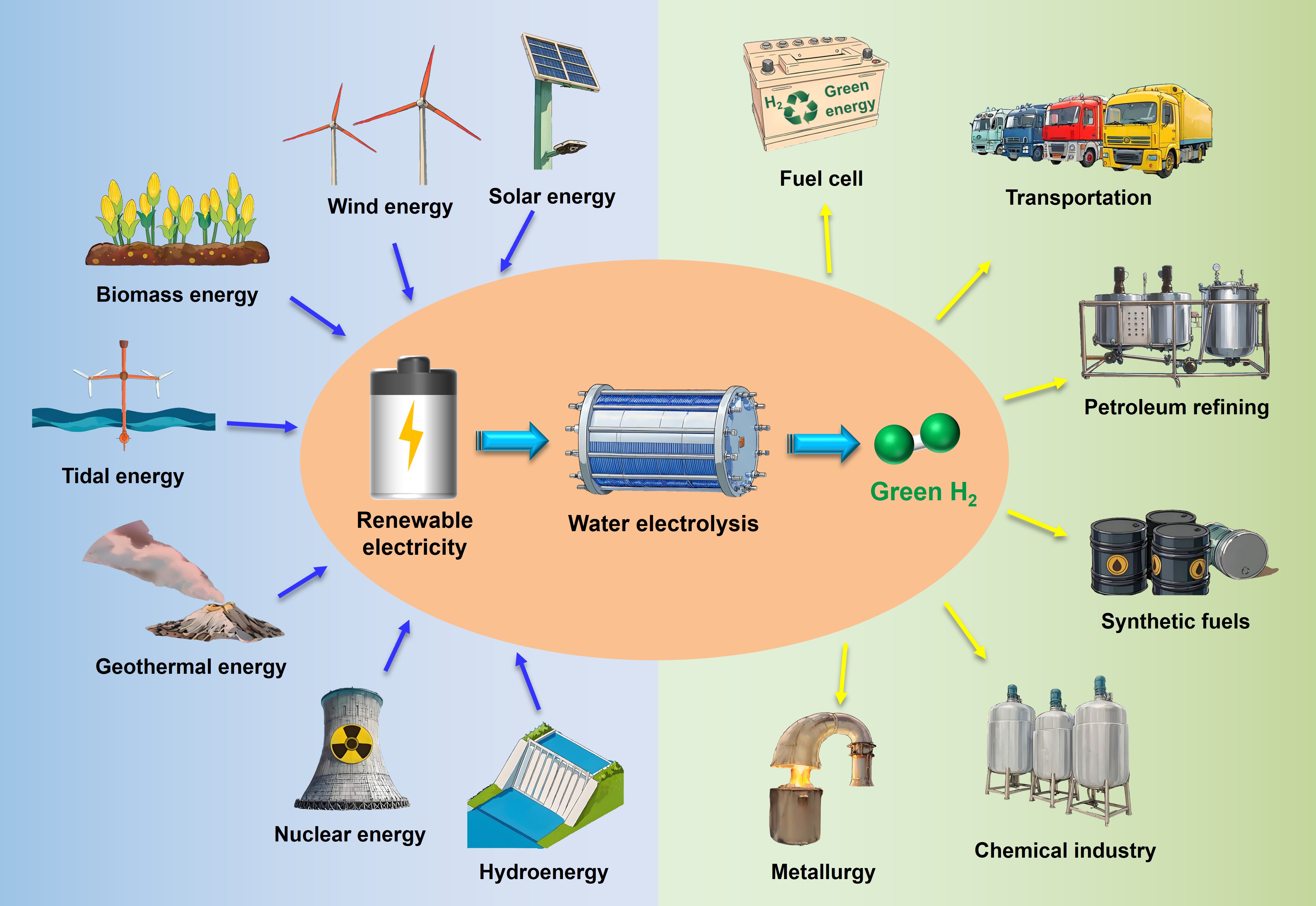
Fig. 1. Overview of renewable energy-powered water electrolysis for green H2 production. This schematic illustrates green H2 production using water electrolysis technology powered by electricity from diverse renewable energy sources, while highlighting the wide-ranging applications of H2 across different sectors.
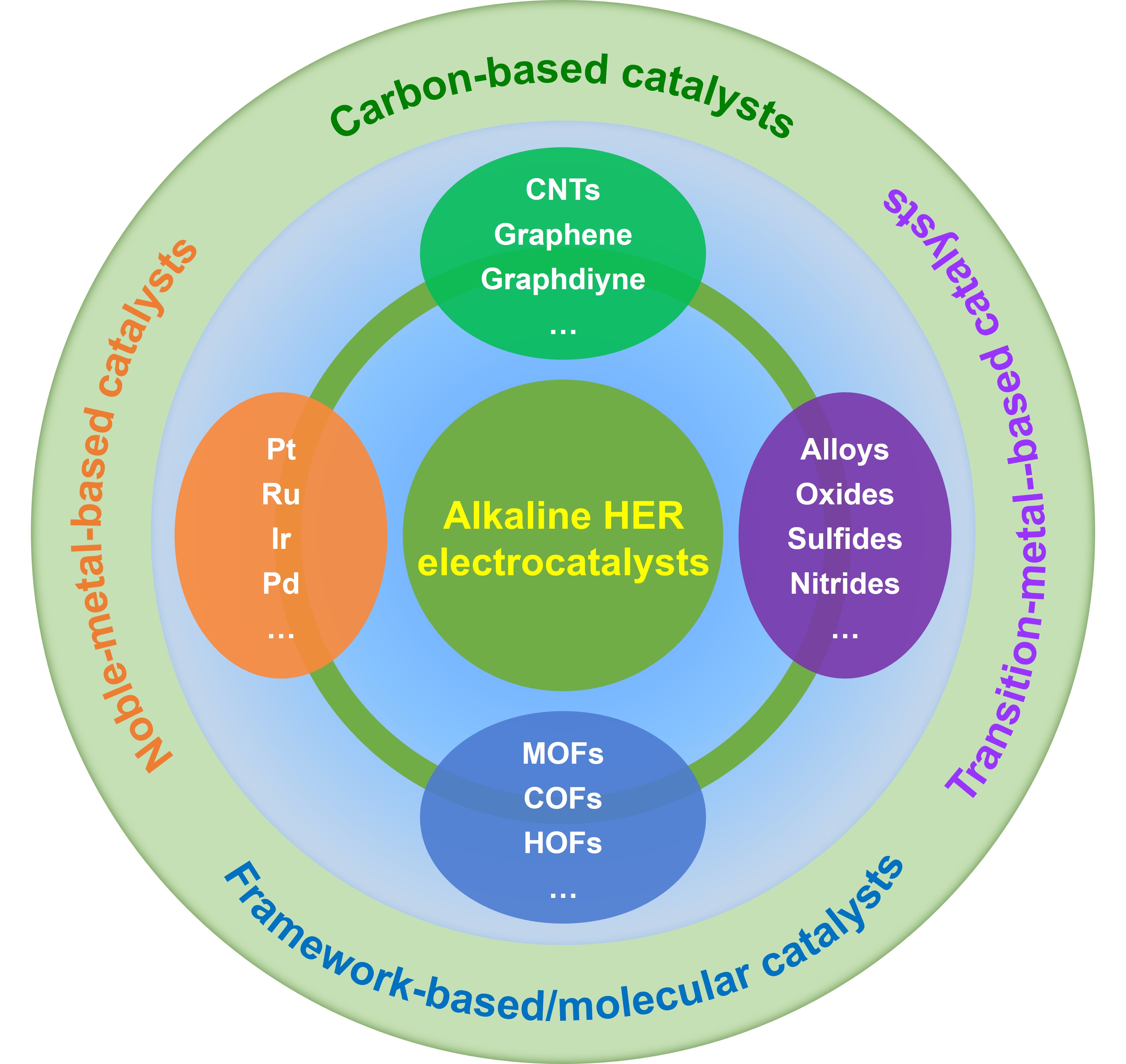
Fig. 2. Overview of major HER electrocatalyst classes and representative material systems.
| Category | Strategy | Main function | Advantage | Limitation |
|---|---|---|---|---|
| Morphological and interfacial engineering | self-supported electrodes | electron transfer mechanical stability | binder-free electrode | substrate limitation |
| Morphological and interfacial engineering | hierarchical porous structures | mass transport | electrolyte penetration bubble release | structural complexity |
| Morphological and interfacial engineering | surface wettability: hydrophilicity and aerophobicity | interfacial regulation | hydrophilicity/aerophobicity optimization | dynamic surface evolution |
| Intrinsic activity engineering | dual active site | H2O dissociation | kinetic acceleration | site optimization |
| Intrinsic activity engineering | element doping | electronic structure modulation | electronic tuning | dopant stability |
| Intrinsic activity engineering | defect | active site generation | electronic regulation | defect instability |
| Durability engineering | mechanical stability enhancement | catalyst retention | robust catalyst- substrate interaction | limited structural flexibility |
| Durability engineering | chemical stability enhancement | active phase stabilization | corrosion/reconstruction suppression | stability-activity trade-off |
Table 1 Representative engineering strategies for industrial-current-density HER electrocatalysts.
| Category | Strategy | Main function | Advantage | Limitation |
|---|---|---|---|---|
| Morphological and interfacial engineering | self-supported electrodes | electron transfer mechanical stability | binder-free electrode | substrate limitation |
| Morphological and interfacial engineering | hierarchical porous structures | mass transport | electrolyte penetration bubble release | structural complexity |
| Morphological and interfacial engineering | surface wettability: hydrophilicity and aerophobicity | interfacial regulation | hydrophilicity/aerophobicity optimization | dynamic surface evolution |
| Intrinsic activity engineering | dual active site | H2O dissociation | kinetic acceleration | site optimization |
| Intrinsic activity engineering | element doping | electronic structure modulation | electronic tuning | dopant stability |
| Intrinsic activity engineering | defect | active site generation | electronic regulation | defect instability |
| Durability engineering | mechanical stability enhancement | catalyst retention | robust catalyst- substrate interaction | limited structural flexibility |
| Durability engineering | chemical stability enhancement | active phase stabilization | corrosion/reconstruction suppression | stability-activity trade-off |
| Descriptor | Significance |
|---|---|
| Overpotential | potential required to drive HER |
| Overpotential at 500-1000 mA cm-2 | practical industrial-current-density activity |
| Tafel slope | reaction kinetics |
| Exchange current density | intrinsic catalytic activity |
| TOF | activity per active site |
| Mass activity | activity normalized by catalyst mass |
| ECSA | electrochemically accessible active area |
| Faradaic efficiency | H2 generation efficiency |
| Stability duration | long-term operational durability |
| Potential/current degradation rate | catalyst degradation behavior |
| Operating temperature | industrial relevance |
| Electrolyte concentration | realistic operating environment |
| Bubble behavior (coverage/release) | gas-transport efficiency |
| Electrolyzer performance (cell voltage) | device-level evaluation |
Table 2 Key performance descriptors for industrial-current-density HER electrocatalysts.
| Descriptor | Significance |
|---|---|
| Overpotential | potential required to drive HER |
| Overpotential at 500-1000 mA cm-2 | practical industrial-current-density activity |
| Tafel slope | reaction kinetics |
| Exchange current density | intrinsic catalytic activity |
| TOF | activity per active site |
| Mass activity | activity normalized by catalyst mass |
| ECSA | electrochemically accessible active area |
| Faradaic efficiency | H2 generation efficiency |
| Stability duration | long-term operational durability |
| Potential/current degradation rate | catalyst degradation behavior |
| Operating temperature | industrial relevance |
| Electrolyte concentration | realistic operating environment |
| Bubble behavior (coverage/release) | gas-transport efficiency |
| Electrolyzer performance (cell voltage) | device-level evaluation |
| Key strategy | Catalyst | Electrode | Electrolyte | η (mV) @500 mA cm-2 | η (mV) @1000 mA cm-2 | Stability | Stability configuration | Ref. |
|---|---|---|---|---|---|---|---|---|
| Self-supported electrodes | Ru-LC-Ni(OH)2 | Ni foam | 1.0 mol L-1 KOH | 102 | 136 | 500 h@500 mA cm-2 RT, 1.0 mol L-1 KOH + seawater | AEMWE | [ |
| Self-supported electrodes | NiFe2O4-HCOO- | Ni foam | 1.0 mol L-1 KOH + seawater | 397 | 435 | 120 h@500 mA cm-2 70 ℃, 1.0 mol L-1 KOH + seawater | AEMWE | [ |
| Self-supported electrodes | D-Ni3Mo/NF | Ni foam | 1.0 mol L-1 KOH | 208 | 232 | 100 h@500 mA cm-2, RT, 1.0 mol L-1 KOH + seawater | Half-cell HER | [ |
| Self-supported electrodes | RH-Ni9S8/RuS2 | Ni foam | 1.0 mol L-1 KOH | — | 180 | 500 h@1000 mA cm-2 RT, 1.0 mol L-1 KOH | Half-cell HER | [ |
| Self-supported electrodes | NiFeCoCuTi | Ni skeleton | 1.0 mol L-1 KOH | — | 134 | 240 h@-0.08 V RT, 1.0 mol L-1 KOH | Half-cell HER | [ |
| Self-supported electrodes | Cu NWs@NiFe-Pt3Ir | Cu foam | 1.0 mol L-1 KOH | 210 | 239 | 168 h@500 mA cm-2 RT, 1.0 mol L-1 KOH | Half-cell HER | [ |
| Self-supported electrodes | FeCoP/CF | Cu foam | 1.0 mol L-1 KOH | — | — | 14 h@1000 mA cm-2 RT, 1.0 mol L-1 KOH | AEMWE | [ |
| Self-supported electrodes | Mo2C(O)/MoO2 | Mo2C-based ceramics | 1.0 mol L-1 KOH | — | 212@1500 mA cm-2 | 260 h@50-1500 mA cm-2 RT, 1.0 mol L-1 KOH | Half-cell HER | [ |
| Self-supported electrodes | NiMo/Mo2N/ NC(500-R) | Ni foam | 1.0 mol L-1 KOH | 117 | 200.6 | 1000 h@1000 mA cm-2 RT, 1.0 mol L-1 KOH | Half-cell HER | [ |
| Self-supported electrodes | Ru-CoP/CC | Carbon cloth | 1.0 mol L-1 KOH | — | 357 | 60 h@100 mA cm-2 RT, 1.0 mol L-1 KOH | Half-cell HER | [ |
| Hierarchical porous structures | Ni4Mo@PDA | Ni foam | 1.0 mol L-1 KOH | 125 | 176@1500 mA cm-2 | 500 h@500 mA cm-2 70 ℃, 1.0 mol L-1 KOH | AEMWE | [ |
| Hierarchical porous structures | NiW | Ni mesh | 1.0 mol L-1 KOH | 198 | 264 | 200 h@500 mA cm-2 RT, 1.0 mol L-1 KOH | AEMWE | [ |
| Hierarchical porous structures | Ru-Ni2P/Fe2P | Ni foam | 1.0 mol L-1 KOH | — | 270 | 100 h@500 mA cm-2, 60 ℃, 1.0 mol L-1 KOH + seawater | AEMWE | [ |
| Hierarchical porous structures | NiCoP@FeNi LDH/NF | Ni foam | 1.0 mol L-1 KOH | 181 | 195 | 30 h@100 mA cm-2 RT, 1.0 mol L-1 KOH | OWS | [ |
| Hierarchical porous structures | Ni@NCW | carbonized wood | 1.0 mol L-1 KOH | 385 | — | 16 h@1000 mA cm-2 RT, 1.0 mol L-1 KOH | AEMWE | [ |
| Hierarchical porous structures | MoNi/NiMoOx | Ni foam | 1.0 mol L-1 KOH | — | 139@1900 mA cm-2 | 1600 h@200 mA cm-2 RT, 1.0 mol L-1 KOH | AEMWE | [ |
| Hierarchical porous structures | C-Ni1-xO | 3D printed Ni | 1.0 mol L-1 KOH | — | 245 | 16 h@2.2 V 80 ℃, 1.0 mol L-1 KOH | OWS | [ |
| Hierarchical porous structures | Fe-NiWB/PW | wood skeleton | 1.0 mol L-1 KOH | 270 | — | 2000 h@500 mA cm-2, 60 ℃, 1.0 mol L-1 KOH + seawater | AEMWE | [ |
| Hierarchical porous structures | MoNi4@NiO/PN | Ni mesh | 1.0 mol L-1 KOH | — | 329 | 400 h@500 mA cm-2 RT, 1.0 mol L-1 KOH | AEMWE | [ |
| Hierarchical porous structures | Ni/NixSy | Ni foam | 1.0 mol L-1 KOH | 121 | — | 120 h@500 mA cm-2 85 ℃, 30% KOH | OWS | [ |
| Surface wettability: hydrophilicity and aerophobicity | Ru/(Fe,Ni)(OH)2/NF | Ni foam | 1.0 mol L-1 KOH | — | 152 | 20 h@500 mA cm-2 RT, 1.0 mol L-1 KOH | OWS | [ |
| Surface wettability: hydrophilicity and aerophobicity | Ni(OH)x/Ni3S2 | Ni foam | 1.0 mol L-1 KOH | 193 | 238 | 1000 h@360 mA cm-2 RT, 1.0 mol L-1 KOH | half-cell HER | [ |
| Surface wettability: hydrophilicity and aerophobicity | NiP2@MoO2/ Co(Ni)MoO4 | Ni foam | 1.0 mol L-1 KOH | — | 297 | 650 h@200 mA cm-2 RT, 1.0 mol L-1 KOH | half-cell HER | [ |
| Surface wettability: hydrophilicity and aerophobicity | PBSCF-Ni3S2 | Ni foam | 1.0 mol L-1 KOH | — | 249 | 500 h@500 mA cm-2 RT, 1.0 mol L-1 KOH | OWS | [ |
| Surface wettability: hydrophilicity and aerophobicity | F-CoxFey(POn)z/IF | Fe foam | 1.0 mol L-1 KOH | — | 276 | 500 h@1000 mA cm-2 RT, 1.0 mol L-1 KOH | OWS | [ |
| Surface wettability: hydrophilicity and aerophobicity | Pt@NMO-N2 | Ni foam | 1.0 mol L-1 KOH + seawater | 122 | 180 | 300 h@500 mA cm-2 60 ℃, 1.0 mol L-1 KOH | AEMWE | [ |
| Surface wettability: hydrophilicity and aerophobicity | Ni/(Ni,Co)3Nv | Ni foam | 1.0 mol L-1 KOH + seawater | — | 297 | 100 h@500 mA cm-2, RT, 1.0 mol L-1 KOH + seawater | AEMWE | [ |
| Surface wettability: hydrophilicity and aerophobicity | LC-Mn2Mo3O8 @Ni/NF | Ni foam | 1.0 mol L-1 KOH | — | 310.6 | 140 h@500 mA cm-2 30 ℃, 1.0 mol L-1 KOH | half-cell HER | [ |
| Surface wettability: hydrophilicity and aerophobicity | NiFeP/Ni3S2 | Ni foam | 1.0 mol L-1 KOH | — | — | 270 h@100 mA cm-2 RT, 1.0 M KOH + seawater | AEMWE | [ |
| Surface wettability: hydrophilicity and aerophobicity | NiFe-O NAs | Fe foam | 1.0 mol L-1 KOH + seawater | 252.4 | 311.2 | 200 h@1000 mA cm-2, 60 ℃, 6.0 mol L-1 KOH + seawater | OWS | [ |
| Dual active site | S-NiBDC | Ni foam | 1.0 mol L-1 KOH | 285 | 310 | 150 h@1000 mA cm-2 RT, 1.0 mol L-1 KOH | half-cell HER | [ |
| Dual active site | Ni3S2/Cr2S3 | Ni foam | 1.0 mol L-1 KOH | — | 227 | 35 h@1000 mA cm-2 60 ℃, 3.0 M KOH | AEMWE | [ |
| Dual active site | RuCo@RuSACoSA-NMC | carbon cloth | 1.0 mol L-1 KOH | — | 225 | 576 h@1000 mA cm-2 RT, 1.0 mol L-1 KOH | half-cell HER | [ |
| Dual active site | Ag(S)@NiO/NF | Ni foam | 1.0 mol L-1 KOH | 157.2 | 167 | 120 h@1490 mA cm-2 RT, 1.0 mol L-1 KOH | half-cell HER | [ |
| Dual active site | PtNiFe-D15 | Ni foam | 1.0 mol L-1 KOH + seawater | 130 | 217 | 120 h@1000 mA cm-2, RT, 1.0 mol L-1 KOH + seawater | AEMWE | [ |
| Dual active site | Ni@CF16 | Cu foam | 1.0 mol L-1 KOH | ~265 | — | 200 h@1000 mA cm-2 RT, 1.0 mol L-1 KOH | AEMWE | [ |
| Dual active site | Ru1-Mo2C | Ni foam | 1.0 mol L-1 KOH | — | — | 200 h@500 mA cm-2 65 ℃, 1.0 mol L-1 KOH | AEMWE | [ |
| Dual active site | Ru-Ni3N | Ni foam | 1.0 mol L-1 KOH | — | ~200 | 550 h@500 mA cm-2 RT, 1.0 mol L-1 KOH | AEMWE | [ |
| Dual active site | Pt-HEA-cluster/CeO2/C | Porous carbon | 1.0 mol L-1 KOH | — | ~90 | 500 h@500 mA cm-2 RT, 1.0 mol L-1 KOH | AEMWE | [ |
| Dual active site | HEANS | — | 1.0 mol L-1 KOH | — | — | 2500 h@1000 mA cm-2 80 ℃, 1.0 mol L-1 KOH | AEMWE | [ |
| Element doping | F-Co2P/Fe2P/IF | Fe form | 1.0 mol L-1 KOH | 229.8 | 260.5 | 1 h@2000 mA cm-2 RT, 6.0 mol L-1 KOH | half-cell HER | [ |
| Element doping | P-Fe3O4/IF | Fe foam | 1.0 mol L-1 KOH | 200@409 mA cm-2 | — | 1000 h@1000 mA cm-2 RT, 1.0 mol L-1 KOH | OWS | [ |
| Element doping | NiCoCu-Mo0.078/CF | Cu foam | 1.0 mol L-1 KOH | — | 212 | 100 h@1000 mA cm-2 RT, 1.0 mol L-1 KOH | half-cell HER | [ |
| Element doping | Ru/P-Fe3O4@IF | Fe foam | 1.0 mol L-1 KOH + seawater | — | 144 | 115 h@500 mA cm-2, 60 ℃, 1.0 mol L-1 KOH + seawater | AEMWE | [ |
| Element doping | Ru/S-Co3O4 | Ni foam | 1.0 mol L-1 KOH | 200 | 287 | 1300 h@1000 mA cm-2 70 ℃, 1.0 mol L-1 KOH | AEMWE | [ |
| Element doping | Y2O3-Co3O4/PCC | Carbon cloth | 1.0 mol L-1 KOH + seawater | — | 346 | 350 h@300 mA cm-2, RT, 1.0 mol L-1 KOH + seawater | AEMWE | [ |
| Element doping | NFA-CA | Ni plate | 1.0 mol L-1 KOH | — | — | 1000 h@1000 mA cm-2 RT, 1.0 mol L-1 KOH | AEMWE | [ |
| Element doping | Ru-NiV LDH | Ni foam | 1.0 mol L-1 KOH | 195 | — | 500 h@500 mA cm-2 RT, 1.0 mol L-1 KOH | AEMWE | [ |
| Element doping | S-NiFe-LDH/NF | Ni foam | 1.0 mol L-1 KOH + seawater | — | 362 | 150 h@100-1000 mA cm-2 RT, 1.0 mol L-1 KOH | OWS | [ |
| Element doping | Mo,P-CoS2/CW | carbonized wood | 1.0 mol L-1 KOH | — | 289 | 100 h@1000 mA cm-2 RT, 1.0 mol L-1 KOH | half-cell HER | [ |
| Defect | CoxPv@NC | Ni foam | 1.0 mol L-1 KOH | — | 260 | 100 h@1000 mA cm-2, 60 ℃, 6.0 mol L-1 KOH + seawater | OWS | [ |
| Defect | HSD-PtNi/NF | Ni foam | 1.0 mol L-1 KOH | 46 | 63 | 300 h@1000 mA cm-2 RT, 1.0 mol L-1 KOH | half-cell HER | [ |
| Defect | MCu0.10-BNiMo | Ni foam | 1.0 mol L-1 KOH | 366 | 444 | 10 h@2000 mA cm-2 RT, 1.0 mol L-1 KOH | AEMWE | [ |
| Defect | Ru/NiMoO4-x | Ni foam | 1.0 mol L-1 KOH + seawater | — | 206 @3000 mA cm-2 | 750 h@500 mA cm-2, RT, 1.0 mol L-1 KOH + seawater | OWS | [ |
| Defect | Ru/MEOx/NC | carbon paper | 1.0 mol L-1 KOH | — | — | 1000 h@700 mA cm-2 RT, 1.0 mol L-1 KOH | AEMWE | [ |
| Defect | Ru/MoB-Bv | Ni foam | 1.0 mol L-1 KOH + seawater | ~100 | — | 100 h@500 mA cm-2, RT, 1.0 mol L-1 KOH + seawater | AEMWE | [ |
| Defect | Y2O2.13@GP | graphite plate | 1.0 mol L-1 KOH | 266 | — | 100 h@1000 mA cm-2 60 ℃, 6.0 mol L-1 KOH | AEMWE | [ |
| Defect | NiMoFe@MoO2 | Ni foam | 1.0 mol L-1 KOH | 175 | 272 | 1000 h@500 mA cm-2 60 ℃, 1.0 mol L-1 KOH | AEMWE | [ |
| Defect | Fe9Ni9S16-(Ni,Fe)S/PNFF | carbon cloth | 1.0 mol L-1 KOH | — | 420 @2000 mA cm-2 | 200 h@1000 mA cm-2 60 ℃, 6.0 mol L-1 KOH | AEMWE | [ |
| Defect | (FeCoNiB0.75)97Pt3 | Cu foil | 1.0 mol L-1 KOH | — | 104 | 200 h@100 mA cm-2 RT, 1.0 mol L-1 KOH | AEMWE | [ |
| Mechanical stability enhancement | CuMo6S8/Cu | Cu foam | 1.0 mol L-1 KOH | — | 320 | 300 h@500-2500 mA cm-2 RT, 1.0 mol L-1 KOH | half-cell HER | [ |
| Mechanical stability enhancement | Mo2C/MoC/CNT | CNT film | 1.0 mol L-1 KOH | 201 | 233 | 336 h@1000 mA cm-2 RT, 1.0 mol L-1 KOH | half-cell HER | [ |
| Mechanical stability enhancement | CAPist-L1 | Ni foam | 1.0 mol L-1 KOH | — | — | 1500 h@1000 mA cm-2 80 ℃, 1.0 mol L-1 KOH | AEMWE | [ |
| Mechanical stability enhancement | Ru NPs/TiN | carbon fiber paper | 1.0 mol L-1 KOH | — | — | 1000 h@5000 mA cm-2 80 ℃, 30% KOH | AEMWE | [ |
| Mechanical stability enhancement | h-Ni/MoO2 | Ni foam | 1.0 mol L-1 KOH | — | 70.9 ± 4.5 | 2500 h@1000 mA cm-2 80 ℃, 1.0 mol L-1 KOH | AEMWE | [ |
| Mechanical stability enhancement | porous Co-P | Co foam | 1.0 mol L-1 KOH | 243 | 290 | 4000 h@1000 mA cm-2 RT, 1.0 mol L-1 KOH | AEMWE | [ |
| Mechanical stability enhancement | 3D AEI-CEI-NiFe /Nf | Ni foam | 1.0 mol L-1 KOH | — | — | 800 h@10000 mA cm-2 80 ℃, 1.0 mol L-1 KOH | AEMWE | [ |
| Mechanical stability enhancement | P-Pt/NiMoO4@NF | Ni foam | 1.0 mol L-1 KOH + seawater | — | 80 | 120 h@500 mA cm-2, 60 ℃, 1.0 mol L-1 KOH + seawater | AEMWE | [ |
| Mechanical stability enhancement | NiMo/Int/NF | Ni foam | 1.0 mol L-1 KOH | — | 80.2 ± 3.53 | 3000 h@1000 mA cm-2 RT, 1.0 mol L-1 KOH | AEMWE | [ |
| Mechanical stability enhancement | Int-Ni/MoO2 | Ni foam | 1.0 mol L-1 KOH | — | 73.2 ± 14.2 | 1000 h@1000 mA cm-2 60 ℃, 1.0 mol L-1 KOH | AEMWE | [ |
| Chemical stability enhancement | Ru98Ir2-350 | carbon paper | 1.0 mol L-1 KOH | 94 | 121 | 1500 h@1000 mA cm-2 RT, 1.0 mol L-1 KOH | half-cell HER | [ |
| Chemical stability enhancement | Mn0.05Ru0.95O2 | carbon paper | 1.0 mol L-1 KOH | — | 269 | 500 h@1000 mA cm-2 RT, 1.0 mol L-1 KOH | half-cell HER | [ |
| Chemical stability enhancement | NiCoP/NiCoSx /NF | Ni foam | 1.0 mol L-1 KOH | 222 | — | 40 h@500 mA cm-2 40-70 ℃, 30% KOH | half-cell HER | [ |
| Chemical stability enhancement | MoOx/A-Ni3S2 | Ni foam | 1.0 mol L-1 KOH | — | 145 | 2500 h@2000 mA cm-2 40 ℃, 1.0 mol L-1 KOH | AEMWE | [ |
| Chemical stability enhancement | UP-RuNiSAs/C | carbon fiber paper | 1.0 mol L-1 KOH | — | 253 | 250 h@1000 mA cm-2 RT, 1.0 mol L-1 KOH | AEMWE | [ |
| Chemical stability enhancement | Os-Ni4Mo/MoO2 | Ni foam | 1.0 mol L-1 KOH + seawater | 113 | 150 | 1100 h@500 mA cm-2, RT, 1.0 mol L-1 KOH + seawater | OWS | [ |
| Chemical stability enhancement | Ni9.5Co0.5-S-FeOx | Cu foam | 1.0 mol L-1 KOH | 169 | 230 | 325 h@1000 mA cm-2, RT, 1.0 mol L-1 KOH + seawater | OWS | [ |
| Chemical stability enhancement | NA-Ru3Ni | Gas diffusion layer | 1.0 mol L-1 KOH | — | 168 | 2000 h@1000 mA cm-2 60 ℃, 1.0 mol L-1 KOH | AEMWE | [ |
| Chemical stability enhancement | Cu-Co-P/NF | Ni foam | 1.0 mol L-1 KOH | 196 | — | 220 h@500 mA cm-2 80 ℃, 6.0 mol L-1 KOH | OWS | [ |
| Chemical stability enhancement | Ni2P-NiMoOx/NF | Ni foam | 1.0 mol L-1 KOH | 297 | — | 100 h@400 mA cm-2 65 ℃, 30% KOH | AEMWE | [ |
Table 3 Representative electrocatalysts for industrial-current-density alkaline HER classified by different engineering strategies.
| Key strategy | Catalyst | Electrode | Electrolyte | η (mV) @500 mA cm-2 | η (mV) @1000 mA cm-2 | Stability | Stability configuration | Ref. |
|---|---|---|---|---|---|---|---|---|
| Self-supported electrodes | Ru-LC-Ni(OH)2 | Ni foam | 1.0 mol L-1 KOH | 102 | 136 | 500 h@500 mA cm-2 RT, 1.0 mol L-1 KOH + seawater | AEMWE | [ |
| Self-supported electrodes | NiFe2O4-HCOO- | Ni foam | 1.0 mol L-1 KOH + seawater | 397 | 435 | 120 h@500 mA cm-2 70 ℃, 1.0 mol L-1 KOH + seawater | AEMWE | [ |
| Self-supported electrodes | D-Ni3Mo/NF | Ni foam | 1.0 mol L-1 KOH | 208 | 232 | 100 h@500 mA cm-2, RT, 1.0 mol L-1 KOH + seawater | Half-cell HER | [ |
| Self-supported electrodes | RH-Ni9S8/RuS2 | Ni foam | 1.0 mol L-1 KOH | — | 180 | 500 h@1000 mA cm-2 RT, 1.0 mol L-1 KOH | Half-cell HER | [ |
| Self-supported electrodes | NiFeCoCuTi | Ni skeleton | 1.0 mol L-1 KOH | — | 134 | 240 h@-0.08 V RT, 1.0 mol L-1 KOH | Half-cell HER | [ |
| Self-supported electrodes | Cu NWs@NiFe-Pt3Ir | Cu foam | 1.0 mol L-1 KOH | 210 | 239 | 168 h@500 mA cm-2 RT, 1.0 mol L-1 KOH | Half-cell HER | [ |
| Self-supported electrodes | FeCoP/CF | Cu foam | 1.0 mol L-1 KOH | — | — | 14 h@1000 mA cm-2 RT, 1.0 mol L-1 KOH | AEMWE | [ |
| Self-supported electrodes | Mo2C(O)/MoO2 | Mo2C-based ceramics | 1.0 mol L-1 KOH | — | 212@1500 mA cm-2 | 260 h@50-1500 mA cm-2 RT, 1.0 mol L-1 KOH | Half-cell HER | [ |
| Self-supported electrodes | NiMo/Mo2N/ NC(500-R) | Ni foam | 1.0 mol L-1 KOH | 117 | 200.6 | 1000 h@1000 mA cm-2 RT, 1.0 mol L-1 KOH | Half-cell HER | [ |
| Self-supported electrodes | Ru-CoP/CC | Carbon cloth | 1.0 mol L-1 KOH | — | 357 | 60 h@100 mA cm-2 RT, 1.0 mol L-1 KOH | Half-cell HER | [ |
| Hierarchical porous structures | Ni4Mo@PDA | Ni foam | 1.0 mol L-1 KOH | 125 | 176@1500 mA cm-2 | 500 h@500 mA cm-2 70 ℃, 1.0 mol L-1 KOH | AEMWE | [ |
| Hierarchical porous structures | NiW | Ni mesh | 1.0 mol L-1 KOH | 198 | 264 | 200 h@500 mA cm-2 RT, 1.0 mol L-1 KOH | AEMWE | [ |
| Hierarchical porous structures | Ru-Ni2P/Fe2P | Ni foam | 1.0 mol L-1 KOH | — | 270 | 100 h@500 mA cm-2, 60 ℃, 1.0 mol L-1 KOH + seawater | AEMWE | [ |
| Hierarchical porous structures | NiCoP@FeNi LDH/NF | Ni foam | 1.0 mol L-1 KOH | 181 | 195 | 30 h@100 mA cm-2 RT, 1.0 mol L-1 KOH | OWS | [ |
| Hierarchical porous structures | Ni@NCW | carbonized wood | 1.0 mol L-1 KOH | 385 | — | 16 h@1000 mA cm-2 RT, 1.0 mol L-1 KOH | AEMWE | [ |
| Hierarchical porous structures | MoNi/NiMoOx | Ni foam | 1.0 mol L-1 KOH | — | 139@1900 mA cm-2 | 1600 h@200 mA cm-2 RT, 1.0 mol L-1 KOH | AEMWE | [ |
| Hierarchical porous structures | C-Ni1-xO | 3D printed Ni | 1.0 mol L-1 KOH | — | 245 | 16 h@2.2 V 80 ℃, 1.0 mol L-1 KOH | OWS | [ |
| Hierarchical porous structures | Fe-NiWB/PW | wood skeleton | 1.0 mol L-1 KOH | 270 | — | 2000 h@500 mA cm-2, 60 ℃, 1.0 mol L-1 KOH + seawater | AEMWE | [ |
| Hierarchical porous structures | MoNi4@NiO/PN | Ni mesh | 1.0 mol L-1 KOH | — | 329 | 400 h@500 mA cm-2 RT, 1.0 mol L-1 KOH | AEMWE | [ |
| Hierarchical porous structures | Ni/NixSy | Ni foam | 1.0 mol L-1 KOH | 121 | — | 120 h@500 mA cm-2 85 ℃, 30% KOH | OWS | [ |
| Surface wettability: hydrophilicity and aerophobicity | Ru/(Fe,Ni)(OH)2/NF | Ni foam | 1.0 mol L-1 KOH | — | 152 | 20 h@500 mA cm-2 RT, 1.0 mol L-1 KOH | OWS | [ |
| Surface wettability: hydrophilicity and aerophobicity | Ni(OH)x/Ni3S2 | Ni foam | 1.0 mol L-1 KOH | 193 | 238 | 1000 h@360 mA cm-2 RT, 1.0 mol L-1 KOH | half-cell HER | [ |
| Surface wettability: hydrophilicity and aerophobicity | NiP2@MoO2/ Co(Ni)MoO4 | Ni foam | 1.0 mol L-1 KOH | — | 297 | 650 h@200 mA cm-2 RT, 1.0 mol L-1 KOH | half-cell HER | [ |
| Surface wettability: hydrophilicity and aerophobicity | PBSCF-Ni3S2 | Ni foam | 1.0 mol L-1 KOH | — | 249 | 500 h@500 mA cm-2 RT, 1.0 mol L-1 KOH | OWS | [ |
| Surface wettability: hydrophilicity and aerophobicity | F-CoxFey(POn)z/IF | Fe foam | 1.0 mol L-1 KOH | — | 276 | 500 h@1000 mA cm-2 RT, 1.0 mol L-1 KOH | OWS | [ |
| Surface wettability: hydrophilicity and aerophobicity | Pt@NMO-N2 | Ni foam | 1.0 mol L-1 KOH + seawater | 122 | 180 | 300 h@500 mA cm-2 60 ℃, 1.0 mol L-1 KOH | AEMWE | [ |
| Surface wettability: hydrophilicity and aerophobicity | Ni/(Ni,Co)3Nv | Ni foam | 1.0 mol L-1 KOH + seawater | — | 297 | 100 h@500 mA cm-2, RT, 1.0 mol L-1 KOH + seawater | AEMWE | [ |
| Surface wettability: hydrophilicity and aerophobicity | LC-Mn2Mo3O8 @Ni/NF | Ni foam | 1.0 mol L-1 KOH | — | 310.6 | 140 h@500 mA cm-2 30 ℃, 1.0 mol L-1 KOH | half-cell HER | [ |
| Surface wettability: hydrophilicity and aerophobicity | NiFeP/Ni3S2 | Ni foam | 1.0 mol L-1 KOH | — | — | 270 h@100 mA cm-2 RT, 1.0 M KOH + seawater | AEMWE | [ |
| Surface wettability: hydrophilicity and aerophobicity | NiFe-O NAs | Fe foam | 1.0 mol L-1 KOH + seawater | 252.4 | 311.2 | 200 h@1000 mA cm-2, 60 ℃, 6.0 mol L-1 KOH + seawater | OWS | [ |
| Dual active site | S-NiBDC | Ni foam | 1.0 mol L-1 KOH | 285 | 310 | 150 h@1000 mA cm-2 RT, 1.0 mol L-1 KOH | half-cell HER | [ |
| Dual active site | Ni3S2/Cr2S3 | Ni foam | 1.0 mol L-1 KOH | — | 227 | 35 h@1000 mA cm-2 60 ℃, 3.0 M KOH | AEMWE | [ |
| Dual active site | RuCo@RuSACoSA-NMC | carbon cloth | 1.0 mol L-1 KOH | — | 225 | 576 h@1000 mA cm-2 RT, 1.0 mol L-1 KOH | half-cell HER | [ |
| Dual active site | Ag(S)@NiO/NF | Ni foam | 1.0 mol L-1 KOH | 157.2 | 167 | 120 h@1490 mA cm-2 RT, 1.0 mol L-1 KOH | half-cell HER | [ |
| Dual active site | PtNiFe-D15 | Ni foam | 1.0 mol L-1 KOH + seawater | 130 | 217 | 120 h@1000 mA cm-2, RT, 1.0 mol L-1 KOH + seawater | AEMWE | [ |
| Dual active site | Ni@CF16 | Cu foam | 1.0 mol L-1 KOH | ~265 | — | 200 h@1000 mA cm-2 RT, 1.0 mol L-1 KOH | AEMWE | [ |
| Dual active site | Ru1-Mo2C | Ni foam | 1.0 mol L-1 KOH | — | — | 200 h@500 mA cm-2 65 ℃, 1.0 mol L-1 KOH | AEMWE | [ |
| Dual active site | Ru-Ni3N | Ni foam | 1.0 mol L-1 KOH | — | ~200 | 550 h@500 mA cm-2 RT, 1.0 mol L-1 KOH | AEMWE | [ |
| Dual active site | Pt-HEA-cluster/CeO2/C | Porous carbon | 1.0 mol L-1 KOH | — | ~90 | 500 h@500 mA cm-2 RT, 1.0 mol L-1 KOH | AEMWE | [ |
| Dual active site | HEANS | — | 1.0 mol L-1 KOH | — | — | 2500 h@1000 mA cm-2 80 ℃, 1.0 mol L-1 KOH | AEMWE | [ |
| Element doping | F-Co2P/Fe2P/IF | Fe form | 1.0 mol L-1 KOH | 229.8 | 260.5 | 1 h@2000 mA cm-2 RT, 6.0 mol L-1 KOH | half-cell HER | [ |
| Element doping | P-Fe3O4/IF | Fe foam | 1.0 mol L-1 KOH | 200@409 mA cm-2 | — | 1000 h@1000 mA cm-2 RT, 1.0 mol L-1 KOH | OWS | [ |
| Element doping | NiCoCu-Mo0.078/CF | Cu foam | 1.0 mol L-1 KOH | — | 212 | 100 h@1000 mA cm-2 RT, 1.0 mol L-1 KOH | half-cell HER | [ |
| Element doping | Ru/P-Fe3O4@IF | Fe foam | 1.0 mol L-1 KOH + seawater | — | 144 | 115 h@500 mA cm-2, 60 ℃, 1.0 mol L-1 KOH + seawater | AEMWE | [ |
| Element doping | Ru/S-Co3O4 | Ni foam | 1.0 mol L-1 KOH | 200 | 287 | 1300 h@1000 mA cm-2 70 ℃, 1.0 mol L-1 KOH | AEMWE | [ |
| Element doping | Y2O3-Co3O4/PCC | Carbon cloth | 1.0 mol L-1 KOH + seawater | — | 346 | 350 h@300 mA cm-2, RT, 1.0 mol L-1 KOH + seawater | AEMWE | [ |
| Element doping | NFA-CA | Ni plate | 1.0 mol L-1 KOH | — | — | 1000 h@1000 mA cm-2 RT, 1.0 mol L-1 KOH | AEMWE | [ |
| Element doping | Ru-NiV LDH | Ni foam | 1.0 mol L-1 KOH | 195 | — | 500 h@500 mA cm-2 RT, 1.0 mol L-1 KOH | AEMWE | [ |
| Element doping | S-NiFe-LDH/NF | Ni foam | 1.0 mol L-1 KOH + seawater | — | 362 | 150 h@100-1000 mA cm-2 RT, 1.0 mol L-1 KOH | OWS | [ |
| Element doping | Mo,P-CoS2/CW | carbonized wood | 1.0 mol L-1 KOH | — | 289 | 100 h@1000 mA cm-2 RT, 1.0 mol L-1 KOH | half-cell HER | [ |
| Defect | CoxPv@NC | Ni foam | 1.0 mol L-1 KOH | — | 260 | 100 h@1000 mA cm-2, 60 ℃, 6.0 mol L-1 KOH + seawater | OWS | [ |
| Defect | HSD-PtNi/NF | Ni foam | 1.0 mol L-1 KOH | 46 | 63 | 300 h@1000 mA cm-2 RT, 1.0 mol L-1 KOH | half-cell HER | [ |
| Defect | MCu0.10-BNiMo | Ni foam | 1.0 mol L-1 KOH | 366 | 444 | 10 h@2000 mA cm-2 RT, 1.0 mol L-1 KOH | AEMWE | [ |
| Defect | Ru/NiMoO4-x | Ni foam | 1.0 mol L-1 KOH + seawater | — | 206 @3000 mA cm-2 | 750 h@500 mA cm-2, RT, 1.0 mol L-1 KOH + seawater | OWS | [ |
| Defect | Ru/MEOx/NC | carbon paper | 1.0 mol L-1 KOH | — | — | 1000 h@700 mA cm-2 RT, 1.0 mol L-1 KOH | AEMWE | [ |
| Defect | Ru/MoB-Bv | Ni foam | 1.0 mol L-1 KOH + seawater | ~100 | — | 100 h@500 mA cm-2, RT, 1.0 mol L-1 KOH + seawater | AEMWE | [ |
| Defect | Y2O2.13@GP | graphite plate | 1.0 mol L-1 KOH | 266 | — | 100 h@1000 mA cm-2 60 ℃, 6.0 mol L-1 KOH | AEMWE | [ |
| Defect | NiMoFe@MoO2 | Ni foam | 1.0 mol L-1 KOH | 175 | 272 | 1000 h@500 mA cm-2 60 ℃, 1.0 mol L-1 KOH | AEMWE | [ |
| Defect | Fe9Ni9S16-(Ni,Fe)S/PNFF | carbon cloth | 1.0 mol L-1 KOH | — | 420 @2000 mA cm-2 | 200 h@1000 mA cm-2 60 ℃, 6.0 mol L-1 KOH | AEMWE | [ |
| Defect | (FeCoNiB0.75)97Pt3 | Cu foil | 1.0 mol L-1 KOH | — | 104 | 200 h@100 mA cm-2 RT, 1.0 mol L-1 KOH | AEMWE | [ |
| Mechanical stability enhancement | CuMo6S8/Cu | Cu foam | 1.0 mol L-1 KOH | — | 320 | 300 h@500-2500 mA cm-2 RT, 1.0 mol L-1 KOH | half-cell HER | [ |
| Mechanical stability enhancement | Mo2C/MoC/CNT | CNT film | 1.0 mol L-1 KOH | 201 | 233 | 336 h@1000 mA cm-2 RT, 1.0 mol L-1 KOH | half-cell HER | [ |
| Mechanical stability enhancement | CAPist-L1 | Ni foam | 1.0 mol L-1 KOH | — | — | 1500 h@1000 mA cm-2 80 ℃, 1.0 mol L-1 KOH | AEMWE | [ |
| Mechanical stability enhancement | Ru NPs/TiN | carbon fiber paper | 1.0 mol L-1 KOH | — | — | 1000 h@5000 mA cm-2 80 ℃, 30% KOH | AEMWE | [ |
| Mechanical stability enhancement | h-Ni/MoO2 | Ni foam | 1.0 mol L-1 KOH | — | 70.9 ± 4.5 | 2500 h@1000 mA cm-2 80 ℃, 1.0 mol L-1 KOH | AEMWE | [ |
| Mechanical stability enhancement | porous Co-P | Co foam | 1.0 mol L-1 KOH | 243 | 290 | 4000 h@1000 mA cm-2 RT, 1.0 mol L-1 KOH | AEMWE | [ |
| Mechanical stability enhancement | 3D AEI-CEI-NiFe /Nf | Ni foam | 1.0 mol L-1 KOH | — | — | 800 h@10000 mA cm-2 80 ℃, 1.0 mol L-1 KOH | AEMWE | [ |
| Mechanical stability enhancement | P-Pt/NiMoO4@NF | Ni foam | 1.0 mol L-1 KOH + seawater | — | 80 | 120 h@500 mA cm-2, 60 ℃, 1.0 mol L-1 KOH + seawater | AEMWE | [ |
| Mechanical stability enhancement | NiMo/Int/NF | Ni foam | 1.0 mol L-1 KOH | — | 80.2 ± 3.53 | 3000 h@1000 mA cm-2 RT, 1.0 mol L-1 KOH | AEMWE | [ |
| Mechanical stability enhancement | Int-Ni/MoO2 | Ni foam | 1.0 mol L-1 KOH | — | 73.2 ± 14.2 | 1000 h@1000 mA cm-2 60 ℃, 1.0 mol L-1 KOH | AEMWE | [ |
| Chemical stability enhancement | Ru98Ir2-350 | carbon paper | 1.0 mol L-1 KOH | 94 | 121 | 1500 h@1000 mA cm-2 RT, 1.0 mol L-1 KOH | half-cell HER | [ |
| Chemical stability enhancement | Mn0.05Ru0.95O2 | carbon paper | 1.0 mol L-1 KOH | — | 269 | 500 h@1000 mA cm-2 RT, 1.0 mol L-1 KOH | half-cell HER | [ |
| Chemical stability enhancement | NiCoP/NiCoSx /NF | Ni foam | 1.0 mol L-1 KOH | 222 | — | 40 h@500 mA cm-2 40-70 ℃, 30% KOH | half-cell HER | [ |
| Chemical stability enhancement | MoOx/A-Ni3S2 | Ni foam | 1.0 mol L-1 KOH | — | 145 | 2500 h@2000 mA cm-2 40 ℃, 1.0 mol L-1 KOH | AEMWE | [ |
| Chemical stability enhancement | UP-RuNiSAs/C | carbon fiber paper | 1.0 mol L-1 KOH | — | 253 | 250 h@1000 mA cm-2 RT, 1.0 mol L-1 KOH | AEMWE | [ |
| Chemical stability enhancement | Os-Ni4Mo/MoO2 | Ni foam | 1.0 mol L-1 KOH + seawater | 113 | 150 | 1100 h@500 mA cm-2, RT, 1.0 mol L-1 KOH + seawater | OWS | [ |
| Chemical stability enhancement | Ni9.5Co0.5-S-FeOx | Cu foam | 1.0 mol L-1 KOH | 169 | 230 | 325 h@1000 mA cm-2, RT, 1.0 mol L-1 KOH + seawater | OWS | [ |
| Chemical stability enhancement | NA-Ru3Ni | Gas diffusion layer | 1.0 mol L-1 KOH | — | 168 | 2000 h@1000 mA cm-2 60 ℃, 1.0 mol L-1 KOH | AEMWE | [ |
| Chemical stability enhancement | Cu-Co-P/NF | Ni foam | 1.0 mol L-1 KOH | 196 | — | 220 h@500 mA cm-2 80 ℃, 6.0 mol L-1 KOH | OWS | [ |
| Chemical stability enhancement | Ni2P-NiMoOx/NF | Ni foam | 1.0 mol L-1 KOH | 297 | — | 100 h@400 mA cm-2 65 ℃, 30% KOH | AEMWE | [ |
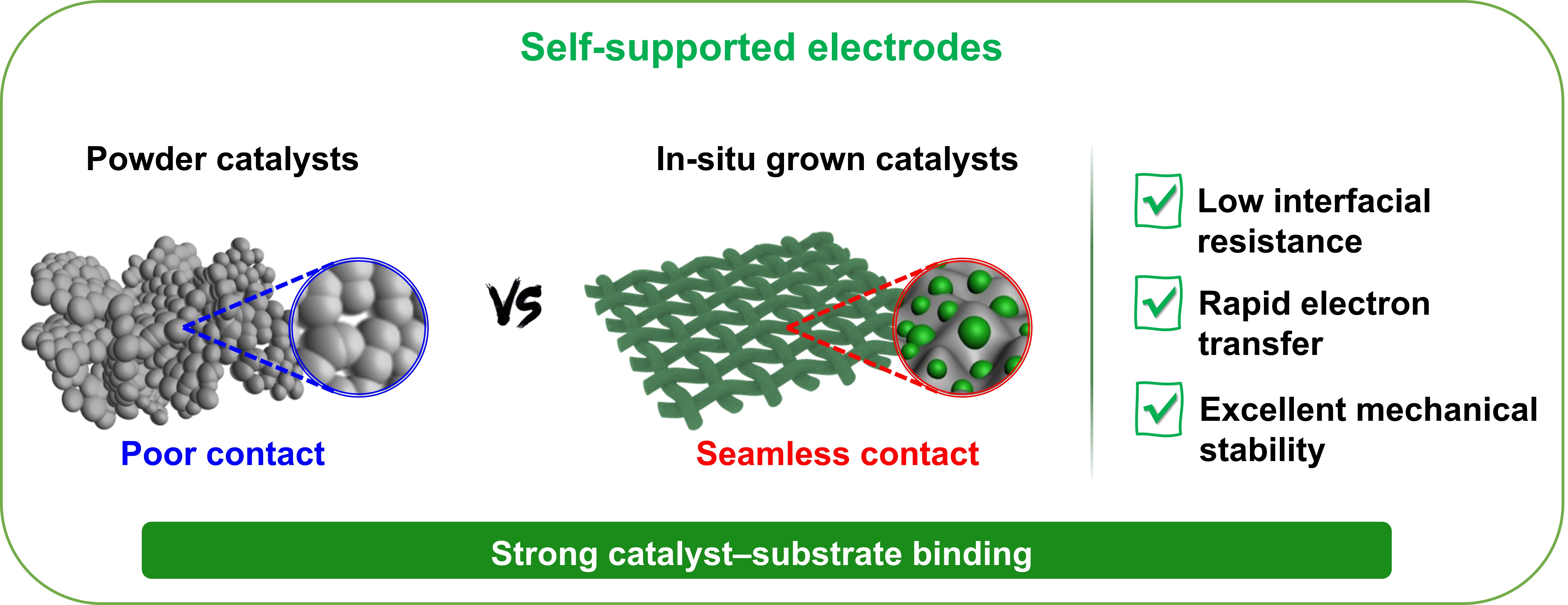
Fig. 3. Self-supported electrodes engineering for industrial-current-density HER. In-situ growth of electrocatalysts on conductive substrates enables seamless catalyst-substrate contact, low interfacial resistance, rapid electron transfer, and excellent mechanical stability.
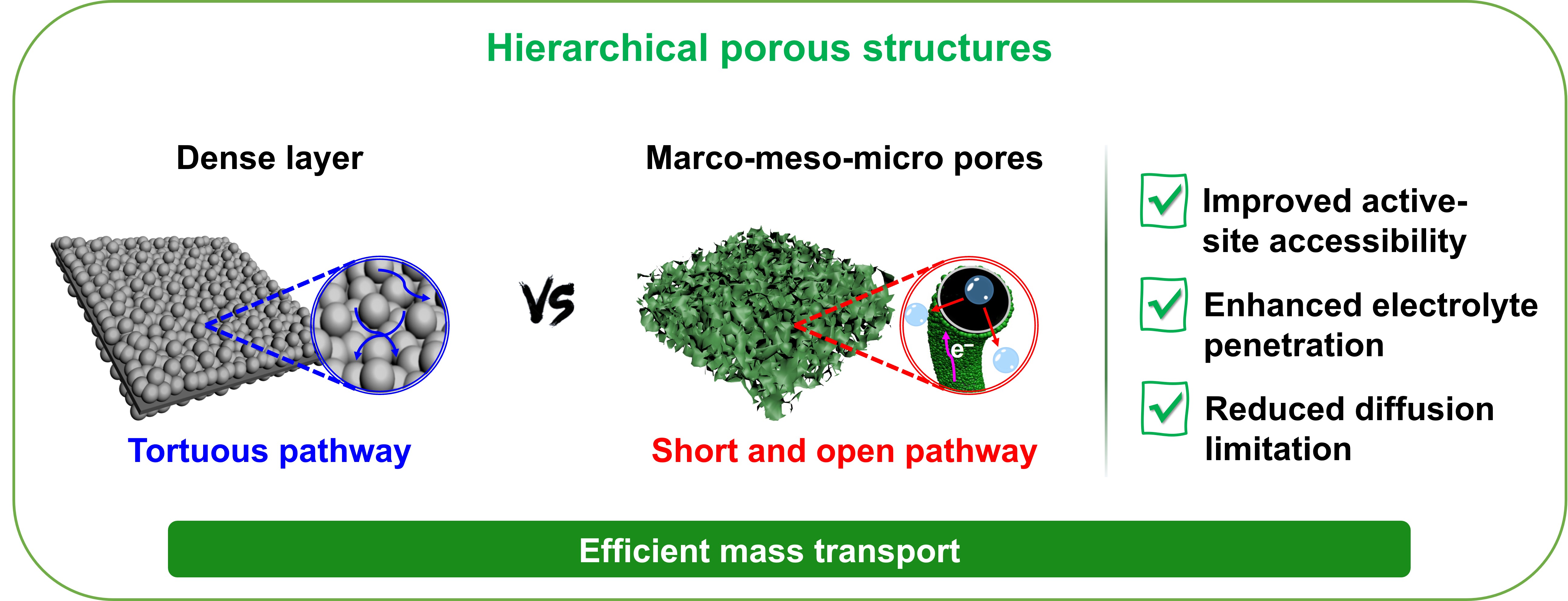
Fig. 4. Hierarchical porous structures engineering for industrial-current-density HER. The construction of interconnected macro-/meso-/microporous structures improves active site accessibility, enhances electrolyte penetration, and reduces diffusion limitation.
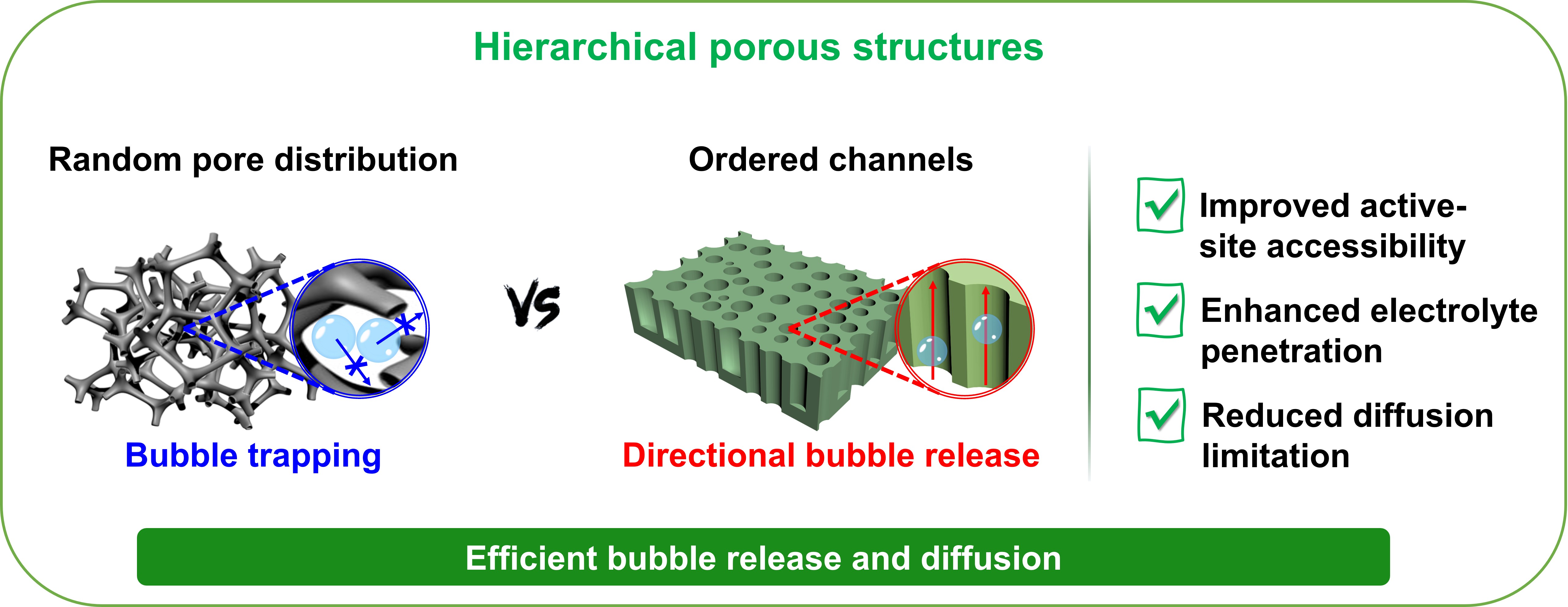
Fig. 5. Hierarchical porous structures engineering for industrial-current-density HER. Compared with randomly distributed pores, ordered flow channels provide directed pathways for bubble release and diffusion.
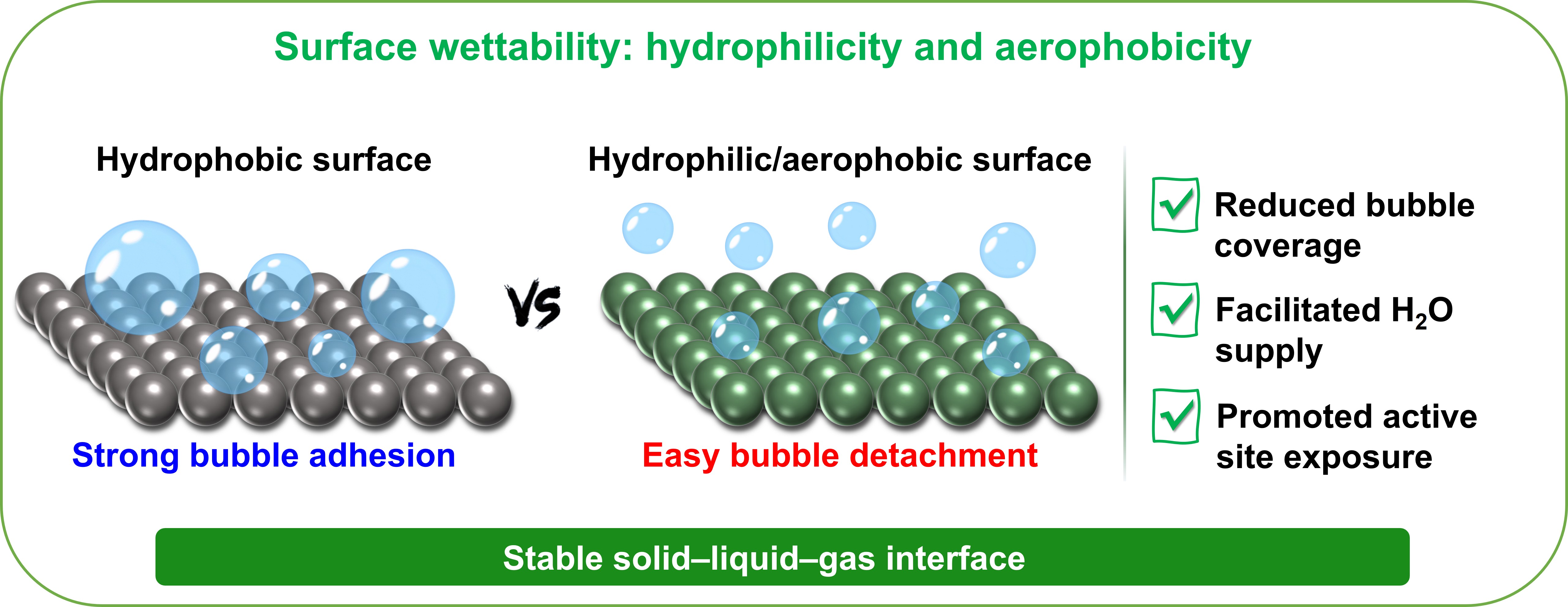
Fig. 6. Hydrophilic and aerophobic surface engineering for industrial-current-density HER. Surface wettability regulation creates hydrophilic and aerophobic surfaces that reduce bubble coverage, facilitate H2O supply, and promote active site exposure.
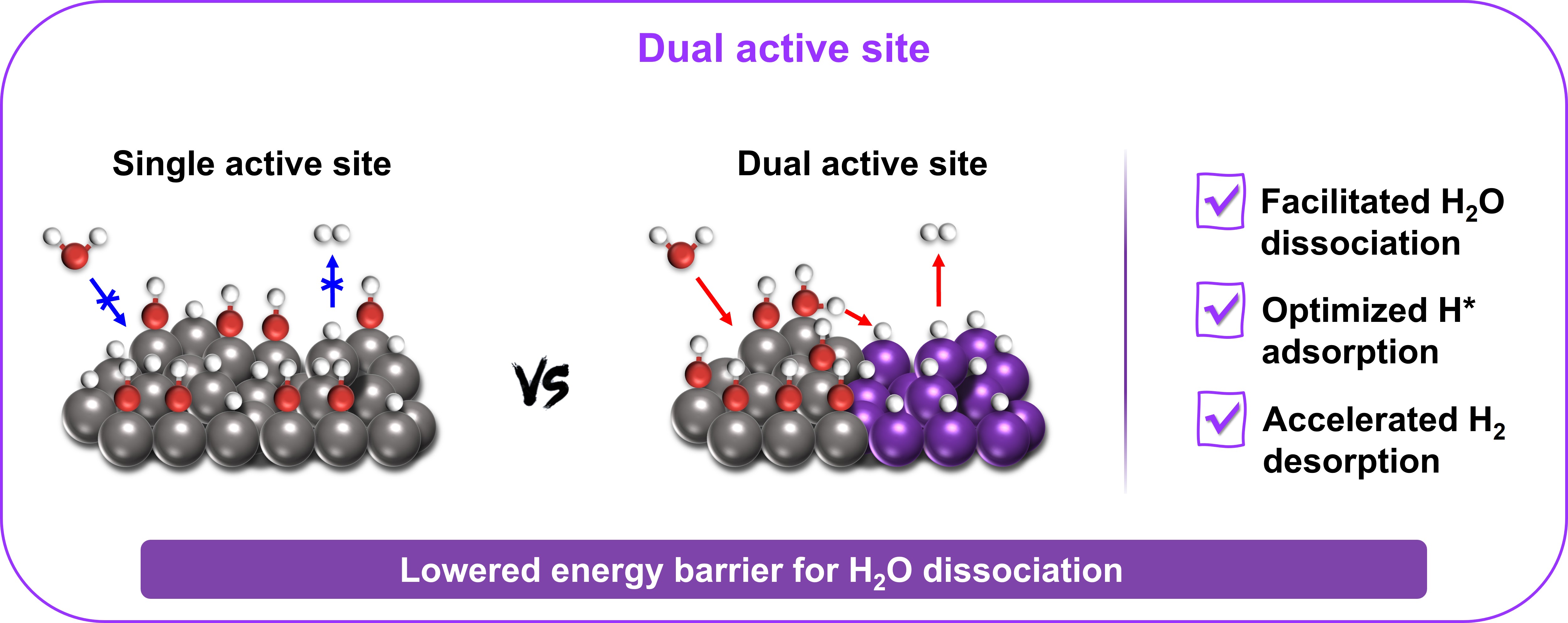
Fig. 7. Dual active site engineering for industrial-current-density HER. Distinct active sites are designed to simultaneously facilitate H2O dissociation and H2 evolution processes to accelerate Volmer-Heyrovsky/ Tafel kinetics.
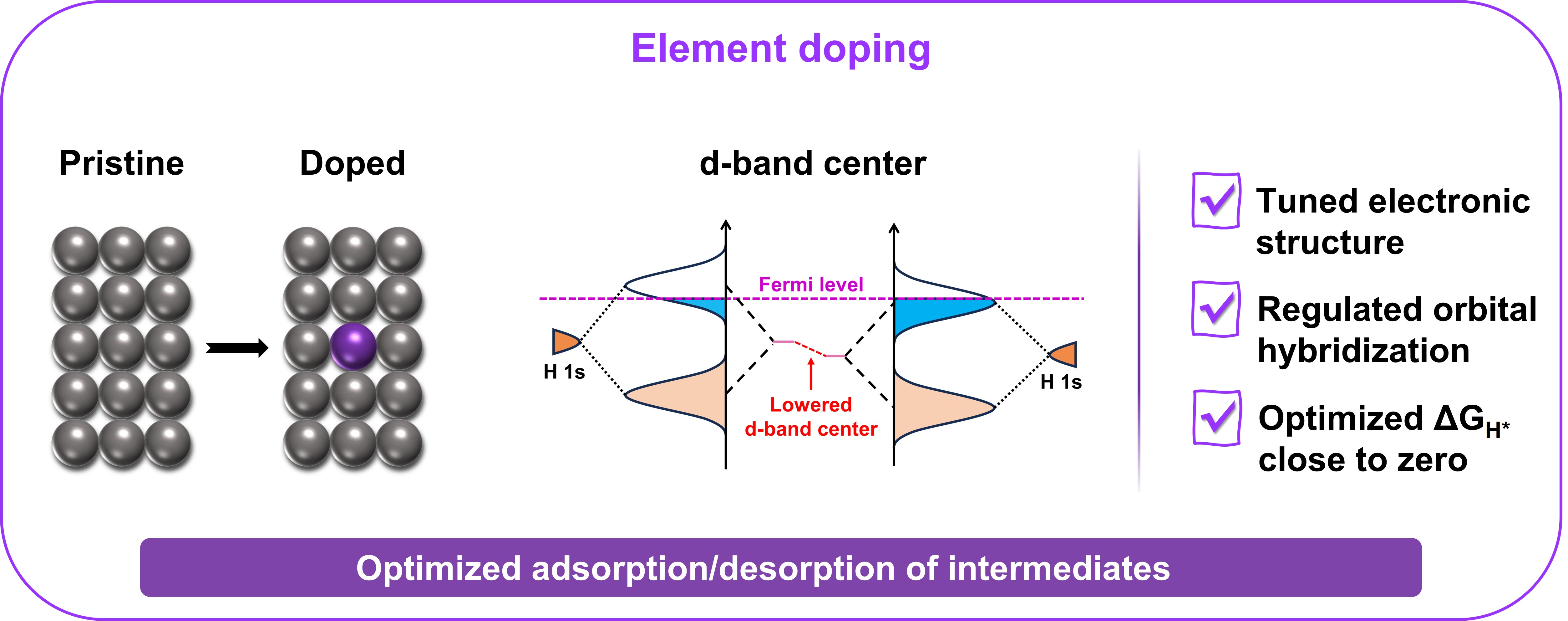
Fig. 8. Element doping engineering for industrial-current-density HER. Incorporation of foreign metal atoms tunes the electronic structure of catalytic centers, regulates orbital hybridization, and optimizes ΔGH*.
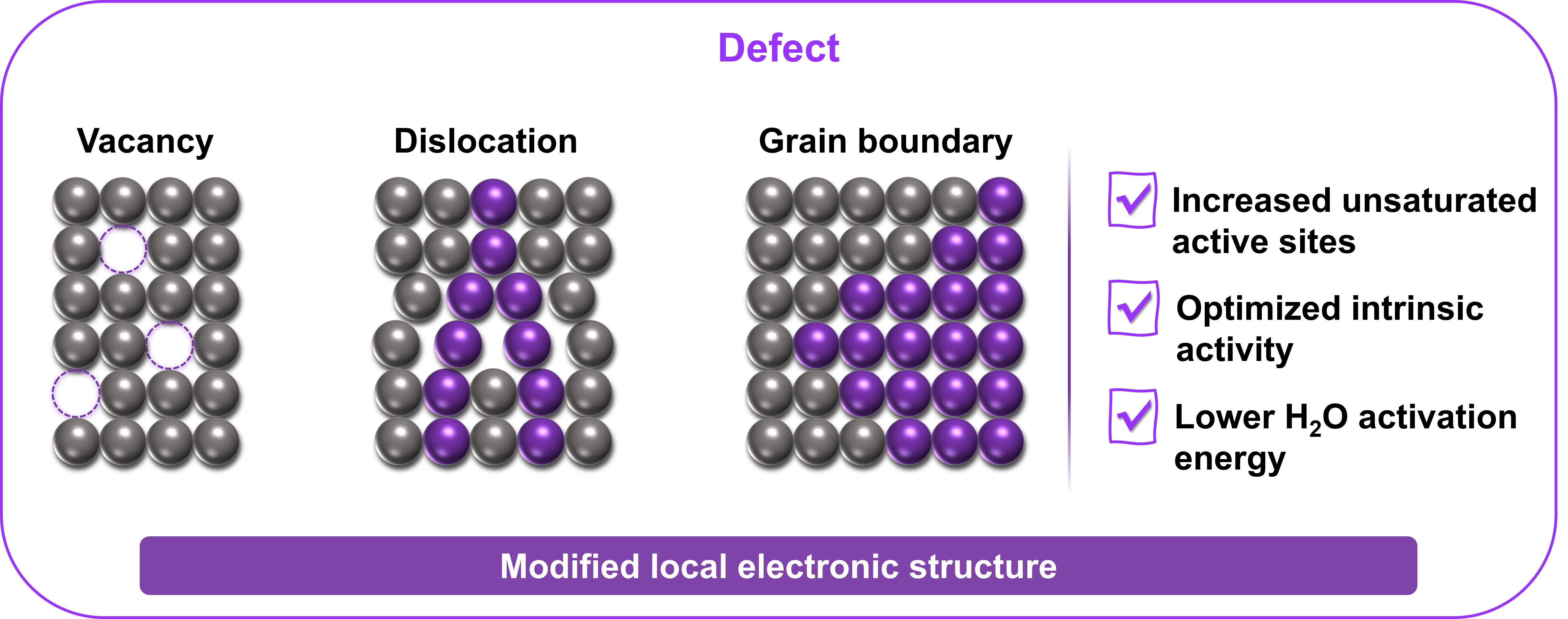
Fig. 9. Defect engineering for industrial-current-density HER. The generation of vacancy, dislocation, and grain boundary creates abundant unsaturated active sites, optimizes intrinsic activity, and lowers the activation energy for H2O dissociation.
图中文字模糊,请替换高清图片
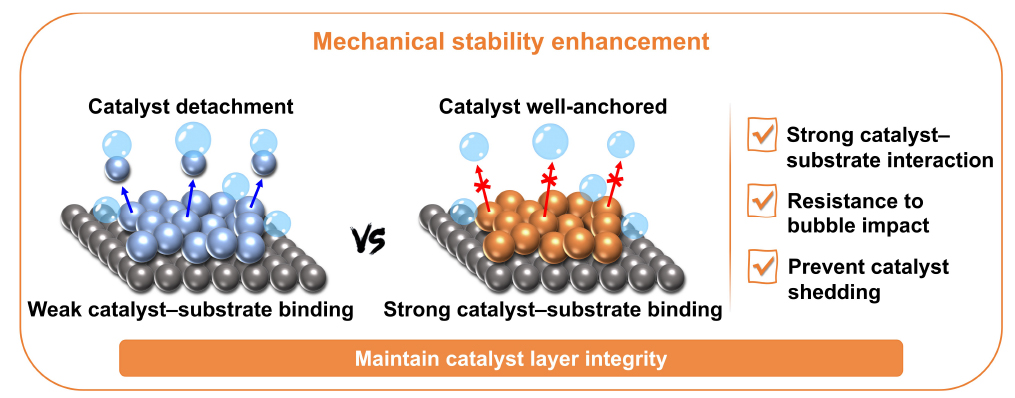
Fig. 10. Mechanical stability enhancement engineering for industrial-current-density HER. Strengthening catalyst-substrate interactions suppresses catalyst detachment induced by vigorous H2 evolution and prolonged operation.
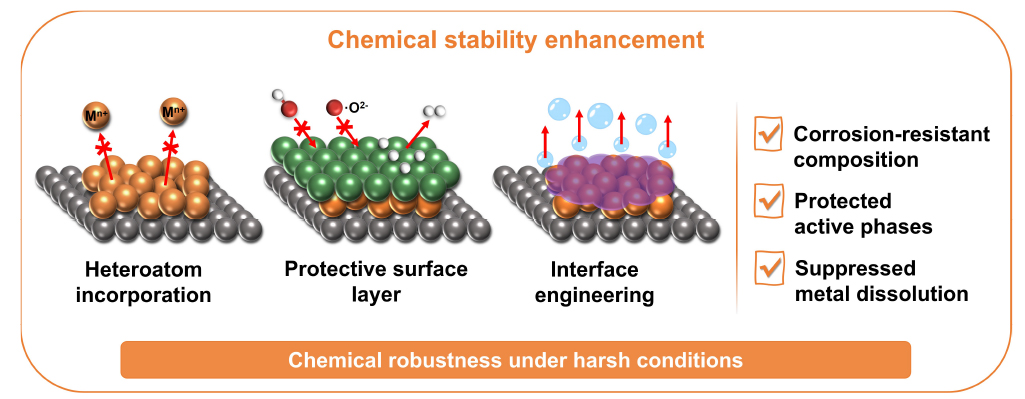
Fig. 11. Chemical stability enhancement engineering for industrial-current-density HER. Rational catalyst design including heteroatom incorporation, protective surface layer, and interface engineering enhance the chemical robustness under harsh conditions.
|
| [1] | 李尚纯, 徐贝贝, 逯景宇, 赵世杰, 张青青, 李仁贵, 张静. 均一亚纳米Co簇催化剂用于工业条件下硝酸盐电合成氨[J]. 催化学报, 2027, 92(1): 355-364. |
| [2] | 周瑞晗, 夏缇萱, 杨迎晨, 徐东波, 施伟东. 次磷酸根界面改性Co(OH)2/Cu纳米线实现2.8 A·cm‒2高电流密度下硝酸盐还原制氨[J]. 催化学报, 2027, 92(1): 365-375. |
| [3] | Khalid Umer, 方潇, Khuram Hasnain, Hira Shahid, 孙玮泽, 石宸宇, 谢俊晗, 马宝春, 丁勇. 碳量子点介导的Fe11多金属氧酸盐用于促进Zn0.5Cd0.5S体系的光催化产氢[J]. 催化学报, 2026, 88(9): 218-232. |
| [4] | 武鹏飞, 娄志昊, 马元硕, 王鹏飞, 薛达, 马方怡, 崔学晶, 刘光波, 周新, 王二东, 姜鲁华. 镍位点局域原子环境调控用于工业级海水制氢[J]. 催化学报, 2026, 87(8): 254-268. |
| [5] | 任宇曦, 许堡荣, 靳瑜, 肖航, 牛冉冉, 刘威, 欧鸿辉, 杨贵东. NiMoO4同质结d带工程促进选择性电化学氮还原制氨[J]. 催化学报, 2026, 85(6): 216-225. |
| [6] | 万自杰, 杨矞琦, 王振权, 武林睿, 张海鹏, 时晴芳, 刘翔, 杨翰林, 康博晗, 徐泉, 罗佳庆, 刘坚. 空间限制与含氮缺陷锚定协同增强钌纳米颗粒催化剂在工业电流密度下的析氢性能[J]. 催化学报, 2026, 84(5): 130-143. |
| [7] | 初铭涛, 张慧敏, 任变清, 曹景, 章腾, 宋平, 王子准, 韩策, 徐维林. 非晶-晶体异质结构RuMoNiN/Ni-MoO2用于高效稳定的碱性析氢反应[J]. 催化学报, 2026, 84(5): 96-105. |
| [8] | 刘沛林, 庄夏青, 崔天泽, 魏子森, 徐华, 张若霖, 杨矞琦, 罗佳庆, 宋卫余, 刘云鹏, 孔裕, 李振兴, 赵震, 刘坚, 孙源卿. 钌单原子/纳米簇双引擎活性中心协同提升析氢反应性能[J]. 催化学报, 2026, 84(5): 80-95. |
| [9] | 张洪文, 蔡颖慧, 李秉岳, 山巍, 唐华. Cu单原子与CuO纳米团簇协同增强TiO2光催化析氢性能[J]. 催化学报, 2026, 83(4): 162-171. |
| [10] | Jegon Lee, Do-Hyun Kim, Seulgi Ji, Sangmoon Yoon, Seung Hyun Nam, Jucheol Park, Jin Young Oh, Seung Gyo Jeong, Jong-Seong Bae, Sang A. Lee, Heechae Choi, Woo Seok Choi. 激活BaRuO3薄膜催化活性表面以促进碱性析氢反应[J]. 催化学报, 2026, 83(4): 341-350. |
| [11] | 石苗苗, 何月轩, 张宁, 鲍迪, 赵大明, 钟海霞, 鄢俊敏, 蒋青. 室温下直接电化学液氨分解实现现场产氢[J]. 催化学报, 2026, 81(2): 310-318. |
| [12] | 于世浩, 严玥莹, 杨阳, 姚博瀚, 朱子雯, 王德文, 邢志财, 杨秀荣. 基于界面工程的NiV-LDH@MoS2异质结构用于高效碱性析氢反应[J]. 催化学报, 2026, 91(12): 222-231. |
| [13] | 杨光, 巩喜良, 孟泽硕, 侯爽, 杨明豪, 龚忠苗, 黄荣, 崔义. 非晶态氢氧化镍限域贵金属单原子增强碱性析氢[J]. 催化学报, 2026, 90(11): 264-275. |
| [14] | 张晓, 王雨欣, 孙书涵, 熊贤强, 李覃, 吕康乐. 电荷-光热-催化协同提升ZnCdS/Co2SnO4光催化产氢与苯甲醇氧化性能[J]. 催化学报, 2026, 90(11): 184-196. |
| [15] | 周家璇, 于耀东, 韩佳倪, 晁艳雪, 赖建平, 王磊. 中性介质中的质子加氢反应: 机理、挑战及性能提升策略[J]. 催化学报, 2026, 90(11): 27-51. |
| 阅读次数 | ||||||
|
全文 |
|
|||||
|
摘要 |
|
|||||


