
Chinese Journal of Catalysis ›› 2026, Vol. 90: 253-263.DOI: 10.1016/S1872-2067(26)65109-1
• Articles • Previous Articles Next Articles
Lingtong Ji, Peimeng Qiu, Qingjun Ma, Peng Li, Shengli Chen*( )
)
Received:2026-02-08
Accepted:2026-03-13
Online:2026-11-18
Published:2026-11-19
Supported by:Lingtong Ji, Peimeng Qiu, Qingjun Ma, Peng Li, Shengli Chen. Praseodymium and nickel co-doped Co3O4 enhances oxygen evolution reaction performance via interfacial water optimization and cobalt pre-oxidation for proton exchange membrane water electrolysis[J]. Chinese Journal of Catalysis, 2026, 90: 253-263.
Add to citation manager EndNote|Ris|BibTeX
URL: https://www.cjcatal.com/EN/10.1016/S1872-2067(26)65109-1

Fig. 1. Characterizations of structure for PrNi-Co3O4 catalyst. (a) Synthesis illustration of the PrNi-Co3O4 catalysts. (b,c) XRD patterns of Co3O4, Ni-Co3O4 and PrNi-Co3O4 catalysts. TEM images of the PrNi-Co3O4 catalyst (d) with the corresponding particle size distribution (e) and the marked lattice spacing (f). (g) EDS elemental mapping images of the PrNi-Co3O4. (h) Co, Ni and Pr atomic ratio depth profiles determined by XPS with Ar+ beam etching. Quantification was performed using only the Pr 3d3/2 and Ni 2p3/2 peaks to avoid spectral interference from Co 2s and Auger signals. (i) Variation of the Co/Pr atomic ratio with etching time.
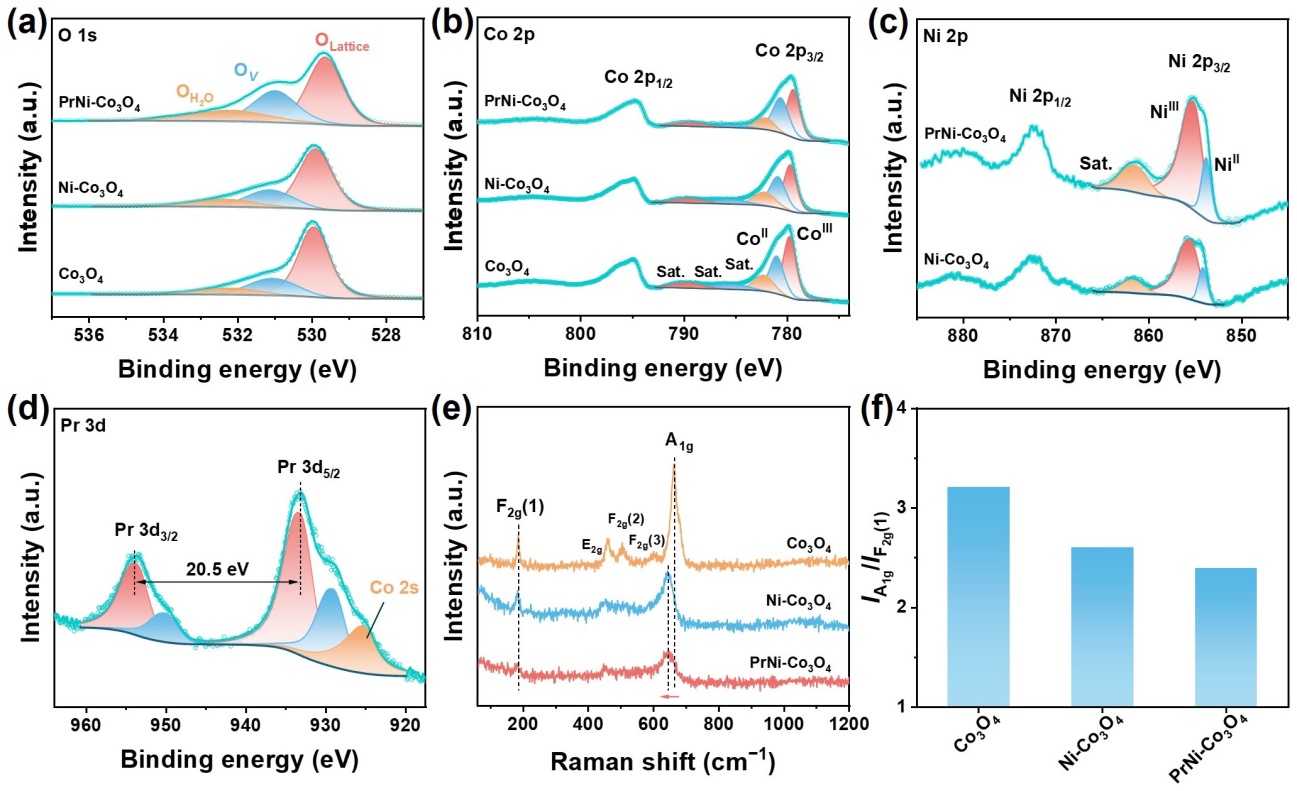
Fig. 2. Chemical and structural characterizations. High-resolution XPS spectra of the Co3O4, Ni-Co3O4, and PrNi-Co3O4 catalysts in the O 1s (a), Co 2p (b), Ni 2p (c), and Pr 3d (d) regions. Raman spectra (e) of the Co3O4, Ni-Co3O4, and PrNi-Co3O4 catalysts, along with the calculated peak intensity ratios (f) of the A1g and F2g(1) modes.
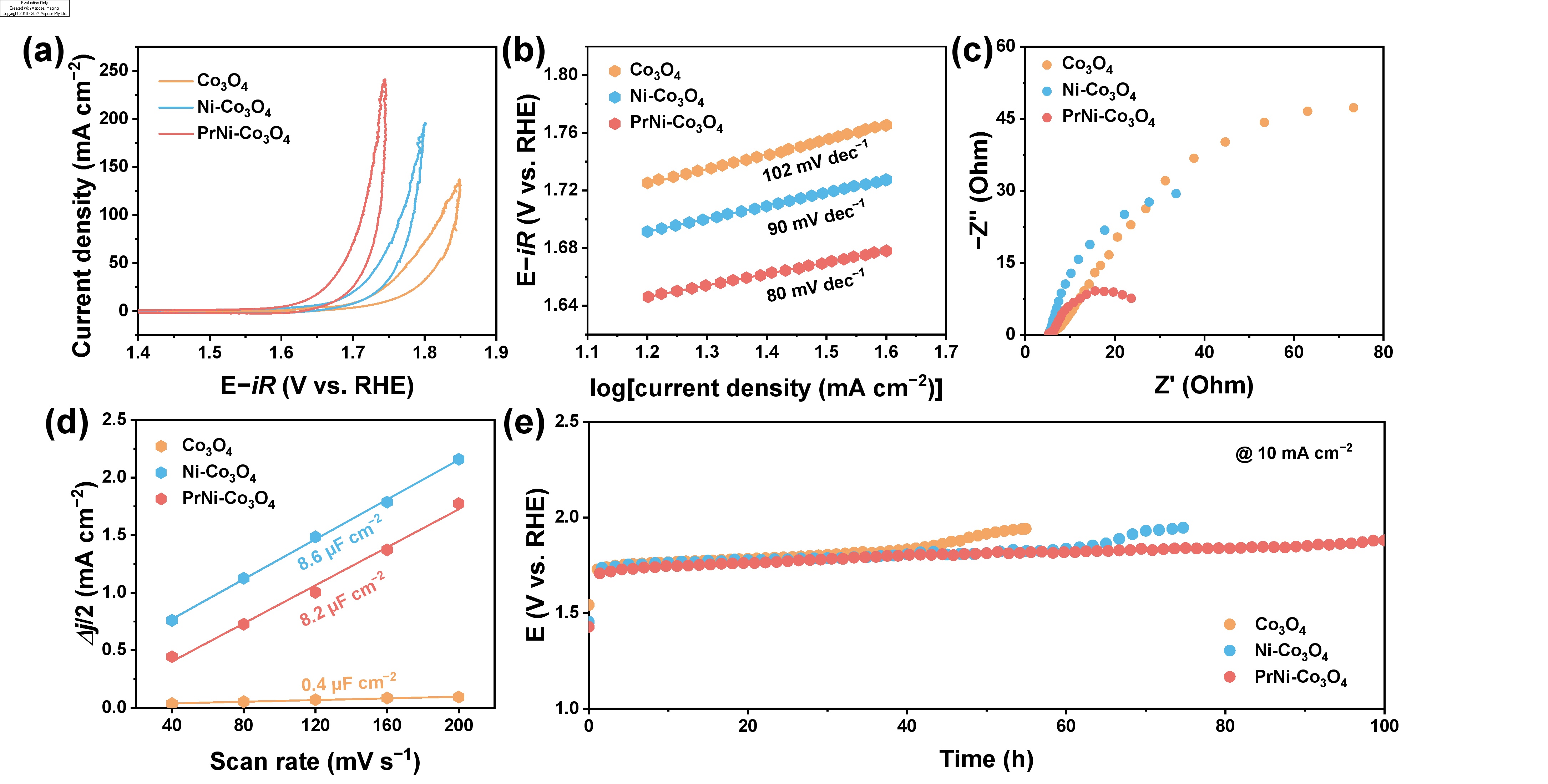
Fig. 3. Electrocatalytic performance in a three-electrode system. Geometric area-normalized CV curves (a), corresponding Tafel plots (b), EIS plots (c), Cdl plots (d), and chronopotentiometric curves (e) of Co3O4, Ni-Co3O4, and PrNi-Co3O4.
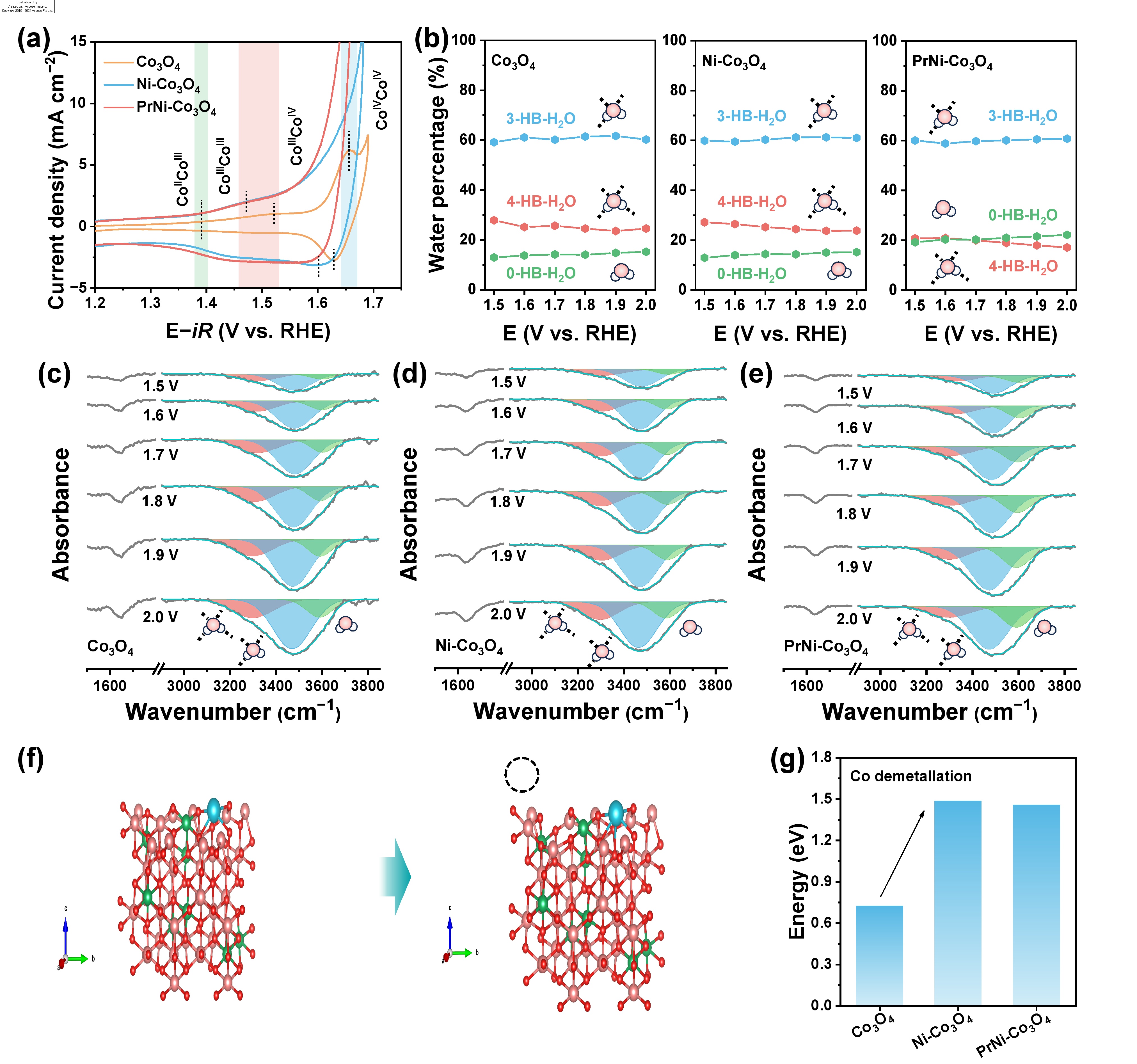
Fig. 4. OER mechanism and stability analysis. (a) iR-corrected CV curves of Co3O4, Ni-Co3O4, and PrNi-Co3O4 catalysts. (b) Percentage evolution of different types of interfacial water structures on Co3O4, Ni-Co3O4, and PrNi-Co3O4 as a function of applied potential. In-situ SEIRAS spectroscopy analysis of Co3O4 (c), Ni-Co3O4 (d) and PrNi-Co3O4 (e) in 0.5 mol L−1 H2SO4 at different applied potentials. (f) Atomistic structures showing the demetallation of Co from PrNi-Co3O4 surface. Pink, green, blue, and red spheres represent Co, Ni, Pr and O atoms, respectively. (g) Calculated Co demetallation energies on Co3O4 (311), Ni-Co3O4 (311), and PrNi-Co3O4 (311) surfaces.
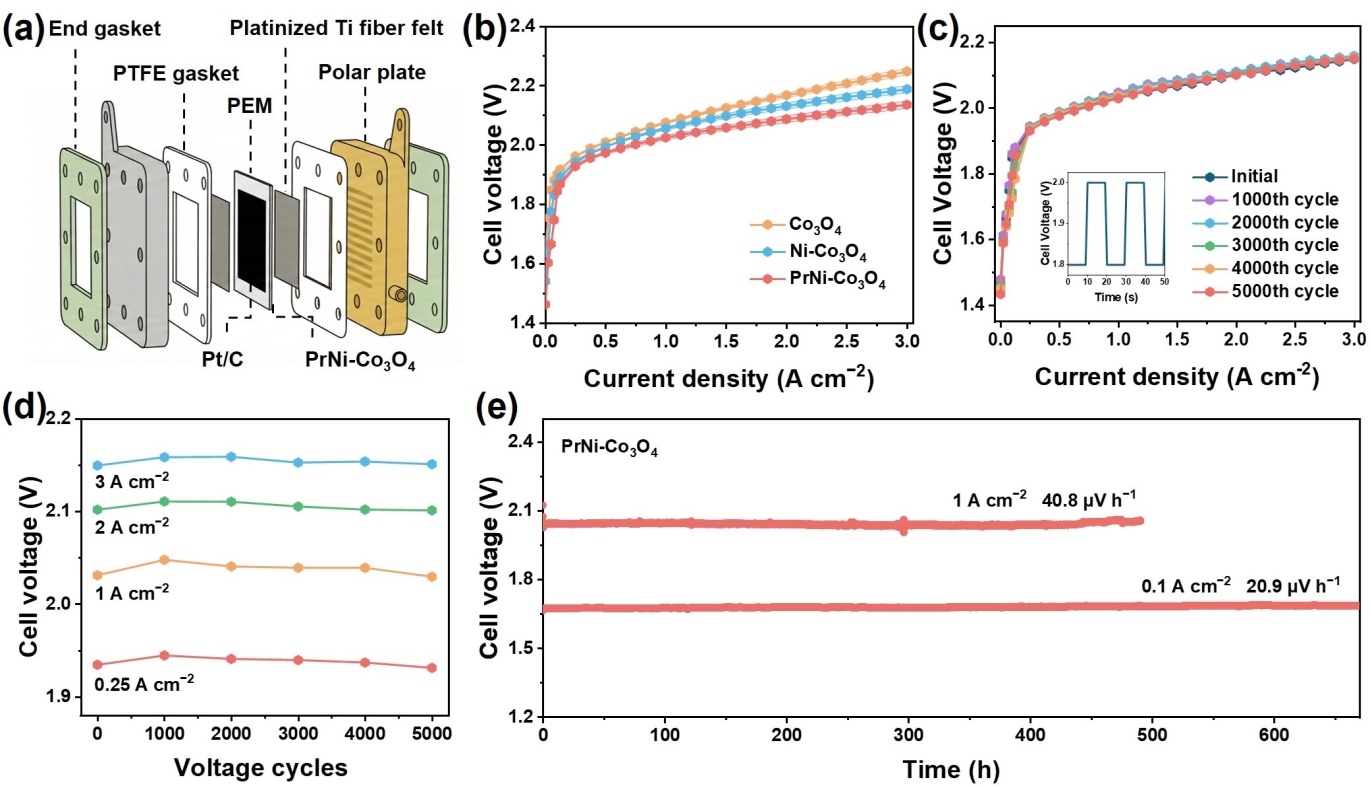
Fig. 5. Electrochemical performance in a PEMWE cell. (a) Schematic illustration of the PEMWE cell system. (b) Current-voltage polarizations of the PEMWE cell with Co3O4, Ni-Co3O4 and PrNi-Co3O4 anodic catalyst. (c) Evolution of PEMWE polarization curves recorded after selected cycle numbers during the voltage-cycling AST. The inset illustrates the square-wave voltage protocol alternating between 1.8 and 2.0 V. (d) Variations in PEMWE cell voltage measured at different current densities every 1000 cycles during the AST. (e) Chronoamperometric stability measurement of the PrNi-Co3O4 anode at 0.1 and 1 A cm−2.
|
| [1] | Pengfei Wu, Zhihao Lou, Yuanshuo Ma, Pengfei Wang, Da Xue, Fangyi Ma, Xuejing Cui, Guangbo Liu, Xin Zhou, Erdong Wang, Luhua Jiang. Local-atomic environment engineering of Ni-sites for industrial hydrogen production from seawater [J]. Chinese Journal of Catalysis, 2026, 87(8): 254-268. |
| [2] | Liqing Wu, Wenxia Huang, Bingbing Zhao, Ping Cai, Wei Luo. Surface anions-mediated dynamic interfacial free water enriched microenvironment on RuO2 for efficient acidic oxygen evolution [J]. Chinese Journal of Catalysis, 2026, 85(6): 237-246. |
| [3] | Jianchao Yue, Yu Zhang, Qianqian Xiong, Wei Luo. Bridging oxygen-induced hydrogen-bond network reconstruction in phosphorus-doped carbon-coated Ni catalyst enhances alkaline hydrogen oxidation electrocatalysis [J]. Chinese Journal of Catalysis, 2026, 82(3): 144-152. |
| [4] | Bingzhi Li, Ganggang Li, Zeyu Zhao, Fenglian Zhang, Zhongshen Zhang, Jie Cheng, Zhengping Hao. Oxygen vacancy-mediated asymmetric Ni-Ov-Co sites for efficient low-temperature N2O decomposition [J]. Chinese Journal of Catalysis, 2026, 90(11): 276-286. |
| [5] | Xiaoshan Hao, Shanshan Lu, Chuanqi Cheng, Qingqing Ruan, Bin Zhang, Yanmei Shi. Promoting interfacial free water supply through the hydration of single-atom lanthanide doping for acidic water oxidation [J]. Chinese Journal of Catalysis, 2026, 89(10): 196-206. |
| [6] | Zhang Bingjie, Wang Chunyan, Yang Fulin, Wang Shuli, Feng Ligang. Work function-induced spontaneous built-in electric field in Ir/MoSe2 for efficient PEM water electrolysis [J]. Chinese Journal of Catalysis, 2025, 75(8): 95-104. |
| [7] | Xiaoyang Wang, Ziqi Fu, Ziyi Luo, Weidi Liu, Jia Ding, Jianrong Zeng, Yanan Chen, Wenbin Hu. Simultaneously achieving ultrahigh loading and ultrasmall particle size of Pt/C catalysts [J]. Chinese Journal of Catalysis, 2025, 74(7): 425-437. |
| [8] | Yiming Jin, Wenjing Cheng, Wei Luo. Ru single atoms-induced interfacial water structure regulation for efficient alkaline hydrogen oxidation reaction [J]. Chinese Journal of Catalysis, 2025, 74(7): 240-249. |
| [9] | Qisen Jia, Yanan Wang, Yan Zhao, Zhenming Tian, Luyao Ren, Xuejing Cui, Guangbo Liu, Xin Chen, Wenzhen Li, Luhua Jiang. Driving selective photoelectrocatalytic oxidation of seawater to oxygen via regulating interfacial water structures on titanium oxides [J]. Chinese Journal of Catalysis, 2025, 72(5): 154-163. |
| [10] | Jiangyu Tang, Xiao Wang, Yunfa Wang, Min Shi, Peng Huo, Jianxiang Wu, Qiaoxia Li, Qunjie Xu. Active non-bonding oxygen mediate lattice oxygen oxidation on NiFe2O4 achieving efficient and stable water oxidation [J]. Chinese Journal of Catalysis, 2025, 72(5): 164-175. |
| [11] | Yuhui Chen, Congbao Guo, Yi Wang, Kun Wang, Shuqin Song. Constructing high-entropy spinel oxide thin films via magnetron sputtering for efficiently electrocatalyzing alkaline oxygen evolution reaction [J]. Chinese Journal of Catalysis, 2025, 77(10): 210-219. |
| [12] | Wangyang Wu, Shidan Yang, Huidan Qian, Ling Zhang, Lishan Peng, Li Li, Bin Liu, Zidong Wei. Interface engineering of advanced electrocatalysts toward alkaline hydrogen evolution reactions [J]. Chinese Journal of Catalysis, 2024, 66(11): 1-19. |
| [13] | Yunrui Tian, Haotian Tan, Xia Li, Jingjing Jia, Zixian Mao, Jian Liu, Ji Liang. Metal-based electrocatalysts for ammonia electro-oxidation reaction to nitrate/nitrite: Past, present, and future [J]. Chinese Journal of Catalysis, 2024, 56(1): 25-50. |
| [14] | Sang Eon Jun, Sungkyun Choi, Jaehyun Kim, Ki Chang Kwon, Sun Hwa Park, Ho Won Jang. Non-noble metal single atom catalysts for electrochemical energy conversion reactions [J]. Chinese Journal of Catalysis, 2023, 50(7): 195-214. |
| [15] | He-lei Wei, Ai-dong Tan, Shu-zhi Hu, Jin-hua Piao, Zhi-yong Fu. Efficient spinel iron-cobalt oxide/nitrogen-doped ordered mesoporous carbon catalyst for rechargeable zinc-air batteries [J]. Chinese Journal of Catalysis, 2021, 42(9): 1451-1458. |
| Viewed | ||||||
|
Full text |
|
|||||
|
Abstract |
|
|||||


