
Chinese Journal of Catalysis ›› 2026, Vol. 89: 292-309.DOI: 10.1016/S1872-2067(26)65115-7
• Article • Previous Articles Next Articles
Felipe Lipskya,*( ), Miguel A. San-Miguelb, Vicent S. Safonta, Mo´nica Olivaa, Juan Andr´esa,*()
Received:2026-01-15
Accepted:2026-03-03
Online:2026-10-18
Published:2026-09-01
Contact:
E-mail: Felipe Lipsky, Miguel A. San-Miguel, Vicent S. Safont, Mo´nica Oliva, Juan Andr´es. Comprehensive understanding of sulfide oxidation on α-Ag2WO4 (110) surface: A DFT study on ROS storm-driven catalytic mechanism[J]. Chinese Journal of Catalysis, 2026, 89: 292-309.
Add to citation manager EndNote|Ris|BibTeX
URL: https://www.cjcatal.com/EN/10.1016/S1872-2067(26)65115-7
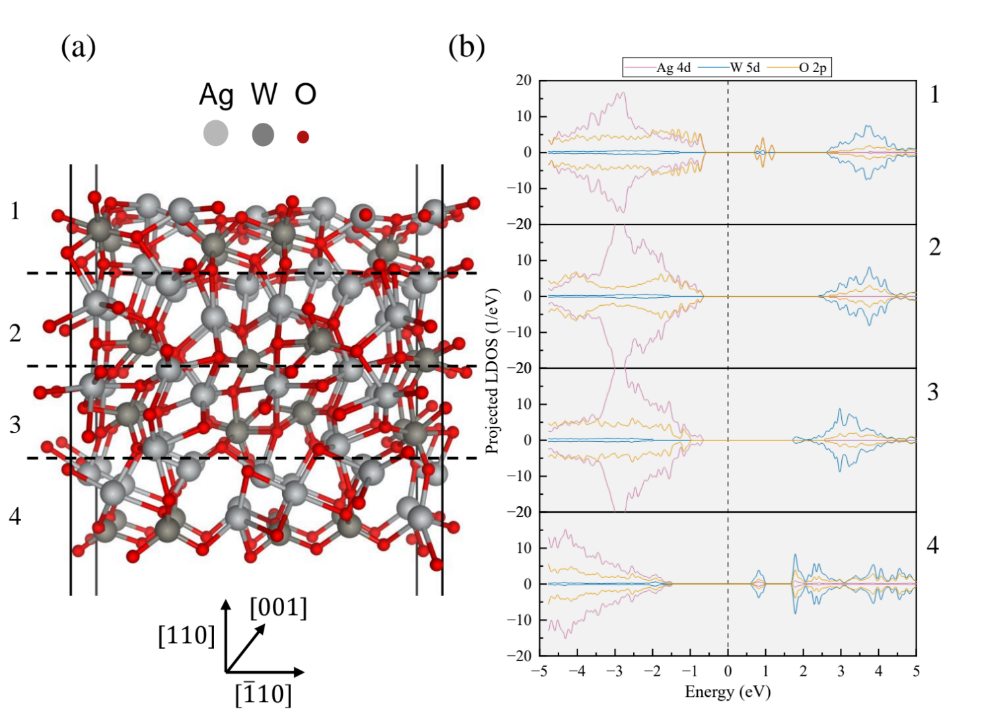
Fig. 1. (a) Slab model representing the AWO (110) surface. The stoichiometric layer units for layer-resolved DOS projection (1?4) are highlighted. The 23 ? vacuum layer is omitted for clarity. (b) DOS projection; the Fermi level is set to 0 eV. States below 0.25 1/eV are excluded to eliminate spurious states arising from numerical integration artifacts and enhance clarity of relevant features. Bulk structure is retrieved in layers 2 and 3, while layers 1 and 4 show surface effects.
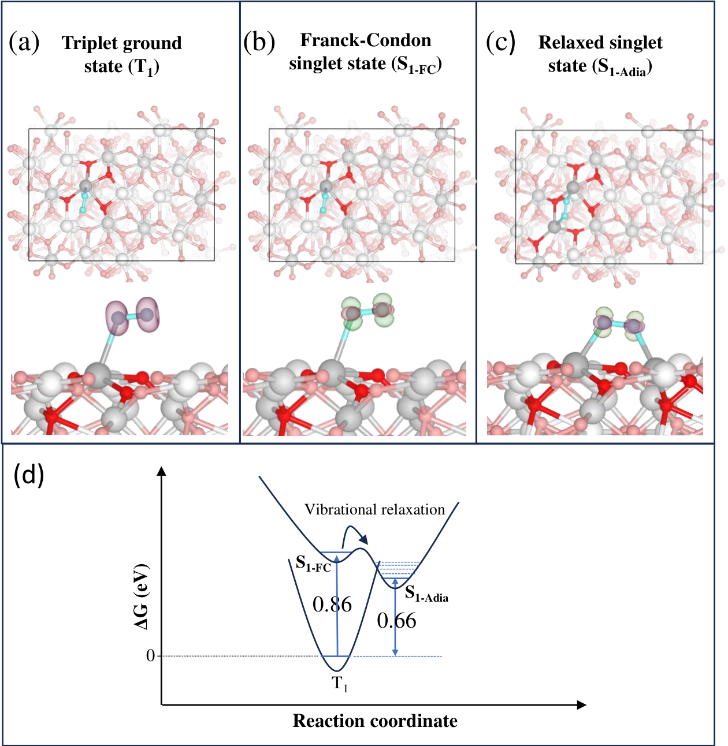
Fig. 2. Adsorption geometries of O2 in its triplet ground state (T1) (a), non-adiabatic Franck-Condon singlet state (S1-FC) (b), and adiabatic singlet state (S1-Adia) (c) on the α-Ag2WO4 (110) surface. Surface Ag-O clusters involved in the adsorption are highlighted. Oxygen atoms for the O2 molecule are depicted in light blue. Side views display spin densities with isosurfaces at 10% of the maximum value; colors distinguish spin-majority and spin-minority channels. (d) Schematic energy diagram along the reaction coordinate, showing the relative energies of T1, S1-FC, and S1-Adia, and indicating the nonadiabatic excitation followed by vibronic relaxation pathways.
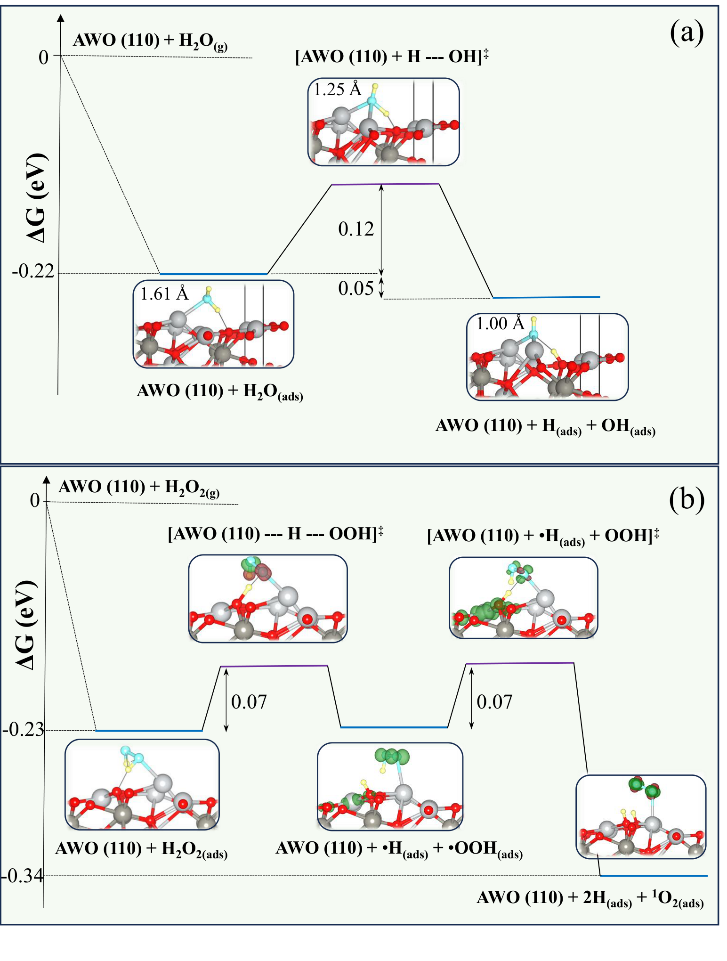
Fig. 3. Minimum-energy pathways on α-Ag2WO4(110) for OH formation from H2O (a) and 1O2 formation from bidentate H2O2 (b). The reaction coordinate in (a) corresponds to the distance between the dissociating H atom and the surface O anion. Relative energies are referenced to the clean slab and gas-phase molecules. Adsorbate atoms are colored blue (O) and yellow (H); H-bonds are black. Spin-density isosurfaces (10% of maximum) show an absence of polarization (heterolytic pathway) in (a), contrasting with the distinct spin evolution observed in (b) (homolytic pathway). Spin majority and minority channels are depicted in red and green.
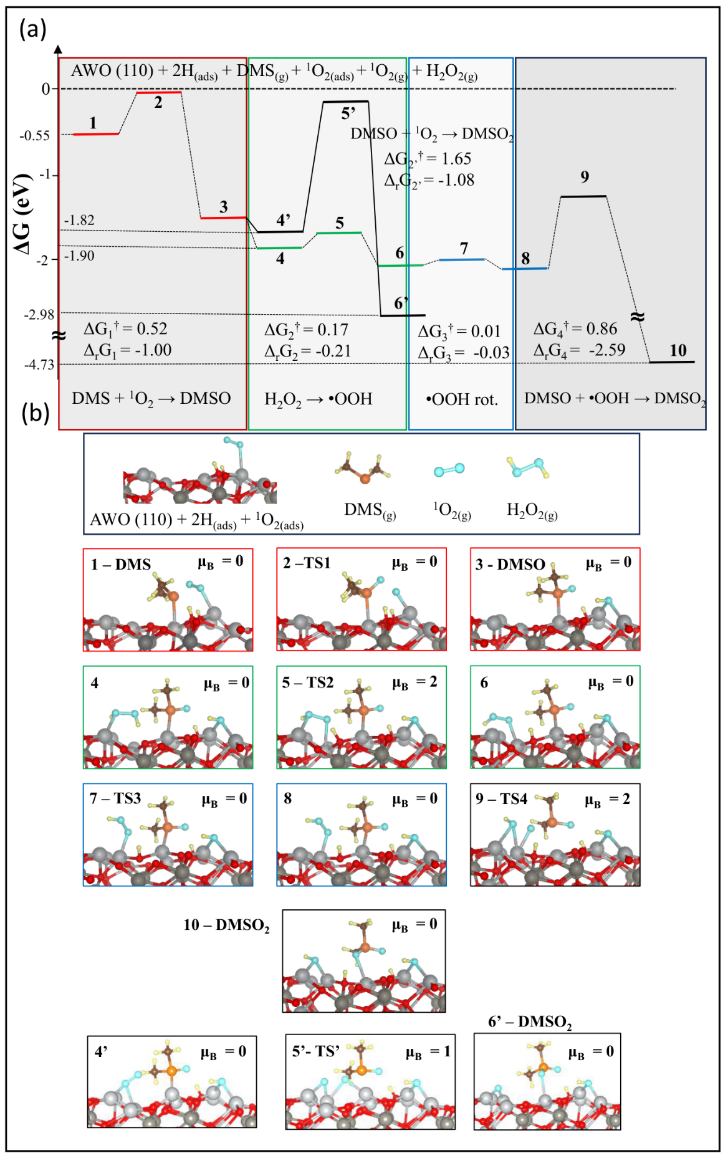
Fig. 4. (a) Gibbs energy profile for the stepwise oxidation of DMS to DMSO and DMSO2 on α-Ag2WO4(110). Energies are referenced to the final activation step in Section 3.2.3 (0 eV). The primary pathway proceeds via an additional H2O2 adsorption and decomposition, while the alternative route (denoted with primes, ‘) involves a second 1O2 molecule for the DMSO → DMSO2 step. (b) Optimized geometries and total magnetic moments (μB) for all intermediates. Atom colors: S (orange), C (brown), O (light blue), H (yellow)
| Step | ∆G‡ (eV) | ν‡ (cm-1) | Wigner κ | k (s-1) | τ = ln 2/k (s) |
|---|---|---|---|---|---|
| 6→ 8 | 0.01 | 42.9007 | 1.0015 4.7090 × 10¹² | 1.47 × 10⁻¹³ | |
| 4→ 6 | 0.17 | 804.2088 | 1.5342 2.3058 × 10¹⁰ | 3.01 × 10⁻¹¹ | |
| 1→ 2 | 0.52 | 213.8600 | 1.0378 5.4266 × 10⁴ | 1.28 × 10⁻⁵ | |
| 8→ 10 | 0.86 | 385.8300 | 1.1230 2.9256 × 10⁻¹ | 2.37 | |
Table 1 Wigner-corrected Eyring rate estimates at T = 323.15 K using calculated ?G?. Steps named after Fig. 4. Imaginary-mode frequencies ν? were used to compute the Wigner tunneling factor.
| Step | ∆G‡ (eV) | ν‡ (cm-1) | Wigner κ | k (s-1) | τ = ln 2/k (s) |
|---|---|---|---|---|---|
| 6→ 8 | 0.01 | 42.9007 | 1.0015 4.7090 × 10¹² | 1.47 × 10⁻¹³ | |
| 4→ 6 | 0.17 | 804.2088 | 1.5342 2.3058 × 10¹⁰ | 3.01 × 10⁻¹¹ | |
| 1→ 2 | 0.52 | 213.8600 | 1.0378 5.4266 × 10⁴ | 1.28 × 10⁻⁵ | |
| 8→ 10 | 0.86 | 385.8300 | 1.1230 2.9256 × 10⁻¹ | 2.37 | |
| Active site system | ϵd - EF (eV) | Work function Φ (eV) | O 2p charge (e) | ∆G† (eV) |
|---|---|---|---|---|
| H2O2(ads) | 2.66 | 6.643 | +0.1 | 0.07 |
| H2O(ads) | 2.73 | 5.845 | 0.0 | 0.12 |
| O2(ads) (Triplet) | 3.01 | 5.908 | 0.0 | 0.86 |
Table 2 Correlation of electronic descriptors with ROS activation barriers on the α-Ag2WO4 (110) Surface.
| Active site system | ϵd - EF (eV) | Work function Φ (eV) | O 2p charge (e) | ∆G† (eV) |
|---|---|---|---|---|
| H2O2(ads) | 2.66 | 6.643 | +0.1 | 0.07 |
| H2O(ads) | 2.73 | 5.845 | 0.0 | 0.12 |
| O2(ads) (Triplet) | 3.01 | 5.908 | 0.0 | 0.86 |
| Reaction step | State | ϵd - EF (eV)a | Φ (eV) | Bader q (e) | ∆G† (eV) |
|---|---|---|---|---|---|
| DMS → DMSO | IS | 3.06 | 5.751 | 0.0 (S) | — |
| TS | 3.45 | 6.055 | -1.20 (O2) | 0.52 | |
| DMSO → DMSO2 | IS | 3.66 | 5.641 | +1.30 (S) | — |
| TS | 2.76 | 5.000 | — | 0.86 |
Table 3 Correlation of electronic descriptors for the sequential DMS oxidation on α-Ag2WO4 (110). IS: initial state; TS: transition state.
| Reaction step | State | ϵd - EF (eV)a | Φ (eV) | Bader q (e) | ∆G† (eV) |
|---|---|---|---|---|---|
| DMS → DMSO | IS | 3.06 | 5.751 | 0.0 (S) | — |
| TS | 3.45 | 6.055 | -1.20 (O2) | 0.52 | |
| DMSO → DMSO2 | IS | 3.66 | 5.641 | +1.30 (S) | — |
| TS | 2.76 | 5.000 | — | 0.86 |
|
| [1] | Shijie Li, Rui Li, Yanping Liu, Xin Yu, Deyun Ma, Jianhui Jiang, Xiaosong Zhou, Chunqiang Zhuang, Zaiwang Zhao, Wei Jiang. Augmented reactive oxygen species generation in Ag/AgBr/C3N5 via LSPR-enhanced S-scheme charge transfer for efficient photocatalytic antibiotic wastewater remediation [J]. Chinese Journal of Catalysis, 2026, 87(8): 126-139. |
| [2] | Zelong Qiao, Run Jiang, Jimmy Yun, Dapeng Cao. Why the abnormal phenomena of D-band center theory exist? A new BASED theory for surface catalysis and chemistry [J]. Chinese Journal of Catalysis, 2024, 64(9): 44-53. |
| [3] | HUANG Weixin, FU Qiang. Surface and Interface Chemistry of Model Catalysts [J]. Chinese Journal of Catalysis, 2019, 40(s1): 165-168. |
| [4] | Svetlana A. Yashnik, Vadim V. Kuznetsov, Zinfer R. Ismagilov. Effect of χ-alumina addition on H2S oxidation properties of pure and modified γ-alumina [J]. Chinese Journal of Catalysis, 2018, 39(2): 258-274. |
| Viewed | ||||||
|
Full text |
|
|||||
|
Abstract |
|
|||||


