
Chinese Journal of Catalysis ›› 2026, Vol. 90: 210-219.DOI: 10.1016/S1872-2067(26)65151-0
• Articles • Previous Articles Next Articles
Xiaojuan Wena,b, Pengfei Weia, Yiyuan Jianga, Yanpeng Songa, Hanyu Wanga,b, Jing Xuea,b, Tianfu Liua,b,*( ), Dunfeng Gaoa,b,*(), Guoxiong Wanga,c, Xinhe Baoa,b,c
Received:2026-01-20
Accepted:2026-02-25
Online:2026-11-18
Published:2026-11-19
Supported by:Xiaojuan Wen, Pengfei Wei, Yiyuan Jiang, Yanpeng Song, Hanyu Wang, Jing Xue, Tianfu Liu, Dunfeng Gao, Guoxiong Wang, Xinhe Bao. Promoting dilute CO2 electrolysis with electron-withdrawing ligand modification[J]. Chinese Journal of Catalysis, 2026, 90: 210-219.
Add to citation manager EndNote|Ris|BibTeX
URL: https://www.cjcatal.com/EN/10.1016/S1872-2067(26)65151-0
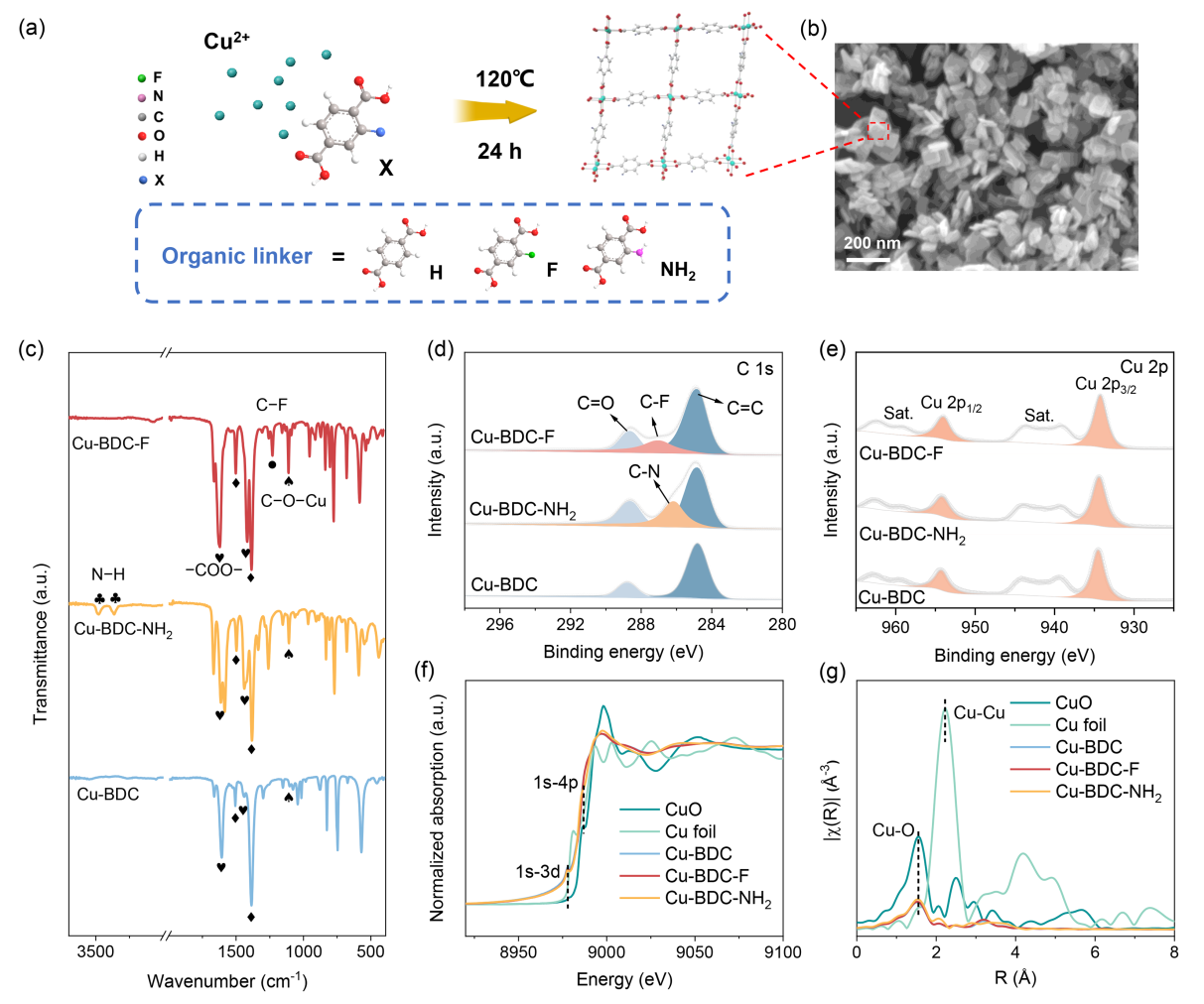
Fig. 1. (a) Schematic illustration of the preparation of Cu-BDC-X MOFs. (b) SEM image of Cu-BDC. (c) FTIR spectra of Cu-BDC-X. C 1s (d) and Cu 2p (e) XPS spectra of Cu-BDC-X. Cu K-edge (f) XANES and (g) R-space EXAFS spectra for Cu-BDC-X, CuO, and Cu foil.
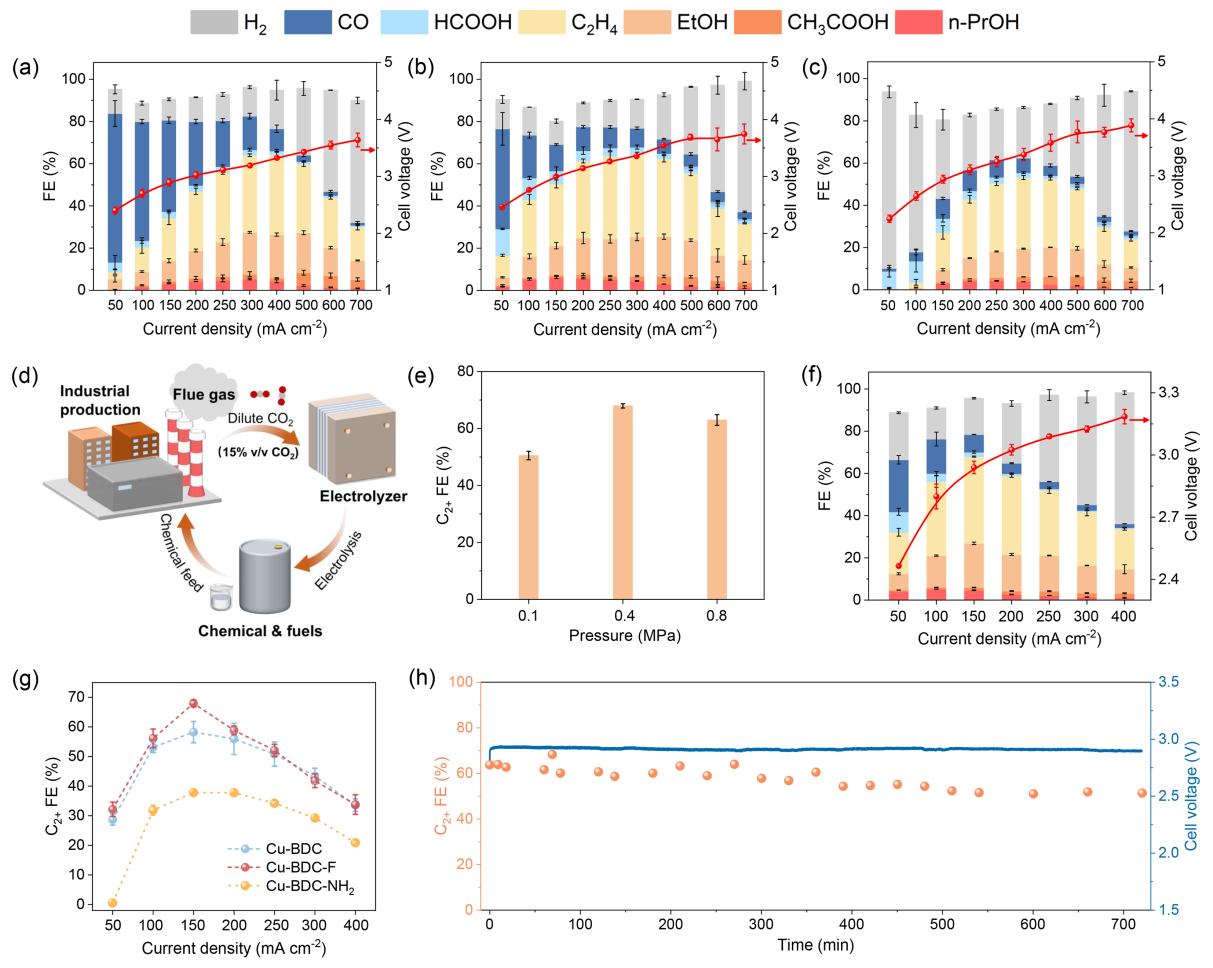
Fig. 2. FE and cell voltage as a function of applied current density over Cu-BDC (a), Cu-BDC-F (b), and Cu-BDC-NH2 (c) measured under high-purity CO2 feed. (d) Schematic of the production of chemicals and fuels via direct flue gas electrolysis. (e) C2+ FE on Cu-BDC-F at 150 mA cm-2 at different CO2 pressures. (f) FE and cell voltage as a function of applied current density over Cu-BDC-F measured under 0.4 MPa dilute CO2 (15%) feed. (g) C2+ FE as a function of applied current density over Cu-BDC, Cu-BDC-F, and Cu-BDC-NH2 measured under 0.4 MPa dilute CO2 (15%) feed. (h) Stability of Cu-BDC-F at 150 mA cm-2 under 0.4 MPa dilute CO2 (15%) feed.
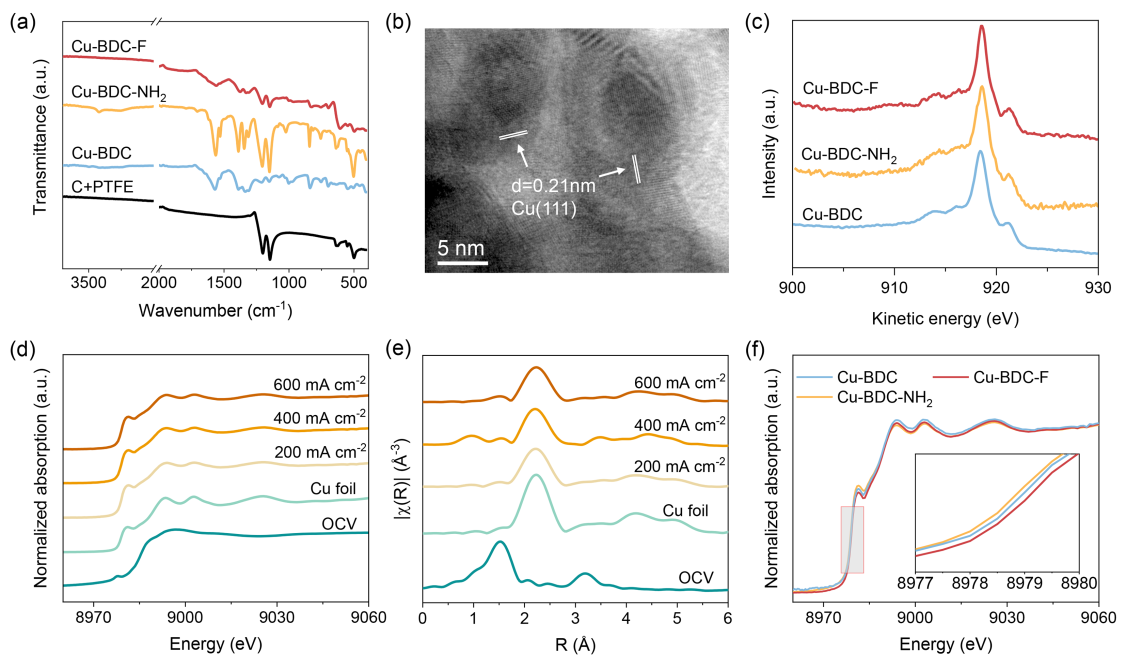
Fig. 3. (a) FTIR spectra of Cu-BDC-X after CO2 electrolysis. (b) HRTEM image of the Cu-BDC-F electrode after CO2 electrolysis. (c) Quasi in-situ XPS spectra of Cu LMM of Cu-BDC-X after CO2 electrolysis at 250 mA cm-2. Operando Cu K-edge XANES (d) and EXAFS (e) spectra of Cu-BDC-F measured in a MEA cell. (f) Cu K-edge XANES spectra of Cu-BDC-X during CO2 electrolysis at 200 mA cm-2.
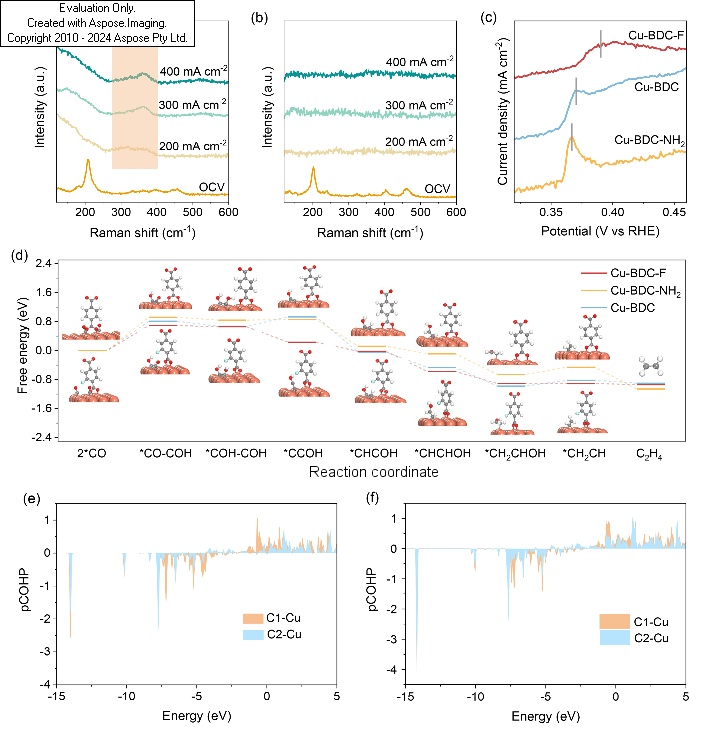
Fig. 4. Operando Raman spectra of Cu-BDC-F (a) and Cu-BDC (b) in a MEA cell at different applied current densities. (c) CO stripping experiments on Cu-BDC-X after CO2 electrolysis, with a scan rate of 50 mV s-1. (d) Gibbs free energy barriers for the formation of C2H4 on Cu-BDC-X during CO2 electrolysis, including the optimized structures of 2*CO, *COCOH, *COH-COH, *CCOH, *CHCOH, *CHCHOH, *CH2CHOH and *CH2CH on the Cu-BDC and Cu-BDC-F during CO2 electrolysis. Projected COHP (pCOHP) curves for the Cu-C1 (C1 originates from the carbon of the -CO fragment in *COCOH) and Cu-C2 (C2 originates from the carbon of the -COH fragment in *COCOH) interactions for the adsorbate carbon atoms in *COCOH and their coordinating Cu sites in Cu-BDC (e) and Cu-BDC-F (f).
|
| [1] | Sathi Chatterjee, Hongmei Li, Kang Liu, Zhang Lin, Liyuan Chai, Min Liu. Single-atom catalysts on two-dimensional (2D) materials for photocatalytic CO2 reduction: Fundamentals, design, and emerging strategies [J]. Chinese Journal of Catalysis, 2026, 88(9): 86-128. |
| [2] | Xinyi Zhang, Weichen Dong, Yi Cao, Caixia Zhou, Jiaxiu Guo, Hailong Zhang. Efficient continuous synthesis of methanol by direct methane conversion on Cu-KFI zeolite catalysts [J]. Chinese Journal of Catalysis, 2026, 88(9): 369-381. |
| [3] | Songling Wang, Anhua Huang, Fengxing Yin, Ruixiang Lu, Wengang Liu, Yun Zhang, Botao Qiao. In-situ synthesis of hydrogen peroxide for highly selective oxidation of methane to methanol over noble-metal-free catalyst [J]. Chinese Journal of Catalysis, 2026, 88(9): 347-355. |
| [4] | Jiaxiang Qin, Songpei Zhang, Xingju Li, Xintai Chen, Jia Zhao, Xiaoling Mou, Xiangen Song, Li Yan, Ronghe Lin, Yunjie Ding. Decoding structure-selectivity interplay in Pd-Ag nanocatalysts for butadiene semi-hydrogenation [J]. Chinese Journal of Catalysis, 2026, 87(8): 342-352. |
| [5] | Jiyeon Lee, Muhammad Irshad, Wonjoong Yoon, Jaehoon Kim. High-pressure switch: Redirecting CO2 hydrogenation from hydrocarbons to carboxylic acids and alcohols [J]. Chinese Journal of Catalysis, 2026, 87(8): 70-86. |
| [6] | Tianchun Li, Tianyang Liu, Yu Jing. Structural origins of selectivity in guaiacol hydrodeoxygenation on copper [J]. Chinese Journal of Catalysis, 2026, 87(8): 376-385. |
| [7] | Yang Ding, Yizhen Lu, Tianrong Yu, Mingrui Zhang, Rui Zhao, Ruijie Yang, Qixin Li, Shiqun Wu, Jinlong Zhang. Dual pathways in photo-driven Fischer-Tropsch synthesis for high selective hydrocarbon production [J]. Chinese Journal of Catalysis, 2026, 87(8): 22-46. |
| [8] | Zi-Hang Wang, Wei Zhong, Si-Qi Li, Bin Sun, Hao Lan, Xiao-Yu Zhang, Xin Wang, Yu Chen, Xuan Ai. The C-C bond cleavage inhibition and intermediates adsorption enhancement co-boost the selective electrooxidation of ethylene glycol on silver-palladium hollow nanocubes [J]. Chinese Journal of Catalysis, 2026, 86(7): 191-200. |
| [9] | Jing-Yu Li, Yi-Jun Xu. Regioselective ring-opening of epoxides triggered by light [J]. Chinese Journal of Catalysis, 2026, 85(6): 34-46. |
| [10] | Xingchen He, Junhui Shao, Najun Li, Dongyun Chen, Hua Li, Qingfeng Xu, Haozhi Wang, Jianmei Lu. Metal-free fluorinated carbon nitride with piezo-boosted hydrogen-bonding networks enable 100% CO selectivity in CO2 reduction [J]. Chinese Journal of Catalysis, 2026, 85(6): 130-142. |
| [11] | Ruiwen Hu, Zhiyong Guo, Xiaogang Peng, Xiaoqi Shi, Yuben Qiao, Qian Li, Chenghua Gao, Aitao Li. Synergistic integration of ancestral sequence reconstruction and rational design empowers unspecific peroxygenase for efficient steroid core oxyfunctionalization [J]. Chinese Journal of Catalysis, 2026, 84(5): 417-427. |
| [12] | Bihua Hu, Hailin Cao, Zhen Chen, Zhiwei Lei, Xin Wang, Panagiotis Tsiakaras, Zhongwei Chen, Baomin Xu. N-supports for electronic regulation of phthalocyanine cobalt to selective carbon dioxide electroreduction toward methanol [J]. Chinese Journal of Catalysis, 2026, 83(4): 330-340. |
| [13] | Jiaxing Li, Yue Peng, Yifan Li, Yunpeng Long, William Orbell, Chuan Gao, Xiao Zhu, Xing Yuan, Lin Chen, Junhua Li. Modulation of Pt-Cu interaction in Pt/Cu-SSZ-13 for selective catalytic oxidation of ammonia [J]. Chinese Journal of Catalysis, 2026, 83(4): 376-387. |
| [14] | Donghang Chen, Junchen Liu, Wei Deng, Biao Gao, Yifu Wang, Motonori Watanabe, Tatsumi Ishihara, Limin Guo. Diffusion-acidity cooperative effect in ZnZrOx/SAPO-34 tandem catalysts for enhanced CO2-to-propylene conversion [J]. Chinese Journal of Catalysis, 2026, 90(11): 145-157. |
| [15] | Chen Hongjing, Li Yueying, Chen Min, Xie Zhongkai, Shi Weidong. Sulfur electron bridge mediating CuInS2/CuS heterostructure for highly selective CO2 photoreduction to C2H4 [J]. Chinese Journal of Catalysis, 2025, 75(8): 180-191. |
| Viewed | ||||||
|
Full text |
|
|||||
|
Abstract |
|
|||||


