
Chinese Journal of Catalysis ›› 2026, Vol. 89: 453-463.DOI: 10.1016/S1872-2067(26)65184-4
• Article • Previous Articles Next Articles
Xuebi Raoa,1, Huiling Fangb,1, Jialin Suna, Liqun Liua, Yongkang Zhua, Junxiang Chenb,*( ), Shiming Zhanga,*(), Bin Liuc,d,*()
Received:2026-02-09
Accepted:2026-04-07
Online:2026-10-18
Published:2026-09-01
Contact:
*E-mail:smzhang@shu.edu.cn(S. Zhang),cjxxjc729@fjirsm.ac.cn(J. Chen),bliu48@cityu.edu.hk(B. Liu).
About author:1 Contributed equally to this work.
Supported by:Xuebi Rao, Huiling Fang, Jialin Sun, Liqun Liu, Yongkang Zhu, Junxiang Chen, Shiming Zhang, Bin Liu. Regulating single-Fe-atom spin-state via implanting second-shell symmetrical sulfur coordination[J]. Chinese Journal of Catalysis, 2026, 89: 453-463.
Add to citation manager EndNote|Ris|BibTeX
URL: https://www.cjcatal.com/EN/10.1016/S1872-2067(26)65184-4

Fig. 1. (a) Schematic illustration of the synthesis procedure. (b) TEM image of the Fe-N-S/CF catalyst and elemental mapping images showing distribution of C (blue), N (yellow), S (green), and Fe (red) elements. (c) Magnified AC-HAADF-STEM image of Fe-N-S/CF. (d) XRD patterns of N/CF, Fe-N/CF, and Fe-N-S/CF. (e) Raman spectra of Fe-N/CF and Fe-N-S/CF. (f) Pore size distribution of N/CF, Fe-N/CF, and Fe-N-S/CF.
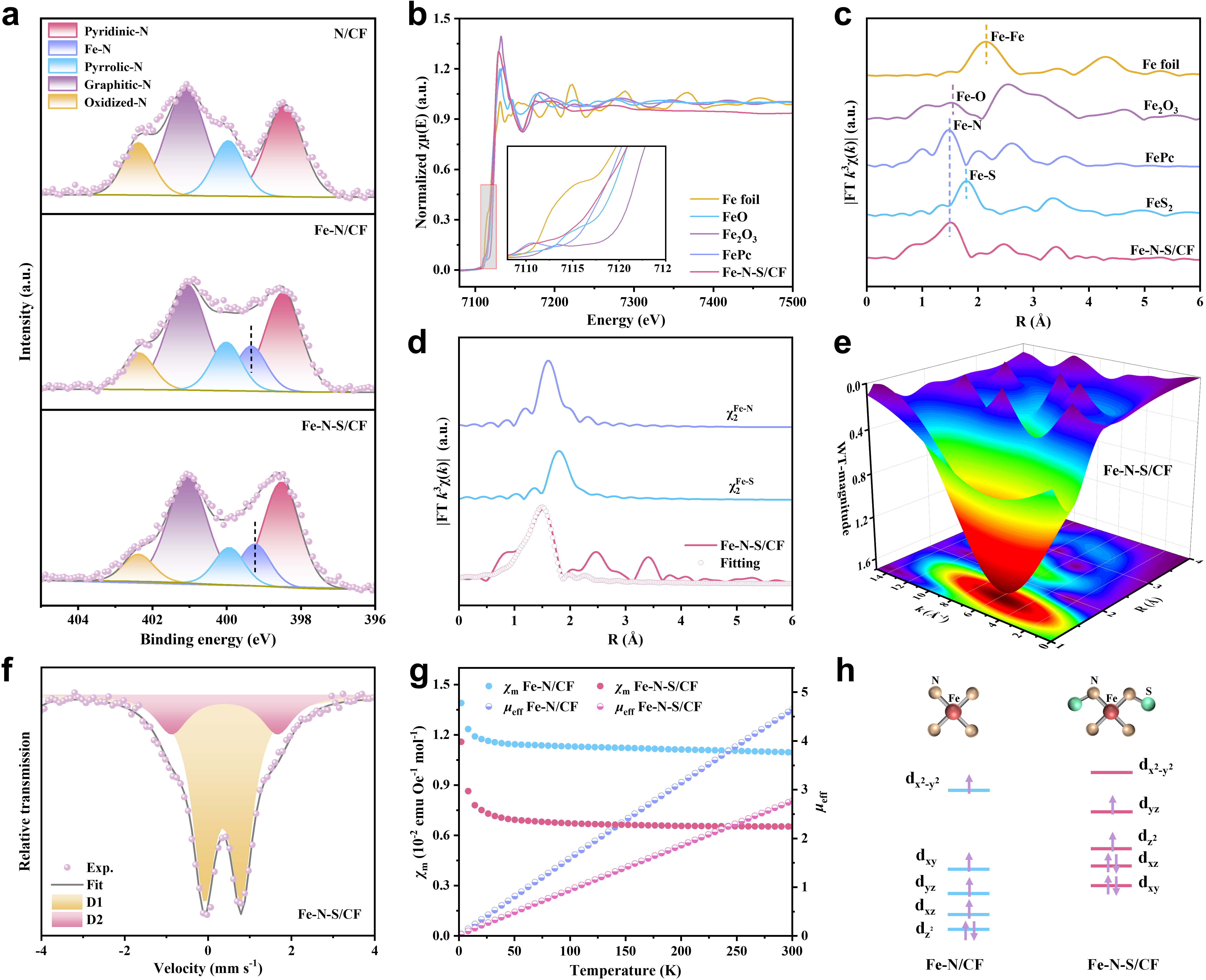
Fig. 2. (a) N 1s XPS spectra of N/CF, Fe-N/CF, and Fe-N-S/CF. (b) Fe K-edge XANES spectra. (c) k3-weighted Fourier-transformed EXAFS spectra of Fe-N-S/CF and reference materials. (d) EXAFS fitting curves of Fe-N-S/CF in R-space and the corresponding fitting paths. (e) Wavelet transform of k3-weighted EXAFS spectrum for Fe-N-S/CF. (f) 57Fe M?ssbauer spectrum of Fe-N-S/CF. (g) χm-T plots and the μeff of Fe-N-S/CF and Fe-N/CF. (h) Schematic diagram showing spin-electron filled states of Fe2+ 3d orbital.
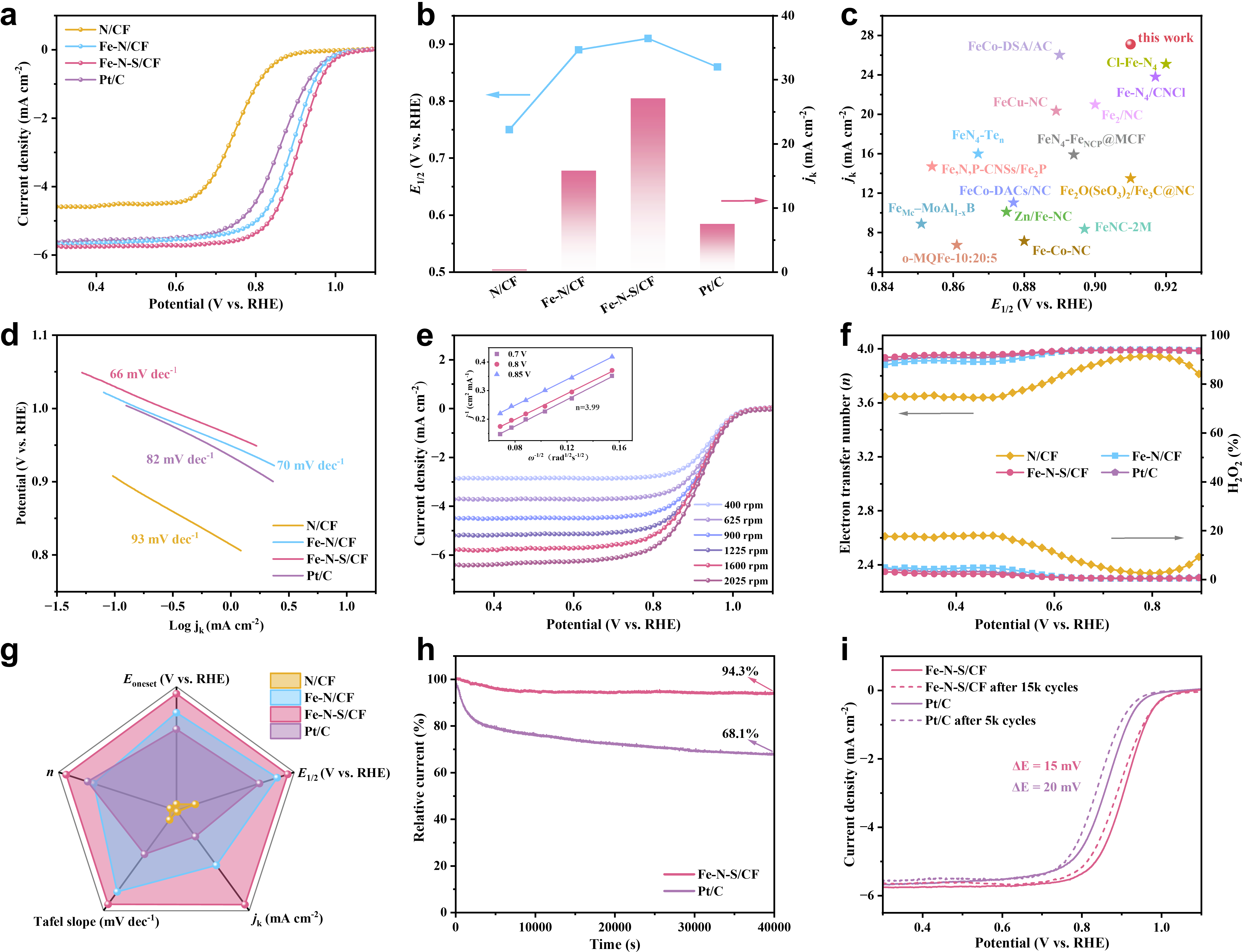
Fig. 3. Electrochemical performance. (a) LSV curves. (b) Comparison of E1/2 and jk at 0.85 V vs. RHE. (c) Comparison of E1/2 and jk at 0.85 V vs. RHE. (d) Tafel plots. (e) LSV curves of Fe-N-S/CF recorded at different rotation speeds (inset: K-L plots at the potential of 0.7, 0.8, and 0.85 V vs. RHE). (f) Electron transfer number (n) and H2O2 yields. (g) A radar chart comparing Eonset, E1/2, jk, Tafel slope, and n. (h) Amperometric i-t curves recorded at 0.7 V (vs. RHE) at a rotation speed of 1600 rpm. (i) LSV curves of Fe-N-S/CF before and after 15000 ADT cycles. Catalyst loading: 400 μg cm-2 for Fe-N-S/CF and 20 μg-Pt cm-2 for Pt/C, electrode rotation speed: 1600 rpm, electrolyte: 0.1 mol L-1 KOH solution.

Fig. 4. ZAB performance. (a) Schematic diagram of a typical ZAB device. (b) OCV curves (inset: the optical image of a Fe-N-S/CF ZAB). (c) Discharge polarization curves with peak power density indicated. (d) Discharge specific capacities at 10 mA cm-2. (e) Comparison of galvanostatic discharge curves at different current densities. (f) Galvanostatic discharge/charge cycling of ZABs evaluated at a current density of 5 mA cm-2.
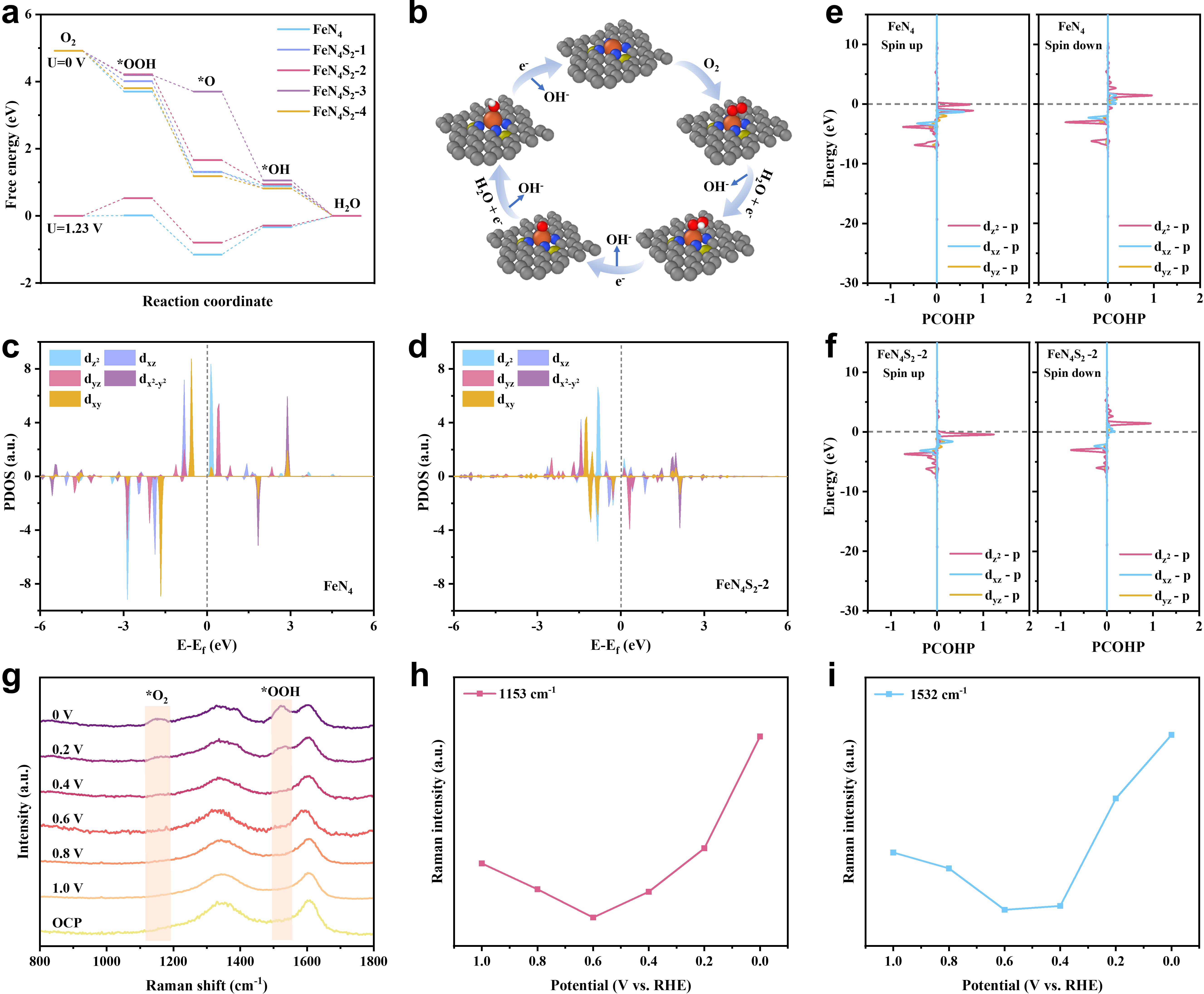
Fig. 5. Reaction mechanism. (a) Free energy diagrams of ORR over FeN4, FeN4S2-2 at 1.23 V and FeN4, FeN4S2-1, FeN4S2-2, FeN4S2-3, FeN4S2-4 at 0 V. (b) The adsorption models of O2 and oxygen intermediates during the ORR process. PDOS of Fe 3d orbitals for FeN4 (c) and FeN4S2-2 (d). PCOHP analysis of the Fe-O bond formed after adsorption of *OH over FeN4 (e) and FeN4S2-2 (f). (g) In-situ Raman spectra recorded over Fe-N-S/CF at different potentials. Peak intensity at 1153 cm-1 (h) and 1532 cm-1 (i) versus applied potentials (vs. RHE).
|
| [1] | Ke Li, Yi Luo, Chenning Cai, Zemin Zheng, Gang Yu, Jianqiang Hu, Shengli Chen. WN enhanced metal-N-C platform for ultra-stable Pt oxygen reduction electrocatalyst in fuel cell [J]. Chinese Journal of Catalysis, 2026, 87(8): 230-242. |
| [2] | Xiang Wang, Min Zhou, Xiaobin Liao, Xu Han, Congcong Xing, René Bes, Simo Huotari, Jordi Arbiol, Andreu Cabot. Enhanced oxygen evolution and reduction by phosphorus-doped Co9S8 derived from MOFs: Toward high-performance zinc-air batteries [J]. Chinese Journal of Catalysis, 2026, 85(6): 204-215. |
| [3] | Qianqian Xu, Haihong Zhong, Chunli Li, Rong Jiang, Yongjun Feng, Luis Alberto Estudillo-Wong. O-bridged NiSe2/CQDs composite synergistically triggers interfacial electrons transfer to promote H2O2 electrosynthesis [J]. Chinese Journal of Catalysis, 2026, 85(6): 258-271. |
| [4] | Ping Li, Liang Wei, Wei Xia, Chengcheng Yuan, Chenbin Ai, Meng Li. Ultrafast electron transfer in 2D/2D g-C3N4/WO3 S-scheme heterojunctions for enhanced H2O2 production [J]. Chinese Journal of Catalysis, 2026, 85(6): 333-345. |
| [5] | Wenning Liu, Li An, Jinming Wang, Ruyue Li, Jie Mu, Yongde Long, Dan Qu, Yichang Liu, Yuxiang Hu, Xiayan Wang, Ning Jiang, Zaicheng Sun. Group IIIA metals-induced p-d orbital hybridization enhances the oxygen reduction performance of Pd based metallene in zinc-air batteries [J]. Chinese Journal of Catalysis, 2026, 84(5): 144-158. |
| [6] | Ran Sun, Yuqi Zhang, Kunge Hou, Yujie Tan, Xingang Liu, Jianyuan Hou, Weixuan Zhao, Andrew E. H. Wheatley, Renxi Zhang. Designing hydrogen-bonds in covalent organic frameworks: accelerating proton-coupled electron transfer for enhanced photocatalytic H2O2 synthesis [J]. Chinese Journal of Catalysis, 2026, 84(5): 274-287. |
| [7] | Yujuan Zhuang, Qingjun Chen, Xingen Lin, Lingwei Meng, Fuwang Hu, Xintao Yu, Geoffrey I. N. Waterhouse, Lishan Peng. Enhancing the stability of Pt/C catalysts for oxygen reduction reaction in PEMFCs via Fe-N-C-mediated 5d-3d/2p orbital hybridization [J]. Chinese Journal of Catalysis, 2026, 83(4): 308-318. |
| [8] | Gong Li, Jingsen Bai, Dan Wang, Liang Liang, Chunyu Ru, Xue Gong, Minhua Shao, Changpeng Liu, Meiling Xiao, Wei Xing. Hollow COF-derived carbon supports enable PtCo alloy catalysts with exceptional activity and durability for oxygen reduction reaction in fuel cells [J]. Chinese Journal of Catalysis, 2026, 83(4): 294-307. |
| [9] | Wenao Xie, Zhifang Jia, Chang Shu, Tingxia Wang, Jianhong Xi, Jiaxuan Cai, Xiangyang Song, Yu Che, Xiaoyan Wang, Kewei Wang, Bien Tan. Cyano-functionalized covalent organic frameworks for enhanced photocatalytic hydrogen peroxide production via microenvironment engineering [J]. Chinese Journal of Catalysis, 2026, 83(4): 282-293. |
| [10] | Weiping Xiao, Yue Zhang, Na Wang, Xiaofei Yang. Synergistic electrode-electrolyte coupling enabled highly efficient and durable high entropy intermetallic-based electrocatalyst for oxygen reduction reaction [J]. Chinese Journal of Catalysis, 2026, 82(3): 92-104. |
| [11] | Hui-Min Xu, Xiao-Qi Gong, Kai-Hang Yue, Chen-Jin Huang, Hong-Rui Zhu, Lian-Jie Song, Gao-Ren Li. Fe and Co bimetallic single-atoms coordinated by N and Te as bifunctional oxygen reduction/evolution catalysts for high-performance zinc-air battery [J]. Chinese Journal of Catalysis, 2026, 81(2): 319-332. |
| [12] | Haihong Zhong, Qianqian Xu, Weiting Yang, Nicolas Alonso-Vante, Yongjun Feng. Composition regulation of iron-group transition metal chalcogenides for the oxygen electrocatalysis: Electronic structure and surface reconstruction [J]. Chinese Journal of Catalysis, 2026, 81(2): 37-68. |
| [13] | Jiaping Lu, Chao Lin, Chao Li, Hongjie Shi, Nengyi Liu, Wandong Xing, Sibo Wang, Guigang Zhang, Teng-Teng Chen, Xiong Chen. Bipyridine-integrated bisoxazole-based donor-acceptor covalent organic framework for enhanced photocatalytic H2O2 synthesis [J]. Chinese Journal of Catalysis, 2026, 81(2): 185-194. |
| [14] | Xiaofeng Chen, Yixuan Huang, Wanbin Lin, Jiaojiao Xia, Xirui Zhang, Wenjie Gong, Chuqian Jian, Hao Liu, Jiacheng Zeng, Jiang Liu, Yu Chen. Mn-doping induced phase segregation of air electrodes enables high-performance and durable reversible protonic ceramic cells [J]. Chinese Journal of Catalysis, 2026, 81(2): 333-343. |
| [15] | Yana Men, Yuzhou Jiao, Yanxing Zheng, Xiaoyan Wang, Shengli Chen, Peng Li. pH-dependent protic ionic liquid tuning effect on oxygen reduction activity of a molecular iron catalyst and its electrochemical interfacial origin [J]. Chinese Journal of Catalysis, 2026, 80(1): 258-269. |
| Viewed | ||||||
|
Full text |
|
|||||
|
Abstract |
|
|||||


