
Chinese Journal of Catalysis ›› 2026, Vol. 90: 158-168.DOI: 10.1016/S1872-2067(26)65193-5
• Articles • Previous Articles Next Articles
Heng Zhanga,1, Zeyu Zhanga,1, Kunming Houa, Lin Jiaa, Yingxin Guoa,*( ), Haorun Lia, Mengbo Zoua, Xianhu Sunb,*(), Shanghong Zenga,*()
Received:2026-02-10
Accepted:2026-04-11
Online:2026-11-18
Published:2026-11-19
About author:First author contact:1Contributed equally to this work.
Supported by:Heng Zhang, Zeyu Zhang, Kunming Hou, Lin Jia, Yingxin Guo, Haorun Li, Mengbo Zou, Xianhu Sun, Shanghong Zeng. Pr(OH)3 nanorods on Cu generates asymmetric active sites through interplay and geometric deformation for CO2 electroreduction[J]. Chinese Journal of Catalysis, 2026, 90: 158-168.
Add to citation manager EndNote|Ris|BibTeX
URL: https://www.cjcatal.com/EN/10.1016/S1872-2067(26)65193-5
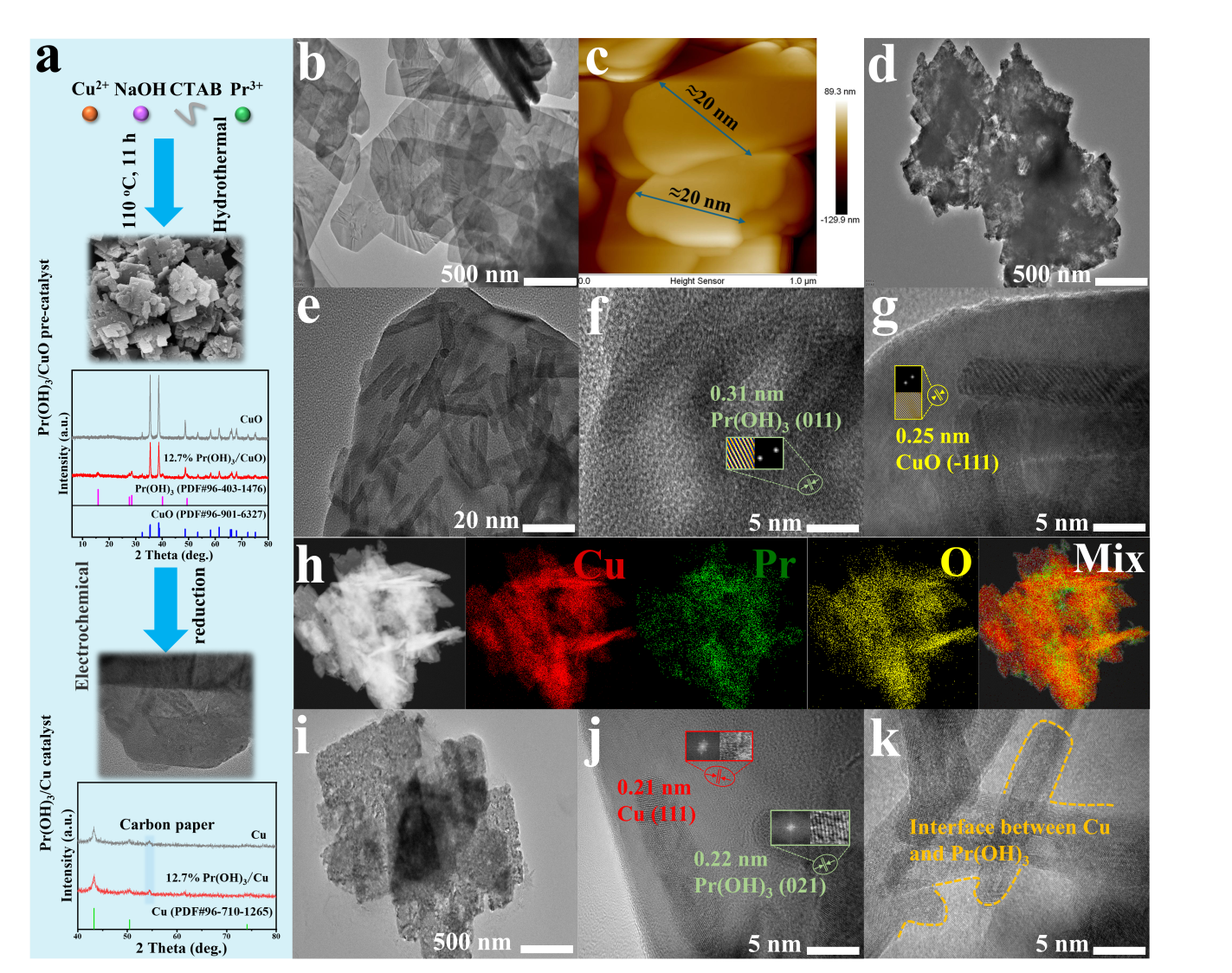
Fig. 1. Structural and microscopic characterizations of CuO, Pr(OH)3/CuO and Pr(OH)3/Cu. (a) Schematic diagram for the preparation of Pr(OH)3/CuO and Pr(OH)3/Cu. Representative TEM (b) and AFM (c) images of the CuO. Representative TEM (d,e), HRTEM (f,g), HAADF-STEM images and corresponding EDS mappings (h) of the 12.7% Pr(OH)3/CuO pre-catalyst. Representative TEM (i) and HRTEM (j,k) images of the12.7% Pr(OH)3/Cu catalyst.
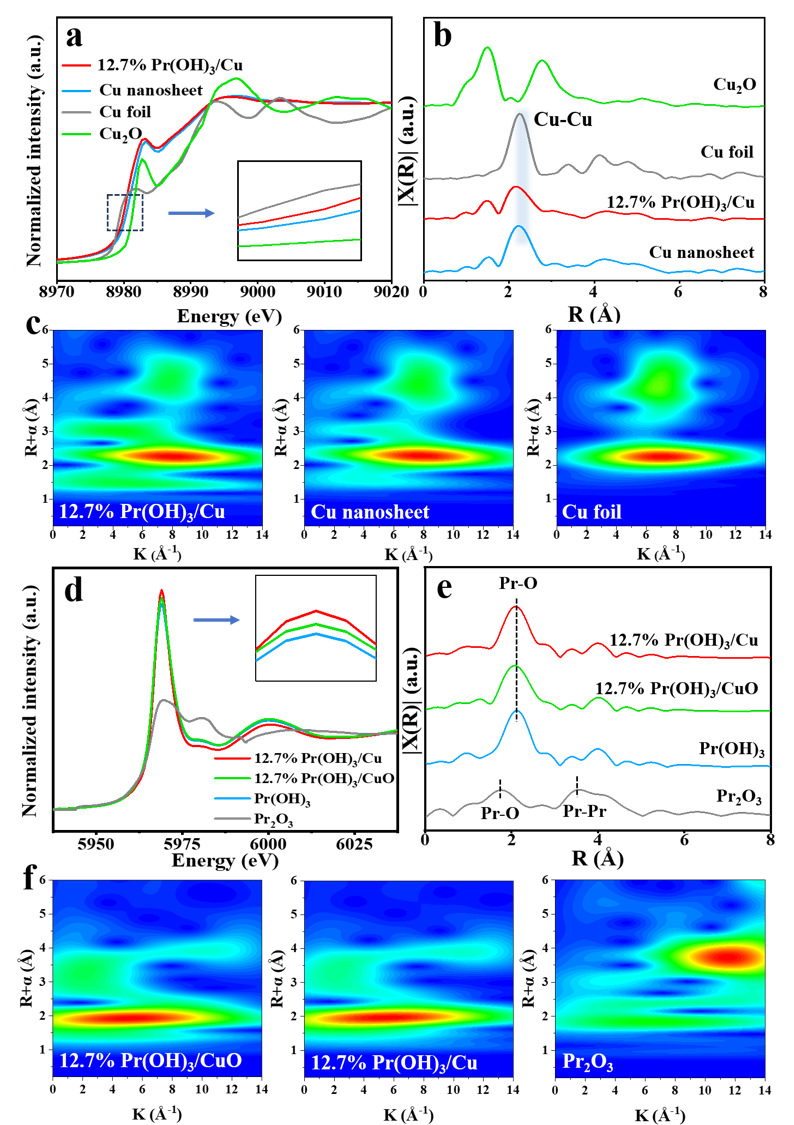
Fig. 2. Normalized Cu k-edge XANES spectra (a) and the corresponding FT-EXAFS spectra (b) of 12.7% Pr(OH)3/Cu, Cu nanosheet and references in R space. (c) WT plots for the k3-weighted EXAFS signal of 12.7% Pr(OH)3/Cu, Cu nanosheet and Cu foil. (d) Pr L3-edge XANES spectra of the 12.7% Pr(OH)3/Cu, 12.7% Pr(OH)3/CuO, Pr(OH)3 and Pr2O3. (e) FT EXAFS spectra of 12.7% Pr(OH)3/Cu, 12.7% Pr(OH)3/CuO, Pr(OH)3 and Pr2O3 at R space. (f) WT plots for the k3-weighted EXAFS signal of 12.7% Pr(OH)3/CuO, 12.7% Pr(OH)3/Cu and Pr2O3.
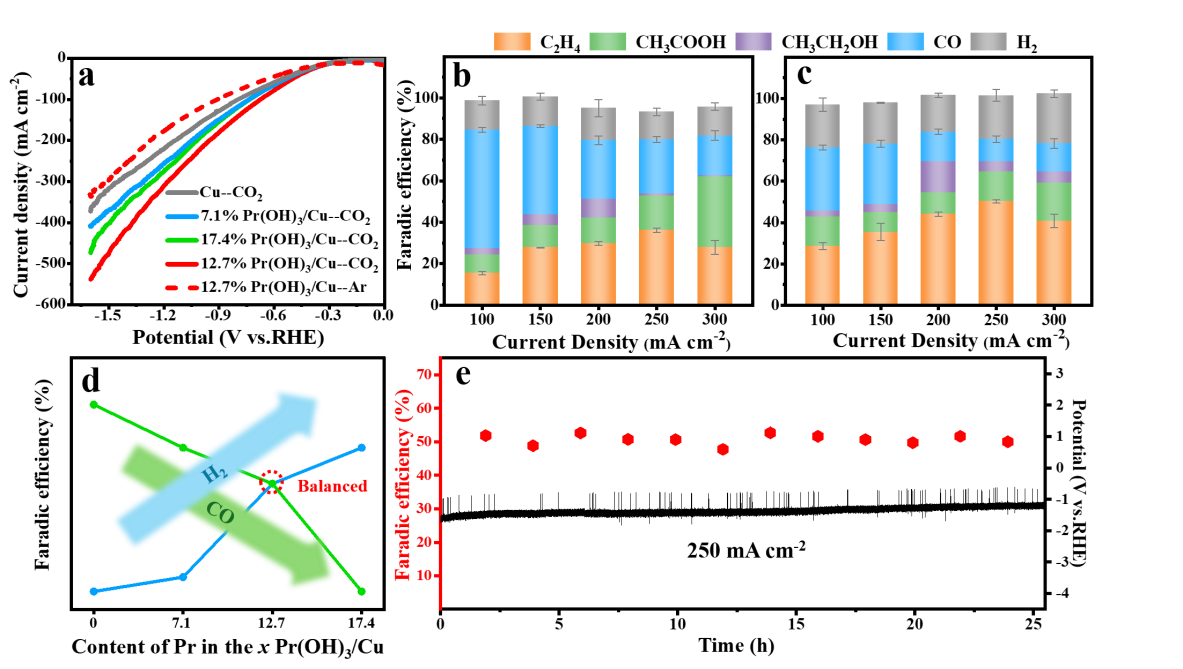
Fig. 3. (a) LSV curves of Cu and Pr(OH)3/Cu catalysts in 1 mol L-1 KOH in a flow cell. FE of Cu (b) and 12.7% Pr(OH)3/Cu (c) catalyst at applied current density in the range from 100 to 300 mA cm-2. (d) Relationship between Pr(OH)3 content and FE. (e) Stability test results for the 12.7% Pr(OH)3/Cu catalyst at 250 mA cm-2.
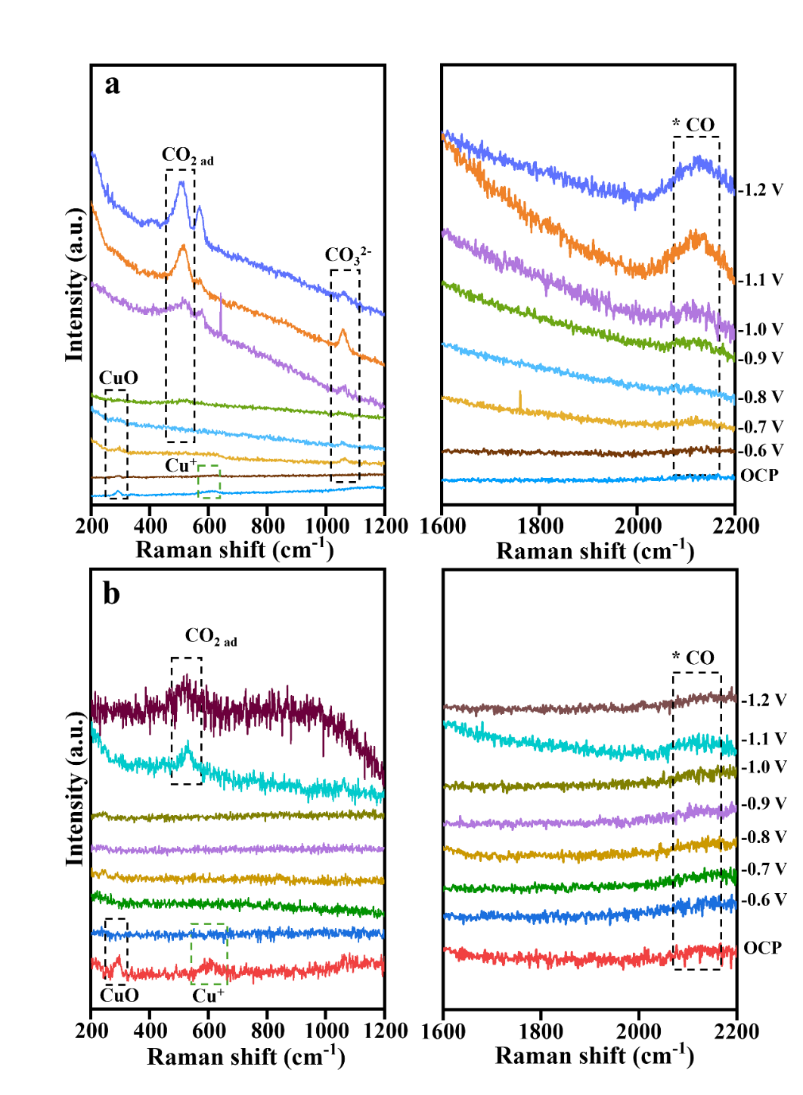
Fig. 4. In-situ potential-dependent surface-enhanced Raman spectra of 12.7% Pr(OH)3/CuO catalyst (a) and CuO nanosheet (b) in the regions of 200-1200 and 1600-2200 cm-1.
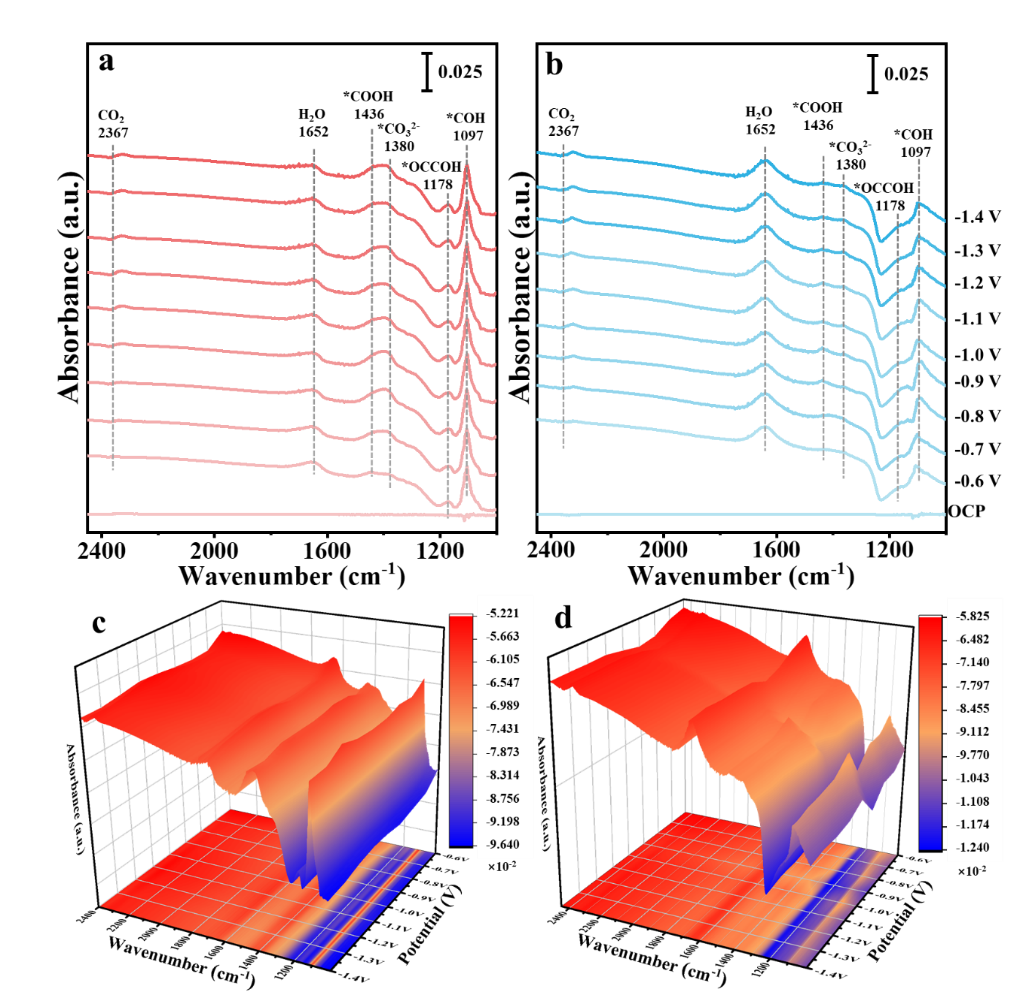
Fig. 5. Operando ATR-SEIRAS spectra of 12.7% Pr(OH)3/Cu (a,c) and Cu nanosheet (b,d) with 0.1 V interval from -0.6 to -1.4 V in a CO2-saturated 0.1 mol L-1 KHCO3 electrolyte.
|
| [1] | Qi Hao, Qi Tang, Junxiu Wu, Kai Liu, Jun Lu, Tianpin Wu. Neighboring Ni-Cu dual single-atom sites regulate the local environment of interfacial water for promoting CO2 electroreduction kinetics in CO2-to-CO conversion [J]. Chinese Journal of Catalysis, 2026, 87(8): 47-58. |
| [2] | Xiaohu Liu, Shoujie Li, Jianing Mao, Aohui Chen, Xiao Dong, Yiheng Wei, Jiayu Xia, Huanyi Zhu, Xiaotong Wang, Ziran Xu, Guihua Li, Yanfang Song, Wei Wei, Wei Chen. Engineering substitutional AgZn3 on penetration electrodes via in-situ reconstruction for ampere-level CO2 electroreduction [J]. Chinese Journal of Catalysis, 2026, 86(7): 201-211. |
| [3] | Sixian Li, Youyu Duan, Xinyuan Liang, Yuhan Li, Dieqing Zhang. Decoding the atomic architecture of photocatalytic active sites: From precise identification to rational design principles [J]. Chinese Journal of Catalysis, 2026, 83(4): 1-23. |
| [4] | Genxiang Wang, Zhiwen Lu, Zhenhai Wen. From fundamental flaw to manageable parameter: Engineering salt precipitation out of acidic CO2RR for industrial viability [J]. Chinese Journal of Catalysis, 2026, 81(2): 5-8. |
| [5] | Yue Shen, Bing Chen, Jielian Yang, Qi Wu, Yuemei Liao, Liya Zhou, Naixin Lyu, Jin Guo, Xuetang Xu, Anxiang Guan, Zaiwang Zhao. Boron-incorporation-mediated interfacial water orientation for boosting CO2 electroreduction to CH4 [J]. Chinese Journal of Catalysis, 2026, 90(11): 130-144. |
| [6] | Gang Wang, Imran Muhammad, Hui-Min Yan, Jun Li, Yang-Gang Wang. Regulating the local environment of Ni single-atom catalysts with heteroatoms for efficient CO2 electroreduction [J]. Chinese Journal of Catalysis, 2025, 74(7): 120-129. |
| [7] | Xiao-Han Li, Bo-Wen Zhang, Wan-Feng Xiong, Ze Li, Xiao-Yu Xiang, Si-Ying Zhang, Duan-Hui Si, Hong-Fang Li, Rong Cao. Highly selective CO2 electroreduction to ethylene on long alkyl chains-functionalized copper nanowires [J]. Chinese Journal of Catalysis, 2025, 73(6): 196-204. |
| [8] | Pengxiang Zhang, Jiawen Wang, Tianyu Yang, Ruizhe Wang, Ruofan Shen, Zhikun Peng, Yanyan Liu, Xianli Wu, Jianchun Jiang, Baojun Li. Unveiling complexities: Reviews on insights into the mechanism of oxygen evolution reaction [J]. Chinese Journal of Catalysis, 2025, 72(5): 48-83. |
| [9] | Lina Zhang, Guowei Liu, Xinyan Deng, Qiuye Li, Jianjun Yang. Atomically dispersed Ba sites as electron promoters to enhance the performance for photoreduction of CO2 [J]. Chinese Journal of Catalysis, 2025, 70(3): 341-352. |
| [10] | Lina Wang, Muhan Na, Ruofei Du, Xiujin Wang, Boyang Yu, Lan Yang, Hui Chen, Xiaoxin Zou. Ultrathin two-dimensional electrocatalysts: Structure-property relationships, mechanistic insights, and applications in water electrolysis [J]. Chinese Journal of Catalysis, 2025, 77(10): 4-19. |
| [11] | Chengguang Lang, Yantong Xu, Xiangdong Yao. Perfecting HER catalysts via defects: Recent advances and perspectives [J]. Chinese Journal of Catalysis, 2024, 64(9): 4-31. |
| [12] | Xingxing Jiang, Yuxin Zhao, Yan Kong, Jianju Sun, Shangzhao Feng, Qi Hu, Hengpan Yang, Chuanxin He. Adequately stabilized and exposed copper heterostructure for CO2 electroreduction to ethanol with ultrahigh mass activity [J]. Chinese Journal of Catalysis, 2024, 58(3): 216-225. |
| [13] | Yuannan Wang, Lina Wang, Kexin Zhang, Jingyao Xu, Qiannan Wu, Zhoubing Xie, Wei An, Xiao Liang, Xiaoxin Zou. Electrocatalytic water splitting over perovskite oxide catalysts [J]. Chinese Journal of Catalysis, 2023, 50(7): 109-125. |
| [14] | Huanhuan Yang, Shiying Li, Qun Xu. Efficient strategies for promoting the electrochemical reduction of CO2 to C2+ products over Cu-based catalysts [J]. Chinese Journal of Catalysis, 2023, 48(5): 32-65. |
| [15] | Wenqian Yang, Ziqian Xue, Jun Yang, Jiahui Xian, Qinglin Liu, Yanan Fan, Kai Zheng, Peiqin Liao, Hui Su, Qinghua Liu, Guangqin Li, Cheng-Yong Su. Fe nanoparticles embedded in N-doped porous carbon for enhanced electrocatalytic CO2 reduction and Zn-CO2 battery [J]. Chinese Journal of Catalysis, 2023, 48(5): 185-194. |
| Viewed | ||||||
|
Full text |
|
|||||
|
Abstract |
|
|||||


