
Chinese Journal of Catalysis ›› 2026, Vol. 90: 130-144.DOI: 10.1016/S1872-2067(26)65192-3
• Articles • Previous Articles Next Articles
Yue Shena, Bing Chena, Jielian Yanga, Qi Wua, Yuemei Liaoa, Liya Zhoua,*( ), Naixin Lyub, Jin Guoa, Xuetang Xua,*(), Anxiang Guana,*(), Zaiwang Zhaoc,*()
Received:2026-04-21
Accepted:2026-06-15
Online:2026-11-18
Published:2026-11-19
About author:First author contact: Study concept and design: Yue Shen. Sample processing and characterization: Yue Shen, Bing Chen, Jielian Yang. Data analysis and interpretation: Yue Shen, Qi Wu, Yuemei Liao, Naixin Lyu, Jin Guo. Funding acquisition: Liya Zhou, Xuetang Xu, Anxiang Guan. Manuscript draft: Yue Shen, Anxiang Guan, Zaiwang Zhao. Manuscript review and editing: Liya Zhou, Xuetang Xu, Anxiang Guan, Zaiwang Zhao. All authors read and approved the final manuscript.
Supported by:Yue Shen, Bing Chen, Jielian Yang, Qi Wu, Yuemei Liao, Liya Zhou, Naixin Lyu, Jin Guo, Xuetang Xu, Anxiang Guan, Zaiwang Zhao. Boron-incorporation-mediated interfacial water orientation for boosting CO2 electroreduction to CH4[J]. Chinese Journal of Catalysis, 2026, 90: 130-144.
Add to citation manager EndNote|Ris|BibTeX
URL: https://www.cjcatal.com/EN/10.1016/S1872-2067(26)65192-3
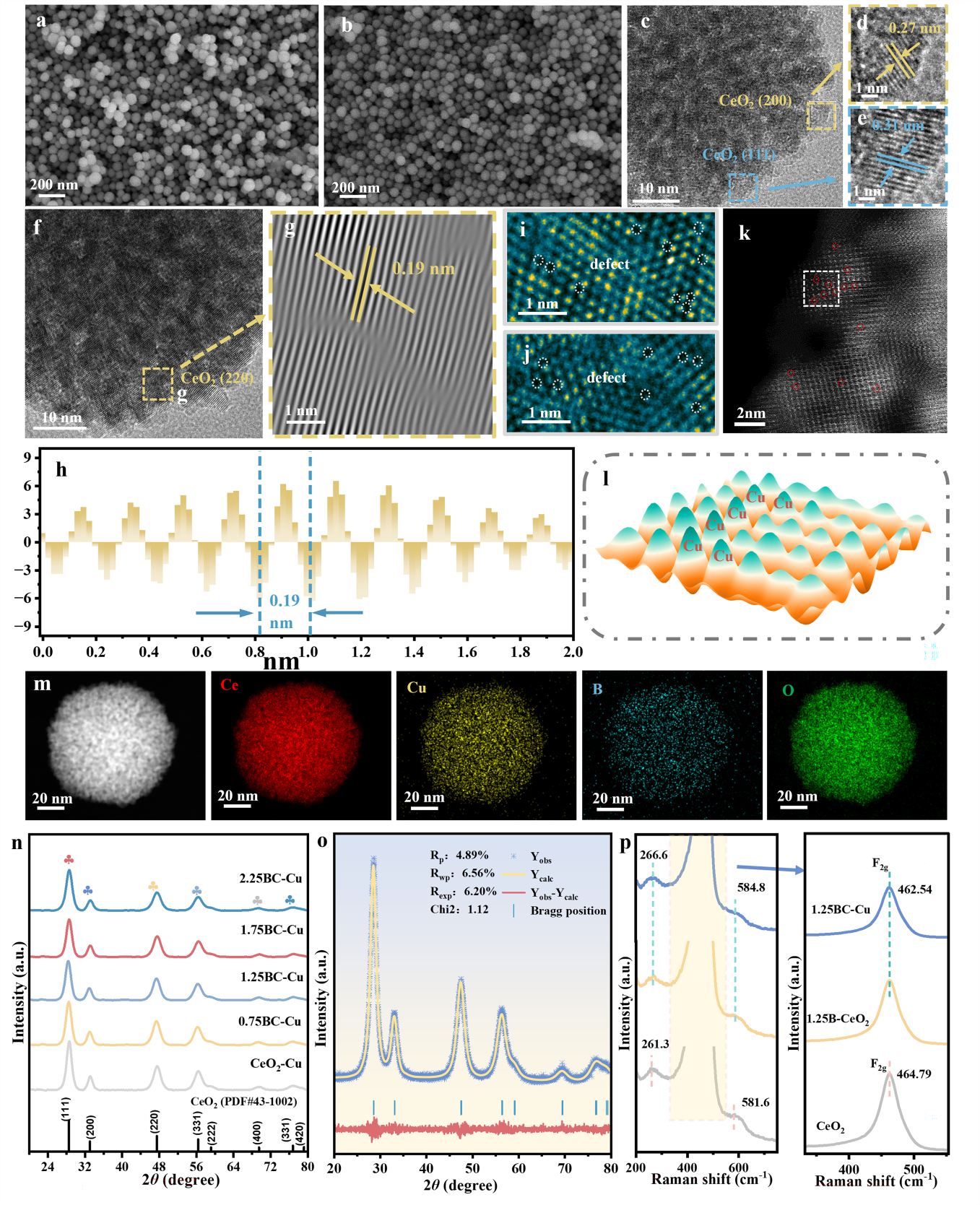
Fig. 1. SEM images of CeO2 (a) and 1.25BC-Cu (b). (c-e) HRTEM images of CeO2 with magnified lattice fringes. HRTEM images (f,g), inverse fast Fourier transform (IFFT) images (h), and HRTEM images (i,j) of 1.25BC-Cu sample, where white circles mark the vacancy defects. Atomic-resolution aberration-corrected HAADF-STEM image (k) and the corresponding 3D intensity surface plot (l) derived from the white dashed boxed region in (k). (m) EDS elemental mapping of 1.25BC-Cu sample. (n) XRD patterns for different Cu doped CeO2 samples. (o) Calculated profile based on Rietveld refinement for 1.25BC-Cu sample. (p) Raman spectra of the CeO2, 1.25B-CeO2, and 1.25BC-Cu samples.
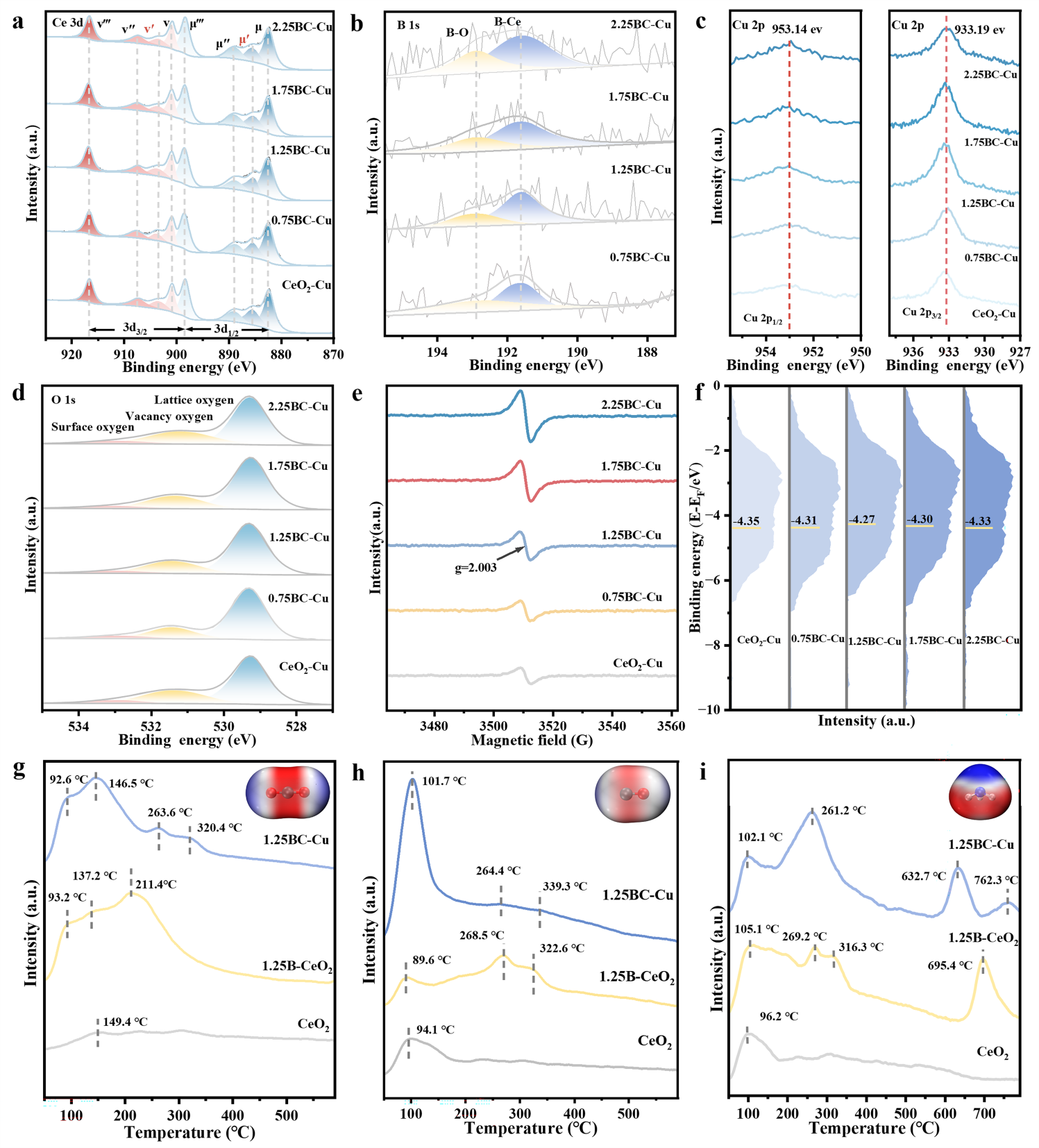
Fig. 2. (a) Ce 3d XPS spectra of different samples. (b) B 1s XPS spectra of different samples. (c) Cu 2p XPS spectra of different samples. (d) O 1s XPS spectra of different samples. (e) EPR spectra of CeO2-Cu and xBC-Cu (x = 0.75, 1.25, 1.75, and 2.25) samples. (g) CO2-TPD curves of the CeO2, 1.25B-CeO2 and 1.25BC-Cu catalysts. (h) CO-TPD curves of the CeO2, 1.25B-CeO2 and 1.25BC-Cu catalysts. (i) NH3-TPD curves of the CeO2, 1.25B-CeO2 and 1.25BC-Cu catalysts.
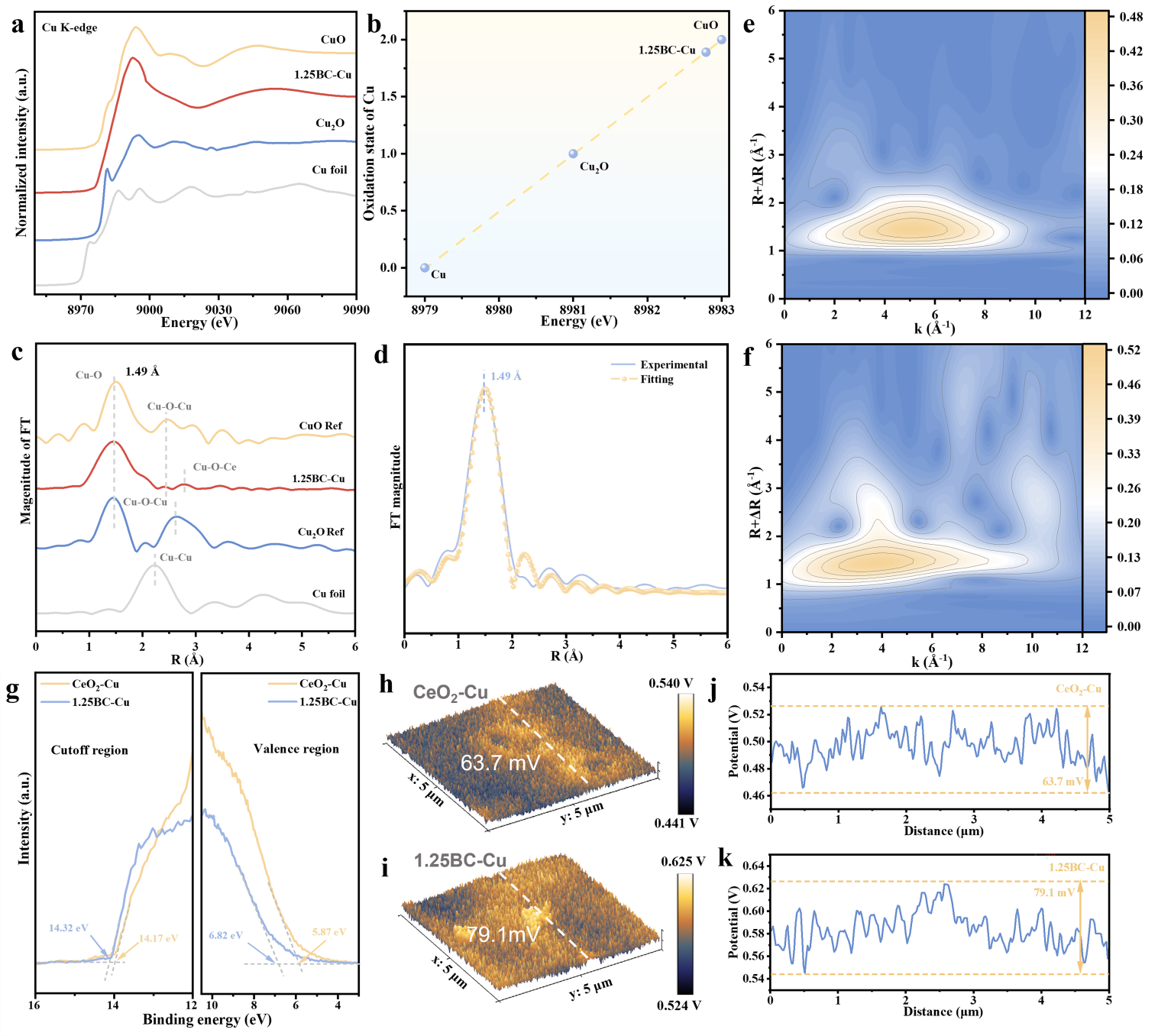
Fig. 3. (a) Cu K-edge XANES spectra of Cu foil, Cu2O, 1.25BC-Cu, and CuO. (b) Average oxidation state of Cu in the 1.25BC-Cu sample. (c) FT-EXAFS of 1.25BC-Cu with reference to Cu foil, Cu2O, and CuO. (d) EXAFS fitting curve for 1.25BC-Cu at the Cu K edge. Wavelet transform images of EXAFS data at Cu K-edge with the optimized Morlet parameter for 1.25BC-Cu (e) and CuO (f). (g) UPS spectra of CeO2-Cu and 1.25BC-Cu samples. KPFM potential maps of CeO2-Cu (h) and 1.25BC-Cu (j). KPFM potential line profiles of CeO2-Cu (j) and 1.25BC-Cu (k).
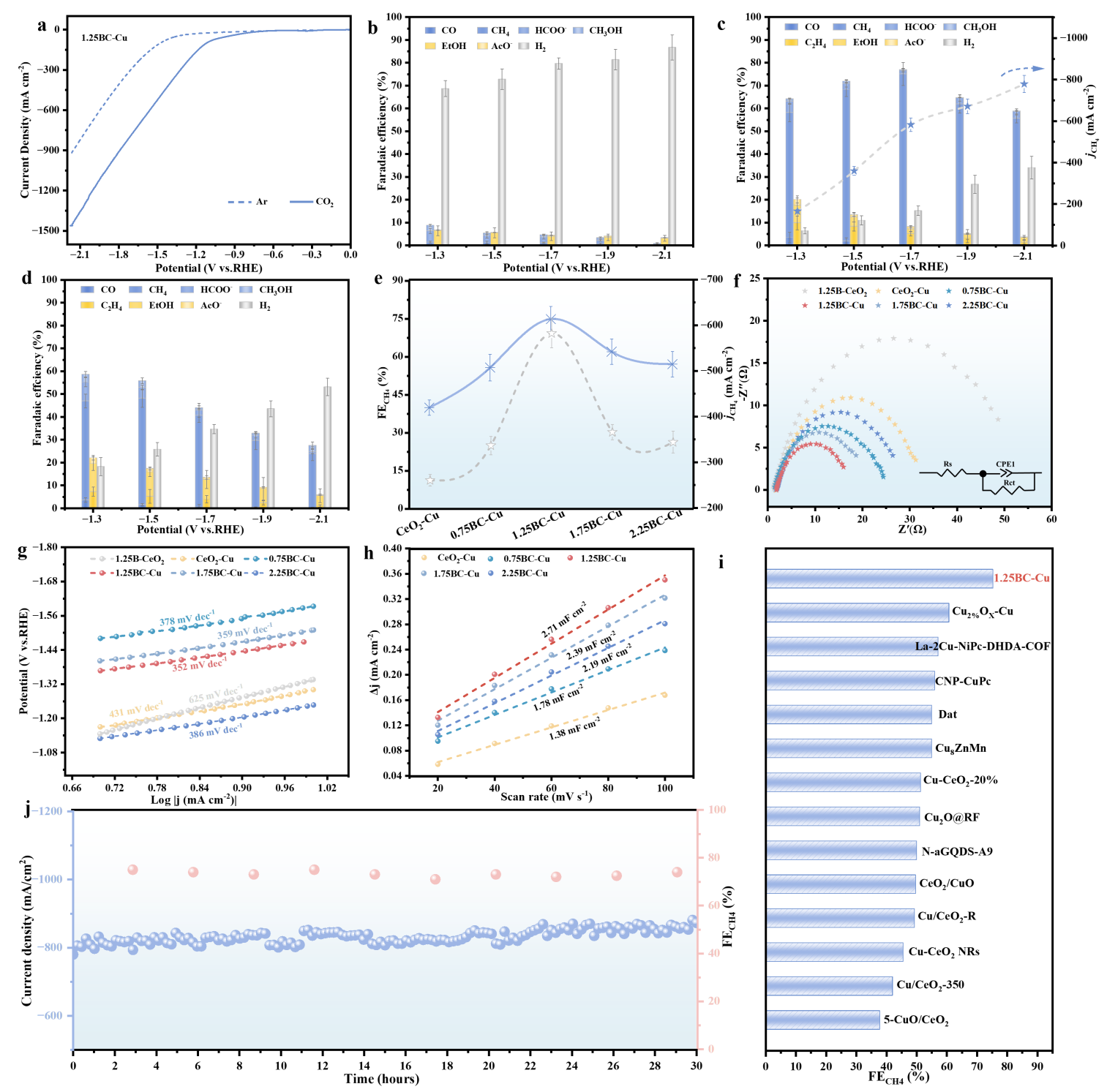
Fig. 4. (a) LSV curves for 1.25BC-Cu catalyst measured in flow-cell with CO2- or Ar-purged 1.0 mol/L KOH as electrolyte (From 0 to −2.1 V vs. RHE). CO2 electroreduction performances of 1.25B-CeO2 (b), 1.25BC-Cu (c), and CeO2-Cu (d) samples measured in flow-cell from −1.3 to −2.1 V vs. RHE. (e) Faradaic efficiencies of CH4 for different samples measured in flow-cell at −1.7 V vs. RHE. (f) Nyquist plots over the frequency ranging from 105 to 10-2 Hz for different catalysts. (g) Tafel slopes for different catalysts. (h) Capacitive currents with different sweep rates of different catalysts. (i) Performance of 1.25BC-Cu catalyst compared with those of CO2-to-CH4 electrocatalysts. (j) Stability test of 1.25BC-Cu catalysts measured in flow-cell at −1.7 V vs. RHE.
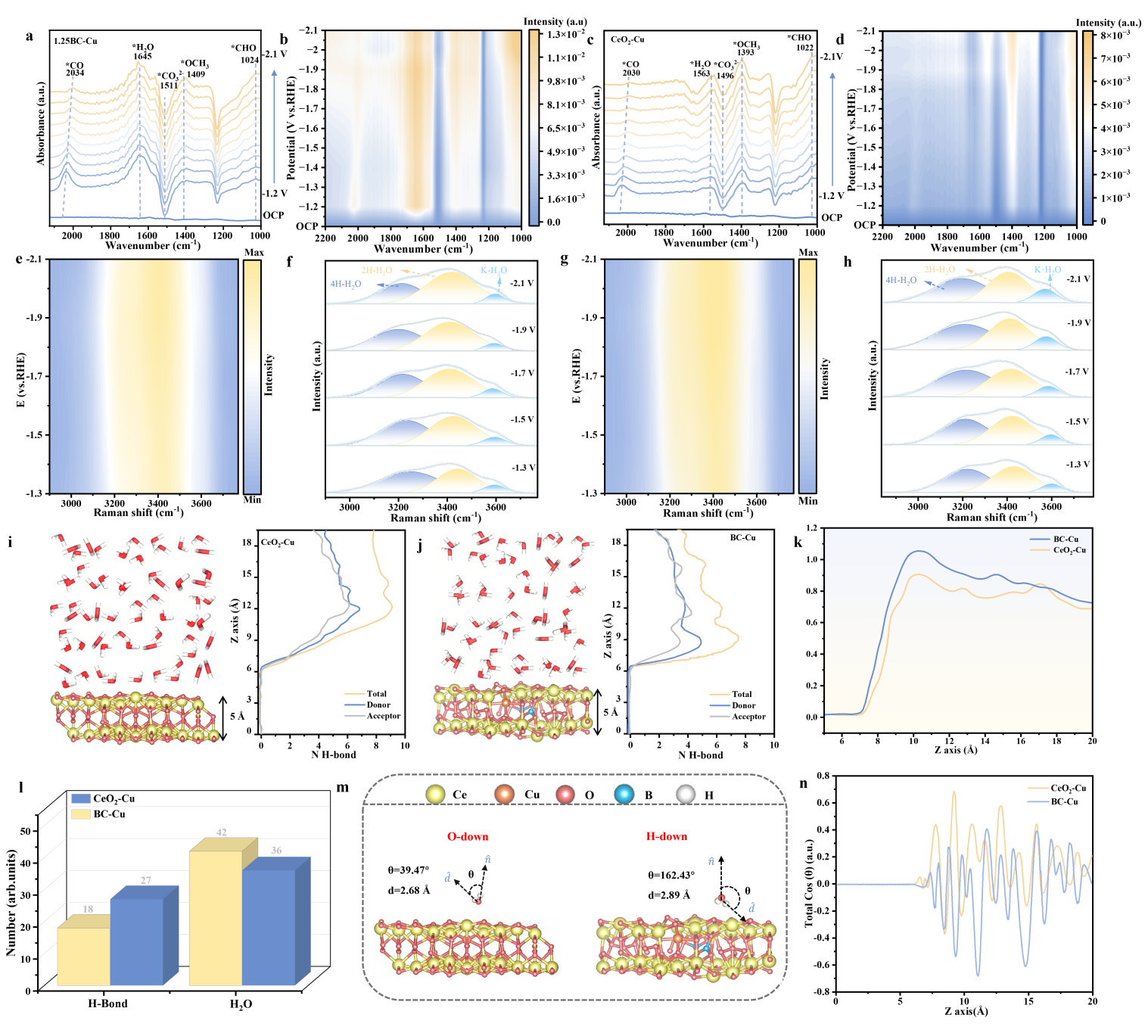
Fig. 5. (a,b) In-situ ATR-SEIRAS spectra collected at different applied potentials over 1.25BC-Cu. (c,d) In-situ ATR-SEIRAS spectra acquired at variable applied potentials for CeO2-Cu. (e,f) Potential-dependent in situ Raman profiles of the CeO2-Cu catalyst. (g,h) Potential-dependent in-situ Raman patterns of the 1.25BC-Cu catalyst. Representative structural snapshots of interfacial water molecules and the corresponding averaged hydrogen-bond number distributions along the surface for CeO2-Cu (i) and BC-Cu (j). (k) Water concentration profiles along the direction normal to the surface over CeO2-Cu and BC-Cu. (l) Averaged hydrogen-bond counts and the corresponding numbers of water molecules for the CeO2-Cu and BC-Cu models. (m) Adsorption configurations of first-layer water molecules on CeO2-Cu and BC-Cu surfaces. (n) Distribution characteristics of water dipole orientations along the surface normal direction.
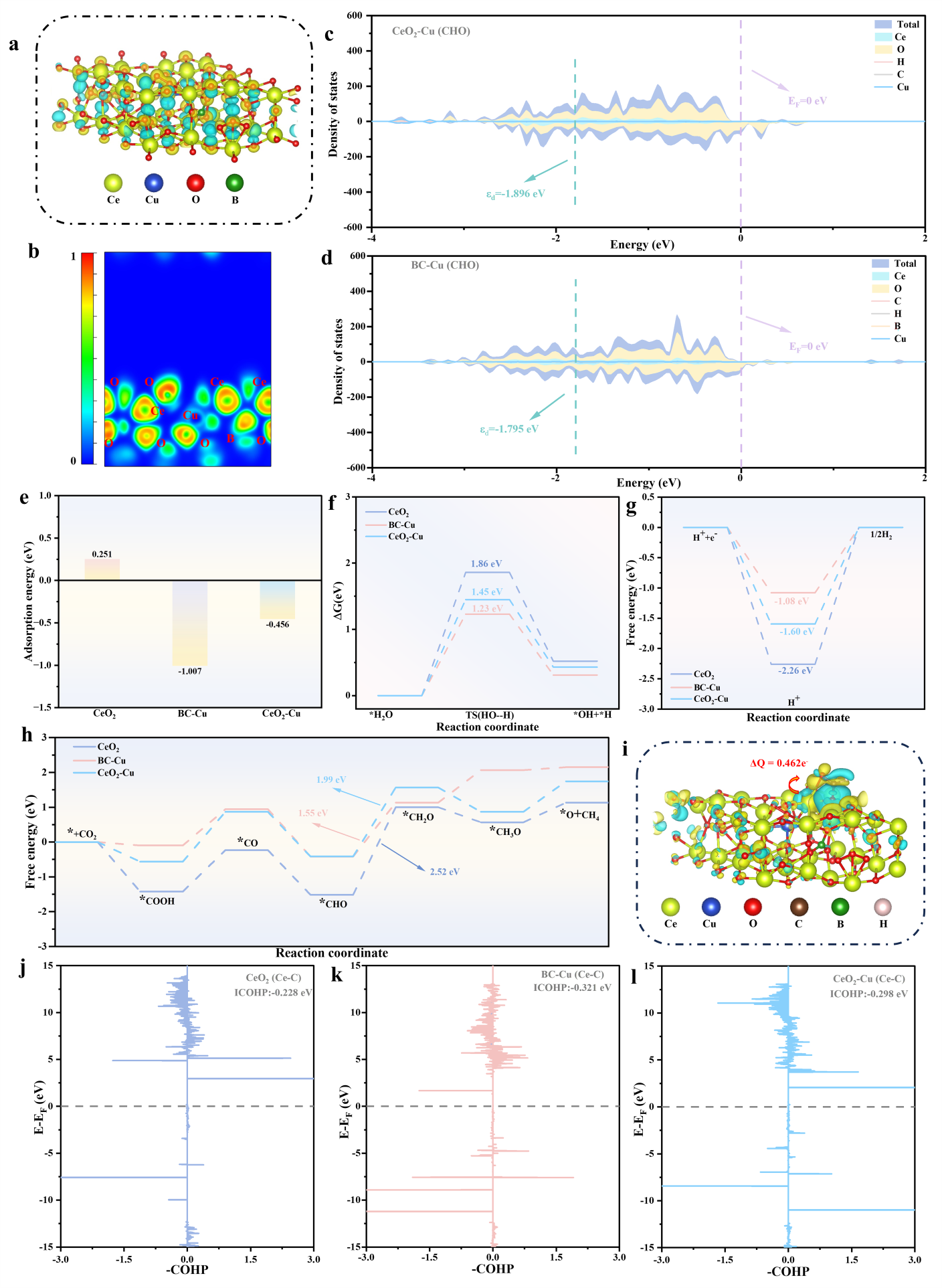
Fig. 6. (a) Charge density distribution diagram of B and Cu co-doped CeO2 (Denoted as BC-Cu). (b) Plot of electron localization function of the B and Cu co-doped CeO2. The calculated density of states for *CHO adsorbed on CeO2-Cu (c) and BC-Cu (d). (e) Adsorption energy of CO2 on CeO2, CeO2-Cu and BC-Cu. (f) H2O dissociation for CeO2, CeO2-Cu and BC-Cu. (g) HER on CeO2, CeO2-Cu and BC-Cu. (h) Reaction paths and free energy diagrams of CO2 reduction to CH4 on CeO2, CeO2-Cu and BC-Cu. (i) Differential charge density distributions of *CHO adsorbed BC-Cu. COHP analysis of CeO2 (j), BC-Cu (k) and CeO2-Cu (l).
|
| [1] | Qi Hao, Qi Tang, Junxiu Wu, Kai Liu, Jun Lu, Tianpin Wu. Neighboring Ni-Cu dual single-atom sites regulate the local environment of interfacial water for promoting CO2 electroreduction kinetics in CO2-to-CO conversion [J]. Chinese Journal of Catalysis, 2026, 87(8): 47-58. |
| [2] | Xiaohu Liu, Shoujie Li, Jianing Mao, Aohui Chen, Xiao Dong, Yiheng Wei, Jiayu Xia, Huanyi Zhu, Xiaotong Wang, Ziran Xu, Guihua Li, Yanfang Song, Wei Wei, Wei Chen. Engineering substitutional AgZn3 on penetration electrodes via in-situ reconstruction for ampere-level CO2 electroreduction [J]. Chinese Journal of Catalysis, 2026, 86(7): 201-211. |
| [3] | Genxiang Wang, Zhiwen Lu, Zhenhai Wen. From fundamental flaw to manageable parameter: Engineering salt precipitation out of acidic CO2RR for industrial viability [J]. Chinese Journal of Catalysis, 2026, 81(2): 5-8. |
| [4] | Heng Zhang, Zeyu Zhang, Kunming Hou, Lin Jia, Yingxin Guo, Haorun Li, Mengbo Zou, Xianhu Sun, Shanghong Zeng. Pr(OH)3 nanorods on Cu generates asymmetric active sites through interplay and geometric deformation for CO2 electroreduction [J]. Chinese Journal of Catalysis, 2026, 90(11): 158-168. |
| [5] | Gang Wang, Imran Muhammad, Hui-Min Yan, Jun Li, Yang-Gang Wang. Regulating the local environment of Ni single-atom catalysts with heteroatoms for efficient CO2 electroreduction [J]. Chinese Journal of Catalysis, 2025, 74(7): 120-129. |
| [6] | Xiao-Han Li, Bo-Wen Zhang, Wan-Feng Xiong, Ze Li, Xiao-Yu Xiang, Si-Ying Zhang, Duan-Hui Si, Hong-Fang Li, Rong Cao. Highly selective CO2 electroreduction to ethylene on long alkyl chains-functionalized copper nanowires [J]. Chinese Journal of Catalysis, 2025, 73(6): 196-204. |
| [7] | Xingxing Jiang, Yuxin Zhao, Yan Kong, Jianju Sun, Shangzhao Feng, Qi Hu, Hengpan Yang, Chuanxin He. Adequately stabilized and exposed copper heterostructure for CO2 electroreduction to ethanol with ultrahigh mass activity [J]. Chinese Journal of Catalysis, 2024, 58(3): 216-225. |
| [8] | Jiao Wang, Fangfang Zhu, Biyi Chen, Shuang Deng, Bochen Hu, Hong Liu, Meng Wu, Jinhui Hao, Longhua Li, Weidong Shi. B atom dopant-manipulate electronic structure of CuIn nanoalloy delivering wide potential activity over electrochemical CO2RR [J]. Chinese Journal of Catalysis, 2023, 49(6): 132-140. |
| [9] | Wenqian Yang, Ziqian Xue, Jun Yang, Jiahui Xian, Qinglin Liu, Yanan Fan, Kai Zheng, Peiqin Liao, Hui Su, Qinghua Liu, Guangqin Li, Cheng-Yong Su. Fe nanoparticles embedded in N-doped porous carbon for enhanced electrocatalytic CO2 reduction and Zn-CO2 battery [J]. Chinese Journal of Catalysis, 2023, 48(5): 185-194. |
| [10] | Huanhuan Yang, Shiying Li, Qun Xu. Efficient strategies for promoting the electrochemical reduction of CO2 to C2+ products over Cu-based catalysts [J]. Chinese Journal of Catalysis, 2023, 48(5): 32-65. |
| [11] | Ernest Pahuyo Delmo, Yian Wang, Jing Wang, Shangqian Zhu, Tiehuai Li, Xueping Qin, Yibo Tian, Qinglan Zhao, Juhee Jang, Yinuo Wang, Meng Gu, Lili Zhang, Minhua Shao. Metal organic framework-ionic liquid hybrid catalysts for the selective electrochemical reduction of CO2 to CH4 [J]. Chinese Journal of Catalysis, 2022, 43(7): 1687-1696. |
| [12] | Han Zheng, Zhengwu Yang, Xiangdong Kong, Zhigang Geng, Jie Zeng. Progresses on carbon dioxide electroreduction into methane [J]. Chinese Journal of Catalysis, 2022, 43(7): 1634-1641. |
| [13] | Qian Sun, Chen Jia, Yong Zhao, Chuan Zhao. Single atom-based catalysts for electrochemical CO2 reduction [J]. Chinese Journal of Catalysis, 2022, 43(7): 1547-1597. |
| [14] | Ming He, Bingjun Xu, Qi Lu. Probing the role of surface speciation of tin oxide and tin catalysts on CO2 electroreduction combining in situ Raman spectroscopy and reactivity investigations [J]. Chinese Journal of Catalysis, 2022, 43(6): 1473-1477. |
| [15] | HuangJingWei Li, Huimin Zhou, Yajiao Zhou, Junhua Hu, Masahiro Miyauchi, Junwei Fu, Min Liu. Electric-field promoted C-C coupling over Cu nanoneedles for CO2 electroreduction to C2 products [J]. Chinese Journal of Catalysis, 2022, 43(2): 519-525. |
| Viewed | ||||||
|
Full text |
|
|||||
|
Abstract |
|
|||||


