
Chinese Journal of Catalysis ›› 2027, Vol. 92: 1-36.DOI: 10.1016/S1872-2067(26)65276-X
• Reviews • Next Articles
Banghu Wei, Wei Ren, Jinhe Li, Weikang Wang, Qinqin Liu*( )
Received:2026-06-11
Accepted:2026-07-21
Online:2027-01-02
Published:2026-10-30
Contact:
*E-mail: qqliu@ujs.edu.cn (Q. Liu).About author:Qinqin Liu, (Professor and Ph.D. Supervisor at the School of Materials Science and Engineering, Jiangsu University, is a young academic leader of Jiangsu University. Her research interests mainly focus on the design and synthesis of nanomaterials and photo(electro)catalytic materials, as well as their applications in energy conversion and environmental remediation. She currently serves as a member of the Photocatalysis Professional Committee of the Chinese Society of Imaging Science and Technology, a young council member of the Chinese Society of Imaging Science and Technology, a member of the Chinese Chemical Society, a member of the Jiangsu Materials Society, and a young editorial board member of Chinese Journal of Catalysis, Acta Physico-Chimica Sinica, and Chinese Journal of Structural Chemistry. She also serves as a reviewer for several international academic journals. She has led more than 10 research projects, including projects supported by the National Natural Science Foundation of China. In recent years, she has published more than 200 SCI-indexed papers in internationally renowned journals, including Angewandte Chemie International Edition, Nano Letters, and National Science Review, with over 6000 citations and an H-index of 54. She has received the Second Prize of the Science and Technology Invention Award of the Ministry of Education, and has been granted 10 Chinese invention patents and 1 PCT international patent.)
Supported by:Banghu Wei, Wei Ren, Jinhe Li, Weikang Wang, Qinqin Liu. S-scheme heterojunctions for coupled redox photocatalysis: Orchestrating electron-hole synergy to unlock dual half-reactions[J]. Chinese Journal of Catalysis, 2027, 92: 1-36.
Add to citation manager EndNote|Ris|BibTeX
URL: https://www.cjcatal.com/EN/10.1016/S1872-2067(26)65276-X
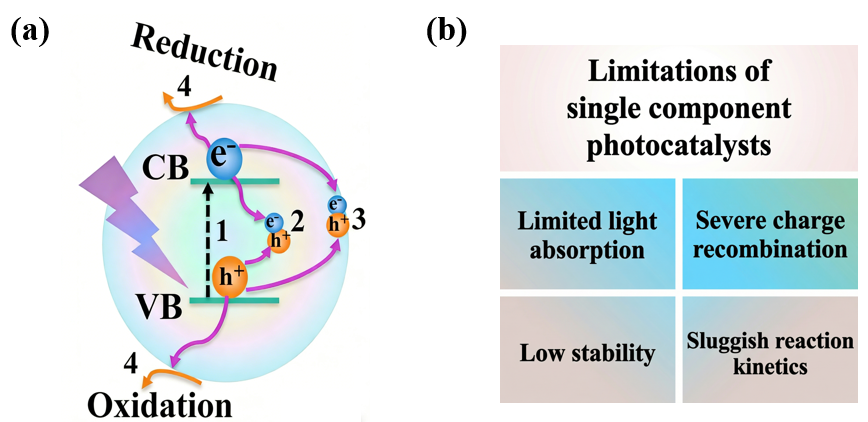
Fig. 1. (a) Schematic of photoinduced carrier dynamics in single semiconductors. (b) Intrinsic catalytic limitations.
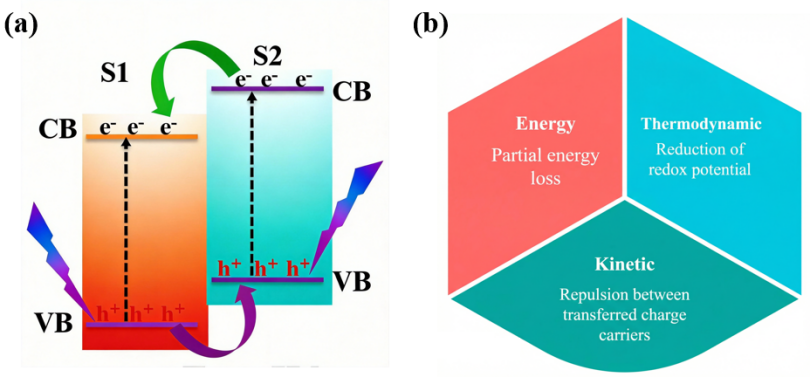
Fig. 2. (a) Charge-transfer pathway of Type-II heterojunctions (S1, S2 = two semiconductors). (b) Inherent thermodynamic/kinetic drawbacks.
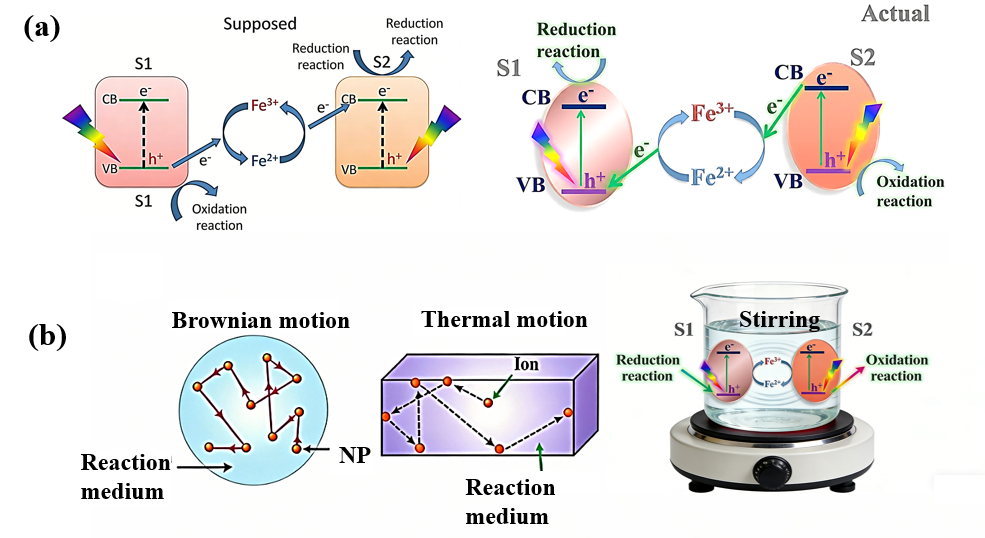
Fig. 3. (a) Charge-transfer discrepancy in liquid Z-scheme models. (b) Practical operational limitations.
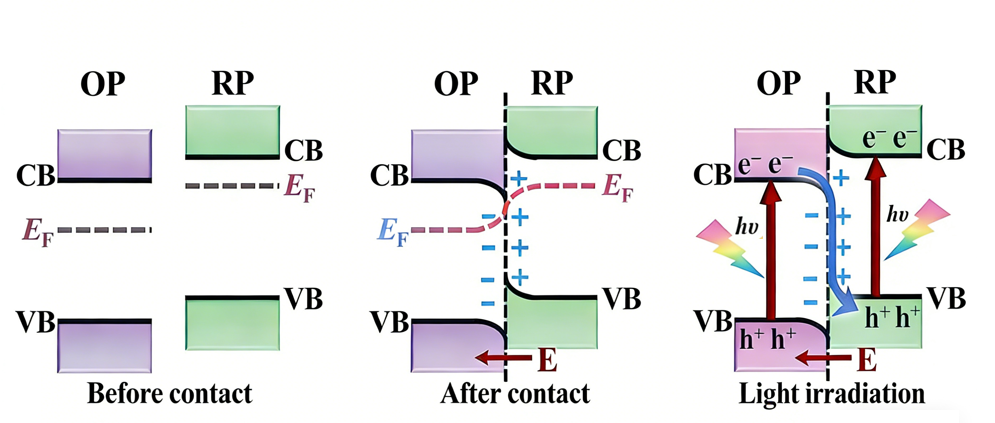
Fig. 4. Schematic representation of the charge transfer process in an S-scheme heterojunction.
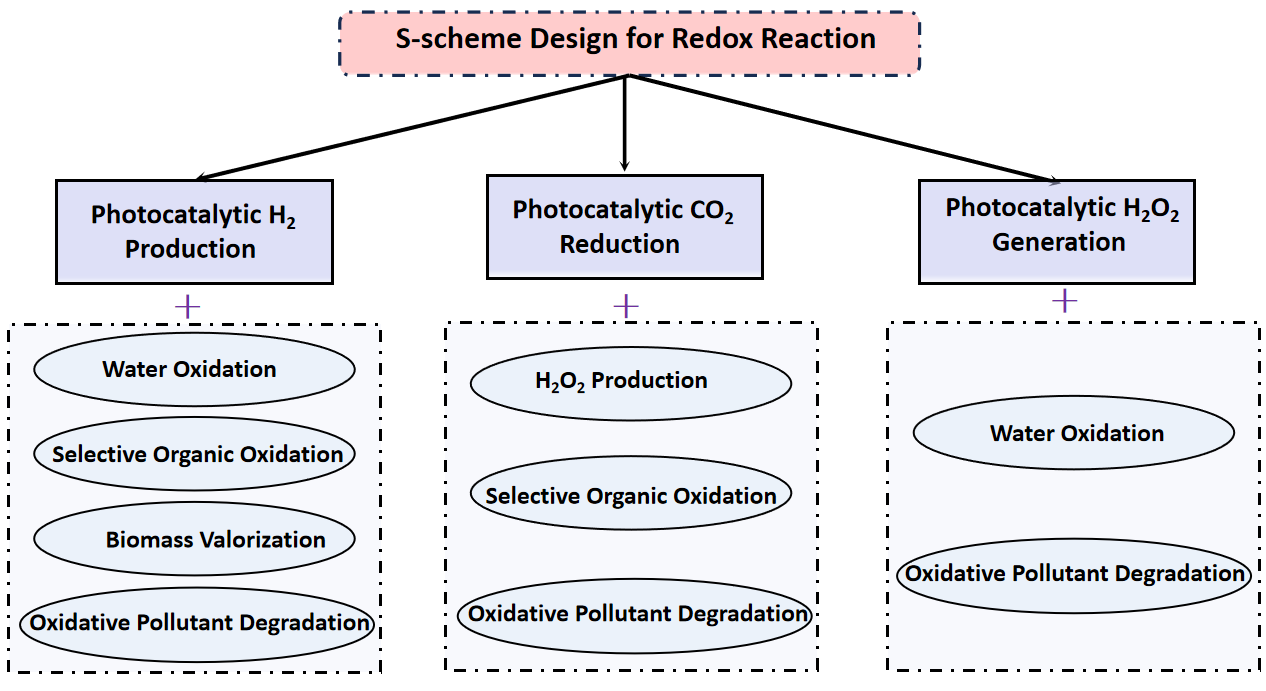
Fig. 5. Summary of S-scheme heterojunction for photocatalytic redox coupling systems.
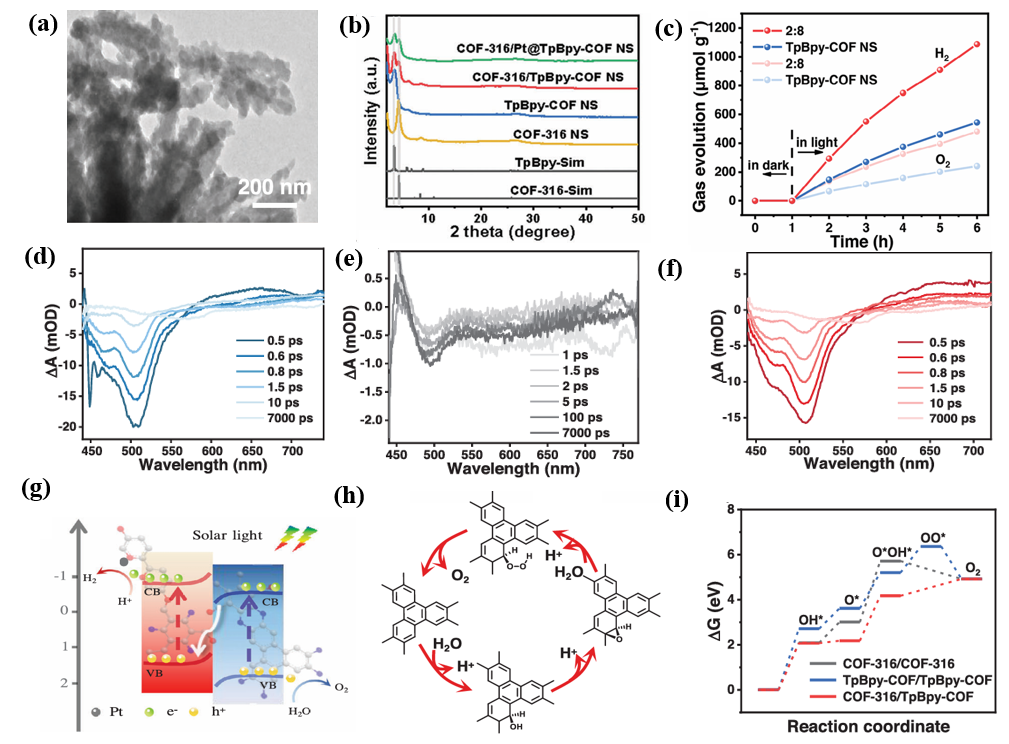
Fig. 6. (a) TEM image of the COF-316/Pt@TpBpy-COF heterojunction. (b) XRD patterns of TpBpy-COF, COF-316, and their heterojunctions. (c) Photocatalytic HER and OER activities of different samples under visible-light irradiation. The fs-TA spectra of TpBpy-COF (d), COF-316 (e), and COF-316/Pt@TpBpy-COF heterojunction (f). (g) Schematic diagram showing the S-scheme charge migration pathway in the COF-316/Pt@TpBpy-COF heterojunction. (h) Free-energy diagram of the OER pathway involving OH*, O*, and OOH* intermediates. (i) Gibbs free-energy comparison of HER and OER. Reprinted with permission from Ref. [140]. Copyright 2024, John Wiley and Sons.
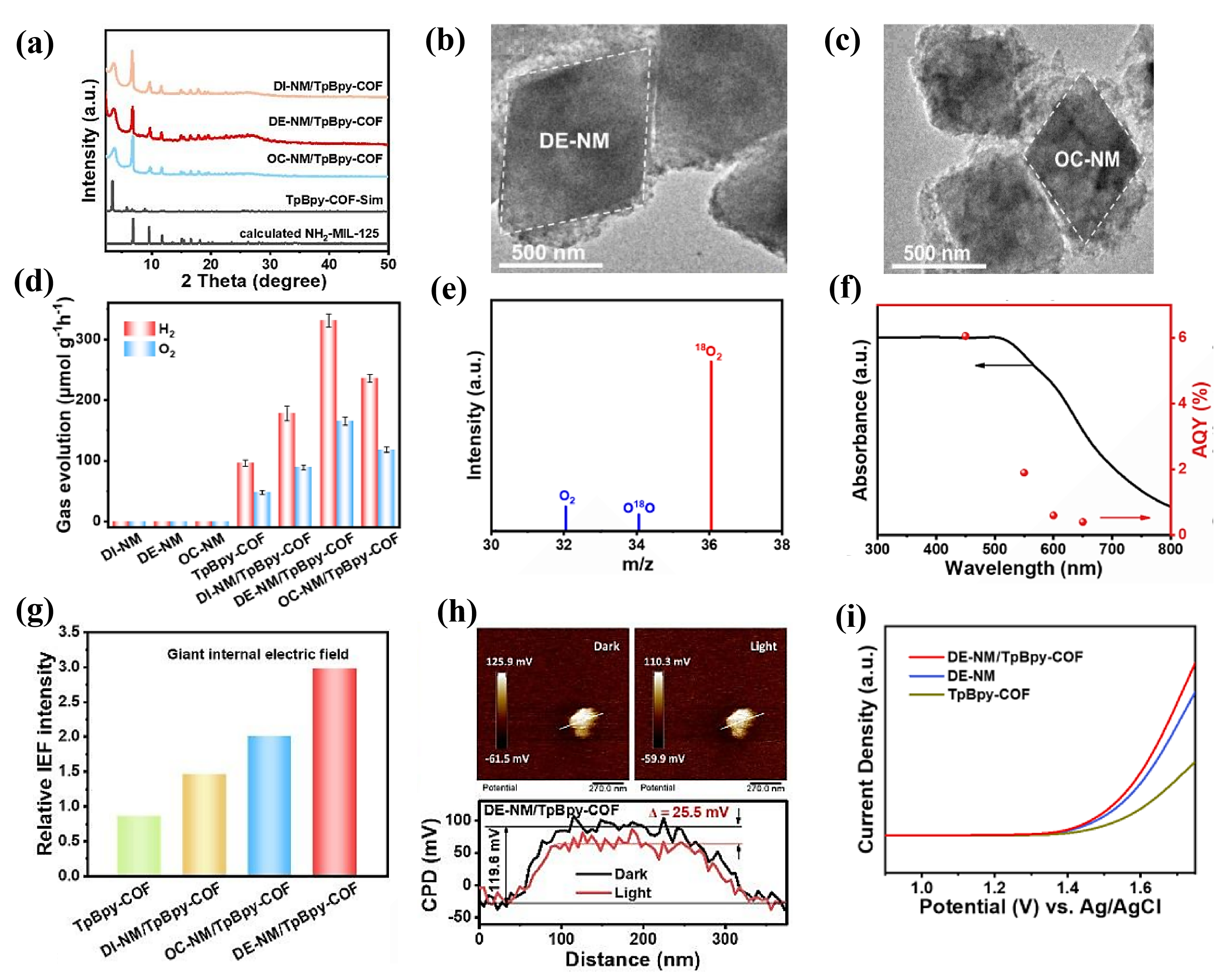
Fig. 7. (a) XRD patterns of sample. TEM images of DE-NM/TpBpy-COF (b) and OC-NM/TpBpy-COF (c). (d) H2 and O2 evolution over different samples. (e) Mass spectra of photocatalytic reaction products from the isotope-labeling experiment. (f) AQY curve of DE-NM/TpBpy-COF under different monochromatic light irradiation. (g) IEF strengths. (h) KPFM contact potential difference (CPD) images of DI-NM/TpBpy-COF, DE-NM/TpBpy-COF, and OC-NM/TpBpy-COF under dark and illuminated conditions. (i) LSV curves for the electrochemical oxidation of TpBpy-COF, DE-NM, and DE-NM/TpBpy-COF in N2-saturated electrolyte. Reprinted with permission from Ref. [151]. Copyright 2025, John Wiley and Sons.
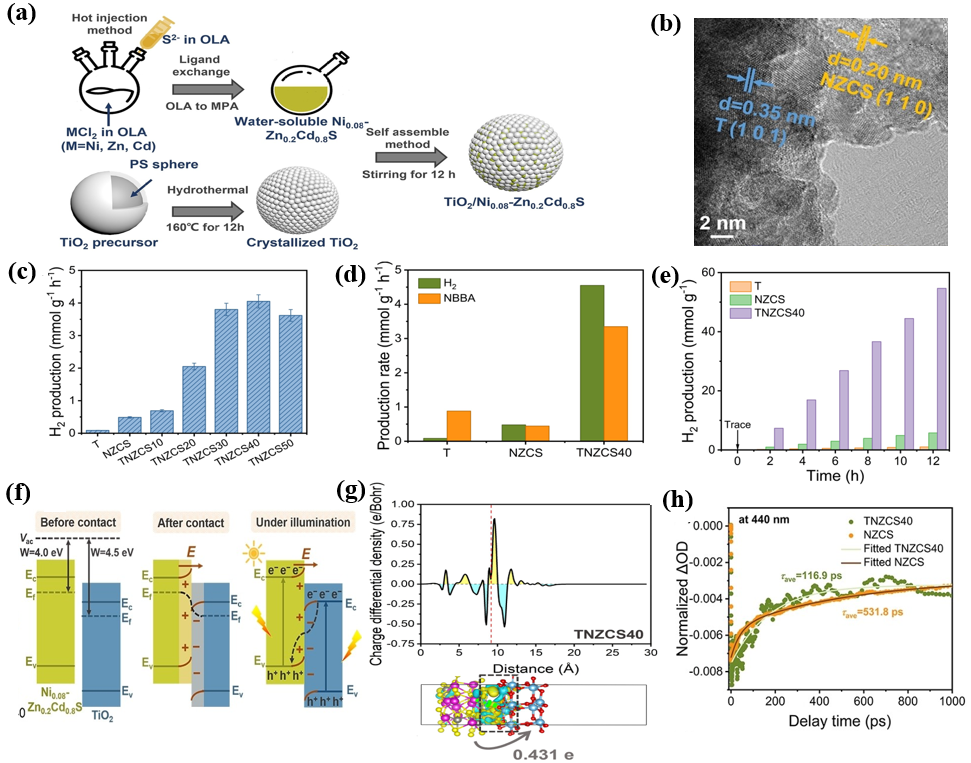
Fig. 8. (a) Schematic illustration of the synthesis procedure for the TNZCSx heterojunction photocatalyst. (b) HRTEM image of TNZCSx showing the interfacial contact between TiO2 and NZCS. (c) Photocatalytic H2 evolution rates of TNZCSx composites. (d) Formation rates of H2 and NBBA over TNZCS40 during photocatalytic reaction. (e) Stability test of TNZCS40 for photocatalytic H2 production over 12 h. (f) Schematic representation of the S-scheme. (g) Charge-density-difference plots obtained from DFT calculations. (h) GSB decay kinetics derived from fs-TA spectra of TZCS40 and TNZCS40. Reprinted with permission from Ref. [154]. Copyright 2023, John Wiley and Sons.
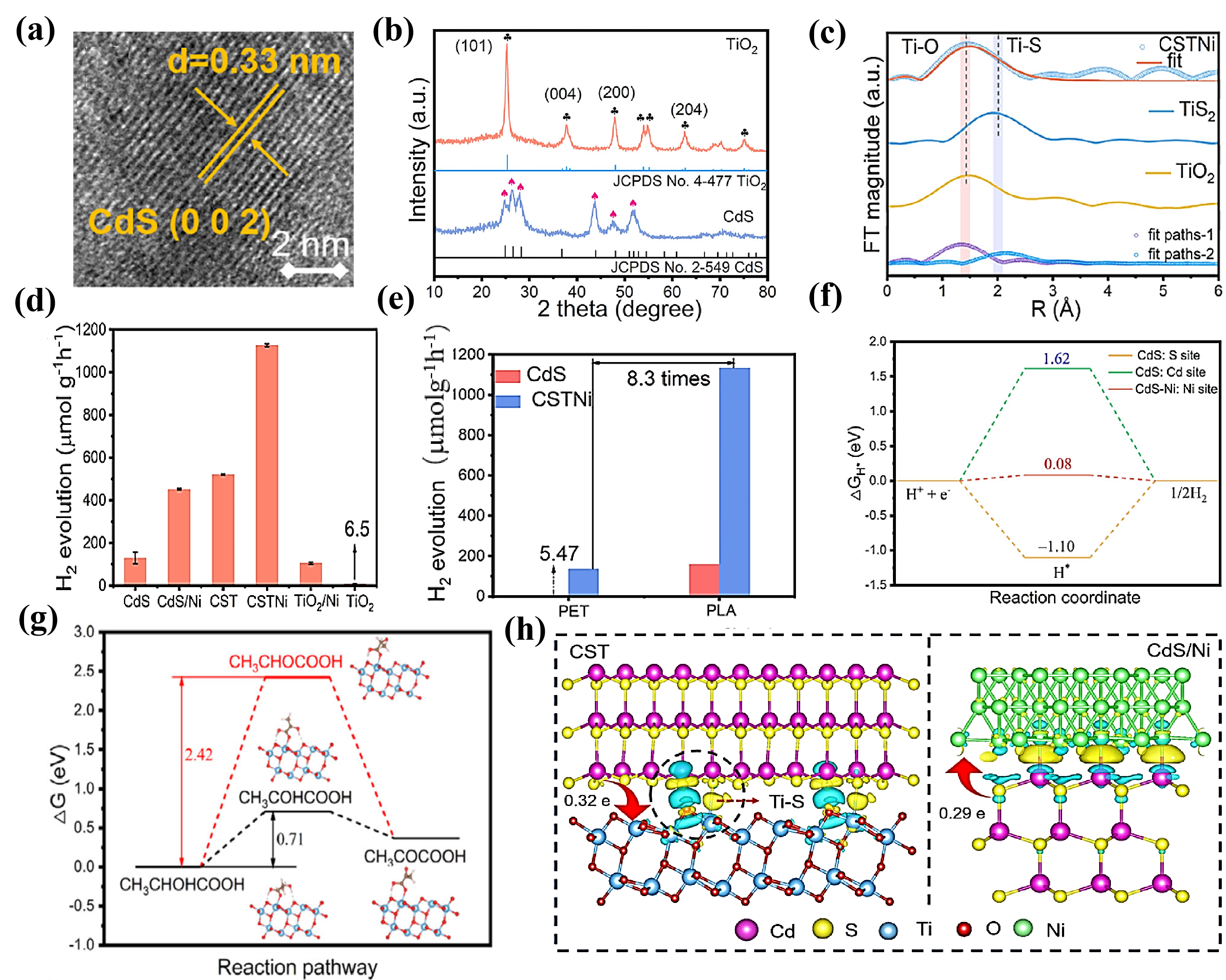
Fig. 9. (a) HRTEM image of CSTNi showing the lattice fringes of the CdS (002) crystal plane. (b) XRD patterns of CSTNi and related samples. (c) FT-EXAFS spectra confirming the existence of Ti-S and Ti-O coordination bonds. (d) Photocatalytic H2 evolution performance. (e) Comparison of H2 evolution rates during degradation of different microplastic substrates. (f) Gibbs free energy calculations of hydrogen adsorption at various active sites. (g) Free-energy pathways for the conversion pathway of lactic acid to pyruvic acid. (h) Charge-density difference distributions and corresponding Bader charge analysis of the CSTNi heterojunction. Reprinted with permission from Ref. [160]. Copyright 2025, John Wiley and Sons.
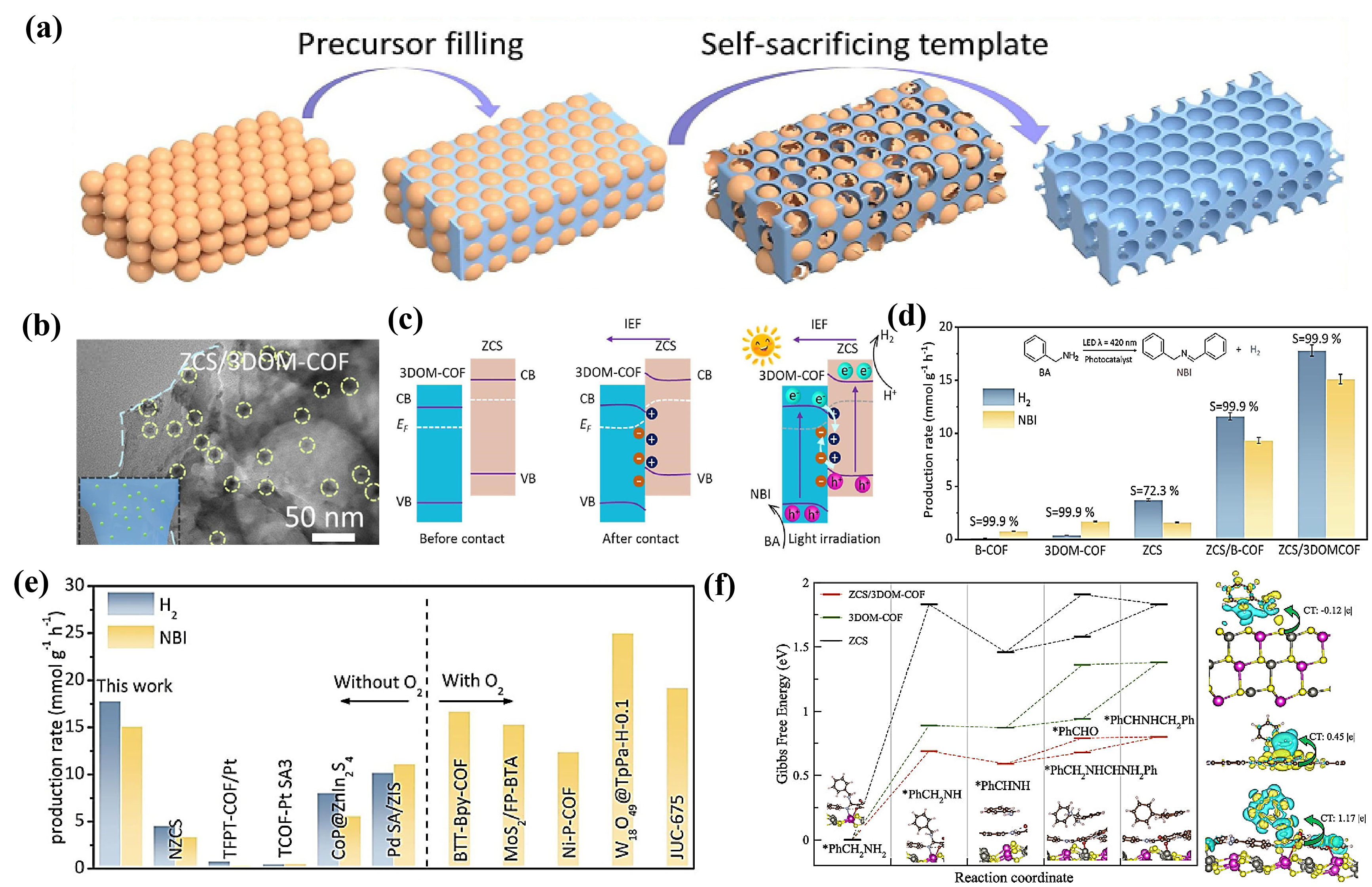
Fig. 10. (a) Schematic illustration of the one-step self-sacrificial template synthesis process for the 3DOM-COF and ZCS/3DOM-COF heterojunction photocatalyst. (b) TEM image of ZCS/3DOM-COF. (c) Proposed S-scheme charge-transfer mechanism. (d) Photocatalytic performances of different catalysts for simultaneous H2 evolution and NBI generation. (e) Comparison of the photocatalytic activity of ZCS/3DOM-COF with previously reported semiconductors. (f) DFT-calculated reaction energy barriers for benzylamine oxidation on different catalyst surfaces. Reprinted with permission from Ref. [161]. Copyright 2025, John Wiley and Sons.

Fig. 11. (a) Schematic representation of the synthesis procedure of the IOOV/TCN. (b) HRTEM images and XRD of samples. (c) HMF conversion toward DFF, FDCA, and FFCA over different photocatalysts. (d) Comparison of HMF conversion and product selectivity of IOOV/TCN-10 under different irradiation conditions. (e) EPR spectra of IOOV, TCN, and IOOV/TCN-10. (f) The band structures of IOOV and TCN. Photocurrent (g) and TRPL decay (h) curves of IOOV/TCN-10. (i) Proposed mechanism of the IOOV/TCN S-scheme heterojunction. Reprinted with permission from Ref. [170]. Copyright 2025, Elsevier.
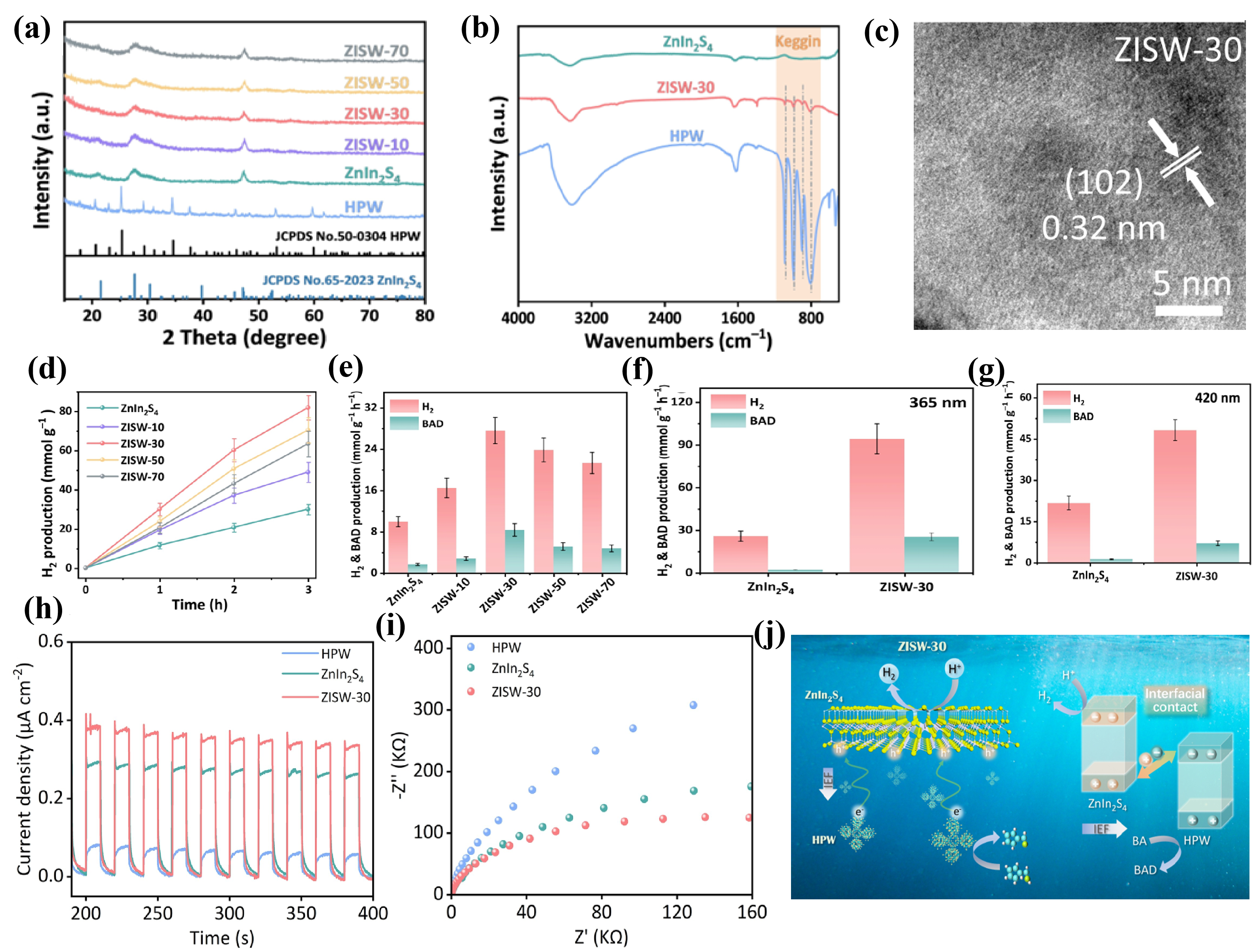
Fig. 12. (a) XRD patterns of samples. (b) FT-IR spectra of HPW, ZnIn2S4, and ZISW-30. (c) HRTEM image of ZISW-30. H2 evolution rates (d) and BAD production (e) over different samples. H2 evolution (f) and BAD production (g) rates of ZISW-30 and ZnIn2S4 under monochromatic LED irradiation (365, 420, 500, and 550 nm). Transient photocurrent response (h) and Nyquist plots of EIS curves (i) of HPW, ZnIn2S4, and ZISW-30. (j) Schematic illustration of the photocatalytic reaction mechanism. Reprinted with permission from Ref. [171]. Copyright 2024, John Wiley and Sons.
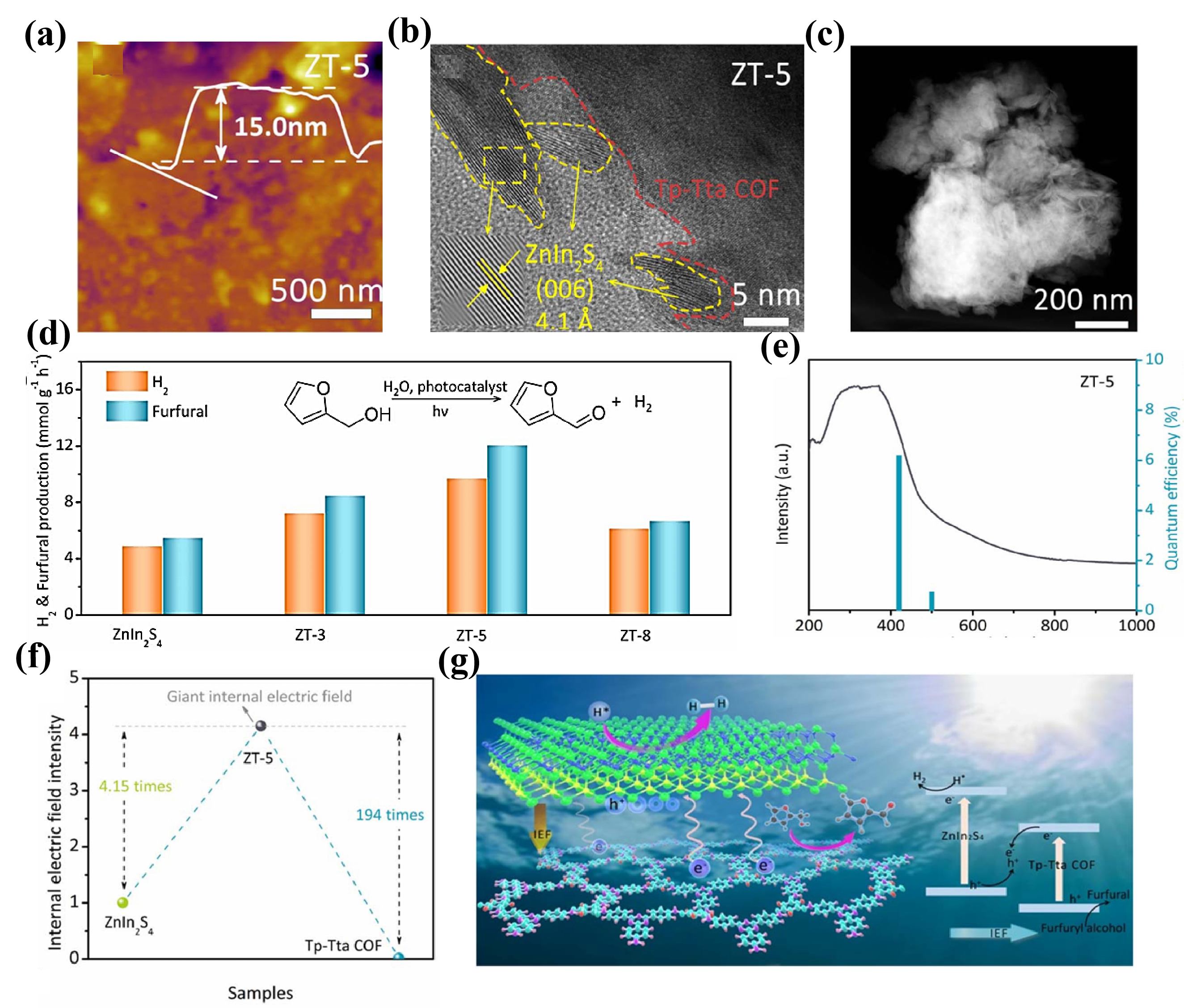
Fig. 13. AFM (a), HRTEM (b), HAADF-STEM (c) images of the ZT-5 composite. (d) Comparison of hydrogen evolution rates and furfural production rates among different samples. (e) AQY of the ZT-5. (f) IEF strength over different samples. (g) Schematic illustration of the S-scheme charge transfer mechanism. Reprinted with permission from Ref. [82]. Copyright 2023, Royal Society of Chemistry (RSC).

Fig. 14. (a) Schematic illustration of the synthesis process of the SS@SIS composite. (b) XRD patterns of Sb2S3, SnIn4S8, and SS@SIS composites. (c,d) H2 evolution curves of different samples. (e,f) Degradation efficiency curves and kinetic constants of TCH over different samples. H2 evolution and degradation efficiencies of SS@SIS-5 in different pollutant systems (g) and the presence of different radical scavengers (h). Schematic illustration of S-scheme heterojunction (i) and reaction mechanism (j). Reprinted with permission from Ref. [172]. Copyright 2025, Elsevier.
| Coupling type | Catalyst system | Hydrogen production capacity (μmol·g‒1·h‒1) | Properties of oxidation products (μmol·g‒1·h‒1) | Reaction conditions | AQY | Solar-to-chemical efficiency (SCC) | TOF (h‒1) | Cycle stability (Retention after N cycles) | Ref. |
|---|---|---|---|---|---|---|---|---|---|
| Pure water splitting | TpBpy-COF/COF-316 | 220.4 | O2:110.2 | 300 W Xe lamp, λ ≥ 420 nm visible light, pure water, 10 °C, sacrificial-agent-free | 5.75% (500 nm) | 0.17% | — | H2/O2 ratio maintained at 2:1 with slight activity loss after 5 cycles. | [ |
| Pure water splitting | DE-NM/TpBpy-COF(NH2-MIL-125/TpBpy-COF) | 331.6 | O2:165.7 | 300 W Xe lamp, λ ≥ 420 nm visible light, pure water, 10 °C, sacrificial-agent-free | 6.06% (450 nm) | 0.21% | — | Stable H2/O2 ratio with no structural damage after 5 cycles. | [ |
| Amino oxidation | Ni-Zn0.2Cd0.8S/TiO2 (TNZCS40) | 4550 | imines: 3350 | 300 W Xe lamp, 350-780 nm, N2-saturated 1, 4-dioxane solution, 0.1 mL H2O + 0.1 mL benzylamine, sacrificial-agent-free | 16.56% (365 nm) | — | — | Stable photocatalytic activity over 12 h. | [ |
| Pollutant degradation/PLA oxidation | TiO2/CdS/Ni (CSTNi) | 1126.9 | PLA degradation (polylactic acid oxidation) | 300 W Xe lamp, 2 M KOH containing PLA solution, air、aqueous solution sacrificial-agent-free | — | — | — | 3 cycles, 85% activity retention | [ |
| Biomass oxidation/furfural oxidation | ZnIn2S4/Tp-Tta COF (ZT-5) | 9730 | Furfural: 12100 | 80 W LED, 10 vol% ethanol solution, Air, aqueous solution, sacrificial-agent-free | 13.91% | — | — | 5 cycles, 90% activity retention | [ |
| Alcohol oxidation/benzyl alcohol oxidation | HPW/ZnIn2S4 (ZISW-30) | 27590 | Benzaldehyde: 8320 | 300 W Xe lamp, full spectrum, 10 vol% benzyl alcohol solution, sacrificial-agent-free | — | — | — | 4 cycles, 88% activity retention | [ |
| Amino oxidation/benzylamine oxidation | 3DOM-COF/ZnCdS (ZCS/3DOM-COF) | 1780 | Imines: 15100 (99% selectivity) | 80 W LED, λ = 420 nm, acetonitrile/H2O solution, N2 inert atmosphere, organic solvent, sacrificial-agent-free | — | — | — | Crystal structure and morphology preserved | [ |
| Antibiotic degradation | Sb2S3@SnIn4S8 (SS@SIS-5) | 3566 | TCH degradation: 90.5% (120 min) | 300 W Xe lamp, visible light, 50 mg·L-1 TCH solution, sacrificial-agent-free | — | — | — | 5 cycles, 91% H2 activity retained | [ |
| HMF oxidation | IOOV/TCN-10 (In2O3‒x/C3N4) | 754.05 | HMF conversion rate: 94.8% DFF + FDCA selectivity: 53.6% | LED lamp, λ = 420 nm, 5 mM HMF solution, N2 atmosphere/H2O, 15 °C, sacrificial agent: HMF | — | — | — | Slight activity loss after repeated cycles. | [ |
Table 1 Representative S-scheme heterojunction photocatalysts for photocatalytic H2 production coupled with value-added oxidation reactions.
| Coupling type | Catalyst system | Hydrogen production capacity (μmol·g‒1·h‒1) | Properties of oxidation products (μmol·g‒1·h‒1) | Reaction conditions | AQY | Solar-to-chemical efficiency (SCC) | TOF (h‒1) | Cycle stability (Retention after N cycles) | Ref. |
|---|---|---|---|---|---|---|---|---|---|
| Pure water splitting | TpBpy-COF/COF-316 | 220.4 | O2:110.2 | 300 W Xe lamp, λ ≥ 420 nm visible light, pure water, 10 °C, sacrificial-agent-free | 5.75% (500 nm) | 0.17% | — | H2/O2 ratio maintained at 2:1 with slight activity loss after 5 cycles. | [ |
| Pure water splitting | DE-NM/TpBpy-COF(NH2-MIL-125/TpBpy-COF) | 331.6 | O2:165.7 | 300 W Xe lamp, λ ≥ 420 nm visible light, pure water, 10 °C, sacrificial-agent-free | 6.06% (450 nm) | 0.21% | — | Stable H2/O2 ratio with no structural damage after 5 cycles. | [ |
| Amino oxidation | Ni-Zn0.2Cd0.8S/TiO2 (TNZCS40) | 4550 | imines: 3350 | 300 W Xe lamp, 350-780 nm, N2-saturated 1, 4-dioxane solution, 0.1 mL H2O + 0.1 mL benzylamine, sacrificial-agent-free | 16.56% (365 nm) | — | — | Stable photocatalytic activity over 12 h. | [ |
| Pollutant degradation/PLA oxidation | TiO2/CdS/Ni (CSTNi) | 1126.9 | PLA degradation (polylactic acid oxidation) | 300 W Xe lamp, 2 M KOH containing PLA solution, air、aqueous solution sacrificial-agent-free | — | — | — | 3 cycles, 85% activity retention | [ |
| Biomass oxidation/furfural oxidation | ZnIn2S4/Tp-Tta COF (ZT-5) | 9730 | Furfural: 12100 | 80 W LED, 10 vol% ethanol solution, Air, aqueous solution, sacrificial-agent-free | 13.91% | — | — | 5 cycles, 90% activity retention | [ |
| Alcohol oxidation/benzyl alcohol oxidation | HPW/ZnIn2S4 (ZISW-30) | 27590 | Benzaldehyde: 8320 | 300 W Xe lamp, full spectrum, 10 vol% benzyl alcohol solution, sacrificial-agent-free | — | — | — | 4 cycles, 88% activity retention | [ |
| Amino oxidation/benzylamine oxidation | 3DOM-COF/ZnCdS (ZCS/3DOM-COF) | 1780 | Imines: 15100 (99% selectivity) | 80 W LED, λ = 420 nm, acetonitrile/H2O solution, N2 inert atmosphere, organic solvent, sacrificial-agent-free | — | — | — | Crystal structure and morphology preserved | [ |
| Antibiotic degradation | Sb2S3@SnIn4S8 (SS@SIS-5) | 3566 | TCH degradation: 90.5% (120 min) | 300 W Xe lamp, visible light, 50 mg·L-1 TCH solution, sacrificial-agent-free | — | — | — | 5 cycles, 91% H2 activity retained | [ |
| HMF oxidation | IOOV/TCN-10 (In2O3‒x/C3N4) | 754.05 | HMF conversion rate: 94.8% DFF + FDCA selectivity: 53.6% | LED lamp, λ = 420 nm, 5 mM HMF solution, N2 atmosphere/H2O, 15 °C, sacrificial agent: HMF | — | — | — | Slight activity loss after repeated cycles. | [ |
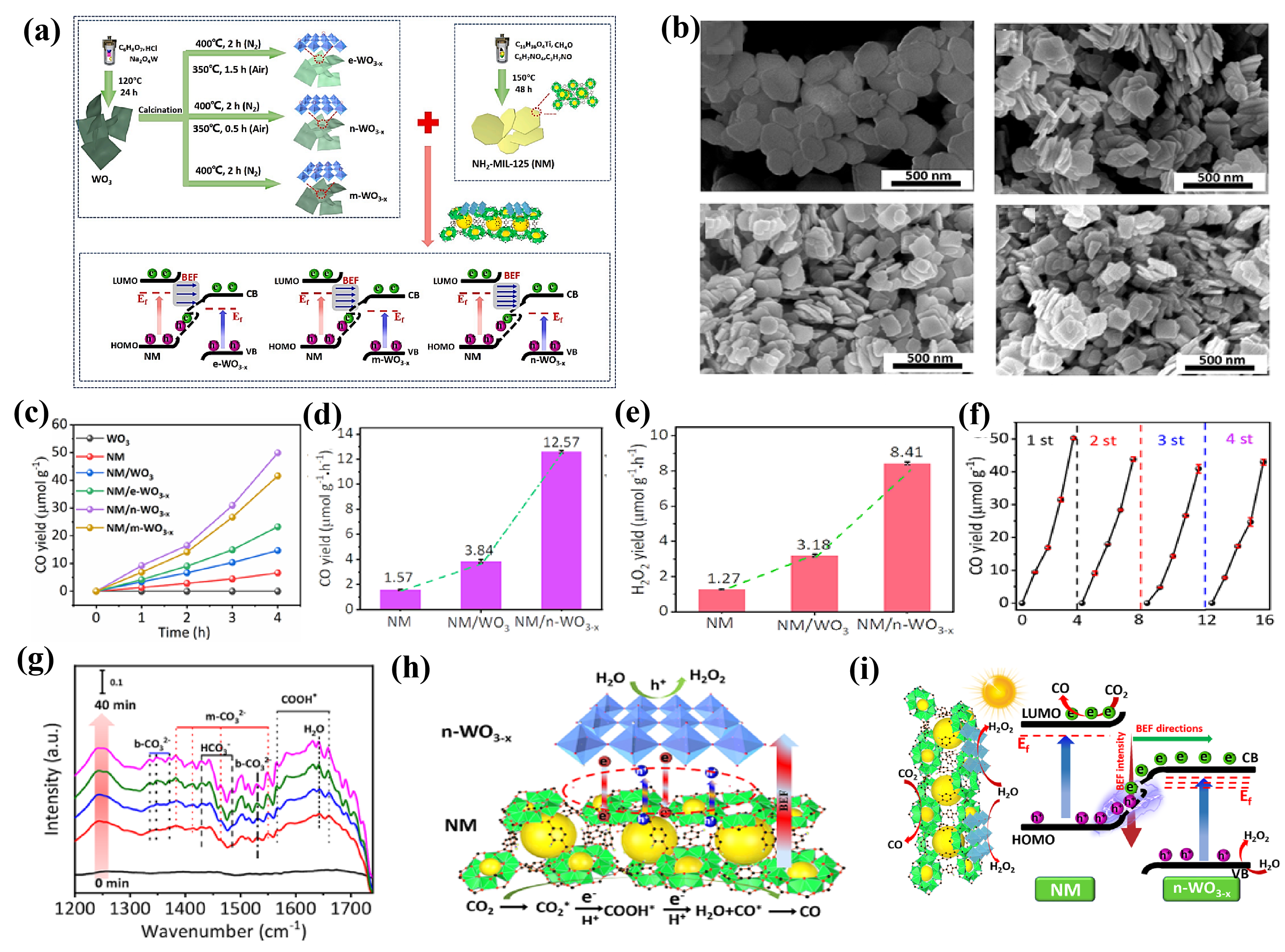
Fig. 15. (a) Schematic illustration of the synthesis process of the NM/WO3-x heterojunction. (b) SEM image of NM. (c) Time-dependent CO production curves of different samples. CO (d) and H2O2 production (e) rates of different samples. (f) Four-cycle stability tests. (g) In-situ DRIFTS spectra of NM/n-WO3‒x under light irradiation. (h,i) Schematic illustration of the CO2 reduction process. Reprinted with permission from Ref. [90]. Copyright 2023, Elsevier.
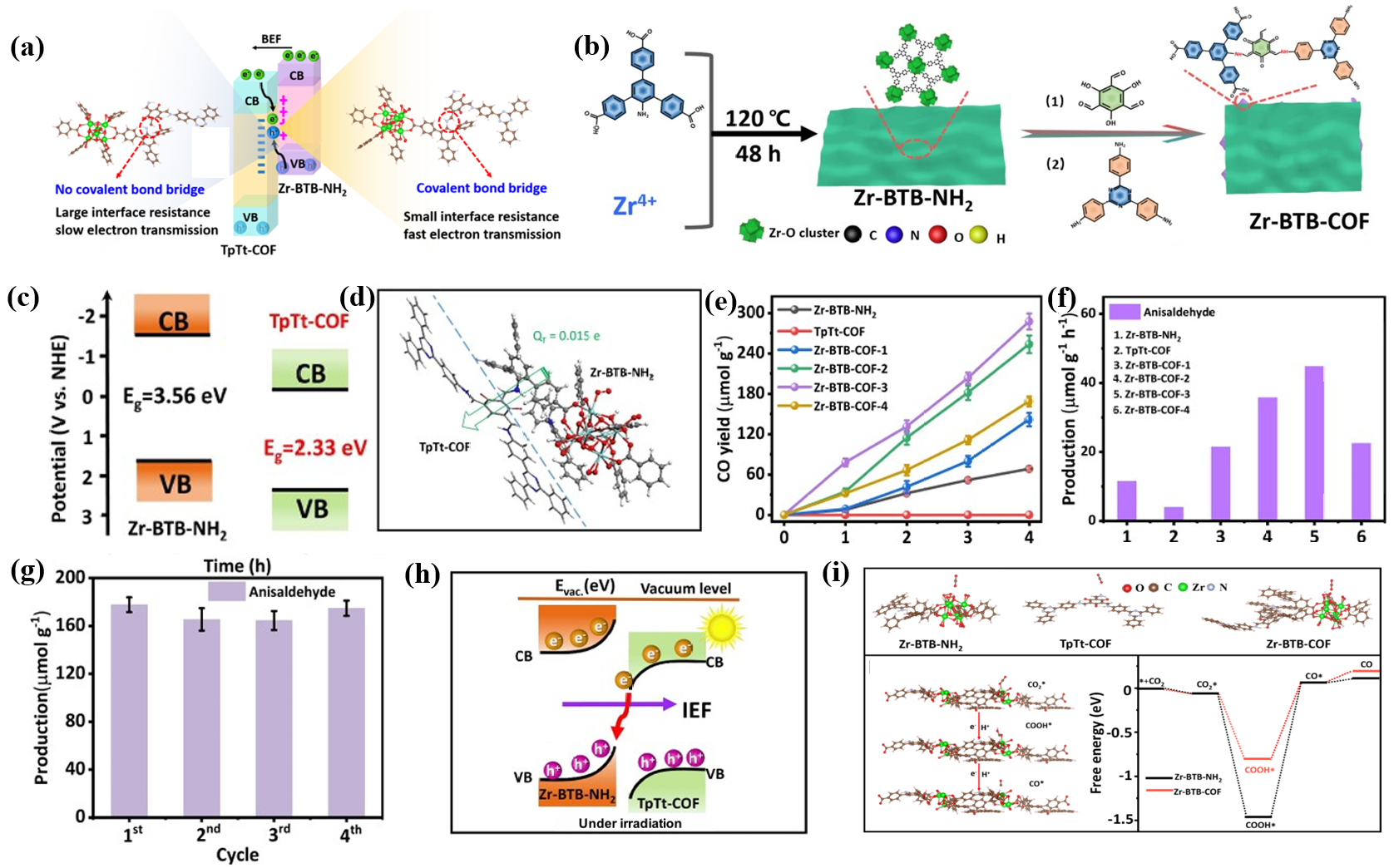
Fig. 16. (a,b) Schematic representation of the construction of a Zr-BTB-COF S-scheme system featuring electron-transport bridge. (c) Band structure diagram of Zr-BTB-NH2 and TpTt-COF. (d) Electron transfer in the Zr-BTB-COF composite. CO production (e) and anisaldehyde production (f) rates over different sample. (g) Anisaldehyde yields of Zr-BTB-COF-3 during four photocatalytic cycling runs. S-scheme (h) and CO2 adsorption and CO2 reduction to CO (i) over Zr-BTB-COF. Reprinted with permission from Ref. [178]. Copyright 2026, Elsevier.
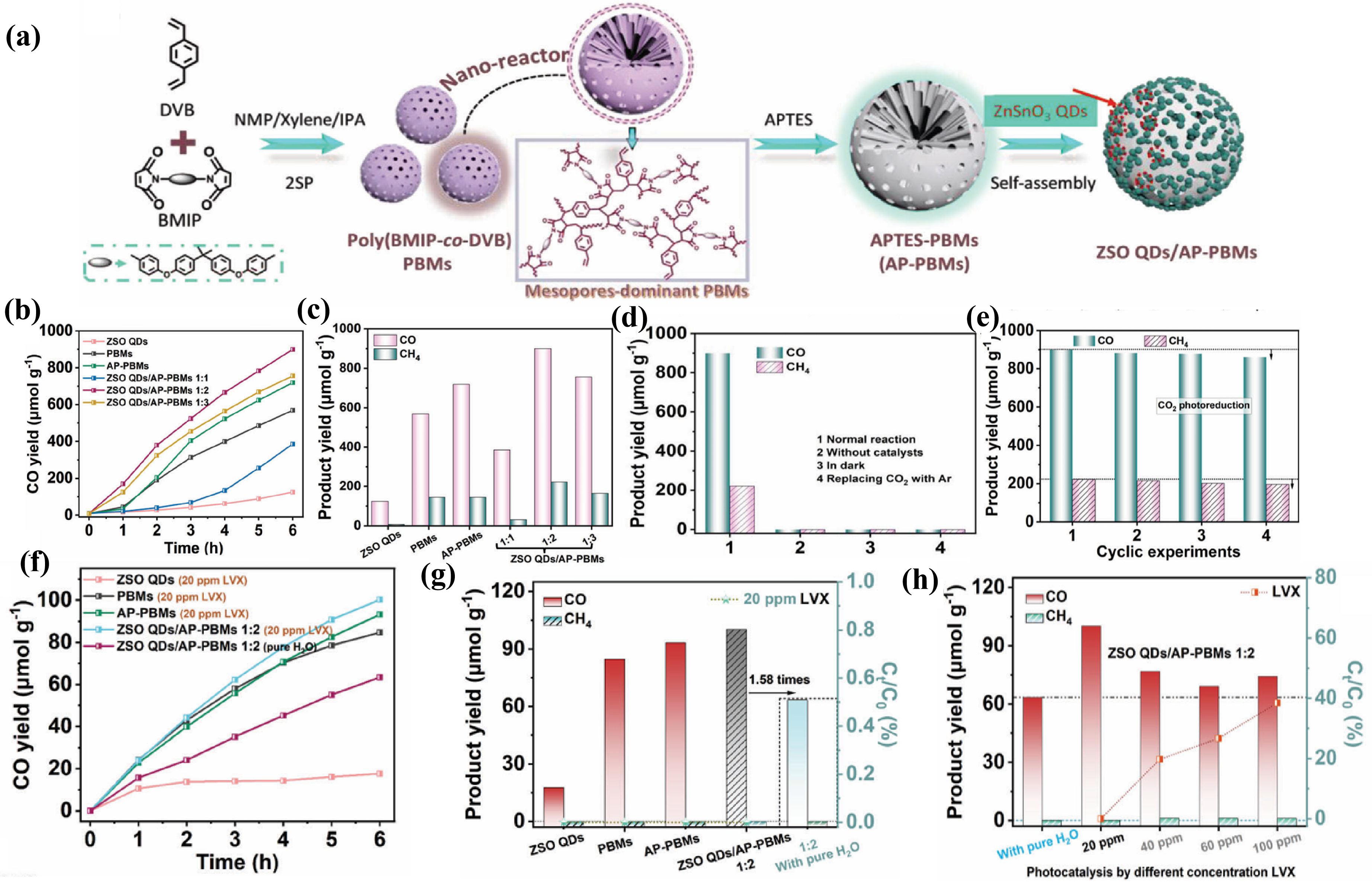
Fig. 17. (a) Schematic illustration of the synthesis process of the ZSO QDs/AP-PBMs composite. (b) CO production curves of different samples (PBMs, AP-PBMs, ZSO QDs, ZSO QDs/AP-PBMs 1:1, 1:2, 1:3, and 1:4) in a 20 ppm LVX solution. (c) CO production curves of different samples. (d) Comparing the photocatalytic activity in LVX solutions with different conditions. (e) Stability of ZSO QDs/AP-PBMs 1:2. (f) Temporal variation of CO production for all photocatalyst samples in a 20 ppm LVX solution in a 20 ppm LVX solution. (g) Product yield of ZSO QDs/AP-PBMs 1:2 after 6 hours. (h) Photocatalytic CO production of ZSO QDs/AP-PBMs 1:2 in LVX solutions with different initial concentrations (20, 40, 60, 80 ppm). Reprinted with permission from Ref. [180]. Copyright 2024, John Wiley and Sons.
| Coupling type | Catalyst system | CO2 reduction product / yield(μmol·g‒1·h‒1) | Oxidation product/performance (μmol·g‒1·h‒1) | Reaction conditions | AQY | Solar-to-chemical efficiency (SCC) | TOF (h‒1) | Cycle stability (Retention after N cycles) | Ref. |
|---|---|---|---|---|---|---|---|---|---|
| H2O oxidation | NH2-MIL-125-Ti/WO3‒x (NM/n-WO3‒x) | CO: 12.57 | H2O2: 8.41 | 300 W Xe lamp, UV-vis light, pure water, CO2‒ saturated, sacrificial-agent-free | 0.17% (365 nm) | — | — | no obvious activity loss after 4 cycles. | [ |
| Alcohol oxidation (4-methoxybenzyl alcohol) | Zr-BTB-COF (Zr-BTB-NH2/TpTt-COF) | CO: 71.9 | p-Anisaldehyde: 44.7 | 300 W Xe lamp, 400 mW·cm‒2, 10% pure water, CO2‒ saturated, sacrificial agent: 4-methoxy- benzyl alcohol solution | 3.75% (365 nm) | — | — | 87% of the initial CO yield retained after 4 cycles | [ |
| Antibiotic degradation (Levofloxacin, LVX) | ZnSnO3 QDs/AP-PBMs (ZSO QDs/AP-PBMs 1:2) | CO: 100.3 μmol·g‒1 (6 h, 100% selectivity) + CH4: 221.7 | LVX degradation rate: 100% (1 h) | 300 W Xe lamp, 20 ppm LVX solution, pure water, CO2-saturated sacrificial-agent-free | — | — | — | no obvious activity loss after 4 cycles | [ |
Table 2 S-scheme heterojunction photocatalysts for photocatalytic CO2 reduction coupled with oxidation reactions.
| Coupling type | Catalyst system | CO2 reduction product / yield(μmol·g‒1·h‒1) | Oxidation product/performance (μmol·g‒1·h‒1) | Reaction conditions | AQY | Solar-to-chemical efficiency (SCC) | TOF (h‒1) | Cycle stability (Retention after N cycles) | Ref. |
|---|---|---|---|---|---|---|---|---|---|
| H2O oxidation | NH2-MIL-125-Ti/WO3‒x (NM/n-WO3‒x) | CO: 12.57 | H2O2: 8.41 | 300 W Xe lamp, UV-vis light, pure water, CO2‒ saturated, sacrificial-agent-free | 0.17% (365 nm) | — | — | no obvious activity loss after 4 cycles. | [ |
| Alcohol oxidation (4-methoxybenzyl alcohol) | Zr-BTB-COF (Zr-BTB-NH2/TpTt-COF) | CO: 71.9 | p-Anisaldehyde: 44.7 | 300 W Xe lamp, 400 mW·cm‒2, 10% pure water, CO2‒ saturated, sacrificial agent: 4-methoxy- benzyl alcohol solution | 3.75% (365 nm) | — | — | 87% of the initial CO yield retained after 4 cycles | [ |
| Antibiotic degradation (Levofloxacin, LVX) | ZnSnO3 QDs/AP-PBMs (ZSO QDs/AP-PBMs 1:2) | CO: 100.3 μmol·g‒1 (6 h, 100% selectivity) + CH4: 221.7 | LVX degradation rate: 100% (1 h) | 300 W Xe lamp, 20 ppm LVX solution, pure water, CO2-saturated sacrificial-agent-free | — | — | — | no obvious activity loss after 4 cycles | [ |
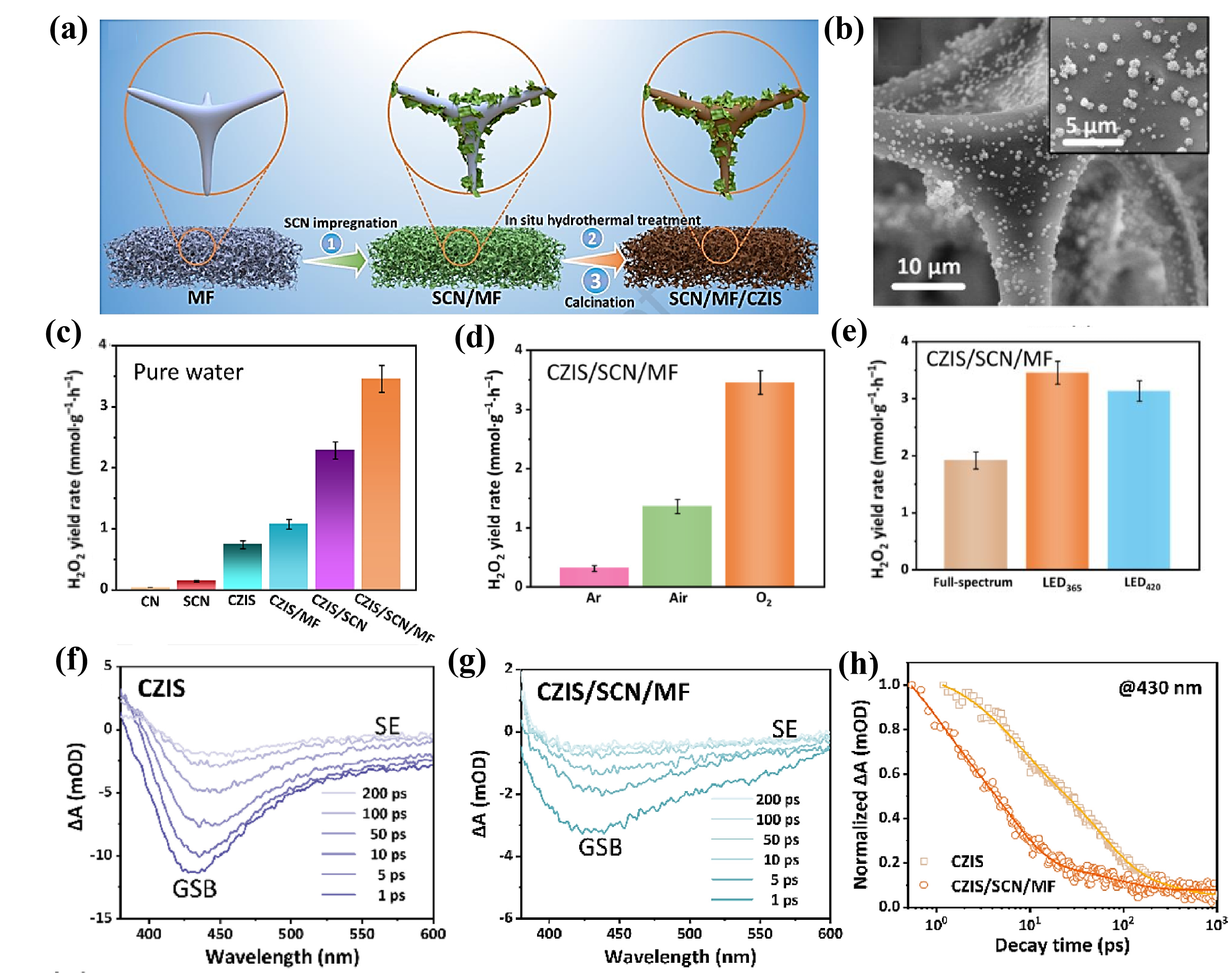
Fig. 18. (a) Schematic illustration of the synthesis process of the CZIS/SCN/MF composite. (b) SEM image of the CZIS/SCN/MF composite. (c) H2O2 production rates over different samples (SCN/MF, CZIS, CZIS/SCN and CZIS/SCN/MF). H2O2 production rates of CZIS/SCN/MF under different atmospheres (d) and different light sources (e). (f-g) fs-TA spectral signals of the samples. (h) GSB decay kinetics of CZIS and CZIS/SCN/MF. Reprinted with permission from Ref. [184]. Copyright 2026, Elsevier.
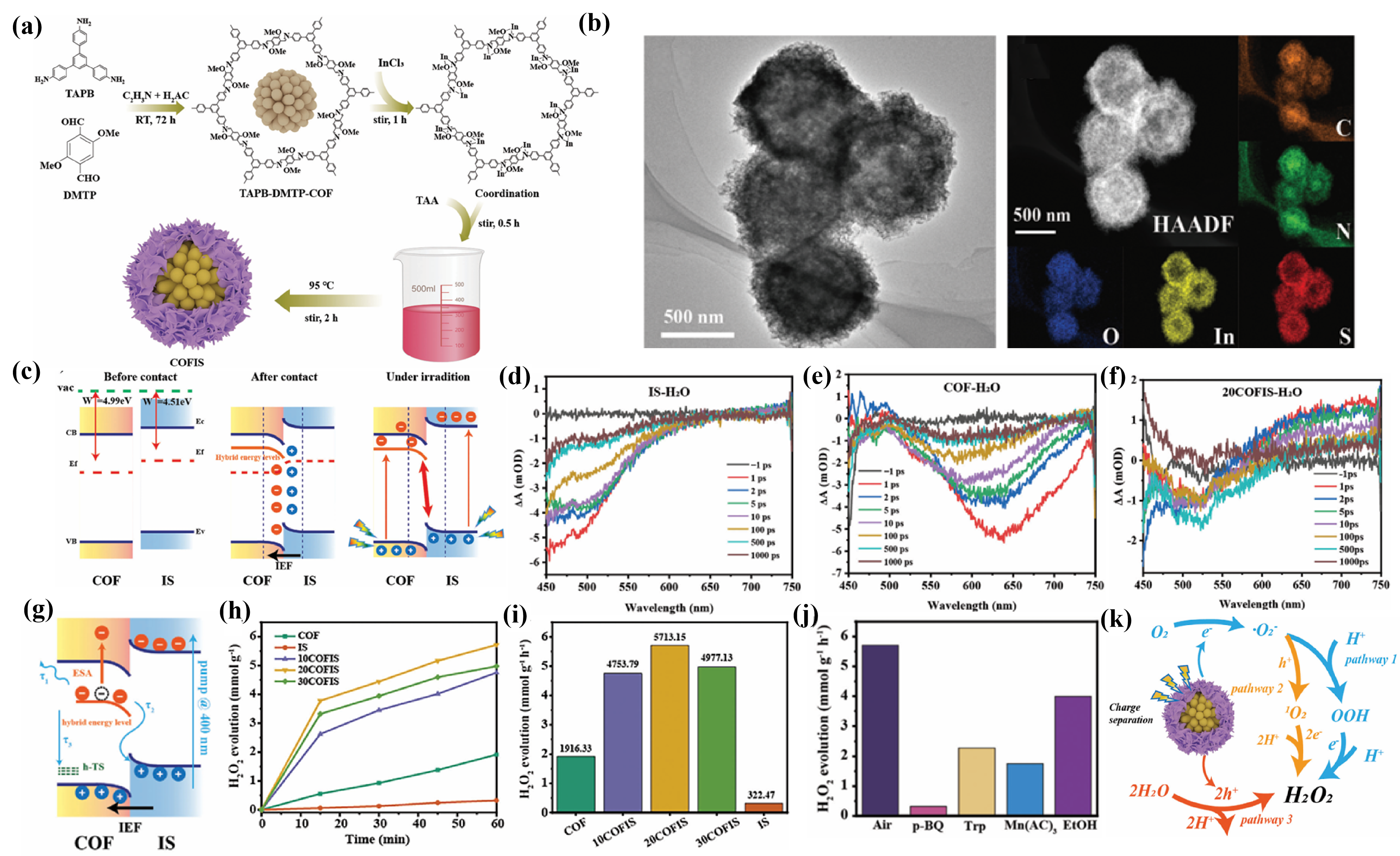
Fig. 19. (a) Schematic illustration of the synthesis process of the COFIS. (b) TEM and HAADF-STEM images of the 20COFIS core-shell structure. (c) Proposed S-scheme charge-transfer mechanism. Fs-TA spectra of In2S3 (d), COF (e), and 20COFIS (f) at different delay times. (g) Photogenerated electron relaxation pathways in 20COFIS. (h,i) H2O2 production of different samples. (j) H2O2 production rates in the presence of different radical scavengers. (k) Proposed reaction mechanism for H2O2 generation over the 20COFIS. Reprinted with permission from Ref. [190]. Copyright 2024, John Wiley and Sons.
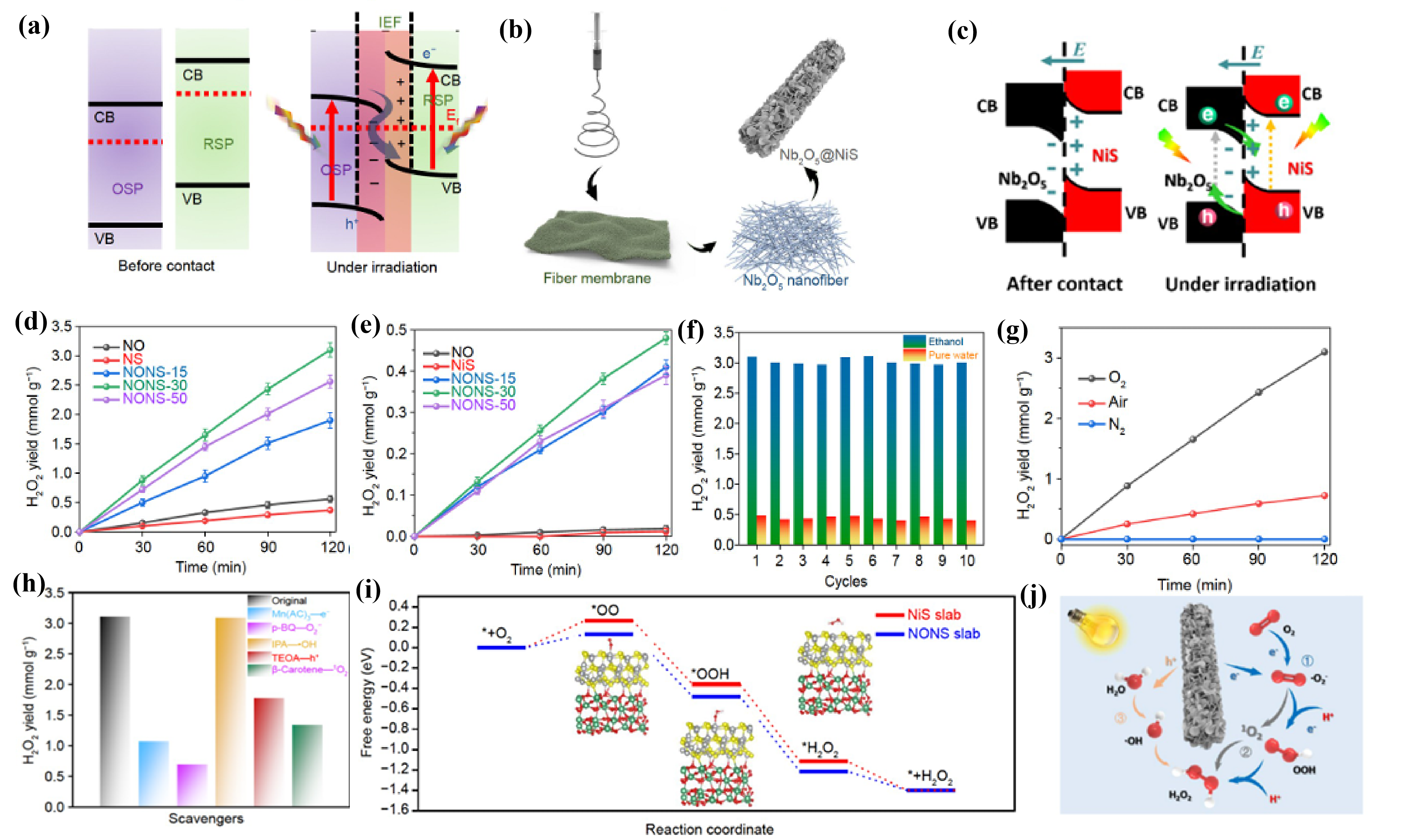
Fig. 20. (a) S-scheme design. (b) Fabrication of NONS. (c) Charge transfer in the NONS S-scheme heterojunction. H2O2 yields of different samples in a 10 vol% ethanol system (d) and pure water (e). (f) Cycling stability test of NONS-30. H2O2 yields of NONS-30 under different atmospheres (g) and in the presence of different scavengers (EDTA-2Na, TEOA, BQ, β-carotene, and IPA) (h). Gibbs free-energy diagram for H2O2 formation (i) and photocatalytic mechanism (j) over NONS catalysts. Reprinted with permission from Ref. [191]. Copyright 2024, Springer Nature.
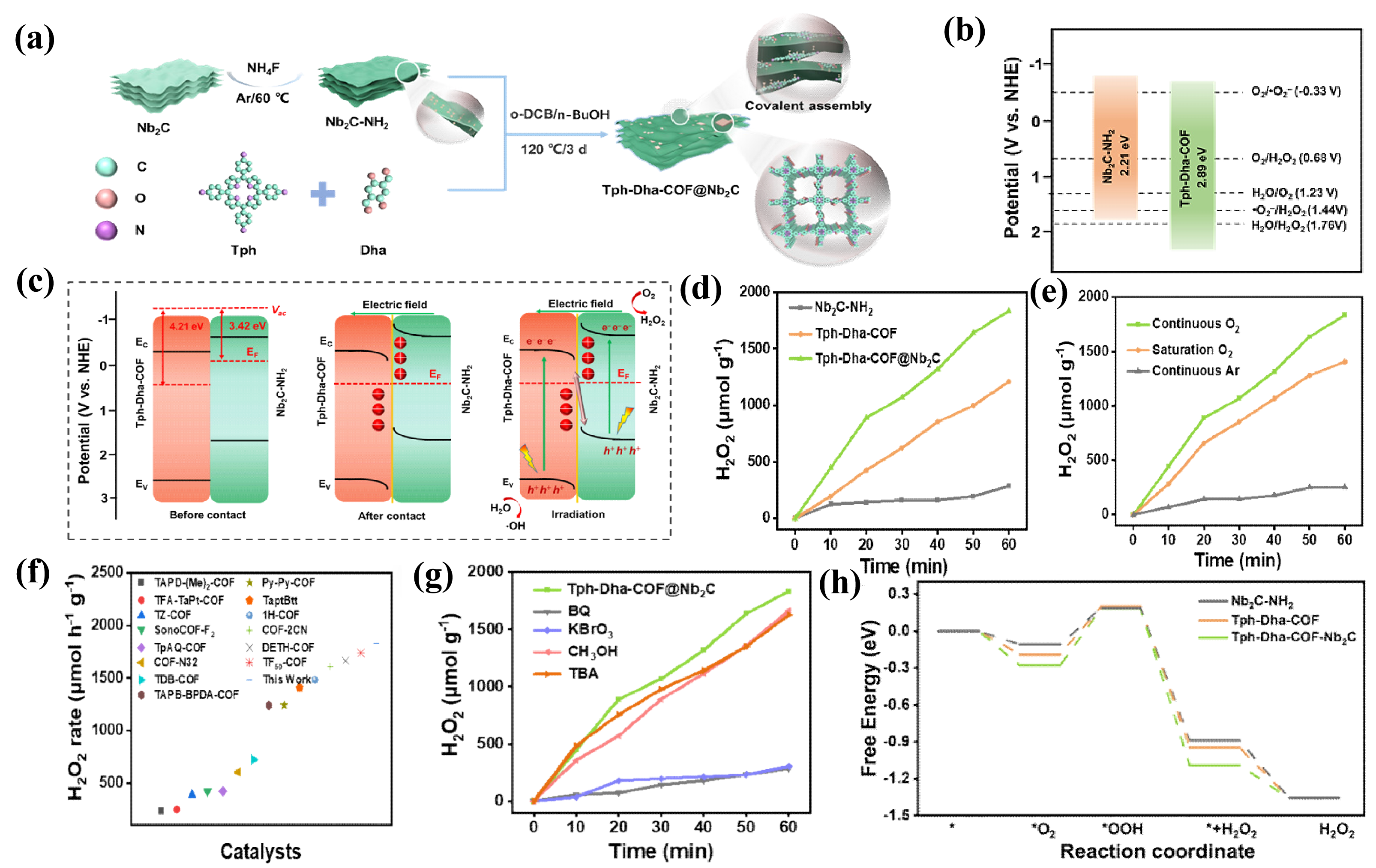
Fig. 21. (a) The synthesis process of the Tph-Dha-COF@Nb2C heterojunction. (b) Band structure diagram of Nb2C-NH2 and Tph-Dha-COF. (c) S-scheme charge-transfer in Tph-Dha-COF@Nb2C. H2O2 production rates of different samples in pure water (d) and under different atmospheres (e). (f) Comparison of H2O2 production. (g) H2O2 yields of Tph-Dha-COF@Nb2C in the presence of different scavengers. (h) Free-energy diagrams of the oxygen reduction pathway over Tph-Dha-COF@Nb2C. Reprinted with permission from Ref. [192]. Copyright 2025, Elsevier.
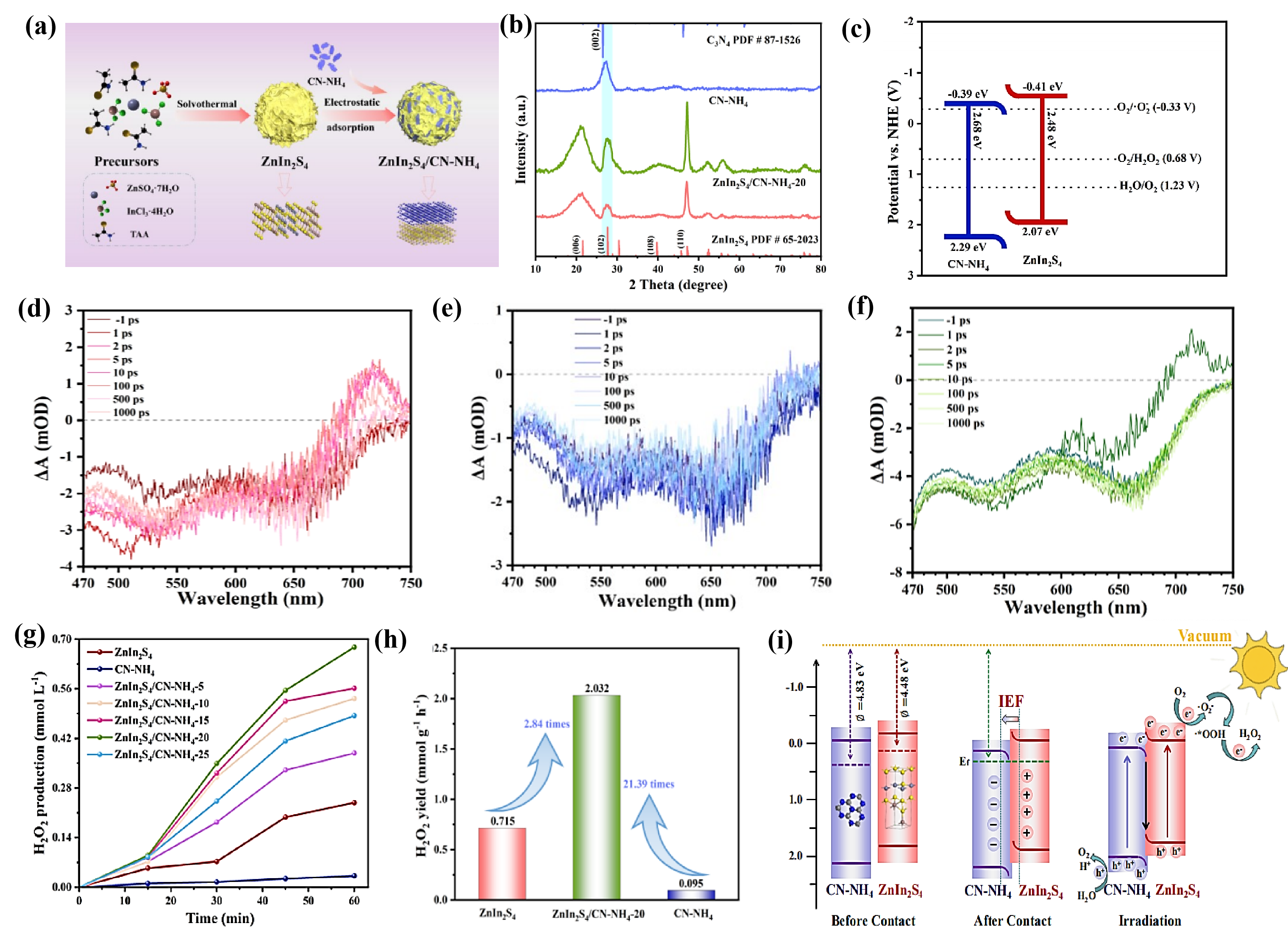
Fig. 22. (a) The electrostatic self-assembly process for constructing the ZnIn2S4/CN-NH4. (b) XRD patterns of ZnIn2S4, CN-NH4, and ZnIn2S4/CN-NH4. (c) Band structure diagram of ZnIn2S4 and CN-NH4. Fs-TA spectra of ZnIn2S4 (d), CN-NH4 (e), and ZnIn2S4/CN-NH4-20 (f). (g) Time-dependent H2O2 over different samples. (h) Comparison of different samples. (i) Proposed H2O2 generation over ZnIn2S4/CN-NH4. Reprinted with permission from Ref. [193]. Copyright 2026, Elsevier.
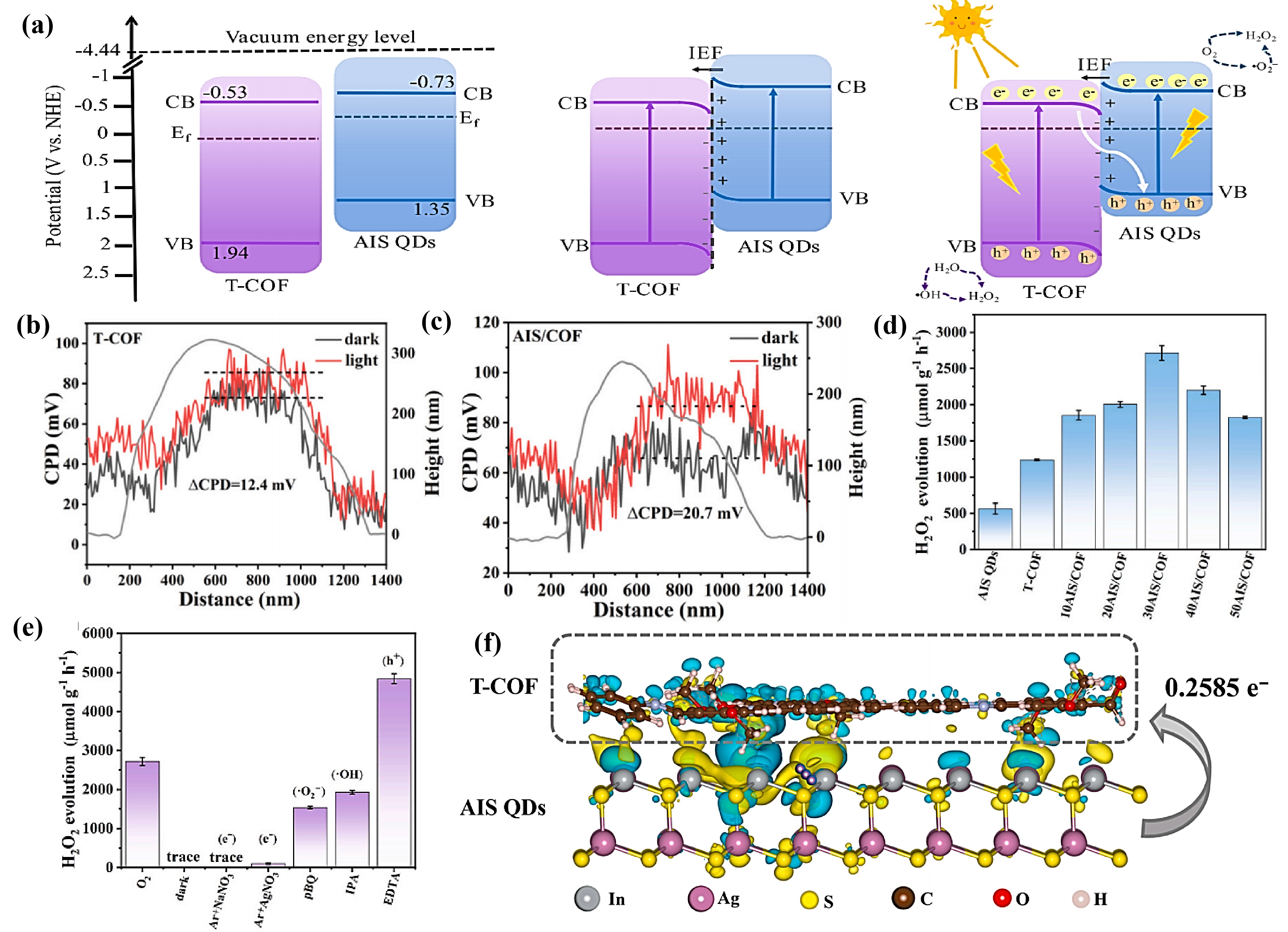
Fig. 23. (a) Band positions of T‑COF and AIS QDs for S-scheme. KPFM of T-COF (b) and AIS/COF (c). (d) H2O2 production rates at different AIS QDs loadings. (e) Radical trapping experiments. (f) Bader charge calculation results of AIS/COF. Reprinted with permission from Ref. [194]. Copyright 2026, Elsevier.
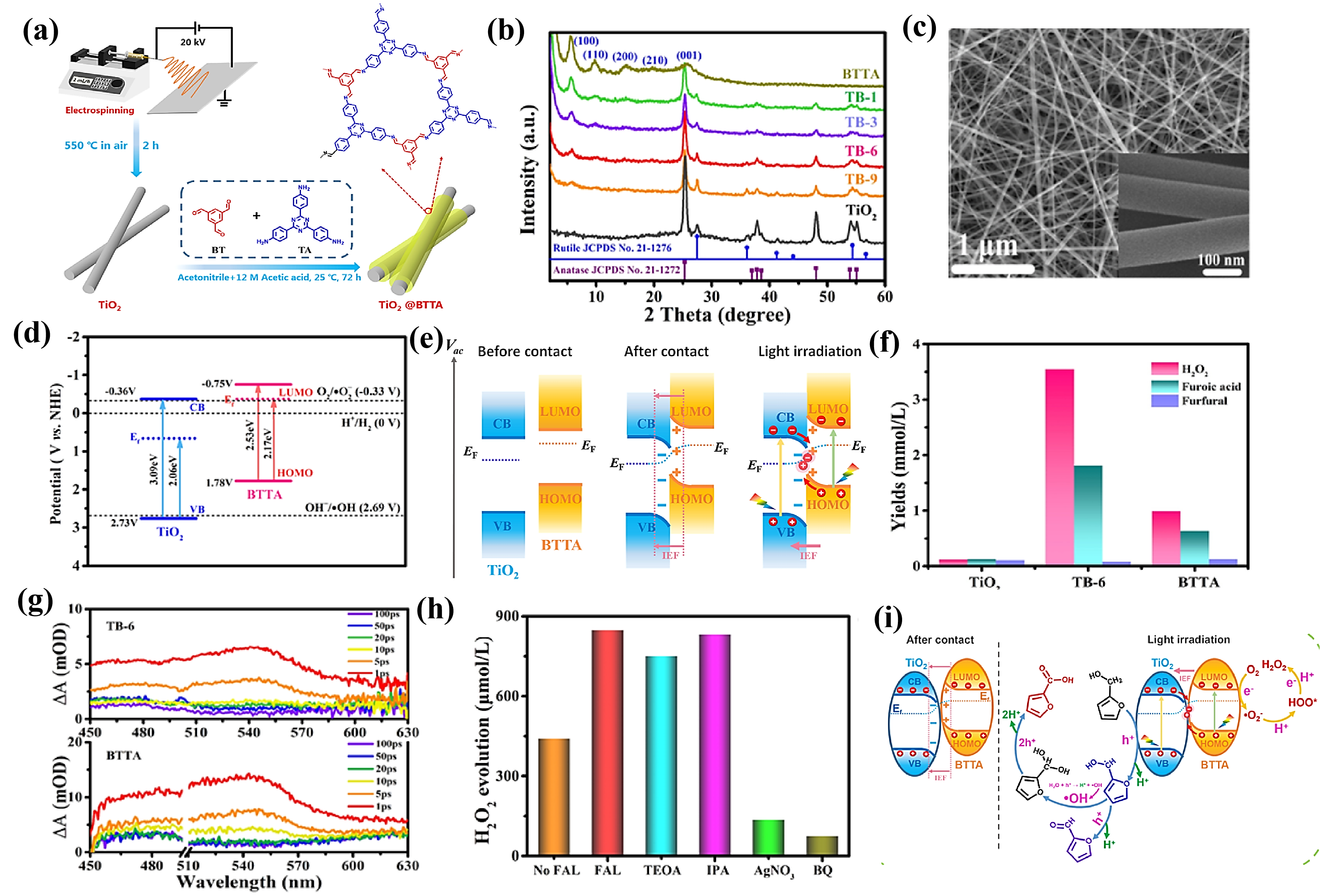
Fig. 24. (a) Schematic illustration of the synthesis process of the TiO2@BTTA core-shell heterojunction. (b) XRD patterns of TiO2@BTTA composites with different BTTA loadings. (c) SEM images of TiO2 nanofibers. (d) Band structure diagram of TiO2 and BTTA-COF. (e) Proposed S-scheme charge-transfer mechanism of TiO2@BTTA. (f) Schematic illustration of the photocatalytic reaction. (g) Fs-TA spectra and carrier decay kinetics of BTTA-COF and TB-6 composite. (h) H2O2 production rates of TiO2@BTTA. (i) Proposed photocatalytic reaction pathway for simultaneous H2O2 production and FAL oxidation over the TiO2@BTTA. Reprinted with permission from Ref. [196]. Copyright 2023, Elsevier.
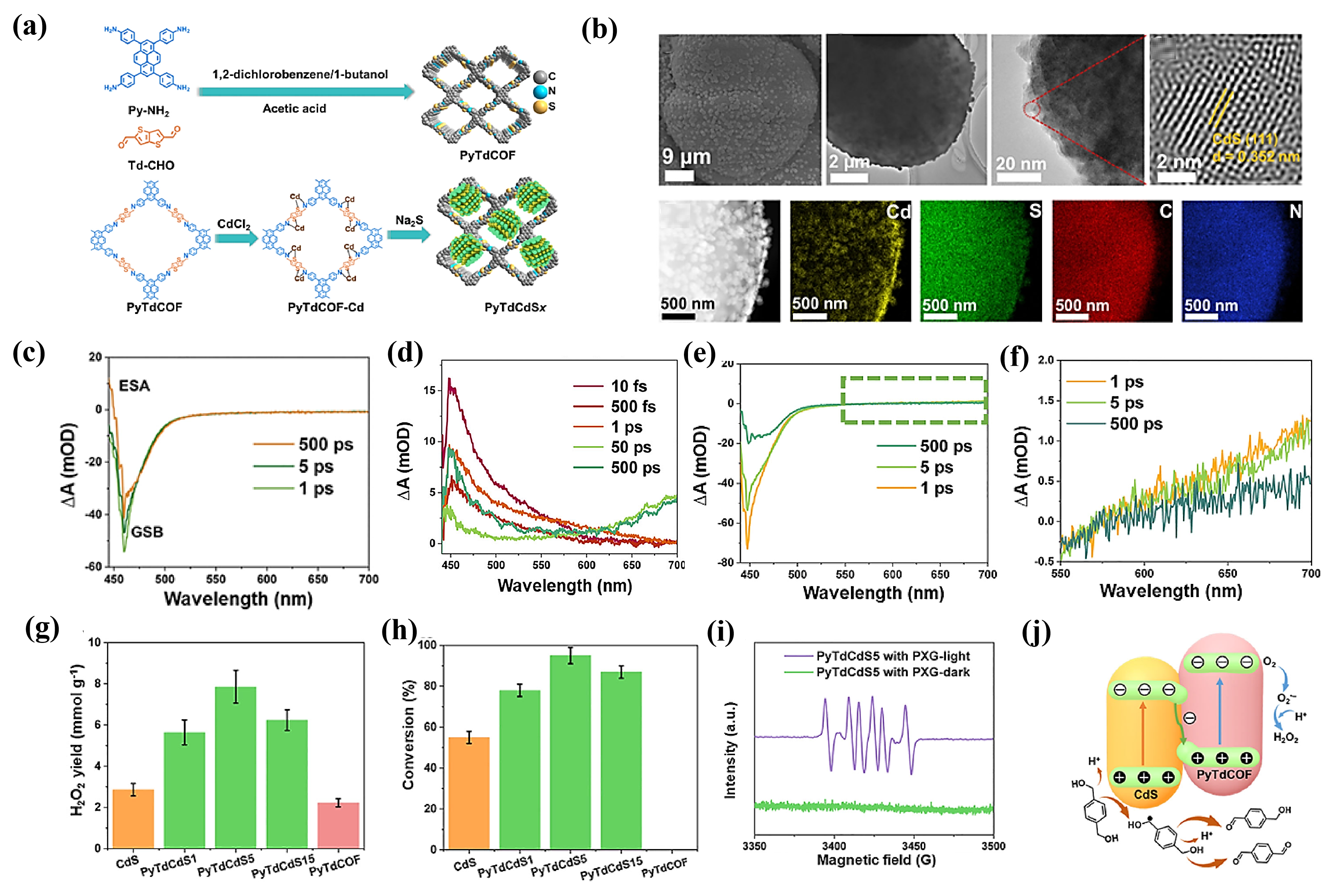
Fig. 25. (a) Schematic illustration of the synthesis of PyTdCOF and PyTdCOF/CdS composite. (b) Morphology of the PyTdCOF/CdS. Fs-TA spectra of pure CdS (c), PyTdCOF (d), and PyTdCOF/CdS composite (e,f). (g) H2O2 production rates of different samples (CdS, PyTdCdS1, PyTdCdS5, PyTdCdS15, and PyTdCOF). (h) Photocatalytic conversion efficiencies of PXG over different samples. (i) EPR spectra showing carbon-centered radical intermediates. (j) Schematic illustration of coupled H2O2 production and PXG oxidation over the PyTdCOF/CdS. Reprinted with permission from Ref. [197]. Copyright 2025, John Wiley and Sons.
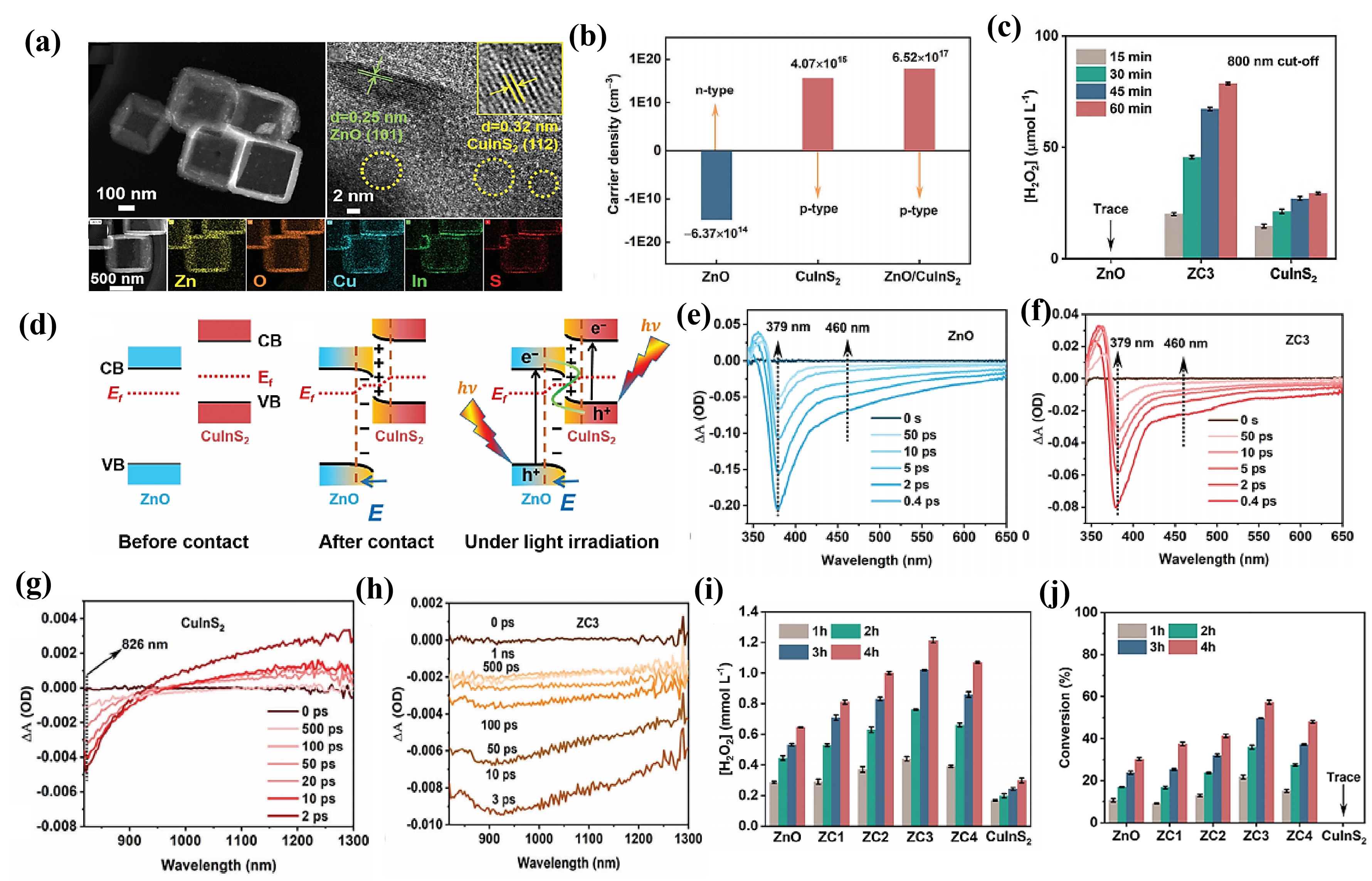
Fig. 26. (a) FESEM, STEM, HRTEM, HAADF images, and corresponding elemental mapping images of ZnO, CuInS2 and ZC3 composite. (b) Carrier concentration of ZnO, CuInS2 and ZC3 obtained from Hall effect measurements. (c) H2O2 production rates of different samples under NIR light irradiation (λ > 800 nm). (d) Schematic illustration of interfacial electron transfer in the ZnO/CuInS2 heterojunction. Fs-TA spectra of ZnO (e) and ZC3 (f) under a 330 nm pump pulse. Fs-TA spectra of CuInS2 (g) and ZC (h)3 in the near-infrared region. (i,j) Photocatalytic H2O2 production curves under UV-vis light irradiation. Reprinted with permission from Ref. [198]. Copyright 2024, John Wiley and Sons.
| Coupling type | Catalyst system | H2O2 yield (μmol·g‒1·h‒1) | Oxidation product performance | Reaction conditions | AQY | Solar-to-chemical efficiency (SCC) | TOF (h‒1) | Cycle stability (retention after N cycles) | Ref. |
|---|---|---|---|---|---|---|---|---|---|
| Pure water | COF/In2S3 (20COFIS) | 5713.2 | — | pure water, O2-saturated, 300 W Xe lamp sacrificial-agent-free | — | — | — | 4 cycles, the H2O2 production activity retains 85% of its initial value | [ |
| Pure water + air | Nb2O5@NiS (NONS-30) | 480 | — | pure water + air, AM 1.5G | — | — | — | slight activity decay after 10 cycles | [ |
| Pure water | Tph-Dha-COF@Nb2C | 1833 | — | pure water, O2-saturated, 300 W Xe lamp, sacrificial-agent-free | 1.94% (420nm) | 0.345% | — | 95% H2O2 yield retention after 5 cycles | [ |
| Pure water | ZnIn2S4/CN-NH4 | 2031 | — | pure water, O2-saturated, 300 W Xe lamp (λ > 420 nm), sacrificial-agent-free | — | — | — | stable interface was kept after repeated cycles | [ |
| Pure water | CZIS/SCN/MF (Cd0.5Zn0.5In2S4) | 3460 | — | pure water, O2-saturated, 300 W Xe lamp, sacrificial- agent-free | — | — | — | H2O2 yield retention >90% after 5 cycles | [ |
| Furfuryl alcohol oxidation | TiO2@BTTA (TB-6) | 740 | Furoic acid: 92% conversion rate | furfuryl alcohol solution, 300 W Xe lamp sacrificial agent: furfuryl alcohol | 5.48% (365 nm) | — | — | negligible performance loss after 4 cycles | [ |
| p-Phenylenedimethanol oxidation | PyTdCOF/CdS (PyTdCdS5) | 7860 (2 h) | p-phenylenedimethanol conversion rate: 95% | p-phenylenedimethanol O2/H2O, solution, λ > 420 nm, sacrificial agent: 1,4-benzenedimethanol | — | — | — | no obvious activity loss after 5 cycles | [ |
| Glycerol oxidation | ZnO/CuInS2 (ZC3) | 450 (H2O2 concentration) | glycerol conversion rate:57.3%, DHA selectivity: 41.1% | pure water, O2-saturated, 300 W Xe lamp sacrificial agent: glycerol | 1.17% (365 nm) | — | — | catalytic activity remained stable after 4 cycles | [ |
Table 3 S-scheme heterojunction photocatalysts for photocatalytic H2O2 production coupled with oxidation reactions.
| Coupling type | Catalyst system | H2O2 yield (μmol·g‒1·h‒1) | Oxidation product performance | Reaction conditions | AQY | Solar-to-chemical efficiency (SCC) | TOF (h‒1) | Cycle stability (retention after N cycles) | Ref. |
|---|---|---|---|---|---|---|---|---|---|
| Pure water | COF/In2S3 (20COFIS) | 5713.2 | — | pure water, O2-saturated, 300 W Xe lamp sacrificial-agent-free | — | — | — | 4 cycles, the H2O2 production activity retains 85% of its initial value | [ |
| Pure water + air | Nb2O5@NiS (NONS-30) | 480 | — | pure water + air, AM 1.5G | — | — | — | slight activity decay after 10 cycles | [ |
| Pure water | Tph-Dha-COF@Nb2C | 1833 | — | pure water, O2-saturated, 300 W Xe lamp, sacrificial-agent-free | 1.94% (420nm) | 0.345% | — | 95% H2O2 yield retention after 5 cycles | [ |
| Pure water | ZnIn2S4/CN-NH4 | 2031 | — | pure water, O2-saturated, 300 W Xe lamp (λ > 420 nm), sacrificial-agent-free | — | — | — | stable interface was kept after repeated cycles | [ |
| Pure water | CZIS/SCN/MF (Cd0.5Zn0.5In2S4) | 3460 | — | pure water, O2-saturated, 300 W Xe lamp, sacrificial- agent-free | — | — | — | H2O2 yield retention >90% after 5 cycles | [ |
| Furfuryl alcohol oxidation | TiO2@BTTA (TB-6) | 740 | Furoic acid: 92% conversion rate | furfuryl alcohol solution, 300 W Xe lamp sacrificial agent: furfuryl alcohol | 5.48% (365 nm) | — | — | negligible performance loss after 4 cycles | [ |
| p-Phenylenedimethanol oxidation | PyTdCOF/CdS (PyTdCdS5) | 7860 (2 h) | p-phenylenedimethanol conversion rate: 95% | p-phenylenedimethanol O2/H2O, solution, λ > 420 nm, sacrificial agent: 1,4-benzenedimethanol | — | — | — | no obvious activity loss after 5 cycles | [ |
| Glycerol oxidation | ZnO/CuInS2 (ZC3) | 450 (H2O2 concentration) | glycerol conversion rate:57.3%, DHA selectivity: 41.1% | pure water, O2-saturated, 300 W Xe lamp sacrificial agent: glycerol | 1.17% (365 nm) | — | — | catalytic activity remained stable after 4 cycles | [ |
|
| [1] | Mengxuan Liu, Rongxin Zhang, Xin Zhang, Yanfeng Zhang. WO3/PHI S-scheme heterojunction with photoinduced dual defects for highly selective photocatalytic CO2-to-CO conversion [J]. Chinese Journal of Catalysis, 2027, 92(1): 219-236. |
| [2] | Shike Wang, Man Lang, Feng Wang, Pengfei Xia, Dieqing Zhang. Recent advances in g-C3N4-based S-scheme photocatalyst [J]. Chinese Journal of Catalysis, 2027, 92(1): 37-64. |
| [3] | Xiaolong Ma, Zhiqiang Wu, Huiqin Yao, Bin Liu, Zhiliang Jin, Paolo Fornasiero. Charging dynamics engineering: Quantum dots-induced full-space electric field cooperative Ag2S QDs/CoWO₄ S-scheme heterojunction boosting photocatalytic hydrogen evolution [J]. Chinese Journal of Catalysis, 2026, 88(9): 233-246. |
| [4] | Gaoxiong Liu, Rundong Chen, Bingquan Xia, Xianlong Zhou, Laiquan Li, Shantang Liu. Thiadiazole-functionalized covalent triazine frameworks for constructing S-scheme heterojunctions enabling boosted H2O2 photosynthesis [J]. Chinese Journal of Catalysis, 2026, 87(8): 170-184. |
| [5] | Hao Wu, Xinyu Zeng, Wang Wang, Bei Cheng, Jingzhao Cheng, Jingsan Xu, Shaowen Cao. The organic-inorganic S-scheme heterojunction with enhanced charge separation simultaneously catalyze the production of hydrogen and imine [J]. Chinese Journal of Catalysis, 2026, 87(8): 185-196. |
| [6] | Shijie Li, Rui Li, Yanping Liu, Xin Yu, Deyun Ma, Jianhui Jiang, Xiaosong Zhou, Chunqiang Zhuang, Zaiwang Zhao, Wei Jiang. Augmented reactive oxygen species generation in Ag/AgBr/C3N5 via LSPR-enhanced S-scheme charge transfer for efficient photocatalytic antibiotic wastewater remediation [J]. Chinese Journal of Catalysis, 2026, 87(8): 126-139. |
| [7] | Yatai Zhou, Chengcheng Yuan, Wei Xia, Jun Wang, Xiaofeng Zhu, Yong Zhang, Bicheng Zhu, Jiaguo Yu. Synergistic optimization of interfacial electron transfer and surface hydrogen adsorption in a CdS/ZnO S-scheme heterojunction by site-specific doping: A DFT study [J]. Chinese Journal of Catalysis, 2026, 86(7): 327-337. |
| [8] | Ping Li, Liang Wei, Wei Xia, Chengcheng Yuan, Chenbin Ai, Meng Li. Ultrafast electron transfer in 2D/2D g-C3N4/WO3 S-scheme heterojunctions for enhanced H2O2 production [J]. Chinese Journal of Catalysis, 2026, 85(6): 333-345. |
| [9] | Jintao Dong, Rui Zhang, Zhishuai Wang, Shengqun Cao, Lina Li, Gaopeng Liu, Bin Wang, Yixuan Gao, Jiexiang Xia. Construction of S-scheme MnO2/BiOCl heterojunction boosting photocatalytic low-concentration peroxymonosulfate activation for contaminants removal [J]. Chinese Journal of Catalysis, 2026, 85(6): 310-321. |
| [10] | Mengmeng Liu, Yan Zhang, Yucheng Xie, Guangxue Pan, Haiqun Cao, Sheng Ye. TiO2 phase junction engineering for promoted interfacial adsorption and catalysis of imidacloprid insecticide [J]. Chinese Journal of Catalysis, 2026, 84(5): 359-367. |
| [11] | Ziyi Liao, Lan Jiang, Yang Yang, Lin Wang, Weiyou Yang, Huilin Hou. Alkali-cyano dual-tailored g-C3N4/BiOCl S-scheme heterojunctions for highly efficient visible-light-driven H2O2 photosynthesis in pure water [J]. Chinese Journal of Catalysis, 2026, 83(4): 143-161. |
| [12] | R. Kavitha, C. Manjunatha, S. Girish Kumar. ZnO-based S-scheme heterojunction: Design principles, preparation methods and photocatalytic activity [J]. Chinese Journal of Catalysis, 2026, 83(4): 54-95. |
| [13] | Keshan Tang, Wanyi Deng, Ningyuan Wang, Yang Xia, Xinhe Wu, Heng Yang. Triazine-based COF/TiO2 S-scheme heterojunction with oxygen vacancies for efficient photocatalytic CO2 reduction [J]. Chinese Journal of Catalysis, 2026, 83(4): 244-257. |
| [14] | Kaiqiang Xu, Wenjun Zhu, Mahmoud Sayed, Sheng Han. Design and preparation of 1D-based S-scheme photocatalysts [J]. Chinese Journal of Catalysis, 2026, 83(4): 24-53. |
| [15] | Jing Zhang, Xidong Zhang, Kaiyan Wang, Xuefei Wang, Ping Wang, Feng Chen, Huogen Yu. Citric directional coordination for efficient photocatalytic synthesis of H2O2 with high value-added β-Ketoglutaric acid [J]. Chinese Journal of Catalysis, 2026, 82(3): 201-211. |
| Viewed | ||||||
|
Full text |
|
|||||
|
Abstract |
|
|||||


