
Chinese Journal of Catalysis ›› 2026, Vol. 89: 390-401.DOI: 10.1016/S1872-2067(26)65157-1
• Article • Previous Articles Next Articles
Chunchun Wanga,1, Yang Gea,1, Xindong Songa, Yiqi Dingb, Zhuo Xinga,*( ), Ying Yua,*()
Received:2026-01-09
Accepted:2026-02-22
Online:2026-10-18
Published:2026-09-01
Contact:
*E-mail:xingzhuo@ccnu.edu.cn(Z. Xing),yuying01@ccnu.edu.cn(Y. Yu).
About author:1 Contributed equally to this work.
Supported by:Chunchun Wang, Yang Ge, Xindong Song, Yiqi Ding, Zhuo Xing, Ying Yu. Restricting proton transfer via carbon nanohorn-supported monomolecular cobalt phthalocyanine enhances CO2-to-CO electrocatalysis in acidic media[J]. Chinese Journal of Catalysis, 2026, 89: 390-401.
Add to citation manager EndNote|Ris|BibTeX
URL: https://www.cjcatal.com/EN/10.1016/S1872-2067(26)65157-1

Fig. 1. Synthesis and structural characterization of monomolecularly dispersed CoPc on CNHs. (a) Schematic illustration showing CoPc molecules immobilized on CNHs. (b) Raman spectra. (c) TEM image and structure diagram (inset) of CoPc/CNHs-3 catalyst. (d) HRTEM images of CoPc/CNHs-3 catalyst. (e) The AC-TEM image of CNHs fragment. (f) FFT filtered image of the selected area (red box), with pentagonal and hexagonal carbocycles marked in white and red, respectively. (g) HAADF-STEM image from 4D-STEM of CoPc/CNHs-3 catalyst with many single Co atoms (bright dots) distributed. Average Co atomic density is roughly 1.38 ± 1.13?atom nm-2. (h) EDX mapping of CoPc/CNHs-3 catalyst.
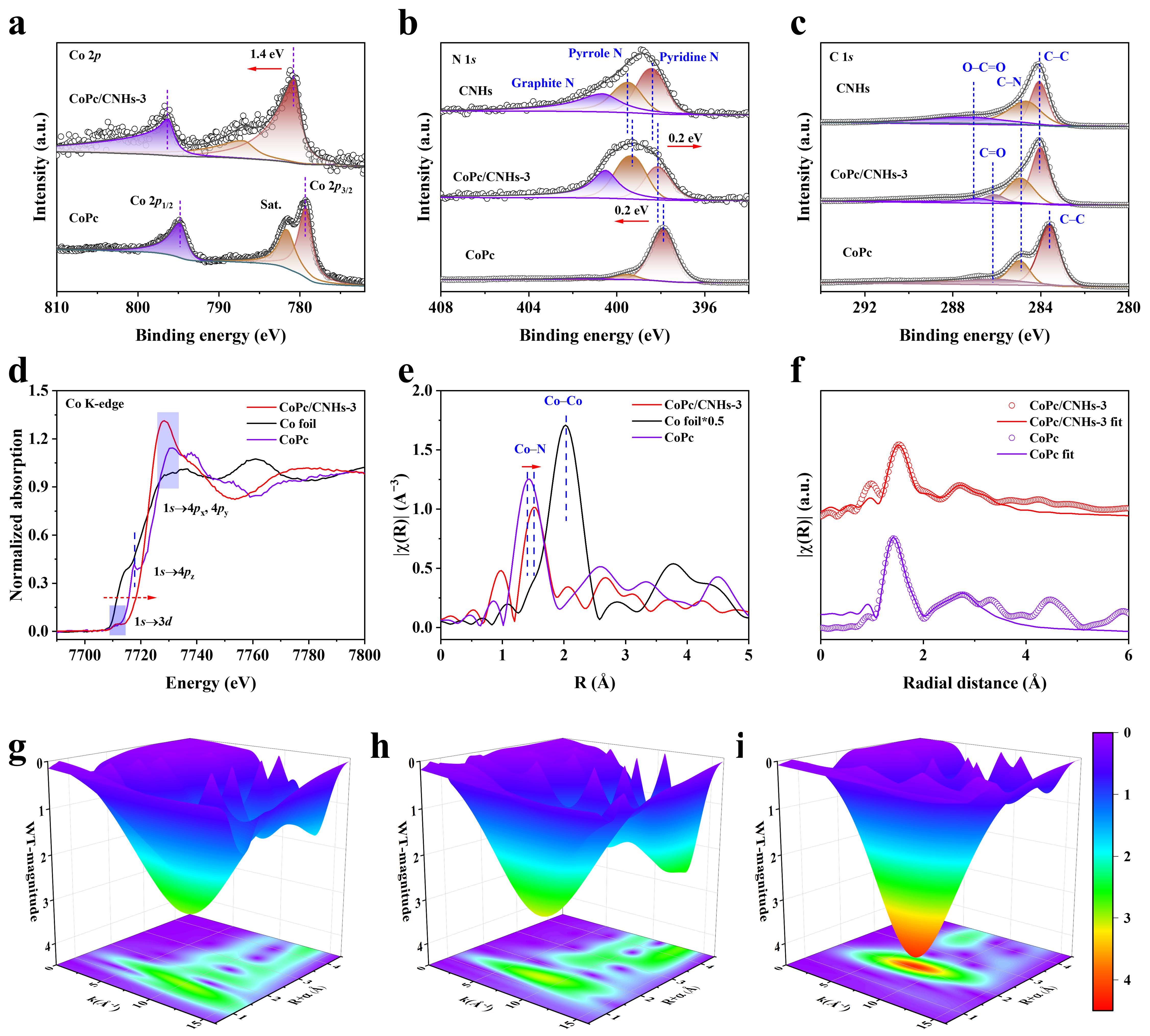
Fig. 2. Electronic structure and coordination environment characterization. High-resolution XPS spectra of Co 2p (a), N 1s (b), and C 1s (c) for CoPc/CNHs-3, CoPc, and CNHs catalysts. Co K-edge XANES spectra (d) and EXAFS spectra (e) of CoPc/CNHs-3, CoPc and Co foil references. (f) Fitted Fourier-transformed EXAFS spectra in R space for CoPc/CNHs-3 and CoPc. Wavelet-transformed EXAFS spectra of CoPc/CNHs-3 (g), CoPc (h), and Co foil (i).
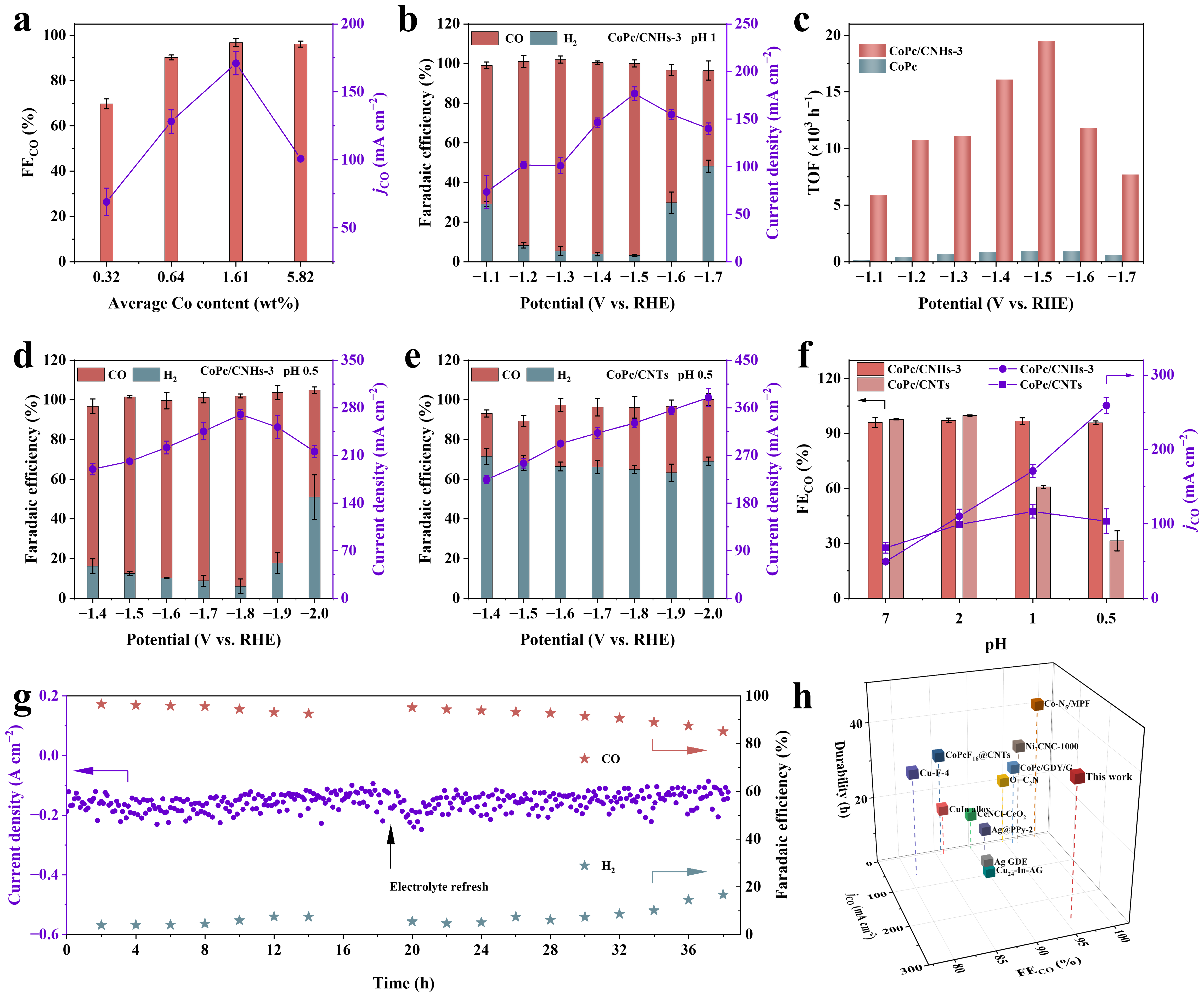
Fig. 3. Electrocatalytic CO2RR performance in acid electrolyte. (a) FEs and jCO of CoPc/CNHs with different Co contents. FEs and total current densities over CoPc/CNHs-3 in 1 mol L-1 KCl (pH = 1) (b) and 1 mol L-1 KCl (pH = 0.5) (d) catholyte. (c) TOF of CO production for CoPc/CNHs-3 and CoPc in 1 mol L-1 KCl (pH = 1) catholyte. The TOF is calculated based on the total number of Co atoms in the catalyst as determined by ICP-OES. (e) FEs of products and total current densities over CoPc/CNTs in 1 mol L-1 KCl (pH = 0.5) catholyte. (f) FEs and jCO of CoPc/CNHs-3 and CoPc/CNTs with electrolyte pH from 7 to 0.5. (g) CO2RR durability of CoPc/CNHs-3 at -1.4 V vs. RHE and the corresponding FECO and FEH2 evolution with time in 1 M KCl (pH = 1) catholyte. (h) Comparison of CO product performance in this study with values reported for other catalysts. The error bars represent the standard deviation of three independent measurements.
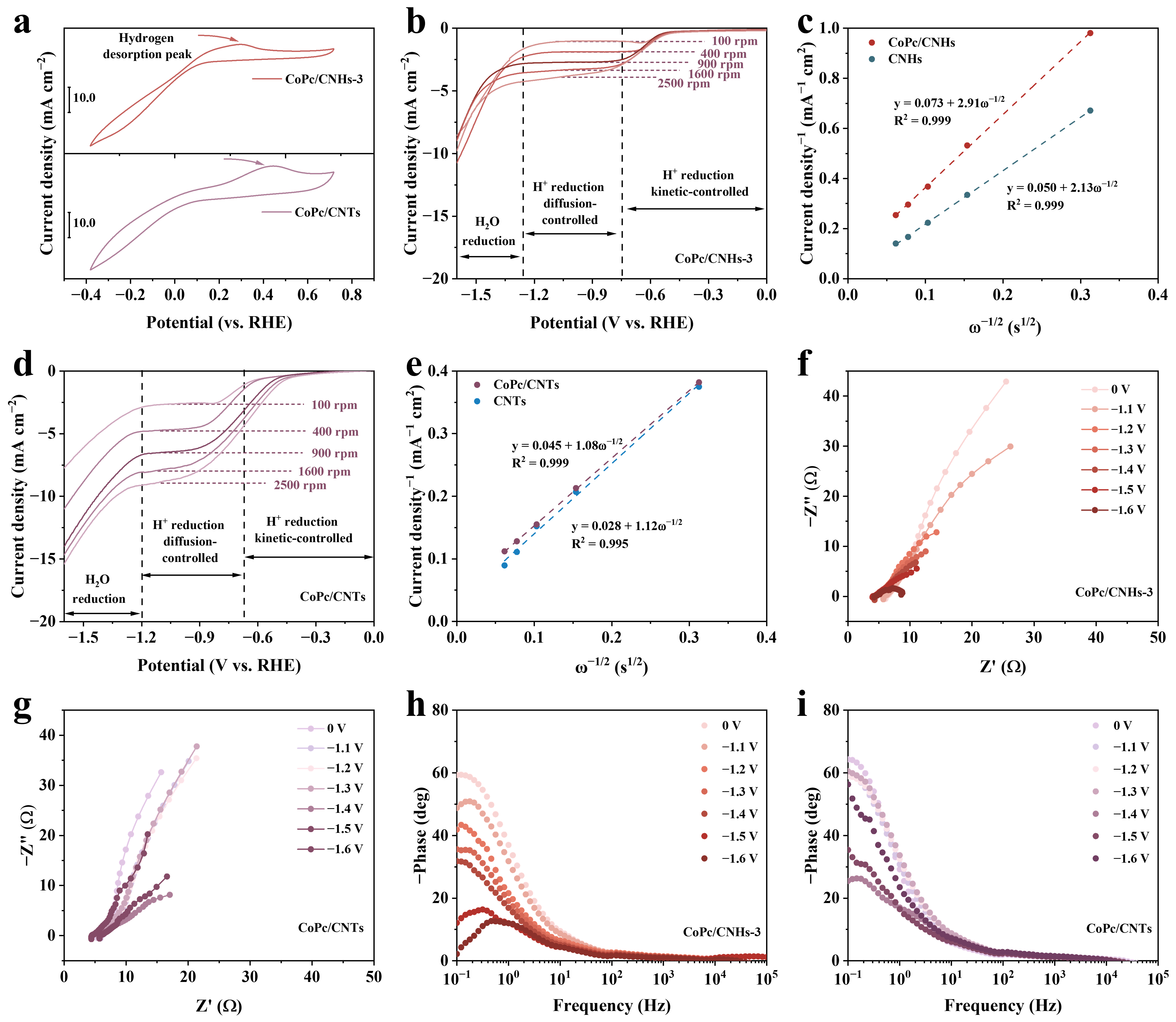
Fig. 4. Effect of restricted proton transfer and reaction kinetics measurements of CO2RR. (a) CVs of CoPc/CNHs-3 and CoPc/CNTs electrodes in Ar-saturated 0.5 mol L-1 H2SO4 with a scan rate of 100 mV s-1. LSV curves of CoPc/CNHs-3 (b) and CoPc/CNTs (d) on RDE in Ar-saturated 0.1 mol L-1 K2SO4 (pH = 2.5) with different rotation rates. Linear fitting plots based on Koutecky-Levich equation for CoPc/CNHs-3 (c) and CoPc/CNTs (e) catalysts. Potential-dependent in-situ Nyquist plots of CoPc/CNHs-3 (f) and CoPc/CNTs (g) catalysts. Potential-dependent in-situ Bode phase plots of CoPc/CNHs-3 (h) and CoPc/CNTs (i) catalysts.
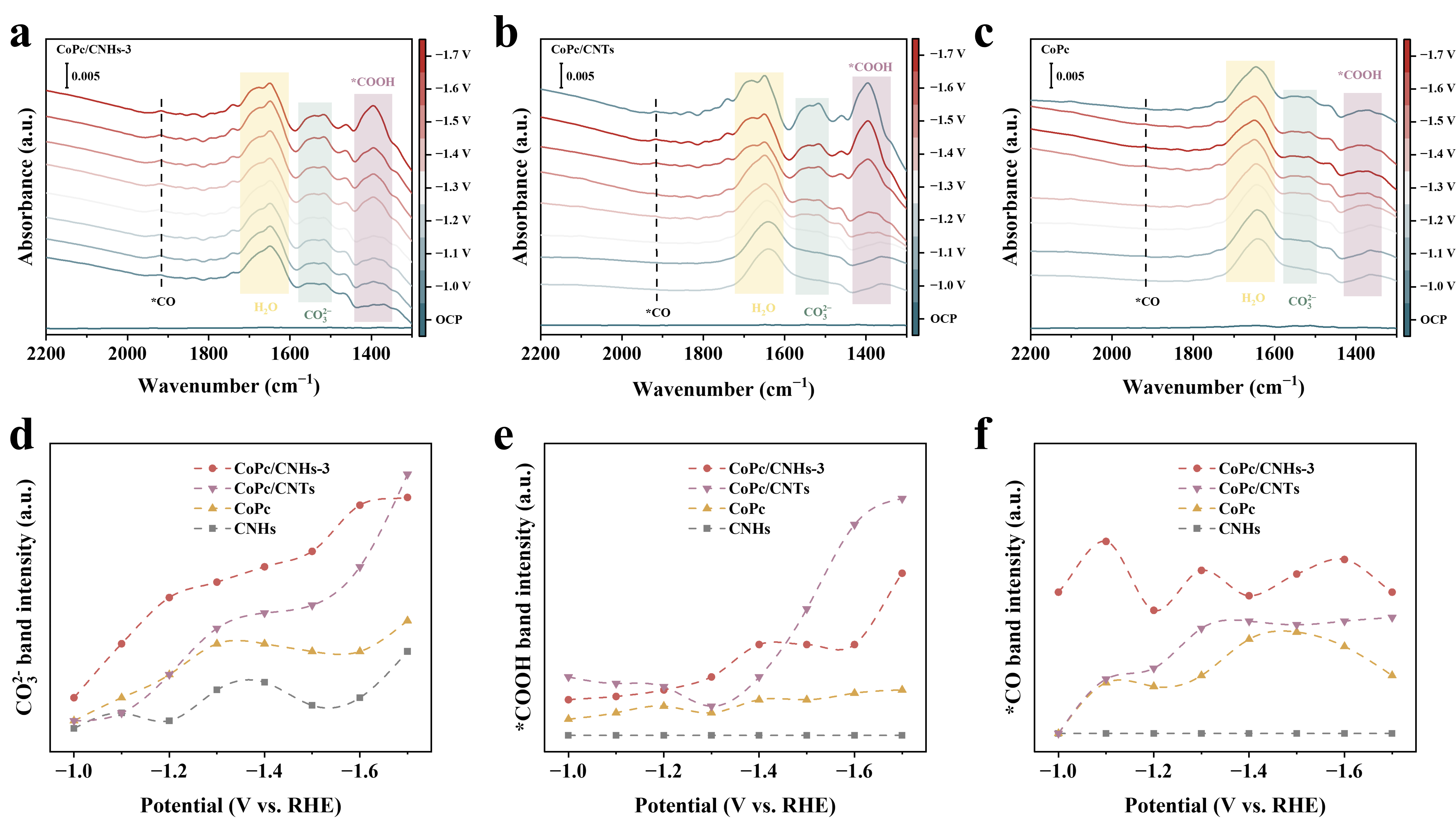
Fig. 5. In-situ spectroscopic investigation for intermediates detection. In-situ ATR-SEIRAS spectra on CoPc/CNHs-3 (a), CoPc/CNTs (b), and CoPc (c) at different potentials. Band intensity of key intermediates CO32- (d), *COOH (e), and *CO (f) formed on surface of CoPc/CNHs-3, CoPc/CNTs, CoPc, and CNHs catalysts.
|
| [1] | Xuanbei Peng, Mengqi An, Ruishao Mao, Yanliang Zhou, Ming Chen, Dongya Huang, Kailin Su, Shiyong Zhang, Jun Ni, Xiuyun Wang, Lilong Jiang. Scheelite-type alkali metal perrhenates supported Co-based catalysts for highly efficient ammonia synthesis [J]. Chinese Journal of Catalysis, 2026, 83(4): 432-443. |
| [2] | Peng Huang, Zhijun Xie, Yong Guo, Jun Wang, Ji-Jun Zou, Qiang Deng. Ruthenium-tungsten alloy nanoparticles accelerate the cascade hydrogenation-ring opening of furfurals to linear ketones [J]. Chinese Journal of Catalysis, 2026, 82(3): 337-347. |
| [3] | Guohao Na, Hongshun Zheng, Mingpeng Chen, Huachuan Sun, Yuewen Wu, Dequan Li, Yun Chen, Boran Zhao, Bo Zhao, Tong Zhou, Tianwei He, Yuxiao Zhang, Jianhong Zhao, Yumin Zhang, Jin Zhang, Feng Liu, Hao Cui, Qingju Liu. In-situ Pt reduction induced topological transformation of NiFe-MOF for industrial seawater splitting [J]. Chinese Journal of Catalysis, 2025, 72(5): 211-221. |
| [4] | Guipeng Zhang, Yan Bin, Yanxin Wang, Jinzhu Chen. Remote hydrogen-spillover effect on catalytic transnitrilation for biomass-based nitrile synthesis [J]. Chinese Journal of Catalysis, 2025, 77(10): 153-170. |
| [5] | Ziwen Mei, Kejun Chen, Yao Tan, Qiuwen Liu, Qin Chen, Qiyou Wang, Xiqing Wang, Chao Cai, Kang Liu, Junwei Fu, Min Liu. Proton feeding from defect-rich carbon support to cobalt phthalocyanine for efficient CO2 electroreduction [J]. Chinese Journal of Catalysis, 2024, 62(7): 190-197. |
| [6] | Wenjing Bao, Chao Feng, Shuyan Ma, Dengwei Yan, Cong Zhang, Changle Yue, Chongze Wang, Hailing Guo, Jiqian Wang, Daofeng Sun, Yunqi Liu, Yukun Lu. Controlled construction of Co3S4@CoMoS yolk-shell sphere for efficient hydrodesulfurization promoted by hydrogen spillover effect [J]. Chinese Journal of Catalysis, 2024, 57(2): 154-170. |
| [7] | Wangyang Wu, Shidan Yang, Huidan Qian, Ling Zhang, Lishan Peng, Li Li, Bin Liu, Zidong Wei. Interface engineering of advanced electrocatalysts toward alkaline hydrogen evolution reactions [J]. Chinese Journal of Catalysis, 2024, 66(11): 1-19. |
| [8] | Zizi Li, Jia-Wei Wang, Yanjun Huang, Gangfeng Ouyang. Enhancing CO2 photoreduction via the perfluorination of Co(II) phthalocyanine catalysts in a noble-metal-free system [J]. Chinese Journal of Catalysis, 2023, 49(6): 160-167. |
| [9] | Zhichao Lin, Zhan Jiang, Yubo Yuan, Huan Li, Hongxuan Wang, Yirong Tang, Chunchen Liu, Yongye Liang. Cobalt-N4 macrocyclic complexes for heterogeneous electrocatalysis of the CO2 reduction reaction [J]. Chinese Journal of Catalysis, 2022, 43(1): 104-109. |
| [10] | Hangjia Shen, Xianyuan Wu, Dahao Jiang, Xiaonian Li, Jun Ni. Identification of active sites for hydrogenation over Ru/SBA-15 using in situ Fourier-transform infrared spectroscopy [J]. Chinese Journal of Catalysis, 2017, 38(9): 1597-1602. |
| Viewed | ||||||
|
Full text |
|
|||||
|
Abstract |
|
|||||


