
Chinese Journal of Catalysis ›› 2026, Vol. 89: 410-421.DOI: 10.1016/S1872-2067(26)65154-6
• Article • Previous Articles Next Articles
Xiaoyan Fua, Dong Luana, Chenyu Yanga,b, Jianping Xiaoa,b,*( )
)
Received:2026-01-09
Accepted:2026-02-25
Online:2026-10-18
Published:2026-09-01
Contact:
*E-mail:xiao@dicp.ac.cn(J. Xiao).
Supported by:Xiaoyan Fu, Dong Luan, Chenyu Yang, Jianping Xiao. Electrochemical ammonia synthesis over copper oxide derived catalysts studied by electric field dependent machine learning potential[J]. Chinese Journal of Catalysis, 2026, 89: 410-421.
Add to citation manager EndNote|Ris|BibTeX
URL: https://www.cjcatal.com/EN/10.1016/S1872-2067(26)65154-6
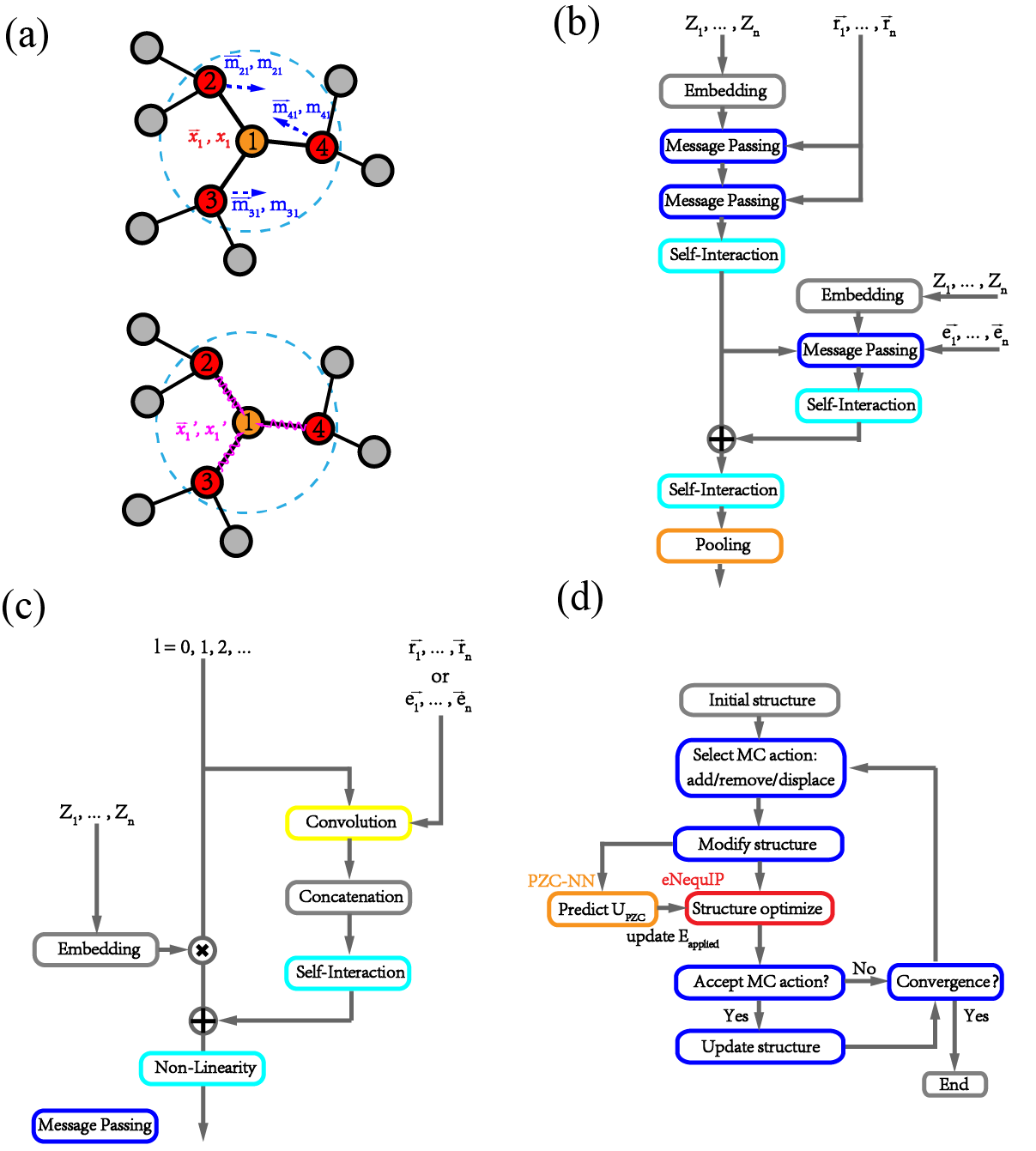
Fig. 1. (a) An illustration of equivariant message-passing. In order to address the atom-atom interactions, the scalars xi were updated invariant while the tensors $\overrightarrow{x_{i}}$ were updated equivariant. mij and $\overrightarrow{m_{i j}}$ were separately the scalar and directional outputs by the message passing over edge (i,j). (b) the eNequIP architecture, a residual network was added following the NequIP, with applied electric field interact with node features in an invariant scheme. $\overrightarrow{e_{n}}$ donates the applied electric field, Zn the atomic number, and $\overrightarrow{r_{i j}}$ the edge vector. (c) The message-passing blocks in eNequIP. The applied electric field $\overrightarrow{e_{i}}$ was treated similarly with edge vector $\overrightarrow{r_{i j}}$ to maintain equivariant. (d) The architecture of GCMC simulations. Oxygen atom addition, oxygen atom removal, and Cu/O atom displacement are all possible MC actions. When the structure is modified, the Eapplied is updated with PZC-NN to calculate the UPZC. The structure optimization and energy calculation are carried out in eNequIP.
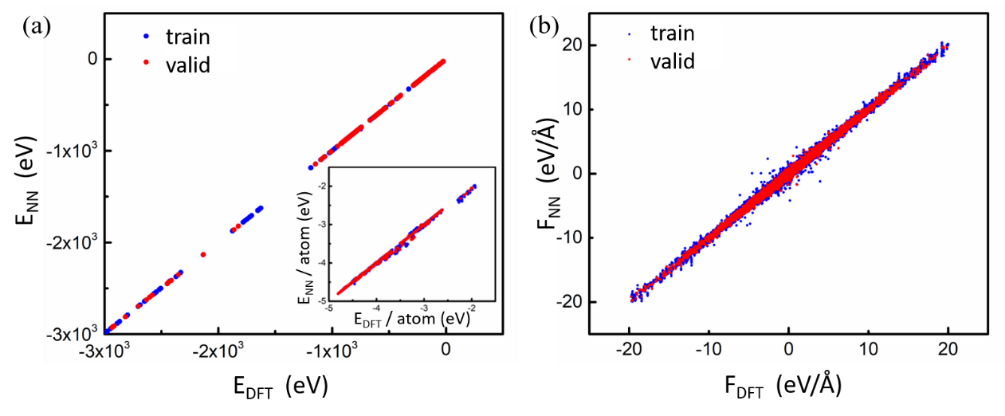
Fig. 2. Evaluation of eNequIP model performance on the Cu-O system. (a) Parity plot of predicted vs. DFT-calculated energies. The model demonstrates high accuracy across a wide energy range (-3000 to 0 eV), with an MAE of 4.2 meV per atom. The inset shows the average atomic energy. (b) Parity plot of predicted vs. DFT-calculated atomic forces. The employed sampling strategy ensured adequate representation of configurations with high-force atoms, resulting in a force MAE of 0.052 eV/?.
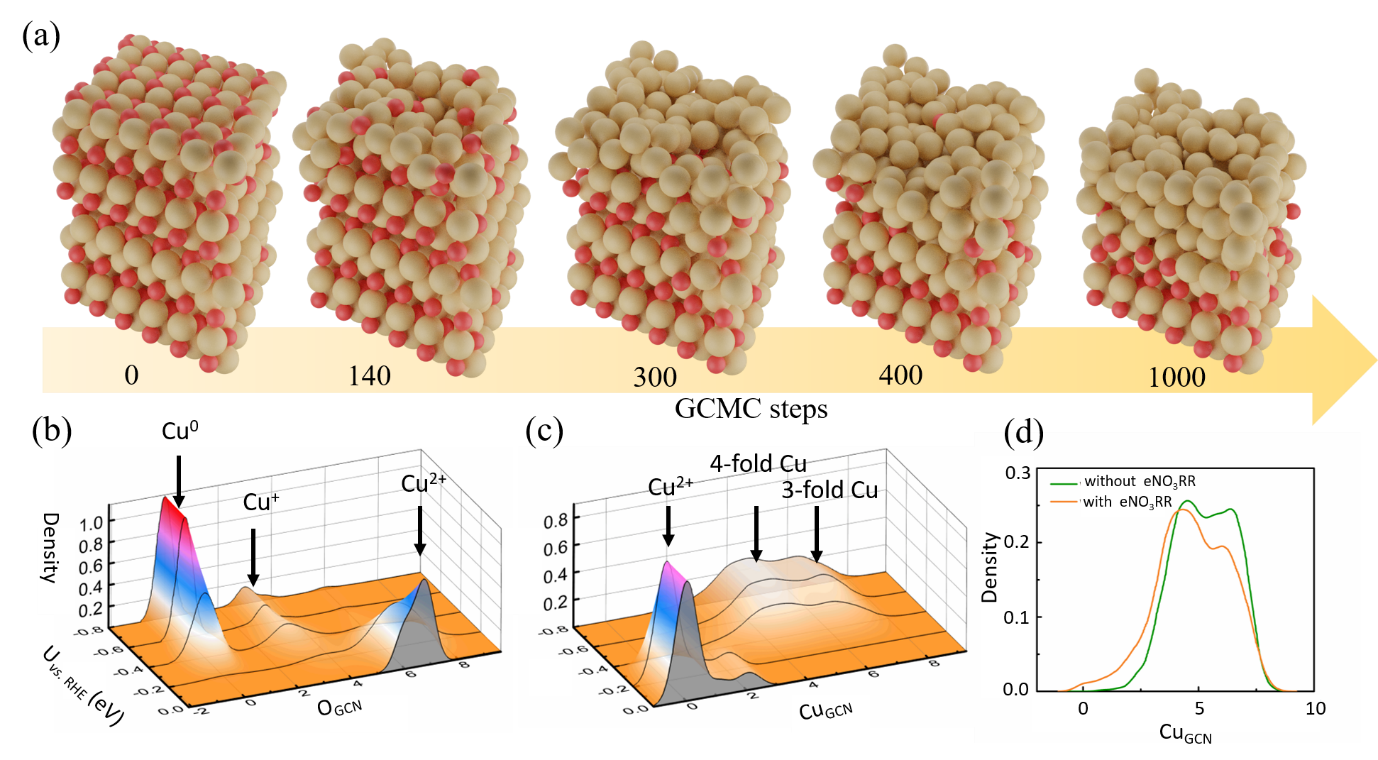
Fig. 3. (a) Illustration of the evolution process of CuO (111) surface at -0.8 V vs. RHE w/o eNO3RR; (b-d) The KDE distribution of GCN of surface atoms on operando reduced CuO (111) surfaces. OGCN represents the generalized coordination number of Cu with O atoms, while CuGCN represents the generalized coordination number of Cu with Cu atoms. (b) The OGCN of equilibrium surface Cu over different potentials, with eNO3RR. (c) The CuGCN of equilibrium surface Cu over different potentials, with eNO3RR. (d) Comparison of CuGCN distribution at -0.4 V vs. RHE, with and without eNO3RR.
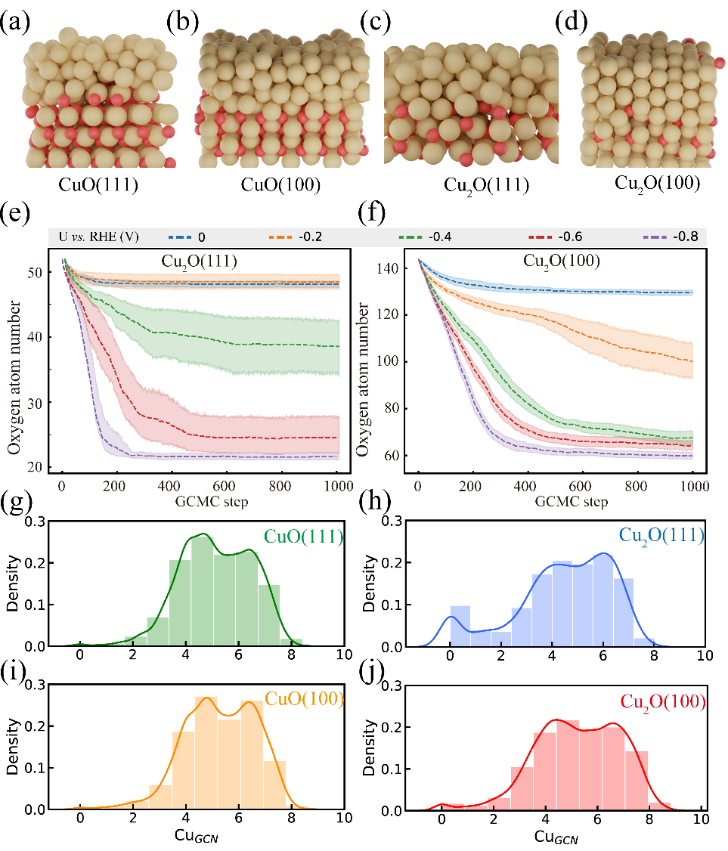
Fig. 4. Representative equilibrium structures of reduced CuO(111) (a), CuO(100) (b), Cu2O(111) (c), and Cu2O(100) (d) surfaces obtained from GCMC simulations at -0.6 V vs. RHE. Snapshots are taken at the end of the simulations after convergence is achieved. The oxygen number evolution history in GCMC simulation: Cu2O(111) (e) and Cu2O(100) (f). Different color represents the different electrode potential. Blue, orange, green, red and pink represents potential at 0.0, -0.2, -0.4, -0.6 and -0.8 V vs. RHE, respectively. The KDE distribution of CuGCN among CuO(111) (g), CuO(100) (h), Cu2O(111) (i), and Cu2O(100) (j). The potential is set as -0.6 V vs. RHE.

Fig. 5. The microkinetic modeling results. Theoretical results of the selectivity on Cu(100) (a), Cu(111) (b), defect-Cu(100) (c), and defect-Cu(111) (d). (e,f) are the potential-dependent Faradaic efficiency compared with experimental results. (e) is the reduced CuO(111) surface, corresponds to the defect-Cu(100) sites, and is compared with the experimental results of the reduced CuO nanosheets [66] (measured in 1 mol/L KOH + 0.2 mol/L KNO3, alkaline condition). (f) The reduced Cu2O(100) surface, corresponds to a combination of defect-Cu(100) sites and perfect Cu(111) sites. And is compared with the experimental results of the reduced Cu2O nanocubes [67] (measured in 0.1 mol/L Na2SO4, pH-neutral condition).
|
| [1] | Shijian Luo, Hao Chen, Yuran Yang, Yang Song, Yongduo Liu, Daojun Long, Siguo Chen, Zidong Wei. Hydride-enhanced plasma catalysis enables ultrahigh-rate ammonia synthesis at room temperature and atmospheric pressure [J]. Chinese Journal of Catalysis, 2026, 88(9): 269-278. |
| [2] | Miao Wang, Tianyu Shen, Heng Zhou, Shuaikang Yang, Fengkun Hao, Chaohui Wang, Mohan Kumar, Zuoxiu Tie, Shuangming Chen, Zhanxi Fan, Zhong Jin. Direct electrosynthesis of ammonia from nitrate reduction using atomically precise carbonyl-rich metal clusters in neutral media [J]. Chinese Journal of Catalysis, 2026, 88(9): 259-268. |
| [3] | Fengjuan Guo, Chunyao Ma, Yue Huang, Sitong Hang, Junwei Ma, Hongtao Gao. Unveiling the dominant distal-alternating hybrid mechanism in B-modulated Mo2TiC2Tx/MoO2 MXene for highly selective ambient NRR [J]. Chinese Journal of Catalysis, 2026, 87(8): 269-281. |
| [4] | Jiaxiang Qin, Songpei Zhang, Xingju Li, Xintai Chen, Jia Zhao, Xiaoling Mou, Xiangen Song, Li Yan, Ronghe Lin, Yunjie Ding. Decoding structure-selectivity interplay in Pd-Ag nanocatalysts for butadiene semi-hydrogenation [J]. Chinese Journal of Catalysis, 2026, 87(8): 342-352. |
| [5] | Zhaochun He, Chunli Liu, Yonghua Liu, Tao Wang. Boosting homogeneous ammonia synthesis by balancing N≡N activation and N-H formation [J]. Chinese Journal of Catalysis, 2026, 87(8): 316-326. |
| [6] | Yatai Zhou, Chengcheng Yuan, Wei Xia, Jun Wang, Xiaofeng Zhu, Yong Zhang, Bicheng Zhu, Jiaguo Yu. Synergistic optimization of interfacial electron transfer and surface hydrogen adsorption in a CdS/ZnO S-scheme heterojunction by site-specific doping: A DFT study [J]. Chinese Journal of Catalysis, 2026, 86(7): 327-337. |
| [7] | Lanlan Chen, Li Sheng, Yanan Zhou, Qiquan Luo, Zhenyu Li, Wenhua Zhang, Jinlong Yang. Unraveling the superiority of Ni1-MoS2 single-atom catalyst in CO2 hydrogenation to methanol: A DFT combined microkinetic study [J]. Chinese Journal of Catalysis, 2026, 85(6): 143-152. |
| [8] | Yihan Ye, Yilun Ding, Tao Peng, Cheng Liu, Xinzhe Li, Yongzhi Zhao, Jianping Xiao, Feng Jiao, Xiulian Pan. Role of accumulated carbonaceous species on dynamic confinement in zeolite catalysis [J]. Chinese Journal of Catalysis, 2026, 84(5): 74-79. |
| [9] | Xuanbei Peng, Mengqi An, Ruishao Mao, Yanliang Zhou, Ming Chen, Dongya Huang, Kailin Su, Shiyong Zhang, Jun Ni, Xiuyun Wang, Lilong Jiang. Scheelite-type alkali metal perrhenates supported Co-based catalysts for highly efficient ammonia synthesis [J]. Chinese Journal of Catalysis, 2026, 83(4): 432-443. |
| [10] | Runlin Ma, Xiandi Ma, Hejing Wang, Xu Zhang, Yongzheng Fang, Menggai Jiao, Zhen Zhou. Bifunctional electrocatalysis of hydrazine oxidation and hydrogen evolution reactions on 2D CoX (X = P, S, As, Se): Insights from DFT calculations [J]. Chinese Journal of Catalysis, 2026, 82(3): 115-124. |
| [11] | Xingshuai Lv, Pei Zhao, Yan Liang, Thomas Frauenheim, Liangzhi Kou. Quantitative insights into the critical role of potential-dependent (electro)chemical steps in ammonia electrosynthesis via constant-potential microkinetic simulations [J]. Chinese Journal of Catalysis, 2026, 81(2): 148-158. |
| [12] | Yang Fei, Qingjuan Lei, Liming Fan, Tuoping Hu, Qi-Pin Qin, Xiutang Zhang. Organic-site-dominated cooperative catalysis in defect-tolerant 2D lanthanide MOFs for direct CO2 valorization and DFT calculations [J]. Chinese Journal of Catalysis, 2026, 89(10): 353-366. |
| [13] | Mansurbek Urol ugli Abdullaev, Woosong Jeon, Yun Kang, Juhwan Noh, Jung Ho Shin, Hee-Joon Chun, Hyun Woo Kim, Yong Tae Kim. Data-driven framework based on machine learning and optimization algorithms to predict oxide-zeolite-based composite and reaction conditions for syngas-to-olefin conversion [J]. Chinese Journal of Catalysis, 2025, 74(7): 211-227. |
| [14] | Bohan An, Xin Li, Weilong Liu, Jipeng Dong, Ruichao Bian, Luyao Zhang, Ning Li, Yangqin Gao, Lei Ge. Developing a stable and high-performance W-CoMnP electrocatalyst by mitigating the Jahn-Teller effect through W doping strategy [J]. Chinese Journal of Catalysis, 2025, 74(7): 264-278. |
| [15] | Yun Ling, Hui Su, Ru-Yu Zhou, Qingyun Feng, Xuan Zheng, Jing Tang, Yi Li, Maosheng Zhang, Qingxiang Wang, Jian-Feng Li. Neighboring effect in PtCuSnCo alloy catalysts for precisely regulating nitrate adsorption and deoxidation to achieve 100% faradaic efficiency in ammonia synthesis [J]. Chinese Journal of Catalysis, 2025, 73(6): 347-357. |
| Viewed | ||||||
|
Full text |
|
|||||
|
Abstract |
|
|||||


