
Chinese Journal of Catalysis ›› 2026, Vol. 89: 422-429.DOI: 10.1016/S1872-2067(26)65170-4
• Article • Previous Articles Next Articles
Yan-Cui Wena, Fei Zengb, Yu-Yu Tana, Rong-Nan Yic, Jun Jianga, Zhi-Lin Wua, Jun-Mei Penga, Yu-Cai Tangd,e, Wei-Min Hea,*( )
)
Received:2025-10-28
Accepted:2026-03-02
Online:2026-10-18
Published:2026-09-01
Contact:
*E-mail:weiminhe@usc.edu.cn(W.-M. He).
Yan-Cui Wen, Fei Zeng, Yu-Yu Tan, Rong-Nan Yi, Jun Jiang, Zhi-Lin Wu, Jun-Mei Peng, Yu-Cai Tang, Wei-Min He. Decarbonylative arylation/alkylation of heteroarenes with aldehydes via triplet synergistic catalysis[J]. Chinese Journal of Catalysis, 2026, 89: 422-429.
Add to citation manager EndNote|Ris|BibTeX
URL: https://www.cjcatal.com/EN/10.1016/S1872-2067(26)65170-4
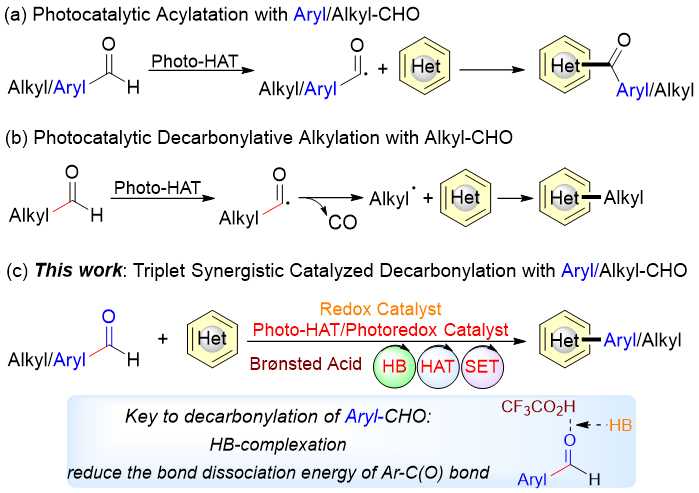
Scheme 1. Photocatalytic functionalization of heteroarenes with aldehydes.
| Entry | Photocata. | Acid | Redox cata. | Time (h) | Yield b (%) |
|---|---|---|---|---|---|
| 1 | w/o | w/o | w/o | 30 | 16 |
| 2 | Eosin Y | w/o | w/o | 30 | 29 |
| 3 | Eosin B | w/o | w/o | 30 | 25 |
| 4 | Rhodamine 6G | w/o | w/o | 30 | 27 |
| 5 | 4CzIPN | w/o | w/o | 30 | 20 |
| 6 | fac-Ir(ppy)3 | w/o | w/o | 30 | 19 |
| 7 | Ru(bpy)3Cl2 | w/o | w/o | 30 | trace |
| 8 | Eosin Y | TFA | w/o | 8 | 67 |
| 9 | Eosin Y | TCA | w/o | 8 | 61 |
| 10 | Eosin Y | AcOH | w/o | 8 | 58 |
| 11 | Eosin Y | HCO2H | w/o | 8 | 51 |
| 12 | Eosin Y | TFA | Cp2Fe | 8 | 88 |
| 13 | Eosin Y | TFA | NHPI | 8 | 82 |
| 14 | Eosin Y | TFA | Ph3N | 8 | 69 |
| 15 | Eosin Y | TFA | Fluorene | 8 | 77 |
| 16 | Eosin Y | TFA | DDQ | 8 | 62 |
| 17c | Eosin Y | TFA | Cp2Fe | 8 | 63 |
| 18d | Eosin Y | TFA | Cp2Fe | 8 | 72 |
| 19e | Eosin Y | TFA | Cp2Fe | 8 | 44 |
| 20 | w/o | w/o | Cp2Fe | 30 | 25 |
| 21 | w/o | TFA | w/o | 8 | 47 |
| 22f | Eosin Y | TFA | Cp2Fe | 30 | N.R. |
| 23g | Eosin Y | TFA | Cp2Fe | 30 | N.R. |
Table 1 Optimization conditions a.
| Entry | Photocata. | Acid | Redox cata. | Time (h) | Yield b (%) |
|---|---|---|---|---|---|
| 1 | w/o | w/o | w/o | 30 | 16 |
| 2 | Eosin Y | w/o | w/o | 30 | 29 |
| 3 | Eosin B | w/o | w/o | 30 | 25 |
| 4 | Rhodamine 6G | w/o | w/o | 30 | 27 |
| 5 | 4CzIPN | w/o | w/o | 30 | 20 |
| 6 | fac-Ir(ppy)3 | w/o | w/o | 30 | 19 |
| 7 | Ru(bpy)3Cl2 | w/o | w/o | 30 | trace |
| 8 | Eosin Y | TFA | w/o | 8 | 67 |
| 9 | Eosin Y | TCA | w/o | 8 | 61 |
| 10 | Eosin Y | AcOH | w/o | 8 | 58 |
| 11 | Eosin Y | HCO2H | w/o | 8 | 51 |
| 12 | Eosin Y | TFA | Cp2Fe | 8 | 88 |
| 13 | Eosin Y | TFA | NHPI | 8 | 82 |
| 14 | Eosin Y | TFA | Ph3N | 8 | 69 |
| 15 | Eosin Y | TFA | Fluorene | 8 | 77 |
| 16 | Eosin Y | TFA | DDQ | 8 | 62 |
| 17c | Eosin Y | TFA | Cp2Fe | 8 | 63 |
| 18d | Eosin Y | TFA | Cp2Fe | 8 | 72 |
| 19e | Eosin Y | TFA | Cp2Fe | 8 | 44 |
| 20 | w/o | w/o | Cp2Fe | 30 | 25 |
| 21 | w/o | TFA | w/o | 8 | 47 |
| 22f | Eosin Y | TFA | Cp2Fe | 30 | N.R. |
| 23g | Eosin Y | TFA | Cp2Fe | 30 | N.R. |
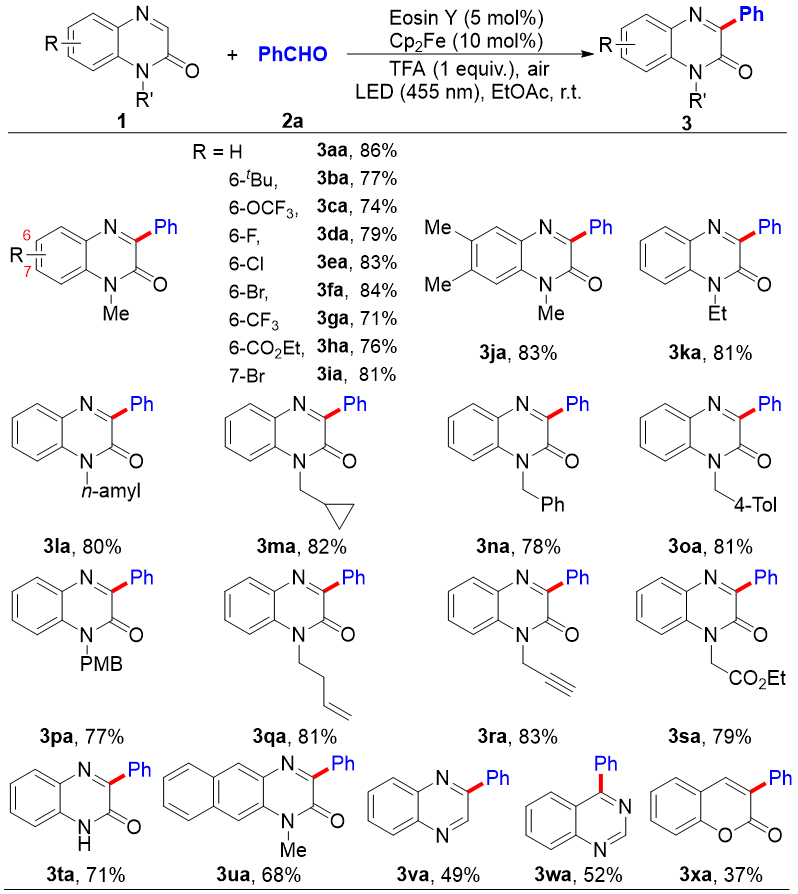 |
Table 2 Reaction scope of heteroarenes a,b,c.
| |
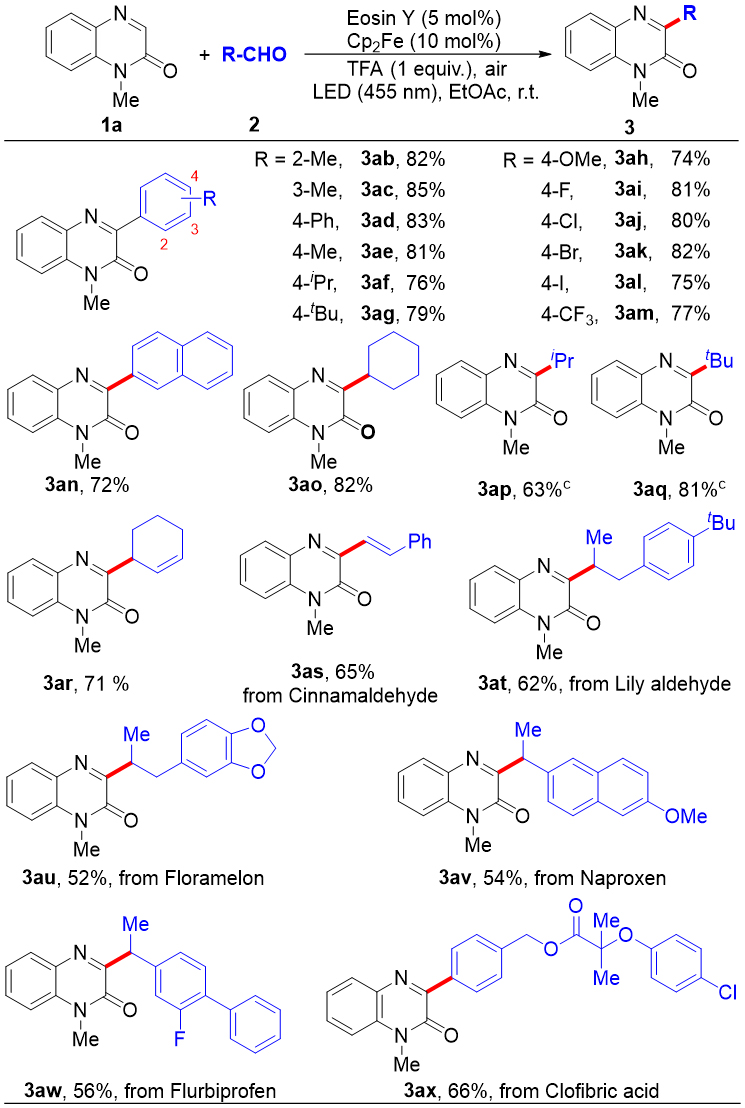 |
Table 3 Reaction scope of aldehydes a,b,c.
| |
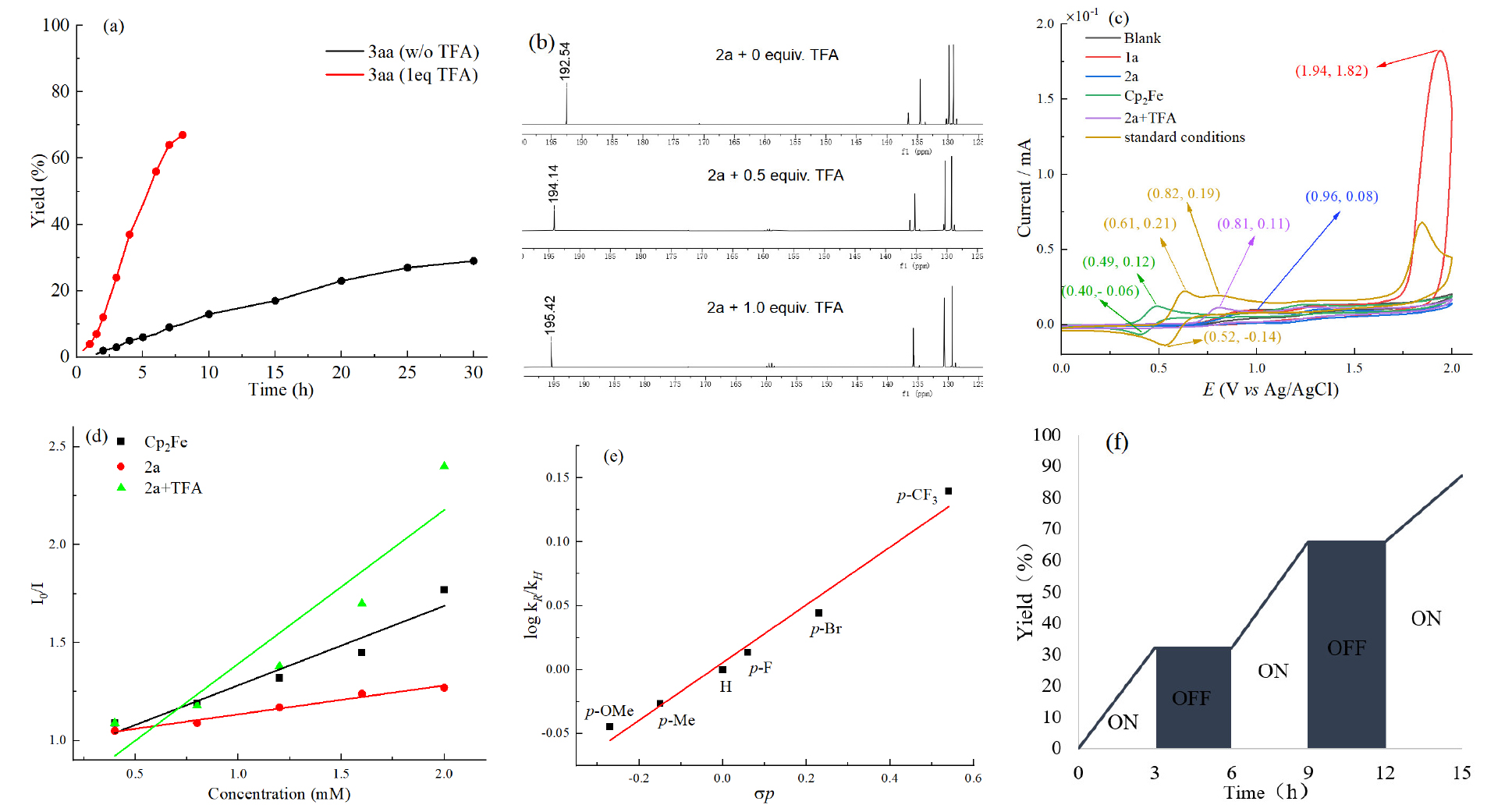
Fig. 1. (a) The effect of TFA. (b) 13C NMR titration experiments. (c) CV experiments. (d) The Stern-Volmer quenching plot. (e) Hammett correlation studies. (f) On/Off experiments.
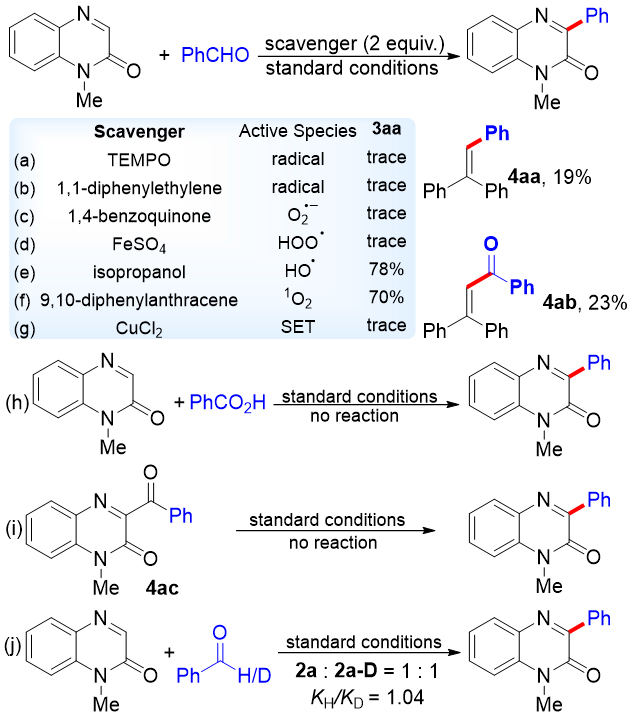
Scheme 2. Control experiments.
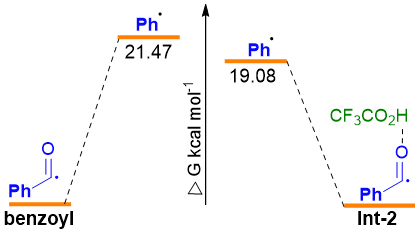
Scheme 3. DFT studies.
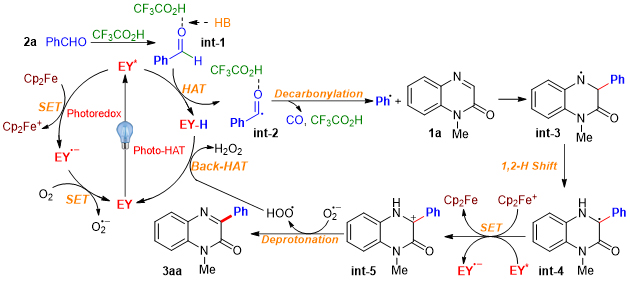
Scheme 4. Possible reaction mechanism.
|
| [1] | Wenxin He, Yuanhong Lu, Chenxi Guan, Xiaohui Hou, Rui Huang, Dehui Deng. Boehmite lattice hydroxyl-mediated selective hydrogenation of cinnamaldehyde via water as hydrogen source [J]. Chinese Journal of Catalysis, 2026, 87(8): 386-395. |
| [2] | Wei Wang, Bin Chen, Ting Li, Zhengchu Chen, Lei Yuan, Qiang Fu, Siping Wei, Xiao-Feng Wu, Dong Yi. Photoredox-catalyzed four-atom skeletal editing of 1,3-diketones with alkenes and aldehydes [J]. Chinese Journal of Catalysis, 2026, 82(3): 212-224. |
| [3] | Xing-Wei Gu, Youcan Zhang, Fengqian Zhao, Han-Jun Ai, Xiao-Feng Wu. Phosphine-catalyzed photo-induced alkoxycarbonylation of alkyl iodides with phenols and 1,4-dioxane through charge-transfer complex [J]. Chinese Journal of Catalysis, 2023, 48(5): 214-223. |
| [4] | Fulin Zhang, Xia Li, Xiaoyun Dong, Huimin Hao, Xianjun Lang. Thiazolo[5,4-d]thiazole-based covalent organic framework microspheres for blue light photocatalytic selective oxidation of amines with O2 [J]. Chinese Journal of Catalysis, 2022, 43(9): 2395-2404. |
| [5] | Zhenlong Zhao, Ji Bian, Lina Zhao, Hongjun Wu, Shuai Xu, Lei Sun, Zhijun Li, Ziqing Zhang, Liqiang Jing. Construction of 2D Zn-MOF/BiVO4 S-scheme heterojunction for efficient photocatalytic CO2 conversion under visible light irradiation [J]. Chinese Journal of Catalysis, 2022, 43(5): 1331-1340. |
| [6] | Muhammad Tayyab, Yujie Liu, Shixiong Min, Rana Muhammad Irfan, Qiaohong Zhu, Liang Zhou, Juying Lei, Jinlong Zhang. Simultaneous hydrogen production with the selective oxidation of benzyl alcohol to benzaldehyde by a noble-metal-free photocatalyst VC/CdS nanowires [J]. Chinese Journal of Catalysis, 2022, 43(4): 1165-1175. |
| [7] | Shaonan Zhang, Shi Cao, Yu-Mei Lin, Liyuan Sha, Cheng Lu, Lei Gong. Photocatalyzed site-selective C(sp3)‒H sulfonylation of toluene derivatives and cycloalkanes with inorganic sulfinates [J]. Chinese Journal of Catalysis, 2022, 43(3): 564-570. |
| [8] | Jiaqi Wang, Hao Cheng, Dingqiong Wei, Zhaohui Li. Ultrasonic-assisted fabrication of Cs2AgBiBr6/Bi2WO6 S-scheme heterojunction for photocatalytic CO2 reduction under visible light [J]. Chinese Journal of Catalysis, 2022, 43(10): 2606-2614. |
| [9] | Feiyue Ge, Shuquan Huang, Jia Yan, Liquan Jing, Feng Chen, Meng Xie, Yuanguo Xu, Hui Xu, Huaming Li. Sulfur promoted n-π* electron transitions in thiophene-doped g-C3N4 for enhanced photocatalytic activity [J]. Chinese Journal of Catalysis, 2021, 42(3): 450-459. |
| [10] | Huimin Liu, Xianguang Meng, Weiwei Yang, Guixia Zhao, Dehua He, Jinhua Ye. Photo-thermal CO2 reduction with methane on group VIII metals: In situ reduced WO3 support for enhanced catalytic activity [J]. Chinese Journal of Catalysis, 2021, 42(11): 1976-1982. |
| [11] | Chen Zhao, Zhihua Wang, Xi Chen, Hongyu Chu, Huifen Fu, Chong-Chen Wang. Robust photocatalytic benzene degradation using mesoporous disk-like N-TiO2 derived from MIL-125(Ti) [J]. Chinese Journal of Catalysis, 2020, 41(8): 1186-1197. |
| [12] | Shunji Xie, Haikun Zhang, Guodong Liu, Xuejiao Wu, Jinchi Lin, Qinghong Zhang, Ye Wang. Tunable localized surface plasmon resonances in MoO3-x-TiO2 nanocomposites with enhanced catalytic activity for CO2 photoreduction under visible light [J]. Chinese Journal of Catalysis, 2020, 41(7): 1125-1131. |
| [13] | Ning Li, Hang Gao, Xin Wang, Sujun Zhao, Da Lv, Guoqing Yang, Xueyun Gao, Haikuan Fan, Yangqin Gao, Lei Ge. Novel indirect Z-scheme g-C3N4/Bi2MoO6/Bi hollow microsphere heterojunctions with SPR-promoted visible absorption and highly enhanced photocatalytic performance [J]. Chinese Journal of Catalysis, 2020, 41(3): 426-434. |
| [14] | Lijie Xu, Lanyue Qi, Yang Sun, Han Gong, Yiliang Chen, Chun Pei, Lu Gan. Mechanistic studies on peroxymonosulfate activation by g-C3N4 under visible light for enhanced oxidation of light-inert dimethyl phthalate [J]. Chinese Journal of Catalysis, 2020, 41(2): 322-332. |
| [15] | Peidong Su, Junke Zhang, Ke Xiao, Shen Zhao, Ridha Djellabi, Xuewei Li, Bo Yang, Xu Zhao. C3N4 modified with single layer ZIF67 nanoparticles for efficient photocatalytic degradation of organic pollutants under visible light [J]. Chinese Journal of Catalysis, 2020, 41(12): 1894-1905. |
| Viewed | ||||||
|
Full text |
|
|||||
|
Abstract |
|
|||||


