
Chinese Journal of Catalysis ›› 2026, Vol. 90: 184-196.DOI: 10.1016/S1872-2067(26)65183-2
• Articles • Previous Articles Next Articles
Xiao Zhanga,b,1, Yuxin Wangb,1, Shuhan Sunb, Xianqiang Xiongb,c,*( ), Qin Lia, Kangle Lva,*()
Received:2026-01-27
Accepted:2026-04-01
Online:2026-11-05
Published:2026-09-09
About author:First author contact:1Contributed equally to this work.
Supported by:Xiao Zhang, Yuxin Wang, Shuhan Sun, Xianqiang Xiong, Qin Li, Kangle Lv. Charge-photothermal-catalysis synergy in ZnCdS/Co2SnO4 for enhanced photocatalytic hydrogen evolution and benzyl alcohol oxidation[J]. Chinese Journal of Catalysis, 2026, 90: 184-196.
Add to citation manager EndNote|Ris|BibTeX
URL: https://www.cjcatal.com/EN/10.1016/S1872-2067(26)65183-2
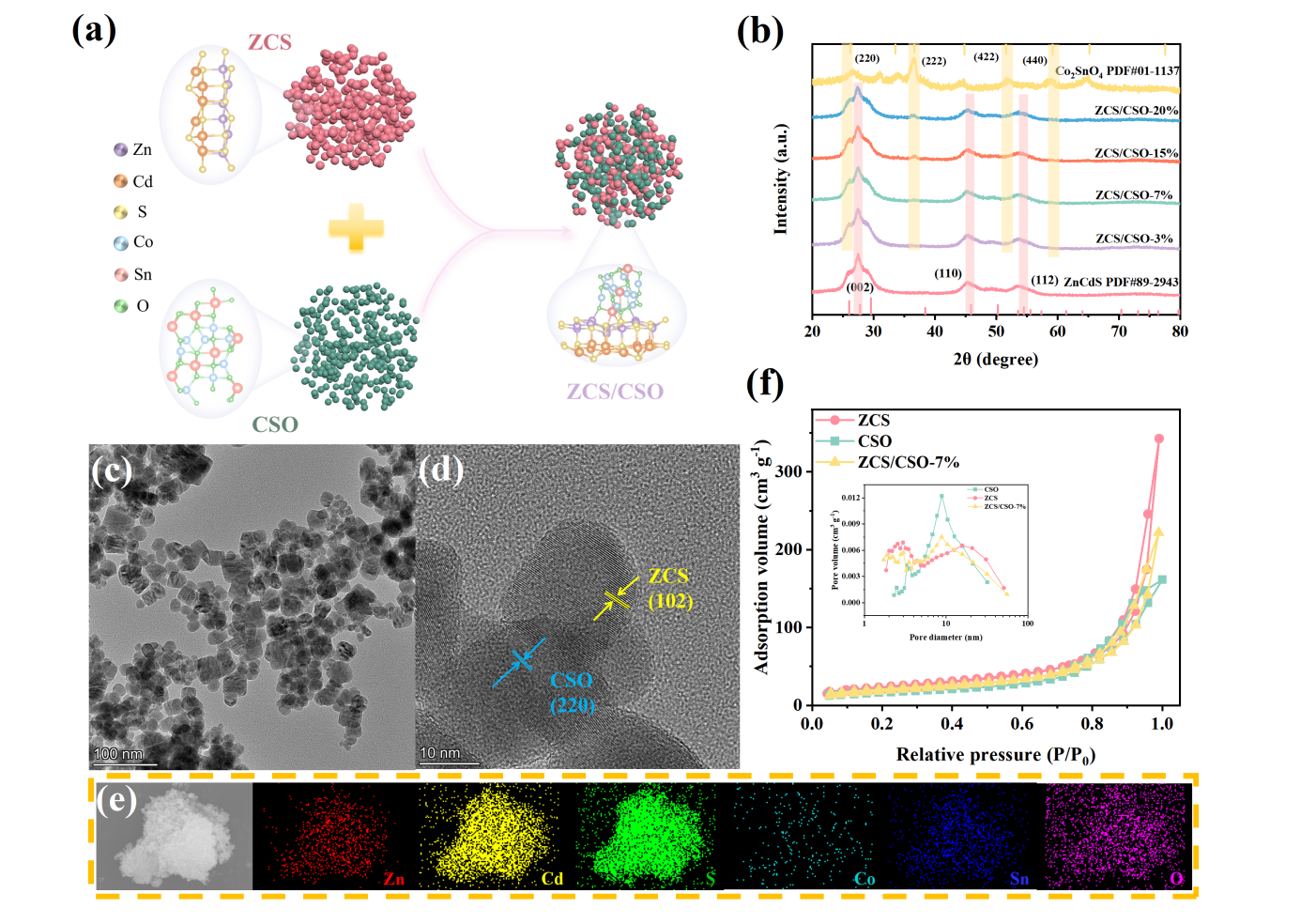
Fig. 1. (a) Schematic of heterojunction preparation procedure. (b) XRD patterns of ZCS, CSO, and ZCS/CSO-x% heterojunction. TEM (c) and HRTEM (d) images of ZCS/CSO-7%. (e) Elemental mapping images of ZCS/CSO-7% composite. (f) N2 physisorption isotherms of ZCS, CSO, and ZCS/CSO-7% heterojunction.
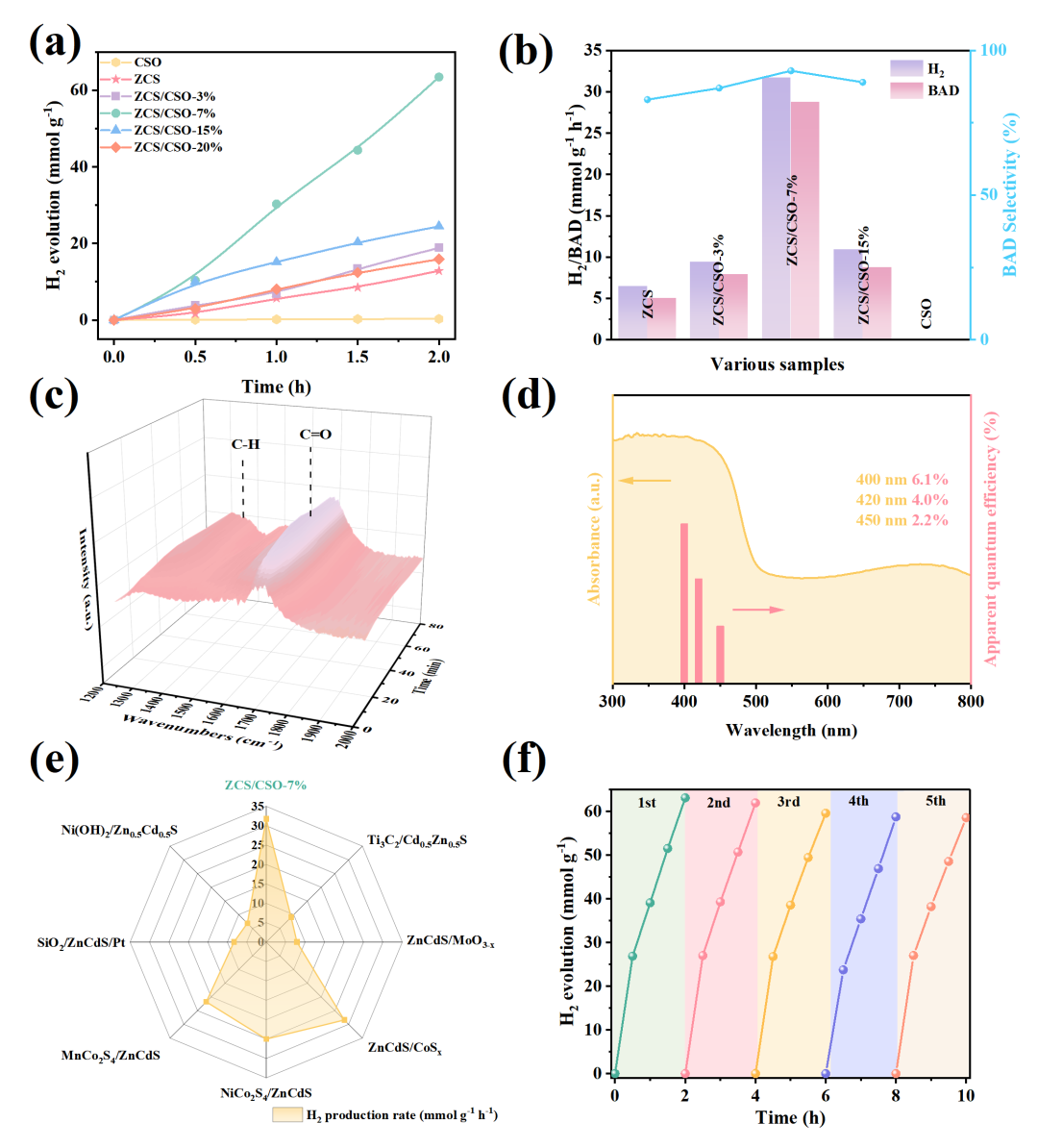
Fig. 2. (a) Time-course profile of H2 production. (b) Production rate of H2 and BAD along with selectivity for BAD. (c) Probing the reaction pathway via in-situ DRIFTS during BA oxidation. (d) AQE across different wavelengths. (e) Benchmarking H2 evolution activity against reported ZCS composites (data in Table S2). (f) Testing the photocatalytic stability through recycling runs.
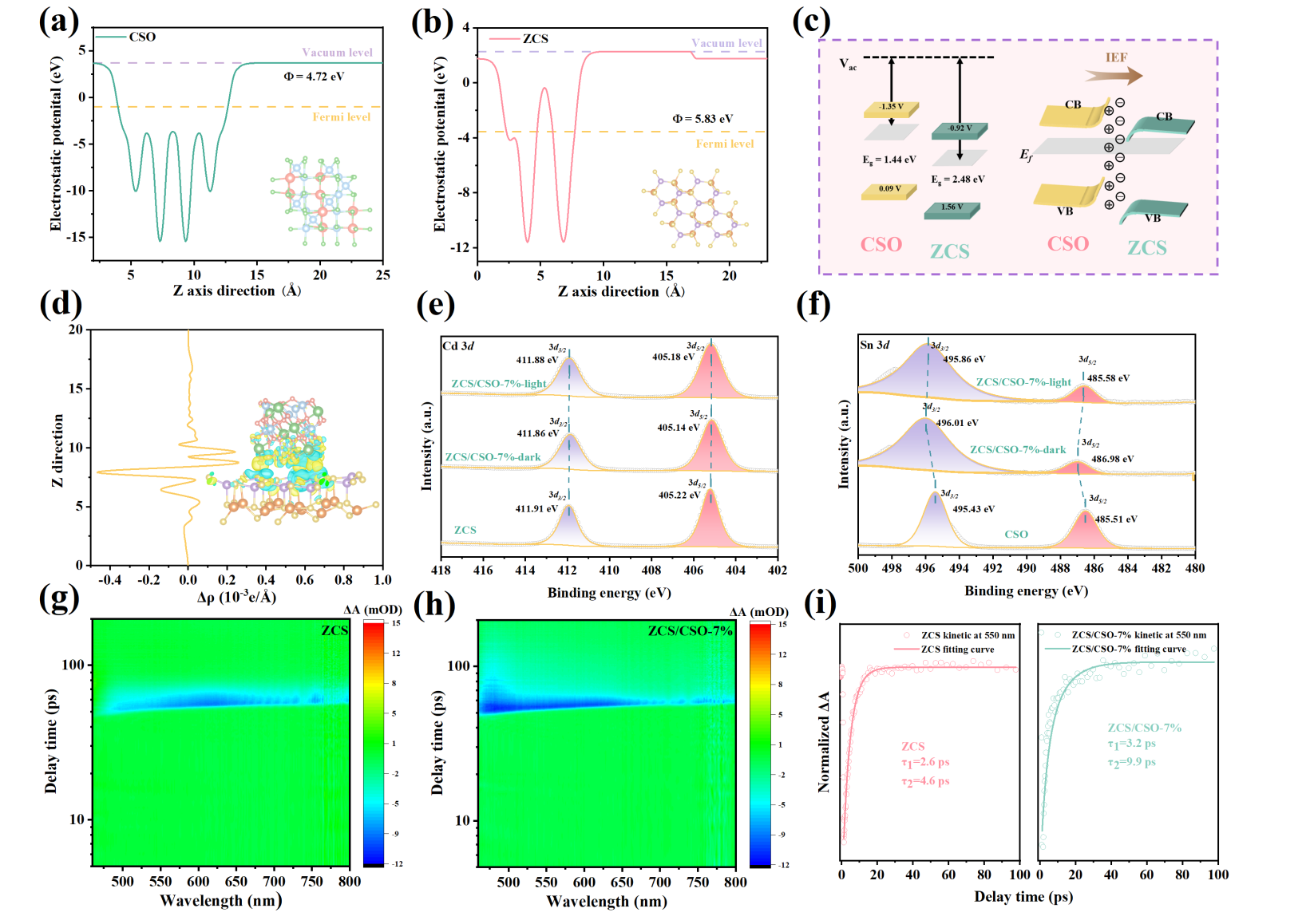
Fig. 3. Calculated work functions for CSO (a) and ZCS (b). Deduced energy band alignment (c) and charge density difference (d) for the ZCS/CSO-7% composite. High-resolution XPS and in-situ irradiated high-resolution XPS spectra of CSO, ZCS, and ZCS/CSO-7% samples: Cd 3d (e) and Sn 3d (f). 2D TA spectra (g,h) and kinetics decay traces (i) probed at 550 nm for ZCS and ZCS/CSO-7%, respectively.
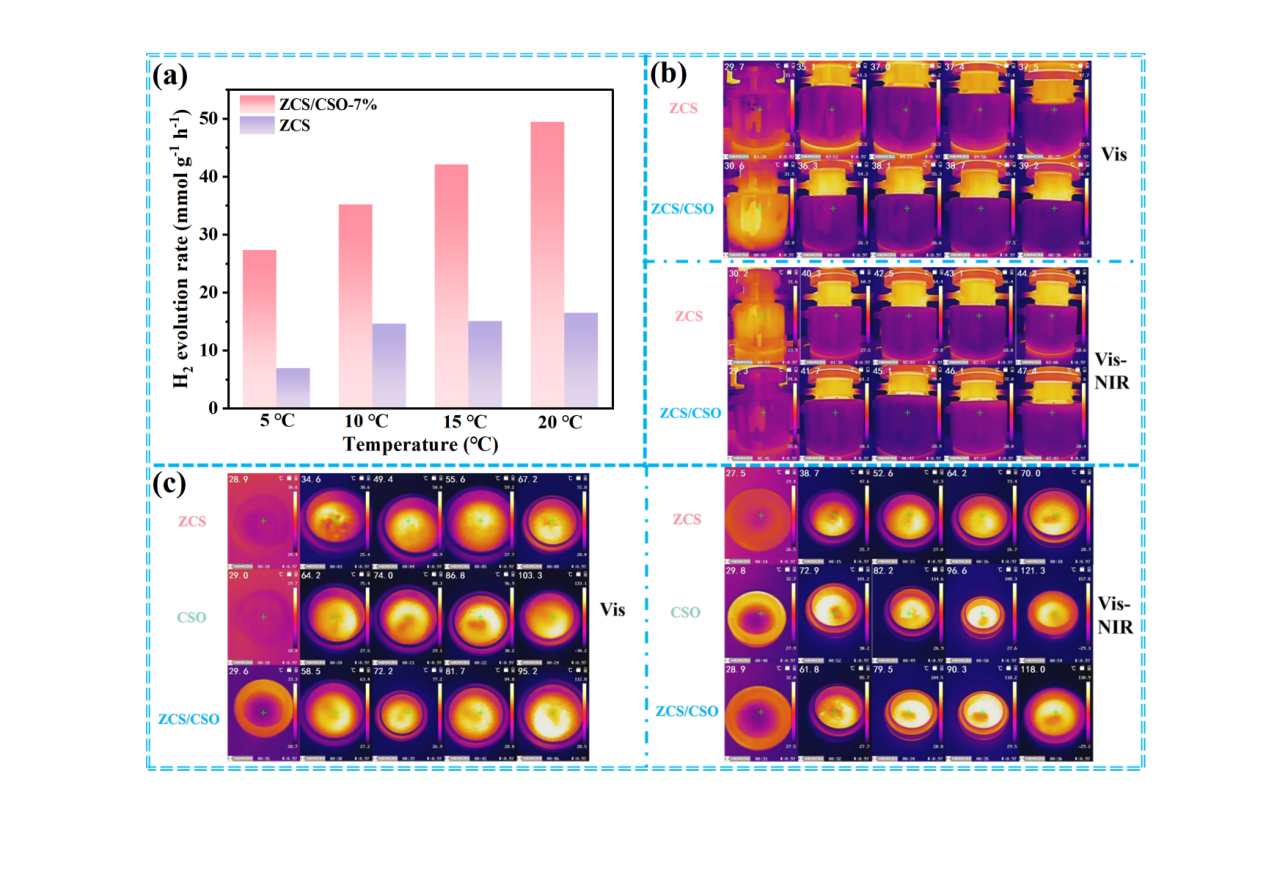
Fig. 4. (a) Photocatalytic H2 generation curves at various temperatures. (b) Infrared thermal images comparing ZCS and the ZCS/CSO-7% composite under visible (Vis) and full-spectrum (Vis-NIR) irradiation during HER testing. (c) Recording the temperature evolution and distribution through thermal mapping under different light sources (Vis and Vis-NIR).
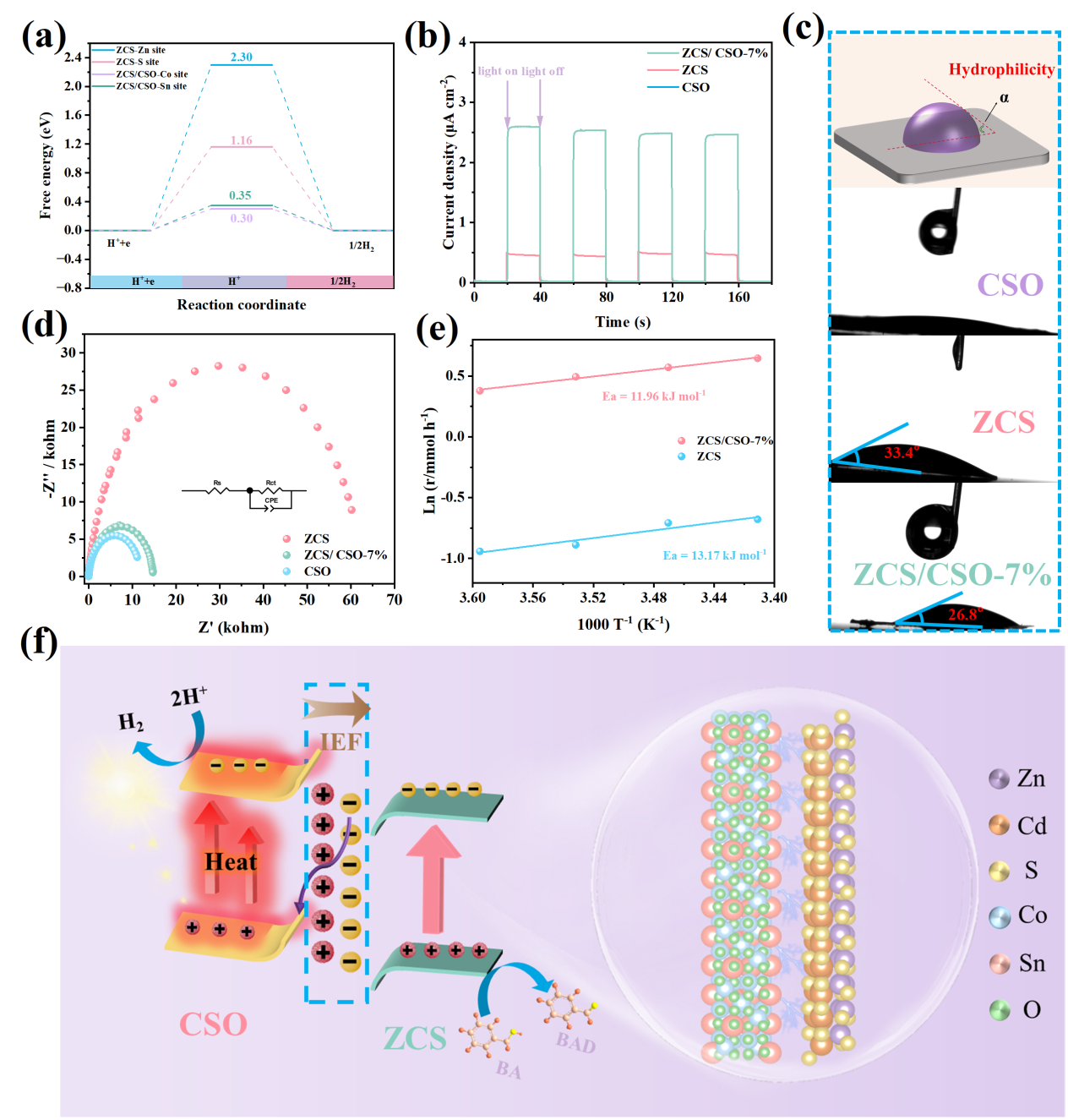
Fig. 5. (a) Presenting the DFT-calculated hydrogen adsorption free energy profile. (b) Transient photocurrent response curves of ZCS, CSO, and ZCS/CSO-7%. (c) Measuring surface wettability via contact angles. (d) EIS spectra. (e) Temperature dependence of H2 evolution rates and comparison of apparent activation energies for ZCS and ZCS/CSO-7%. (f) Illustrating the proposed synergistic photocatalytic mechanism.
|
| [1] | Xiaolong Ma, Zhiqiang Wu, Huiqin Yao, Bin Liu, Zhiliang Jin, Paolo Fornasiero. Charging dynamics engineering: Quantum dots-induced full-space electric field cooperative Ag2S QDs/CoWO₄ S-scheme heterojunction boosting photocatalytic hydrogen evolution [J]. Chinese Journal of Catalysis, 2026, 88(9): 233-246. |
| [2] | Gaoxiong Liu, Rundong Chen, Bingquan Xia, Xianlong Zhou, Laiquan Li, Shantang Liu. Thiadiazole-functionalized covalent triazine frameworks for constructing S-scheme heterojunctions enabling boosted H2O2 photosynthesis [J]. Chinese Journal of Catalysis, 2026, 87(8): 170-184. |
| [3] | Hao Wu, Xinyu Zeng, Wang Wang, Bei Cheng, Jingzhao Cheng, Jingsan Xu, Shaowen Cao. The organic-inorganic S-scheme heterojunction with enhanced charge separation simultaneously catalyze the production of hydrogen and imine [J]. Chinese Journal of Catalysis, 2026, 87(8): 185-196. |
| [4] | Heng Zhou, Longfei Hong, Yan Zhang, Yuyue Zhou, Sheng Chu, Huiyan Zhang, Hui Li, Tianyi Ma, Heng Zhang. Efficient solar-simulated-driven valorization of non-edible oils for biodiesel production via interfacial localized photothermal catalysis [J]. Chinese Journal of Catalysis, 2026, 87(8): 156-169. |
| [5] | Shijie Li, Rui Li, Yanping Liu, Xin Yu, Deyun Ma, Jianhui Jiang, Xiaosong Zhou, Chunqiang Zhuang, Zaiwang Zhao, Wei Jiang. Augmented reactive oxygen species generation in Ag/AgBr/C3N5 via LSPR-enhanced S-scheme charge transfer for efficient photocatalytic antibiotic wastewater remediation [J]. Chinese Journal of Catalysis, 2026, 87(8): 126-139. |
| [6] | Yang Ding, Yizhen Lu, Tianrong Yu, Mingrui Zhang, Rui Zhao, Ruijie Yang, Qixin Li, Shiqun Wu, Jinlong Zhang. Dual pathways in photo-driven Fischer-Tropsch synthesis for high selective hydrocarbon production [J]. Chinese Journal of Catalysis, 2026, 87(8): 22-46. |
| [7] | Mingyu Ma, Zongyang Liu, Kuo Yuan, Zheyuan Liu, Jiaxin Wang, Qingqing Lin, Di-Chang Zhong, Tong-Bu Lu. Self-photosensitizing metal complexes for photocatalytic hydrogen evolution [J]. Chinese Journal of Catalysis, 2026, 86(7): 375-383. |
| [8] | Hanxi Li, Zhendong Luo, Qiang Xue, Yunfei Zhi, Jun Du, Xukai Zhou. Engineering channel microenvironment and charge dynamics in covalent organic frameworks through linkage-specific povarov cyclization for enhanced photocatalytic hydrogen evolution [J]. Chinese Journal of Catalysis, 2026, 86(7): 363-374. |
| [9] | Yatai Zhou, Chengcheng Yuan, Wei Xia, Jun Wang, Xiaofeng Zhu, Yong Zhang, Bicheng Zhu, Jiaguo Yu. Synergistic optimization of interfacial electron transfer and surface hydrogen adsorption in a CdS/ZnO S-scheme heterojunction by site-specific doping: A DFT study [J]. Chinese Journal of Catalysis, 2026, 86(7): 327-337. |
| [10] | Ping Li, Liang Wei, Wei Xia, Chengcheng Yuan, Chenbin Ai, Meng Li. Ultrafast electron transfer in 2D/2D g-C3N4/WO3 S-scheme heterojunctions for enhanced H2O2 production [J]. Chinese Journal of Catalysis, 2026, 85(6): 333-345. |
| [11] | Jintao Dong, Rui Zhang, Zhishuai Wang, Shengqun Cao, Lina Li, Gaopeng Liu, Bin Wang, Yixuan Gao, Jiexiang Xia. Construction of S-scheme MnO2/BiOCl heterojunction boosting photocatalytic low-concentration peroxymonosulfate activation for contaminants removal [J]. Chinese Journal of Catalysis, 2026, 85(6): 310-321. |
| [12] | Ziyi Liao, Lan Jiang, Yang Yang, Lin Wang, Weiyou Yang, Huilin Hou. Alkali-cyano dual-tailored g-C3N4/BiOCl S-scheme heterojunctions for highly efficient visible-light-driven H2O2 photosynthesis in pure water [J]. Chinese Journal of Catalysis, 2026, 83(4): 143-161. |
| [13] | Hongwen Zhang, Yinghui Cai, Bingyue Li, Wei Shan, Hua Tang. Isolated Cu atoms and CuO nanoclusters synergistically boost hydrogen evolution over TiO2 [J]. Chinese Journal of Catalysis, 2026, 83(4): 162-171. |
| [14] | Changjun You, Yuqi Ren, Hongbin He, Ruoxuan Peng, Yuan-Hao Zhu, Miao Cheng, Peigen Ding, Liuna Zhang, Shengnan Lan, Hongyang Zhang, Yiqin Zhang, Fengfan Zhu, Jing Li, Jiancheng Zhou. Dual-site atomic engineering of Ru Single-atoms and Ni clusters on CeO2 nanorods for solar-driven CO2 methanation [J]. Chinese Journal of Catalysis, 2026, 83(4): 183-197. |
| [15] | Mang Zheng, Qi Li, Qianxi Liu, Huiquan Gu, Mingyang Liu, Qi Liu, Baojiang Jiang. Asymmetric oxygen-bridged Bi-In dual sites for efficient photothermal CO2 methanation [J]. Chinese Journal of Catalysis, 2026, 83(4): 351-362. |
| Viewed | ||||||
|
Full text |
|
|||||
|
Abstract |
|
|||||


