
Chinese Journal of Catalysis ›› 2026, Vol. 91: 147-162.DOI: 10.1016/S1872-2067(26)65205-9
• Articles • Previous Articles Next Articles
Kexin Maa, Mifeng Xuea, Yuhan Wangb,*( ), Maohong Fanc,d, Lixia Linga, Riguang Zhanga,*()
Received:2026-01-08
Accepted:2026-04-14
Online:2026-12-18
Published:2026-10-13
Supported by:Kexin Ma, Mifeng Xue, Yuhan Wang, Maohong Fan, Lixia Ling, Riguang Zhang. Unraveling the surface structural evolution and single-atom doping effect in CO2-assisted ethane dehydrogenation over TiO2-based catalysts[J]. Chinese Journal of Catalysis, 2026, 91: 147-162.
Add to citation manager EndNote|Ris|BibTeX
URL: https://www.cjcatal.com/EN/10.1016/S1872-2067(26)65205-9
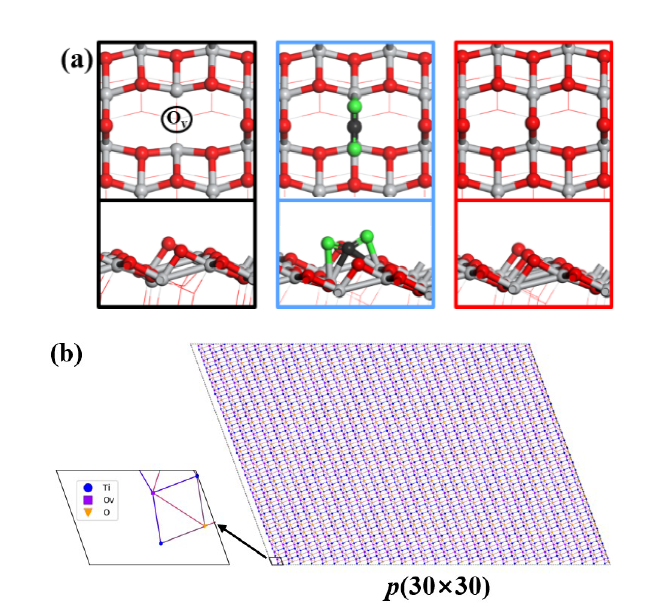
Fig. 1. (a) Top and side views for the optimized configurations of TiO2-Ov, CO2-TiO2 and TiO2 catalysts (lattice O atoms: red balls, Ti atoms: grey balls, adsorbed CO2: (O atoms: green balls, C atoms: black balls)). (b) The lattice of TiO2-Ov catalyst (Ti: blue circles, Ov: purple squares, O: yellow triangles).
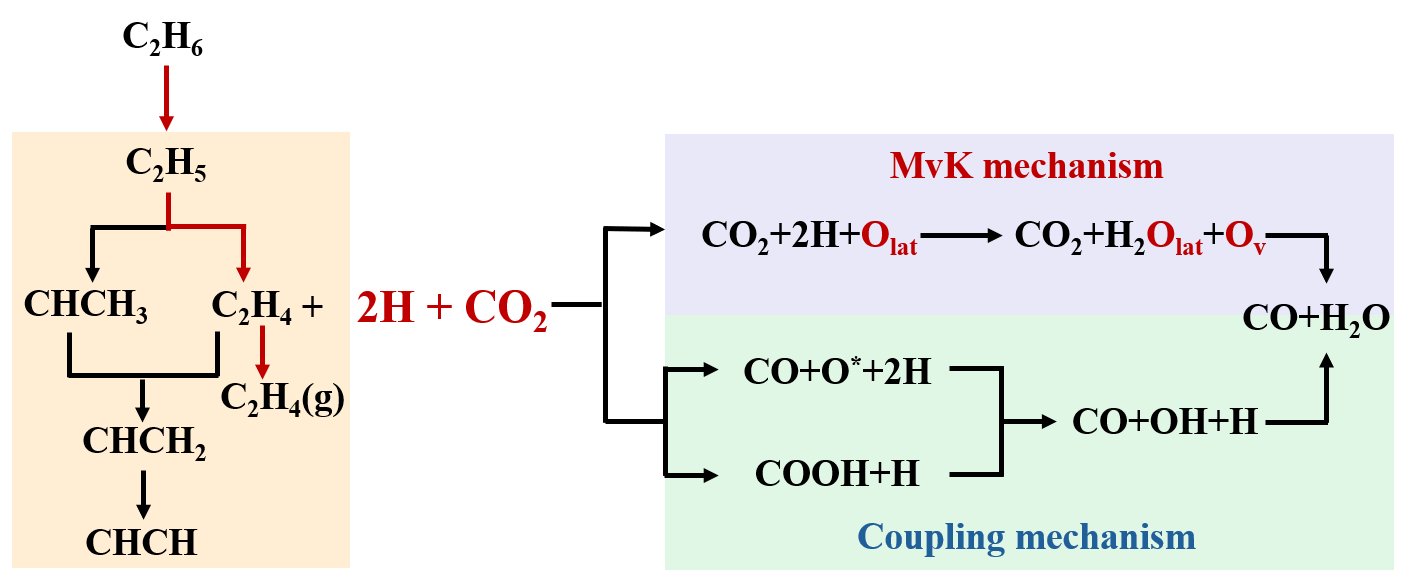
Fig. 2. The reaction network of CO2-ODHE over TiO2 and M-TiO2 catalysts. The left side illustrates the ethane dehydrogenation pathway, including the main reaction forming the target product C2H4(g) and the side reaction of deep dehydrogenation to CHCH(g). The right side depicts two distinct pathways for the consumption of surface H* by CO2.
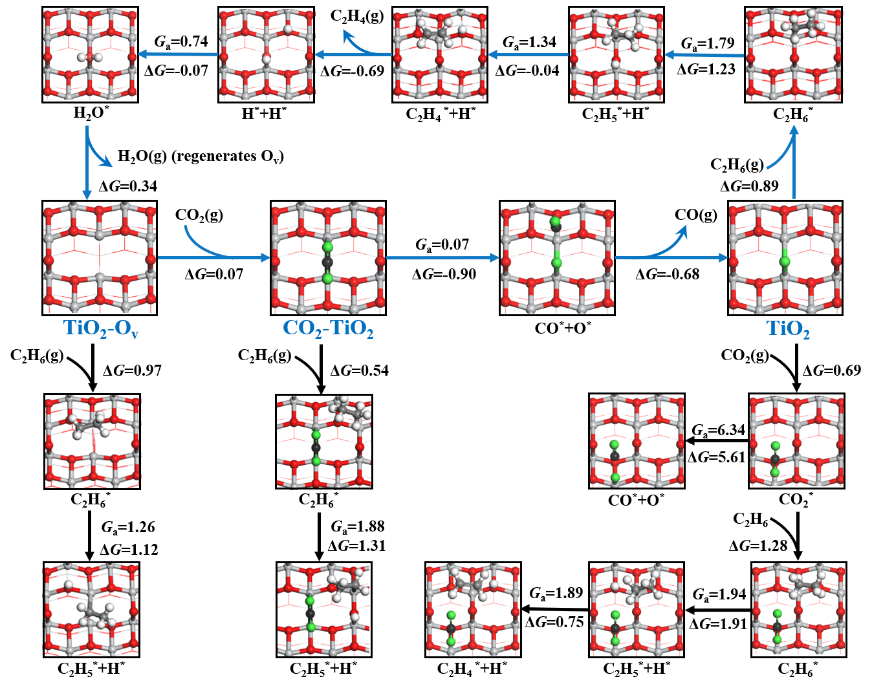
Fig. 3. TiO2 structure evolution process involved in CO2-ODHE over TiO2 catalyst under the condition of C2H6(g) and CO2(g) co-feeding. The numerical values correspond to the activation free energy (Ga, eV) and reaction free energy (ΔG, eV). The blue path represents the entire cycle process on the catalyst, and the black path represents side reactions. Lattice O atoms: red balls, Ti atoms: grey balls, H atoms: white balls, C atoms: black balls, and adsorbed CO2: (O atoms: green balls, C atoms: black balls).
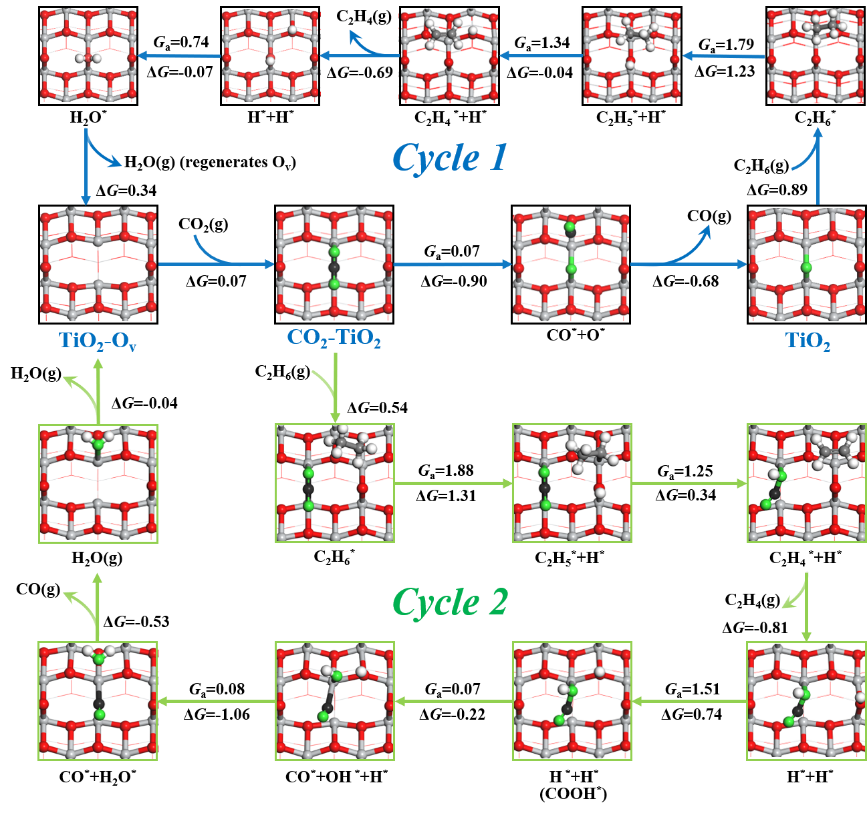
Fig. 4. Cycle 1 (blue) depicts the MvK redox cycle on the TiO2 catalyst, involving ethane dehydrogenation (lattice oxygen consumption) and CO2 dissociation (oxygen vacancy replenishment). Cycle 2 (green) corresponds to the coupling mechanism of ethane dehydrogenation and the RWGS reaction occurring on the metastable CO2-TiO2 surface. The numerical values correspond to the activation free energy (Ga, eV) and reaction free energy (ΔG, eV).
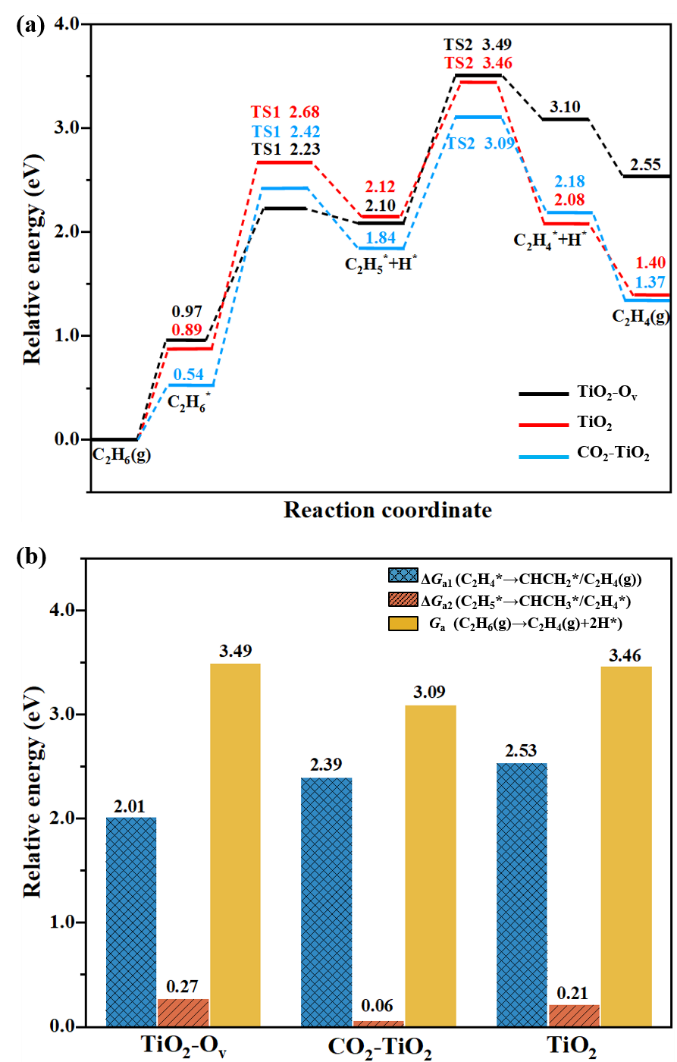
Fig. 5. (a) Free energy profiles of ethane dehydrogenation over TiO2-Ov, CO2-TiO2 and TiO2 catalysts at 873 K. * and (g) represent the adsorbed and gaseous states, respectively. (b) The overall energy barrier of the reaction C2H6(g) → C2H4(g), and free energy difference between C2H4(g) and CHCH2* formation, as well as that between C2H4* and CHCH3* formation at 873 K over three catalysts.
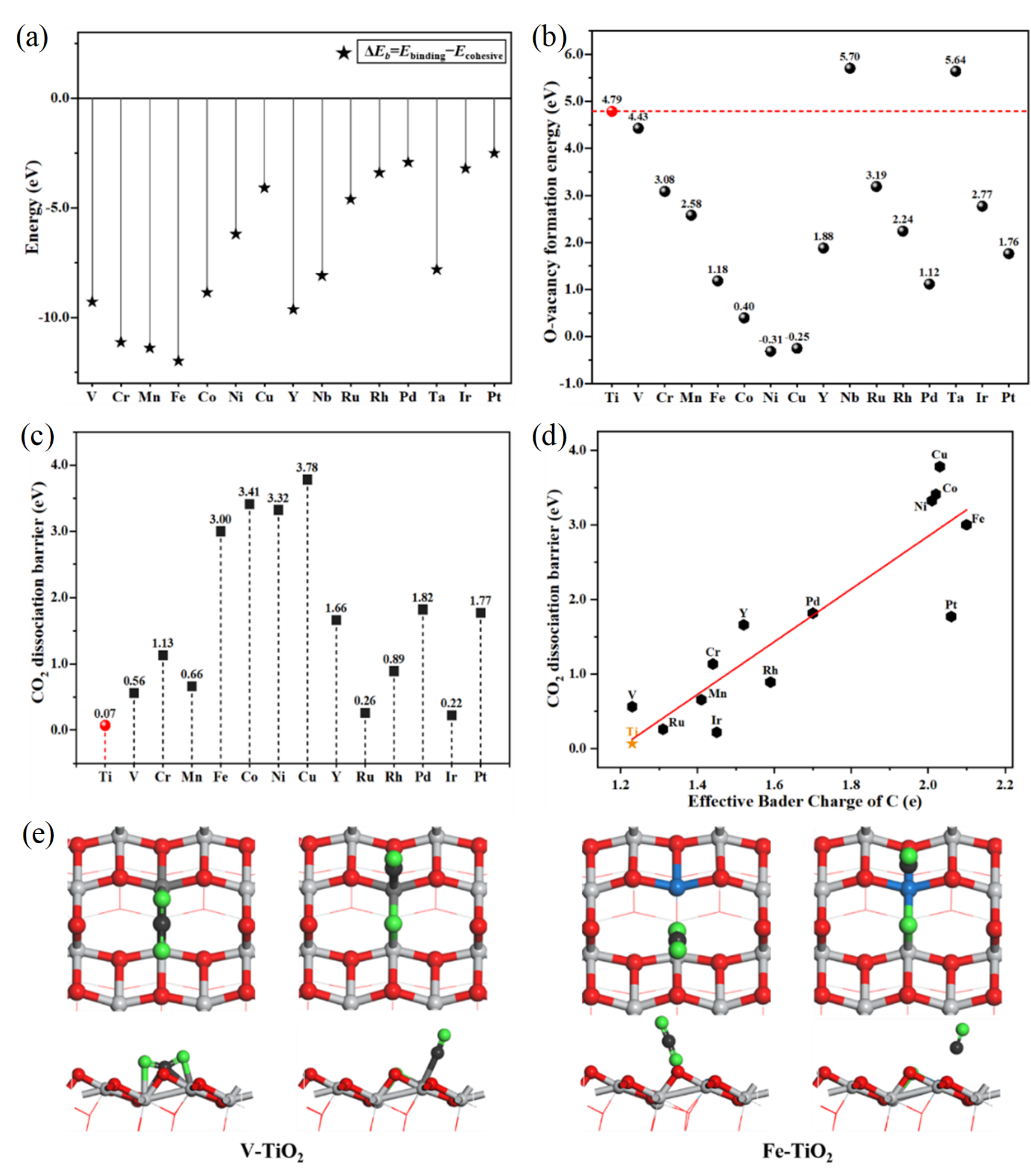
Fig. 6. (a) Energy difference ΔEb=Ebinding-Ecohesive for M-TiO2 catalysts. Ebinding is the binding energy of the single M atom over M-TiO2 catalysts, and Ecohesive is the average cohesive energy of the corresponding bulk metal. (b) The oxygen-vacancy formation energy of M-TiO2 catalysts. (c) The CO2 dissociation energy of M-TiO2 catalysts. (d) Relationship of Bader charge transfer of C atom with CO2 dissociation energy over M-TiO2 catalysts. (e) Top and side views of the initial and final states for CO2 dissociation on M-TiO2-Ov surfaces, illustrating the distinct bent (e.g., on V-doped) and linear (e.g., on Fe-doped) adsorption configurations.
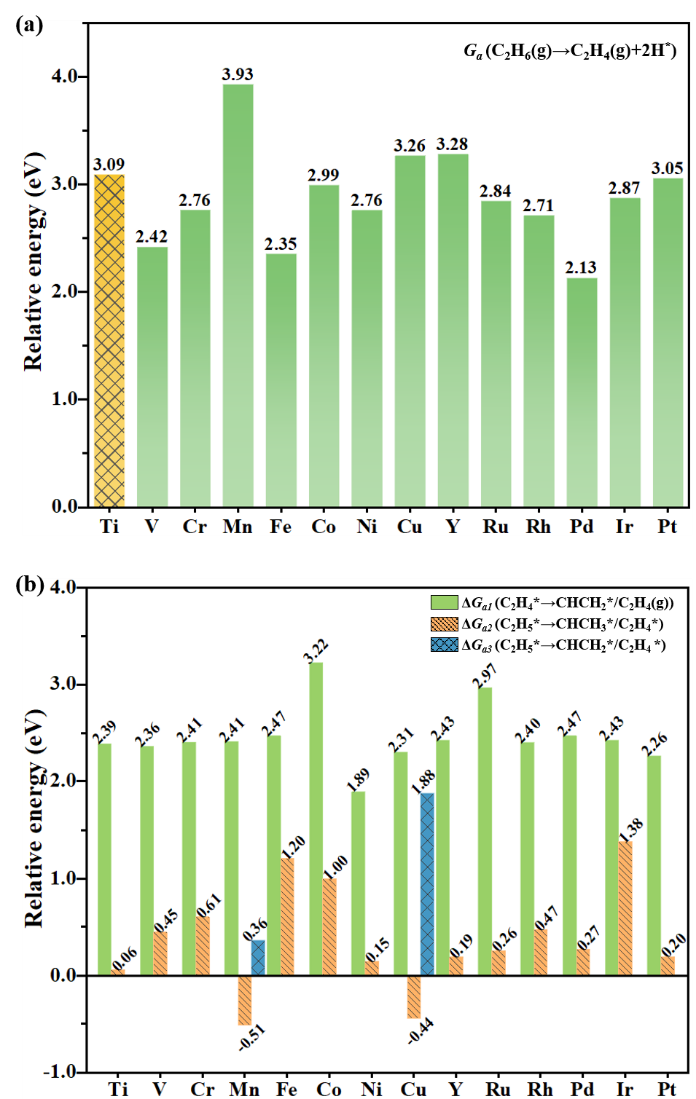
Fig. 7. (a) The overall energy barrier of the reaction C2H6(g)→C2H4(g) over TiO2-Ov and M-TiO2-Ov catalysts at 873.15 K. (b) Free energy difference between C2H4(g) and CHCH2* formation, as well as that between C2H4* and CHCH3* formation over M-TiO2-Ov catalysts at 873.15 K.

Fig. 8. (a) C2H4(g) formation activity and selectivity over TiO2-Ov and M-TiO2-Ov catalysts at 873.15 K with a C2H6/CO2 feed ratio of 1:1. (b) Relationship between C2H4(g) formation activity (logTOF, s-1) and the H* + H* adsorption energy (Eads(H* + H*), eV) over M-TiO2-Ov catalysts. (c) Relationship between Eads(H* + H*) and the effective Bader charge on the C atom of adsorbed CO2 over M-TiO2-Ov catalysts. (d) Effect of temperature on C2H4(g) formation activity and selectivity over Pd-TiO2-Ov catalyst at the fixed C2H6(g)/CO2(g) feed ratio of 1:1. (e) Effect of C2H6(g)/CO2(g) feed ratio at the fixed temperature 873.15 K on catalytic performance. (f) Comparative C2H4(g) formation activity of 13 M-TiO2-Ov catalysts under O2 versus CO2 atmospheres.
| Catalyst | Feed ratio (C2:CO2: inert gas) | T (K) | Conversion (%) | Sel. (%) | Ref. |
|---|---|---|---|---|---|
| Experimental study | |||||
| NiFe/CeO2 | 1: 1: 2 | 873 | 4.6 | 83 | [ |
| 1 wt% Co/S-1 | 1: 1: 3 | 923 | 20 | 84 | [ |
| Ga2O3 | 3: 15: 82 | 923 | 13 | 87.4 | [ |
| PdFe(1: 9)/CeO2 | 1: 1: 2 | 873 | 6.6 | 85.8 | [ |
| PdGa3/CeO2 | 1: 1: 2 | 873 | 0.4 | 95.5 | [ |
| PdIn3/CeO2 | 1: 1: 2 | 873 | 3.1 | 89 | [ |
| PtCe@MZ | 2: 1: 17 | 873 | 34 | 94 | [ |
| Fe-10%/SiO2 | 1: 2: 1 | 923 | 18.9 | 99.0 | [ |
| Fe-ZrO2 | 1: 1: 3 | 923 | 9 | 85 | [ |
| Catalyst | Feed composition | T (K) | TOF (s-1) | Sel. (%) | Ref. |
| Theoretical study | |||||
| Pt(111) | 0.2 bar C2H6 | 873 | 1.60 × 10³ | 93.4 | [ |
| Pt3Sn(111) | 0.2 bar C2H6 | 873 | 1.00 × 10² | 100.0 | [ |
| Fe3O4-B2 | C2H6:CO2=1: 1 | 873 | 2.14 × 10³ | — | [ |
| Pd-TiO2 | C2H6:CO2=1: 1 | 873 | 4.33 × 10⁴ | 99.9 | This work |
Table 1 Comparisons of C2H4(g) production activity and selectivity in this work with those over different types of catalysts previously reported in C2H6(g) dehydrogenation.
| Catalyst | Feed ratio (C2:CO2: inert gas) | T (K) | Conversion (%) | Sel. (%) | Ref. |
|---|---|---|---|---|---|
| Experimental study | |||||
| NiFe/CeO2 | 1: 1: 2 | 873 | 4.6 | 83 | [ |
| 1 wt% Co/S-1 | 1: 1: 3 | 923 | 20 | 84 | [ |
| Ga2O3 | 3: 15: 82 | 923 | 13 | 87.4 | [ |
| PdFe(1: 9)/CeO2 | 1: 1: 2 | 873 | 6.6 | 85.8 | [ |
| PdGa3/CeO2 | 1: 1: 2 | 873 | 0.4 | 95.5 | [ |
| PdIn3/CeO2 | 1: 1: 2 | 873 | 3.1 | 89 | [ |
| PtCe@MZ | 2: 1: 17 | 873 | 34 | 94 | [ |
| Fe-10%/SiO2 | 1: 2: 1 | 923 | 18.9 | 99.0 | [ |
| Fe-ZrO2 | 1: 1: 3 | 923 | 9 | 85 | [ |
| Catalyst | Feed composition | T (K) | TOF (s-1) | Sel. (%) | Ref. |
| Theoretical study | |||||
| Pt(111) | 0.2 bar C2H6 | 873 | 1.60 × 10³ | 93.4 | [ |
| Pt3Sn(111) | 0.2 bar C2H6 | 873 | 1.00 × 10² | 100.0 | [ |
| Fe3O4-B2 | C2H6:CO2=1: 1 | 873 | 2.14 × 10³ | — | [ |
| Pd-TiO2 | C2H6:CO2=1: 1 | 873 | 4.33 × 10⁴ | 99.9 | This work |
|
| [1] | Miao Wang, Tianyu Shen, Heng Zhou, Shuaikang Yang, Fengkun Hao, Chaohui Wang, Mohan Kumar, Zuoxiu Tie, Shuangming Chen, Zhanxi Fan, Zhong Jin. Direct electrosynthesis of ammonia from nitrate reduction using atomically precise carbonyl-rich metal clusters in neutral media [J]. Chinese Journal of Catalysis, 2026, 88(9): 259-268. |
| [2] | Jiaxiang Qin, Songpei Zhang, Xingju Li, Xintai Chen, Jia Zhao, Xiaoling Mou, Xiangen Song, Li Yan, Ronghe Lin, Yunjie Ding. Decoding structure-selectivity interplay in Pd-Ag nanocatalysts for butadiene semi-hydrogenation [J]. Chinese Journal of Catalysis, 2026, 87(8): 342-352. |
| [3] | Zhaochun He, Chunli Liu, Yonghua Liu, Tao Wang. Boosting homogeneous ammonia synthesis by balancing N≡N activation and N-H formation [J]. Chinese Journal of Catalysis, 2026, 87(8): 316-326. |
| [4] | Sen Wang, Shiying Li, Rui Geng, Bo Zhou, Pengfei Wang, Zhangfeng Qin, Mei Dong, Jianguo Wang, Unni Olsbye, Weibin Fan. The smallest Ni species triggering selective hydrogenation of CO2 to methane: Ni dimer embedded in MFI and enhancement of MnOx [J]. Chinese Journal of Catalysis, 2026, 87(8): 113-125. |
| [5] | Yang Ding, Yizhen Lu, Tianrong Yu, Mingrui Zhang, Rui Zhao, Ruijie Yang, Qixin Li, Shiqun Wu, Jinlong Zhang. Dual pathways in photo-driven Fischer-Tropsch synthesis for high selective hydrocarbon production [J]. Chinese Journal of Catalysis, 2026, 87(8): 22-46. |
| [6] | Yatai Zhou, Chengcheng Yuan, Wei Xia, Jun Wang, Xiaofeng Zhu, Yong Zhang, Bicheng Zhu, Jiaguo Yu. Synergistic optimization of interfacial electron transfer and surface hydrogen adsorption in a CdS/ZnO S-scheme heterojunction by site-specific doping: A DFT study [J]. Chinese Journal of Catalysis, 2026, 86(7): 327-337. |
| [7] | Shahla Karimi, Mehran Rezaei, Jiguang Deng, Hongxing Dai, Ali Rastegarpanah. Recent advances in noble metal-based catalysts for methane decomposition: Performance, mechanism, and optimization [J]. Chinese Journal of Catalysis, 2026, 86(7): 9-48. |
| [8] | Jiaying Liu, Yu Fang. Unraveling structure-activity relationships in 2-D covalent organic frameworks for photocatalysis: From molecular engineering to high-performance optimization [J]. Chinese Journal of Catalysis, 2026, 85(6): 47-87. |
| [9] | Lanlan Chen, Li Sheng, Yanan Zhou, Qiquan Luo, Zhenyu Li, Wenhua Zhang, Jinlong Yang. Unraveling the superiority of Ni1-MoS2 single-atom catalyst in CO2 hydrogenation to methanol: A DFT combined microkinetic study [J]. Chinese Journal of Catalysis, 2026, 85(6): 143-152. |
| [10] | Yihan Ye, Yilun Ding, Tao Peng, Cheng Liu, Xinzhe Li, Yongzhi Zhao, Jianping Xiao, Feng Jiao, Xiulian Pan. Role of accumulated carbonaceous species on dynamic confinement in zeolite catalysis [J]. Chinese Journal of Catalysis, 2026, 84(5): 74-79. |
| [11] | Jingyao Wu, Yujing Lv, Qiang Zhao, Shuo Wang, Ying Wang, Na Wen, Zhengxin Ding, Zizhong Zhang, Jinlin Long. Electron-proton duet in covalent organic frameworks for efficient direct oxygen reduction to hydrogen peroxide [J]. Chinese Journal of Catalysis, 2026, 84(5): 288-300. |
| [12] | Zhiyao Liu, Tangkang Liu, Chuan Qin, Guoliang Liu, Anmin Zheng. Zirconia-mediated interfacial catalysis for CO2 hydrogenation [J]. Chinese Journal of Catalysis, 2026, 84(5): 1-24. |
| [13] | Yu Gu, Shujia Zhang, Minglu Xu, Hao Yan, Minghao Zhou, Lei Wang, Hui Shi. Dehydroaromatization of methane and methane co-aromatization process with propane: Reaction mechanism, catalyst design, carbon deposition and process optimization [J]. Chinese Journal of Catalysis, 2026, 84(5): 25-60. |
| [14] | Haifeng Fan, Di Xu, Ting Zeng, Guoqiang Hou, Yangyang Li, Siyi Huang, Yanfei Xu, Zheng Wang, Xinhua Gao, Xiang-Kui Gu, Mingyue Ding. Highly efficient electron-enriched Y2O3‒x-Ni interfaces boosting low-temperature CO2 methanation [J]. Chinese Journal of Catalysis, 2026, 84(5): 200-213. |
| [15] | Runlin Ma, Xiandi Ma, Hejing Wang, Xu Zhang, Yongzheng Fang, Menggai Jiao, Zhen Zhou. Bifunctional electrocatalysis of hydrazine oxidation and hydrogen evolution reactions on 2D CoX (X = P, S, As, Se): Insights from DFT calculations [J]. Chinese Journal of Catalysis, 2026, 82(3): 115-124. |
| Viewed | ||||||
|
Full text |
|
|||||
|
Abstract |
|
|||||


