
Chinese Journal of Catalysis ›› 2027, Vol. 92: 123-129.DOI: 10.1016/S1872-2067(26)65217-5
• Communications • Previous Articles Next Articles
Yuxing Xua, Yin Lia, Hengwei Wanga, Botao Tengb, Junling Lua,*( )
Received:2026-03-02
Accepted:2026-06-03
Online:2027-01-02
Published:2026-10-30
Contact:
*E-mail: junling@ustc.edu.cn (J. Lu).Supported by:Yuxing Xu, Yin Li, Hengwei Wang, Botao Teng, Junling Lu. Frontier orbital insights into the stability and activity of zero-valent single-atom catalysts[J]. Chinese Journal of Catalysis, 2027, 92: 123-129.
Add to citation manager EndNote|Ris|BibTeX
URL: https://www.cjcatal.com/EN/10.1016/S1872-2067(26)65217-5
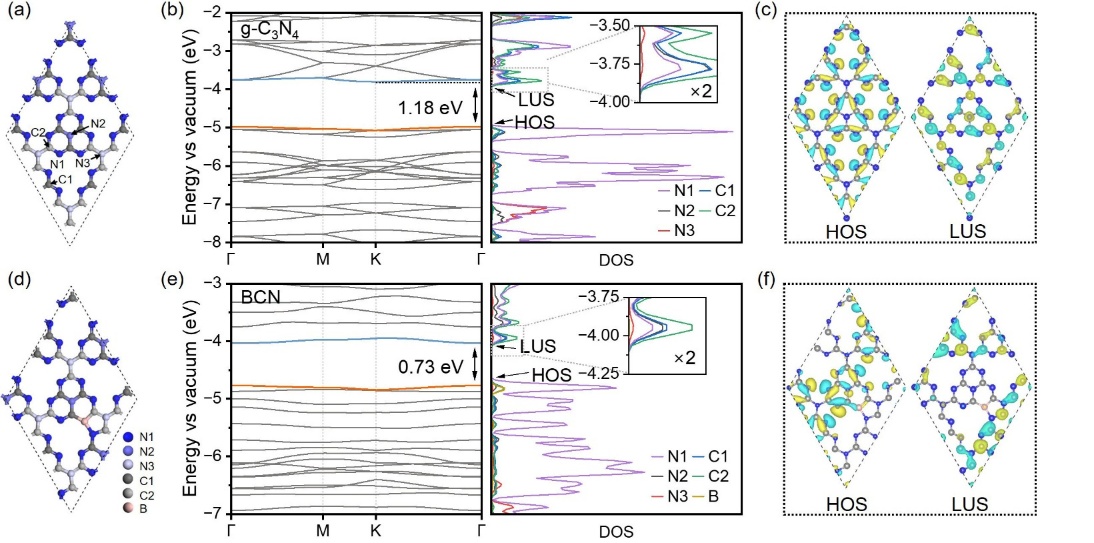
Fig. 1. Optimized structure of g-C3N4 (a) and its calculated band structure (left panel) and DOS (right panel) (b). (c) The top view of HOS and LUS of g-C3N4, with an isosurface value of 0.025 e-/Bohr3. Optimized structure of BCN (d) and its calculated band structure (left panel) and DOS (right panel) (e). (f) The top view of the HOS and LUS of BCN, with an isosurface value of 0.025 e-/Bohr3.
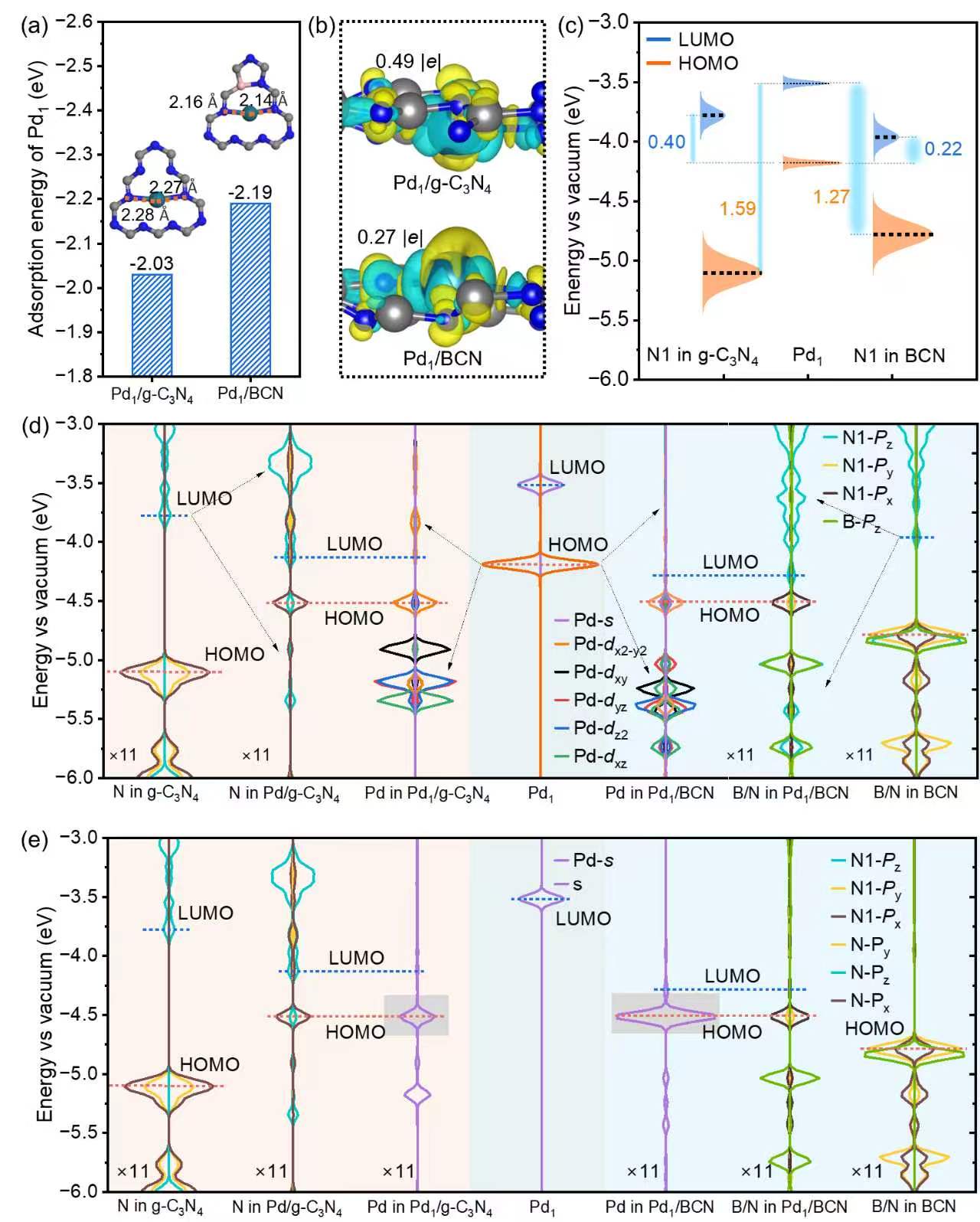
Fig. 2. (a) Adsorption energies of Pd1 in Pd1/g-C3N4 and Pd1/BCN. The insets show the top view of the Pd1/g-C3N4 and Pd1/BCN structures. (b) Side view of charge density differences and Bader charges of the Pd1 atom in Pd1/g-C3N4 (top) and Pd1/BCN (bottom). The yellow and cyan areas indicate the accumulation and depletion of electrons, respectively, with an isosurface value of 0.003 e-/Bohr3. The balls in blue, grey, pink and dark cyan represent N, C, B and Pd, respectively. (c) Schematic illustration of frontier orbital alignment for freestanding Pd1, N1 in g-C3N4 as well as N1 and B in BCN. (d) The PDOS analysis illustrates the frontier orbital coupling between the HOMO of Pd1 and the LUMO of N1 in g-C3N4 and BCN, respectively. (e) The PDOS analysis reveals distinct frontier orbital coupling between the LUMO of Pd1 and the HOMO of the N1 in g-C3N4 and BCN, respectively.
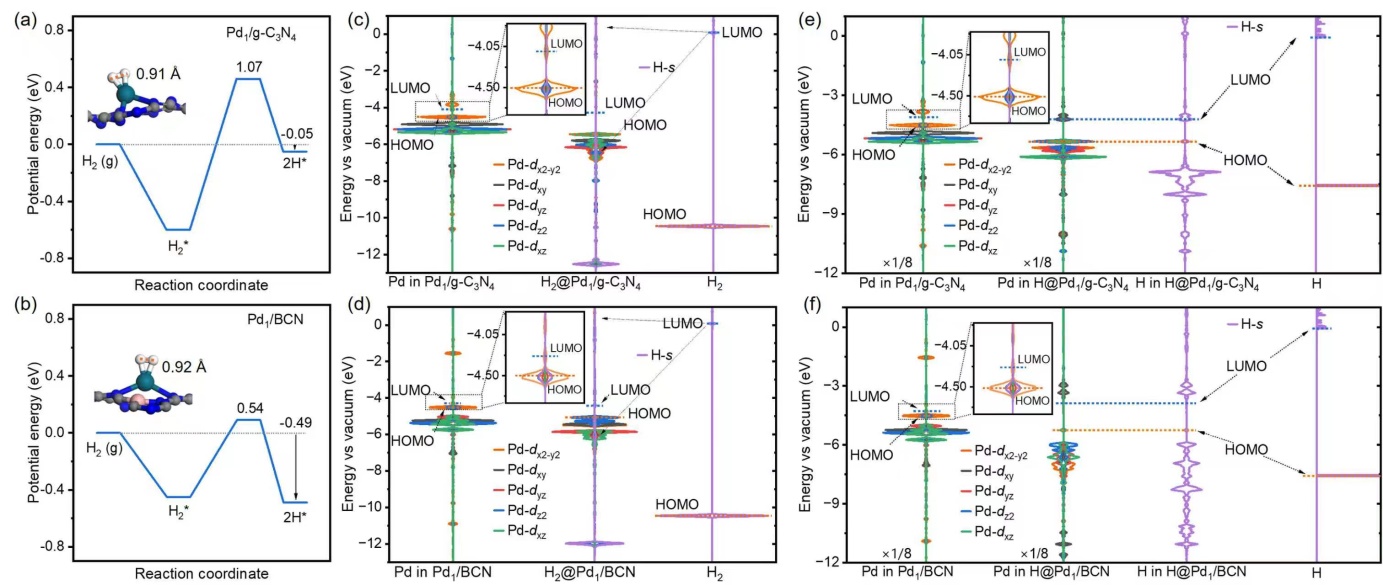
Fig. 3. Calculated H2 dissociation paths on Pd1/g-C3N4 (a) and Pd1/BCN (b). The insets show H2 molecule adsorbed on Pd1/g-C3N4 and Pd1/BCN, respectively. The balls in white, blue, grey, pink and dark cyan represent H, N, C, B and Pd, respectively. PDOS analysis of frontier orbital coupling between H2 LUMO and Pd1 HOMO for Pd1/g-C3N4 (c) as well as between H2 LUMO and Pd1 HOMO for Pd1/BCN (d). PDOS analysis of frontier orbital coupling between H atom and Pd1/g-C3N4 (e) as well as between H atom and Pd1/BCN (f).
|
| [1] | Anqi Li, Yusen Chen, Xiaoli Pan, Yujing Ren, Hongchen Cao, Guiyue Bi, Xiaofeng Yang, Aiqin Wang, Tao Zhang. Pt1/FeOx single-atom catalyst with dual-valent Pt sites for water-promoted hydrogenation of nitroarenes [J]. Chinese Journal of Catalysis, 2027, 92(1): 410-419. |
| [2] | Yang Wang, Cun-Feng Fan, Yang Liu, Xiao-Qin Zheng, Xuan-Yi Liu, Kai Zhang, Jiahui Kou, Hengming Huang, Lin-Bing Sun. Iron single-atom catalysts created in constrained space with in-situ-formed carbon layers for efficient Fenton reaction [J]. Chinese Journal of Catalysis, 2026, 88(9): 432-441. |
| [3] | Sathi Chatterjee, Hongmei Li, Kang Liu, Zhang Lin, Liyuan Chai, Min Liu. Single-atom catalysts on two-dimensional (2D) materials for photocatalytic CO2 reduction: Fundamentals, design, and emerging strategies [J]. Chinese Journal of Catalysis, 2026, 88(9): 86-128. |
| [4] | Yueling Chen, Yuling Lin, Ziyan Chen, Xiangyu Kong, Jinhong Bi, Guocheng Huang, Ling Wu. Asymmetric N-Ru-S dipole within covalent organic framework enhances internal electric field for efficient CO2 photoreduction [J]. Chinese Journal of Catalysis, 2026, 87(8): 59-69. |
| [5] | Jianwei Jiang, Minji Kang, Jeongcheol Shin, Kiyoung Park, Sungho Yoon. Cobalt nanoparticle catalyst with magnetic recoverability for high-performance epoxide carbonylation to β-lactones with high selectivity [J]. Chinese Journal of Catalysis, 2026, 86(7): 89-98. |
| [6] | Shahla Karimi, Mehran Rezaei, Jiguang Deng, Hongxing Dai, Ali Rastegarpanah. Recent advances in noble metal-based catalysts for methane decomposition: Performance, mechanism, and optimization [J]. Chinese Journal of Catalysis, 2026, 86(7): 9-48. |
| [7] | Yi-Wen Han, Run-Yu Liu, Yu-Xin Zhang, Lei Ye, Phuc T. T. Nguyen, Tian-Jun Gong, Xue-Bin Lu, Yao Fu, Ning Yan. Establishing built-in electric field within single-atom-anchored hollow architectures for efficient solar-thermal regulation in plastic photoreforming [J]. Chinese Journal of Catalysis, 2026, 84(5): 301-313. |
| [8] | Cheng Rao, Mengyu Qian, Songyun Tao, Huaiyuan Wang, Dan He, Jun Ye, Hai Liu, Xiangguang Yang, Yibo Zhang. Synergistic enhancement of methane combustion over Pd/CeO2 via single-atom Ni doping: Boosting Pd4+ and oxygen vacancies [J]. Chinese Journal of Catalysis, 2026, 83(4): 419-431. |
| [9] | Weiping Xiao, Yue Zhang, Na Wang, Xiaofei Yang. Synergistic electrode-electrolyte coupling enabled highly efficient and durable high entropy intermetallic-based electrocatalyst for oxygen reduction reaction [J]. Chinese Journal of Catalysis, 2026, 82(3): 92-104. |
| [10] | Run Pan, Abubakar Yusuf, Chengjun Wang, Jianrong Li, Zhiyu Xiao, Shuai Liu, Yidong Zhong, Yong Ren, Zheng Wang, Hainam Do, John L. Zhou, George Zheng Chen, Jun He. Core-shell Pd@CeO2/γ‐Al2O3 catalysts: Boosting efficiency and durability in stoichiometric natural gas vehicle exhaust treatment [J]. Chinese Journal of Catalysis, 2026, 82(3): 348-362. |
| [11] | Feng Li, Ye Ma, Mingyu Wan, Yating Lv, Jiamin Yuan, Shichao Han, Houyu Ma, Liang Wang, Xiangju Meng, Anmin Zheng, Yanhang Ma, Feng-Shou Xiao. Pure silica Beta zeolite supported Ag-Mn catalyst for efficient ozone decomposition [J]. Chinese Journal of Catalysis, 2026, 82(3): 292-300. |
| [12] | Miao-Miao Shi, Yue-Xuan He, Ning Zhang, Di Bao, Da-Ming Zhao, Hai-Xia Zhong, Jun-Min Yan, Qing Jiang. Direct electrochemical liquid ammonia splitting for onsite hydrogen generation under room temperature [J]. Chinese Journal of Catalysis, 2026, 81(2): 310-318. |
| [13] | Han-Yue Yang, Jia-Jia Wen, Xue Xiao, Yu Chen. Interfacial charge transfer via SMSI in heterostructured Pd/Bi2O3: A paradigm for sustainable electrochemical biomass upcycling [J]. Chinese Journal of Catalysis, 2026, 91(12): 304-314. |
| [14] | Yi Liu, Peng Zhang, Yijun Li, Zhihua Han, Bo Feng, Xiaowa Nie, Jingyun Chen, Ruonan He, Zhoujun Wang, Lei Shao, Shaodong Qin, Guanghui Zhang, Xinwen Guo. Zn-mediated modulation of Fe-Si interactions to achieve a balance between stability and selectivity in CO2 hydrogenation [J]. Chinese Journal of Catalysis, 2026, 91(12): 122-134. |
| [15] | Wei Chen, Massimo Bocus, Unni Olsbye, Veronique Van Speybroeck. Dynamic evolution and stability of ketenes in MAPO-18 (M = Si or Mg): Molecular insights into the reaction mechanism for CO2-to-hydrocarbons [J]. Chinese Journal of Catalysis, 2026, 89(10): 337-352. |
| Viewed | ||||||
|
Full text |
|
|||||
|
Abstract |
|
|||||


