
Chinese Journal of Catalysis ›› 2026, Vol. 91: 304-314.DOI: 10.1016/S1872-2067(26)65201-1
• Articles • Previous Articles Next Articles
Han-Yue Yang, Jia-Jia Wen, Xue Xiao*( ), Yu Chen*()
Received:2026-04-07
Accepted:2026-05-27
Online:2026-12-18
Published:2026-10-13
Supported by:Han-Yue Yang, Jia-Jia Wen, Xue Xiao, Yu Chen. Interfacial charge transfer via SMSI in heterostructured Pd/Bi2O3: A paradigm for sustainable electrochemical biomass upcycling[J]. Chinese Journal of Catalysis, 2026, 91: 304-314.
Add to citation manager EndNote|Ris|BibTeX
URL: https://www.cjcatal.com/EN/10.1016/S1872-2067(26)65201-1
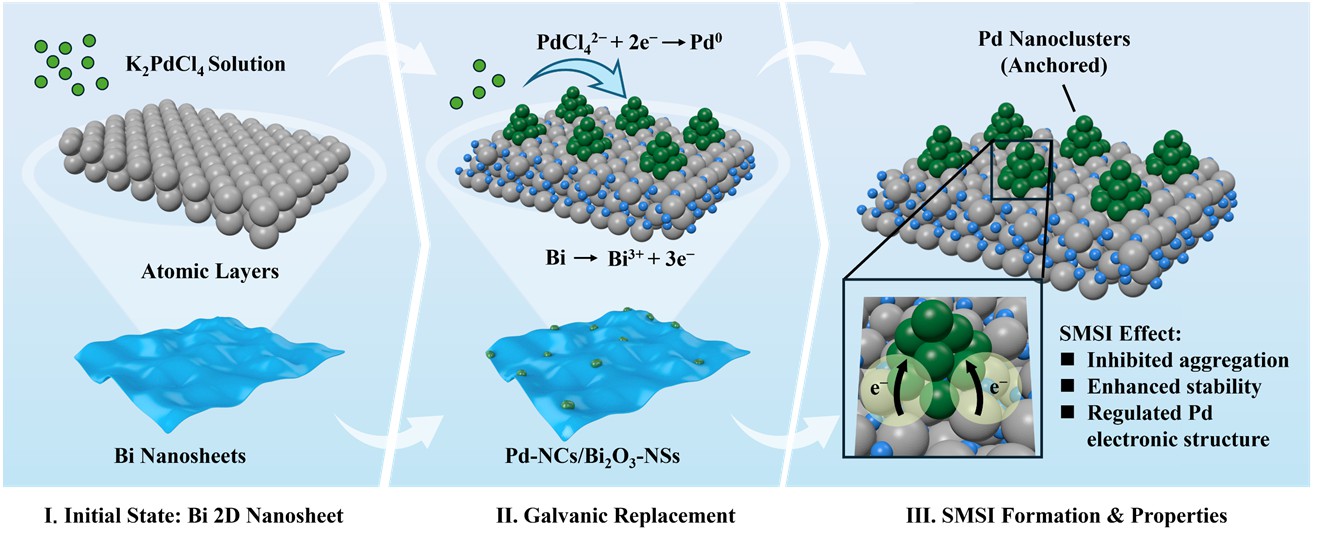
Scheme 1. Formation and SMSI of Pd nanoclusters anchored on ultrathin Bi2O3 nanosheets via Galvanic Replacement.

Fig. 1. (a) TEM image of Bi NSs. TEM image (b), HAADF-STEM image (c), AFM image (d), HR-TEM (e), lattice strain measured from GPA (f), and STEM-EDX elemental mapping images (g) of Pd-NCs/Bi2O3-NSs.
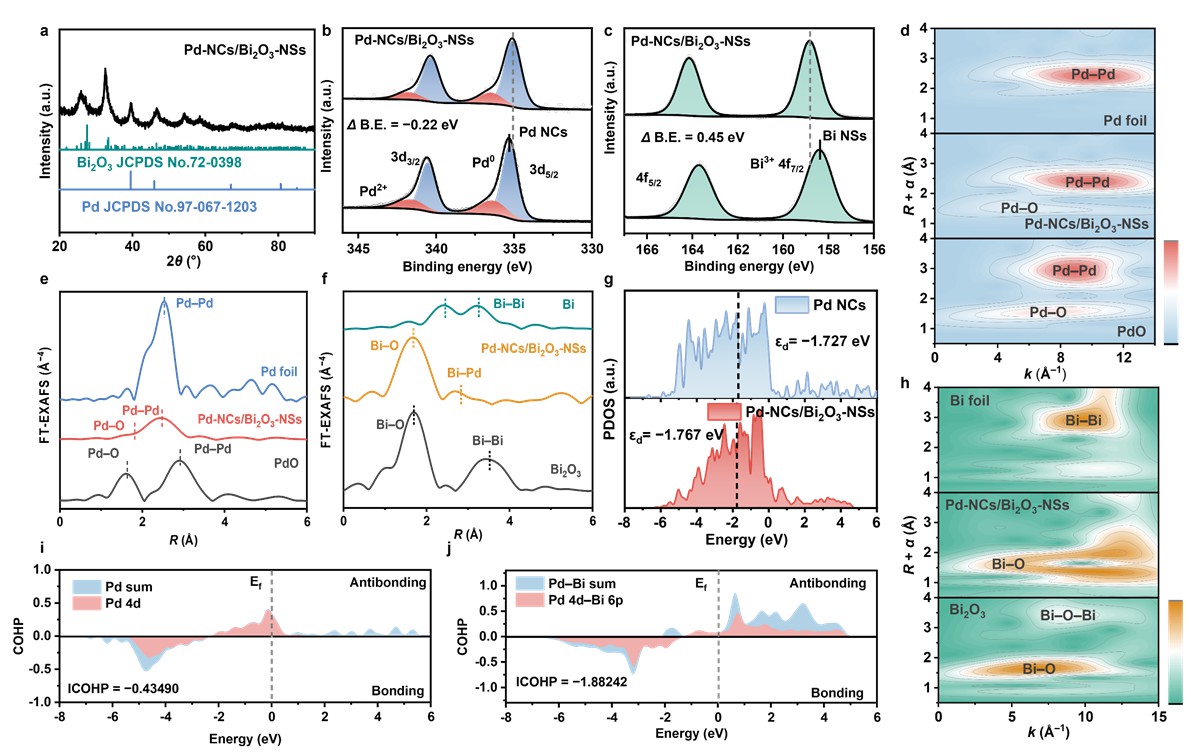
Fig. 2. (a) XRD pattern of Pd-NCs/Bi2O3-NSs. (b) Pd 3d XPS spectra of Pd-NCs/Bi2O3-NSs and Pd NCs. (c) Bi 4f XPS spectra of Pd-NCs/Bi2O3-NSs and Bi2O3 NSs. (d) WT-EXAFS spectra of Pd foil, Pd-NCs/Bi2O3-NSs, and PdO. (e) FT-EXAFS spectra of Pd foil, Pd-NCs/Bi2O3-NSs, and PdO. (f) FT-EXAFS spectra of Bi foil, Pd-NCs/Bi2O3-NSs and Bi2O3. (g) PDOS (d-band) of Pd and Pd-NCs/Bi2O3-NSs. (h) WT-EXAFS spectra of Bi foil, Pd-NCs/Bi2O3-NSs and Bi2O3. (i) COHP curve of the Pd bond in the Pd. (j) COHP curve of the Pd-Bi bond in the Pd-NCs/Bi2O3-NS.
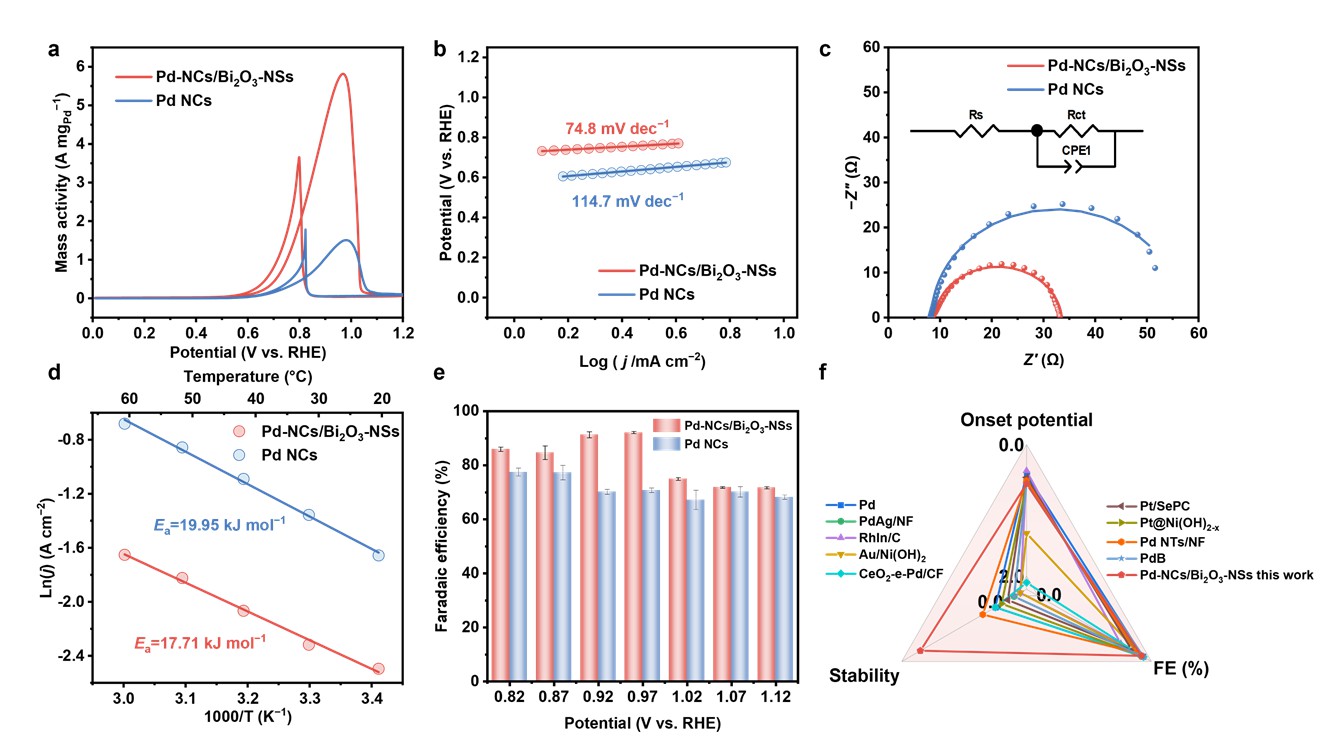
Fig. 3. (a) CV curves of Pd-NCs/Bi2O3-NSs and Pd NCs in 1 mol L-1 KOH + 1 mol L-1 EG. (b) Corresponding Tafel slopes. Nyquist plots (c) and Arrhenius plots (d) of Pd-NCs/Bi2O3-NSs and Pd NCs. (e) FEGA of EGOR by Pd-NCs/Bi2O3-NSs and Pd NCs at different potentials. Data are presented as mean ± SD. Error bars (SD) represent the standard deviation of three separate measurements. (f) Comparison of the EGOR performance between this work and that of reported catalysts.
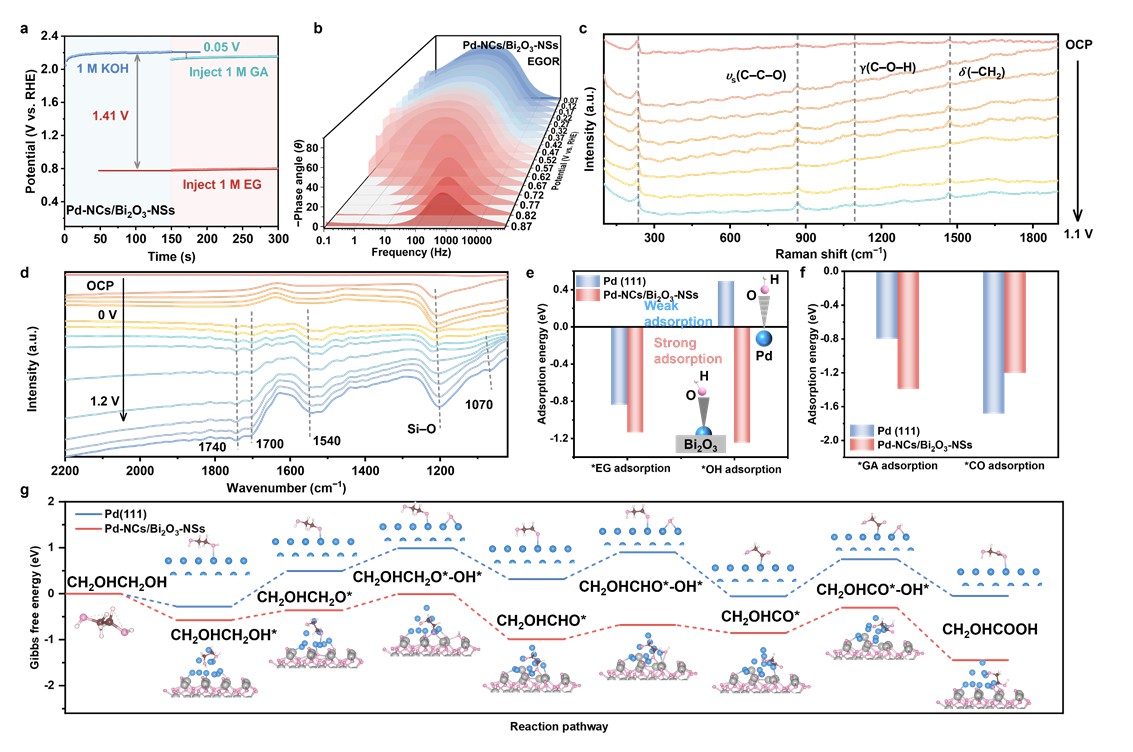
Fig. 4. (a) Open circuit potentials (OCPs) of Pd-NCs/Bi2O3-NSs in 1 mol L-1 KOH solution before and after 1 mol L-1 EG was added, and 1 mol L-1 KOH before and after 1 mol L-1 GA was added. (b) Corresponding Bode phase plots of Pd-NCs/Bi2O3-NSs electrode at varied potentials in 1 mol L-1 KOH with 1 mol L-1 EG. (c) In-situ Raman spectra of Pd-NCs/Bi2O3-NSs. (d) In-situ electrochemical FTIR spectra of EGOR catalyzed by Pd-NCs/Bi2O3-NSs. Calculated adsorption energies of EG* and OH* (e), and GA* and CO* (f), on the surfaces of Pd and Pd-NCs/Bi2O3-NSs. (g) Reaction Gibbs free energy of EGOR on Pd and Pd-NCs/Bi2O3-NSs.
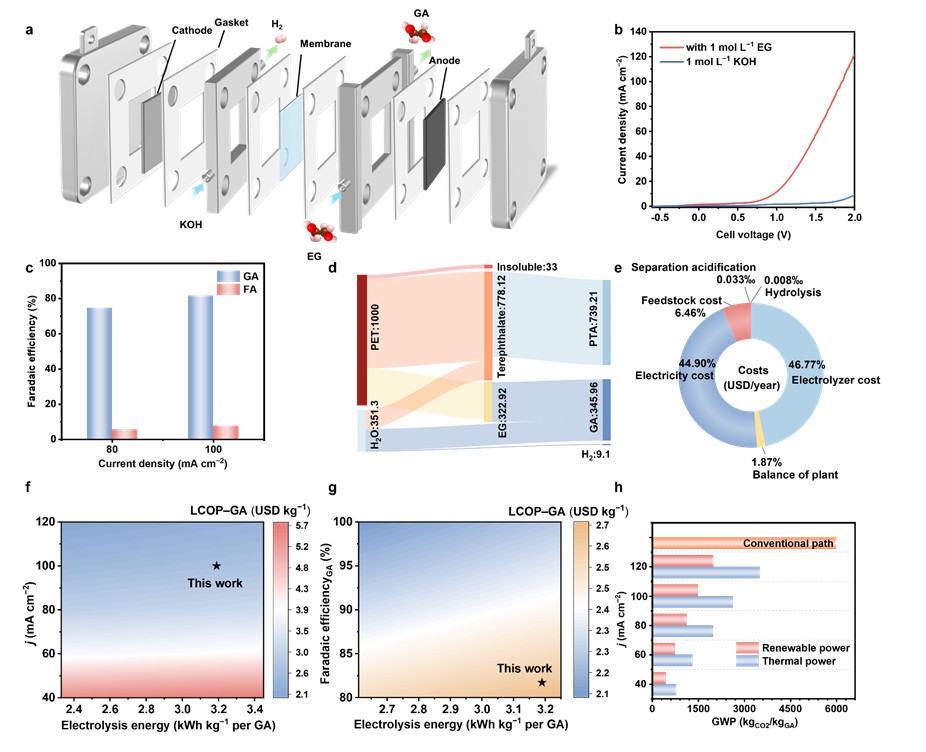
Fig. 5. (a) The flow cell setup for paired HER (-) || EG oxidation (+) of Pt mesh and Pd-NCs/Bi2O3-NSs. (b) LSV curves for water splitting and EG electrolysis in the flow cell reactor. (c) Faradaic efficiency as function of current density for EG oxidation. (d) Sankey diagram for the mass flow of PET upcycling. (e) Subdivided the cost of the process. (f,g) LCOP for processing PET as function of current density, electrolysis energy, and faradic efficiency. (h) GWP of the conventional path and the system to produce GA powered by renewable power and thermal power.
|
| [1] | Yuwei Li, Yuxin He, Zongyao Guo, Jingyi Zhang, Yizhi Wu, Mingkun Jiang, Shiyu Chen, Dan Wu. Dual-site CuS-Co9S8 heterojunctions for efficient and selective glycerol electrooxidation [J]. Chinese Journal of Catalysis, 2026, 85(6): 272-285. |
| [2] | Cheng Rao, Mengyu Qian, Songyun Tao, Huaiyuan Wang, Dan He, Jun Ye, Hai Liu, Xiangguang Yang, Yibo Zhang. Synergistic enhancement of methane combustion over Pd/CeO2 via single-atom Ni doping: Boosting Pd4+ and oxygen vacancies [J]. Chinese Journal of Catalysis, 2026, 83(4): 419-431. |
| [3] | Li Zheng, Zeng Ying, Dong Yuanyuan, Lv Hongjin, Yang Guo-Yu. Metal/H+ sites modulation in the decatungstate+Pd/C catalytic system for photocatalytic generation of furfuryl ethyl ether [J]. Chinese Journal of Catalysis, 2025, 75(8): 137-146. |
| [4] | Yangyang Li, Jingyi Yang, Botao Qiao, Tao Zhang. Size-dependent strong metal-support interaction modulation of Pt/CoFe2O4 catalysts [J]. Chinese Journal of Catalysis, 2025, 69(2): 292-302. |
| [5] | Zhaohui Chen, Jun Deng, Yanmei Zheng, Wenjun Zhang, Lin Dong, Zupeng Chen. Modulation of ketyl radical reactivity to mediate the selective synthesis of coupling and carbonyl compounds [J]. Chinese Journal of Catalysis, 2024, 61(6): 135-143. |
| [6] | Fengwei Zhang, Hefang Guo, Mengmeng Liu, Yang Zhao, Feng Hong, Jingjing Li, Zhengping Dong, Botao Qiao. Enhancing the chemoselective hydrogenation of nitroarenes: Designing a novel surface-strained carbon-based Pt nanocatalyst [J]. Chinese Journal of Catalysis, 2023, 48(5): 195-204. |
| [7] | Peng Xu, Zhixing Wu, Jiguang Deng, Yuxi Liu, Shaohua Xie, Guangsheng Guo, Hongxing Dai. Catalytic performance enhancement by alloying Pd with Pt on ordered mesoporous manganese oxide for methane combustion [J]. Chinese Journal of Catalysis, 2017, 38(1): 92-105. |
| [8] | Xiang Liu, Shushuang Li, Yongmei Liu, Yong Cao. Formic acid: A versatile renewable reagent for green and sustainable chemical synthesis [J]. Chinese Journal of Catalysis, 2015, 36(9): 1461-1475. |
| Viewed | ||||||
|
Full text |
|
|||||
|
Abstract |
|
|||||


