
Chinese Journal of Catalysis ›› 2027, Vol. 92: 442-451.DOI: 10.1016/S1872-2067(26)65279-5
• Articles • Previous Articles
Shunyu Zhaoa,b,c, Xinping Zhanga,b,c, Xiangyuan Gua,b,c, Jieyu Zhoua,b,c,*( ), Ye Nia,b,c,*()
Received:2026-07-15
Accepted:2026-08-17
Online:2027-01-02
Published:2026-10-30
Contact:
*E-mail: zhoujieyu@jiangnan.edu.cn (J. Zhou),About author:First author contact: S. Z., X. Z. and X. G. performed and analyzed the experiments. S. Z., J. Z. and Y. N. conceived the project and designed the experiments. S. Z., J. Z. and Y. N. wrote the manuscript. All authors have given approval to the final version of the manuscript.
Supported by:Shunyu Zhao, Xinping Zhang, Xiangyuan Gu, Jieyu Zhou, Ye Ni. Engineering imine reductases enables stereodivergent reductive amination of 4-substituted cyclohexanones[J]. Chinese Journal of Catalysis, 2027, 92: 442-451.
Add to citation manager EndNote|Ris|BibTeX
URL: https://www.cjcatal.com/EN/10.1016/S1872-2067(26)65279-5
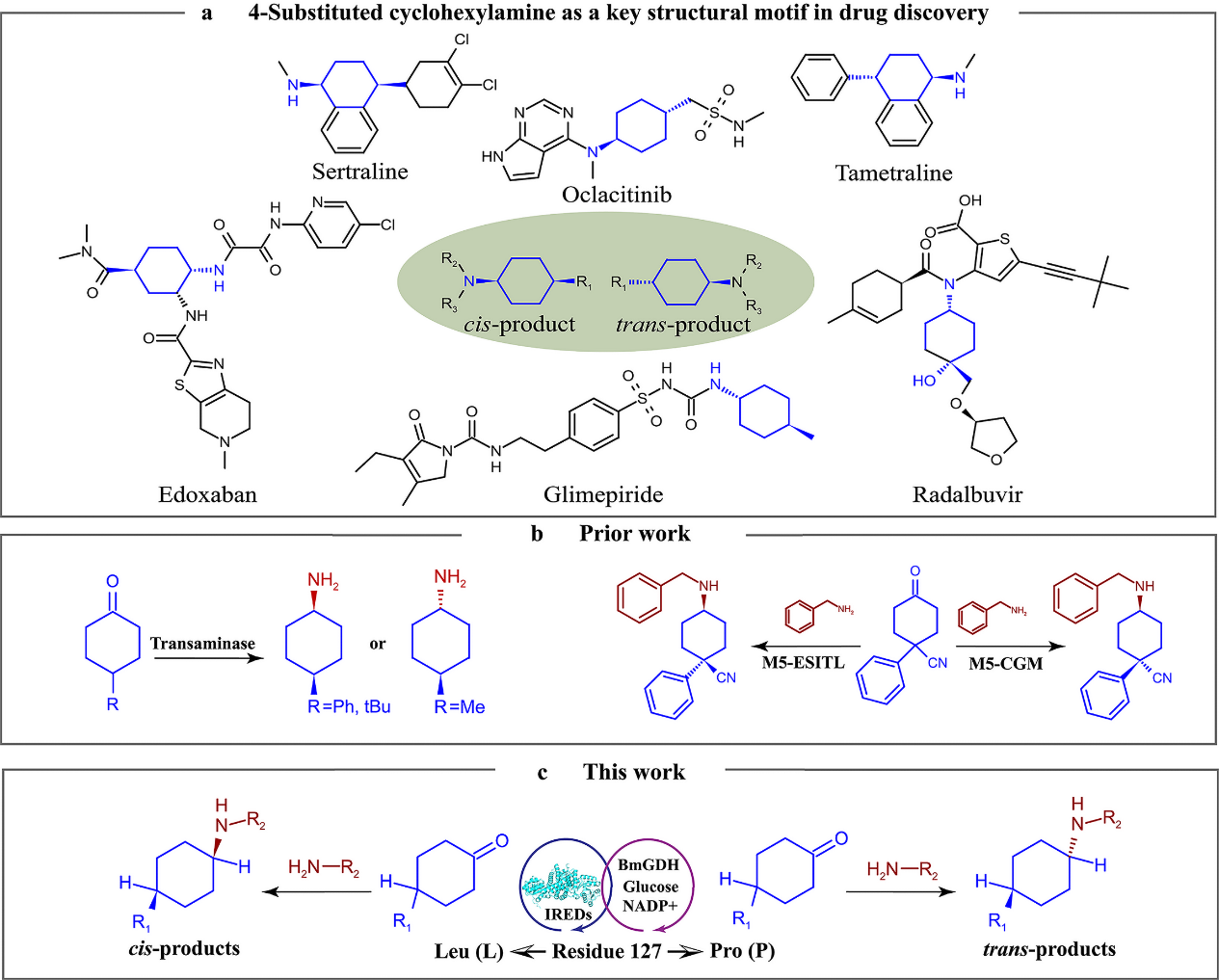
Fig. 1. Preparation of 4-substituted cyclohexylamines. (a) Examples of bioactive molecules containing 4-substituted cyclohexylamines. (b) Strategies for the asymmetric synthesis of 4-substituted cyclohexylamines employing transaminases and imine reductases in previously reports. (c) Stereodivergent synthesis of cis/trans-products by IREDs via modulating a key residue developed in this study.
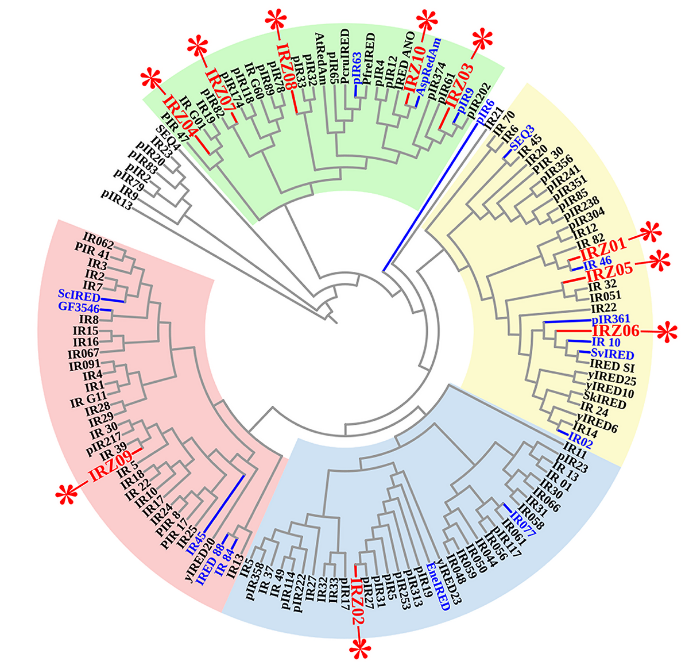
Fig. 2. A phylogenetic tree of imine reductases. The four distinct imine reductase clusters are indicated by different colors. Branches corresponding to literature-reported enzymes with excellent catalytic activity are marked in blue, and the candidate enzymes selected in this study are highlighted in red.
| Enzyme | Conv. (%) | d.e. (%) |
|---|---|---|
| IRZ01 | 85±3.2 | 1±0.8 (cis) |
| IRZ02 | 0 | 0 |
| IRZ03 | 95±2.1 | 69±0.3 (trans) |
| IRZ04 | 96±2.4 | 64±3.1 (trans) |
| IRZ05 | 30±5.5 | 27±1.5 (cis) |
| IRZ06 | 61±3.0 | 48±1.1 (cis) |
| IRZ07 | 63±4.8 | 71±2.5 (trans) |
| IRZ08 | >99 | 51±5.2 (trans) |
| IRZ09 | 83±2.5 | >99 (trans) |
| IRZ10 | >99 | 71±0.5 (trans) |
Table 1 Conversions and stereoselectivities of IREDs toward 1a.
| Enzyme | Conv. (%) | d.e. (%) |
|---|---|---|
| IRZ01 | 85±3.2 | 1±0.8 (cis) |
| IRZ02 | 0 | 0 |
| IRZ03 | 95±2.1 | 69±0.3 (trans) |
| IRZ04 | 96±2.4 | 64±3.1 (trans) |
| IRZ05 | 30±5.5 | 27±1.5 (cis) |
| IRZ06 | 61±3.0 | 48±1.1 (cis) |
| IRZ07 | 63±4.8 | 71±2.5 (trans) |
| IRZ08 | >99 | 51±5.2 (trans) |
| IRZ09 | 83±2.5 | >99 (trans) |
| IRZ10 | >99 | 71±0.5 (trans) |
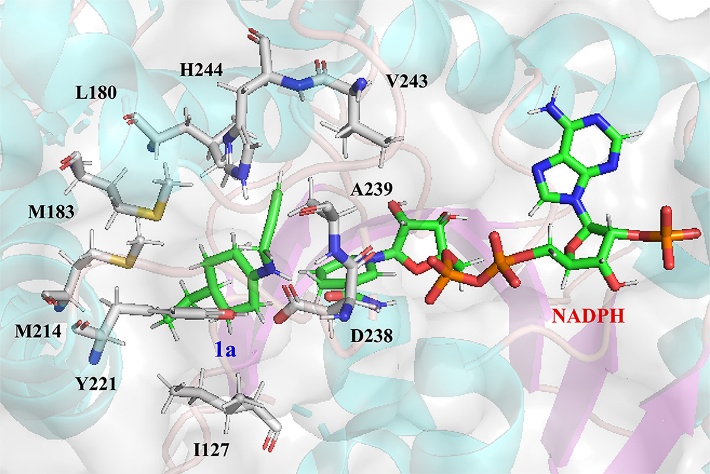
Fig. 3. Model of wild-type IRZ06 with the docked ligands. Residues subjected to mutagenesis are represented as white sticks. NADPH and 1a are represented as green sticks.
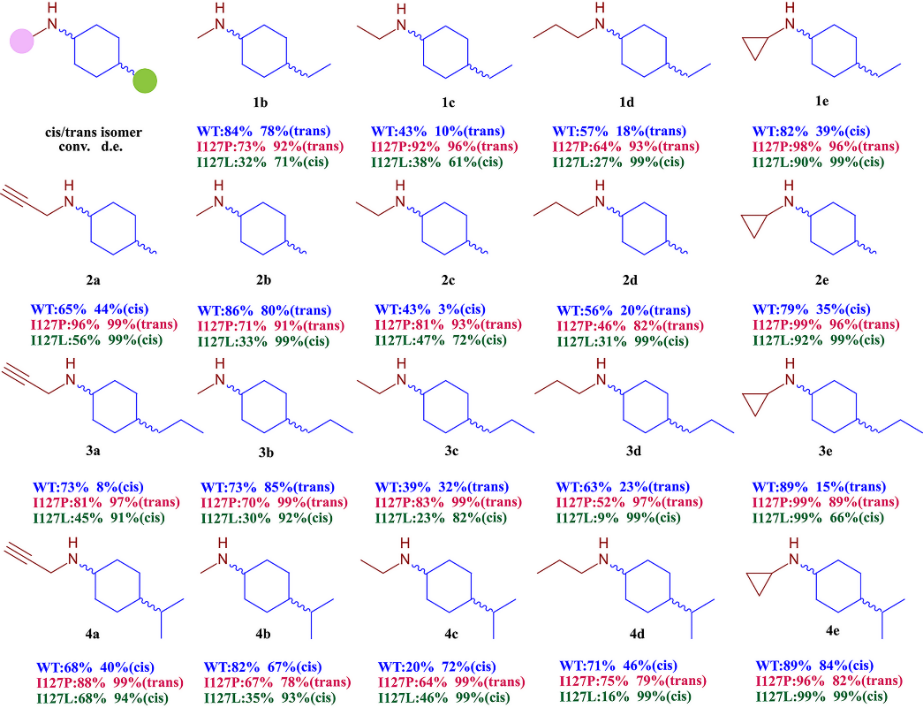
Fig. 4. Synthesis of cis/trans 4-substituted cyclohexylamines with different amines catalyzed by IRZ06 and its variants. Standard conditions: ketone (5 mmol/L), amine (a‒d, 4 equiv.), NADP+ (1 mmol/L), D-glucose (30 mmol/L), BmGDH (0.1 mg/mL), IREDs (1 mg/mL), in PBS buffer (100 mmol/L, pH = 7.5) at 30 °C for 24 h.
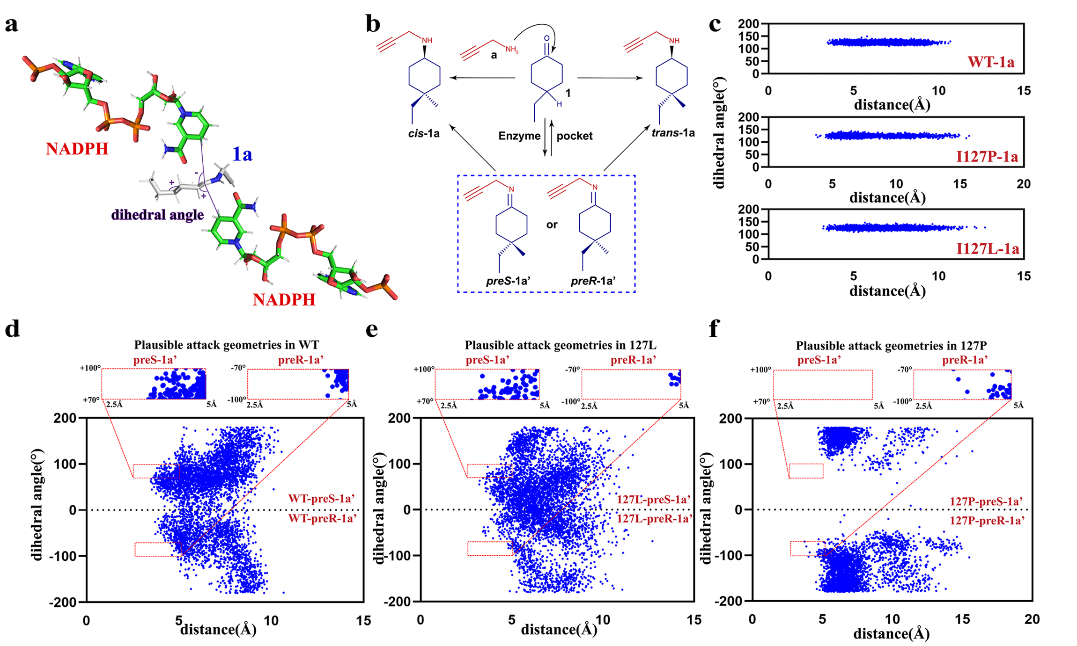
Fig. 5. Mechanism analysis of stereodivergent-functionalization for I127P and I127L by MD simulations. (a) Approach direction of NADPH toward substrate is characterized by the sign of ϕC4P. (b) Proposed mechanism of reductive amination process. (c) Statistics of ϕCSP for the imine intermediate within the active site of the IRZ06(WT), I127P, and I127L variants. (d) Conformation maps of WT in pre-reaction state simulation. (e) Conformation maps of I127L in pre-reaction state simulation. (f) Conformation maps of I127P in pre-reaction state simulation. The X-axis shows the distance between NADPH-C4 and the imine carbon, and the Y-axis shows the dihedral angle of NADPH-C4 relative to the cyclohexane plane in active site.
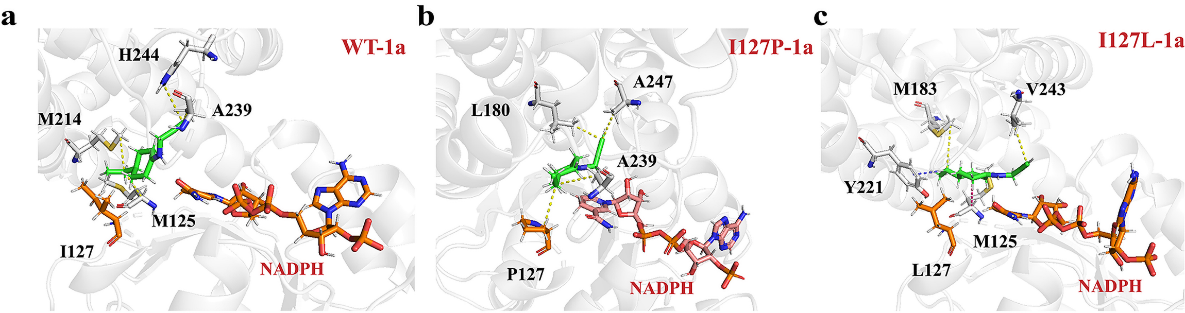
Fig. 6. Intermolecular interactions of the imine intermediate in the active site of (a) WT, (b) I127P, and (c) I127L.
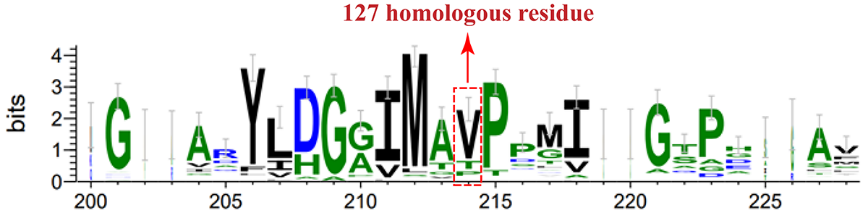
Fig. 7. Sequence conservation analysis logo of IREDs. The homologous residue 127 was indicated by a red dashed rectangle.
| Enzyme | de (%) | Enzyme | de (%) | Enzyme | de (%) |
|---|---|---|---|---|---|
| IRZ01 | 1±0.8 (cis) | IRZ01-V119L | 42±1.6 (cis) | IRZ01-V119P | 87±1.5 (trans) |
| IRZ03 | 69±0.3 (trans) | IRZ03-T120L | 56±1.1 (trans) | IRZ03-T120P | 81±2.3 (trans) |
| IRZ04 | 64±3.1 (trans) | IRZ04-V125L | 12±1.0 (trans) | IRZ04-V125P | 92±2.1 (trans) |
| IRZ05 | 27±1.5 (cis) | IRZ05-V129L | 23±0.8 (trans) | IRZ05-V129P | 69±6.5 (trans) |
| IRZ07 | 71±2.5 (trans) | IRZ07-V120L | 29±5.5 (trans) | IRZ07-V120P | 96±0.5 (trans) |
| IRZ08 | 51±5.2 (trans) | IRZ08-V122L | 49±6.3 (trans) | IRZ08-V122P | 91±1.0 (trans) |
| IRZ09 | >99 (trans) | IRZ09-P137L | 73±2.5 (trans) | ||
| IRZ10 | 71±0.5 (trans) | IRZ10-V121L | 69±3.2 (trans) | IRZ10-V121P | >99 (trans) |
Table 2 Diastereoselectivities of IREDs toward 1a.
| Enzyme | de (%) | Enzyme | de (%) | Enzyme | de (%) |
|---|---|---|---|---|---|
| IRZ01 | 1±0.8 (cis) | IRZ01-V119L | 42±1.6 (cis) | IRZ01-V119P | 87±1.5 (trans) |
| IRZ03 | 69±0.3 (trans) | IRZ03-T120L | 56±1.1 (trans) | IRZ03-T120P | 81±2.3 (trans) |
| IRZ04 | 64±3.1 (trans) | IRZ04-V125L | 12±1.0 (trans) | IRZ04-V125P | 92±2.1 (trans) |
| IRZ05 | 27±1.5 (cis) | IRZ05-V129L | 23±0.8 (trans) | IRZ05-V129P | 69±6.5 (trans) |
| IRZ07 | 71±2.5 (trans) | IRZ07-V120L | 29±5.5 (trans) | IRZ07-V120P | 96±0.5 (trans) |
| IRZ08 | 51±5.2 (trans) | IRZ08-V122L | 49±6.3 (trans) | IRZ08-V122P | 91±1.0 (trans) |
| IRZ09 | >99 (trans) | IRZ09-P137L | 73±2.5 (trans) | ||
| IRZ10 | 71±0.5 (trans) | IRZ10-V121L | 69±3.2 (trans) | IRZ10-V121P | >99 (trans) |
|
| [1] | Jinhai Yu, Yingdi Hao, Yingzhi Ren, Beibei Zhao, Ge Ma, Zihao Guo, Yan Zhang, Xiaoqiang Huang. Radical hydroazidation of alkene enabled by synergistic photobiocatalysis combining ene-reductase with an organophotocatalyst [J]. Chinese Journal of Catalysis, 2026, 85(6): 88-95. |
| [2] | Jian-Peng Wang, Guang-Hui Lu, Qian Wu, Jian-Rong Dai, Ning Li. Toward scalable production of biobased N-substituted furfurylamines by engineered imine reductases [J]. Chinese Journal of Catalysis, 2025, 76(9): 210-220. |
| [3] | Wenjin Pan, Xinlong Fan, Wantong Jiang, Sirui Xin, Ningzhi Wang, Qian Wang, Keyang Yu, Xinkun Ren. Engineering metalloenzymes for new-to-nature carbene and nitrene transfer biocatalysis [J]. Chinese Journal of Catalysis, 2025, 72(5): 4-23. |
| [4] | Xiaomeng Liu, Zehua Chen, Xinyue Liu, Tong Zhu, Jinyuan Sun, Chunli Li, Yinglu Cui, Bian Wu. Computational redesign of a thermostable MHET hydrolase and its role as an endo-PETase in promoting PET depolymerization [J]. Chinese Journal of Catalysis, 2025, 78(11): 182-191. |
| [5] | Fei-Xiang Dong, Tian Jin, Xiaojuan Yu, Hong-Yue Wang, Qi Chen, Jian-He Xu, Gao-Wei Zheng. Artificial cascade biocatalysis for the synthesis of 2-aminocyclohexanols with contiguous stereocenters [J]. Chinese Journal of Catalysis, 2025, 68(1): 345-355. |
| [6] | Fengming Shi, Bin Chen, Jinhai Yu, Ruiqi Zhu, Yu Zheng, Xiaoqiang Huang. Enantioselective biosynthesis of vicinal diamines enabled by synergistic photo/biocatalysis consisting of an ene-reductase and a green-light-excited organic dye [J]. Chinese Journal of Catalysis, 2025, 68(1): 223-229. |
| [7] | Zhenhua Wu, Jiafu Shi, Boyu Zhang, Yushuai Jiao, Xiangxuan Meng, Ziyi Chu, Yu Chen, Yiran Cheng, Zhongyi Jiang. Conjugated microporous polymers-scaffolded enzyme cascade systems with enhanced catalytic activity [J]. Chinese Journal of Catalysis, 2024, 63(8): 213-223. |
| [8] | Yufei Cao, Jun Ge. Hybrid enzyme catalysts synthesized by a de novo approach for expanding biocatalysis [J]. Chinese Journal of Catalysis, 2021, 42(10): 1625-1633. |
| [9] | Aqib Zafar Khan, Muhammad Bilal, Tahir Rasheed, Hafiz M. N. Iqbal. Advancements in biocatalysis: From computational to metabolic engineering [J]. Chinese Journal of Catalysis, 2018, 39(12): 1861-1868. |
| [10] | Qing-Hua Li, Yuan Dong, Fei-Fei Chen, Lei Liu, Chun-Xiu Li, Jian-He Xu, Gao-Wei Zheng. Reductive amination of ketones with ammonium catalyzed by a newly identified Brevibacterium epidermidis strain for the synthesis of (S)-chiral amines [J]. Chinese Journal of Catalysis, 2018, 39(10): 1625-1632. |
| [11] | K. Parthasarathy, T. Ponpandian, C. Praveen. Gold-catalyzed addition reaction between creatinine and isatin: A sustainable and green chemistry approach for the diastereoselective synthesis of 3-substituted-3-hydroxyisatins [J]. Chinese Journal of Catalysis, 2017, 38(5): 775-783. |
| [12] | Yilong Wang, Yun Zhang, Aijun Sun, Yunfeng Hu . Characterization of a novel marine microbial esterase and its use to make D-methyl lactate [J]. Chinese Journal of Catalysis, 2016, 37(8): 1396-1402. |
| [13] | Dun Deng, Yun Zhang, Aijun Sun, Yunfeng Hu. Enantio-selective preparation of (S)-1-phenylethanol by a novel marine GDSL lipase MT6 with reverse stereo-selectivity [J]. Chinese Journal of Catalysis, 2016, 37(11): 1966-1974. |
| [14] | P. B. Thorat, S. V. Goswami, V. P. Sondankar, S. R. Bhusare. Stereoselective synthesis of vic-halohydrins and an unusual Knoevenagel product from an organocatalyzed aldol reaction: A non-enamine mode [J]. Chinese Journal of Catalysis, 2015, 36(7): 1093-1100. |
| [15] | JI De-Bin, WANG Lei, ZHOU Yong-Jin, YANG Wei, WANG Qian, ZHAO Zong-Bao. Oxidative Decarboxylation of L-Malate by Using a Synthetic Bioredox System [J]. Chinese Journal of Catalysis, 2012, 33(3): 530-535. |
| Viewed | ||||||
|
Full text |
|
|||||
|
Abstract |
|
|||||


