
Chinese Journal of Catalysis ›› 2026, Vol. 90: 231-242.DOI: 10.1016/S1872-2067(26)65174-1
• Articles • Previous Articles Next Articles
Haoran Chena, Junwei Fub, Graham Dawsonc, Jinfeng Zhanga,*( ), Qingpo Penga,*(), Kai Daia,*()
Received:2026-02-21
Accepted:2026-03-24
Online:2026-11-05
Published:2026-09-09
Supported by:Haoran Chen, Junwei Fu, Graham Dawson, Jinfeng Zhang, Qingpo Peng, Kai Dai. 2D Ag modified g-C3N4/1D CdS-diethylenetriamine S-scheme heterojunction with enhanced photocatalytic H2O2 production[J]. Chinese Journal of Catalysis, 2026, 90: 231-242.
Add to citation manager EndNote|Ris|BibTeX
URL: https://www.cjcatal.com/EN/10.1016/S1872-2067(26)65174-1
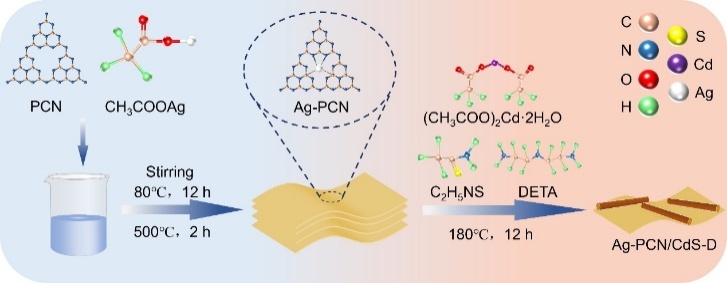
Fig. 1. Schematic illustration of the synthetic route for 10%Ag-PCN/CdS-D.
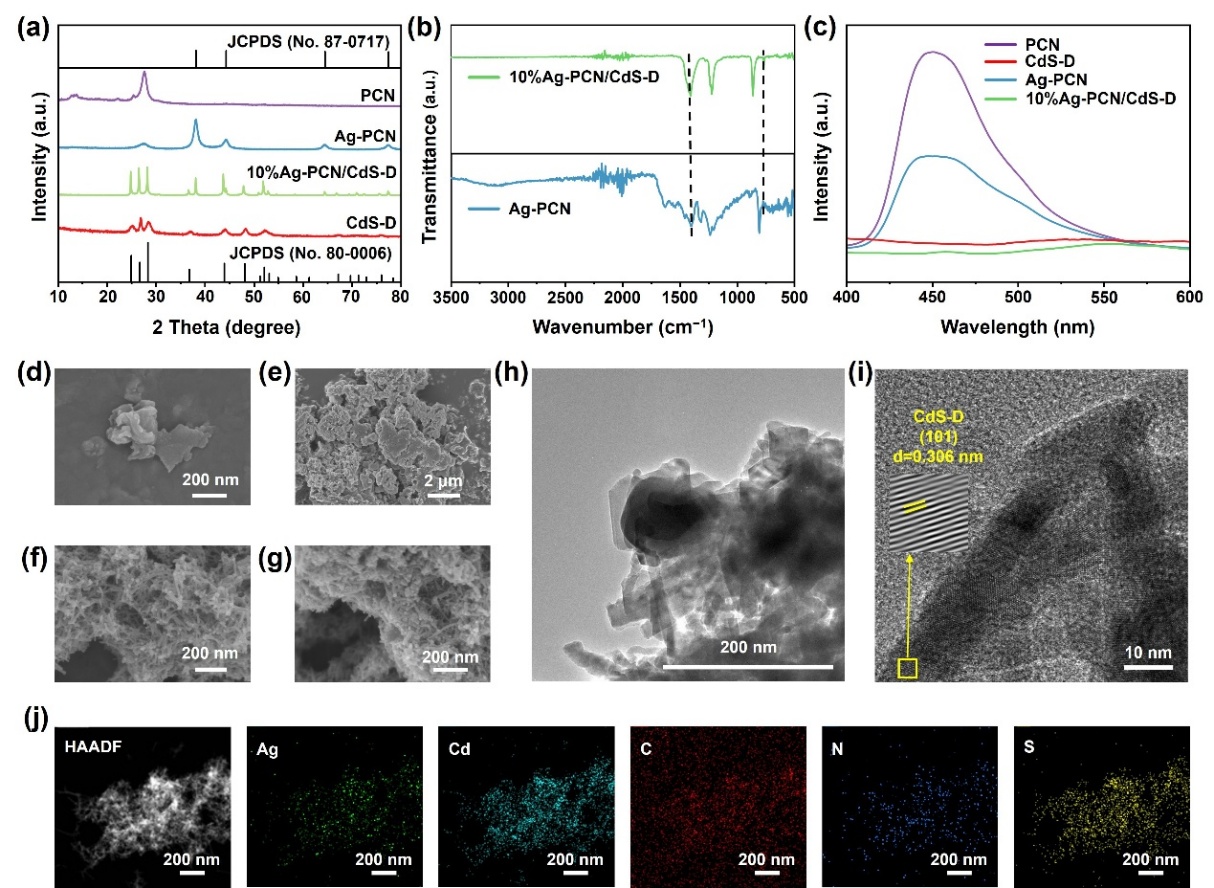
Fig. 2. (a) XRD pattern of PCN, Ag-PCN, 10%Ag-PCN/CdS-D, and CdS-D. (b) FT-IR spectra of Ag-PCN and the 10%Ag-PCN/CdS-D. (c) Photoluminescence spectra of samples. (d-g) SEM images of PCN, Ag-PCN, CdS-D, 10%Ag-PCN/CdS-D. TEM (h) and HRTEM (i) images of 10%Ag-PCN/CdS-D. (j) Elemental mapping of 10%Ag-PCN/CdS-D.
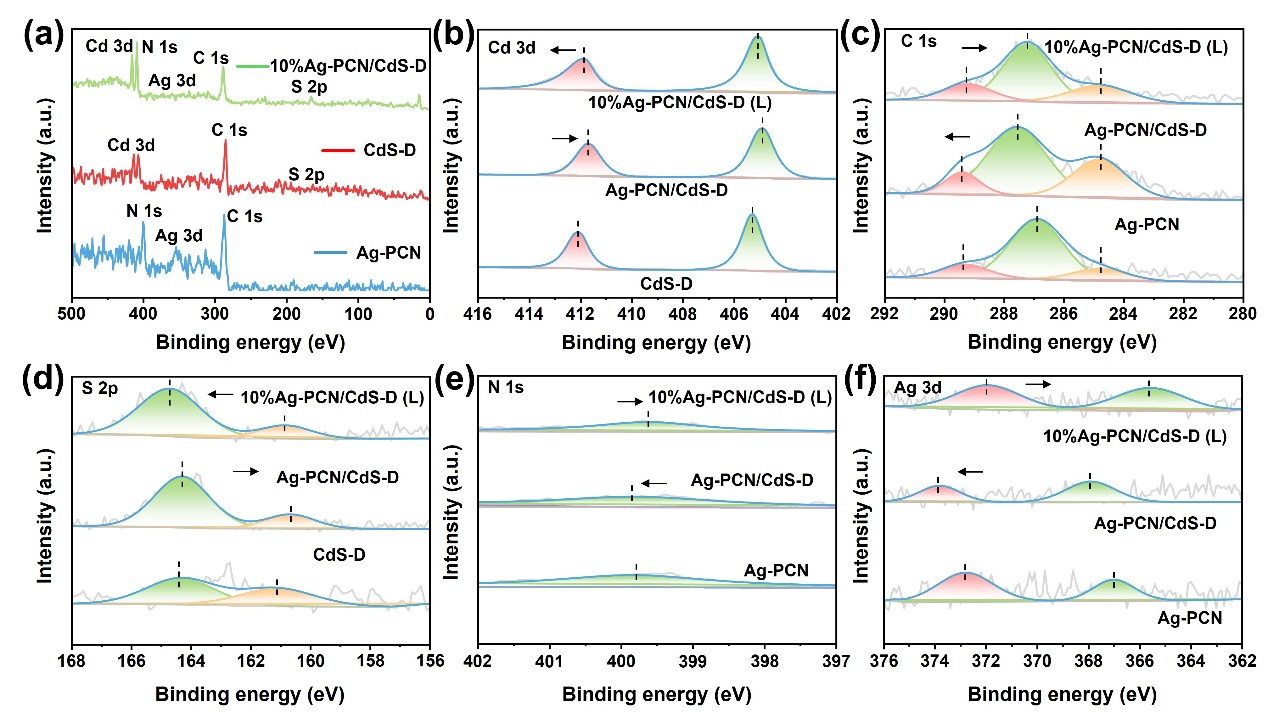
Fig. 3. (a) The XPS spectra of pristine Ag-PCN, 10%Ag-PCN/CdS-D, and CdS-D. The survey XPS spectra: (b) Cd 3d, (c) C 1s, (d) S 2p, (e) N 1s, (f) Ag 3d.
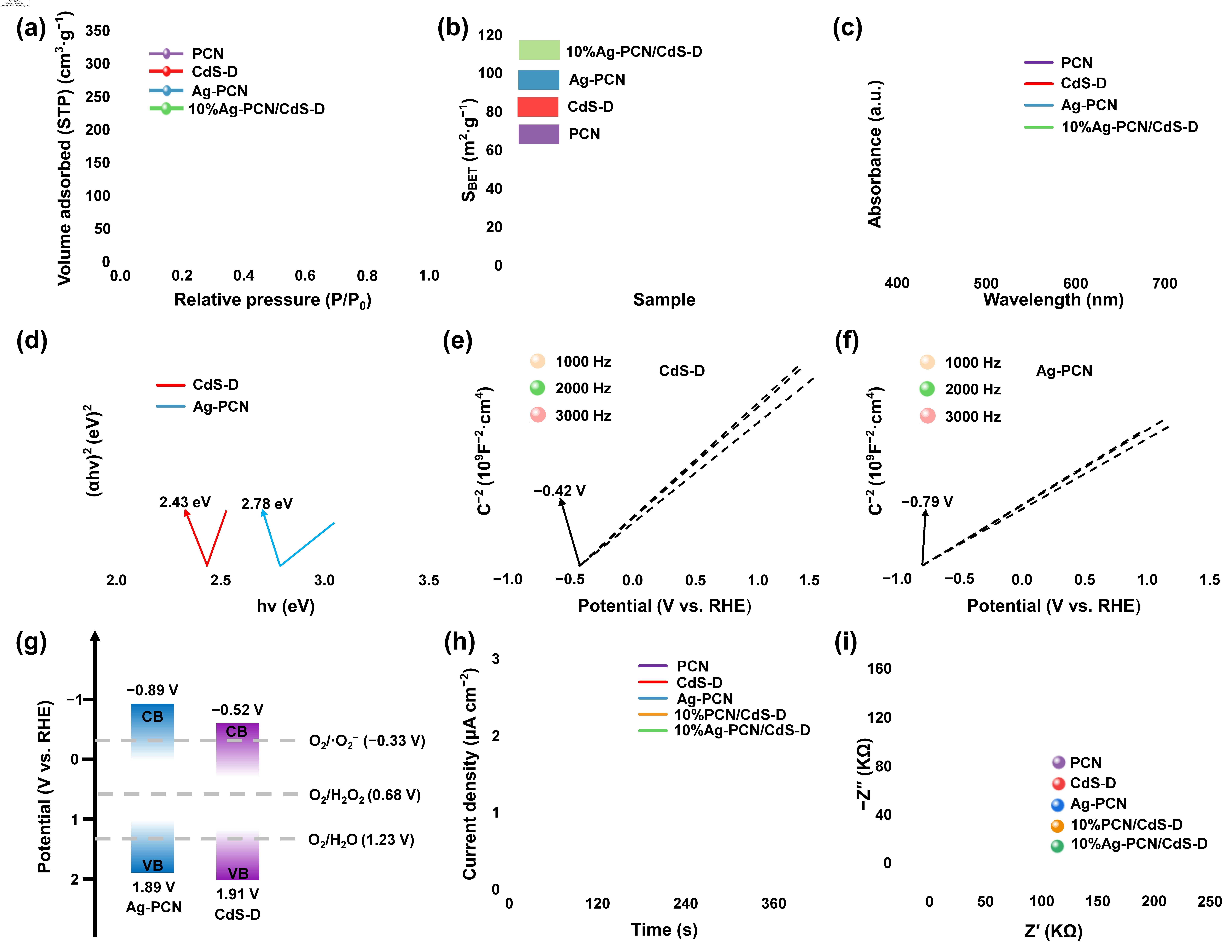
Fig. 4. (a) N2 adsorption-desorption isotherms of the prepared samples. (b) SBET of PCN, Ag-PCN, 10%Ag-PCN/CdS-D, and CdS-D. UV-vis DRS (c) and corresponding profiles (d) derived from the transformed Kubelka-Munk model as a function of incident photon energy for the as-fabricated specimens. (e) Mott-Schottky plots for CdS-D. (f) Mott-Schottky plots for Ag-PCN. (g) The band structure of Ag-PCN and CdS-D. (h) Photocurrent-time curves of photocatalysts. (i) Nyquist plots of electrochemical impedance spectra.
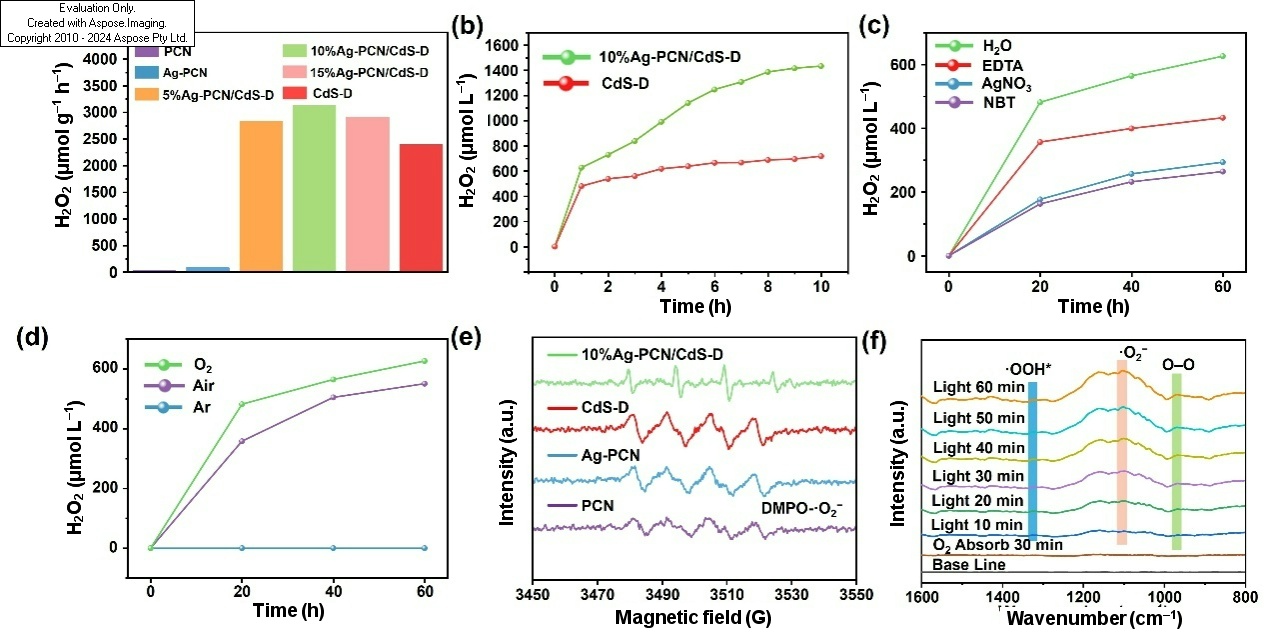
Fig. 5. (a) The catalytic PHP performance graph. (b) The productions of H2O2 with prolonged reaction time. (c) Comparison of H2O2 production by 10%Ag-PCN/CdS-D under different conditions over 1 h: H2O, EDTA (0.5 mmol L-1), NBT (0.06 mmol L-1), and AgNO3 (0.5 mmol L-1). (d) Control tests: air atmosphere, Ar atmosphere and O2 atmosphere. (e) •O2- was registered by EPR capture tests under photoirradiation. (f) In situ FT-IR spectra of 10%Ag-PCN/CdS-D in photocatalytic reaction.
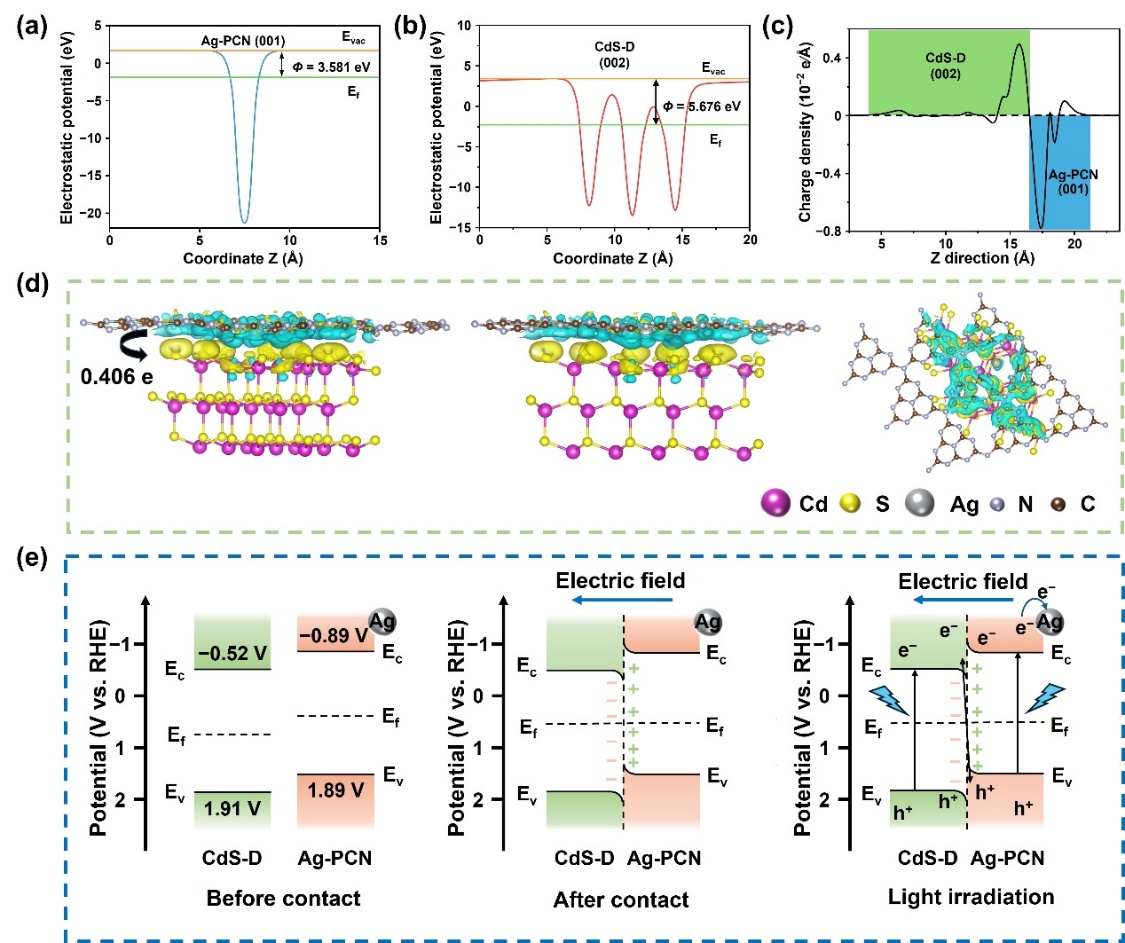
Fig. 6. Electrostatic potentials of Ag-PCN (001) (a) and CdS-D (002) (b) surface. (c) Bader charge analysis of Ag-PCN absorbed with CdS-D. (d) The charge enrichment in yellow regions and charge consumption in cyan regions. (e) The charge migration pathway of S-scheme heterojunction.
|
| [1] | Xiaolong Ma, Zhiqiang Wu, Huiqin Yao, Bin Liu, Zhiliang Jin, Paolo Fornasiero. Charging dynamics engineering: Quantum dots-induced full-space electric field cooperative Ag2S QDs/CoWO₄ S-scheme heterojunction boosting photocatalytic hydrogen evolution [J]. Chinese Journal of Catalysis, 2026, 88(9): 233-246. |
| [2] | Gaoxiong Liu, Rundong Chen, Bingquan Xia, Xianlong Zhou, Laiquan Li, Shantang Liu. Thiadiazole-functionalized covalent triazine frameworks for constructing S-scheme heterojunctions enabling boosted H2O2 photosynthesis [J]. Chinese Journal of Catalysis, 2026, 87(8): 170-184. |
| [3] | Hao Wu, Xinyu Zeng, Wang Wang, Bei Cheng, Jingzhao Cheng, Jingsan Xu, Shaowen Cao. The organic-inorganic S-scheme heterojunction with enhanced charge separation simultaneously catalyze the production of hydrogen and imine [J]. Chinese Journal of Catalysis, 2026, 87(8): 185-196. |
| [4] | Shijie Li, Rui Li, Yanping Liu, Xin Yu, Deyun Ma, Jianhui Jiang, Xiaosong Zhou, Chunqiang Zhuang, Zaiwang Zhao, Wei Jiang. Augmented reactive oxygen species generation in Ag/AgBr/C3N5 via LSPR-enhanced S-scheme charge transfer for efficient photocatalytic antibiotic wastewater remediation [J]. Chinese Journal of Catalysis, 2026, 87(8): 126-139. |
| [5] | Yatai Zhou, Chengcheng Yuan, Wei Xia, Jun Wang, Xiaofeng Zhu, Yong Zhang, Bicheng Zhu, Jiaguo Yu. Synergistic optimization of interfacial electron transfer and surface hydrogen adsorption in a CdS/ZnO S-scheme heterojunction by site-specific doping: A DFT study [J]. Chinese Journal of Catalysis, 2026, 86(7): 327-337. |
| [6] | Ping Li, Liang Wei, Wei Xia, Chengcheng Yuan, Chenbin Ai, Meng Li. Ultrafast electron transfer in 2D/2D g-C3N4/WO3 S-scheme heterojunctions for enhanced H2O2 production [J]. Chinese Journal of Catalysis, 2026, 85(6): 333-345. |
| [7] | Jintao Dong, Rui Zhang, Zhishuai Wang, Shengqun Cao, Lina Li, Gaopeng Liu, Bin Wang, Yixuan Gao, Jiexiang Xia. Construction of S-scheme MnO2/BiOCl heterojunction boosting photocatalytic low-concentration peroxymonosulfate activation for contaminants removal [J]. Chinese Journal of Catalysis, 2026, 85(6): 310-321. |
| [8] | Yong Zhang, Wenjun Zhu, Yanyan Zhao, Shumin Zhang. In2S3/HOF S-scheme heterojunction for enhanced photocatalytic H2O2 production [J]. Chinese Journal of Catalysis, 2026, 84(5): 261-273. |
| [9] | Ziyi Liao, Lan Jiang, Yang Yang, Lin Wang, Weiyou Yang, Huilin Hou. Alkali-cyano dual-tailored g-C3N4/BiOCl S-scheme heterojunctions for highly efficient visible-light-driven H2O2 photosynthesis in pure water [J]. Chinese Journal of Catalysis, 2026, 83(4): 143-161. |
| [10] | R. Kavitha, C. Manjunatha, S. Girish Kumar. ZnO-based S-scheme heterojunction: Design principles, preparation methods and photocatalytic activity [J]. Chinese Journal of Catalysis, 2026, 83(4): 54-95. |
| [11] | Keshan Tang, Wanyi Deng, Ningyuan Wang, Yang Xia, Xinhe Wu, Heng Yang. Triazine-based COF/TiO2 S-scheme heterojunction with oxygen vacancies for efficient photocatalytic CO2 reduction [J]. Chinese Journal of Catalysis, 2026, 83(4): 244-257. |
| [12] | Kaiqiang Xu, Wenjun Zhu, Mahmoud Sayed, Sheng Han. Design and preparation of 1D-based S-scheme photocatalysts [J]. Chinese Journal of Catalysis, 2026, 83(4): 24-53. |
| [13] | Jing Zhang, Xidong Zhang, Kaiyan Wang, Xuefei Wang, Ping Wang, Feng Chen, Huogen Yu. Citric directional coordination for efficient photocatalytic synthesis of H2O2 with high value-added β-Ketoglutaric acid [J]. Chinese Journal of Catalysis, 2026, 82(3): 201-211. |
| [14] | Wanggang Zhang, Haochen Xie, Hongliang Wang, Rufeng Tian, Lei Liu, Jian Wang, Yiming Liu. Atomic-level lattice matching in hexagonal WO3/TiO2 S-scheme heterojunctions for high-efficiency selective photoelectrocatalytic glycerol-to-dihydroxyacetone conversion [J]. Chinese Journal of Catalysis, 2026, 82(3): 161-173. |
| [15] | Chunyuan Chen, Zhongliao Wang, Ying Ma, Bo Weng, Shifu Chen, Sugang Meng. Synergistic effect of S-doping and nitrogen-vacancy engineering on 2D/3D S-scheme photocatalyst for efficient photosynthesis of H2O2 [J]. Chinese Journal of Catalysis, 2026, 82(3): 278-291. |
| Viewed | ||||||
|
Full text |
|
|||||
|
Abstract |
|
|||||


