
Chinese Journal of Catalysis ›› 2027, Vol. 92: 248-261.DOI: 10.1016/S1872-2067(26)65196-0
• Articles • Previous Articles Next Articles
Zizhan Lianga,1, Xiaolin Wanga,1, Zhilin Honga, Xinao Lia, Xinbang Penga, Lilin Tanb,*( ), Limin Xiaoc, Yecheng Zhoua,*(), Junmin Liua,*()
Received:2026-02-26
Accepted:2026-04-02
Online:2027-01-02
Published:2026-10-30
Contact:
*E-mail: tanll@ccelab.com.cn (L.-L. Tan),About author:First author contact:1 Contributed equally to this work.
Supported by:Zizhan Liang, Xiaolin Wang, Zhilin Hong, Xinao Li, Xinbang Peng, Lilin Tan, Limin Xiao, Yecheng Zhou, Junmin Liu. Cobalt-coordinated covalent organic framework as a versatile water oxidation catalyst in dye-sensitized photoelectrochemical cells for solar water splitting[J]. Chinese Journal of Catalysis, 2027, 92: 248-261.
Add to citation manager EndNote|Ris|BibTeX
URL: https://www.cjcatal.com/EN/10.1016/S1872-2067(26)65196-0
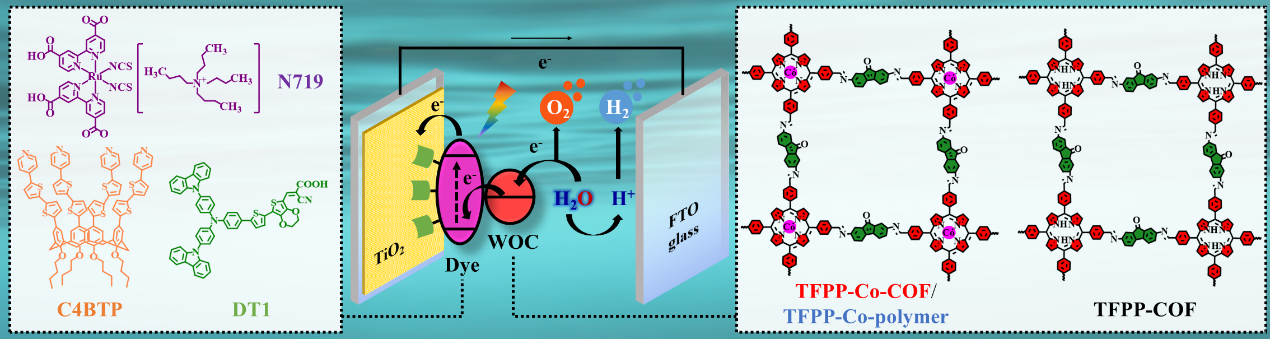
Scheme 1. Schematic diagram of DSPEC device based on OPPs (middle) and chemical structures of dyes (left) and WOCs (right).
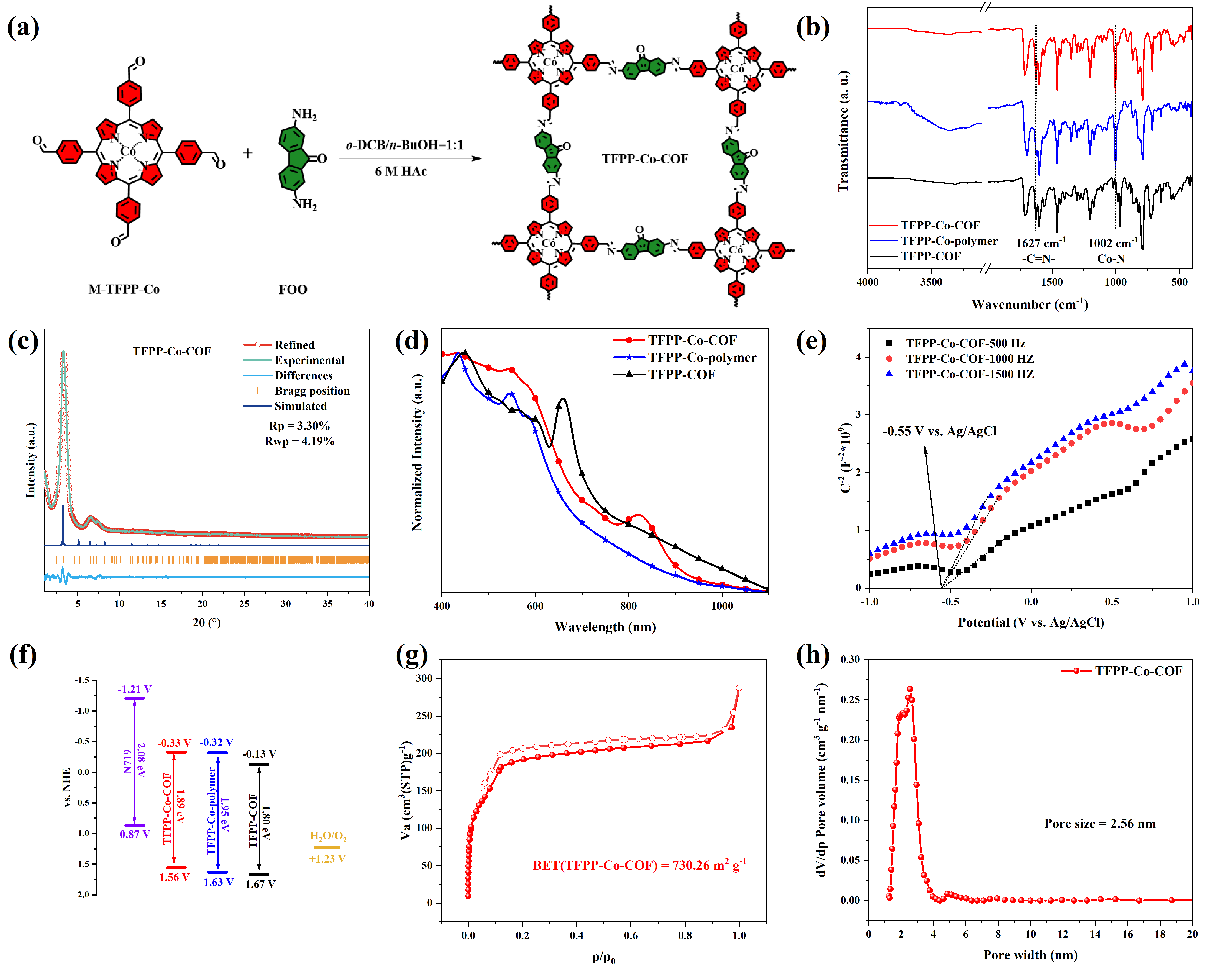
Fig. 1. (a) The synthetic route of TFPP-Co-COF under solvothermal conditions. (b) FT-IR spectra of TFPP-Co-COF, TFPP-Co-polymer and TFPP-COF. (c) Experimental, Pawley-refined, and simulated PXRD patterns of TFPP-Co-COF (Rp: unweighted-profile factor; Rwp: weighted-profile factor). (d) Solid-state UV-vis spectra of TFPP-Co-COF, TFPP-Co-polymer and TFPP-COF. (e) Mott-Schottky plot of TFPP-Co-COF. (f) Energy level diagrams of N719, OPPs and the oxygen evolution oxidation potential of water. (g) The nitrogen adsorption isotherm measured at 77 K and (h) the pore size distribution curves of TFPP-Co-COF.
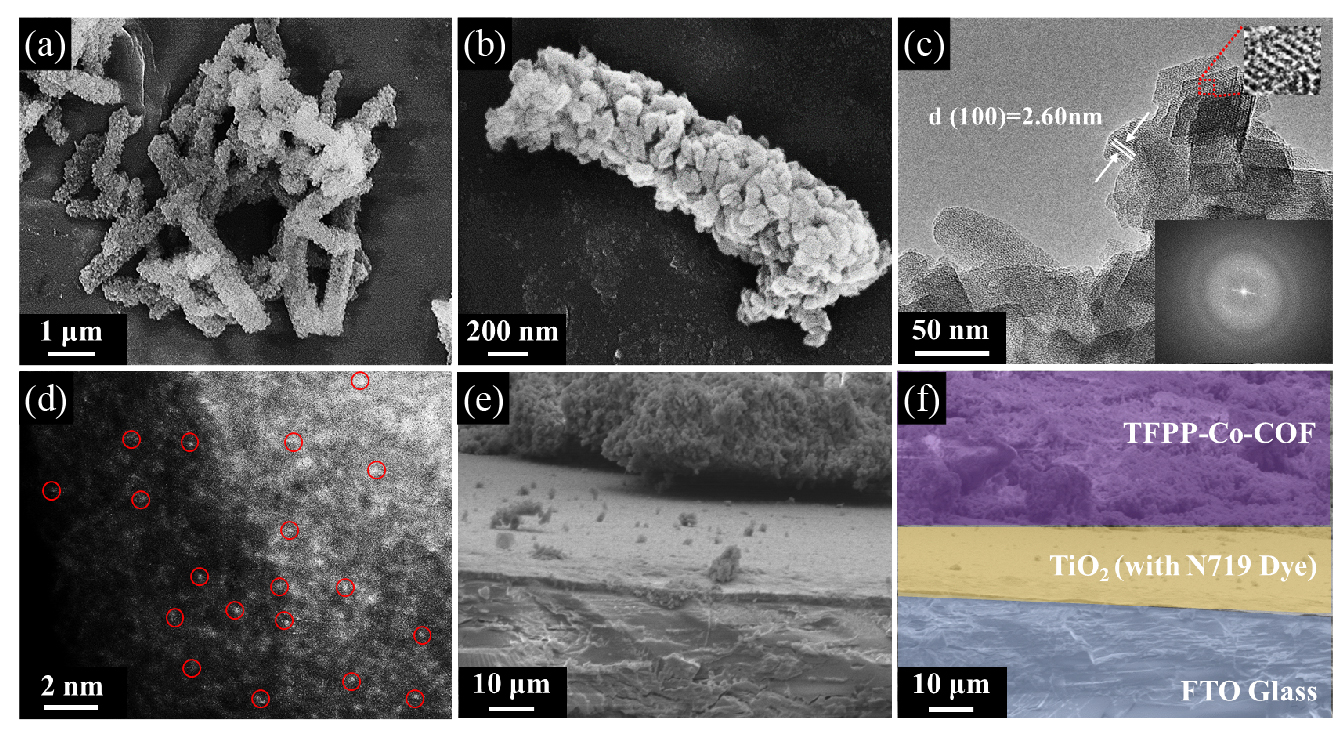
Fig. 2. (a,b) SEM images of TFPP-Co-COF at different magnifications. STEM (c) and AC-TEM (d) images of TFPP-Co-COF. (e) SEM image of FTO|TiO2|N719+TFPP-Co-COF. (f) Profile analysis of electrode structure (Blue area represents FTO glass, yellow area represents TiO2 attached with dye molecules and purple area represents OPPs).
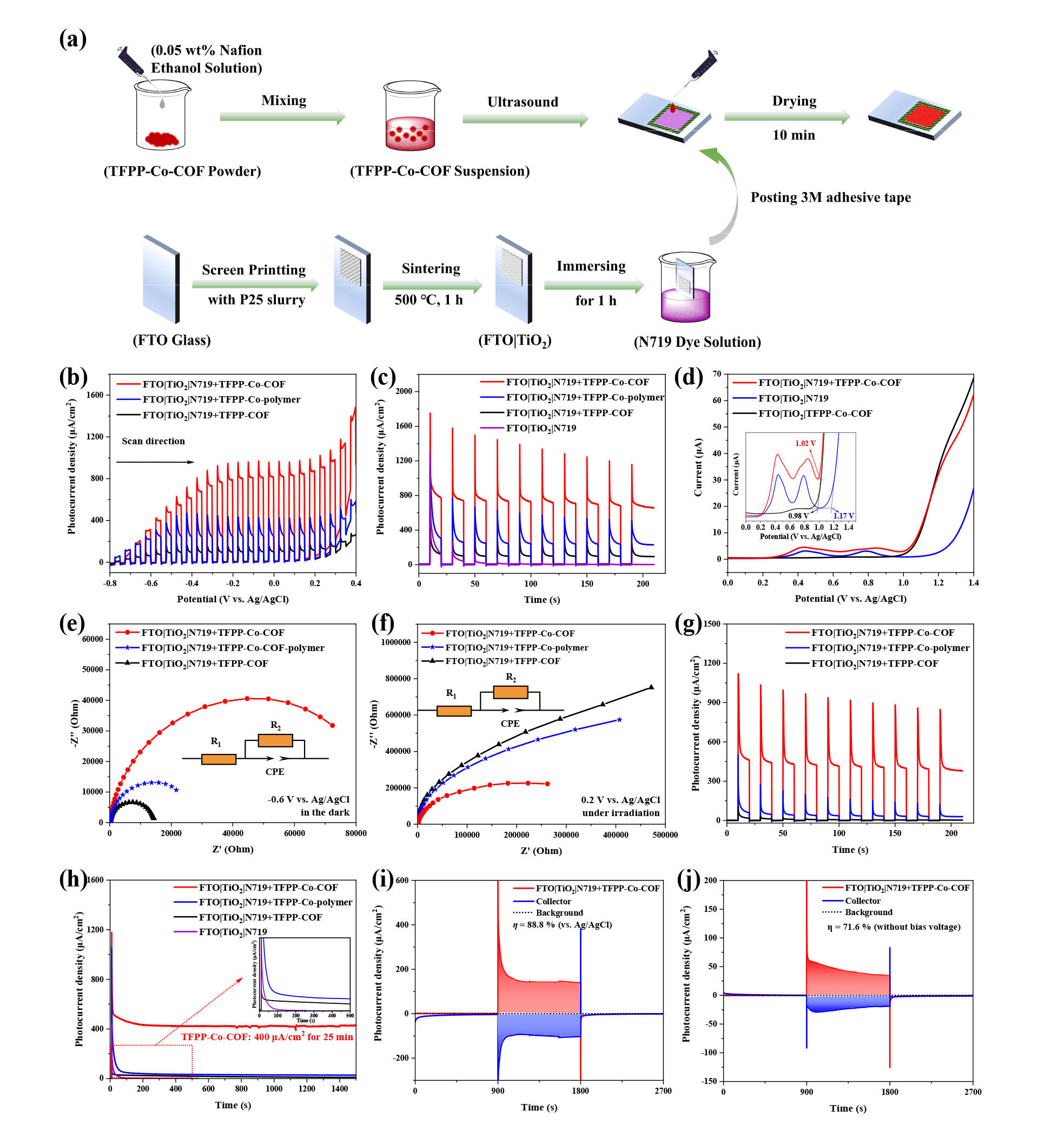
Fig. 3. (a) Schematic diagram of preparation process of sensitized electrode. (b) LSV curves of the N719-sensitized electrodes corresponding to different OPPs under positive scan direction. (c) I-t curves of photoanodes corresponding to the different OPPs with a bias of 0 V vs. Ag/AgCl. (d) DPV curves of FTO|TiO2|N719+TFPP-Co-COF, FTO|TiO2|N719 and FTO|TiO2|TFPP-Co-COF. EIS Nyquist plots of photoanodes in the dark with a bias of -0.6 V vs. Ag/AgCl (R1: series resistance; R2: recombination resistance; CPE: constant phase element) (e) and under irradiation with a bias of 0.2 V vs. Ag/AgCl (R1: series resistance; R2: charge-transfer resistance; CPE: constant phase element) (f). (g) I-t curves of photoanodes corresponding to the different OPPs with a bias of 0 V vs. NHE. (h) Long-term illumination test of electrodes corresponding to different OPPs under illumination without bias voltage in a dual-electrode system. Faradaic efficiency test results of FTO|TiO2|N719+TFPP-Co-COF in three-electrode system at 0 V vs. Ag/AgCl (i) and in dual-electrode system without bias voltage (j).
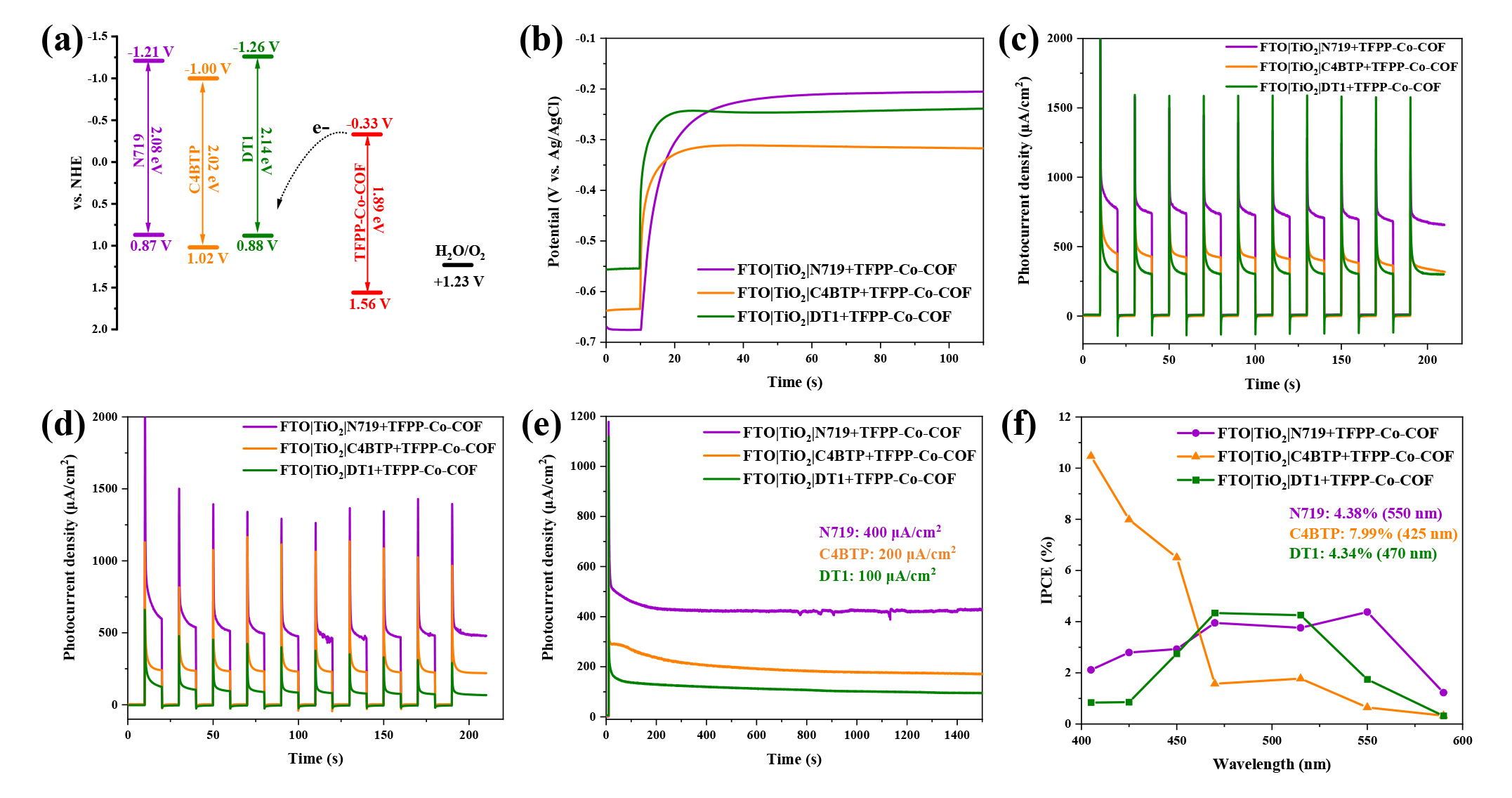
Fig. 4. (a) Energy level diagram of various dyes matching with TFPP-Co-COF. (b) Open circuit voltage-time curves of electrodes sensitized by different dyes. I-t curves of photoanodes sensitized by different dyes with a bias of 0 V vs. Ag/AgCl (c) and with a bias of 0 V vs. NHE (d). (e) Long-term illumination test of electrodes sensitized by different dyes under illumination without bias voltage in a dual-electrode system. (f) IPCE curves of different dye-sensitized electrodes loaded with TFPP-Co-COF.
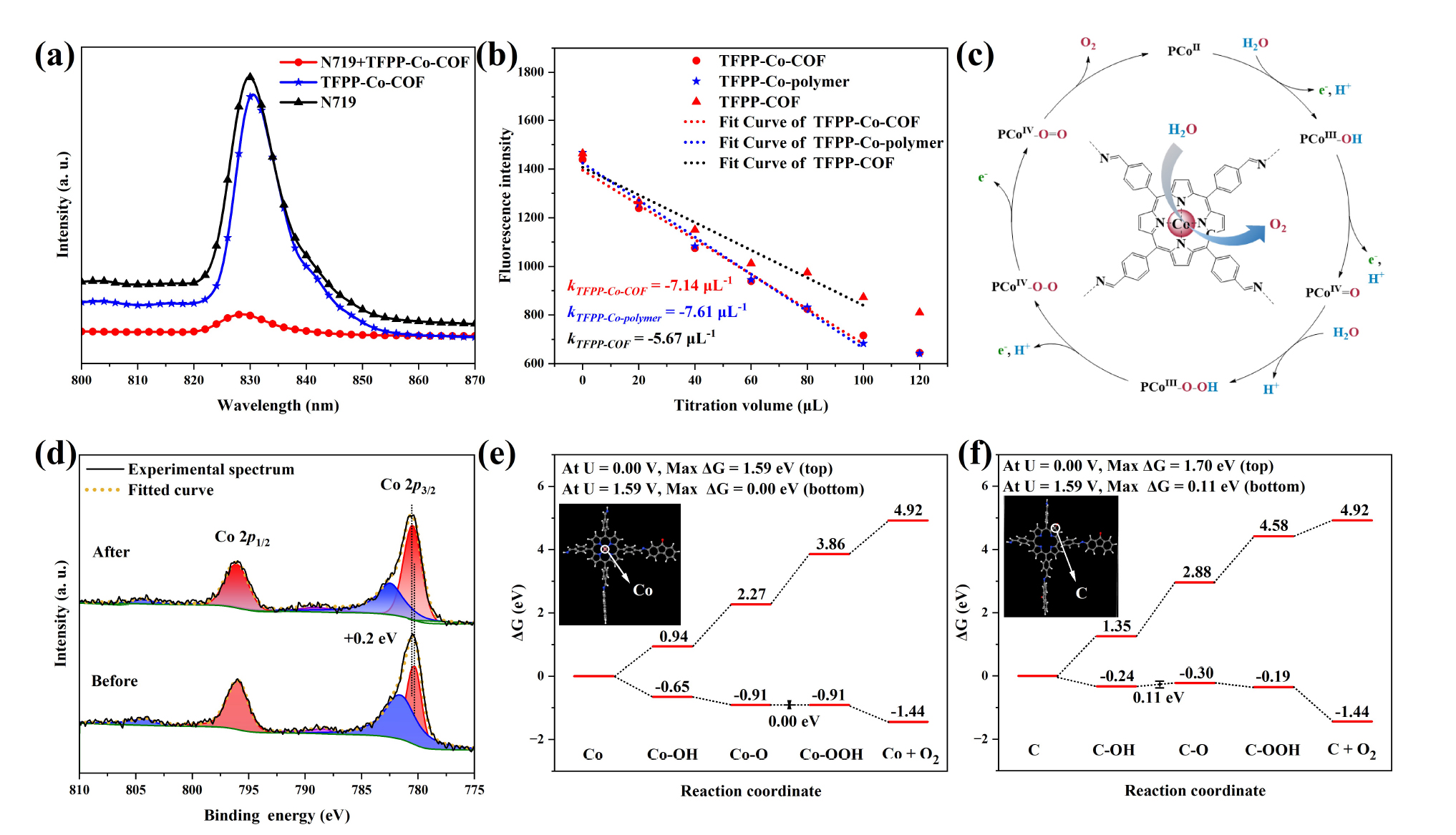
Fig. 5. (a) Solid-state FL spectra of N719, TFPP-Co-COF and their complexes. (b) Fluorescence intensity-titration volume curves of fluorescence quenching experiment of OPPs. (c) Mechanism of water oxidation catalyzed by Co active site on TFPP-Co-COF. (d) XPS spectra of Co on TFPP-Co-COF before and after illumination. (e) Gibbs free energy diagrams for oxygen evolution at Co active sites of TFPP-Co-COF. (f) Gibbs free energy diagrams for direct oxygen evolution at C1 active sites of TFPP-COF.
|
| [1] | Yangpeng Zhang, You Wu, Qianfeng Gu, Yue Gao, Chencheng Cai, Haoyu Liu, Yuehan Zhao, Zhonghua Li, Feng-Ming Zhang, Yang Liu, Qichun Zhang. Engineering local electronic asymmetry in isostructural covalent organic frameworks to maximize charge separation for H2O2 photosynthesis [J]. Chinese Journal of Catalysis, 2027, 92(1): 130-144. |
| [2] | Keke Zhang, Fulin Zhang, Yuexin Wang, Fengwei Huang, Kanghui Xiong, Xiang-Kui Gu, Xianjun Lang. Tweaking the electron push-pull effect of vinylene-linked thienothiophene covalent organic frameworks for enhanced selective photocatalysis [J]. Chinese Journal of Catalysis, 2026, 87(8): 206-216. |
| [3] | Hanxi Li, Zhendong Luo, Qiang Xue, Yunfei Zhi, Jun Du, Xukai Zhou. Engineering channel microenvironment and charge dynamics in covalent organic frameworks through linkage-specific povarov cyclization for enhanced photocatalytic hydrogen evolution [J]. Chinese Journal of Catalysis, 2026, 86(7): 363-374. |
| [4] | Jiaying Liu, Yu Fang. Unraveling structure-activity relationships in 2-D covalent organic frameworks for photocatalysis: From molecular engineering to high-performance optimization [J]. Chinese Journal of Catalysis, 2026, 85(6): 47-87. |
| [5] | Jingyao Wu, Yujing Lv, Qiang Zhao, Shuo Wang, Ying Wang, Na Wen, Zhengxin Ding, Zizhong Zhang, Jinlin Long. Electron-proton duet in covalent organic frameworks for efficient direct oxygen reduction to hydrogen peroxide [J]. Chinese Journal of Catalysis, 2026, 84(5): 288-300. |
| [6] | Wenao Xie, Zhifang Jia, Chang Shu, Tingxia Wang, Jianhong Xi, Jiaxuan Cai, Xiangyang Song, Yu Che, Xiaoyan Wang, Kewei Wang, Bien Tan. Cyano-functionalized covalent organic frameworks for enhanced photocatalytic hydrogen peroxide production via microenvironment engineering [J]. Chinese Journal of Catalysis, 2026, 83(4): 282-293. |
| [7] | Donghua Li, Hongyin Hu, Jinye Zhou, Hanyun Miao, Yu Wu, Jinyan Wang, Baochun Guo, Mingliang Du, Shuanglong Lu. Steering product selectivity via metallic site-dependent pathways in porphyrin-based covalent organic frameworks for electrocatalytic nitrite reduction [J]. Chinese Journal of Catalysis, 2026, 83(4): 258-270. |
| [8] | Ke-Hui Xie, Cong-Xue Liu, Yan Geng, Jing-Lan Kan, Guang-Bo Wang, Yu-Bin Dong. Efficient H2O2 photosynthesis through linker engineering of benzotrithiophene-based covalent organic frameworks [J]. Chinese Journal of Catalysis, 2026, 83(4): 271-281. |
| [9] | Rumeng Zhang, Muke Lin, Yimu Jiao, Cheng Chen, Mengling Hu, Hao Zhou, Dehua Xia. Fe(III)-mediated self-sustaining photo-Fenton system on metal-free pyridine-COF: Interfacial electron transfer for water purification [J]. Chinese Journal of Catalysis, 2026, 82(3): 225-237. |
| [10] | Jiaping Lu, Chao Lin, Chao Li, Hongjie Shi, Nengyi Liu, Wandong Xing, Sibo Wang, Guigang Zhang, Teng-Teng Chen, Xiong Chen. Bipyridine-integrated bisoxazole-based donor-acceptor covalent organic framework for enhanced photocatalytic H2O2 synthesis [J]. Chinese Journal of Catalysis, 2026, 81(2): 185-194. |
| [11] | Bolin Yang, Fei Jin, Zhiliang Jin. Efficient photocatalytic hydrogen production by a heterojunction strategy with covalent organic frameworks loaded with non-precious-metal semiconductors [J]. Chinese Journal of Catalysis, 2026, 81(2): 172-184. |
| [12] | Zeng Li, Mingfei Yu, Liuyi Li, Yan Yu. Hole-confining covalent organic frameworks for photosynthesis of H2O2 and H2 from pure water [J]. Chinese Journal of Catalysis, 2026, 91(12): 263-273. |
| [13] | Tengyuan Gao, Aoyu Shu, Xiufan Liu, Xinhe Wu, Guohong Wang. Organic-inorganic DVA-COF@TiO2 S-scheme heterojunction for highly selective photocatalytic reduction of CO2 to CO [J]. Chinese Journal of Catalysis, 2026, 90(11): 197-209. |
| [14] | Zixian Guo, Youhang He, Mingfei Yu, Liuyi Li, Jinhong Bi, Yan Yu, Ling Wu. Multiscale engineering of COFs toward practical photocatalysis: From heterojunction design to membrane fabrication [J]. Chinese Journal of Catalysis, 2026, 89(10): 142-176. |
| [15] | Xuan Zhang, Lin Zhou, Teng Yan, Xiaohu Zhang, Hao Chen. Fabrication of S-scheme heterojunction between covalent organic frameworks and Ni-ZIF-8 and its photocatalytic hydrogen production performance [J]. Chinese Journal of Catalysis, 2026, 80(1): 200-212. |
| Viewed | ||||||
|
Full text |
|
|||||
|
Abstract |
|
|||||


