
Chinese Journal of Catalysis ›› 2026, Vol. 91: 241-251.DOI: 10.1016/S1872-2067(26)65203-5
• Articles • Previous Articles Next Articles
Zhuangzhuang Wanga, Yuan Lia, Qiang Chenga, Xiaotian Wanga, Bin Liub,c, Gaoke Zhanga,*( )
)
Received:2025-12-18
Accepted:2026-02-04
Online:2026-12-18
Published:2026-10-13
Supported by:Zhuangzhuang Wang, Yuan Li, Qiang Cheng, Xiaotian Wang, Bin Liu, Gaoke Zhang. Boosting sequential single-electron O2 reduction reaction on S-scheme SbVO4/PCN heterojunction for efficient artificial photosynthesis of H2O2 under ambient condition[J]. Chinese Journal of Catalysis, 2026, 91: 241-251.
Add to citation manager EndNote|Ris|BibTeX
URL: https://www.cjcatal.com/EN/10.1016/S1872-2067(26)65203-5
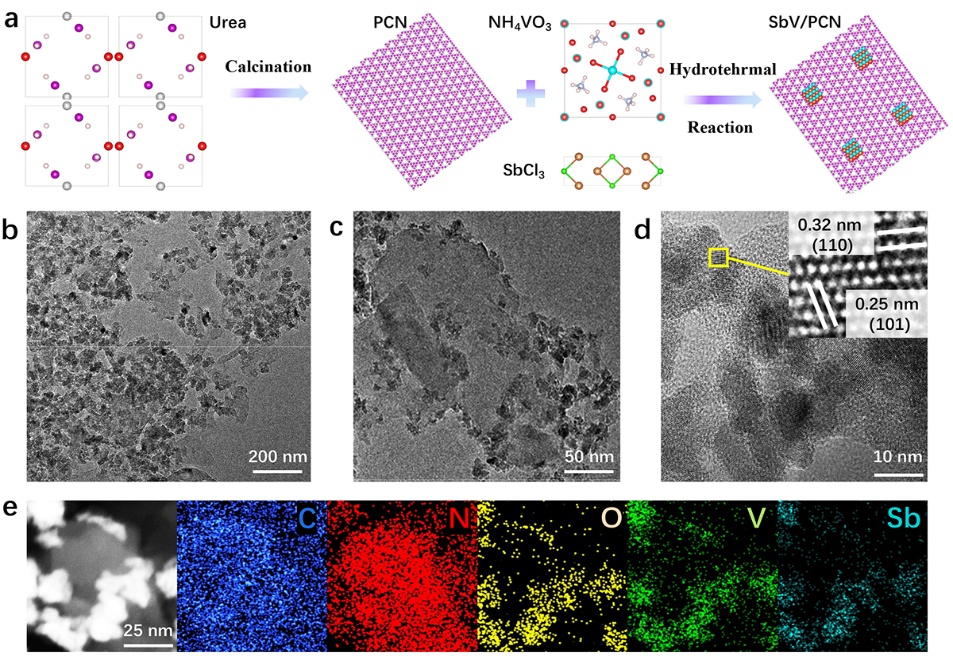
Fig. 1. (a) Schematic illustration showing the synthetic process of 10-SbV/PCN nanocomposites. (b,c) TEM images of 10-SbV/PCN nanocomposites. (d) HRTEM image of 10-SbV/PCN nanocomposites. (e) EDS elemental mapping images of 10-SbV/PCN nanocomposites.
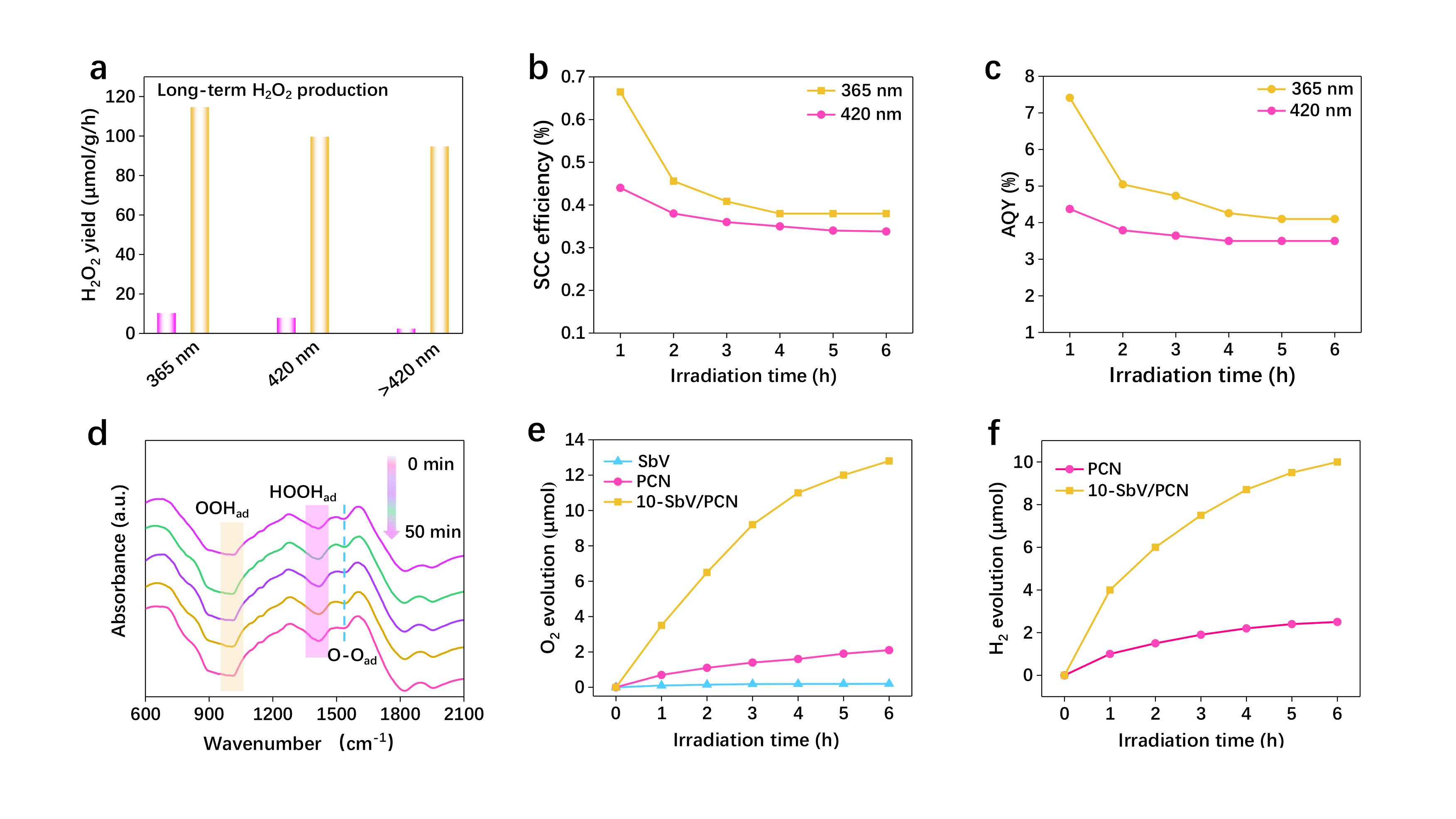
Fig. 2. (a) Long-term photocatalytic H2O2 production catalyzed by pristine PCN (pink color) and 10-SbV/PCN (yellow color) under different irradiation wavelength. (b) Solar-to-chemical conversion efficiency of 10-SbV/PCN under 365 and 420 nm light irradiation in pure water and open air. (c) Apparent quantum yield of 10-SbV/PCN under 365 and 420 nm light irradiation in pure water and open air. (d) In-situ DRIFTS spectra recorded over 10-SbV/PCN. Photocatalytic O2 (e) and H2 (f) evolution over PCN and 10-SbV/PCN.
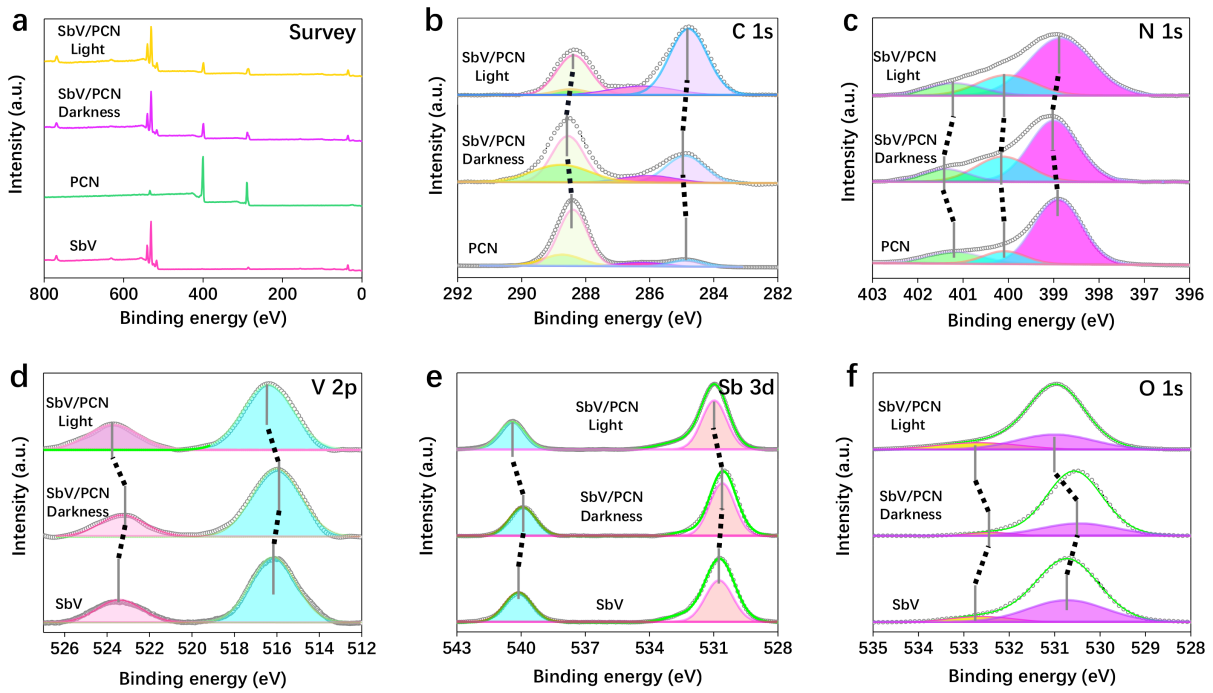
Fig. 3. (a) In-situ and ex-situ survey XPS spectra of different catalysts. In-situ and ex-situ high-resolution XPS spectra of C 1s (b), N 1s (c), V 3d (d), Sb 3d (e), and O 1s (f). In-situ XPS spectra were collected under the irradiation of 365 nm light.
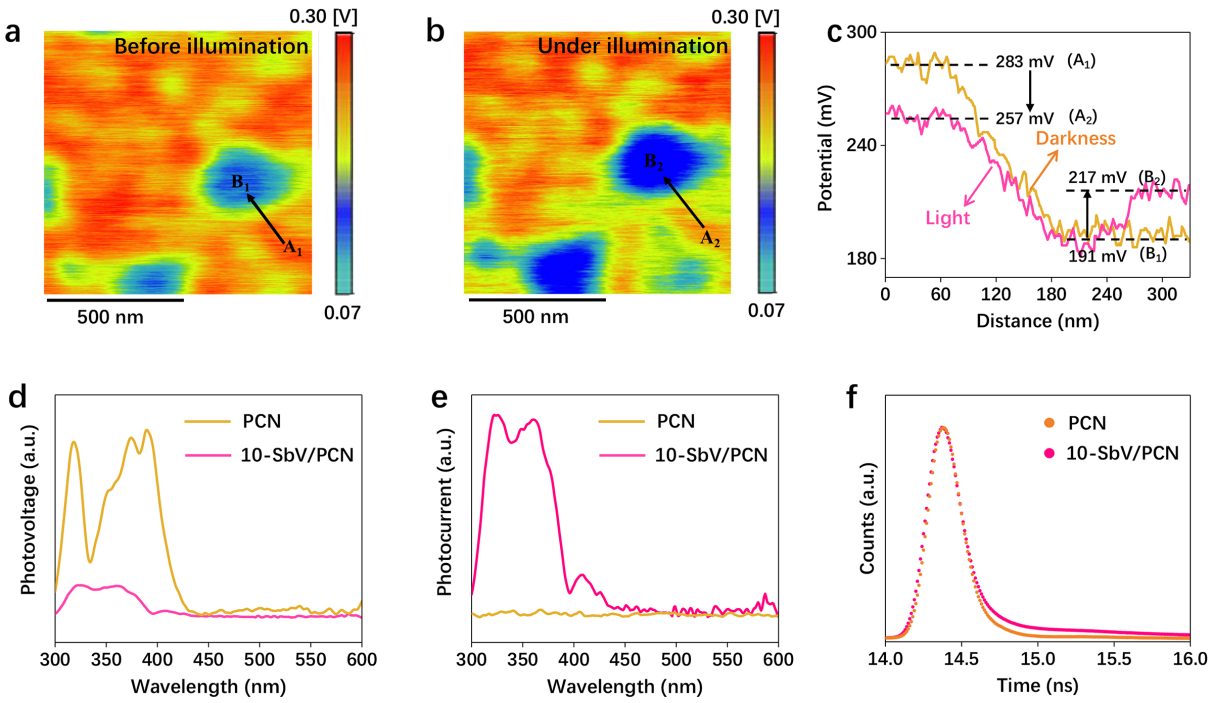
Fig. 4. Surface potential distribution of 10-SbV/PCN in dark (a) and under 365 nm light irradiation (b). (c) The line-scanning surface potential from A1 to B1 in dark and A2 to B2 under 365 nm light irradiation, respectively. (d) Surface photovoltage spectra of pristine PCN and 10-SbV/PCN. (e) Surface photocurrent spectra of PCN and 10-SbV/PCN. (f) TRPL spectra of PCN and 10-SbV/PCN.
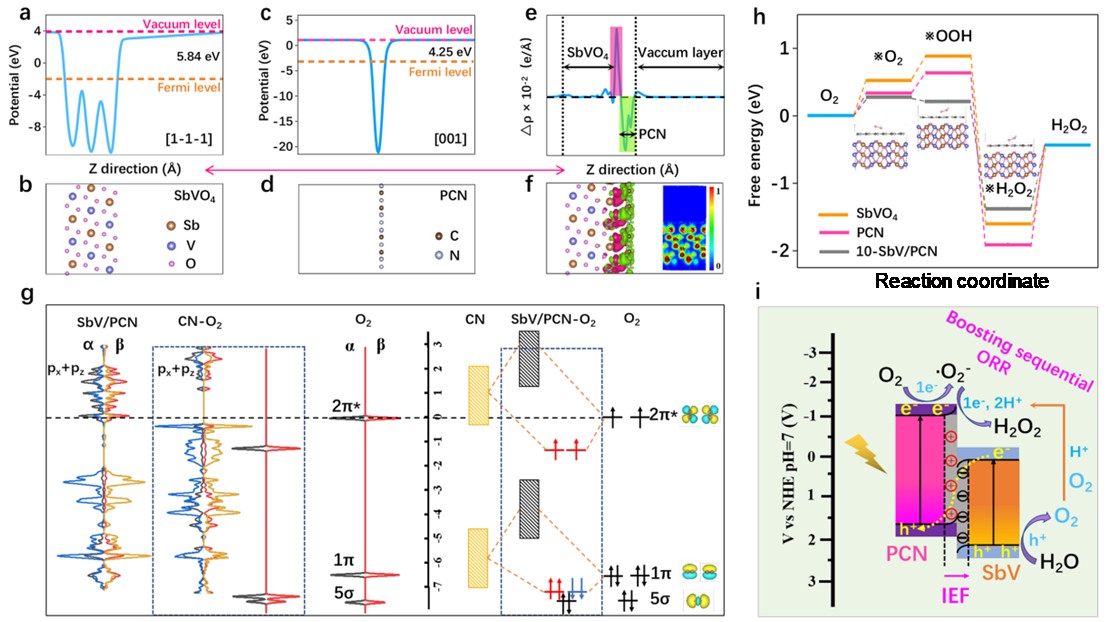
Fig. 5. The calculated electrostatic potential of (111) plane of SbV (a) and its corresponding structural model along the [111] direction (b). The calculated electrostatic potential of (001) plane of PCN (c) and its corresponding structural model along the [001] direction (d). The planar-averaged electron density difference Δρ (e) and the side-view of the charge density difference (f) over the SbV/PCN heterojunction. Inset shows the electronic location function of SbV/PCN (the red and green colors represent electron accumulation and depletion, respectively). (g) The interaction of px+py orbitals of SbV/PCN and O2 orbitals after O2 adsorption on SbV/PCN. (h) Free energy of sequential single-electron ORR. (i) Proposed photocatalytic mechanism of SbV/PCN heterojunction for robust production of H2O2.
|
| [1] | Yuhang Sun, Xu Li, Zhongtian Zeng, Hua Wei, Yulong Zhao, Xiaoyan Cai, Liang Mao, Chang-Long Tan, Bo Shen, Yi-Jun Xu. Sulfur-induced charge-site reconstruction and in-situ formed ZnO2 protection enable robust solar H2O2 production [J]. Chinese Journal of Catalysis, 2026, 88(9): 207-217. |
| [2] | Xiaolong Ma, Zhiqiang Wu, Huiqin Yao, Bin Liu, Zhiliang Jin, Paolo Fornasiero. Charging dynamics engineering: Quantum dots-induced full-space electric field cooperative Ag2S QDs/CoWO₄ S-scheme heterojunction boosting photocatalytic hydrogen evolution [J]. Chinese Journal of Catalysis, 2026, 88(9): 233-246. |
| [3] | Gaoxiong Liu, Rundong Chen, Bingquan Xia, Xianlong Zhou, Laiquan Li, Shantang Liu. Thiadiazole-functionalized covalent triazine frameworks for constructing S-scheme heterojunctions enabling boosted H2O2 photosynthesis [J]. Chinese Journal of Catalysis, 2026, 87(8): 170-184. |
| [4] | Hao Wu, Xinyu Zeng, Wang Wang, Bei Cheng, Jingzhao Cheng, Jingsan Xu, Shaowen Cao. The organic-inorganic S-scheme heterojunction with enhanced charge separation simultaneously catalyze the production of hydrogen and imine [J]. Chinese Journal of Catalysis, 2026, 87(8): 185-196. |
| [5] | Sue-Faye Ng, Joel Jie Foo, Karlo Nolkemper, Zahra Hajiahmadi, Jaya Bharti, Nannan Hou, Jiankang Zheng, Thomas D. Kühne, Markus Antonietti, Christian Mark Pelicano, Wee-Jun Ong. Triazole ring functionalized poly(heptazine imide): Leveraging donor- acceptor configuration toward enhanced solar-driven H2O2 synthesis [J]. Chinese Journal of Catalysis, 2026, 87(8): 140-155. |
| [6] | Shijie Li, Rui Li, Yanping Liu, Xin Yu, Deyun Ma, Jianhui Jiang, Xiaosong Zhou, Chunqiang Zhuang, Zaiwang Zhao, Wei Jiang. Augmented reactive oxygen species generation in Ag/AgBr/C3N5 via LSPR-enhanced S-scheme charge transfer for efficient photocatalytic antibiotic wastewater remediation [J]. Chinese Journal of Catalysis, 2026, 87(8): 126-139. |
| [7] | Hua Gao, Yong Zhu, Zhibing Wen, Ran Zhao, Zhi Chen, Siyao Wang, Shuanglin He, Kuang Peng, Yiwen Tang, Licheng Sun, Fei Li. Efficient and selective photocatalytic CO2 conversion enabled by FePc nanosheets in a dye-sensitized system [J]. Chinese Journal of Catalysis, 2026, 86(7): 350-362. |
| [8] | Yatai Zhou, Chengcheng Yuan, Wei Xia, Jun Wang, Xiaofeng Zhu, Yong Zhang, Bicheng Zhu, Jiaguo Yu. Synergistic optimization of interfacial electron transfer and surface hydrogen adsorption in a CdS/ZnO S-scheme heterojunction by site-specific doping: A DFT study [J]. Chinese Journal of Catalysis, 2026, 86(7): 327-337. |
| [9] | Ping Li, Liang Wei, Wei Xia, Chengcheng Yuan, Chenbin Ai, Meng Li. Ultrafast electron transfer in 2D/2D g-C3N4/WO3 S-scheme heterojunctions for enhanced H2O2 production [J]. Chinese Journal of Catalysis, 2026, 85(6): 333-345. |
| [10] | Jintao Dong, Rui Zhang, Zhishuai Wang, Shengqun Cao, Lina Li, Gaopeng Liu, Bin Wang, Yixuan Gao, Jiexiang Xia. Construction of S-scheme MnO2/BiOCl heterojunction boosting photocatalytic low-concentration peroxymonosulfate activation for contaminants removal [J]. Chinese Journal of Catalysis, 2026, 85(6): 310-321. |
| [11] | Baolong Zhang, Bin Sun, Xingpeng Liu, Wenyu Liu, Shaonan Gu, Guowei Zhou. Defect-engineered S-scheme charge transfer in TiO2/Zn0.5Cd0.5S heterojunction for high-efficiency photocatalytic hydrogen evolution [J]. Chinese Journal of Catalysis, 2026, 84(5): 117-129. |
| [12] | Rongxing Chen, Yongkang Quan, Weilong Cai, Yun Hau Ng, Jianying Huang, Yuekun Lai. Synergistic band and electronic engineering in cyano-oxygen co-functionalized carbon nitride for efficient photocatalytic H2O2 synthesis [J]. Chinese Journal of Catalysis, 2026, 84(5): 250-260. |
| [13] | Yong Zhang, Wenjun Zhu, Yanyan Zhao, Shumin Zhang. In2S3/HOF S-scheme heterojunction for enhanced photocatalytic H2O2 production [J]. Chinese Journal of Catalysis, 2026, 84(5): 261-273. |
| [14] | Ziyi Liao, Lan Jiang, Yang Yang, Lin Wang, Weiyou Yang, Huilin Hou. Alkali-cyano dual-tailored g-C3N4/BiOCl S-scheme heterojunctions for highly efficient visible-light-driven H2O2 photosynthesis in pure water [J]. Chinese Journal of Catalysis, 2026, 83(4): 143-161. |
| [15] | R. Kavitha, C. Manjunatha, S. Girish Kumar. ZnO-based S-scheme heterojunction: Design principles, preparation methods and photocatalytic activity [J]. Chinese Journal of Catalysis, 2026, 83(4): 54-95. |
| Viewed | ||||||
|
Full text |
|
|||||
|
Abstract |
|
|||||


