
Chinese Journal of Catalysis ›› 2026, Vol. 91: 210-221.DOI: 10.1016/S1872-2067(26)65225-4
• Articles • Previous Articles Next Articles
Jing Xiea,b,1, Ying Tanga,c,1, Songbo Yeb, Wentao Baoa, Tiantian Wanga, Yunxia Zhaoa, Shifu Wangd, Jie Yue, Xuning Lid, Hao Lib,*( ), Feng Yua,*()
Received:2026-01-27
Accepted:2026-04-29
Online:2026-12-18
Published:2026-10-13
About author:1Contributed equally to this work.
Supported by:Jing Xie, Ying Tang, Songbo Ye, Wentao Bao, Tiantian Wang, Yunxia Zhao, Shifu Wang, Jie Yu, Xuning Li, Hao Li, Feng Yu. Activating synergetic adsorbate evolution and lattice oxygen mechanisms in NiFe-LDH via M-O-Si bonding for improved oxygen evolution reaction[J]. Chinese Journal of Catalysis, 2026, 91: 210-221.
Add to citation manager EndNote|Ris|BibTeX
URL: https://www.cjcatal.com/EN/10.1016/S1872-2067(26)65225-4
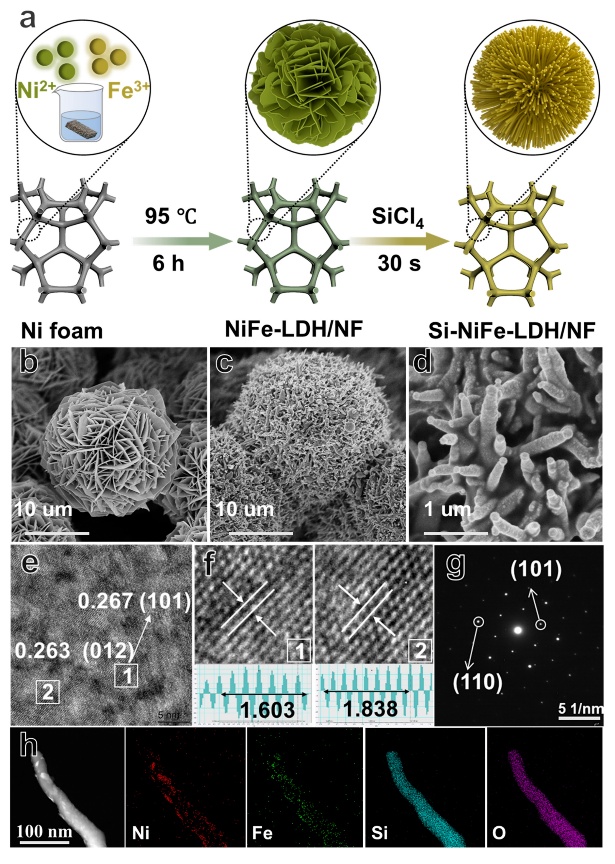
Fig. 1. (a) Schematic of SiCl4 etching for NiFe-LDH/NF nanoflowers. SEM images of NiFe-LDH/NF (b) and Si-NiFe-LDH/NF (c,d). (e,f) HRTEM images of Si-NiFe-LDH/NF. (g) Selected area electron diffraction pattern of Si-NiFe-LDH/NF. (h) EDX elemental-mapping results of Si-NiFe-LDH/NF.
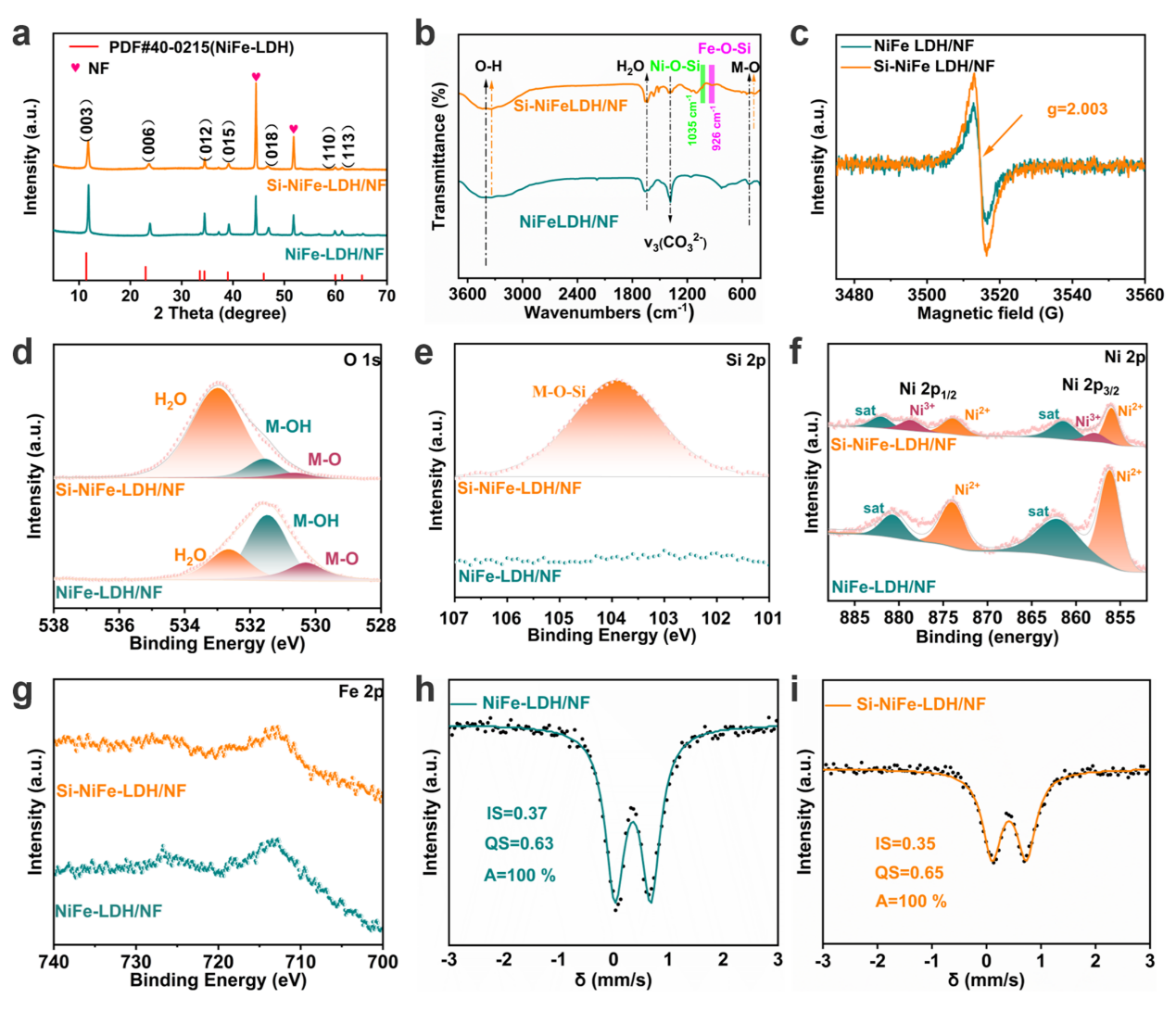
Fig. 2. XRD patterns (a), FTIR spectra (b), and EPR spectra (c) of NiFe-LDH/NF and Si-NiFe-LDH/NF. XPS spectra of O 1s (d), Si 2p (e), Ni 2p (f), and Fe 2p (g). Mössbauer spectra of NiFe-LDH/NF (h) and Si-NiFe-LDH/NF (i).
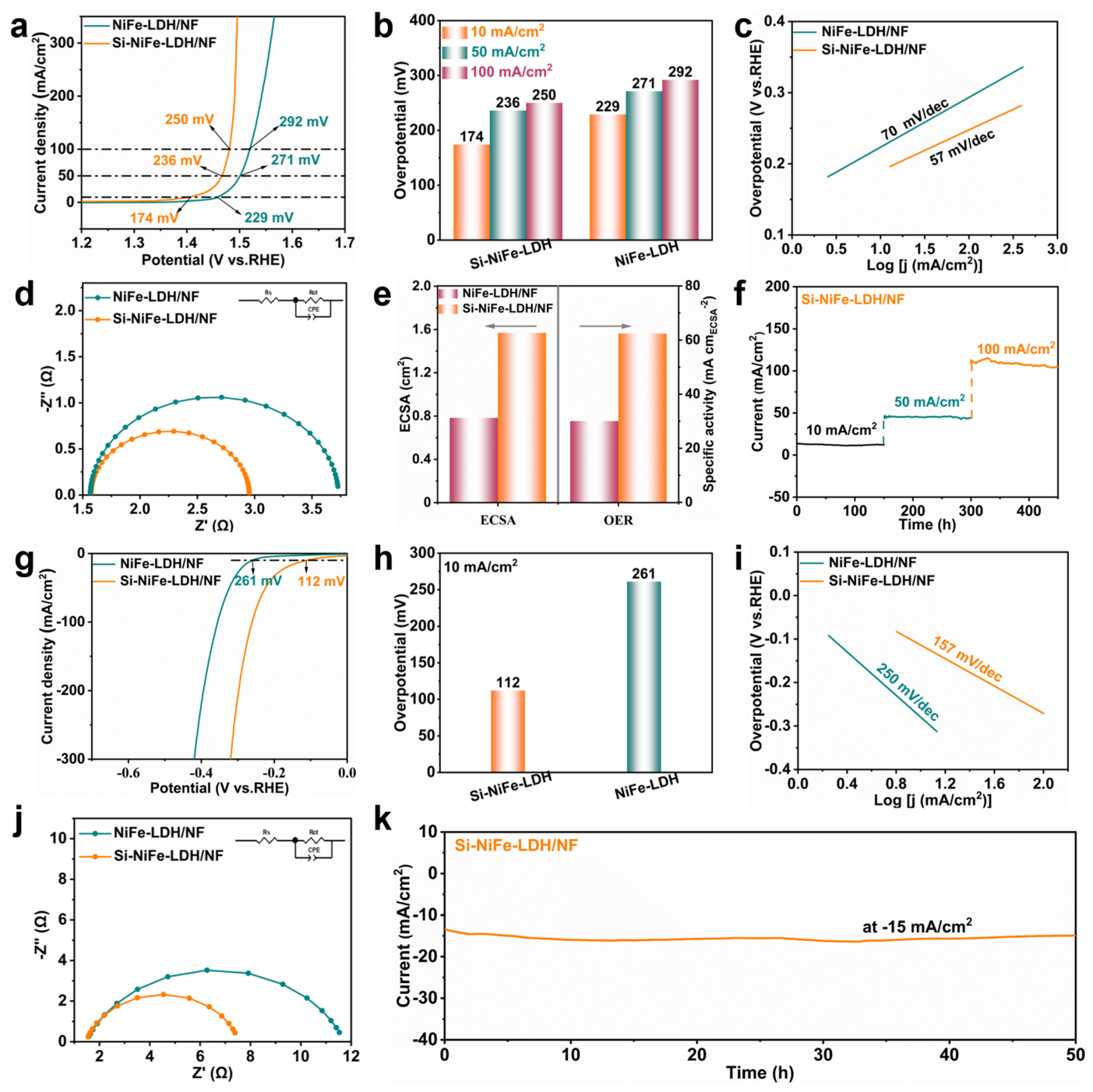
Fig. 3. Electrocatalytic performance of NiFe-LDH/NF and Si-NiFe-LDH/NF in a 1 mol L-1 KOH solution: iR-corrected LSV curves for the OER (a), comparison plot of OER overpotentials (b), Tafel plots (c), EIS and equivalent-circuit-fitting plots (d), and ECSA normalized specific activities for the OER (1.48 VRHE) (e). (f) Chronopotentiometry curve of Si-NiFe-LDH/NF at different current densities. NiFe-LDH/NF and Si-NiFe-LDH/NF in a 1 mol L-1 KOH solution: iR-corrected LSV curves for the HER (g), comparison plot of HER overpotentials (h), Tafel slope (i), and EIS and equivalent-circuit-fitting plots (j). (k) Chronopotentiometry curve of Si-NiFe-LDH/NF at -15 mA cm-2.
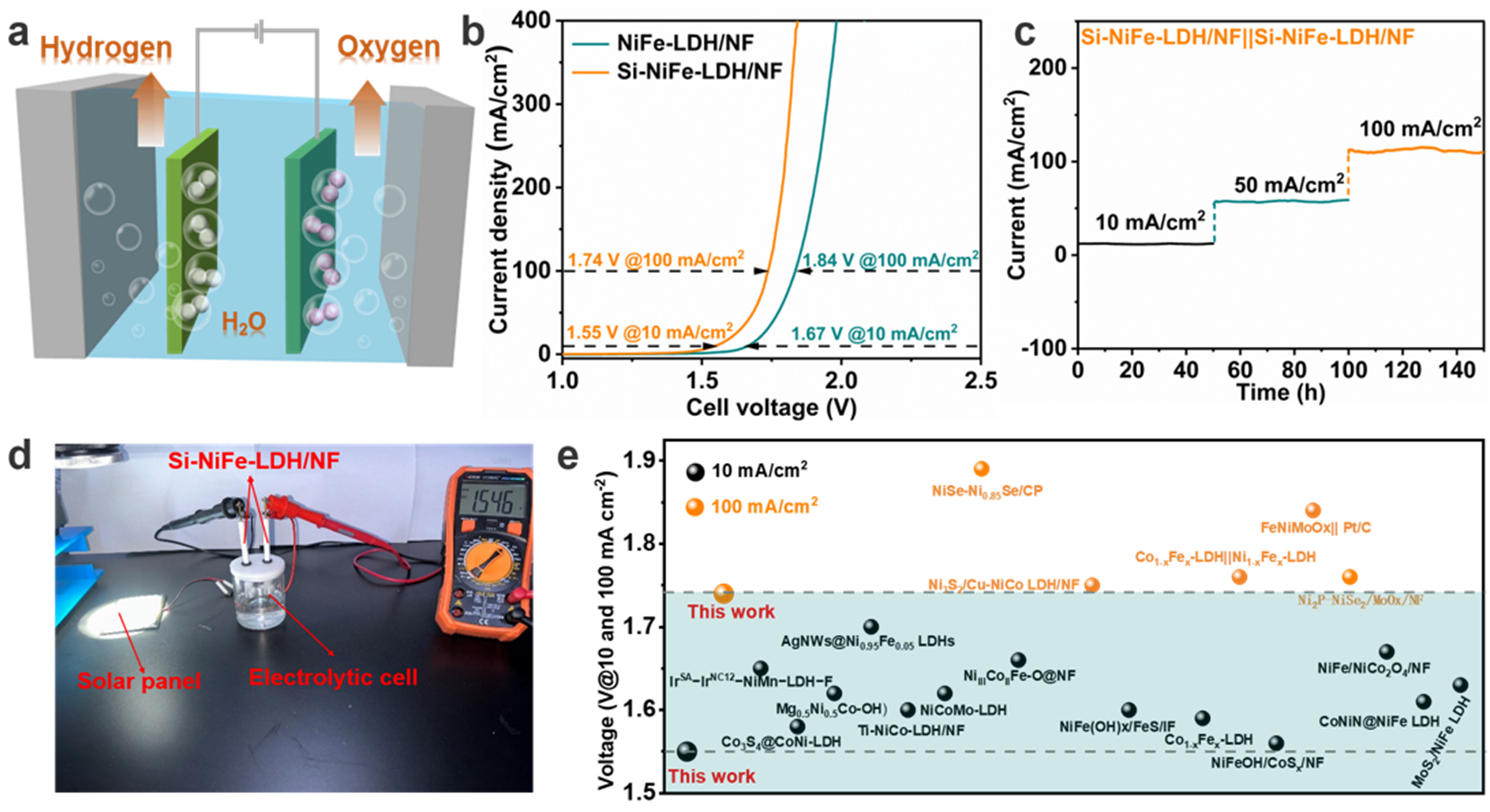
Fig. 4. (a) Schematic illustration of the assembled two-electrode system. (b) LSV curves for overall water splitting. (c) Chronopotentiometry curve of the Si-NiFe-LDH/NF‖Si-NiFe-LDH/NF electrolyzer at different current densities. (d) Schematic of the solar energy-driven overall water-splitting system. (e) Comparison of the electrolysis voltages of Si-NiFe-LDH/NF with those of some previously reported Ni-based catalysts.
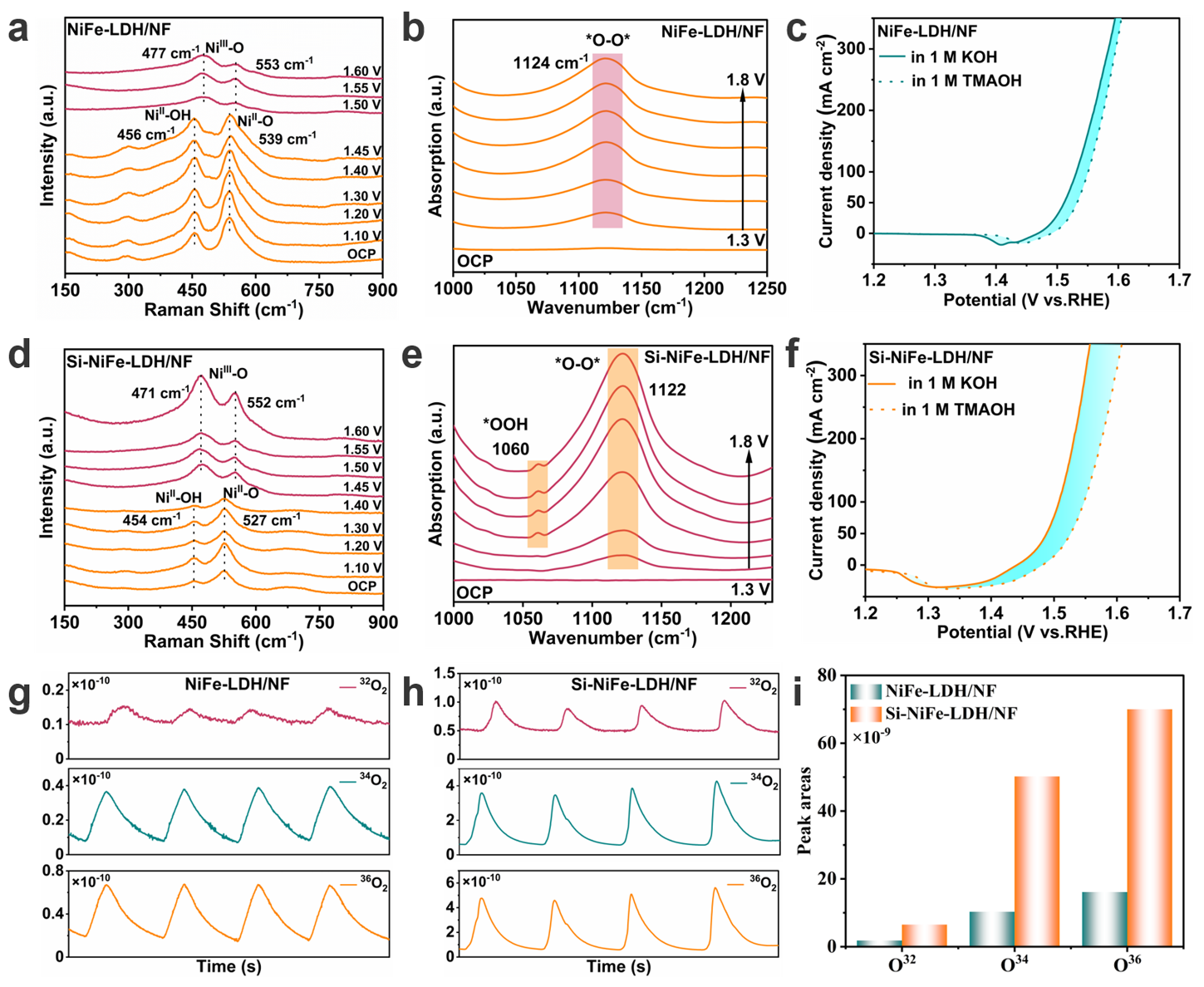
Fig. 5. In-situ Raman spectra of NiFe-LDH/NF (a) and Si-NiFe-LDH/NF (d). In-situ ATR-FTIR spectra of NiFe-LDH/NF (b) and Si-NiFe-LDH/NF (e). LSV curves of NiFe-LDH/NF (g) and Si-NiFe-LDH/NF (h) in 1 mol L-1 KOH and 1 mol L-1 TMAOH detected DEMS signals. (i) Calculated signal peak areas of O32, O34, and O36.
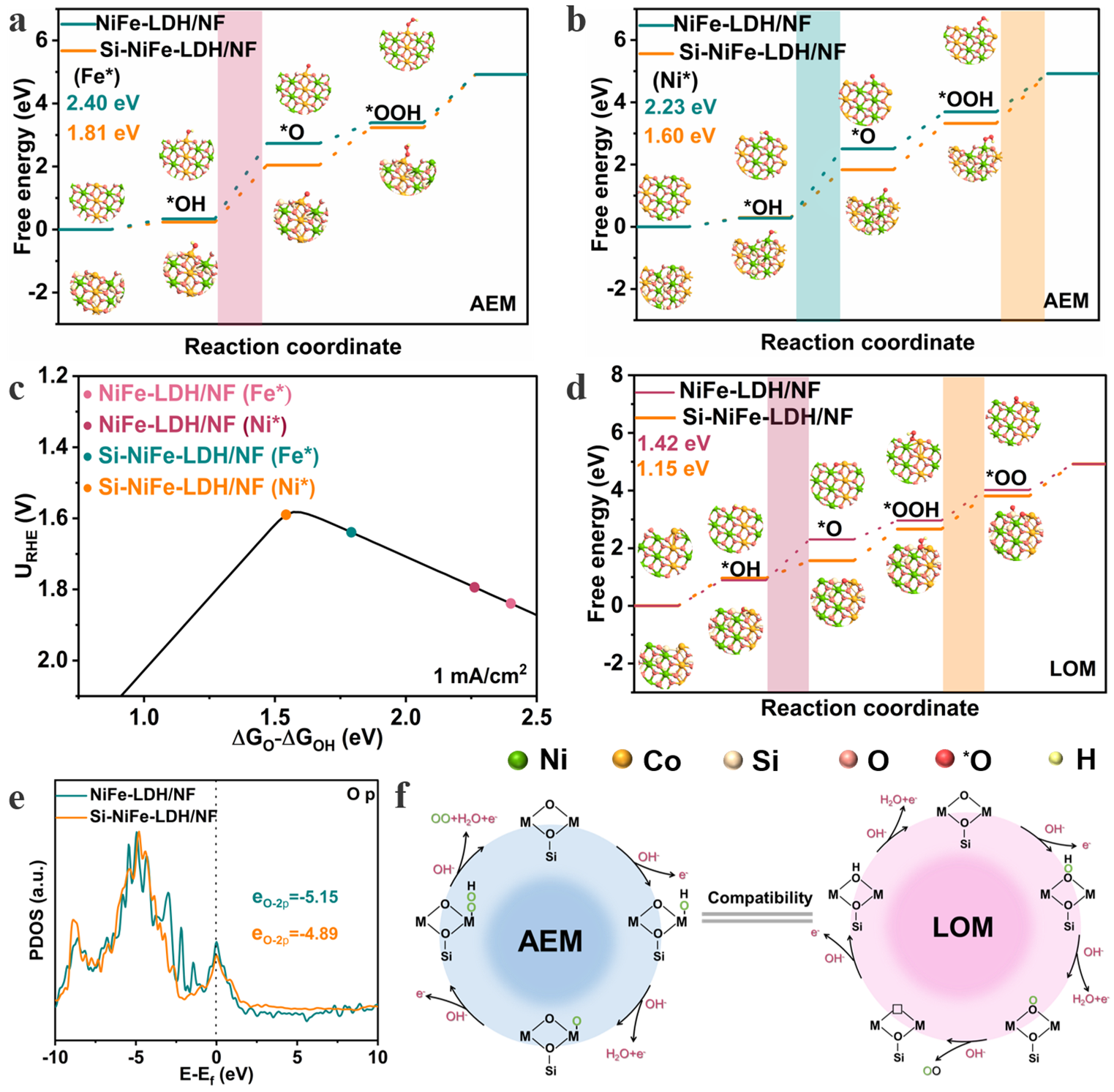
Fig. 6. Gibbs free-energy diagrams of NiFe-LDH/NF and Si-NiFe-LDH/NF for the OER: AEM pathway (a,b) and LOM pathway (d). (c) Microkinetic volcano model plotted for NiFe-LDH/NF and Si-NiFe-LDH/NF at a current density of 1 mA cm-2. (e) PDOS of O for NiFe-LDH/NF and Si-NiFe-LDH/NF. (f) Schematic illustration of the AEM-LOM compatible mechanism.
|
| [1] | Qi Tang, Bomiao Wang, Chongtai Wang, DaoXiong Wu, Ziming Cheng, Huimin Han, Leiyun Han, Huaxia Chen, Yingjie Hua. The regulation of interface structure improves the performance of the MoxOy/Co3O4 electrocatalytic oxygen evolution reaction in acidic media [J]. Chinese Journal of Catalysis, 2026, 88(9): 295-306. |
| [2] | Jianping Zhang, Kun Zhang, Yinglong Weng, Nannan Li, Tingting Huang, Yitong Lu, Tingyu Sun, Xiaotong Han, Jieshan Qiu. Bioinspired acetate-mediated proton shuttling toward robust oxygen evolution [J]. Chinese Journal of Catalysis, 2026, 87(8): 282-294. |
| [3] | Quan Zhang, Hejin Ma, Ruobing Han, Tonglin Yang, Zhenhui Chen, Miaoyang Zhu, Jiawei Shi, Weiwei Cai, Fangqi Yang, Zehui Yang. Lattice-expanded NiSe catalyst via lanthanum incorporation for accelerating urea electrooxidation in assisting water electrolysis [J]. Chinese Journal of Catalysis, 2026, 86(7): 254-264. |
| [4] | Chen Cao, Shirui Cui, Feng Shi, Yanqin Li, Chunyang Zhao, Wei Hu, Zelong Li, Yu Tang. Lanthanum-mediated single-atom dispersion of Ir and Dynamic oxygen replenishment in acidic water oxidation [J]. Chinese Journal of Catalysis, 2026, 86(7): 236-243. |
| [5] | Qiurong Wang, Fozia Sultana, Renkun Li, Yan Fang, Selvi Mushina, Mingwu Tan, Tongtong Li, Renhong Li. Chromium-driven lattice oxygen activation in high-entropy oxide for efficient oxygen evolution reaction [J]. Chinese Journal of Catalysis, 2026, 86(7): 277-289. |
| [6] | Jun Ke, Jiaxi Zhang, Longhai Zhang, Chengzhi Zhong, Huiyu Song, Li Du, Yuwei Zhang, Zhiming Cui. Interfacial charge manipulation enhancing H-bond connectivity for promoted oxygen evolution [J]. Chinese Journal of Catalysis, 2026, 86(7): 290-301. |
| [7] | Kaiyang Zhang, Huihui Li, Shuhao Wang, Rui Yao, Jinping Li, Chuan Zhao, Guang Liu. Breaking the activity-stability trade-off of iridium-based catalysts for proton exchange membrane water electrolyzers [J]. Chinese Journal of Catalysis, 2026, 85(6): 193-203. |
| [8] | Liqing Wu, Wenxia Huang, Bingbing Zhao, Ping Cai, Wei Luo. Surface anions-mediated dynamic interfacial free water enriched microenvironment on RuO2 for efficient acidic oxygen evolution [J]. Chinese Journal of Catalysis, 2026, 85(6): 237-246. |
| [9] | Xiang Wang, Min Zhou, Xiaobin Liao, Xu Han, Congcong Xing, René Bes, Simo Huotari, Jordi Arbiol, Andreu Cabot. Enhanced oxygen evolution and reduction by phosphorus-doped Co9S8 derived from MOFs: Toward high-performance zinc-air batteries [J]. Chinese Journal of Catalysis, 2026, 85(6): 204-215. |
| [10] | Zijie Wan, Yuqi Yang, Zhenquan Wang, Linrui Wu, Haipeng Zhang, Qingfang Shi, Xiang Liu, Hanlin Yang, Bohan Kang, Quan Xu, Jiaqing Luo, Jian Liu. Spatial confinement and nitrogenous defect anchoring synergistically enhance Ru nanoparticles catalyst performance for industrial current densities hydrogen evolution [J]. Chinese Journal of Catalysis, 2026, 84(5): 130-143. |
| [11] | Hyunseok Yoon, Hee Jo Song, Yumin Park, Andi Haryanto, Dohun Kim, Kyuri Cho, Chanyeon Kim, Wooyul Kim, Chan Woo Lee, Dong-Wan Kim. Dynamic tuning of acidic oxygen evolution reaction pathways in Ru catalysts via Cu-induced surface restructuring [J]. Chinese Journal of Catalysis, 2026, 83(4): 363-375. |
| [12] | Xinran Sun, Mengtian Huo, Jianhang Sun, Yu Liang, Kaichi Qin, Haoyang Zhang, Zihao Xing, Jinfa Chang. Sacrificial conversion of metal sulfide precursors into active oxyhydroxide catalysts for enhanced oxygen evolution reaction [J]. Chinese Journal of Catalysis, 2026, 82(3): 84-91. |
| [13] | Lin Liu, Jun Chen, Ailong Li, Shuang Kong, Ying Zhang, Yafei Qiao, Pengfei Zhang, Can Li, Hongxian Han. Harmonization of acidic OER activity and stability of ruthenium-manganese oxide by optimization of amorphous-crystalline heterostructure [J]. Chinese Journal of Catalysis, 2026, 82(3): 61-73. |
| [14] | Yu Tang, Yang Chen, Kerun Chen, Edmund Qi, Xiaoyang Liu, Haiyan Lu, Yu Gao. Cu-Mo synergistic doping of metal-organic framework double-shelled hollow nanospheres: Surface reconstruction activates adsorbate evolution and lattice oxygen mechanisms [J]. Chinese Journal of Catalysis, 2026, 81(2): 159-171. |
| [15] | Hui-Min Xu, Xiao-Qi Gong, Kai-Hang Yue, Chen-Jin Huang, Hong-Rui Zhu, Lian-Jie Song, Gao-Ren Li. Fe and Co bimetallic single-atoms coordinated by N and Te as bifunctional oxygen reduction/evolution catalysts for high-performance zinc-air battery [J]. Chinese Journal of Catalysis, 2026, 81(2): 319-332. |
| Viewed | ||||||
|
Full text |
|
|||||
|
Abstract |
|
|||||


