
Chinese Journal of Catalysis ›› 2026, Vol. 91: 222-231.DOI: 10.1016/S1872-2067(26)65224-2
• Articles • Previous Articles Next Articles
Shihao Yua,b, Yueying Yana,b, Yang Yanga,b, Bohan Yaoa,b, Ziwen Zhua,b, Dewen Wanga, Zhicai Xinga,*( ), Xiurong Yanga,b,*()
Received:2026-01-29
Accepted:2026-04-07
Online:2026-12-18
Published:2026-10-13
Supported by:Shihao Yu, Yueying Yan, Yang Yang, Bohan Yao, Ziwen Zhu, Dewen Wang, Zhicai Xing, Xiurong Yang. Interfacial engineering of an advanced NiV-LDH@MoS2 heterostructure electrocatalyst for efficient alkaline hydrogen evolution[J]. Chinese Journal of Catalysis, 2026, 91: 222-231.
Add to citation manager EndNote|Ris|BibTeX
URL: https://www.cjcatal.com/EN/10.1016/S1872-2067(26)65224-2
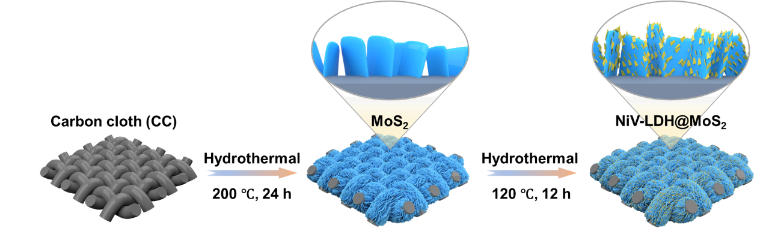
Fig. 1. Schematic illustration for the synthesis of the NiV-LDH@MoS2 heterostructure.

Fig. 2. XRD patterns (a), SEM image (b), STEM image (c), HRTEM image (d), HAADF-STEM image (e), and EDS elemental mapping images (f) of the NiV-LDH@MoS2 heterostructure.
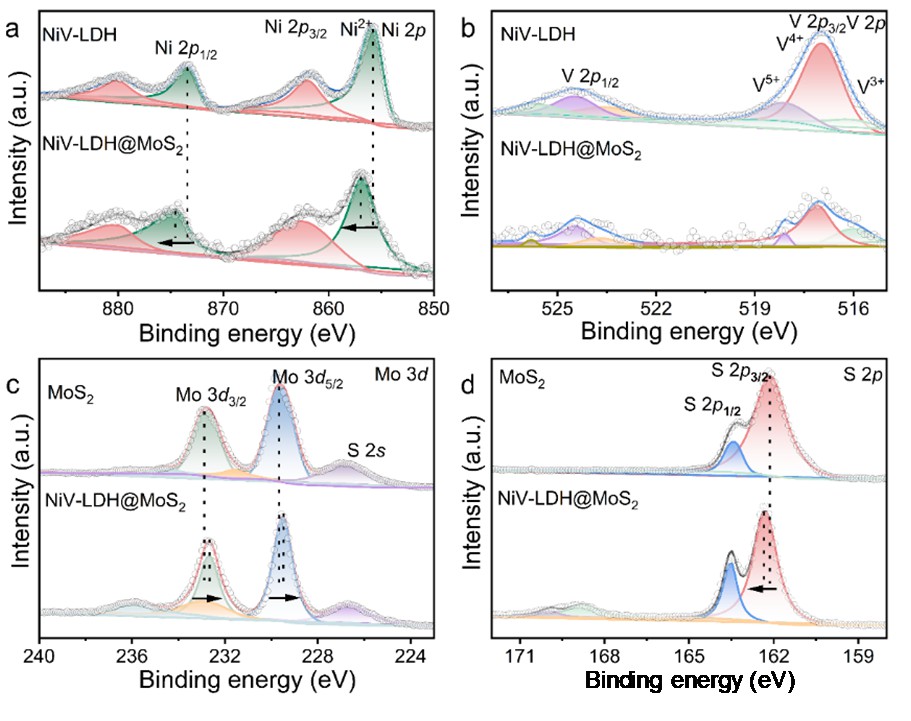
Fig. 3. High-resolution XPS spectra: Ni 2p (a) and V 2p (b) of NiV-LDH and NiV-LDH@MoS2; Mo 3d (c) and S 2p (d) of MoS2 and NiV-LDH@MoS2.

Fig. 4. Electrochemical HER performance of NiV-LDH@MoS2, MoS2, NiV-LDH, and Pt/C in 1 mol L-1 KOH. LSV curves (a), Tafel plots (b), comparison of overpotentials at 10 and 100 mA cm-2 (c), ECSA-normalized polarization curves (d), Nyquist plots with the equivalent circuit (inset) (e), comparison of overpotentials at 10 mA cm-2 with recently reported non-noble-metal catalysts (f), and chronopotentiometry curve of NiV-LDH@MoS2 at 10 mA cm-2 (g).

Fig. 5. DFT calculations. (a) Atomic structure model and proposed HER pathway on NiV-LDH@MoS2. (b) ΔG(H*) on Ni and V sites. (c) PDOS of Ni 3d orbitals. (d) Free energy diagrams for the HER on MoS2, NiV-LDH, and NiV-LDH@MoS2 surfaces.
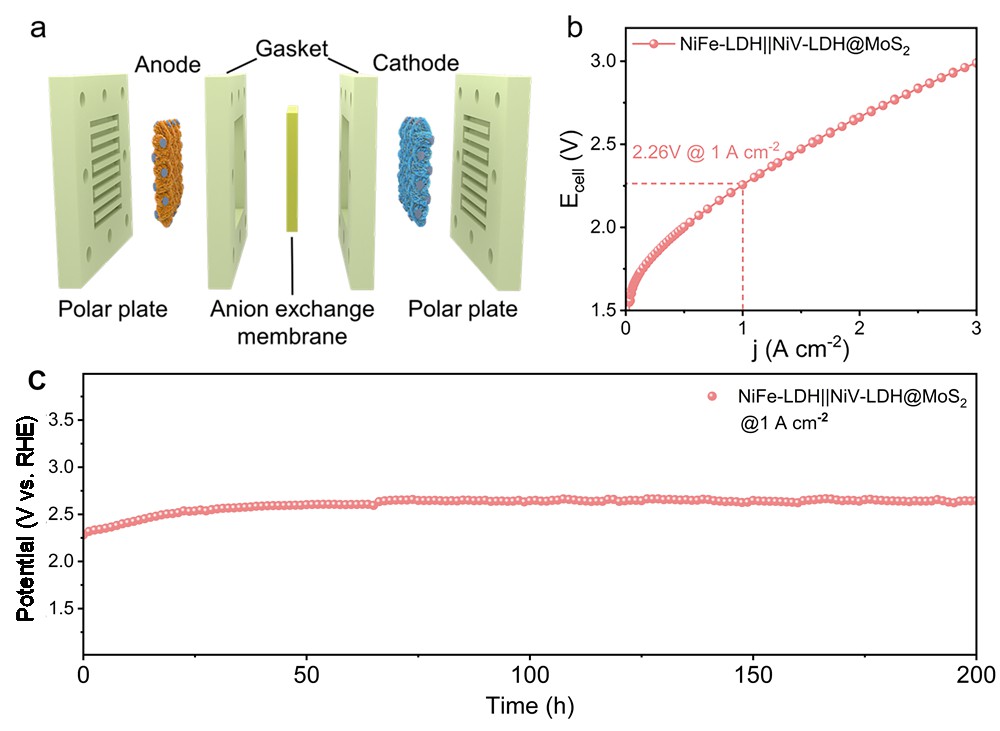
Fig. 6. (a) Schematic diagram of the AEMWE cell. (b) Polarization curve of the AEM electrolyzer at 60 °C. (c) Chronopotentiometry curve of the NiFe-LDH||NiV-LDH@MoS2 electrolyzer at 1 A cm-2 and 60 °C.
|
| [1] | Bashir Adegbemiga Yusuf, Hennayaka Mudiyanselage Charitha Madusanka Jayawardana, Waleed Yaseen, Jimin Xie, Yilin Deng, Suci Meng, Yongming Li, Abdussamad Mukhtar Mohammed, Aminu Magaji, Min Chen, Meng Xie, Yuanguo Xu. Vacancy-engineered Ru-based CNT electrocatalysts for ampere-level water splitting in alkaline and anion-exchange membrane water electrolyzers [J]. Chinese Journal of Catalysis, 2026, 88(9): 279-294. |
| [2] | Jianping Zhang, Kun Zhang, Yinglong Weng, Nannan Li, Tingting Huang, Yitong Lu, Tingyu Sun, Xiaotong Han, Jieshan Qiu. Bioinspired acetate-mediated proton shuttling toward robust oxygen evolution [J]. Chinese Journal of Catalysis, 2026, 87(8): 282-294. |
| [3] | Wei Zuo, Mingyu Liu, Shengjun Sun, Yu Yang, Zixiao Li, Xixi Zhang, Chaoxin Yang, Hefeng Wang, Imran Shakir, Xuefei Liu, Qian Liu, Xuping Sun, Bo Tang. Synergistic chloride resistance via hydrogen‒bond network dynamic optimization and electrostatic repulsion for alkaline seawater oxidation [J]. Chinese Journal of Catalysis, 2026, 87(8): 295-304. |
| [4] | Chongzheng Xu, Haoping Di, Fengyue Sun, Wenjing Bao, Yanwei Ju, Dengwei Yan, Changle Yue, Yiyuan Xu, Yunxiu Zhao, Shuo Wang, Jiqian Wang, Yukun Lu. Achieving selective C−O bond cleavage of esters over monolayer NiMoS catalysts derived from oil-soluble polyoxometalates [J]. Chinese Journal of Catalysis, 2026, 87(8): 327-341. |
| [5] | Dezhi Wang, Songhua Yang, Yiyi Yangliu, Xufa Peng, Fangyang Liu, Hao Fei, Zhuangzhi Wu. Decoupling competitive reactions by their differential orbital-coupling response to vacancy engineering for efficient electrocatalytic nitrogen reduction [J]. Chinese Journal of Catalysis, 2026, 86(7): 181-190. |
| [6] | Yuxi Ren, Baorong Xu, Yu Jin, Hang Xiao, Ranran Niu, Wei Liu, Honghui Ou, Guidong Yang. Homojunction-driven d-band engineering in NiMoO4 for selective electrochemical nitrogen reduction to ammonia [J]. Chinese Journal of Catalysis, 2026, 85(6): 216-225. |
| [7] | Lanlan Chen, Li Sheng, Yanan Zhou, Qiquan Luo, Zhenyu Li, Wenhua Zhang, Jinlong Yang. Unraveling the superiority of Ni1-MoS2 single-atom catalyst in CO2 hydrogenation to methanol: A DFT combined microkinetic study [J]. Chinese Journal of Catalysis, 2026, 85(6): 143-152. |
| [8] | Zijie Wan, Yuqi Yang, Zhenquan Wang, Linrui Wu, Haipeng Zhang, Qingfang Shi, Xiang Liu, Hanlin Yang, Bohan Kang, Quan Xu, Jiaqing Luo, Jian Liu. Spatial confinement and nitrogenous defect anchoring synergistically enhance Ru nanoparticles catalyst performance for industrial current densities hydrogen evolution [J]. Chinese Journal of Catalysis, 2026, 84(5): 130-143. |
| [9] | Mingtao Chu, Huimin Zhang, Bianqing Ren, Jing Cao, Teng Zhang, Ping Song, Zizhun Wang, Ce Han, Weilin Xu. Amorphous-crystalline heterostructured RuMoNiN/Ni-MoO2 for highly efficient and stable alkaline hydrogen evolution reaction [J]. Chinese Journal of Catalysis, 2026, 84(5): 96-105. |
| [10] | Peilin Liu, Xiaqing Zhuang, Tianze Cui, Zisen Wei, Hua Xu, Ruolin Zhang, Yuqi Yang, Jiaqing Luo, Weiyu Song, Yunpeng Liu, Yu Kong, Zhenxing Li, Zhen Zhao, Jian Liu, Yuanqing Sun. Dual-engine active centers of Ru single atoms and nanoclusters synergistically enhancing hydrogen evolution reaction [J]. Chinese Journal of Catalysis, 2026, 84(5): 80-95. |
| [11] | Hongwen Zhang, Yinghui Cai, Bingyue Li, Wei Shan, Hua Tang. Isolated Cu atoms and CuO nanoclusters synergistically boost hydrogen evolution over TiO2 [J]. Chinese Journal of Catalysis, 2026, 83(4): 162-171. |
| [12] | Jegon Lee, Do-Hyun Kim, Seulgi Ji, Sangmoon Yoon, Seung Hyun Nam, Jucheol Park, Jin Young Oh, Seung Gyo Jeong, Jong-Seong Bae, Sang A. Lee, Heechae Choi, Woo Seok Choi. Awakening catalytically active surface of BaRuO3 thin film for alkaline hydrogen evolution [J]. Chinese Journal of Catalysis, 2026, 83(4): 341-350. |
| [13] | Xinran Sun, Mengtian Huo, Jianhang Sun, Yu Liang, Kaichi Qin, Haoyang Zhang, Zihao Xing, Jinfa Chang. Sacrificial conversion of metal sulfide precursors into active oxyhydroxide catalysts for enhanced oxygen evolution reaction [J]. Chinese Journal of Catalysis, 2026, 82(3): 84-91. |
| [14] | Rui Yang, Zimin Han, Yin Gao, Guoqing Feng, Huaizhi Liu, Yiyin Huang, Zhongkai Wang, Yaobing Wang. Charge-mediated cyclohexanone enrichment and intermediate stabilization at MoNi4/MoO2 heterostructures enable paired cyclohexanone electrooxidation-hydrogen production at ampere-level current [J]. Chinese Journal of Catalysis, 2026, 81(2): 344-354. |
| [15] | Yu Tang, Yang Chen, Kerun Chen, Edmund Qi, Xiaoyang Liu, Haiyan Lu, Yu Gao. Cu-Mo synergistic doping of metal-organic framework double-shelled hollow nanospheres: Surface reconstruction activates adsorbate evolution and lattice oxygen mechanisms [J]. Chinese Journal of Catalysis, 2026, 81(2): 159-171. |
| Viewed | ||||||
|
Full text |
|
|||||
|
Abstract |
|
|||||


