
Chinese Journal of Catalysis ›› 2026, Vol. 91: 341-350.DOI: 10.1016/S1872-2067(26)65234-5
• Articles • Previous Articles Next Articles
Junwei Yao,1, Chuanqi Cheng,1, Rui Li, Ying Gao*( ), Bin Zhang
Received:2026-03-16
Accepted:2026-05-15
Online:2026-12-18
Published:2026-10-13
About author:1Contributed equally to this work.
Supported by:Junwei Yao, Chuanqi Cheng, Rui Li, Ying Gao, Bin Zhang. Phosphate anions accelerated deprotonation and proton transfer for water-involved electrooxidation[J]. Chinese Journal of Catalysis, 2026, 91: 341-350.
Add to citation manager EndNote|Ris|BibTeX
URL: https://www.cjcatal.com/EN/10.1016/S1872-2067(26)65234-5
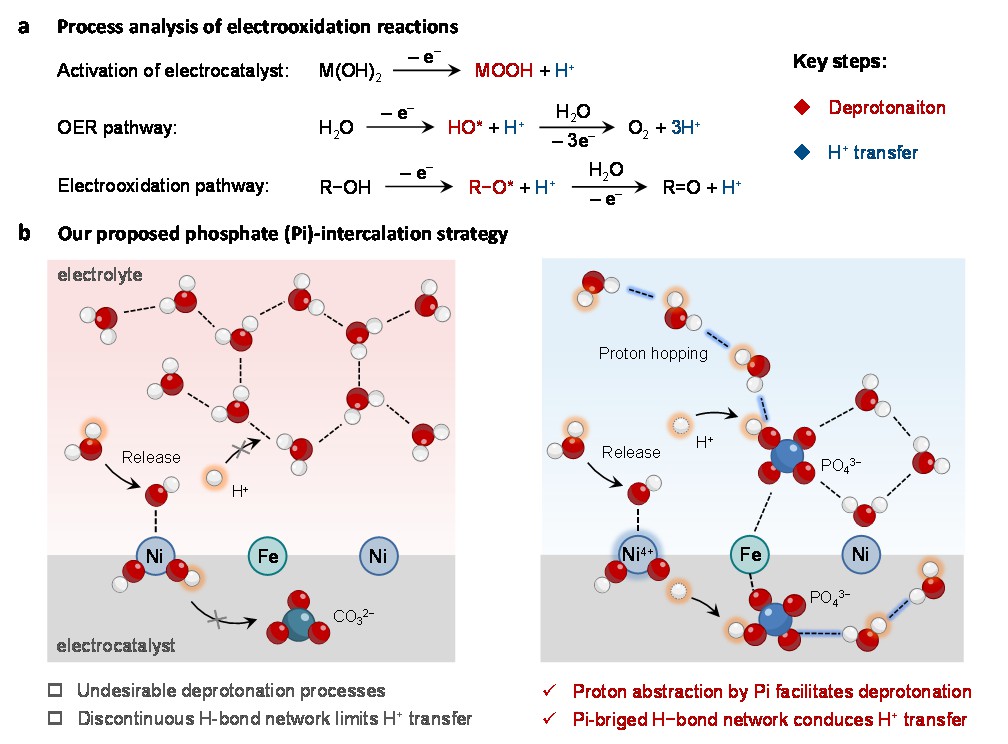
Fig. 1. Proposed Pi-intercalation strategy for facilitating deprotonation and proton transfer. (a) Process analysis of electrooxidation reactions. (b) The proposed Pi-intercalation strategy.
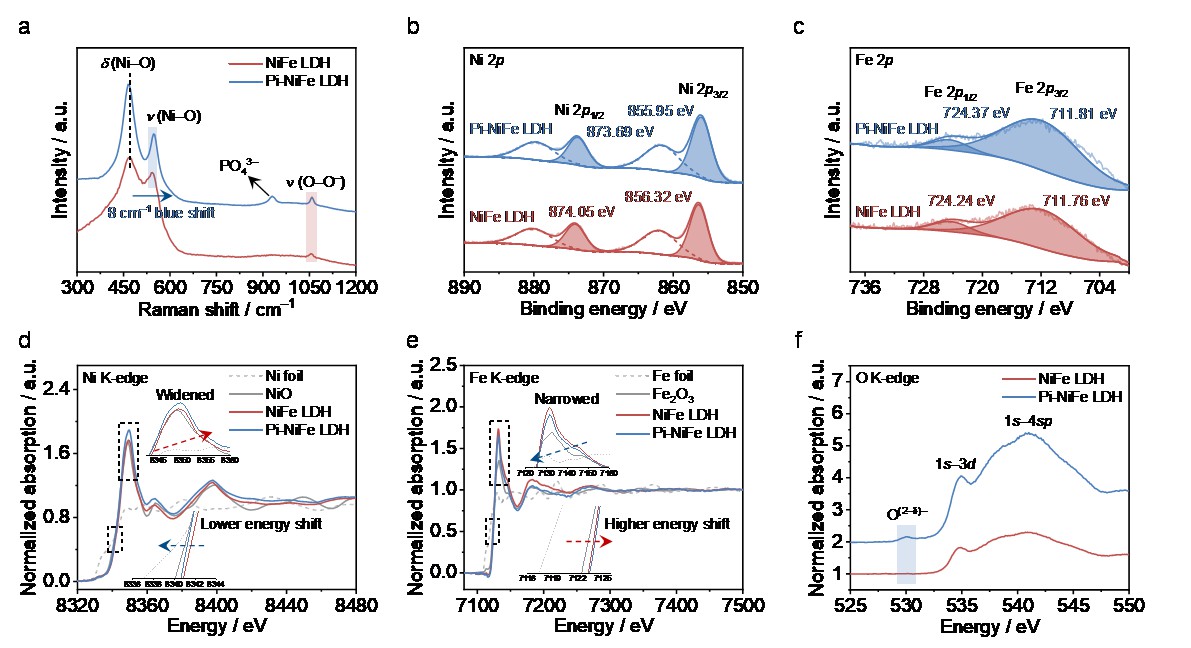
Fig. 2. Characterization of the Pi-NiFe LDH. Raman spectra (a), Ni 2p XPS spectra (b), Fe 2p XPS spectra (c), Ni K-edge XANES spectra (d), Fe K-edge XANES spectra (e), and O K-edge XANES spectra (f) of NiFe LDH and Pi-NiFe LDH.
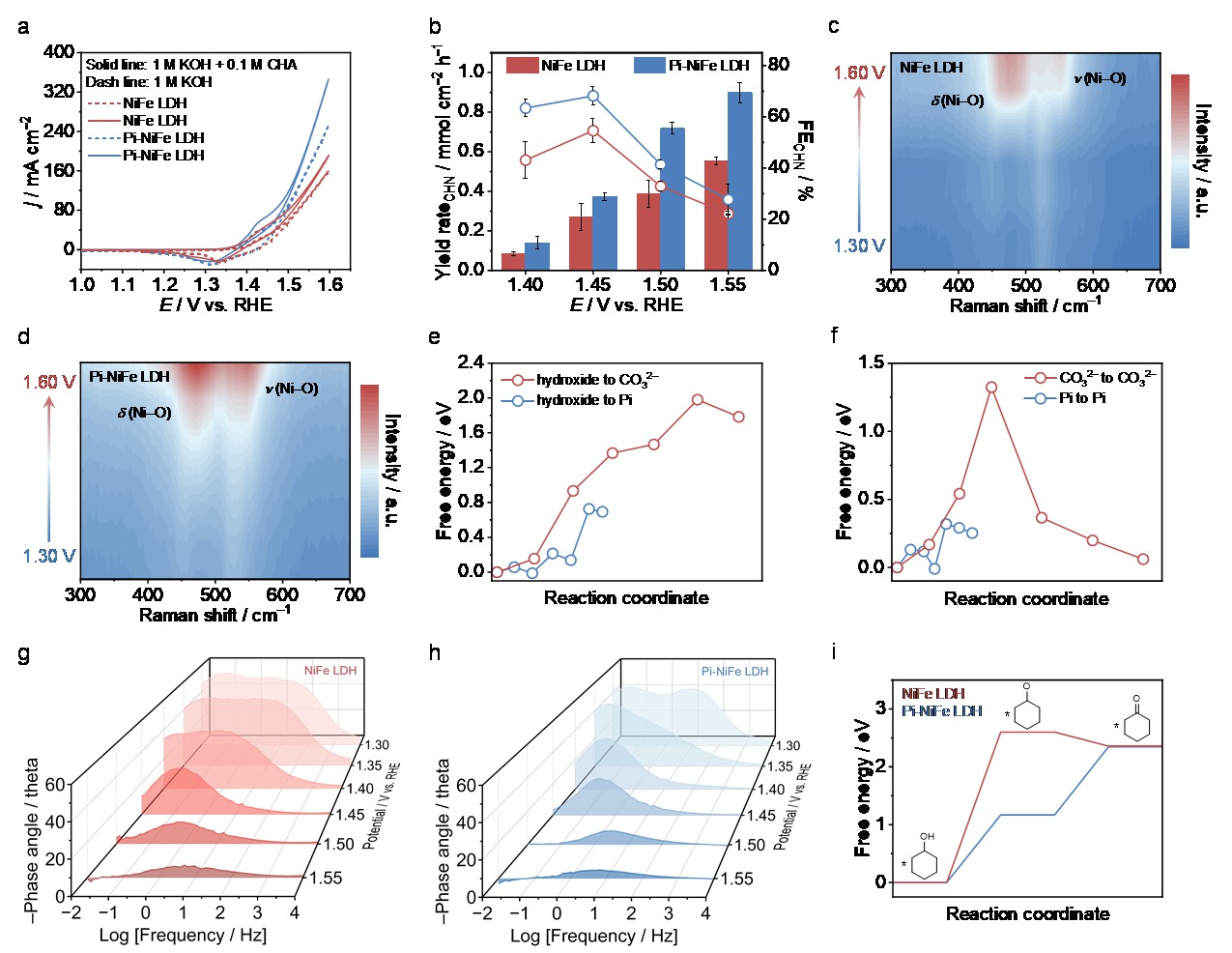
Fig. 3. Origin of facilitated deprotonation. (a) CV curves measured in 1 mol L-1 KOH with or without 0.1 mol L-1 CHA at a scan rate of 10 mV s-1. (b) Potential-dependent yield rates and FEs for the CHN of NiFe LDH and Pi-NiFe LDH. Potential-dependent in situ Raman spectra measured in 1 mol L-1 KOH with 0.1 mol L-1 CHA over NiFe LDH (c) and Pi-NiFe LDH (d). Proton transfer barriers of hydroxides to anions (e) and anions to anions (f). Potential-dependent Bode plots measured in 1 mol L-1 KOH with 0.1 mol L-1 CHA over NiFe LDH (g) and Pi-NiFe LDH (h). (i) Free energy diagram for CHA oxidation.
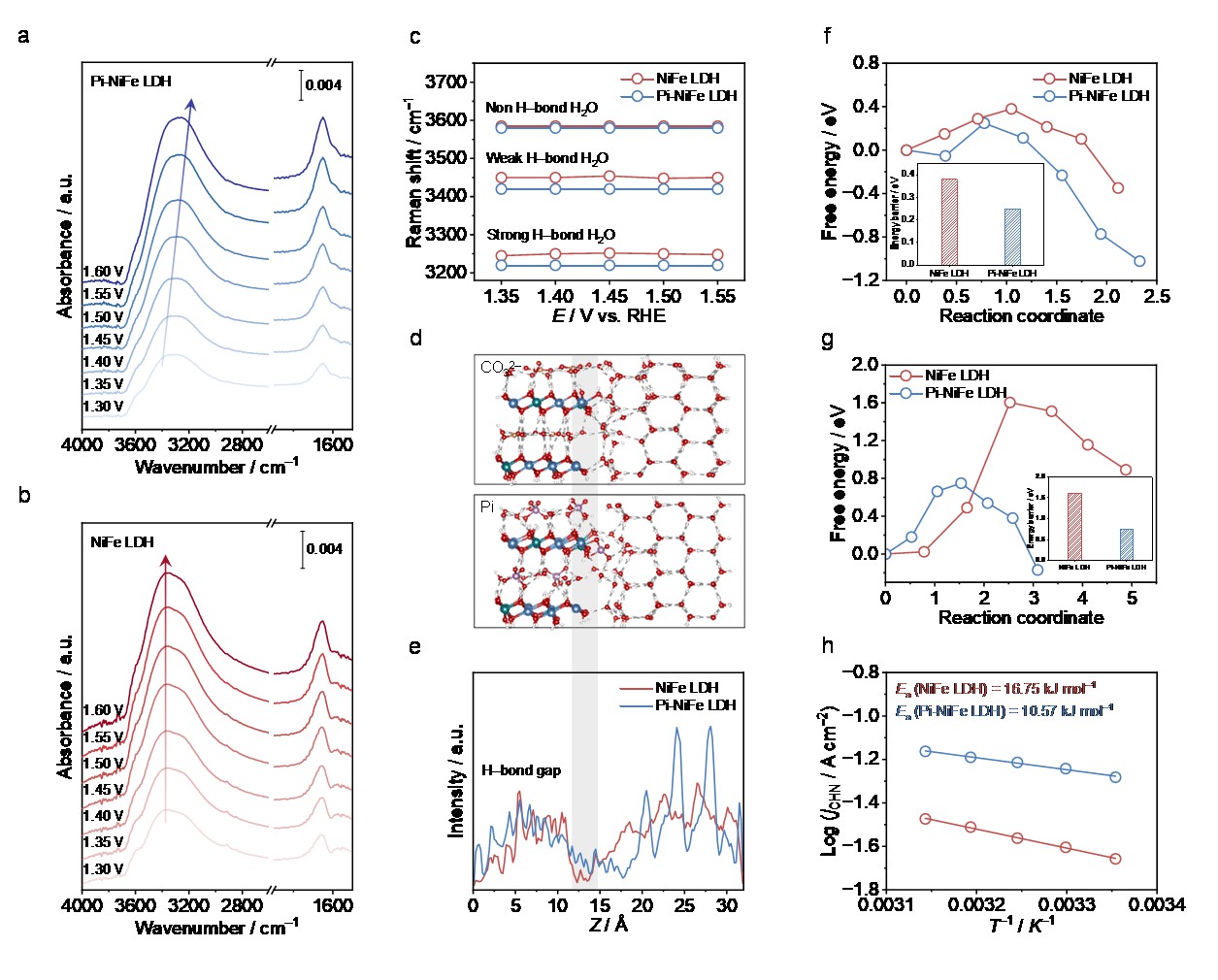
Fig. 4. Origin of facilitated proton transfer. Potential-dependent ATR-FTIR spectra of Pi-NiFe LDH (a) and NiFe LDH (b). (c) Corresponding wavenumbers of the O-H stretching vibration under different potentials. (d) Representative snapshot of the interfacial H-bond networks adjacent to NiFe LDH and Pi-NiFe LDH. (e) Statistical distribution of the intensity of H-bonds. (f) Proton transfer barriers at the interfaces of NiFe LDH and Pi-NiFe LDH. Inset: calculated energy barriers for proton transfer. (g) CHA deprotonation energy barriers at the interfaces of NiFe LDH and Pi-NiFe LDH. Inset: calculated energy barriers for CHA deprotonation. (h) Ea for the CHA electrooxidation of NiFe LDH and Pi-NiFe LDH.
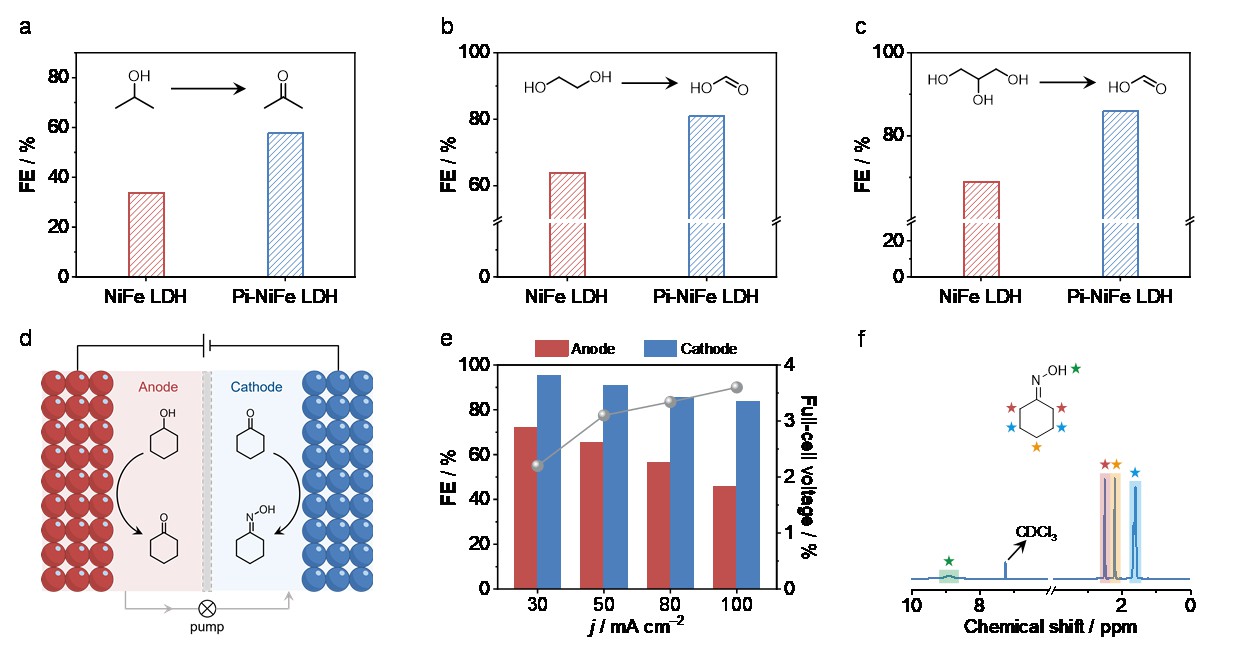
Fig. 5. Universality and utility of Pi-NiFe LDH. FEs of electrooxidation of isopropanol (a), ethylene glycol (b), and glycerol electrooxidation (c) at a current density of 100 mA cm-2 over NiFe LDH and Pi-NiFe LDH. (d) Schematic diagram of the cascade system for cyclohexanone oxime electrosynthesis. (e) FE and full-cell voltage of anodic CHN electrosynthesis and cathodic cyclohexanone oxime electrosynthesis. (f) 1H NMR spectra of the obtained cyclohexanone oxime.
|
| [1] | Qi Tang, Bomiao Wang, Chongtai Wang, DaoXiong Wu, Ziming Cheng, Huimin Han, Leiyun Han, Huaxia Chen, Yingjie Hua. The regulation of interface structure improves the performance of the MoxOy/Co3O4 electrocatalytic oxygen evolution reaction in acidic media [J]. Chinese Journal of Catalysis, 2026, 88(9): 295-306. |
| [2] | Haoye Wang, Bingjie Qiu, Richard, Jr L. Smith, Xinhua Qi. Electrocatalytic nitrate reduction systems for chemical production: Mechanisms, process engineering and challenges [J]. Chinese Journal of Catalysis, 2026, 88(9): 129-182. |
| [3] | Chenyu Bu, Zhuoran Lu, Zhongcheng Xia, Yun Fan, Cairong Wang, Yutong Huang, Shuangyin Wang, Yuqin Zou. Interfacial two-site synergy for biomass electro-oxidation in a near-neutral electrolyte [J]. Chinese Journal of Catalysis, 2026, 86(7): 160-170. |
| [4] | Chao Wang, Kun Feng, Liangshuyu Tang, Wujun Zhang, Muyu Zhou, Jialu Li, Tianyu Shao, Flemming Besenbacher, Yanbin Shen, Jun Zhong, Ren Su. In-situ developed active sites of MOFs in aqueous electrocatalytic ammoxidation [J]. Chinese Journal of Catalysis, 2026, 86(7): 171-180. |
| [5] | Quan Zhang, Hejin Ma, Ruobing Han, Tonglin Yang, Zhenhui Chen, Miaoyang Zhu, Jiawei Shi, Weiwei Cai, Fangqi Yang, Zehui Yang. Lattice-expanded NiSe catalyst via lanthanum incorporation for accelerating urea electrooxidation in assisting water electrolysis [J]. Chinese Journal of Catalysis, 2026, 86(7): 254-264. |
| [6] | Chen Cao, Shirui Cui, Feng Shi, Yanqin Li, Chunyang Zhao, Wei Hu, Zelong Li, Yu Tang. Lanthanum-mediated single-atom dispersion of Ir and Dynamic oxygen replenishment in acidic water oxidation [J]. Chinese Journal of Catalysis, 2026, 86(7): 236-243. |
| [7] | Qingxi Zhai, Yiqi Tian, Hao Wang, Shisi Tang, Qiang Yuan, Xu Liu, Weiping Ding, Fan Tian, Yan Zhu. Molecular adaptability and reactivity in Ni6(SR)12-catalyzed adipic acid synthesis [J]. Chinese Journal of Catalysis, 2026, 86(7): 225-235. |
| [8] | Yuxi Ren, Baorong Xu, Yu Jin, Hang Xiao, Ranran Niu, Wei Liu, Honghui Ou, Guidong Yang. Homojunction-driven d-band engineering in NiMoO4 for selective electrochemical nitrogen reduction to ammonia [J]. Chinese Journal of Catalysis, 2026, 85(6): 216-225. |
| [9] | Xingchen He, Junhui Shao, Najun Li, Dongyun Chen, Hua Li, Qingfeng Xu, Haozhi Wang, Jianmei Lu. Metal-free fluorinated carbon nitride with piezo-boosted hydrogen-bonding networks enable 100% CO selectivity in CO2 reduction [J]. Chinese Journal of Catalysis, 2026, 85(6): 130-142. |
| [10] | Ran Sun, Yuqi Zhang, Kunge Hou, Yujie Tan, Xingang Liu, Jianyuan Hou, Weixuan Zhao, Andrew E. H. Wheatley, Renxi Zhang. Designing hydrogen-bonds in covalent organic frameworks: accelerating proton-coupled electron transfer for enhanced photocatalytic H2O2 synthesis [J]. Chinese Journal of Catalysis, 2026, 84(5): 274-287. |
| [11] | Mingtao Chu, Huimin Zhang, Bianqing Ren, Jing Cao, Teng Zhang, Ping Song, Zizhun Wang, Ce Han, Weilin Xu. Amorphous-crystalline heterostructured RuMoNiN/Ni-MoO2 for highly efficient and stable alkaline hydrogen evolution reaction [J]. Chinese Journal of Catalysis, 2026, 84(5): 96-105. |
| [12] | Yong Zhang, Wenjun Zhu, Yanyan Zhao, Shumin Zhang. In2S3/HOF S-scheme heterojunction for enhanced photocatalytic H2O2 production [J]. Chinese Journal of Catalysis, 2026, 84(5): 261-273. |
| [13] | Tao Wei, Zhanpeng Liang, Boxin Zhang, Yunhao Xu, Zhaoxue Sun, Minghao Duo, Minghui Chen, Sheng Zhang, Bao Zhang. Efficient electrocatalytic CO2 reduction by crystalline polymetallophthalocyanine covalent organic frameworks unprecedentedly constructed involving 4-dimethylaminopyridine (DMAP)-type nucleophilic catalyst [J]. Chinese Journal of Catalysis, 2026, 83(4): 319-329. |
| [14] | Runlin Ma, Xiandi Ma, Hejing Wang, Xu Zhang, Yongzheng Fang, Menggai Jiao, Zhen Zhou. Bifunctional electrocatalysis of hydrazine oxidation and hydrogen evolution reactions on 2D CoX (X = P, S, As, Se): Insights from DFT calculations [J]. Chinese Journal of Catalysis, 2026, 82(3): 115-124. |
| [15] | Jianchao Yue, Yu Zhang, Qianqian Xiong, Wei Luo. Bridging oxygen-induced hydrogen-bond network reconstruction in phosphorus-doped carbon-coated Ni catalyst enhances alkaline hydrogen oxidation electrocatalysis [J]. Chinese Journal of Catalysis, 2026, 82(3): 144-152. |
| Viewed | ||||||
|
Full text |
|
|||||
|
Abstract |
|
|||||


