
Chinese Journal of Catalysis ›› 2026, Vol. 91: 396-411.DOI: 10.1016/S1872-2067(26)65256-4
• Articles • Previous Articles
Mengrong Li, Bram D. Bruininks, Ivo A. W. Filot*( ), Emiel J. M. Hensen*()
Received:2026-05-18
Accepted:2026-07-31
Online:2026-12-18
Published:2026-10-13
Mengrong Li, Bram D. Bruininks, Ivo A. W. Filot, Emiel J. M. Hensen. Balancing lattice oxygen activation and surface reoxidation in lanthanide-Zn co-doped Pd/CeO2 single-atom catalysts for CO oxidation[J]. Chinese Journal of Catalysis, 2026, 91: 396-411.
Add to citation manager EndNote|Ris|BibTeX
URL: https://www.cjcatal.com/EN/10.1016/S1872-2067(26)65256-4
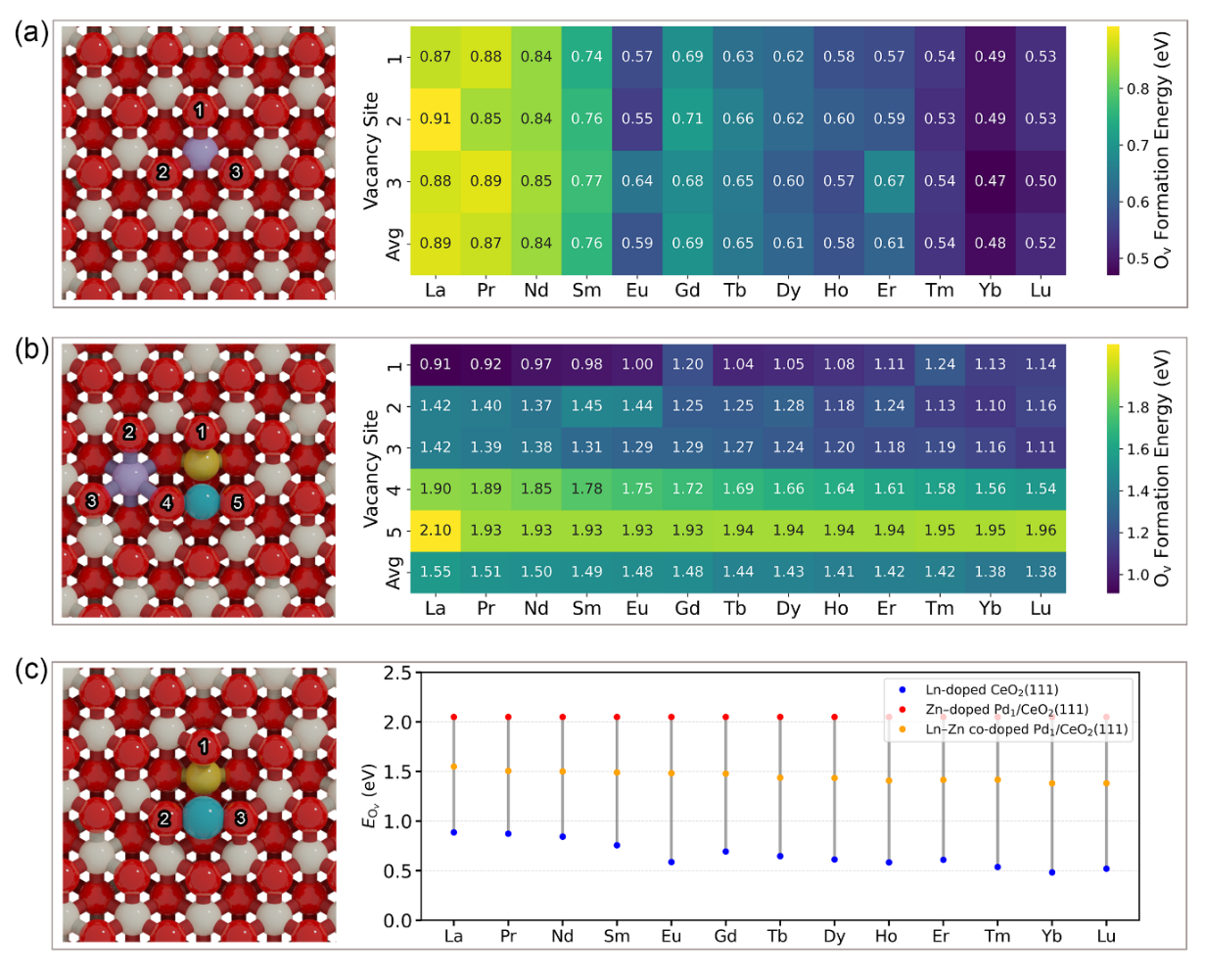
Fig. 1. Configurations (left) and corresponding Ov formation energy heatmaps (right) for Ln-doped CeO2(111) (a) and Ln-Zn co-doped Pd1/CeO2(111) (b) (Ln=purple; Zn=yellow; Pd=blue).
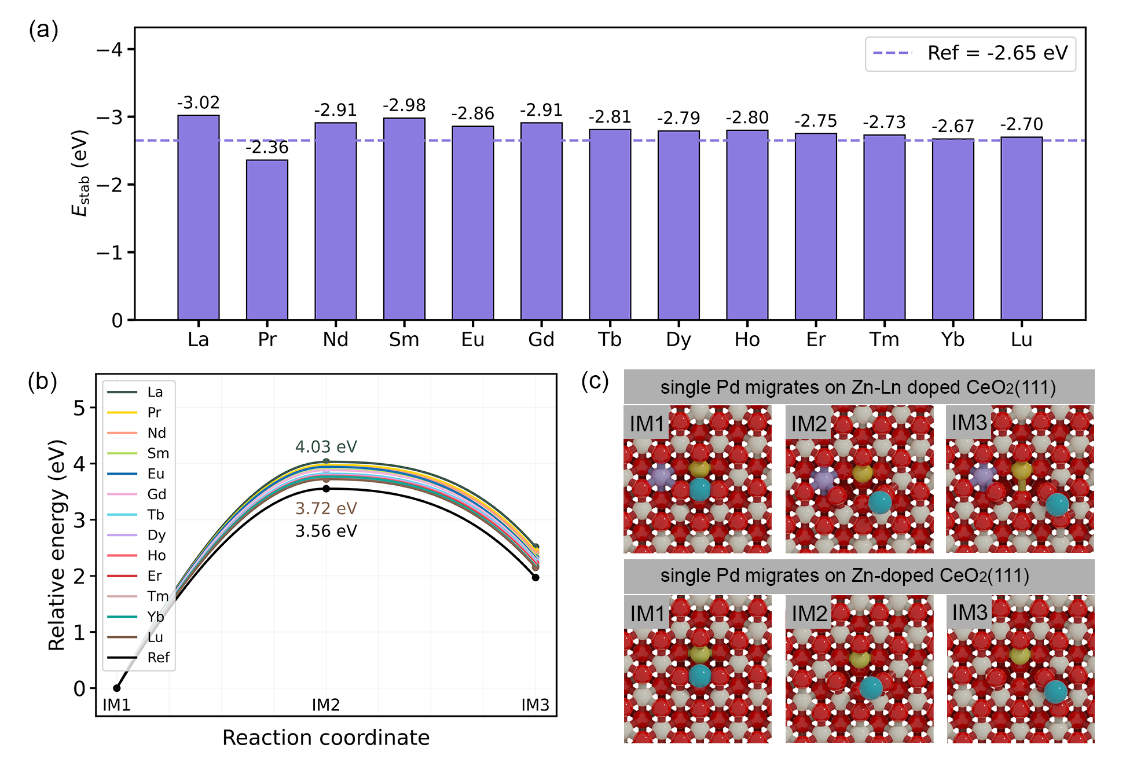
Fig. 2. (a) Stabilization energies of a Pd atom on Zn-Ln co-doped CeO2(111), with Zn-doped CeO2(111) taken as the reference (Ref). (b) Energy profiles for migration of a Pd atom on Zn-Ln co-doped CeO2(111) surfaces. IM1, IM2, and IM3 denote the initial, transition, and final states, respectively. The values reported along the migration pathway represent the energy difference between the transition state (IM2) and the initial state (IM1). (c) Corresponding structures along the migration pathway for IM1, IM2, and IM3 in both Zn-Ln co-doped and Zn-doped CeO2(111).
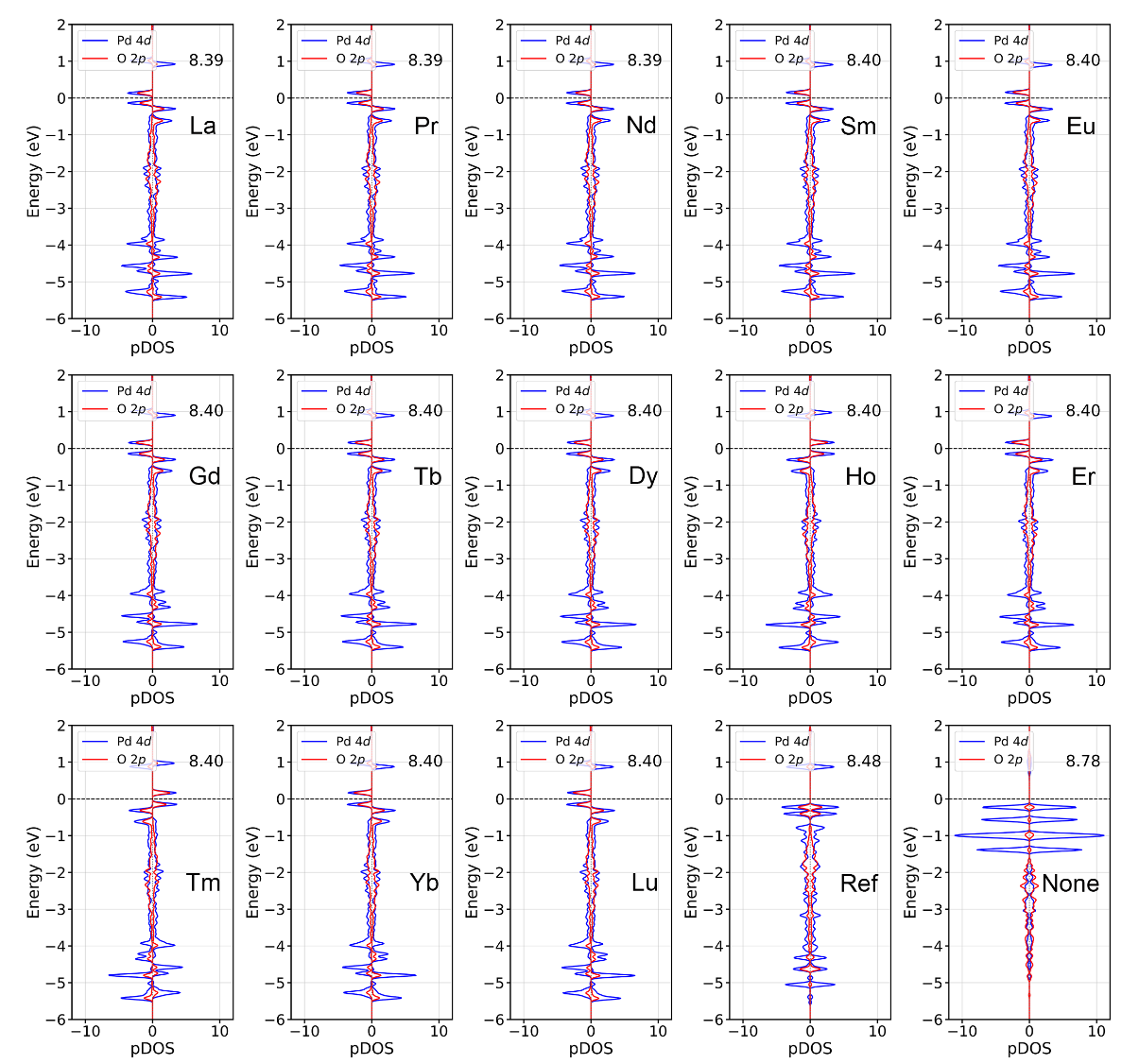
Fig. 3. The partial density of states of Pd-4d and O-2p orbitals (O adjacent to the Pd and Ln) in Ln-Zn co-doped Pd1/CeO2(111) (Ln=La, Pr, Nd, Sm, Eu, Gd, Tb, Dy, Ho, Er, Tm, Yb, and Lu). Energies are referenced to the Fermi level (EF=0). The value shown in each of the graphs corresponds to the integrated DOS (number of electrons) of the Pd-4d below the Fermi level. The corresponding pDOS of Zn-doped Pd1/CeO2(111) and pristine Pd1/CeO2(111), denoted as None, are included for comparison [65].
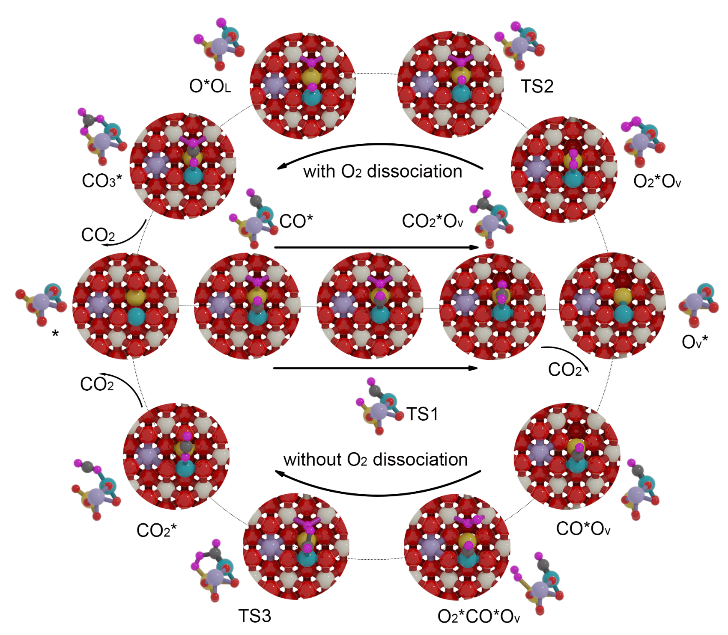
Fig. 4. The reaction pathways over Ln-Zn co-doped Pd1/CeO2(111) (Ln=La, Pr, Nd, Sm, Eu, Gd, Tb, Dy, Ho, Er, Tm, Yb, Lu) (colour code: white=Ce; red=lattice O; yellow=Zn; light purple=Ln; blue=Pd; grey=C; pink=O involved in reaction). Pathway 1=P1 + P2, Pathway 2=P1 + P3.
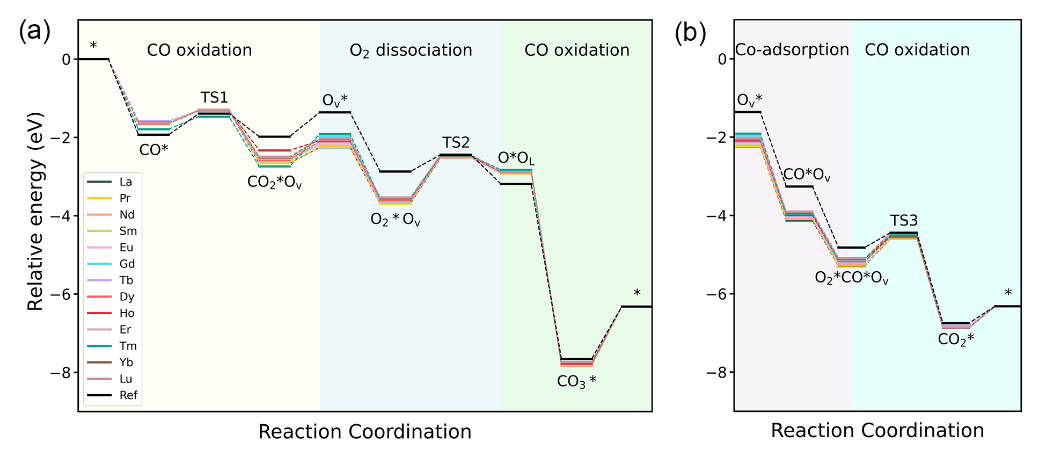
Fig. 5. Potential energy diagrams of CO oxidation on Ln-Zn co-doped Pd1/CeO2(111), with Zn-doped Pd1/CeO2(111) as reference (Ref). (a) The common initial pathway (P1), followed by O2 dissociative pathway (P2). (b) The possible O2 non-dissociative pathway (P3) following P1.
| CO oxidation with O2 direct dissociation (P1 + P2) | |||||||||
|---|---|---|---|---|---|---|---|---|---|
| Ln | COads | TS1 | CO2rea | CO2des | O2ads | TS2 | O2rea | COads | CO2des |
| La | ‒1.65 | 0.34 | ‒1.00 | 0.41 | ‒1.44 | 1.17 | 0.85 | ‒5.01 | 1.53 |
| Pr | ‒1.70 | 0.37 | ‒1.00 | 0.42 | ‒1.45 | 1.16 | 0.77 | ‒4.93 | 1.52 |
| Nd | ‒1.65 | 0.36 | ‒0.88 | 0.35 | ‒1.48 | 1.15 | 0.76 | ‒4.92 | 1.51 |
| Sm | ‒1.64 | 0.34 | ‒0.97 | 0.44 | ‒1.47 | 1.14 | 0.74 | ‒4.91 | 1.50 |
| Eu | ‒1.64 | 0.34 | ‒0.96 | 0.44 | ‒1.48 | 1.14 | 0.74 | ‒4.92 | 1.50 |
| Gd | ‒1.64 | 0.33 | ‒0.95 | 0.63 | ‒1.67 | 1.13 | 0.75 | ‒4.92 | 1.48 |
| Tb | ‒1.58 | 0.26 | ‒1.00 | 0.46 | ‒1.50 | 1.12 | 0.72 | ‒4.90 | 1.47 |
| Dy | ‒1.64 | 0.33 | ‒0.92 | 0.46 | ‒1.50 | 1.12 | 0.72 | ‒4.89 | 1.46 |
| Ho | ‒1.64 | 0.33 | ‒0.69 | 0.25 | ‒1.51 | 1.12 | 0.71 | ‒4.90 | 1.46 |
| Er | ‒1.63 | 0.32 | ‒0.91 | 0.49 | ‒1.53 | 1.11 | 0.73 | ‒4.90 | 1.44 |
| Tm | ‒1.80 | 0.33 | ‒0.94 | 0.82 | ‒1.65 | 1.11 | 0.73 | ‒4.92 | 1.43 |
| Yb | ‒1.62 | 0.32 | ‒0.89 | 0.49 | ‒1.53 | 1.10 | 0.68 | ‒4.88 | 1.44 |
| Lu | ‒1.63 | 0.33 | ‒0.86 | 0.48 | ‒1.51 | 1.09 | 0.65 | ‒4.86 | 1.42 |
| Ref | ‒1.93 | 0.53 | ‒0.06 | 0.63 | ‒1.51 | 0.43 | ‒0.33 | ‒4.46 | 1.34 |
| CO oxidation with O2 non-direct dissociation (P1 +P3) | |||||||||
| Ln | COads | TS1 | CO2rea | CO2des | COads | O2ads | TS3 | CO2rea | CO2des |
| La | — | — | — | — | ‒1.88 | ‒1.15 | 0.70 | ‒1.58 | 0.55 |
| Pr | — | — | — | — | ‒1.85 | ‒1.19 | 0.70 | ‒1.59 | 0.55 |
| Nd | — | — | — | — | ‒1.90 | ‒1.88 | 0.70 | ‒1.61 | 0.55 |
| Sm | — | — | — | — | ‒1.88 | ‒1.18 | 0.69 | ‒1.64 | 0.55 |
| Eu | — | — | — | — | ‒1.88 | ‒1.88 | 0.68 | ‒1.66 | 0.55 |
| Gd | — | — | — | — | ‒2.05 | ‒1.19 | 0.68 | ‒1.67 | 0.55 |
| Tb | — | — | — | — | ‒1.90 | ‒1.17 | 0.68 | ‒1.63 | 0.49 |
| Dy | — | — | — | — | ‒1.88 | ‒1.18 | 0.67 | ‒1.70 | 0.55 |
| Ho | — | — | — | — | ‒1.90 | ‒1.16 | 0.61 | ‒1.71 | 0.55 |
| Er | — | — | — | — | ‒1.90 | ‒1.19 | 0.66 | ‒1.73 | 0.55 |
| Tm | — | — | — | — | ‒2.05 | ‒1.16 | 0.66 | ‒1.74 | 0.55 |
| Yb | — | — | — | — | ‒1.91 | ‒1.18 | 0.60 | ‒1.75 | 0.55 |
| Lu | — | — | — | — | ‒1.88 | ‒1.19 | 0.65 | ‒1.77 | 0.55 |
| Ref | — | — | — | — | ‒1.90 | ‒1.57 | 0.39 | ‒0.05 | 0.43 |
Table 1 Calculated energies for the CO oxidation reaction of Ln-Zn co-doped and Zn-doped Pd1/CeO2(111), which also correspond to Figs. 4 and 5 (all energies in eV).
| CO oxidation with O2 direct dissociation (P1 + P2) | |||||||||
|---|---|---|---|---|---|---|---|---|---|
| Ln | COads | TS1 | CO2rea | CO2des | O2ads | TS2 | O2rea | COads | CO2des |
| La | ‒1.65 | 0.34 | ‒1.00 | 0.41 | ‒1.44 | 1.17 | 0.85 | ‒5.01 | 1.53 |
| Pr | ‒1.70 | 0.37 | ‒1.00 | 0.42 | ‒1.45 | 1.16 | 0.77 | ‒4.93 | 1.52 |
| Nd | ‒1.65 | 0.36 | ‒0.88 | 0.35 | ‒1.48 | 1.15 | 0.76 | ‒4.92 | 1.51 |
| Sm | ‒1.64 | 0.34 | ‒0.97 | 0.44 | ‒1.47 | 1.14 | 0.74 | ‒4.91 | 1.50 |
| Eu | ‒1.64 | 0.34 | ‒0.96 | 0.44 | ‒1.48 | 1.14 | 0.74 | ‒4.92 | 1.50 |
| Gd | ‒1.64 | 0.33 | ‒0.95 | 0.63 | ‒1.67 | 1.13 | 0.75 | ‒4.92 | 1.48 |
| Tb | ‒1.58 | 0.26 | ‒1.00 | 0.46 | ‒1.50 | 1.12 | 0.72 | ‒4.90 | 1.47 |
| Dy | ‒1.64 | 0.33 | ‒0.92 | 0.46 | ‒1.50 | 1.12 | 0.72 | ‒4.89 | 1.46 |
| Ho | ‒1.64 | 0.33 | ‒0.69 | 0.25 | ‒1.51 | 1.12 | 0.71 | ‒4.90 | 1.46 |
| Er | ‒1.63 | 0.32 | ‒0.91 | 0.49 | ‒1.53 | 1.11 | 0.73 | ‒4.90 | 1.44 |
| Tm | ‒1.80 | 0.33 | ‒0.94 | 0.82 | ‒1.65 | 1.11 | 0.73 | ‒4.92 | 1.43 |
| Yb | ‒1.62 | 0.32 | ‒0.89 | 0.49 | ‒1.53 | 1.10 | 0.68 | ‒4.88 | 1.44 |
| Lu | ‒1.63 | 0.33 | ‒0.86 | 0.48 | ‒1.51 | 1.09 | 0.65 | ‒4.86 | 1.42 |
| Ref | ‒1.93 | 0.53 | ‒0.06 | 0.63 | ‒1.51 | 0.43 | ‒0.33 | ‒4.46 | 1.34 |
| CO oxidation with O2 non-direct dissociation (P1 +P3) | |||||||||
| Ln | COads | TS1 | CO2rea | CO2des | COads | O2ads | TS3 | CO2rea | CO2des |
| La | — | — | — | — | ‒1.88 | ‒1.15 | 0.70 | ‒1.58 | 0.55 |
| Pr | — | — | — | — | ‒1.85 | ‒1.19 | 0.70 | ‒1.59 | 0.55 |
| Nd | — | — | — | — | ‒1.90 | ‒1.88 | 0.70 | ‒1.61 | 0.55 |
| Sm | — | — | — | — | ‒1.88 | ‒1.18 | 0.69 | ‒1.64 | 0.55 |
| Eu | — | — | — | — | ‒1.88 | ‒1.88 | 0.68 | ‒1.66 | 0.55 |
| Gd | — | — | — | — | ‒2.05 | ‒1.19 | 0.68 | ‒1.67 | 0.55 |
| Tb | — | — | — | — | ‒1.90 | ‒1.17 | 0.68 | ‒1.63 | 0.49 |
| Dy | — | — | — | — | ‒1.88 | ‒1.18 | 0.67 | ‒1.70 | 0.55 |
| Ho | — | — | — | — | ‒1.90 | ‒1.16 | 0.61 | ‒1.71 | 0.55 |
| Er | — | — | — | — | ‒1.90 | ‒1.19 | 0.66 | ‒1.73 | 0.55 |
| Tm | — | — | — | — | ‒2.05 | ‒1.16 | 0.66 | ‒1.74 | 0.55 |
| Yb | — | — | — | — | ‒1.91 | ‒1.18 | 0.60 | ‒1.75 | 0.55 |
| Lu | — | — | — | — | ‒1.88 | ‒1.19 | 0.65 | ‒1.77 | 0.55 |
| Ref | — | — | — | — | ‒1.90 | ‒1.57 | 0.39 | ‒0.05 | 0.43 |
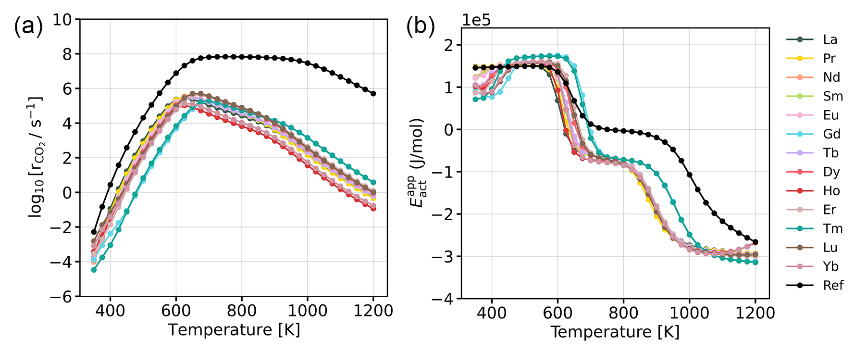
Fig. 6. (a) CO2 formation rate and (b) apparent activation energies ($E_{\text {act }}^{a p p}$) as a function of temperature for Zn-Ln co-doped Pd1/CeO2(111) systems, with Zn-doped Pd1/CeO2(111) system as reference (Ref).
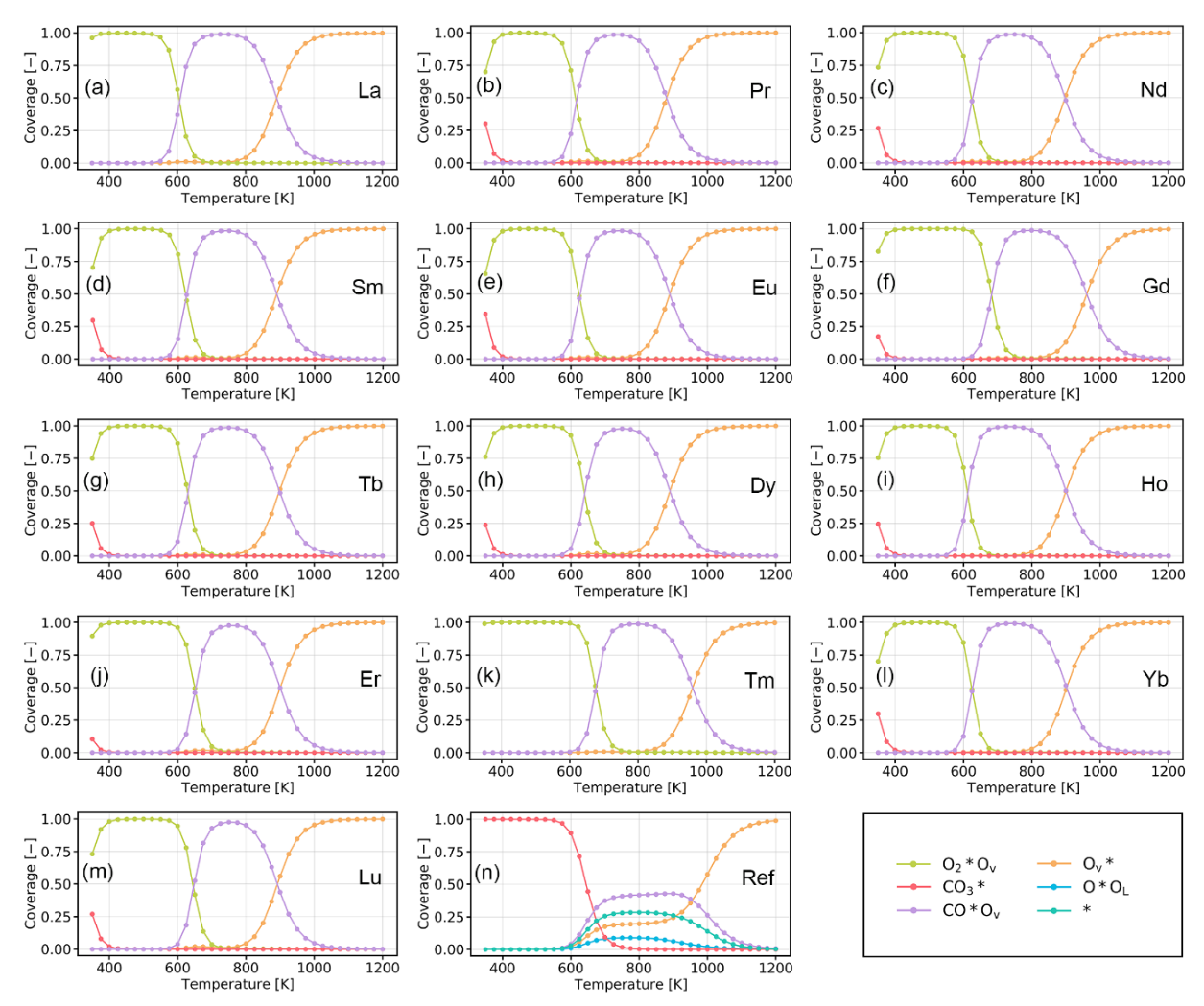
Fig. 7. (a)-(n) Surface coverages of key intermediates as a function of temperature during the CO oxidation reaction on co-doped Zn-Ln Pd1/CeO2(111) systems, where Ln=La (a), Pr (b), Nd (c), Sm (d), Eu (e), Gd (f), Tb (g), Dy (h), Ho (i), Er (j), Tm (k), Yb (l), and Lu (m). (n) The corresponding results for the Zn-doped are shown in panel (n) as the reference system (Ref).
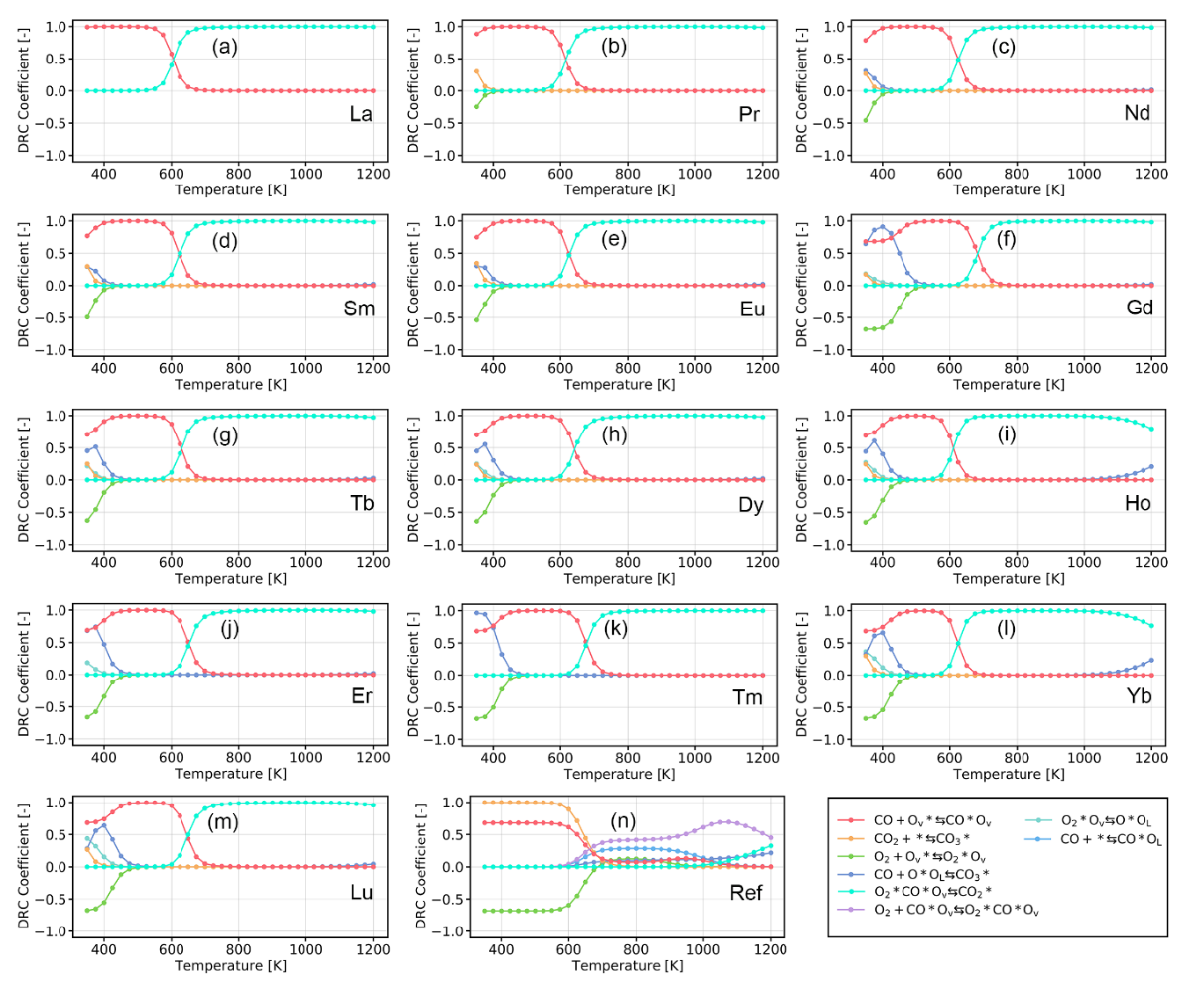
Fig. 8. Degree of rate-control coefficients for elementary steps in CO oxidation over Ln-Zn co-doped Pd1/CeO2(111) systems, where Ln=La (a), Pr (b), Nd (c), Sm (d), Eu (e), Gd (f), Tb (g), Dy (h), Ho (i), Er (j), Tm (k), Yb (l), and Lu (m), together with Zn-doped Pd1/CeO2(111) as the reference system (n).
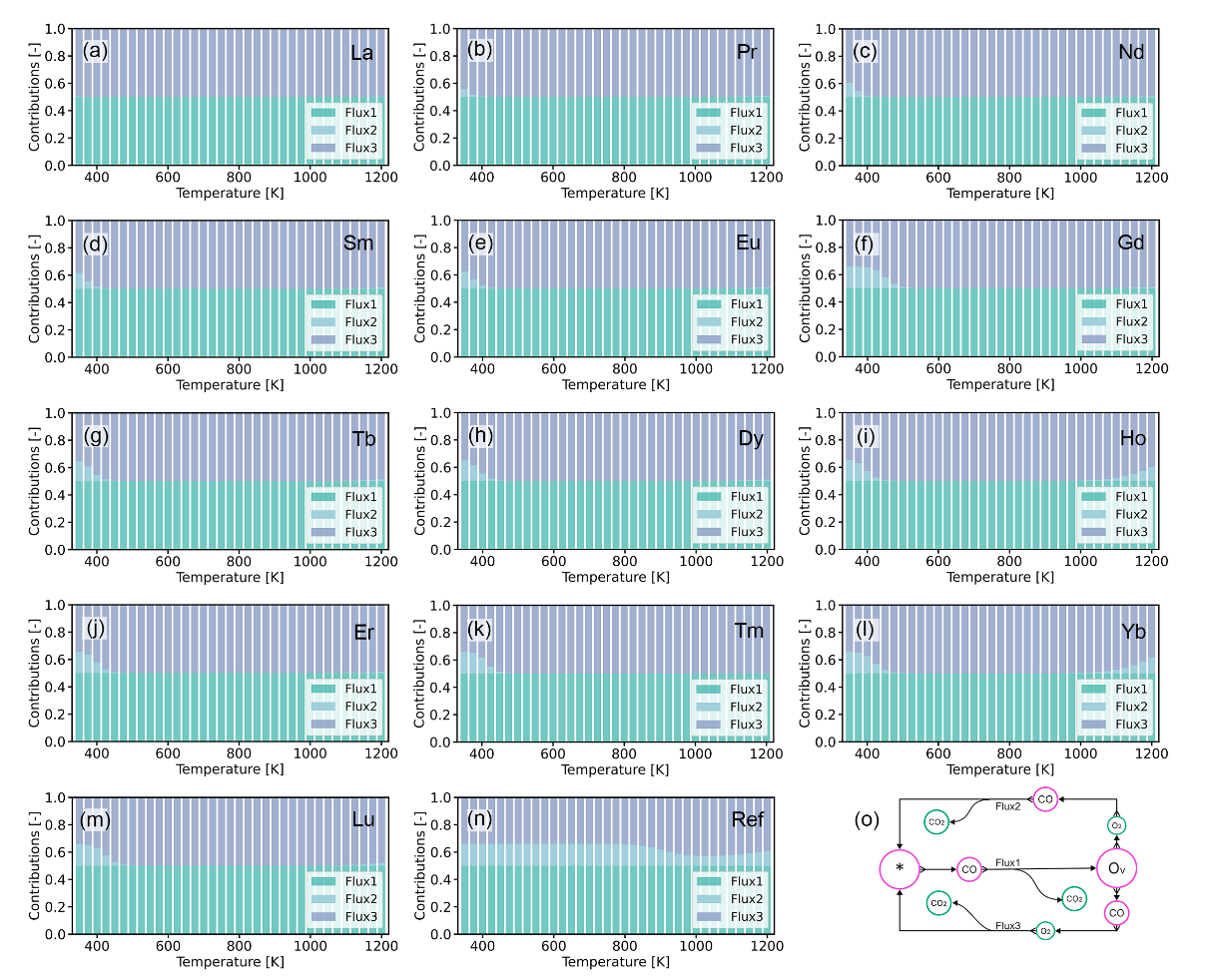
Fig. 9. (a)‒(n) Normalized contributions of each CO2-forming flux to the overall reaction of CO2 production as a function of temperature. (o) Schematic representation of the CO oxidation reaction network based on CO2 as a key intermediate.
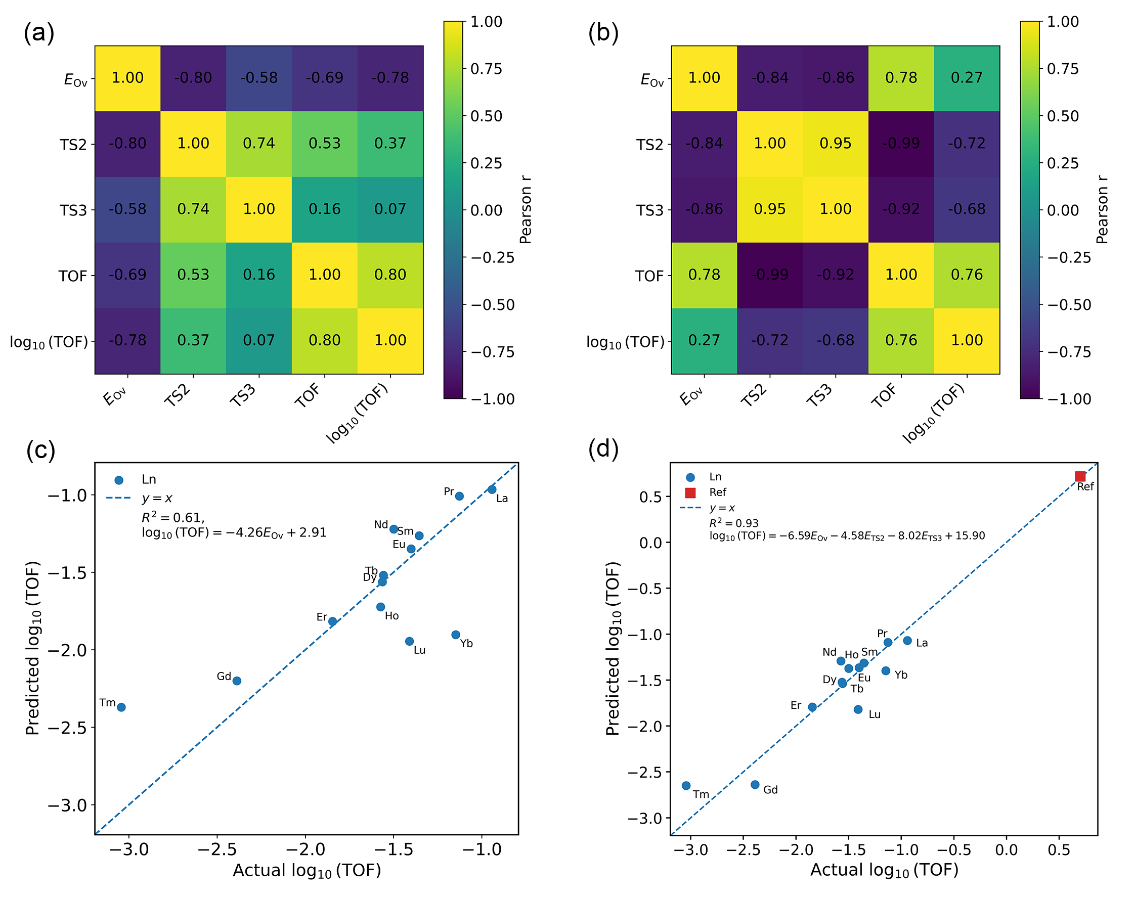
Fig. 10. Statistical assessment of the applicability and transferability of EOv as an activity descriptor. Pearson correlation matrices among EOv, TS2, TS3, TOF, and log10(TOF) for (a) Ln-Zn co-doped systems and (b) Ln-Zn co-doped systems together with Zn-doped reference. (c) Parity plot of the calculated and in-sample fitted log10(TOF) values for the Zn-Ln co-doped systems using a single-parameter linear regression based on EOv. (d) Parity plot of the calculated and in-sample fitted log10(TOF) values for the complete dataset using a multiple linear regression containing EOv, TS2, and TS3. The Zn-doped reference is highlighted by the red square, and the dashed lines in (c) and (d) represent perfect agreement between the calculated and fitted values (y=x). The detailed p-values, confidence intervals, adjusted R2, leave-one-out cross-validation metrics, variance inflation factors, and influence diagnostics have been added to Table S3 and Table S4, respectively.
|
| [1] | Wenmin Lei, Yan Zhang, Dalin Sun, Lin Ban, Heng Zhou, Song Yang, Liquan Jing, Jinguang Hu, Heng Zhang. Transition-metals photocatalysts for lignin valorization toward sustainable biofuel production [J]. Chinese Journal of Catalysis, 2026, 88(9): 35-85. |
| [2] | Miao Wang, Tianyu Shen, Heng Zhou, Shuaikang Yang, Fengkun Hao, Chaohui Wang, Mohan Kumar, Zuoxiu Tie, Shuangming Chen, Zhanxi Fan, Zhong Jin. Direct electrosynthesis of ammonia from nitrate reduction using atomically precise carbonyl-rich metal clusters in neutral media [J]. Chinese Journal of Catalysis, 2026, 88(9): 259-268. |
| [3] | Jiaxiang Qin, Songpei Zhang, Xingju Li, Xintai Chen, Jia Zhao, Xiaoling Mou, Xiangen Song, Li Yan, Ronghe Lin, Yunjie Ding. Decoding structure-selectivity interplay in Pd-Ag nanocatalysts for butadiene semi-hydrogenation [J]. Chinese Journal of Catalysis, 2026, 87(8): 342-352. |
| [4] | Zhaochun He, Chunli Liu, Yonghua Liu, Tao Wang. Boosting homogeneous ammonia synthesis by balancing N≡N activation and N-H formation [J]. Chinese Journal of Catalysis, 2026, 87(8): 316-326. |
| [5] | Zi-Hang Wang, Wei Zhong, Si-Qi Li, Bin Sun, Hao Lan, Xiao-Yu Zhang, Xin Wang, Yu Chen, Xuan Ai. The C-C bond cleavage inhibition and intermediates adsorption enhancement co-boost the selective electrooxidation of ethylene glycol on silver-palladium hollow nanocubes [J]. Chinese Journal of Catalysis, 2026, 86(7): 191-200. |
| [6] | Yatai Zhou, Chengcheng Yuan, Wei Xia, Jun Wang, Xiaofeng Zhu, Yong Zhang, Bicheng Zhu, Jiaguo Yu. Synergistic optimization of interfacial electron transfer and surface hydrogen adsorption in a CdS/ZnO S-scheme heterojunction by site-specific doping: A DFT study [J]. Chinese Journal of Catalysis, 2026, 86(7): 327-337. |
| [7] | Zheguan Lin, Shuyi He, Tiesen Li, Qingyan Cui, Wenfu Yan, Yuanyuan Yue. Design of interface structure to enhance the operational temperature range of CuO/Cu-SSZ-13 for concurrent NOx selective catalytic reduction and CO oxidation [J]. Chinese Journal of Catalysis, 2026, 85(6): 286-297. |
| [8] | Polina Lavrik, Jurjen Cazemier, Mohamed N. Hedhili, Sudheesh K. Veeranmaril, Abdallah Nassereddine, Antonio Aguilar-Tapia, Marina Chernova, Jean-Louis Hazemann, Alla Dikhtiarenko, Javier Ruiz-Martínez. Relationship between palladium nuclearity and catalytic activity and selectivity in acetylene semi-hydrogenation [J]. Chinese Journal of Catalysis, 2026, 85(6): 384-393. |
| [9] | Lanlan Chen, Li Sheng, Yanan Zhou, Qiquan Luo, Zhenyu Li, Wenhua Zhang, Jinlong Yang. Unraveling the superiority of Ni1-MoS2 single-atom catalyst in CO2 hydrogenation to methanol: A DFT combined microkinetic study [J]. Chinese Journal of Catalysis, 2026, 85(6): 143-152. |
| [10] | Yihan Ye, Yilun Ding, Tao Peng, Cheng Liu, Xinzhe Li, Yongzhi Zhao, Jianping Xiao, Feng Jiao, Xiulian Pan. Role of accumulated carbonaceous species on dynamic confinement in zeolite catalysis [J]. Chinese Journal of Catalysis, 2026, 84(5): 74-79. |
| [11] | Wenning Liu, Li An, Jinming Wang, Ruyue Li, Jie Mu, Yongde Long, Dan Qu, Yichang Liu, Yuxiang Hu, Xiayan Wang, Ning Jiang, Zaicheng Sun. Group IIIA metals-induced p-d orbital hybridization enhances the oxygen reduction performance of Pd based metallene in zinc-air batteries [J]. Chinese Journal of Catalysis, 2026, 84(5): 144-158. |
| [12] | Cheng Rao, Mengyu Qian, Songyun Tao, Huaiyuan Wang, Dan He, Jun Ye, Hai Liu, Xiangguang Yang, Yibo Zhang. Synergistic enhancement of methane combustion over Pd/CeO2 via single-atom Ni doping: Boosting Pd4+ and oxygen vacancies [J]. Chinese Journal of Catalysis, 2026, 83(4): 419-431. |
| [13] | Xinran Sun, Mengtian Huo, Jianhang Sun, Yu Liang, Kaichi Qin, Haoyang Zhang, Zihao Xing, Jinfa Chang. Sacrificial conversion of metal sulfide precursors into active oxyhydroxide catalysts for enhanced oxygen evolution reaction [J]. Chinese Journal of Catalysis, 2026, 82(3): 84-91. |
| [14] | Runlin Ma, Xiandi Ma, Hejing Wang, Xu Zhang, Yongzheng Fang, Menggai Jiao, Zhen Zhou. Bifunctional electrocatalysis of hydrazine oxidation and hydrogen evolution reactions on 2D CoX (X = P, S, As, Se): Insights from DFT calculations [J]. Chinese Journal of Catalysis, 2026, 82(3): 115-124. |
| [15] | Wenjie Gong, Yangsen Xu, Hao Liu, Wanbin Lin, Zhiwei Du, Yixuan Huang, Jiang Liu, Yu Chen. An active and durable anode catalytic layer with in-situ exsolved Pd-Ni nanoparticles for protonic ceramic fuel cells on hydrocarbon fuels [J]. Chinese Journal of Catalysis, 2026, 82(3): 125-134. |
| Viewed | ||||||
|
Full text |
|
|||||
|
Abstract |
|
|||||


