
催化学报 ›› 2026, Vol. 90: 1-26.DOI: 10.1016/S1872-2067(26)65191-1
• 综述 • 下一篇
Ikram Ullaha, 段日升a, Muhammad Aminb, Waqar Ahmad Qureshia, 徐安武c,*( ), 赵培a,*(), 秦宁a,*()
收稿日期:2026-01-01
接受日期:2026-03-09
出版日期:2026-11-18
发布日期:2026-09-09
通讯作者:
*电子信箱: anwuxu@ustc.edu.cn (徐安武),基金资助:
Ikram Ullaha, Risheng Duana, Muhammad Aminb, Waqar Ahmad Qureshia, An-Wu Xuc,*(), Pei Zhaoa,*(), Ning Qina,*()
Received:2026-01-01
Accepted:2026-03-09
Online:2026-11-18
Published:2026-09-09
Contact:
*E-mail:anwuxu@ustc.edu.cn(A. Xu),pei.zhao@sdu.edu.cn(P. Zhao),n4qin@sdu.edu.cn(N. Qin).
About author:An-Wu Xu (Hefei National Research Center for Physical Sciences at the Microscale, University of Science and Technology of China) is a Professor at the University of Science and Technology of China. He received his Ph.D. degree in Applied Chemistry from the same University in 1998. He has published more than 270 SCI papers in prestigious journals, including J. Am. Chem. Soc., Angew. Chem. Int. Ed., Adv. Mater., ACS Nano, ACS Energy Lett., ACS Catal., and Adv. Funct. Mater.Supported by:摘要:
面对日益严峻的全球能源危机与环境污染问题, 开发清洁、可再生的替代能源已成为人类社会可持续发展的迫切需求. 氢能因其极高的能量密度且燃烧产物仅为水, 被视为最具潜力的理想绿色能源之一. 在众多制氢技术中, 利用太阳能驱动的光催化水分解制氢技术能够直接将取之不尽的太阳能转化为高附加值的化学能, 具有广阔的应用前景. 然而, 传统光催化剂普遍面临光生载流子复合严重、表面催化反应动力学缓慢等瓶颈. 近年来, 单原子催化剂(SACs)因其100%的原子利用率、独特的量子尺寸效应以及高度可调的配位环境, 在光催化领域引起了极大关注. 本综述系统梳理了贵金属与非贵金属单原子光催化剂的最新研究进展, 旨在为高效太阳能-氢能转换系统的设计提供深刻的理论指导与重要参考.
本文以单原子催化剂在光催化制氢中的核心机制为切入点, 全面探讨了其设计理念、性能提升及内在构效关系. 首先, 重点概述了单原子催化剂的基本原理, 并详细阐述了实现金属原子在载体上原子级分散以及提高活性位点密度的合理设计策略(如缺陷工程、空间限域效应及配位锚定等). 随后, 系统性地总结并对比了贵金属(如Pt, Pd, Ag, Au, Ru和Rh)与非贵金属(如Co, Cu, Ni, Fe和Mo)单原子光催化剂在增强制氢活性方面的具体表现. 贵金属单原子凭借其优异的本征活性展现出极高的产氢速率, 而非贵金属单原子则因其地球储量丰富、成本低廉, 在经过配位环境优化后展现出媲美甚至超越贵金属的巨大潜力. 在反应机理层面, 本文深入探究了单原子引入对光催化体系电荷转移行为的根本影响. 特别聚焦于电荷分离、定向电荷转移以及空间限定的电子离域效应. 通过对光生载流子动力学的详细解析, 揭示了中心金属原子与其周围配位原子的配位环境依赖性, 明确了配位构型与宏观催化性能之间的构效关系, 为定向调控光催化产氢性能提供了详实的理论支撑.
最后, 本文客观讨论了当前高效单原子催化剂在规模化制备、工况条件下的结构稳定性以及动态活性位点精准表征等方面所面临的挑战. 本文通过总结基本原理与机制见解, 为推动光催化单原子制氢技术从实验室基础研究迈向实际太阳能转换的工业化应用提供了极具价值的科学指导.
Ikram Ullah, 段日升, Muhammad Amin, Waqar Ahmad Qureshi, 徐安武, 赵培, 秦宁. 用于光催化制氢的贵金属与非贵金属单原子催化剂的创新策略[J]. 催化学报, 2026, 90: 1-26.
Ikram Ullah, Risheng Duan, Muhammad Amin, Waqar Ahmad Qureshi, An-Wu Xu, Pei Zhao, Ning Qin. Innovative strategies in noble and earth abundant metal single-atom-based photocatalysts for hydrogen production[J]. Chinese Journal of Catalysis, 2026, 90: 1-26.
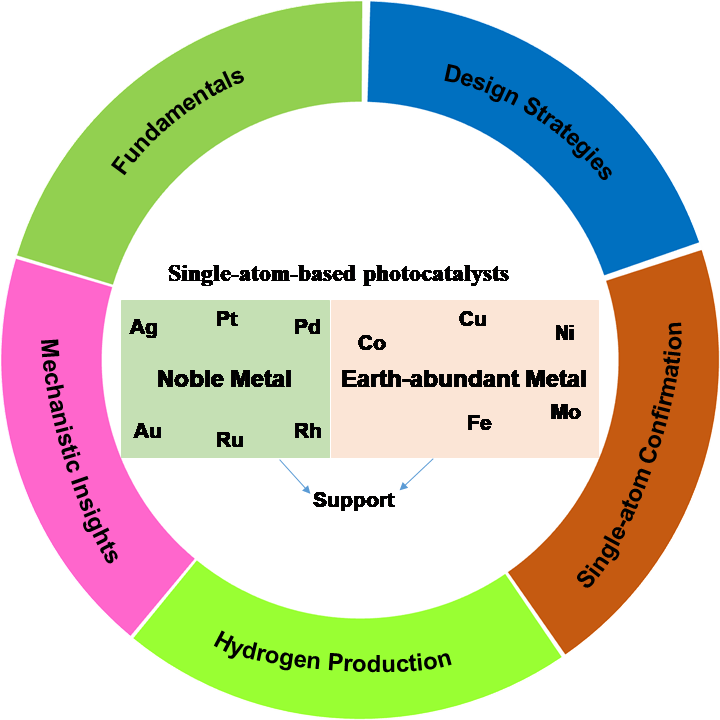
Fig. 1. Schematic diagram presenting the key aspects covered in this review.
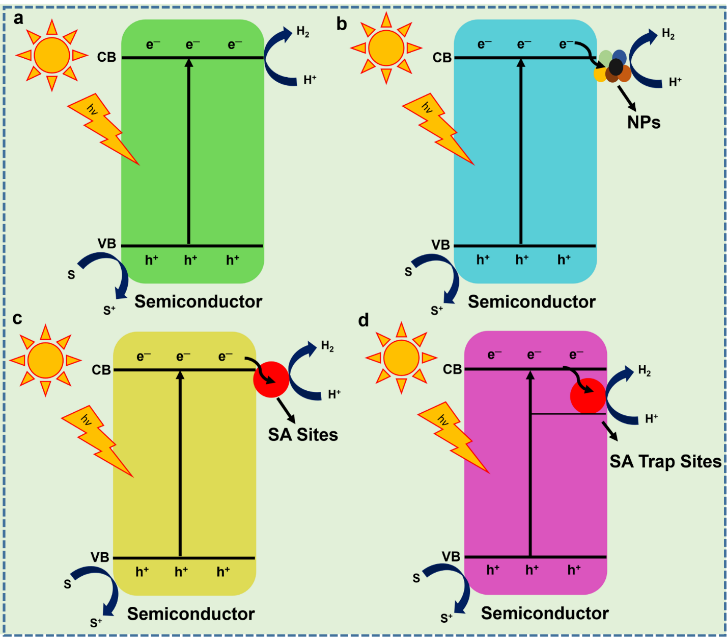
Fig. 2. Typical photocatalytic H2 evolution mechanism on semiconductors (a), semiconductors with nanoparticle cocatalysts (b), semiconductor with SA as cocatalysts (c), and semiconductors with SA as trap sites (d).
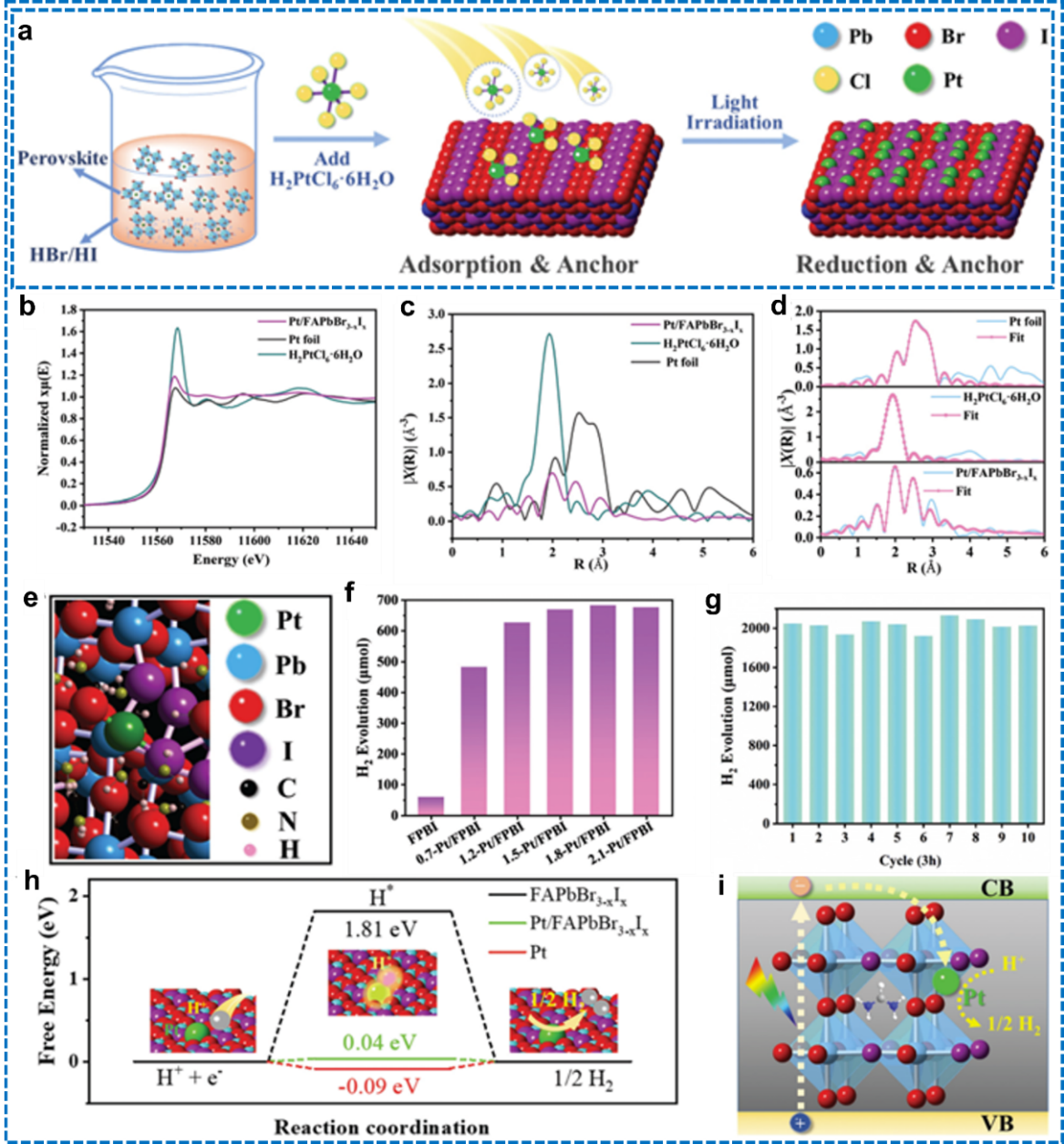
Fig. 3. (a) Preparation mechanism of Pt/FAPbBr3-xIx. (b) XANES spectra at the Pt L3-edge for Pt foil, H2PtCl6, and 1.8-Pt/FAPbBr3-xIx. k3-weighted FT spectra of the EXAFS data (c), R-space data analysis and fitting (d) for 1.8-Pt/FAPbBr3-xIx compared with two reference samples. (e) Simulated model for the configuration of Pt/FAPbBr3-xIx. (f) H2 production rates of different photocatalysts. (g) Stability plots of 1.8-Pt/FAPbBr3-xIx over 10 cycles. (h) Free energy patterns for H* adsorption on Pt, FAPbBr3-xIx, and Pt/FAPbBr3-xIx with the inset illustrating the related mechanism. (i) Schematic diagram of the photocatalytic mechanism in Pt/FAPbBr3-xIx. Adopted with permission from Ref. [49]. Copyright 2022, Royal Society of Chemistry.
| Photocatalyst | Light source | Sacrificial agent | H2 production (mmol h−1 g−1) | AQE (%) | Ref. |
|---|---|---|---|---|---|
| ZOS-SAPt | 300 W Xe lamp (AM 1.5 filter) | Na2S/Na2SO3 | 9.66 | 8.28 at 365 nm | [ |
| 0.72wt% Pt1@TpPa-1 | 300 W Xe lamp (λ ≥ 420 nm) | sodium ascorbate | 0.719 | 0.38 at 420 nm | [ |
| Pt SA-P25 | LED (365 nm) | — | 4.60 | — | [ |
| Pt-SAs@Pd-PCN-222-NH2 | 300 W Xe lamp (λ ≥ 420 nm) | triisopropanolamine | 16.591 | — | [ |
| TiO2-BNS-Pt0.05 | 150 W Xe lamp (AM 1.5G) | methanol | 0.688 | 8.48 at 325 nm | [ |
| Cd-Pt2-SSs | 150 W Xe lamp (UV-Visible) | Na2S/Na2SO3 | 154.68 | ≈91.1 at 365 nm | [ |
| TCOF/Pt SA | 300 W Xe lamp | benzylamine | 0.5018 | — | [ |
| PtSAs-Au2.5/PCN | 300 Xe lamp (λ ≥ 420 nm) | TEOA | 13.70 | — | [ |
| Sb2S3-Pt0.9% | 300 W Xe lamp (simulated) | TEOA | 1.37 | 5.41 at 700 nm | [ |
| VN2c-UCN-Pt | 300 W Xe lamp (λ ≥ 395 nm) | TEOA | 1.774 | 2.43 at 380 nm | [ |
| PFC-1@Pt | 300 W Xe lamp (λ > 420 nm) | ascorbic acid | 2.2025 | — | [ |
| PtSA/TiO2(Pr) | UV | methanol | 196.43 | 42.07 at 365 nm | [ |
| Pt SAs/g-C3N5-x-O | 300 W Xe lamp (λ > 420 nm) | TEOA | 1.8092 | — | [ |
| Pt SA-NS | LED (365 nm) | methanol | 11.7 | — | [ |
| 0.63%Pt1-N-CN1 | 300 W Xe lamp (λ > 320 nm) | TEOA | 30 | 21.3 at 400 nm | [ |
| Au@Pt-SA/CdS Y-S | 300 W Xe lamp (λ > 420 nm) | Na2S/Na2SO3 | 10.9 | — | [ |
| 1.42wt% Pt1/TiO2 | 300 W Xe lamp (200-2500 nm) | methanol | 95.180 | — | [ |
| Pt0.08SAC3N4.6 | 250 W mercury vapor lamp (Vis-light) | TEOA | 64.1 | 25.3 at 420 nm | [ |
| TAPAT-TFP-Pt1-0.31 wt% | 300 W Xe lamp (λ ≥ 420 nm) | ascorbic acid | 2.39 | 0.24 at 500 nm | [ |
| Pt1/CSv | 300 W Xe lamp (λ > 420 nm) | TEOA | 0.8272 | 17.6 at 420 nm | [ |
Table 1 Photocatalytic H2 production over representative Pt SACs.
| Photocatalyst | Light source | Sacrificial agent | H2 production (mmol h−1 g−1) | AQE (%) | Ref. |
|---|---|---|---|---|---|
| ZOS-SAPt | 300 W Xe lamp (AM 1.5 filter) | Na2S/Na2SO3 | 9.66 | 8.28 at 365 nm | [ |
| 0.72wt% Pt1@TpPa-1 | 300 W Xe lamp (λ ≥ 420 nm) | sodium ascorbate | 0.719 | 0.38 at 420 nm | [ |
| Pt SA-P25 | LED (365 nm) | — | 4.60 | — | [ |
| Pt-SAs@Pd-PCN-222-NH2 | 300 W Xe lamp (λ ≥ 420 nm) | triisopropanolamine | 16.591 | — | [ |
| TiO2-BNS-Pt0.05 | 150 W Xe lamp (AM 1.5G) | methanol | 0.688 | 8.48 at 325 nm | [ |
| Cd-Pt2-SSs | 150 W Xe lamp (UV-Visible) | Na2S/Na2SO3 | 154.68 | ≈91.1 at 365 nm | [ |
| TCOF/Pt SA | 300 W Xe lamp | benzylamine | 0.5018 | — | [ |
| PtSAs-Au2.5/PCN | 300 Xe lamp (λ ≥ 420 nm) | TEOA | 13.70 | — | [ |
| Sb2S3-Pt0.9% | 300 W Xe lamp (simulated) | TEOA | 1.37 | 5.41 at 700 nm | [ |
| VN2c-UCN-Pt | 300 W Xe lamp (λ ≥ 395 nm) | TEOA | 1.774 | 2.43 at 380 nm | [ |
| PFC-1@Pt | 300 W Xe lamp (λ > 420 nm) | ascorbic acid | 2.2025 | — | [ |
| PtSA/TiO2(Pr) | UV | methanol | 196.43 | 42.07 at 365 nm | [ |
| Pt SAs/g-C3N5-x-O | 300 W Xe lamp (λ > 420 nm) | TEOA | 1.8092 | — | [ |
| Pt SA-NS | LED (365 nm) | methanol | 11.7 | — | [ |
| 0.63%Pt1-N-CN1 | 300 W Xe lamp (λ > 320 nm) | TEOA | 30 | 21.3 at 400 nm | [ |
| Au@Pt-SA/CdS Y-S | 300 W Xe lamp (λ > 420 nm) | Na2S/Na2SO3 | 10.9 | — | [ |
| 1.42wt% Pt1/TiO2 | 300 W Xe lamp (200-2500 nm) | methanol | 95.180 | — | [ |
| Pt0.08SAC3N4.6 | 250 W mercury vapor lamp (Vis-light) | TEOA | 64.1 | 25.3 at 420 nm | [ |
| TAPAT-TFP-Pt1-0.31 wt% | 300 W Xe lamp (λ ≥ 420 nm) | ascorbic acid | 2.39 | 0.24 at 500 nm | [ |
| Pt1/CSv | 300 W Xe lamp (λ > 420 nm) | TEOA | 0.8272 | 17.6 at 420 nm | [ |
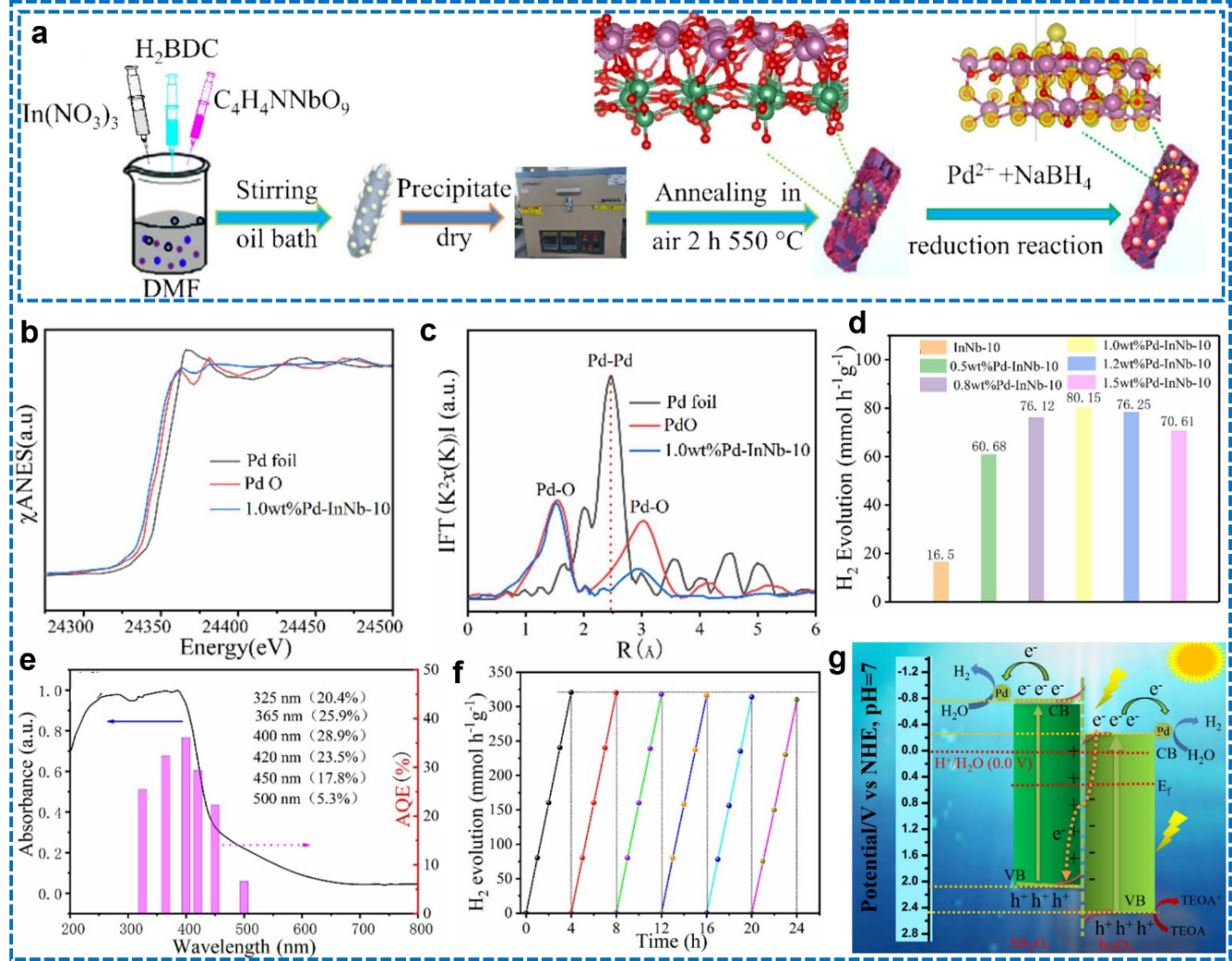
Fig. 4. (a) Diagram of the synthesis process for Pd-InNb-10. Normalized Pd K-edge XANES spectra (b) and k2-weighted Pd K-edge FT-EXAFS spectra (c) in R-space for 1.0 wt%Pd-InNb-10 with reference Pd foil and PdO samples. (d) H2 evolution rate of 1.0 wt%Pd-InNb-10 with varying Pd amounts under simulated solar light illumination. (e) Wavelength-dependent AQE of H2 production. (f) Recycling tests for the optimal sample. (g) Mechanism diagram of the optimal composite upon simulated sunlight driven photocatalytic H2 production. Adopted with permission from Ref. [89]. Copyright 2025, Elsevier.
| Photocatalyst | Light source | Sacrificial agent | H2 production (mmol h−1 g−1) | AQE (%) | Ref. |
|---|---|---|---|---|---|
| 3.5% MAC-1/g-C3N4 | 300 W Xe lamp (λ > 420 nm) | TEOA | 22.3 | 1.61 at 405 nm | [ |
| Pd0.03/ZIS | 300 W Xe lamp (AM 1.5 G) | — | 1.0379 | 4.79 at 380 nm | [ |
| Pd-TiO2 | 300 W Xe lamp | methanol | 24.59 | 23.4 at 365 nm | [ |
| Pd1+NPs/CCN3 | 300 W Xe lamp (λ > 320 nm) | TEOA | 24.1 | 17.1 at 400 nm | [ |
| Pd-MOF | LED (450 nm) | ascorbic acid | 21.3 | — | [ |
| Pd/Cd0.1Zn0.9S | 300 W Xe lamp (λ > 420 nm) | — | 0.6082 | — | [ |
| 0.10PdSA-CuCo2S4 | 250 W mercury vapor lamp | Na2S/Na2SO3 | 39.559 | 15.57 at 420 nm | [ |
| 0.3Pd SA/CdS-H | 300 W Xe lamp (λ > 420 nm) | lactic acid | 22.23 | 16 at 380 nm | [ |
Table 2 Representative Pd SACs for photocatalytic H2 evolution.
| Photocatalyst | Light source | Sacrificial agent | H2 production (mmol h−1 g−1) | AQE (%) | Ref. |
|---|---|---|---|---|---|
| 3.5% MAC-1/g-C3N4 | 300 W Xe lamp (λ > 420 nm) | TEOA | 22.3 | 1.61 at 405 nm | [ |
| Pd0.03/ZIS | 300 W Xe lamp (AM 1.5 G) | — | 1.0379 | 4.79 at 380 nm | [ |
| Pd-TiO2 | 300 W Xe lamp | methanol | 24.59 | 23.4 at 365 nm | [ |
| Pd1+NPs/CCN3 | 300 W Xe lamp (λ > 320 nm) | TEOA | 24.1 | 17.1 at 400 nm | [ |
| Pd-MOF | LED (450 nm) | ascorbic acid | 21.3 | — | [ |
| Pd/Cd0.1Zn0.9S | 300 W Xe lamp (λ > 420 nm) | — | 0.6082 | — | [ |
| 0.10PdSA-CuCo2S4 | 250 W mercury vapor lamp | Na2S/Na2SO3 | 39.559 | 15.57 at 420 nm | [ |
| 0.3Pd SA/CdS-H | 300 W Xe lamp (λ > 420 nm) | lactic acid | 22.23 | 16 at 380 nm | [ |
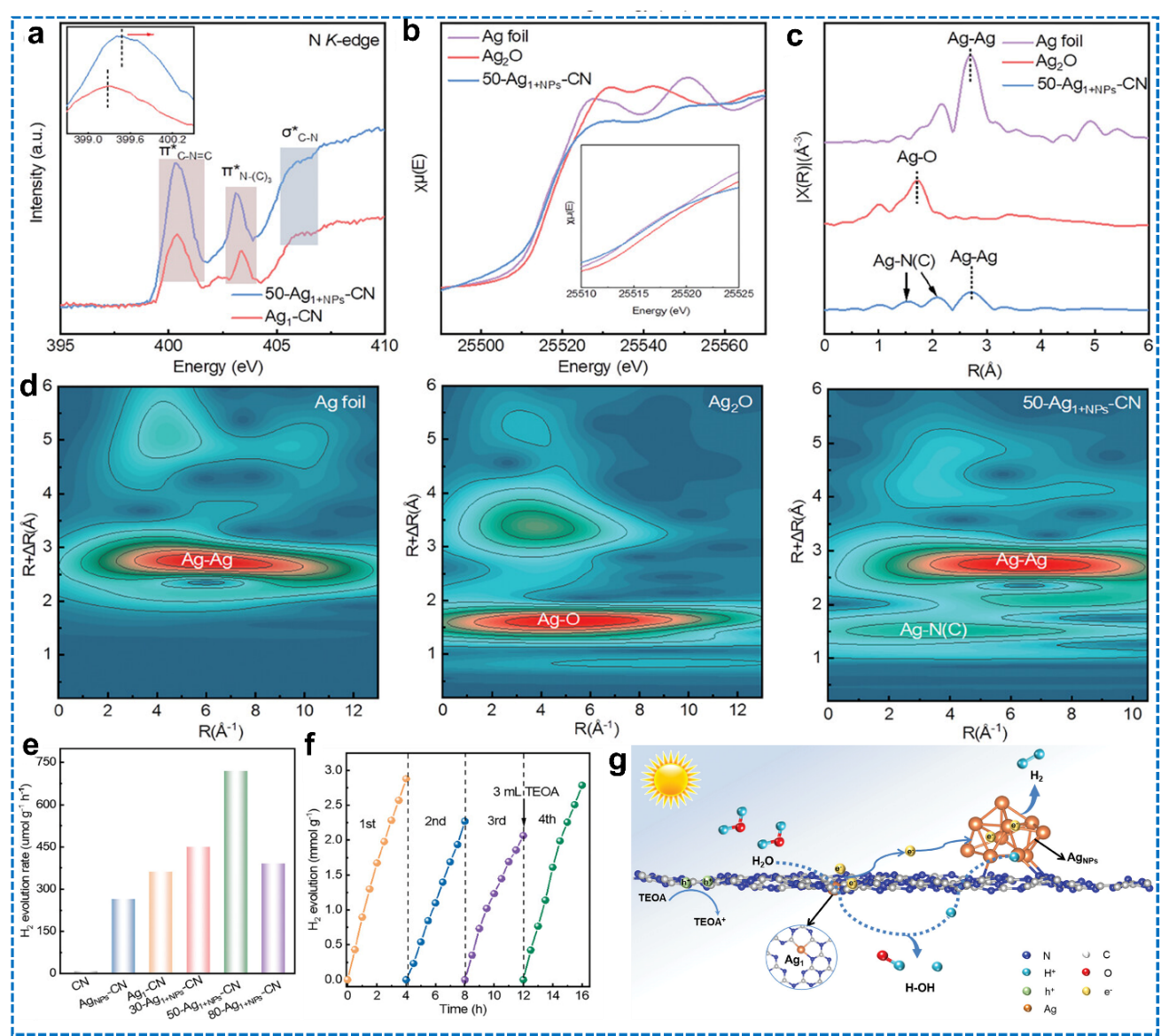
Fig. 5. (a) Normalized N K-edge XANES spectra of Ag1-CN and 50-Ag1+NPs-CN. Ag K-edge XANES spectra (b), FT-EXAFS spectra (c), and WT of the Ag K-edge EXAFS spectra (d) for Ag foil, Ag2O, and the optimal sample. (e) H2 evolution rates of samples. Recycling tests (f) and mechanism (g) of 50-Ag1+NPs-CN upon solar light illumination. Adopted with permission from Ref. [105]. Copyright 2025, John Wiley and Sons.
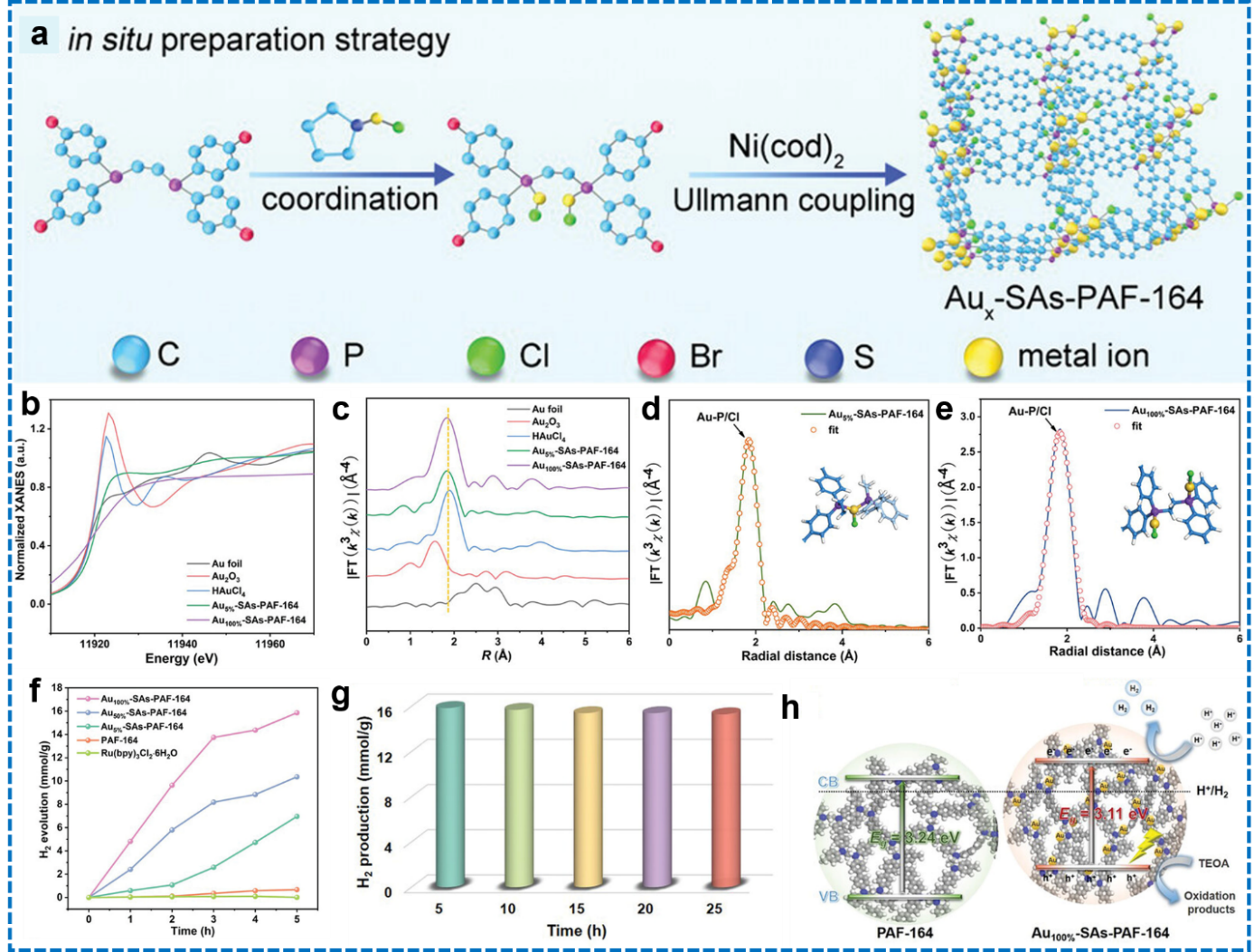
Fig. 6. (a) Schematic of in-situ preparation of Au SAs on PAF-164 by pre-metallated building blocks. Au L3-edge XANES spectra (b) and FT-EXAFS spectra (c) of Au foil, Au2O3, HAuCl4, Au5%-SAs PAF-164, and Au100%-SAs-PAF-164. (d,e) EXAFS fitting plots of Au5%-SAs PAF-164 and Au100%-SAs-PAF-164. (f) H2 production over synthesized photocatalysts. (g) Five-cycle stability test of Au100%-SAs-PAF-164. (h) Charge transfer process in PAF-164 and Aux-SAs-PAF-164 for H2 evolution upon visible-light illumination. Adopted with permission from Ref. [111]. Copyright 2024, John Wiley and Sons.
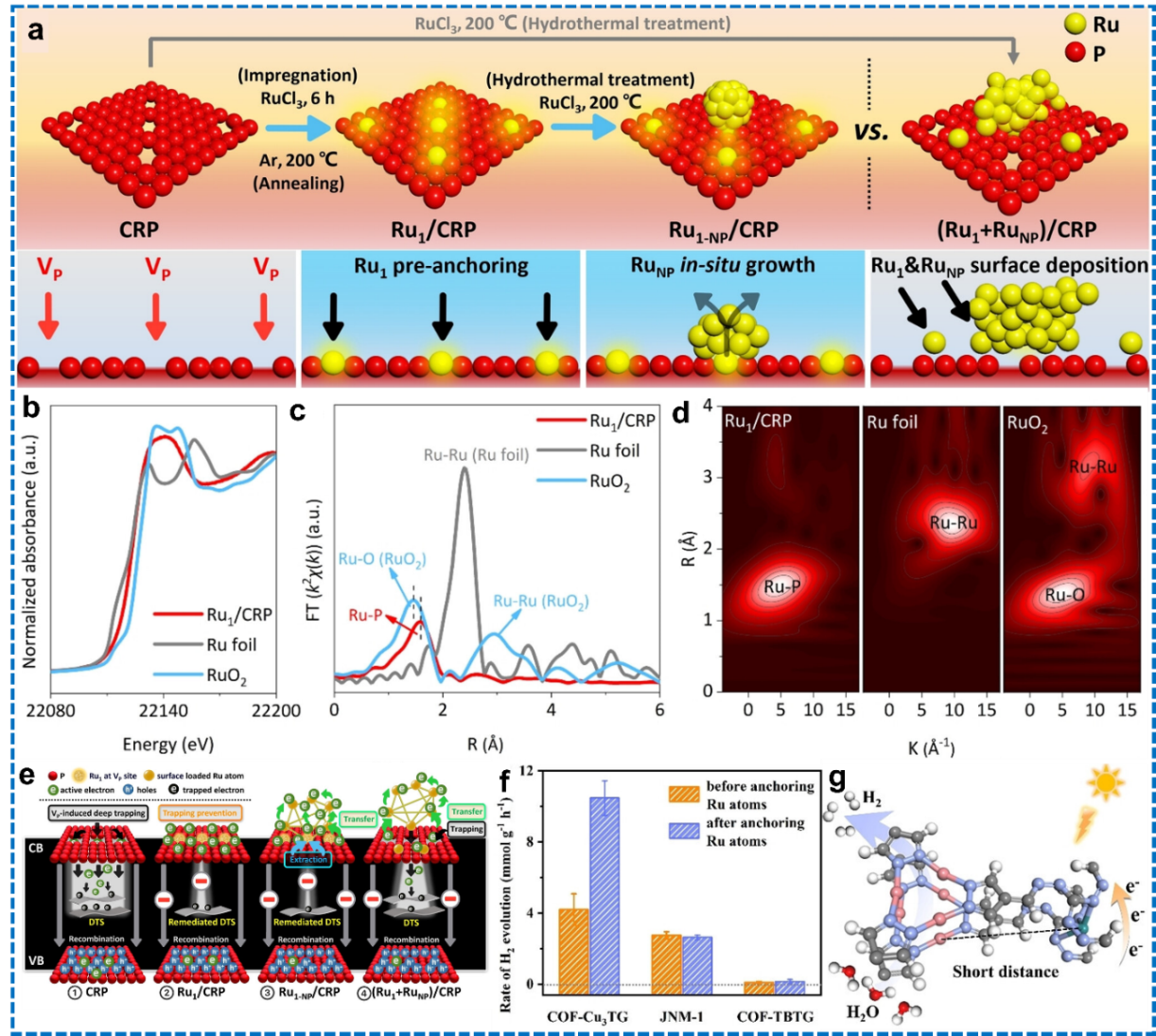
Fig. 7. (a) Scheme for the preparation of photocatalysts. Ru K-edge XANES (b), FT-EXAFS spectra in R-space (c), and WT EXAFS spectra (d) of Ru1/CRP compared with Ru foil and RuO2. (e) Schematic representation of the proposed charge dynamics in CRP, Ru1/CRP, and Ru1-NP/CRP and Ru1+RuNP/CRP. Adopted with permission from Ref. [123]. Copyright 2024, John Wiley and Sons. (f) H2 production rate before and after loading Ru atoms. (g) Schematic illustration of the mechanism of H2 evolution over COF-Cu3TG. Adopted with permission from Ref. [131]. Copyright, 2024, John Wiley and Sons.
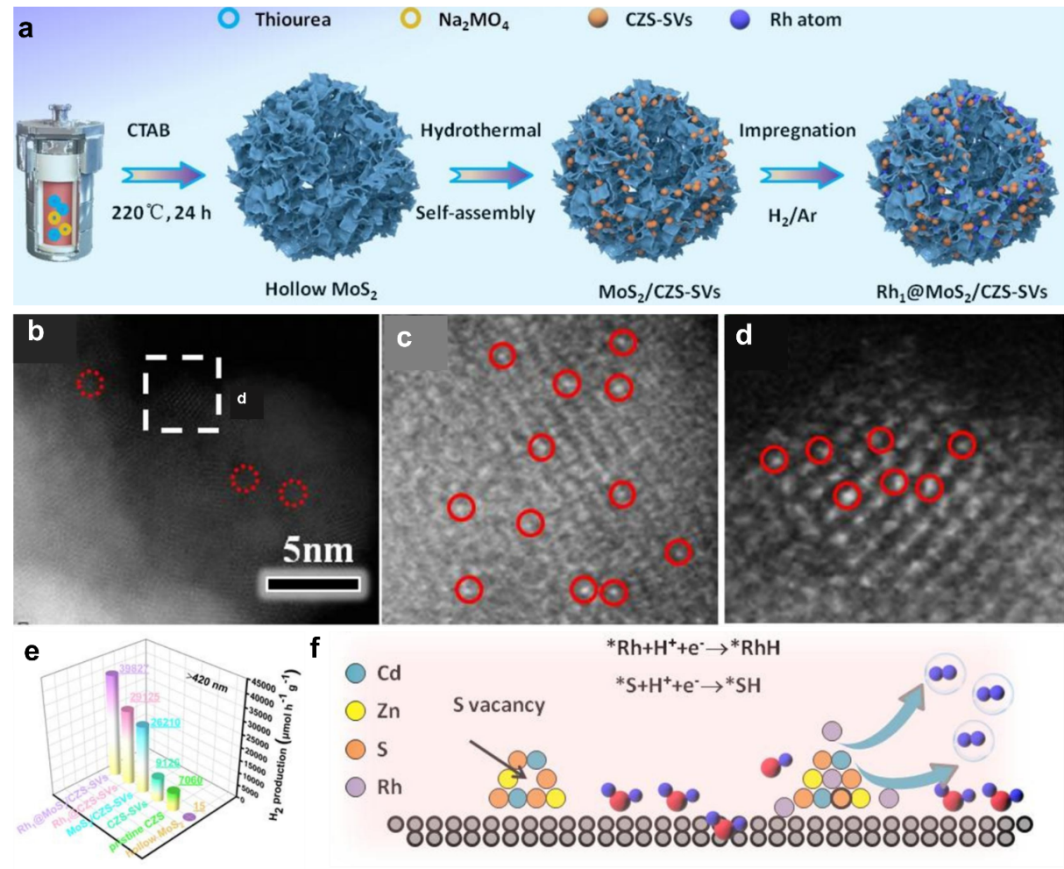
Fig. 8. (a) Synthesis process of Rh1@MoS2/CZS-SVs photocatalyst. (b-d) HAADF-STEM images of Rh1@MoS2/CZS-SVs, where red circles represent atomically dispersed Rh SAs. (e) H2 evolution rates of different samples. (f) Charge transfer mechanism for Rh1@MoS2/CZS-SVs. Adopted with permission from Ref. [132]. Copyright 2025, Elsevier.
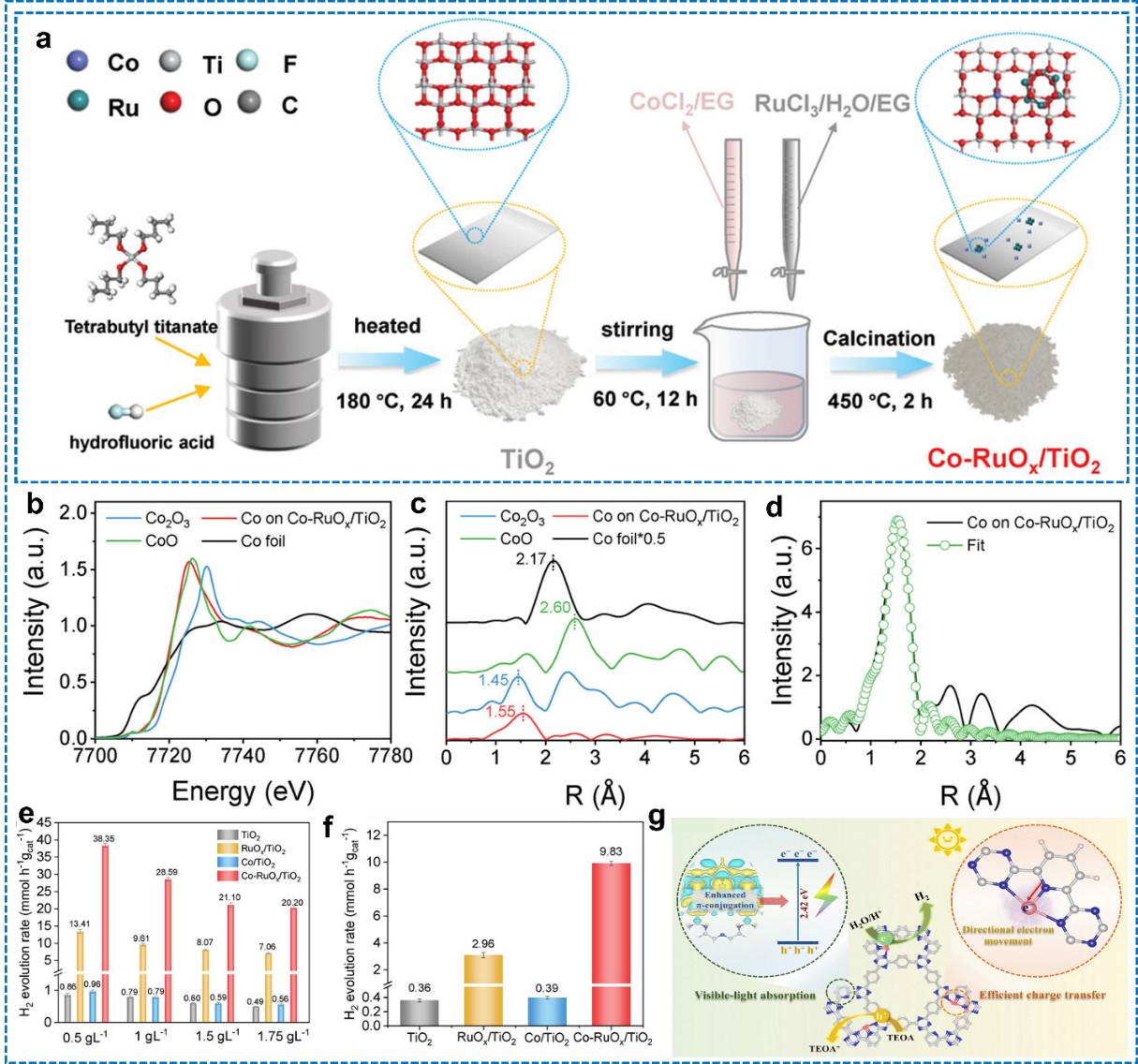
Fig. 9. (a) Illustration of the synthesis of Co-RuOx/TiO2. Co K-edge XANES spectra (b), FT spectra in R-space (c) for Co-RuOx/TiO2 and reference samples. (d) EXAFS fitting plot in R-space for Co-RuOx/TiO2. (e) H2 evolution rates as a function of photocatalyst concentration. (f) H2 production rates in seawater at 1.75 g L−1 for various photocatalysts. Adopted with permission from Ref. [138]. Copyright 2023, John Wiley and Sons. (g) Photocatalytic H2 production mechanism over Co1-PCTF. Adopted with permission from Ref. [149]. Copyright 2024, Royal Society of Chemistry.
| Photocatalyst | Light Source | Sacrificial agent | H2 production (mmol h−1 g−1) | AQE (%) | Ref. |
|---|---|---|---|---|---|
| Co-N-C/g-C3N4 | 12 W LED-lamp (λ = 420 ± 10 nm) | TEOA | 1.180 | — | [ |
| 30%Co@PCMP | 300 W Xe-lamp (λ > 420 nm) | TEOA | 1.72 | 2.05 at 420 nm | [ |
| Co/P/CN-sc | 300 W Xe-lamp (λ > 420 nm) | TEOA | 3.7304 | — | [ |
| Co-CCN-PTI | 300 W Xe-lamp (λ > 420 nm) | TEOA | 3.538 | 20.88 at 425 nm | [ |
| Co0.10-SA/CTF | 300 W Xe-lamp (λ = 420 nm) | TEOA | 1.29318 | 1.72 at 420 nm | [ |
| 1.5%Co/PCN | 300 W Xe-lamp (λ = 400 nm) | TEOA | 0.8925 | — | [ |
| Co(N, S)/C3N4 | 10 W LED-lamp (λ = 420 nm) | ethanol | 9.99 | 15.82 at 420 nm | [ |
| CNA/10Co-dcbpy | 300 W Xe-lamp (λ > 400 nm) | TEOA | 1.016 | 3.43 at 420 nm | [ |
Table 3 outlines latest Co SACs for H2 production.
| Photocatalyst | Light Source | Sacrificial agent | H2 production (mmol h−1 g−1) | AQE (%) | Ref. |
|---|---|---|---|---|---|
| Co-N-C/g-C3N4 | 12 W LED-lamp (λ = 420 ± 10 nm) | TEOA | 1.180 | — | [ |
| 30%Co@PCMP | 300 W Xe-lamp (λ > 420 nm) | TEOA | 1.72 | 2.05 at 420 nm | [ |
| Co/P/CN-sc | 300 W Xe-lamp (λ > 420 nm) | TEOA | 3.7304 | — | [ |
| Co-CCN-PTI | 300 W Xe-lamp (λ > 420 nm) | TEOA | 3.538 | 20.88 at 425 nm | [ |
| Co0.10-SA/CTF | 300 W Xe-lamp (λ = 420 nm) | TEOA | 1.29318 | 1.72 at 420 nm | [ |
| 1.5%Co/PCN | 300 W Xe-lamp (λ = 400 nm) | TEOA | 0.8925 | — | [ |
| Co(N, S)/C3N4 | 10 W LED-lamp (λ = 420 nm) | ethanol | 9.99 | 15.82 at 420 nm | [ |
| CNA/10Co-dcbpy | 300 W Xe-lamp (λ > 400 nm) | TEOA | 1.016 | 3.43 at 420 nm | [ |
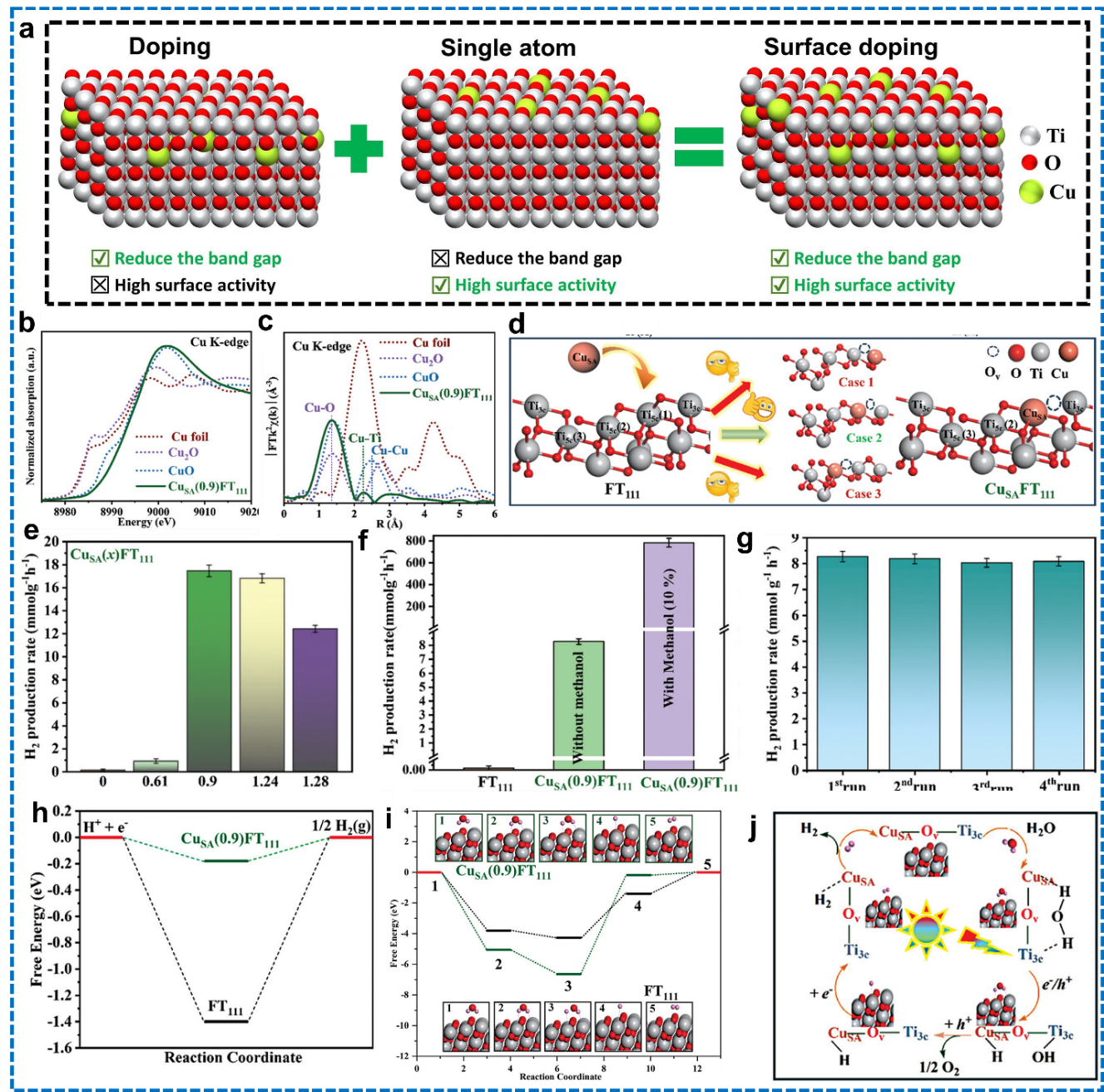
Fig. 10. (a) Schematic representation of Cu SAs on TiO2 via surface doping approach. Adopted with permission from Ref. [166]. Copyright 2023, Elsevier. Normalized Cu K-edge XANES spectra (b) and Cu K-edge K2-weighted FT EXAFS spectra (c) of samples. (d) Illustration of CuSA-OV-Ti3c HAAS construction, displaying CuSA replacement at Ti5c sites next to Ti3c based EXAFS analysis. (e) H2 evolution over HAASC catalysts with various Cu amounts. (f) H2 evolution rates over FT111 and CuSA(0.9)FT111. (g) Photocatalytic H2 production stability test of CuSA(0.9)FT111. (h) Gibbs free energy plot for H2 evolution reaction at CuSA-OV-Ti3c (green) and Ti5c-O-Ti3c (black) sites. (i) Proposed H2O activation path and free energy pattern of intermediates for CuSA-OV-Ti3c HAAS (green) and Ti5c-O-Ti3c AAS (black). (j) Proposed photocatalytic water splitting reaction mechanism over CuSA-OV-Ti3c HAASC (grey, brown, red, and pink color indicate Ti, Cu, O, and H atoms, respectively). Adopted with permission from Ref. [168]. Copyright 2024, John Wiley and Sons.
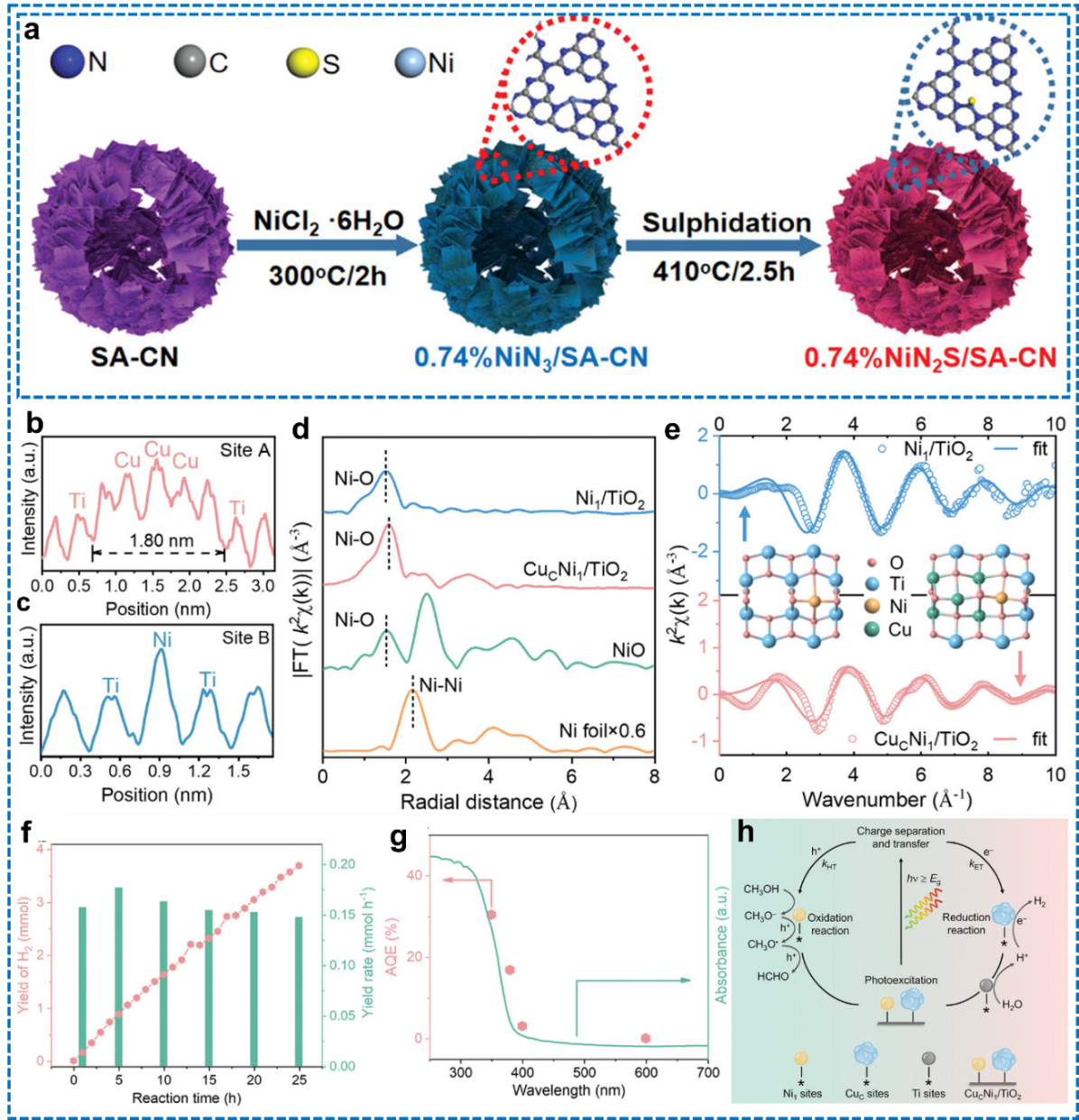
Fig. 11. (a) Schematic illustration for the synthesis of 0.74%NiN2S/SA-CN. Adopted with permission from Ref. [185]. Copyright 2022, John Wiley and Sons. Intensity profiles for site A (b) and site B (c). (d) FT-EXAFS spectra of Ni foil, NiO, CuCNi1/TiO2, and Ni1/TiO2. (e) FT-EXAFS fitting plots of Ni1/TiO2 and CuCNi1/TiO2 in k space. Photocatalytic H2 production stability test (f) and AQE (g) for CuCNi1/TiO2 upon 350 nm. (h) Photocatalytic H2 production mechanism over CuCNi1/TiO2. Adopted with permission from Ref. [187]. Copyright 2024, John Wiley and Sons.
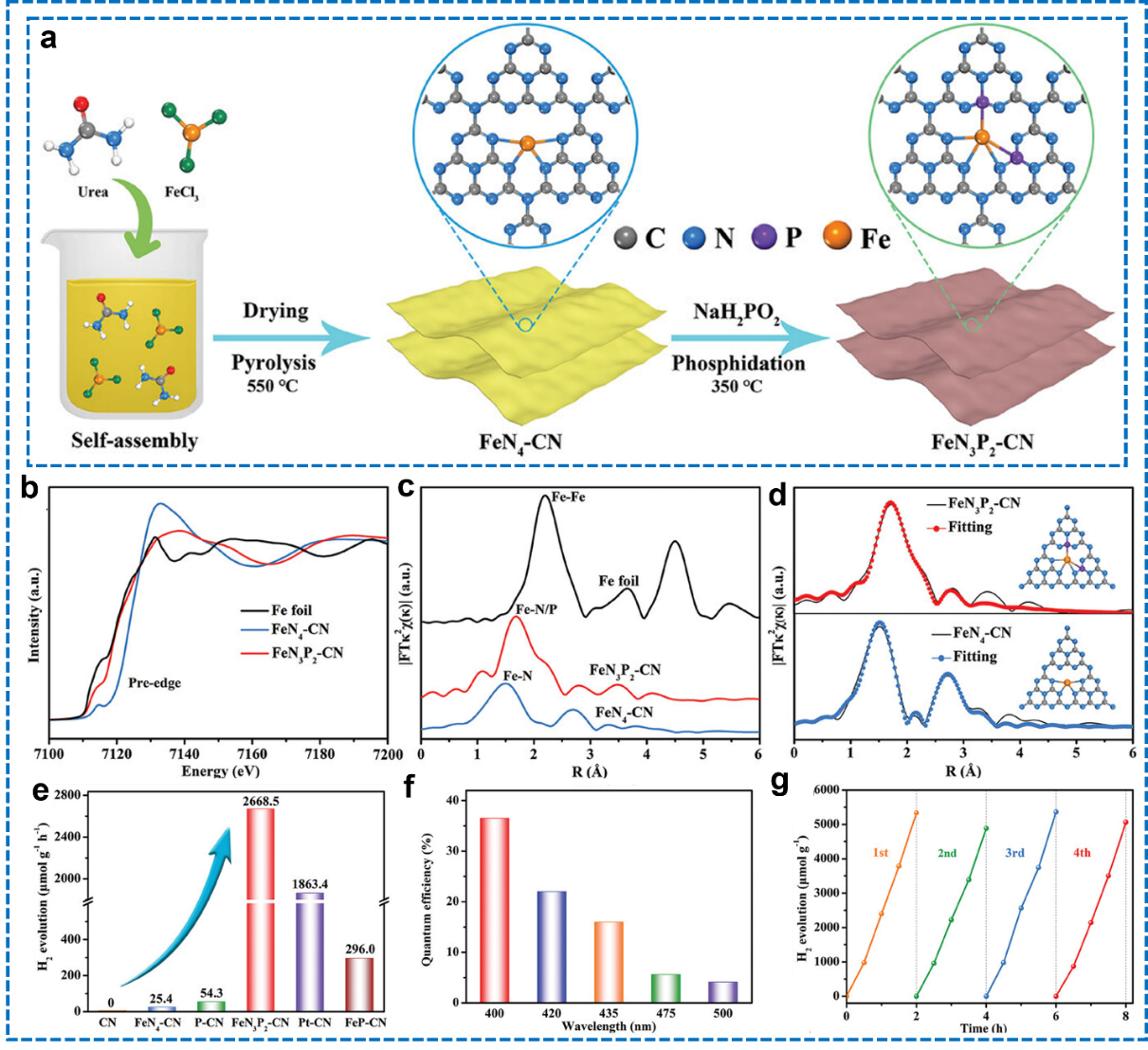
Fig. 12. (a) Schematic representation for synthesis of FeN4-CN and FeN3P2-CN. Fe K-edge XANES spectra (b) and FT K-edge EXAFS spectra (c) of FeN3N2-CN, FeN4-CN, and Fe foil. (d) R space fitting curves of FeN3P2-CN and FeN4-CN. (e) Average H2 evolution rates for various photocatalysts upon visible-light illumination. (f) Quantum efficiency of H2 production for FeN3P2-CN. (g) Cycling durability test of H2 production over FeN3P2-CN. Adopted with permission from Ref. [189]. Copyright 2024, John Wiley and Sons.
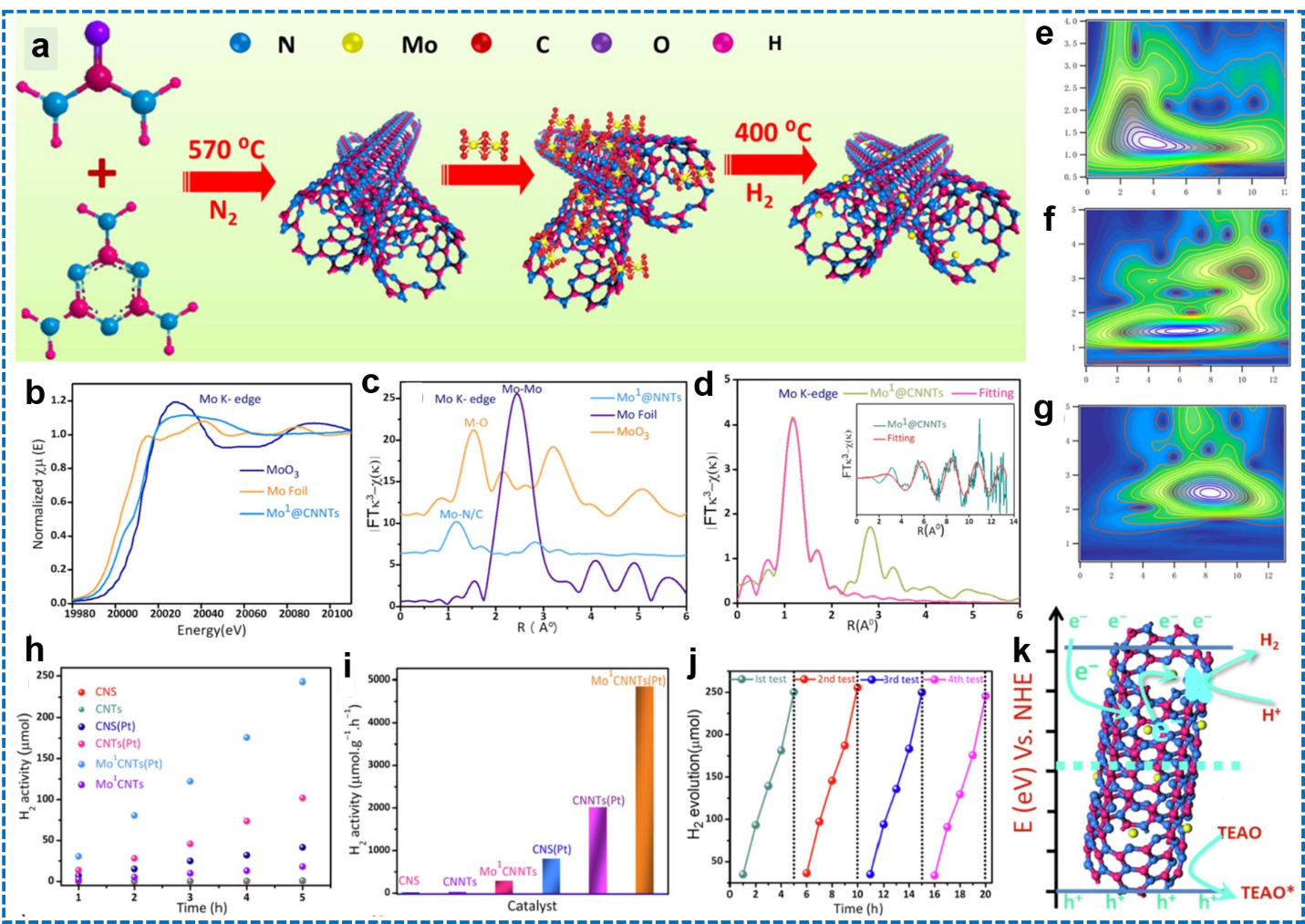
Fig. 13. (a) Schematic illustration of Mo1@CNNTs synthesis. Mo K-edge XANES (b) and K-edge FT-EXAFS (c) spectra of Mo1@CNNTs and reference samples. (d) EXAFS fitting curves in R space with inset in k space. EXAFS WT of Mo1@CNNTs (e), Mo foil (f), and MoO3 (g). (h) Time-dependent H2 production activity over different samples. (i) H2 production rates over various samples. (j) Cycling stability tests of Mo1@CNNT. (k) Possible charge transfer mechanism of H2 production. Adopted with permission from Ref. [201]. Copyright 2025, Elsevier.
|
| [1] | 曹晨, 崔诗锐, 石峰, 李彦琴, 赵春阳, 胡伟, 李泽龙, 唐瑜. 镧介导的铱单原子分散及酸性析氧反应中的动态氧补充[J]. 催化学报, 2026, 86(7): 236-243. |
| [2] | Shahla Karimi, Mehran Rezaei, 邓积光, 戴洪兴, Ali Rastegarpanah. 甲烷分解用贵金属基催化剂的最新进展: 性能、机理与优化[J]. 催化学报, 2026, 86(7): 9-48. |
| [3] | 初铭涛, 张慧敏, 任变清, 曹景, 章腾, 宋平, 王子准, 韩策, 徐维林. 非晶-晶体异质结构RuMoNiN/Ni-MoO2用于高效稳定的碱性析氢反应[J]. 催化学报, 2026, 84(5): 96-105. |
| [4] | 马润林, 马贤迪, 王鹤静, 张旭, 方永正, 焦梦改, 周震. 基于密度泛函理论计算的二维CoX (X = P, S, As, Se)材料对肼氧化与析氢反应的双功能电催化研究[J]. 催化学报, 2026, 82(3): 115-124. |
| [5] | 张哲, 潘桂旭, 朱炜, 张珂瑜, 梁桂杰, 王诗涵, 王宁, 邢艳, 李云锋. 分子间作用力增强聚巴比妥酸全有机异质结界面载流子迁移以实现高效光催化制氢[J]. 催化学报, 2026, 81(2): 284-298. |
| [6] | 吉凌仝, 邱沛萌, 马清君, 李朋, 陈胜利. PrNi共掺杂Co3O4通过界面水优化和钴预氧化增强质子交换膜水电解中的析氧反应性能[J]. 催化学报, 2026, 90(11): 253-263. |
| [7] | 陈沛然, 成洛, 郭从宝, 何语, 刘洋洋, 王毅, 宋树芹. 高熵工程促进层状双氢氧化物活性位点构筑用于海水析氧反应[J]. 催化学报, 2026, 89(10): 246-257. |
| [8] | 张璇, 周林, 闫腾, 张晓虎, 陈浩. S型共价有机框架/Ni-ZIF-8异质结的构筑及其光催化制氢性能[J]. 催化学报, 2026, 80(1): 200-212. |
| [9] | 周生辉, 王铮, 吴超, 席识博, 徐蓉. 亚纳米氧化钼稳定铂纳米催化剂高效催化甲基环己烷制氢[J]. 催化学报, 2026, 80(1): 347-357. |
| [10] | 钟威, 孟爱云, 蔡旭东, 甘义遥, 王敬涛, 苏耀荣. Co诱导不对称电荷分布弱化S-Had键增强NiCoS助剂的光催化制氢性能[J]. 催化学报, 2025, 76(9): 108-119. |
| [11] | 王啟航, 孟利, 李卓, 杨卓然, 汤意南, 余浪, 李志君, 孙建辉, 井立强. 钴单原子-磷酸功能化还原氧化石墨烯/苝四羧酸纳米片异质结用于高效光催化生产过氧化氢[J]. 催化学报, 2025, 75(8): 192-203. |
| [12] | 李亚慧, 陈宇, 郭锦瑜, 王锐, 赵淑娜, 李纲, 臧双全. 调控COF共价连接的多吡啶镍催化剂微环境促进光催化二氧化碳还原[J]. 催化学报, 2025, 74(7): 155-166. |
| [13] | 周正宇, 靳治良. 自定义暴露晶面: 最佳晶面各向异性和欧姆异质结的协同效应促进光催化析氢[J]. 催化学报, 2025, 74(7): 294-307. |
| [14] | 郑馨龙, 宋一铭, 王崇太, 高奇志, 邵钟鋆, 林佳鑫, 翟佳迪, 李静, 史晓东, 吴道雄, 刘维峰, 黄玮, 陈琦, 田新龙, 刘雨昊. 铜/锌体系多元过渡金属硫化物光催化剂的半导体特性及其光催化制氢的应用与挑战[J]. 催化学报, 2025, 74(7): 22-70. |
| [15] | 张自豪, 张家铭, 王海峰, 刘梦, 许垚, 刘铠玮, 张博杨, 史珂, 张继方, 马贵军. 基于Sm2Ti2O5S2纳米片各向异性电荷迁移性质提升光催化分解水产氢活性[J]. 催化学报, 2025, 74(7): 341-351. |
| 阅读次数 | ||||||
|
全文 |
|
|||||
|
摘要 |
|
|||||


