
催化学报 ›› 2026, Vol. 90: 309-332.DOI: 10.1016/S1872-2067(26)65215-1
• 论文 • 上一篇
吴君a,*( ), 白家豪a, 潘刚a, 史泰龙a, 席永杰b,*(), 李福伟c,d,*(), 李永a,*()
收稿日期:2026-02-24
接受日期:2026-04-28
出版日期:2026-11-18
发布日期:2026-09-09
通讯作者:
*电子信箱: wjhg168@163.com (吴君),基金资助:
Jun Wua,*(), Jiahao Baia, Gang Pana, Tailong Shia, Yongjie Xib,*(), Fuwei Lic,d,*(), Yong Lia,*()
Received:2026-02-24
Accepted:2026-04-28
Online:2026-11-18
Published:2026-09-09
Contact:
*E-mail:wjhg168@163.com(J. Wu),xiyj@licp.cas.cn(Y. Xi),fuweili@ucas.ac.cn(F. Li),yongli@sust.edu.cn(Y. Li).
Supported by:摘要:
将可再生生物质高效转化为高附加值含氮化合物, 已成为绿色化学与可持续精细化学品合成的核心课题之一. 其中伯胺作为重要的关键结构单元和合成中间体, 广泛应用于药物、聚合物、农业化学品、染料和表面活性剂的生产, 具有显著的工业价值. 在众多合成路线中, 以分子氢为还原剂, 氨水为氮源的羰基化合物的催化还原胺化反应, 因其操作简便, 原子效率高, 经济效益显著, 被视为生产伯胺最具吸引力且可持续的策略之一. 然而, 由于还原胺化反应网络的复杂性, 在活性氢和氨的作用下, 反应物和中间体的直接还原和胺化之间存在竞争性反应, 高选择性制备伯胺仍是一项巨大的挑战. 因此设计与开发具有双功能活性位点协同催化作用的催化体系有望解决这一问题.
本文通过硬模板导向的原位合成策略, 开发了一系列氮掺杂空心碳球负载RuCo合金的双金属纳米催化剂(Ru2Co1@NHCS-T, T: 600-800), 并以典型的生物质羰基化合物糠醛还原胺化制备糠胺为探针反应, 系统的评估了双金属催化剂的还原胺化性能和反应机理. 通过RuCo合金效应及金属-载体相互作用, 针对性地调控了双金属RuCo催化剂的电子结构和几何构型, 进而在RuCo合金中构建了由富电子的Ru0和缺电子的Coδ+组成的双功能活性位点, 显著提升了RuCo合金的催化活性和选择性. 其中, 优选的Ru2Co1@NHCS-600催化剂还原胺化性能尤为显著, 具有优异的稳定性和广泛的底物适用性. 该催化剂在0.1 MPa压力下表现出极高的H2活化能力, 同时对NH3, C=O和C=N键表现了出色的吸附和活化能力, 同时对NH3, C=O和C=N键表现了出色的胺化活性, 获得了98.1%的高糠胺产率和238.65 molFUA molSm-1 h-1的高反应速率. 动力学评估证实了RuCo双金属催化剂具有较低的表观活化能(28.44 kJ mol-1), 显著优于单金属Ru@NHCS-600以及绝大多数已报道的催化剂. 利用球差电镜, 原位CO吸附漫反射红外光谱, X-射线光电子能谱和H2-程序升温脱附等系统性结构表征以及本征动力学测试, 深入研究了催化体系的构效关系. 结果表明, RuCo双金属催化剂表面丰富的金属-N和吡啶-N物种可有效锚定金属纳米颗粒, 并通过电子金属-载体相互作用提高了金属电子密度; 同时Ru和Co之间的d-d轨道耦合效应实现了Co向Ru的电子转移, 从而形成了富电子Ru0和缺电子Coδ+双功能活性位点. 值得注意的是, 富电子的Ru0活性位点显著增强了对H2的吸附和解离活化, 而缺电子的Coδ+活性位点则在串联还原胺化过程中协同促进了糠醛, NH3和席夫碱中间体的吸附和活化. 密度泛函理论计算结果表明, 相比于单金属Ru催化剂, RuCo双金属催化剂对NH3具有更优的吸附与活化能力, 促进了NH2*和H*物种对席夫碱C=N键优先胺化攻击以及紧随其后的加氢断键反应, 并探究了关键席夫碱中间体的氨解反应机理.
综上, 本文提出的双金属RuCo催化剂协同催化策略, 为羰基化合物还原胺化过程中直接还原和胺化的竞争性反应提供了有效的解决途径, 也为生物质可持续转化合成高附加值含氮化合物所需的高性能催化剂的理性设计提供重要指导.
吴君, 白家豪, 潘刚, 史泰龙, 席永杰, 李福伟, 李永. RuCo合金对糠醛高选择性还原胺化的协同催化机理研究[J]. 催化学报, 2026, 90: 309-332.
Jun Wu, Jiahao Bai, Gang Pan, Tailong Shi, Yongjie Xi, Fuwei Li, Yong Li. Mechanism insights into the synergistic catalysis of bimetallic RuCo alloys for the highly selective reductive amination of biomass-derived furfural[J]. Chinese Journal of Catalysis, 2026, 90: 309-332.
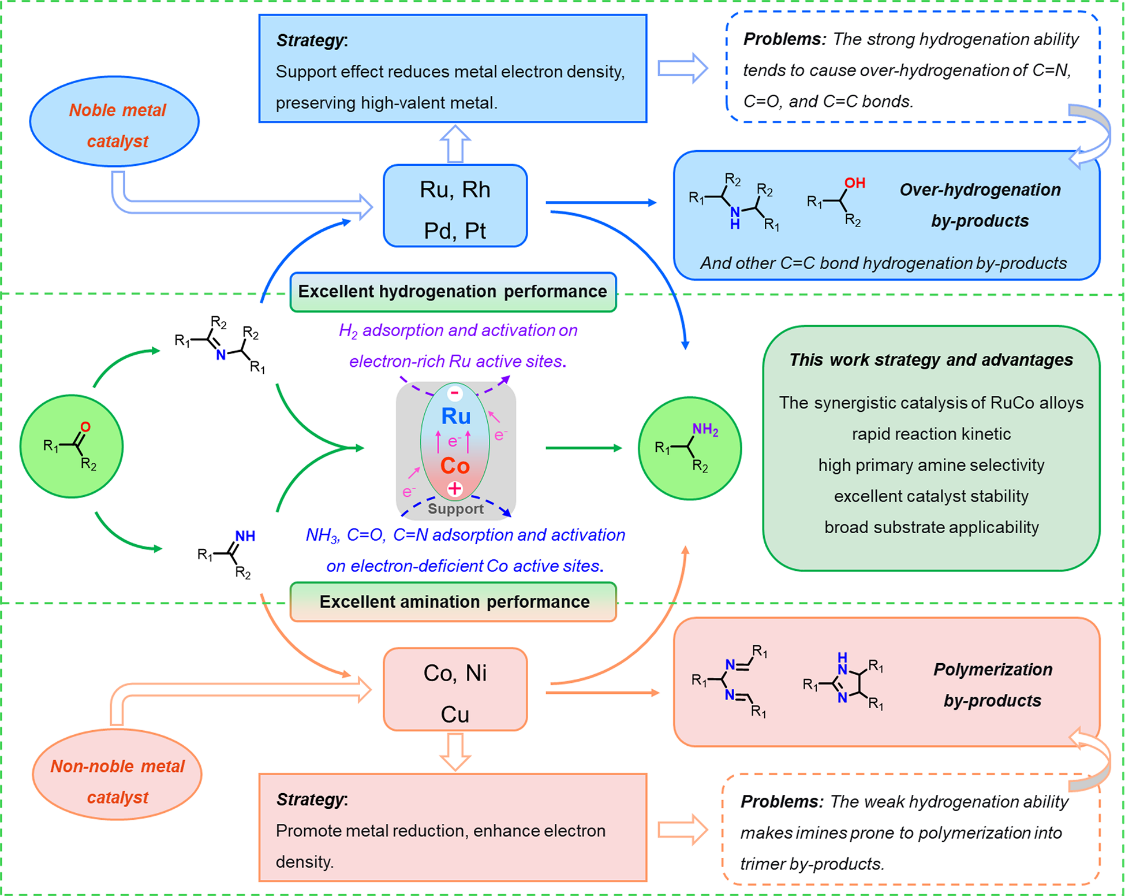
Scheme 1. Limitations and corresponding strategies for reported noble and non-noble metal catalysts for furfural reductive amination, along with the synergistic catalysis strategy of bimetallic RuCo catalysts of this work.
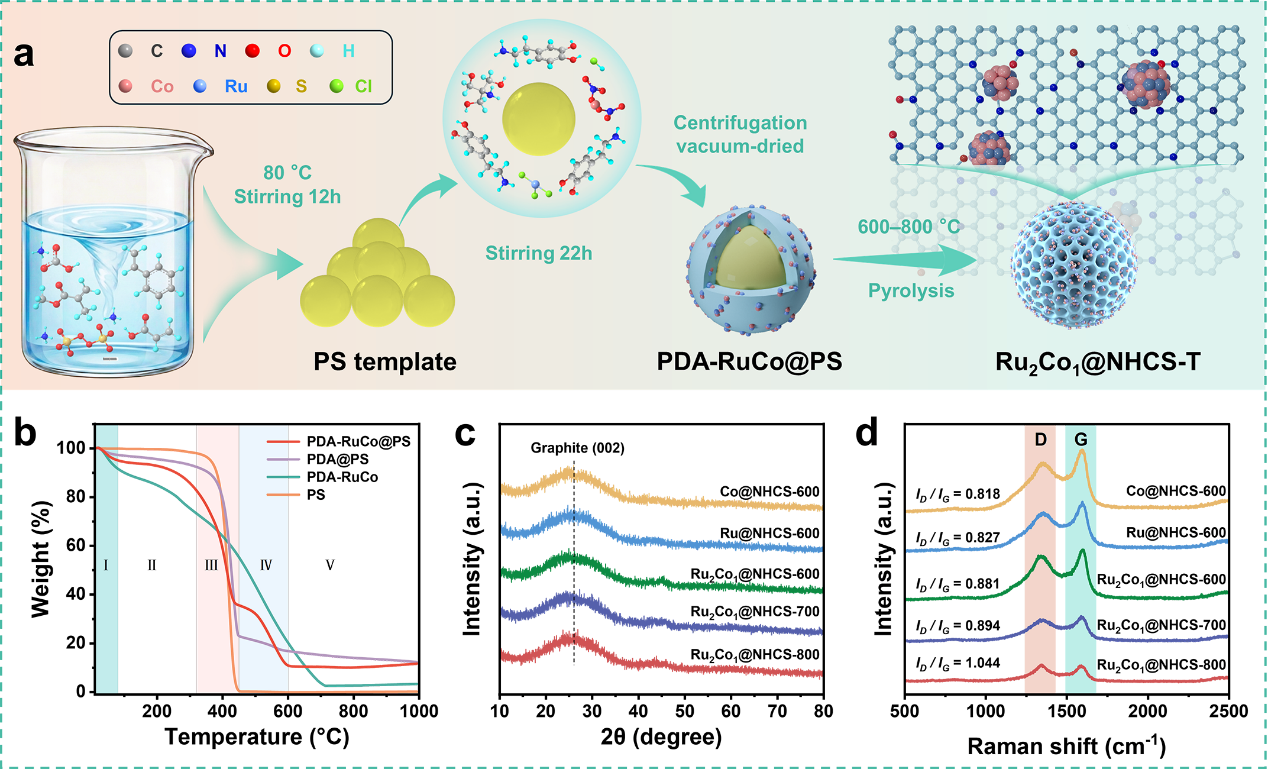
Fig. 1. (a) Schematic illustration for the synthesis pathways of Ru2Co1@NHCS-T catalysts. (b) TGA curves of various catalyst precursors. XRD patterns (c) and Raman spectra (d) of various catalysts.
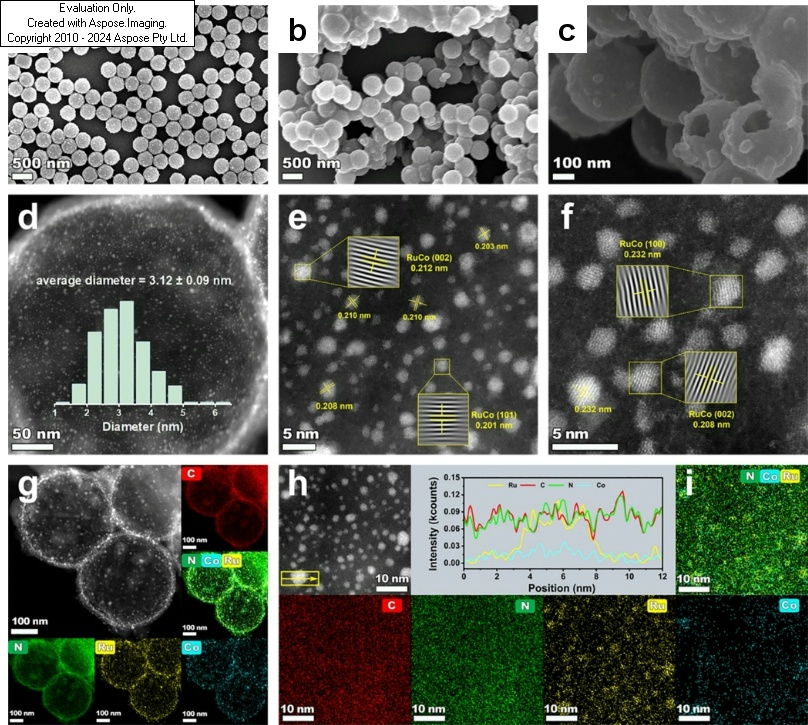
Fig. 2. Morphology and microstructure characterizations: SEM images of PS nanospheres (a), the PDA-RuCo@PS precursor (b) and Ru2Co1@NHCS-600 (c). (d-f) AC-HAADF-STEM images and the particle size distribution histograms of Ru2Co1@NHCS-600. AC-HAADF-STEM images of Ru2Co1@NHCS-600 and the corresponding elemental mappings of C, N, Ru, Co: elemental mappings at 100 nm scale (g), line scan across a RuCo alloy nanoparticle (h), and elemental mappings at 10 nm scale (i).
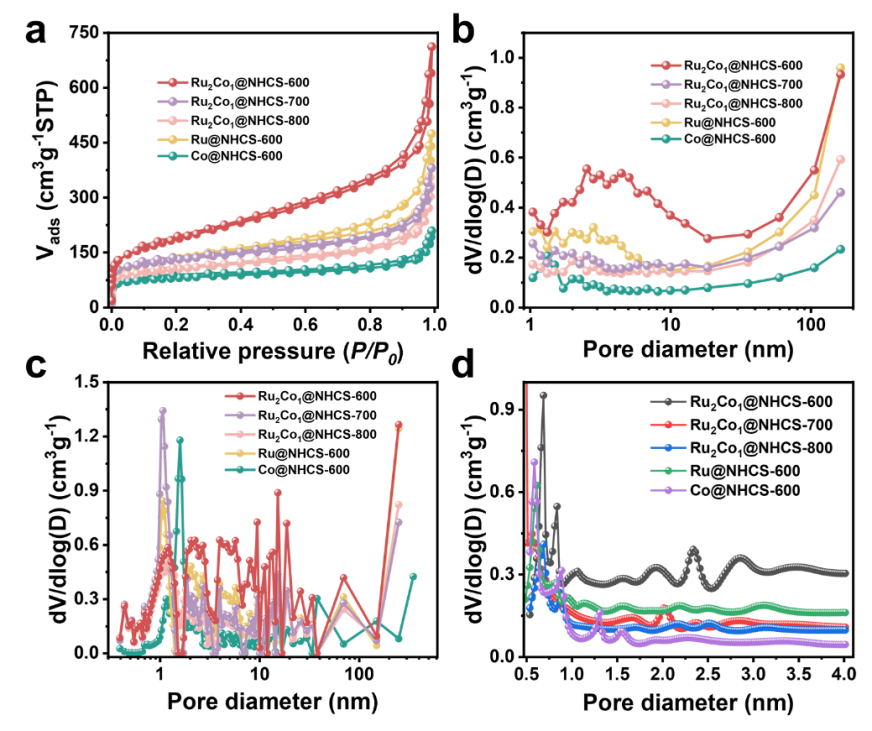
Fig. 3. N2 adsorption-desorption isotherms (a), the pore size distributions determined by the BJH method (b) and NLDFT/GCMC method (c) based on the adsorption isotherms of various catalysts. (d) H2-TPR profiles of the PDA-Co@PS, PDA-Ru@PS and PDA-Ru2Co1@PS precursors.
| Entry | Catalyst | Conversion (%) | Selectivity (%) | ||||
|---|---|---|---|---|---|---|---|
| FUA | FDA | FUI | FAL | Others | |||
| 1 | Blank | 62.6 | — | — | 28.8 | — | 71.2 |
| 2 | NHCS-600 | 74 | — | — | 23.2 | — | 76.8 |
| 3 | Ru2Co1@NHCS-600 | 100 | 98.1 | — | — | 1.9 | — |
| 4 | Ru@NHCS-600 | 100 | 53.2 | 40 | — | 1.6 | 5.2 |
| 5 | Co@NHCS-600 | 84 | — | 4.4 | 28.5 | — | 67.1 |
| 6 | Ru@NHCS-600 + Co@NHCS-600 | 100 | 69.1 | 28.5 | — | 2.4 | — |
| 7 | Ru1Co2@NHCS-600 | 95 | 2.6 | 72.8 | 24.6 | — | — |
| 8 | Ru1Co1@NHCS-600 | 100 | 83 | 14.6 | — | 2.4 | — |
| 9 | Ru2Cu1@NHCS-600 | 90 | 1.8 | 74.2 | 4.6 | 1.2 | 18.2 |
| 10 | Ru2Ni1@NHCS-600 | 100 | 83.5 | 6.6 | — | 1.5 | 8.4 |
| 11 | Ru2Co1@NHCS-700 | 100 | 76.4 | 21.4 | — | 2.2 | — |
| 12 | Ru2Co1@NHCS-800 | 96.4 | 4.8 | 86 | 7.5 | 0.8 | 0.9 |
| 13 | Ru2Co1@NC-600 | 87 | — | 84.6 | — | 11.5 | 3.9 |
| 14 | Ru2Co1@HCS-600 | 100 | 31.8 | 64.4 | — | 2.3 | 1.5 |
Table 1 Reductive amination of furfural with different catalysts.
| Entry | Catalyst | Conversion (%) | Selectivity (%) | ||||
|---|---|---|---|---|---|---|---|
| FUA | FDA | FUI | FAL | Others | |||
| 1 | Blank | 62.6 | — | — | 28.8 | — | 71.2 |
| 2 | NHCS-600 | 74 | — | — | 23.2 | — | 76.8 |
| 3 | Ru2Co1@NHCS-600 | 100 | 98.1 | — | — | 1.9 | — |
| 4 | Ru@NHCS-600 | 100 | 53.2 | 40 | — | 1.6 | 5.2 |
| 5 | Co@NHCS-600 | 84 | — | 4.4 | 28.5 | — | 67.1 |
| 6 | Ru@NHCS-600 + Co@NHCS-600 | 100 | 69.1 | 28.5 | — | 2.4 | — |
| 7 | Ru1Co2@NHCS-600 | 95 | 2.6 | 72.8 | 24.6 | — | — |
| 8 | Ru1Co1@NHCS-600 | 100 | 83 | 14.6 | — | 2.4 | — |
| 9 | Ru2Cu1@NHCS-600 | 90 | 1.8 | 74.2 | 4.6 | 1.2 | 18.2 |
| 10 | Ru2Ni1@NHCS-600 | 100 | 83.5 | 6.6 | — | 1.5 | 8.4 |
| 11 | Ru2Co1@NHCS-700 | 100 | 76.4 | 21.4 | — | 2.2 | — |
| 12 | Ru2Co1@NHCS-800 | 96.4 | 4.8 | 86 | 7.5 | 0.8 | 0.9 |
| 13 | Ru2Co1@NC-600 | 87 | — | 84.6 | — | 11.5 | 3.9 |
| 14 | Ru2Co1@HCS-600 | 100 | 31.8 | 64.4 | — | 2.3 | 1.5 |
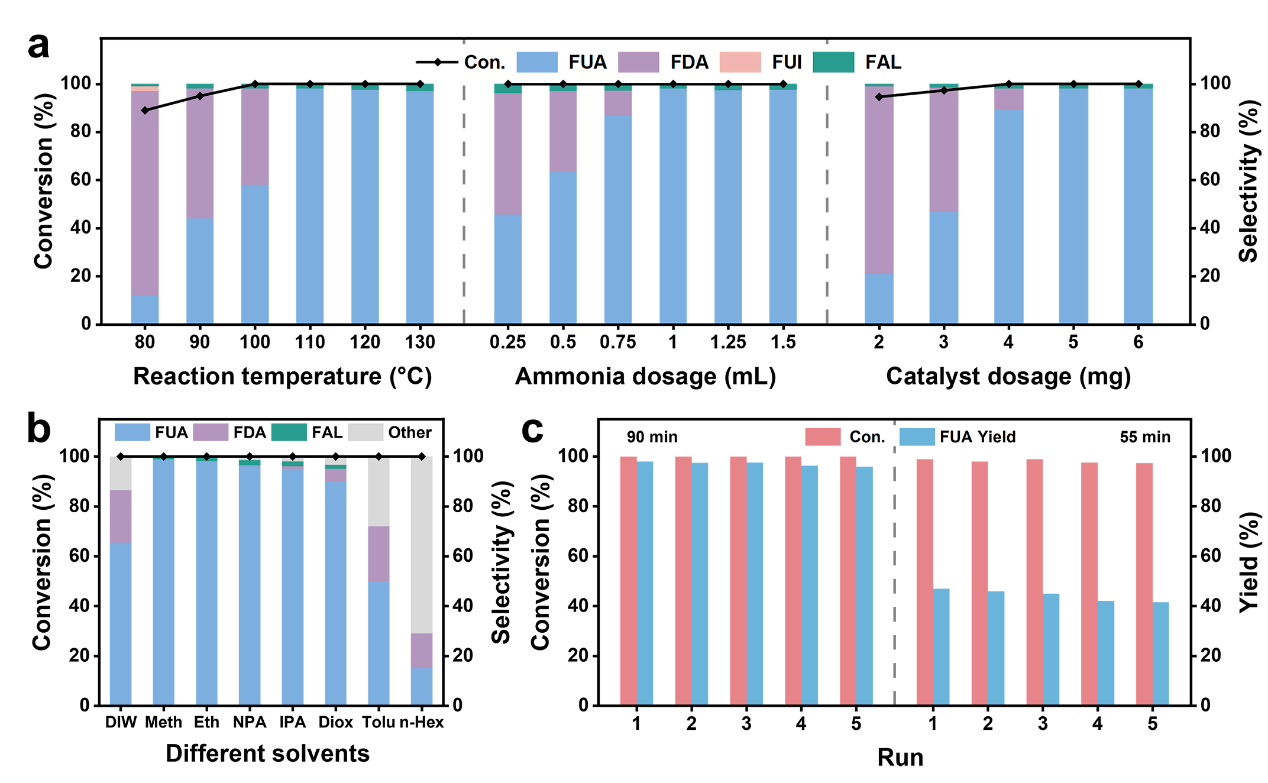
Fig. 4. Effects of reaction temperature, ammonia dosage, and catalyst dosage (a), and the different solvents (DIW: deionized water, Meth: methanol, Eth: ethanol, IPA: isopropanol, NPA: n-propanol, Diox: dioxane, Tolu: toluene, n-Hex: n-hexane) (b) on the reductive amination of furfural. (c) The stability tests of Ru2Co1@NHCS-600 catalyst at different reaction times, reaction conditions: furfural (0.5 mmol), catalyst (5 mg), ethanol (5.5 mL), NH3·H2O (1 mL, 25%-28%), H2 (0.1 MPa), 110 °C.
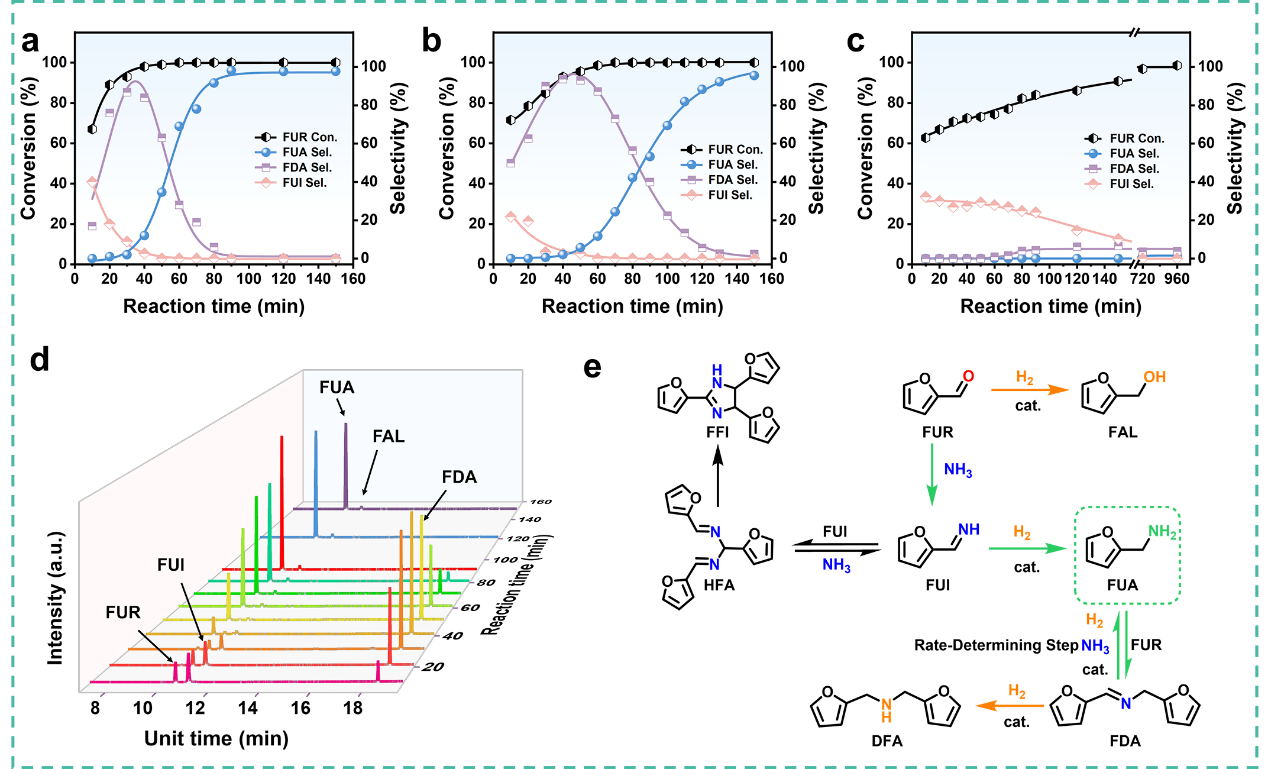
Fig. 5. Time courses for the reductive amination of furfural over Ru2Co1@NHCS-600 (a), Ru@NHCS-600 (b), and Co@NHCS-600 (c) catalysts. (d) GC profiles of the furfural reductive amination process at different reaction times over Ru2Co1@NHCS-600 catalyst. (e) The reaction networks for furfural reductive amination to furfurylamine and the possible byproducts. Reaction conditions: furfural (0.5 mmol), H2 (0.1 MPa), ethanol (5.5 mL), NH3·H2O (1 mL, 25%-28%), Ru2Co1@NHCS-600 (5 mg), 110 °C.
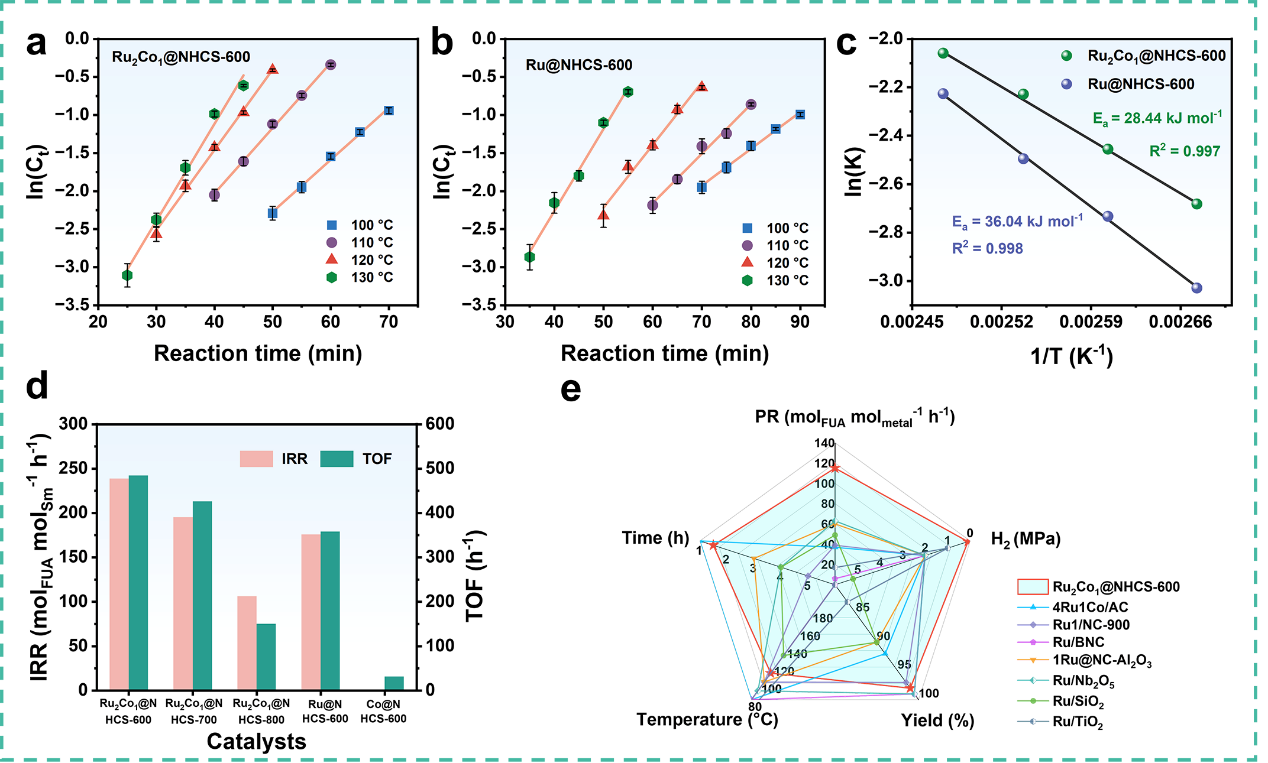
Fig. 6. The plots of the natural logarithm of furfurylamine concentration with respect to reaction time under 100-130 °C over Ru2Co1@NHCS-600 (a) and Ru@NHCS-600 (b) catalysts. (c) The corresponding Arrhenius plots for the reaction rate constants. Note: The results for each reaction were obtained from three repeated experiments. (d) The IRR and TOF over various catalysts. (e) Comparisons of conditions and performances with the previously reported catalysts [8,9,13,23,42,49,51]. Reaction conditions: furfural (0.5 mmol), H2 (0.1 MPa), ethanol (5.5 mL), NH3·H2O (1 mL, 25%-28%), catalyst (5 mg).
| Entry | Substrate | Tem. (°C) | Time (h) | H2 (MPa) | Con. (%) | Product | Yield (%) |
|---|---|---|---|---|---|---|---|
| 1 | | 110 | 1.5 | 0.1 | 100 | | 98.3 |
| 2 | | 110 | 1.5 | 0.1 | 100 | | 96.2 |
| 3 | | 110 | 4 | 0.1 | 100 | | 96.9 |
| 4 | | 90 | 2 | 0.1 | 96.6 | | 91.8 |
| 5 | | 90 | 2 | 0.1 | 100 | | 87.2 |
| 6 | | 110 | 4 | 0.3 | 100 | | 95.1 |
| 7 | | 110 | 4 | 0.5 | 100 | | 94.8 |
| 8 | | 110 | 6 | 0.5 | 100 | | 85.7 |
| 9 | | 110 | 6 | 0.3 | 100 | | 90.7 |
| 10 | | 110 | 5 | 0.1 | 98.9 | | 91.4 |
| 11 | | 130 | 8 | 1 | 94.4 | | 92.1 |
| 12 | | 130 | 12 | 0.5 | 98.5 | | 90.2 |
| 13b | | 130 | 18 | 0.5 | 93.9 | | 81.7 |
Table 2 Reductive amination of various aldehydes and ketones catalyzed by the Ru2Co1@NHCS-600 catalyst.
| Entry | Substrate | Tem. (°C) | Time (h) | H2 (MPa) | Con. (%) | Product | Yield (%) |
|---|---|---|---|---|---|---|---|
| 1 | | 110 | 1.5 | 0.1 | 100 | | 98.3 |
| 2 | | 110 | 1.5 | 0.1 | 100 | | 96.2 |
| 3 | | 110 | 4 | 0.1 | 100 | | 96.9 |
| 4 | | 90 | 2 | 0.1 | 96.6 | | 91.8 |
| 5 | | 90 | 2 | 0.1 | 100 | | 87.2 |
| 6 | | 110 | 4 | 0.3 | 100 | | 95.1 |
| 7 | | 110 | 4 | 0.5 | 100 | | 94.8 |
| 8 | | 110 | 6 | 0.5 | 100 | | 85.7 |
| 9 | | 110 | 6 | 0.3 | 100 | | 90.7 |
| 10 | | 110 | 5 | 0.1 | 98.9 | | 91.4 |
| 11 | | 130 | 8 | 1 | 94.4 | | 92.1 |
| 12 | | 130 | 12 | 0.5 | 98.5 | | 90.2 |
| 13b | | 130 | 18 | 0.5 | 93.9 | | 81.7 |
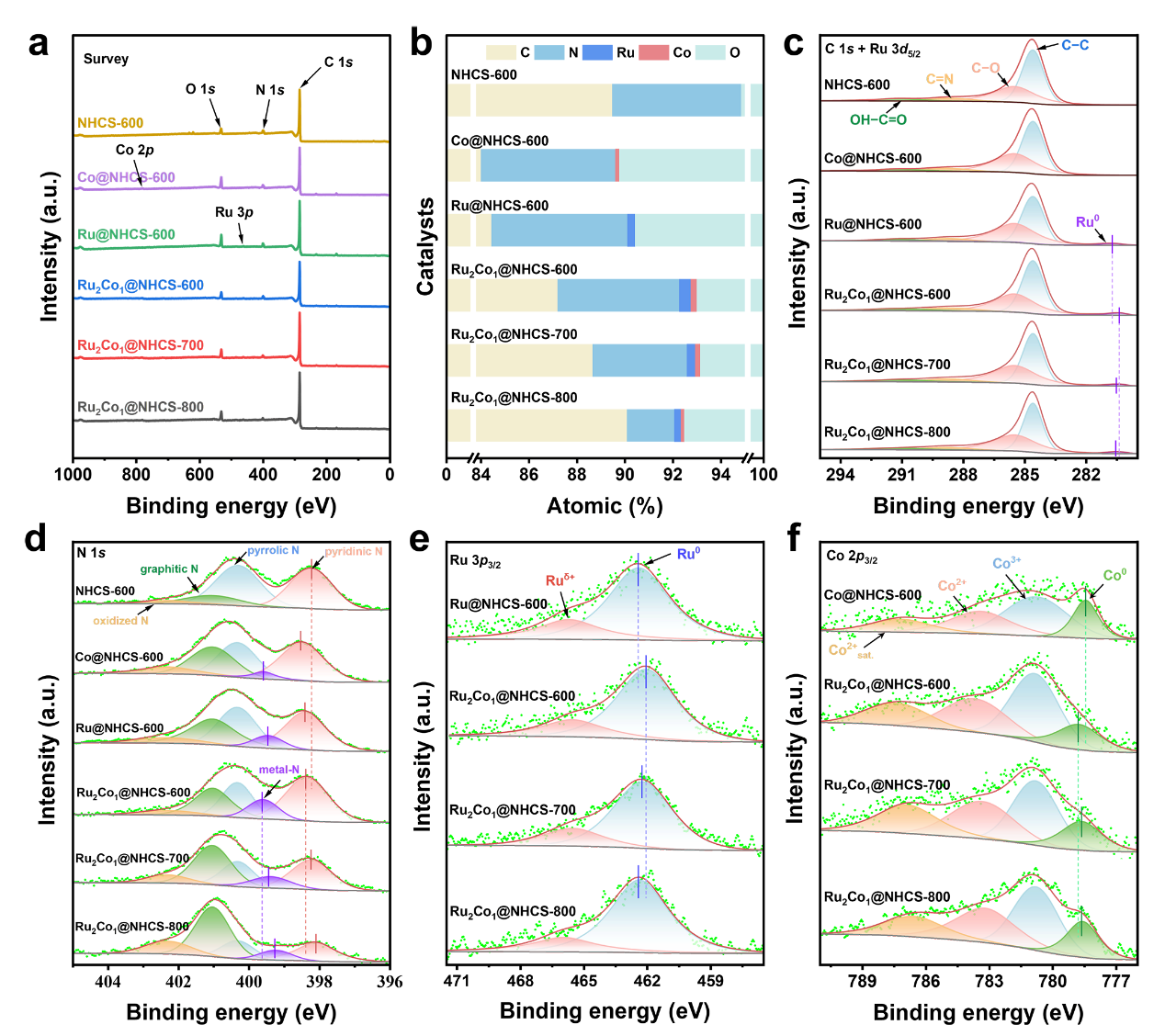
Fig. 7. The XPS spectra of survey scan (a), relative contents of C, N, O, Ru and Co elements (b), and the high-resolution C 1s and Ru 3d (c), N 1s (d), Ru 3p (e), and Co 2p (f) for various monometallic and bimetallic catalysts.
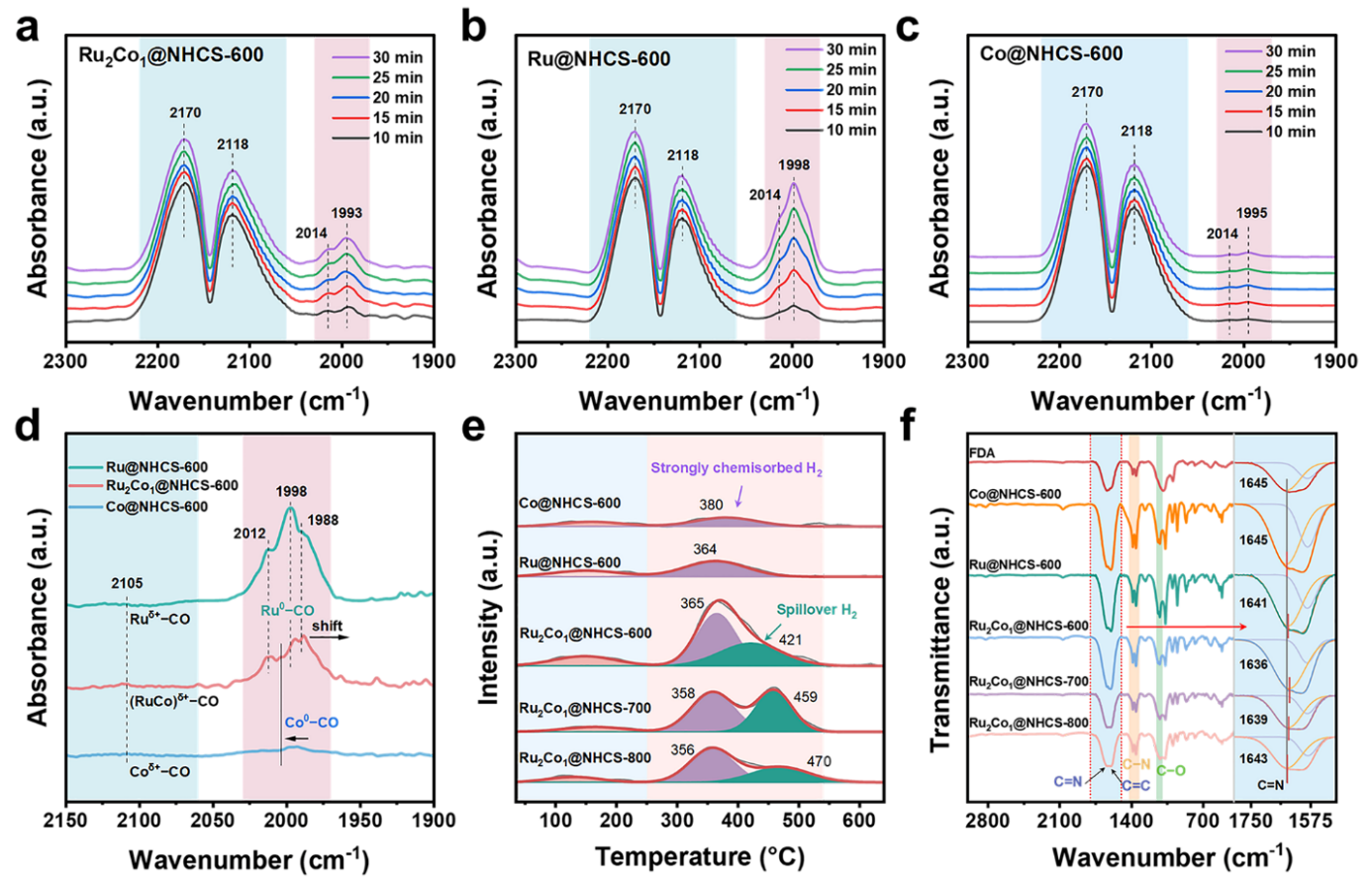
Fig. 8. In-situ CO-DRIFTS spectra of the Ru2Co1@NHCS-600 (a), Ru@NHCS-600 (b), Co@NHCS-600 (c), and the corresponding DRIFTS spectra (d) after outgassed CO by Ar. (e) H2-TPD profiles of various monometallic and bimetallic catalysts. (f) FTIR spectra of various catalysts after adsorption of Schiff base.
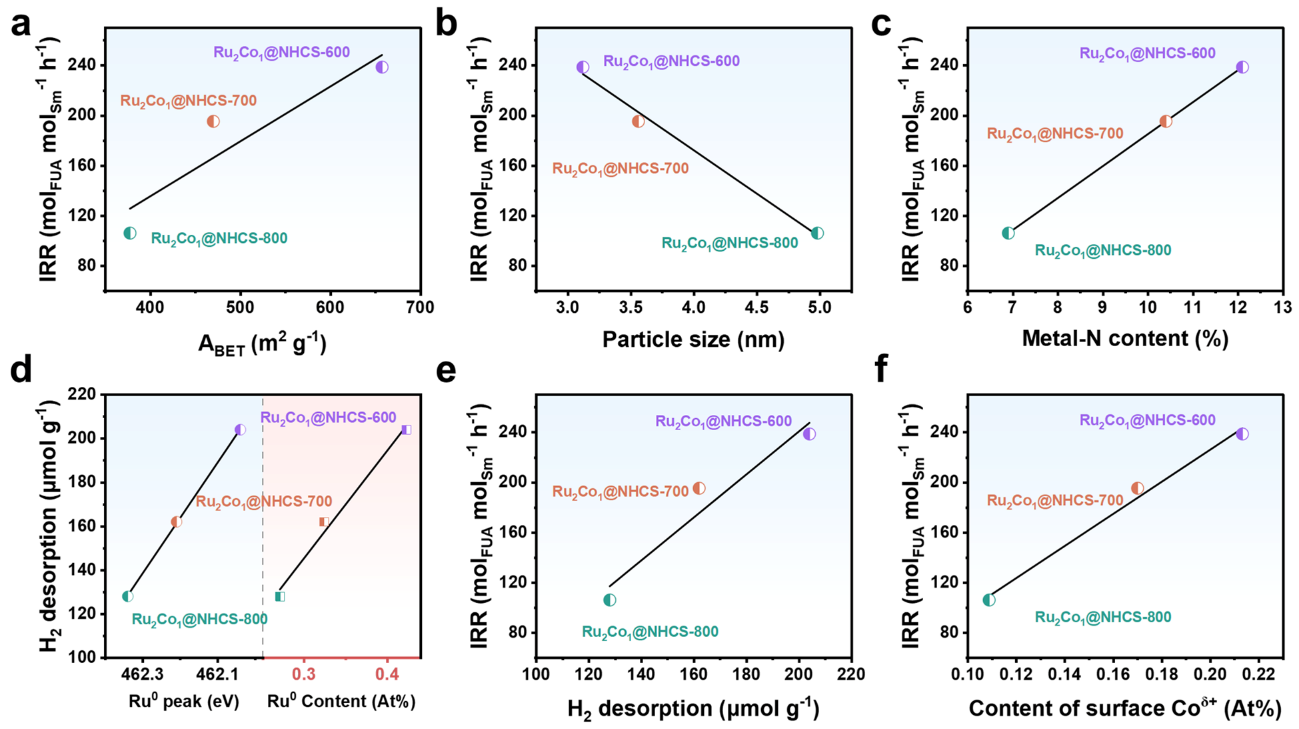
Fig. 9. Structure-performance relationship of the various Ru2Co1@NHCS catalysts: The correlations between the IRR and the specific surface area (BET) (a), and the average particle size (b) of RuCo alloys determined by TEM images, and the content of surface metal-N species determined by XPS (c). The correlations between H2 desorption and the binding energy of Ru0 3p3/2 peak and the content of surface Ru0 species (d), and the correlations between IRR and H2 desorption (e), and the content of surface Coδ+ species (f).
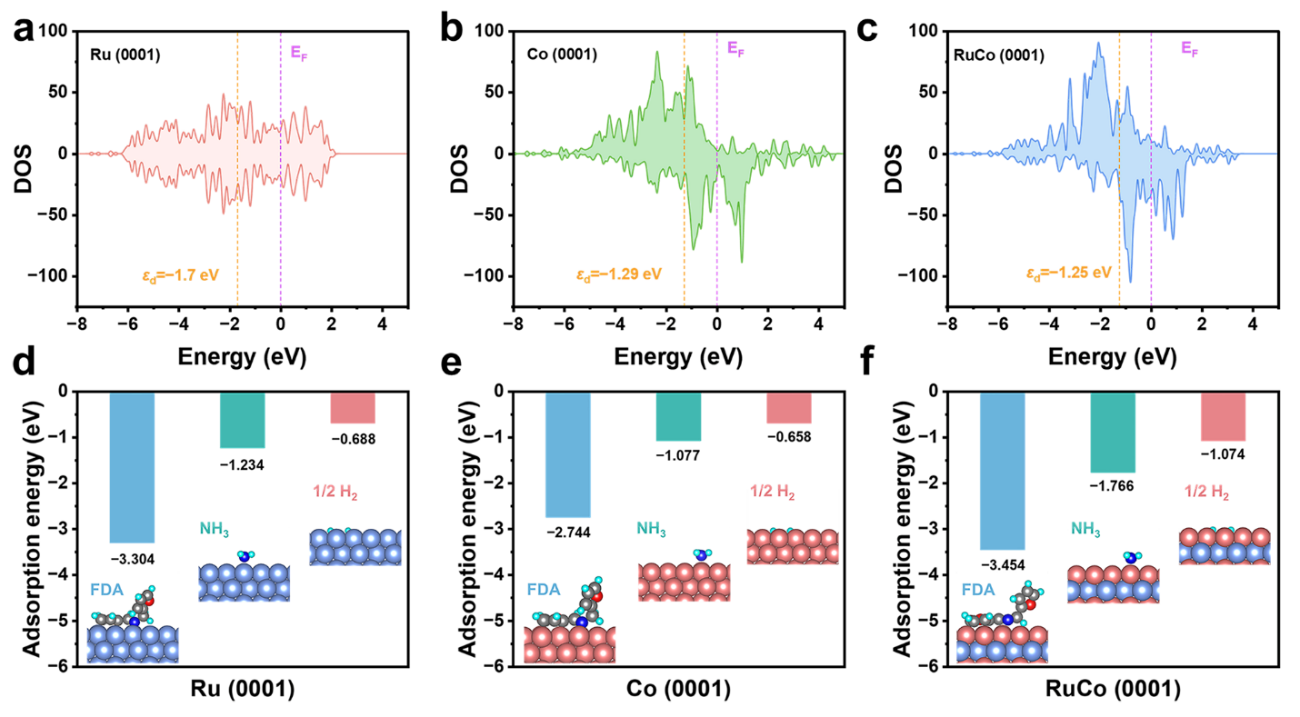
Fig. 10. Spin-resolved DOS for the Ru(0001) (a), Co(0001) (b), and RuCo(0001) (c) models. The positive and negative values represent the upper and lower spin states, respectively, the energy scale is referenced to the Fermi level (EF = 0). Adsorption energies and stable adsorption configurations for the Schiff base, NH3 and H2 on Ru(0001) (d), Co(0001) (e) and RuCo(0001) (f) surfaces. Color code: C, gray; N, dark blue; H, cyan; O, red; Co, pale red; Ru, pale blue.
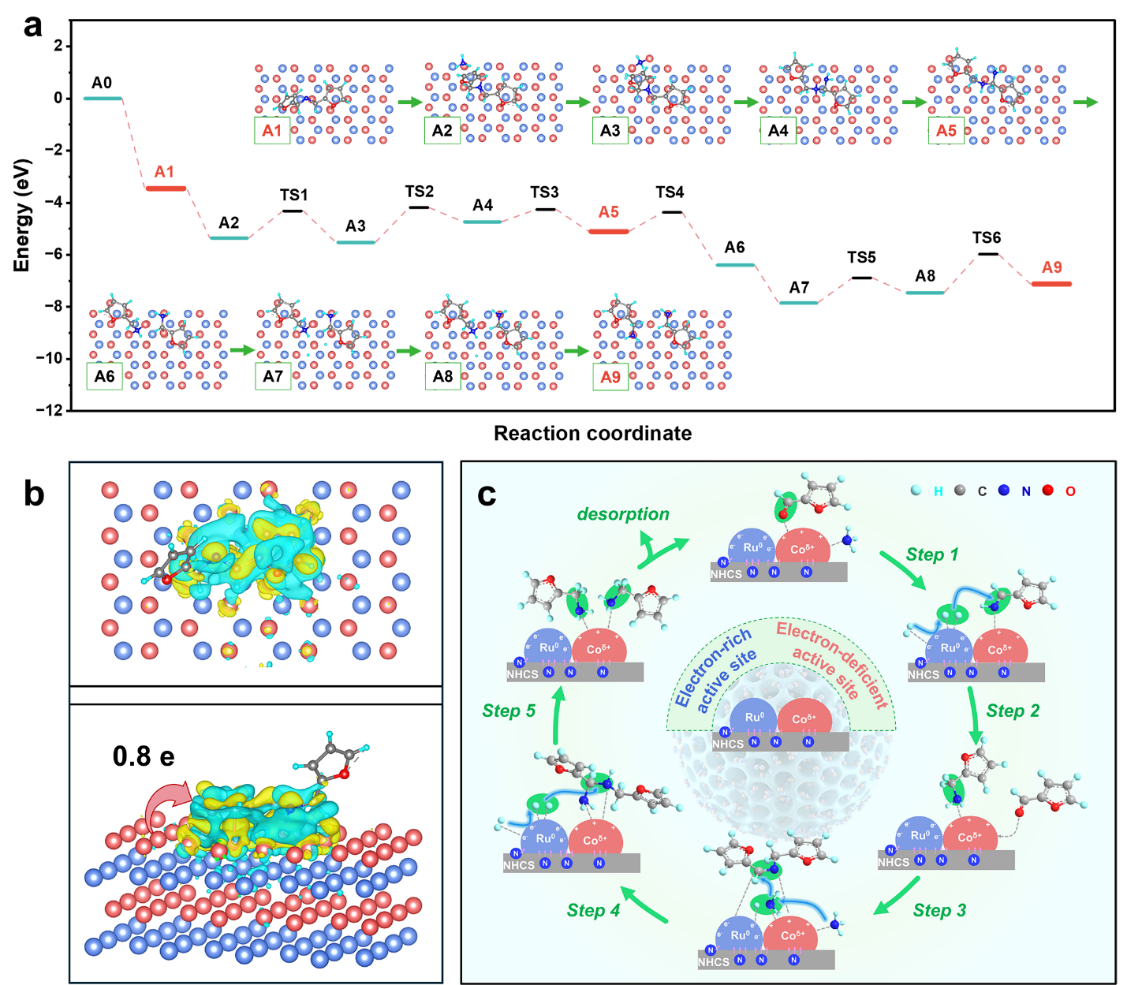
Fig. 11. (a) Schematic molecular models of the Schiff base ammonolysis reaction mechanism on RuCo(0001). A0: side view of metal sites on the RuCo(0001) surface; A1: adsorption of the Schiff base; A2, adsorption of NH3; TS1, NH3 dissociation into NH2* and H*; A3, co-adsorbed NH2* and H*; TS2, configurational rearrangements of adsorbed NH2* and Schiff base leading to nucleophilic attack of NH2* on the C=N bond; A4, NH2* bonds to the C atom of C=N group; TS3, approach of H* to the N atom of C=N bond; A5, bonding of H* to the N atom; TS4, further weakening of the formed C-N bond in the Schiff base intermediate; A6, stable adsorption of the Schiff‑base‑derived amination intermediate; A7, adsorption of two H* resulting from dissociation of H2 molecules; TS5, approach of an H* to the C atom of C=N bond; A8, bonding of H* to the C atom; TS6, approach of the second H* to the N atom; A9, bonding of the second H* to the N atom, yielding two molecules of furfurylamine. Color code: C, gray; N, dark blue; H, cyan; O, red; Co, pale red; Ru, pale blue. (*) denotes active species. (b) Isosurface plots of the charge-density difference for a Schiff base adsorbed on RuCo(0001): top view (upper) and side view (lower), the amount of electron transfer is given by Bader charge analysis. (c) Schematic illustration of the synergistic catalysis mechanism for the reductive amination of furfural to furfurylamine over the bimetallic RuCo catalyst.
|
| [1] | 骆诗剑, 陈浩, 杨宇然, 宋阳, 刘泳铎, 龙道莙, 陈四国, 魏子栋. 氢化物增强的等离子体催化在室温常压下实现超高效率氨合成[J]. 催化学报, 2026, 88(9): 269-278. |
| [2] | 香含, 林露, 李雨, 衣启松, 姜超然, 陈睿, 刘远帅, 赛娜, 贺进逯, 白凤华, 罗文豪. 镧改性Silicalite-1封装铜纳米团簇增强糠醛加氢制糠醇的性能[J]. 催化学报, 2026, 88(9): 382-392. |
| [3] | 秦家祥, 张松培, 李星局, 陈鑫泰, 赵佳, 牟效玲, 宋宪根, 严丽, 林荣和, 丁云杰. 丁二烯半加氢反应中Pd-Ag纳米催化剂结构-选择性耦合关系解析[J]. 催化学报, 2026, 87(8): 342-352. |
| [4] | 李彦霖, 郭宁欣, 毕佳婷, 薛凌雨, 朱月路, 邵友东, 夏纪宝. 光氧化还原/钴协同催化炔烃、N-甲基胺和水的羟甲基化反应[J]. 催化学报, 2026, 87(8): 197-205. |
| [5] | 卜辰宇, 卢卓然, 夏忠诚, 樊赟, 王才荣, 黄雨桐, 王双印, 邹雨芹. 界面双位点协同增效近中性介质中的生物质电氧化反应[J]. 催化学报, 2026, 86(7): 160-170. |
| [6] | 谢浩东, 佛雨萌, 张宏伟, 徐华, 张逍, 郭盈铄, 李润泽, 张若霖, 刘贵林, 贾希成, 李家州, 张玉明, 荆湄赞, 宋卫余, 罗文豪, 吴志杰. Sn-MFI沸石负载PtIn合金催化剂高效催化甘油氧化制乳酸[J]. 催化学报, 2026, 86(7): 99-111. |
| [7] | 马明宇, 刘棕阳, 袁阔, 刘哲源, 王嘉新, 林清清, 钟地长, 鲁统部. 自光敏金属配合物用于光催化析氢[J]. 催化学报, 2026, 86(7): 375-383. |
| [8] | 余旭, 田汉, 于子怡, 孔繁涛, 王敏, 申如香, 崔香枝, 施剑林. WO2.72调控的Ru团簇增强双位点吸附用于高效抗CO阴离子交换膜燃料电池[J]. 催化学报, 2026, 86(7): 302-314. |
| [9] | 杜濮宇, 沈奕, 彭涛, 余子晟, 杜婷婷, 马猛, 何泓雨, 贾志林, 刘阳, 沈少华. CuAu合金吸附行为调控及单电子脱氢电催化5-羟甲基糠醛氧化协同双极制氢[J]. 催化学报, 2026, 85(6): 226-236. |
| [10] | 刘鑫, 杨烨舟, 杨敬茹, 王茂弟, 杨启华. 镍铁双金属催化剂中铁对糠醛选择性加氢的促进作用[J]. 催化学报, 2026, 83(4): 411-418. |
| [11] | 韩贝, 靳宸, 罗翠红, 刘云焘, 戴志超, 孙运强, 甘自保, 王崇臣, 郑秀文, 胡尊富. 铁镍纳米颗粒与单原子位点协同驱动非自由基类芬顿催化反应: 单线态氧和电子转移途径主导的高效水净化[J]. 催化学报, 2026, 82(3): 187-200. |
| [12] | 文延萃, 曾飞, 谭誉宇, 易荣楠, 蒋俊, 伍智林, 彭俊梅, 唐裕才, 何卫民. 三重协同催化杂芳烃与醛的脱羰芳基化/烷基化反应[J]. 催化学报, 2026, 89(10): 422-429. |
| [13] | 刘玲技, 蔚晓盛, 陈洲, 海雪清, 王永钊, 王长真, 肖天存. 同晶取代Co3O4纳米复合材料流水线式协同催化分解N2O[J]. 催化学报, 2026, 89(10): 430-443. |
| [14] | 廖光健, 吕文博, 王志超, 陈朱琦, 尹国川. 路易斯酸对金属活性氧物种氧化性能的调控与催化[J]. 催化学报, 2026, 89(10): 102-126. |
| [15] | 王剑朋, 路光辉, 吴倩, 代建容, 李宁. 利用工程化亚胺还原酶实现生物基N-取代糠胺的规模化生产[J]. 催化学报, 2025, 76(9): 210-220. |
| 阅读次数 | ||||||
|
全文 |
|
|||||
|
摘要 |
|
|||||


