
催化学报 ›› 2026, Vol. 91: 68-92.DOI: 10.1016/S1872-2067(26)65261-8
陈挺, 吴思宇, 吕康乐, 李覃*( )
收稿日期:2026-05-26
接受日期:2026-06-13
出版日期:2026-12-18
发布日期:2026-10-13
通讯作者:
*电子信箱: liqin0518@mail.scuec.edu.cn (李覃).基金资助:
Ting Chen, Siyu Wu, Kangle Lv, Qin Li*()
Received:2026-05-26
Accepted:2026-06-13
Online:2026-12-18
Published:2026-10-13
About author:Qin Li (School of Chemistry and Materials Science, South Central Minzu University) was invited as a member of the 6th Young Editorial Board of Chin. J. Catal.. She received a Ph.D degree in Materials Science from Wuhan University of Technology in 2014, and thereafter worked in the School of Chemistry and Materials Science in South-Central Minzu University. She was co-trained as a graduate student in 2010-2011 at the National Nanoscience Center, and she carried out a CSC project in the Domen-Hisatomi lab in Shinshu University (Japan) from 2024 to 2025. Over the last 12 years, her research has focused on photocatalytic hydrogen production from water splitting over metal sulfide based composite materials. Prof. Li has published related papers with over 11610 citations with an H-index of 53. She has been ranked among the top 100,000 scientists in the world in 2022, and also listed as one of the Top 2% scientists sourced from ELSEVIER and Standford Univeristy in 2024 and 2025.
Supported by:摘要:
随着能源转换和环境修复需求的日益增长, 光催化因其绿色、可再生和反应条件温和等特点, 已成为太阳能高效利用和小分子转化的重要途径. 助催化剂的引入能够促进光生载流子分离, 并调控表面反应过程, 是提升光催化性能的有效策略. 近年来, 原子级分散助催化剂因其明确的配位结构、最大化的金属原子利用率和独特的电子调控能力受到广泛关注, 为连接多相催化与均相催化, 以及理解光催化构效关系提供了重要平台. 该领域已从单原子位点逐步拓展至具有协同作用的双原子位点, 并进一步发展到组成和结构更加复杂的高熵合金. 因此, 本文将单原子、双原子和高熵合金助催化剂作为连续发展的研究体系, 系统总结其合成方法、稳定策略、结构特点及其在光催化能源和小分子转化中的应用进展.
首先, 本文概述了单原子助催化剂的结构特点与作用机制, 包括金属单原子与载体之间的配位锚定、缺陷限域、杂原子配位和强金属-载体相互作用等稳定化方式. 单原子位点能够作为高效的电子捕获中心和反应活性中心, 促进光生载流子的定向迁移, 并调节水分解、CO2还原和选择性氧化还原反应中的关键中间体吸附行为. 随后, 本文进一步讨论了双原子助催化剂的设计理念和协同催化机制. 与单原子位点相比, 双原子位点不仅保留了高原子利用率, 还能够通过相邻金属原子之间的电子耦合、几何协同和双活性中心效应, 优化多电子/多质子转移过程, 降低关键反应步骤的能垒, 提高光催化反应活性和产物选择性. 在此基础上, 本文重点介绍了高熵合金助催化剂在光催化领域中的新兴应用. 高熵合金由多种金属元素组成, 具有复杂的组成空间、可调控的电子结构以及潜在的协同效应, 可为复杂光催化反应提供多类型活性位点, 并通过熵稳定效应提升催化剂结构稳定性. 本文还总结了热解、光沉积、原子层沉积、缺陷工程、配位调控和限域合成等常用制备方法, 并结合原位/准原位表征、X-射线吸收谱、电子显微技术以及密度泛函理论计算等手段, 阐述了原子级分散助催化剂在光催化水分解、CO2还原、生物质转化及相关能源和小分子转化反应中的结构和性能关系. 总体来看, 合理调控金属原子的种类、配位环境、空间分布和载体界面结构, 是提升光催化活性、选择性和稳定性的关键.
综上, 原子级分散助催化剂的发展为构建高效光催化体系提供了新的思路, 也为揭示光催化反应机理和精确调控活性位点奠定了重要基础. 未来仍需在可控制备、真实结构解析、长期稳定性评价、多活性位点协同机制以及理论计算与实验表征结合等方面深入研究. 随着先进合成技术、原位表征方法和理论模拟的发展, 单原子、双原子及高熵合金助催化剂有望在太阳能燃料合成和绿色小分子转化中发挥更重要作用.
陈挺, 吴思宇, 吕康乐, 李覃. 光催化领域中的原子级分散助催化剂: 从单原子、双原子到高熵合金[J]. 催化学报, 2026, 91: 68-92.
Ting Chen, Siyu Wu, Kangle Lv, Qin Li. Atomically dispersed cocatalysts for photocatalysis: From single and dual atoms to high-entropy alloys[J]. Chinese Journal of Catalysis, 2026, 91: 68-92.
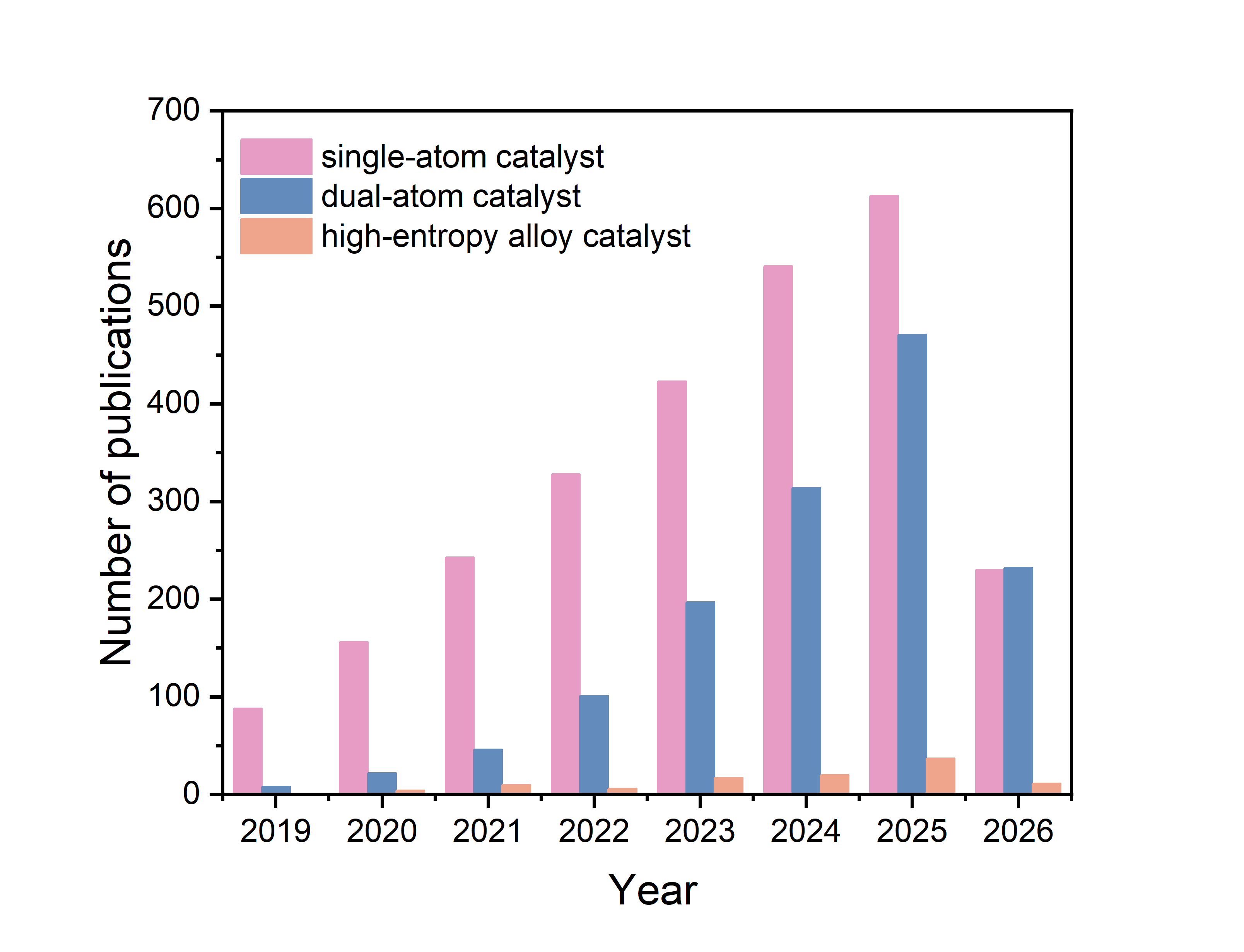
Fig. 1. Publication trends of papers with the keywords “single-atom and photocataly*”, “dual-atom or diatomic and photocataly*”, and “high-entropy alloy and photocataly*” from 2019 to 2026.
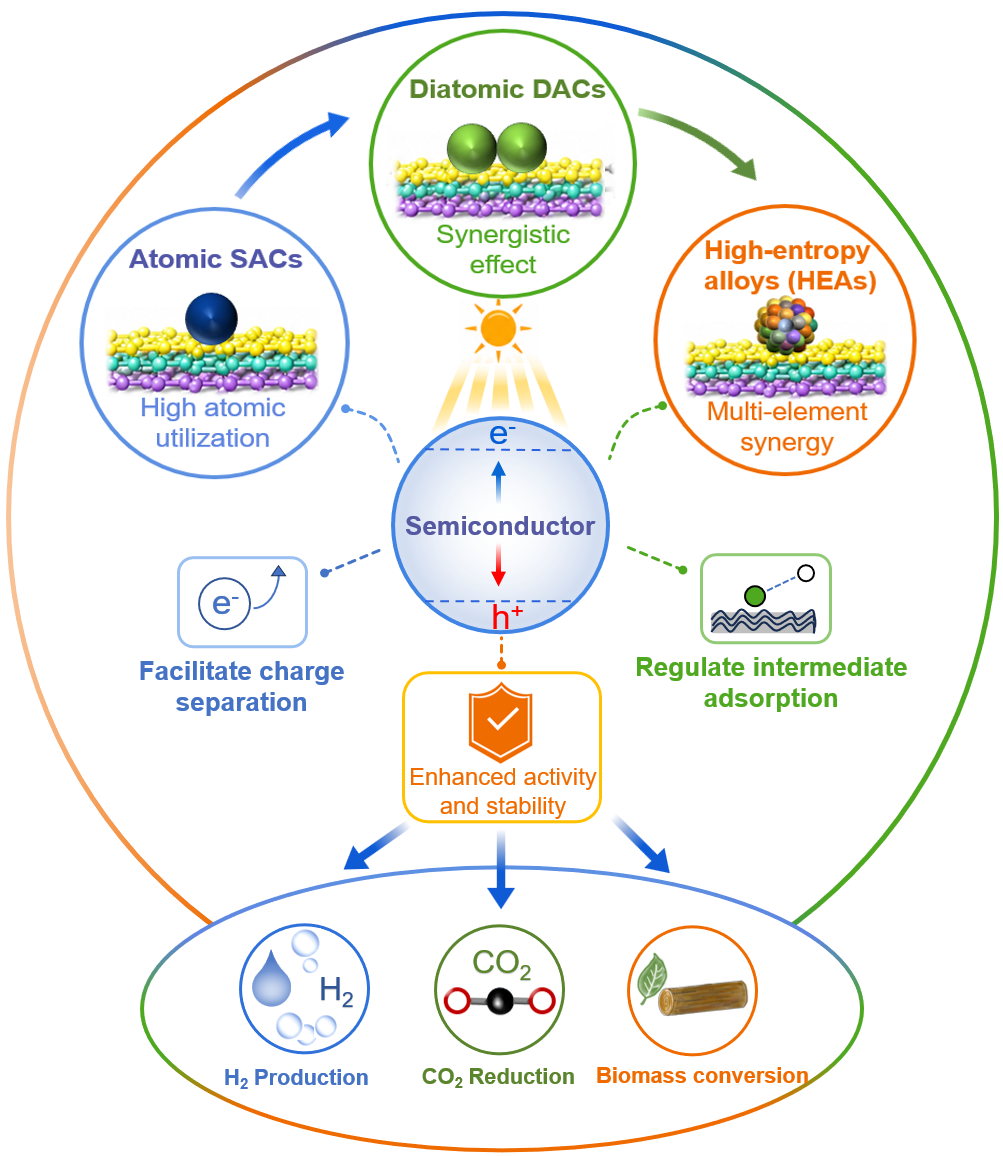
Fig. 2. Content diagram of this review article: development of cocatalysts from single- and dual-atom sites to high-entropy alloys for photocatalytic applications.
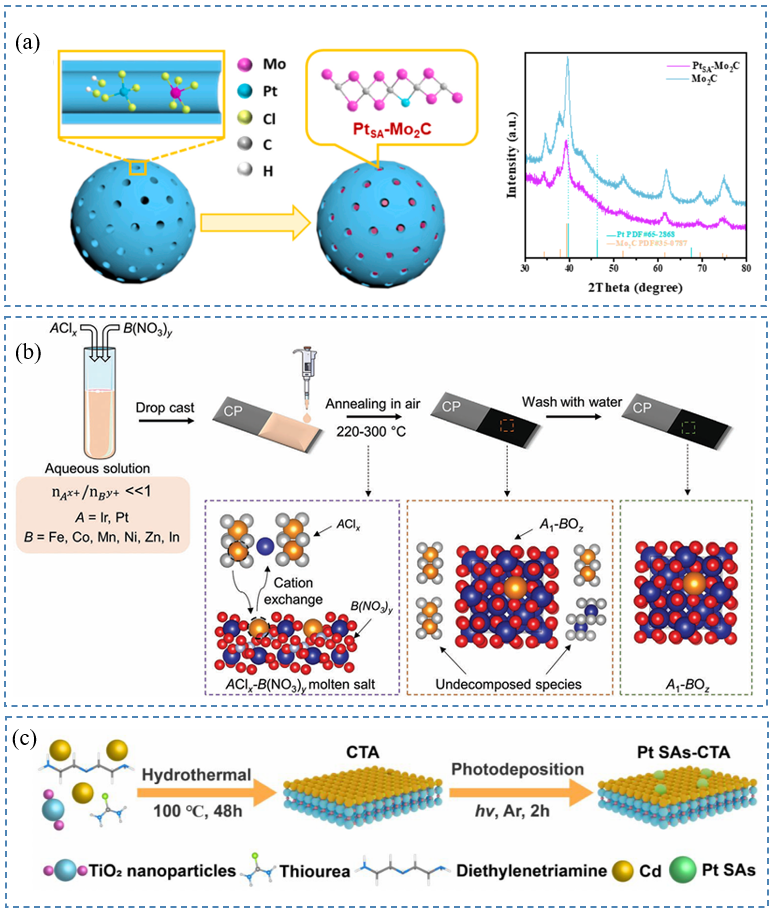
Fig. 3. (a) Synthesis scheme and XRD pattern of PtSA-Mo2C@C. Reprinted with permission from Ref. [57]. Copyright 2026, Elsevier. (b) Molten-salt-mediated construction of A1-BOZ single-atom catalysts. Reprinted with permission from Ref. [58]. Copyright 2024, John Wiley and Sons. (c) Schematic illustration of the Pt SAs-CTA synthesis. Reprinted with permission from Ref. [59]. Copyright 2025, American Chemical Society.
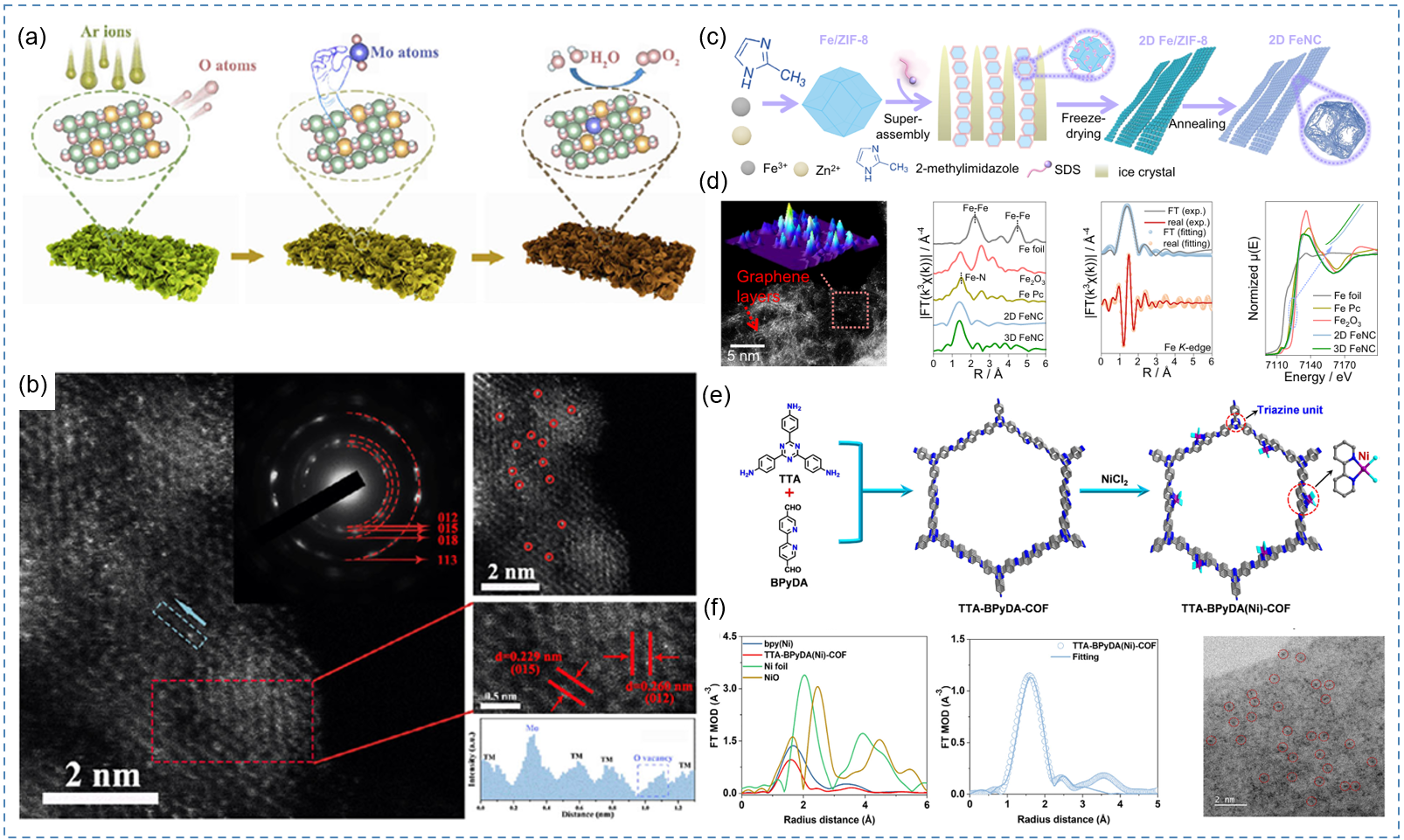
Fig. 4. (a) Synthesis scheme of the SAMo-NiFe LDH/Ti-1e15. (b) Aberration-corrected microscopy image of the sample. Reprinted with permission from Ref. [62]. Copyright 2025, John Wiley and Sons. (c) Synthesis scheme of the FeNC catalyst. (d) Atomic Gaussian-fitted overlap image and XANES spectrum of FeNC. Reprinted with permission from Ref. [63]. Copyright 2026, Springer Nature. (e) Post-synthetic Ni coordination in the TTA-BPyDA-COF framework. (f) XAFS spectra, RDF curves, and HAADF-STEM images of the samples. Reprinted with permission from Ref. [64]. Copyright 2026, John Wiley and Sons.
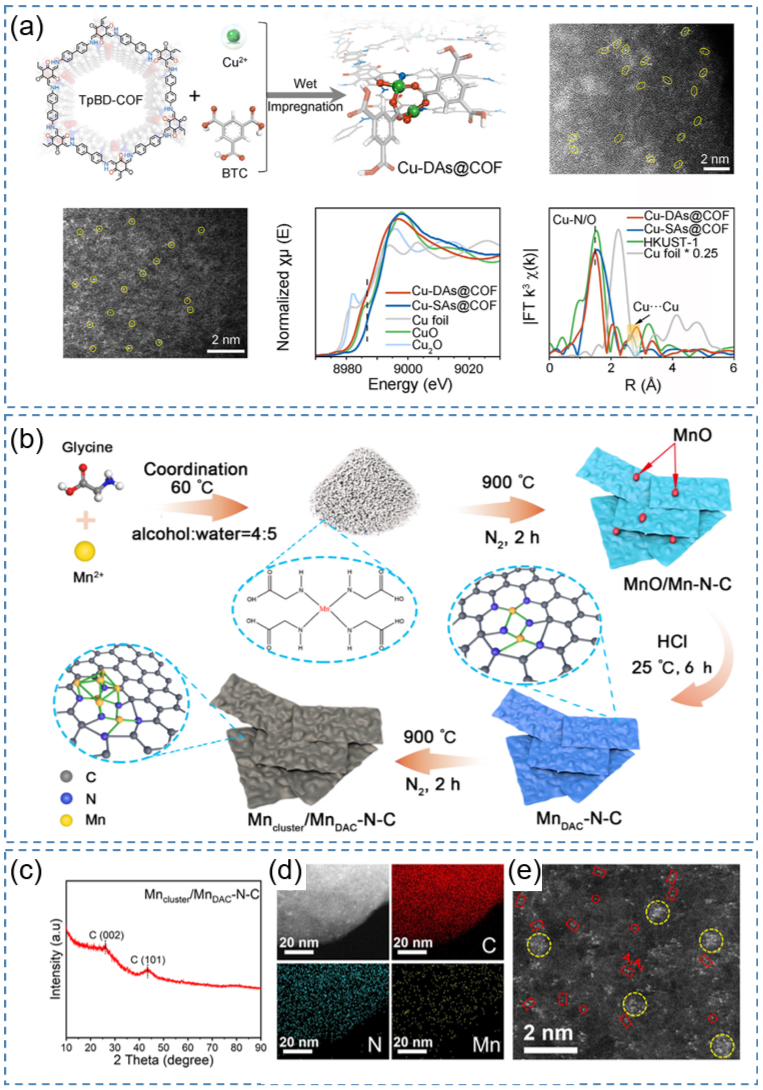
Fig. 5. (a) Preparation and site identification of Cu-DAs@COF by atomic-resolution imaging and Cu K-edge XAFS. Reprinted with permission from Ref. [76]. Copyright 2026, John Wiley and Sons. (b) Synthesis scheme, (c) XRD pattern, (d) spatial elemental distribution, and (e) atomically resolved structural image of Mncluster/MnDAC-N-C. Reprinted with permission from Ref. [77]. Copyright 2024, Elsevier.
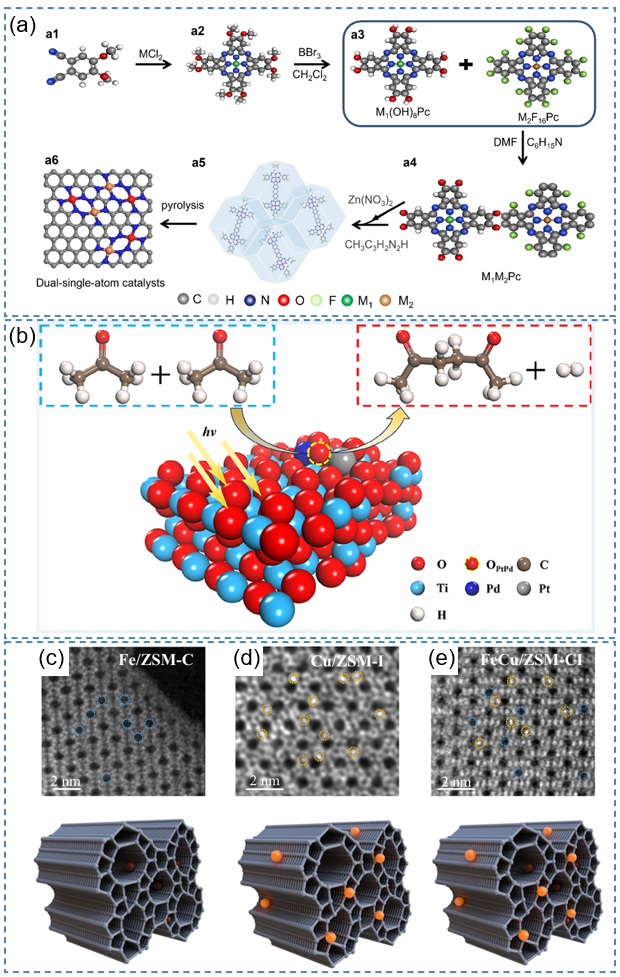
Fig. 6. (a) Synthesis Scheme of M1M2Pc. Reprinted with permission from Ref. [82]. Copyright 2024, John Wiley and Sons. (b) Schematic illustration of PtPd bimetallic single-atom cocatalysts promoting photocatalytic C(sp3)-H activation. Reprinted with permission from Ref. [83]. Copyright 2025, American Chemical Society. Atomic structural models of (c) Fe, (d) Cu, and (e) FeCu/ZSM (Zeolite Socony Mobil) catalysts. Reprinted with permission from Ref. [84]. Copyright 2026, Springer Nature.
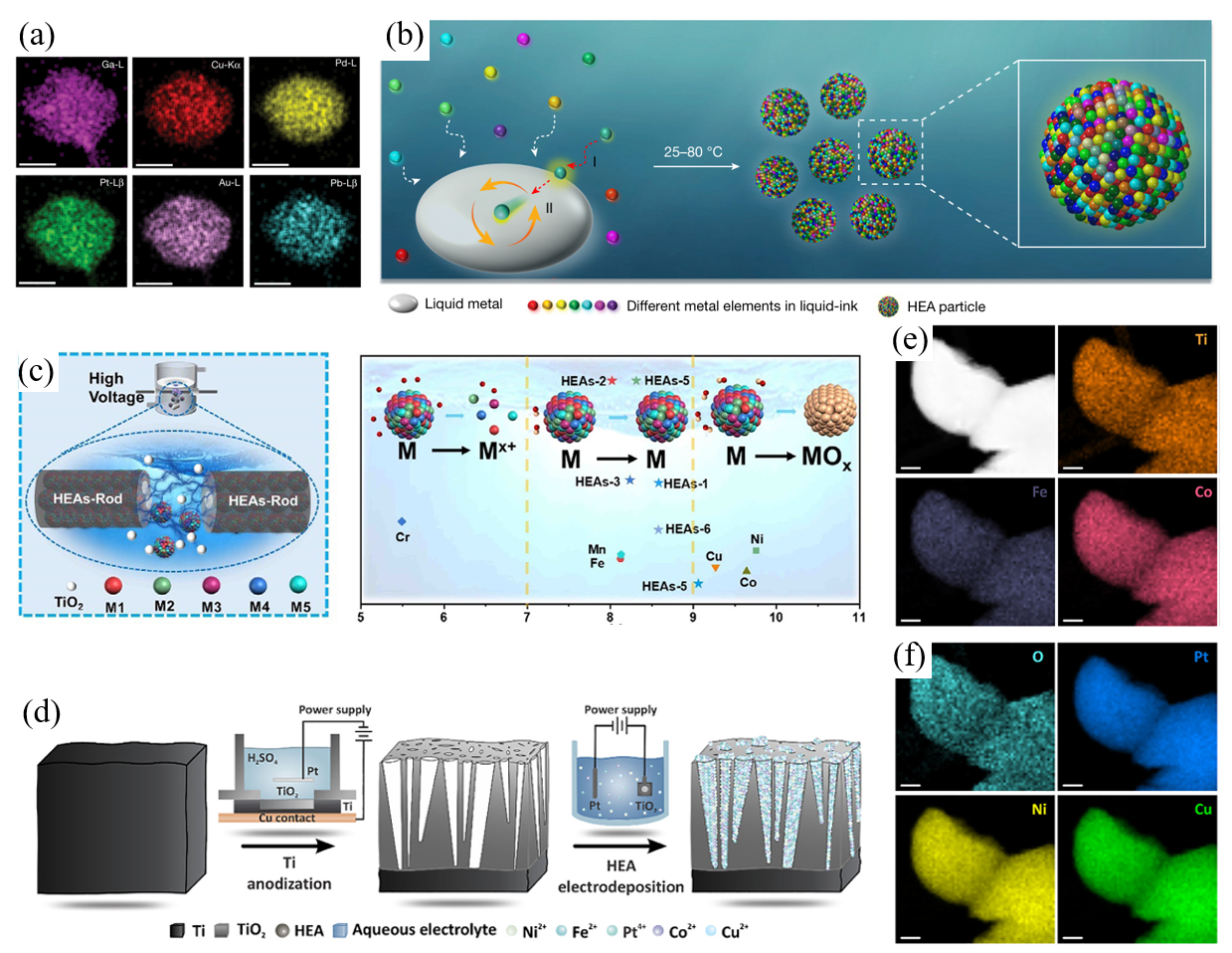
Fig. 7. (a) STEM-EDS analysis of elemental distribution in high-entropy alloy nanoparticles. (b) Schematic illustration of the low-temperature isothermal solidification synthesis of HEA nanoparticles. Reprinted with permission from Ref. [99]. Copyright 2025, Springer Nature. (c) Synthesis scheme of FeCoNiCrMn/TiO2 and the influence of pH on catalytic performance. Reprinted with permission from Ref. [100]. Copyright 2025, John Wiley and Sons. (d) Preparation scheme of PtFeCoNiCu HEA/TiO2-NF. (e,f) HAADF-STEM and EDX mapping results of PtFeCoNiCu HEA/TiO2-NF. Reprinted with permission from Ref. [101]. Copyright 2025, John Wiley and Sons.
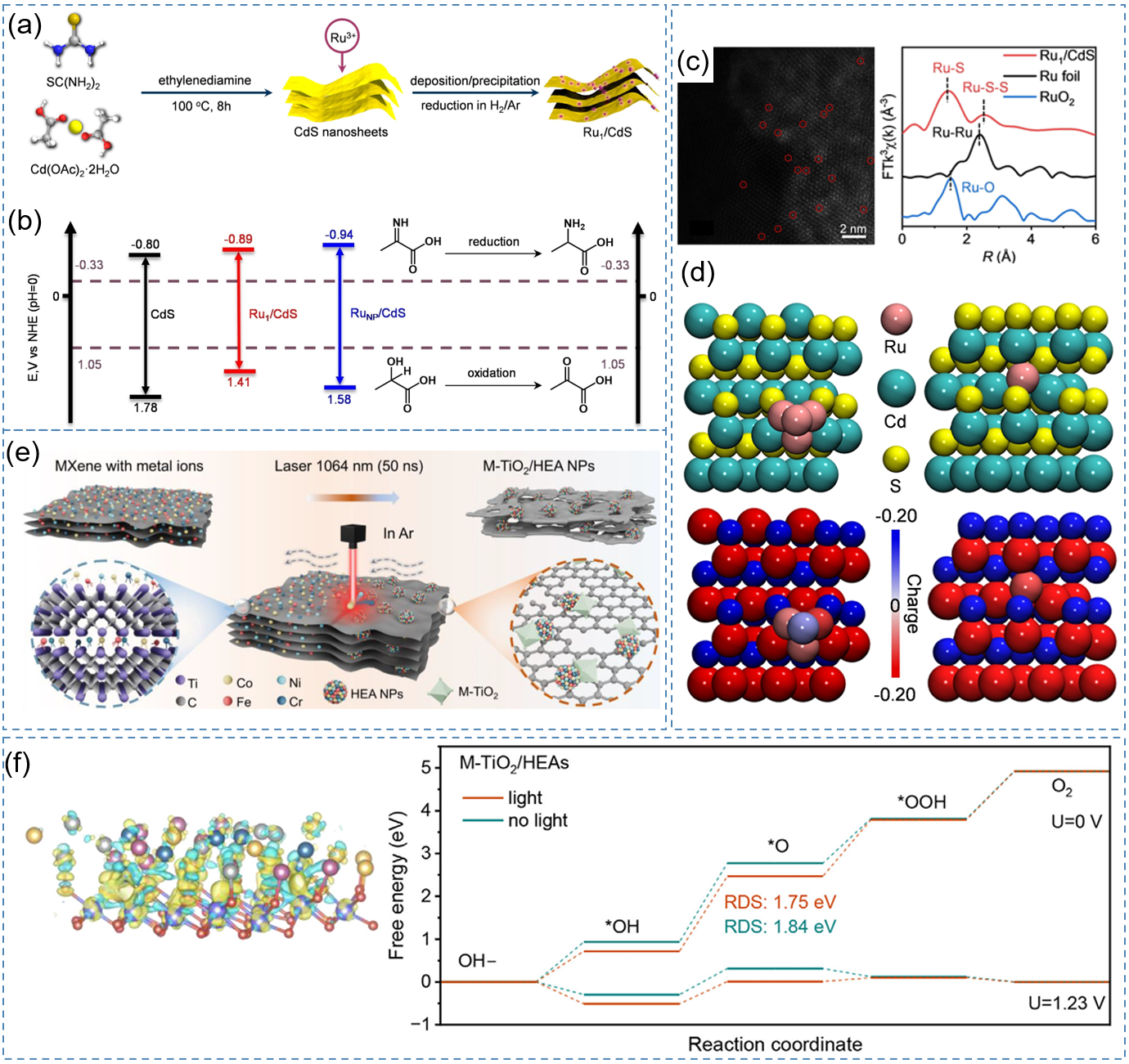
Fig. 8. (a) Synthesis scheme of Ru1/CdS SACs. (b) Band diagrams of CdS, Ru1/CdS, and RuNP/CdS. (c) HAADF-STEM image and EXAFS spectra of Ru1/CdS. (d) Bader-charge color maps of RuNP/CdS and Ru1/CdS. Reprinted with permission from Ref. [131]. Copyright 2024, John Wiley and Sons. (e) Synthesis scheme of M-TiO2/HEAs. (f) Charge density difference and free-energy diagrams of M-TiO2/HEAs. Reprinted with permission from Ref. [132]. Copyright 2025, John Wiley and Sons.
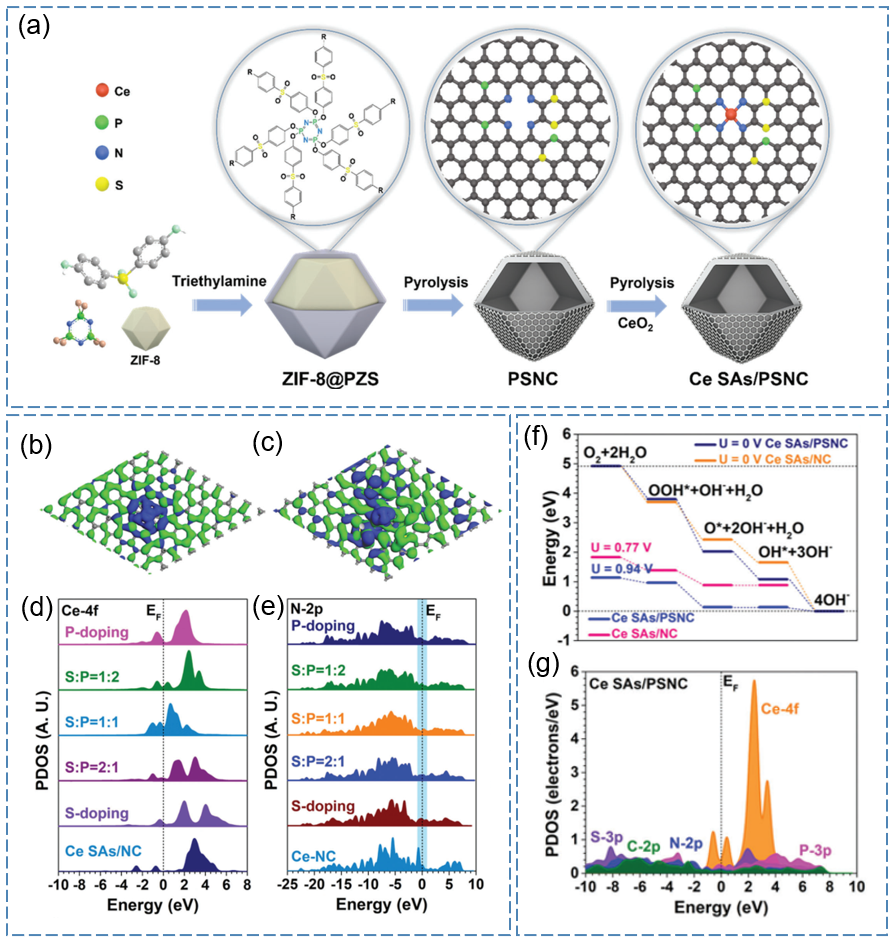
Fig. 9. (a) Synthesis scheme of Ce SAs/PSNC. 3D isosurface plots of electron distributions in (b) Ce SAs/PSNC and (c) Ce SAs/NC model. (d,e) PDOS analysis of Ce-4f and N-2p under S/P regulation. (f) ORR free-energy profiles of Ce SAs/PSNC and Ce SAs/NC. (g) PDOS of Ce SAs/PSNC. Reprinted with permission from Ref. [142]. Copyright 2023, John Wiley and Sons.
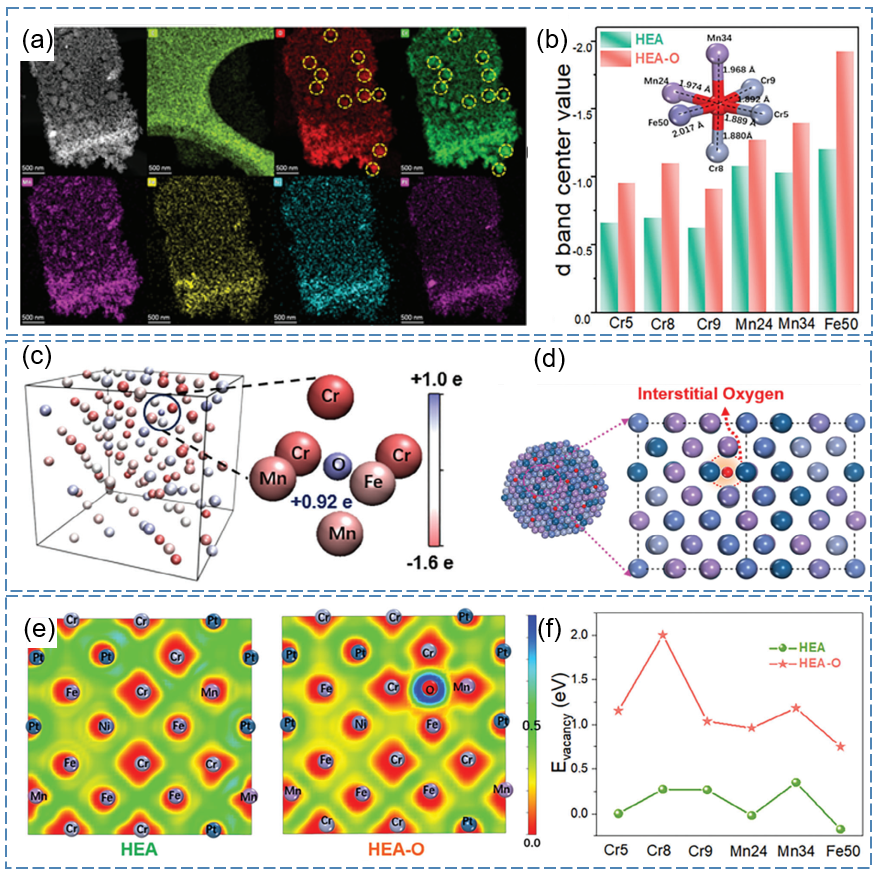
Fig. 10. (a) EDS mapping of HEA-O. (b) d-band center comparison and bond-length structural models of HEA/HEA-O. (c) Atomic charge color map of the bulk HEA-O structure. (d) Structural model of HEA-O. (e) Electron localization distributions and (f) vacancy formation energies at distinct sites of HEA/HEA-O. Reprinted with permission from Ref. [98]. Copyright 2024, John Wiley and Sons.
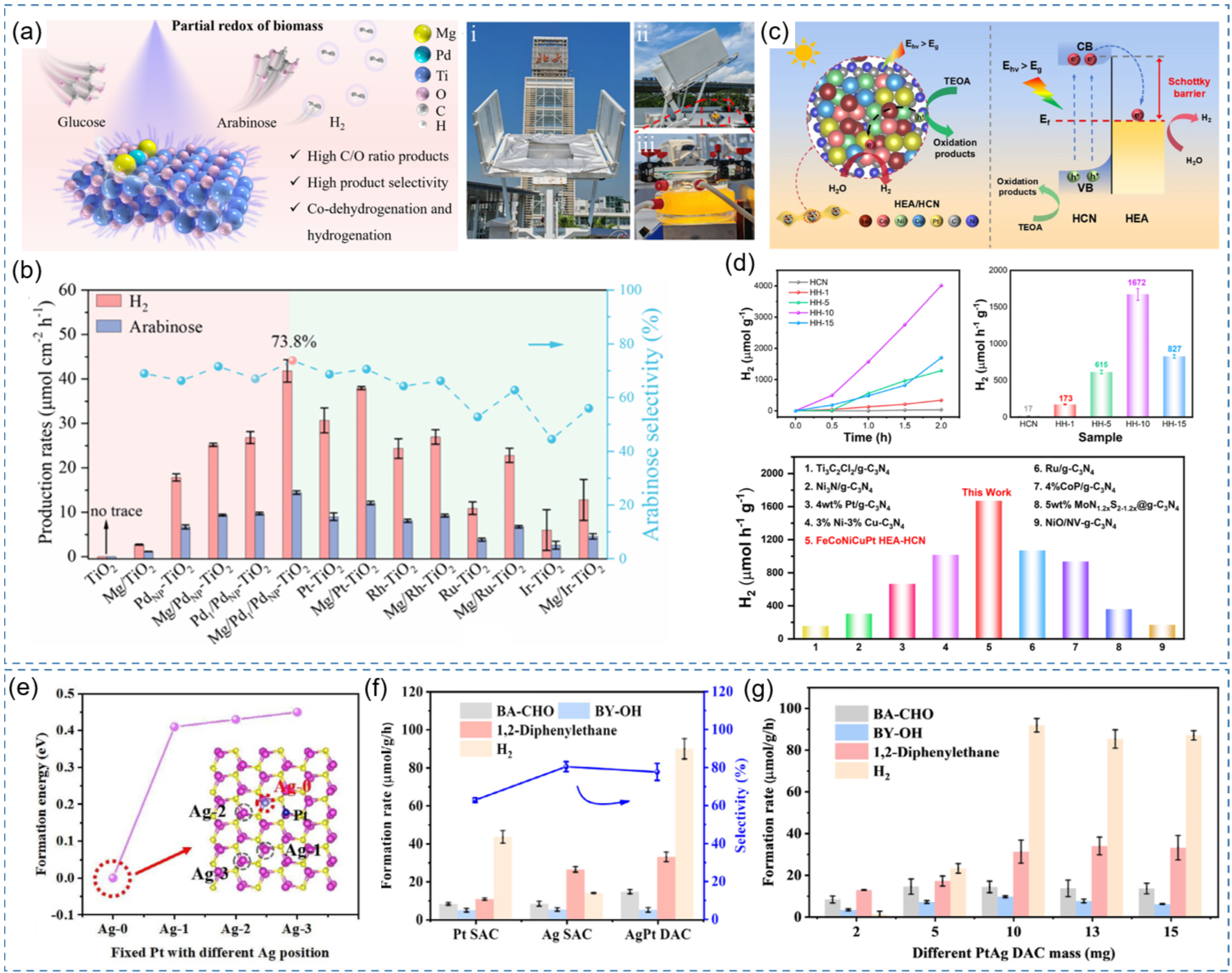
Fig. 11. (a) Schematic illustration of photocatalytic glucose reforming to arabinose and H2 over Mg/Pd1/PdNP-TiO2 and photographs of the outdoor photocatalytic system. (b) Photocatalytic H2 and arabinose production activity and selectivity of the as-prepared samples. Reprinted with permission from Ref. [168]. Copyright 2025, American Chemical Society. (c) Mechanism of HEA/HCN for photocatalytic hydrogen production. (d) Photocatalytic HER activity and rates of HCN and HH-x composites and comparison of HEA/HCN with representative reported photocatalysts. Reprinted with permission from Ref. [169]. Copyright 2026, John Wiley and Sons. (e) Site-dependent formation energies of Pt/Ag atoms on CdS. (f) H2 and 1,2-diphenylethane production rates over PtAg DACS and Pt/Ag SACS. (g) Effect of catalyst mass on product yield. Reprinted with permission from Ref. [170]. Copyright 2026, John Wiley and Sons.
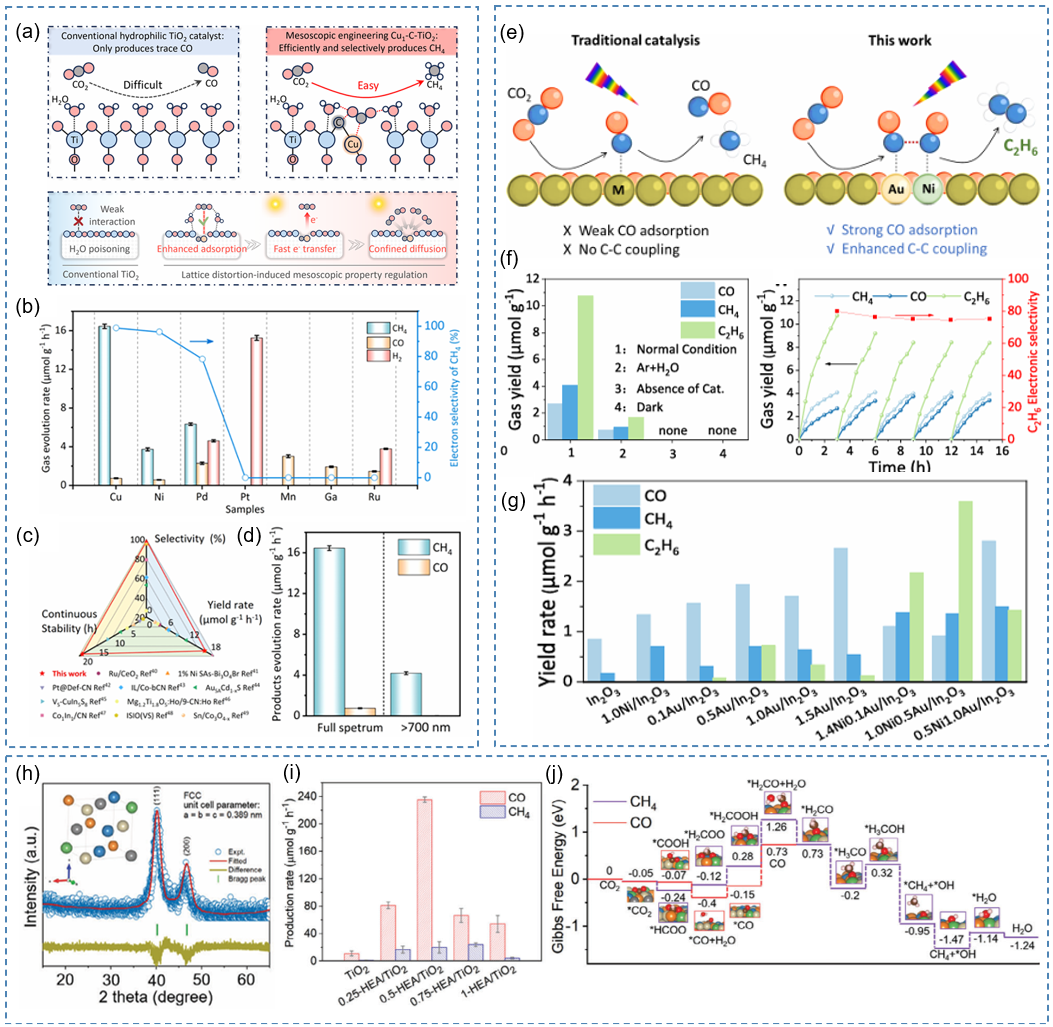
Fig. 12. (a) Schematic illustration of aqueous CO2RR over conventional TiO2 and mesoscopically engineered Cu1-C-TiO2. (b) Photocatalytic CO2 reduction performance of different single-metal-atom-loaded C-TiO2 catalysts. (c) Comparison of photocatalytic CO2 conversion performance with reported systems. (d) Photocatalytic CO2RR performance of Cu1-C-TiO2 under NIR irradiation. Reprinted with permission from Ref. [189]. Copyright 2026, American Chemical Society. (e) Schematic diagram of efficient CO2 photoreduction to C2H6 over Ni-Au dual-atom sites. (f) Control experiments under different conditions and cycling stability of 1.0Ni0.5Au/In2O3. (g) Product yields. Reprinted with permission from Ref. [190]. Copyright 2025, American Chemical Society. (h) XRD pattern and crystal-structure schematic of HEA nanoparticles. (i) CO2 photoreduction performance of pristine TiO2 and x-HEA/TiO2. (j) DFT energy profiles and intermediate adsorption structures for CO2-to-product conversion over HEA(111). Reprinted with permission from Ref. [191]. Copyright 2024, John Wiley and Sons.
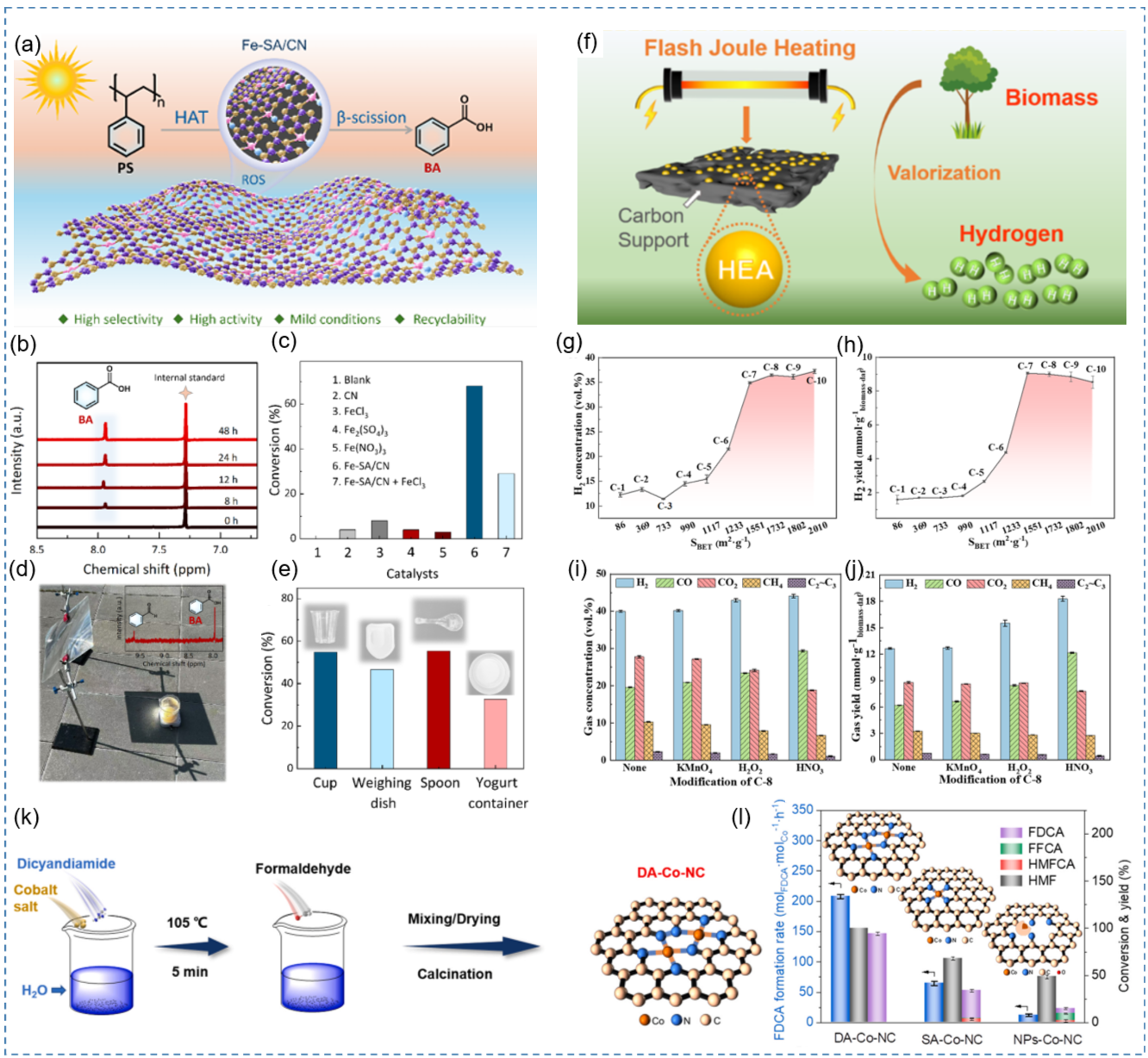
Fig. 13. (a) Schematic illustration of Fe-SA/CN for selective photocatalytic upcycling of polystyrene plastic waste to benzoic acid. (b) 1H NMR spectra of PS upcycling over Fe-SA/CN at different reaction times. (c) 24 h PS conversion under different conditions. (d) Natural-sunlight-driven PS photocatalytic conversion device. (e) 24 h conversion of real PS plastic waste over Fe-SA/CN. Reprinted with permission from Ref. [200]. Copyright 2026, American Chemical Society. (f) Schematic illustration of HEA-catalyzed conversion of biomass waste to green hydrogen. (g) Influence of carbon surface area on H2 evolution during biomass conversion. (h) Variation in H2 yield with carbon surface area. (i) Effect of C-8 modification type on H2 concentration. (j) Effect of C-8 modification type on H2 yield. Reprinted with permission from Ref. [201]. Copyright 2025, American Chemical Society. (k) Synthesis scheme of Co/NC catalysts. (l) HMF oxidation activities of DA-Co-NC, SA-Co-NC, and NPs-Co-NC. Reprinted with permission from Ref. [202]. Copyright 2025, Elsevier.
|
| [1] | 雷文敏, 张艳, 孙大琳, 班林, 周恒, 杨松, 景立权, 胡劲光, 张衡. 过渡金属光催化剂用于木质素可持续转化生产生物燃料[J]. 催化学报, 2026, 88(9): 35-85. |
| [2] | 王洋, 范存冯, 刘洋, 郑晓芹, 刘譞懿, 张凯, 寇佳慧, 黄亨明, 孙林兵. 基于限域空间内原位形成的碳层构筑铁单原子催化剂用于高效芬顿反应[J]. 催化学报, 2026, 88(9): 432-441. |
| [3] | 曾悦, 王泓升, 轩靖, 肖萍, 冯瑶瑶, 吕帅, 朱君江. CeO2/Co3O4催化剂界面相互作用的尺寸依赖性: 从单原子到纳米颗粒[J]. 催化学报, 2026, 88(9): 478-491. |
| [4] | 朱君江, 许凯强. CdS/NiPc S-型光催化剂及其增强的光催化产过氧化氢性能[J]. 催化学报, 2026, 88(9): 5-8. |
| [5] | 孙宇航, 李旭, 曾众天, 魏华, 赵宇龙, 蔡晓燕, 毛梁, 谭昌龙, 沈博, 徐艺军. 硫诱导电荷位点重构与原位生成ZnO2保护层实现稳定高效的太阳能制备H2O2[J]. 催化学报, 2026, 88(9): 207-217. |
| [6] | Sathi Chatterjee, 李红梅, 刘康, 林璋, 柴立元, 刘敏. 二维(2D)材料上的单原子催化剂用于光催化CO2还原: 基础、设计与新兴策略[J]. 催化学报, 2026, 88(9): 86-128. |
| [7] | 刘淑芳, 陈锋宇, 李思媛, 叶宇昕, 欧阳钢锋. 氧中心有机自由基最新研究进展: 表征、合成及应用[J]. 催化学报, 2026, 88(9): 183-206. |
| [8] | 陈翔锋, 黄丝雨, 杨煜杭, 倪嘉浩, 方诚, 徐杨帆, 匡代彬. 卤素钙钛矿材料在杂化光催化中的研究进展[J]. 催化学报, 2026, 88(9): 9-34. |
| [9] | 黄芸, 陈奇, 陈月铃, 杨泽锋, 吴炯桦, 余济美, 吴棱. 在Pt/DUT-67(Zr)表面生成氢物种增强光催化合成氨[J]. 催化学报, 2026, 88(9): 247-258. |
| [10] | 张盛鑫, 李安琦, 虞周楠, 李林, 刘晓艳, 刘伟, 王爱琴, 张涛. 铂镍单原子合金催化剂在一氧化碳还原一氧化氮反应中协同效应的最大化[J]. 催化学报, 2026, 88(9): 422-431. |
| [11] | 陈月铃, 林玉玲, 陈紫妍, 孔祥昱, 毕进红, 黄国城, 吴棱. 共价有机框架中不对称的N-Ru-S偶极子增强内建电场以实现高效的CO2光还原[J]. 催化学报, 2026, 87(8): 59-69. |
| [12] | 吴昊, 曾芯宇, 王往, 程蓓, 程敬招, 许景三, 曹少文. 有机-无机S型异质结增强载流子分离用于光催化产氢耦合亚胺合成[J]. 催化学报, 2026, 87(8): 185-196. |
| [13] | 姜晓康, 高永泽, 张博闻, 杨晓东, 袁之敏, 许兆宁, 孙彬, 姜在勇, 周国伟, 周恩龙. 内建电场耦合非贵金属等离基元效应助推MIL-125光催化二氧化碳还原活性[J]. 催化学报, 2026, 87(8): 100-112. |
| [14] | Sue-Faye Ng, Joel Jie Foo, Karlo Nolkemper, Zahra Hajiahmadi, Jaya Bharti, Nannan Hou, Jiankang Zheng, Thomas D. Kühne, Markus Antonietti, Christian Mark Pelicano, Wee-Jun Ong. 三唑环功能化聚(七嗪亚胺): 利用给体-受体构型实现高效太阳驱动过氧化氢合成[J]. 催化学报, 2026, 87(8): 140-155. |
| [15] | 段江林, 邓鹏程, 熊惠峰, 杨娜, 周雪灵, 王静雯, 张瑞, 冯丹, 杨级, 覃勇, 任煜京. 亚埃尺度空间调控Fe1-N4配位结构实现高效C-H键氧化过程[J]. 催化学报, 2026, 87(8): 305-315. |
| 阅读次数 | ||||||
|
全文 |
|
|||||
|
摘要 |
|
|||||


