
催化学报 ›› 2026, Vol. 91: 396-411.DOI: 10.1016/S1872-2067(26)65256-4
• 论文 • 上一篇
Mengrong Li, Bram D. Bruininks, Ivo A. W. Filot*( ), Emiel J. M. Hensen*()
收稿日期:2026-05-18
接受日期:2026-07-31
出版日期:2026-12-18
发布日期:2026-10-13
通讯作者:
*电子信箱: i.a.w.filot@tue.nl (I. A.W. Filot),
Mengrong Li, Bram D. Bruininks, Ivo A. W. Filot*(), Emiel J. M. Hensen*()
Received:2026-05-18
Accepted:2026-07-31
Online:2026-12-18
Published:2026-10-13
摘要:
氧化铈负载的Pd单原子催化剂在三效催化体系的低温CO氧化中具有良好的应用前景, 但其稳定性与活性之间的内在权衡关系仍缺乏深入认识. 本文结合密度泛函理论计算和微动力学模拟, 系统地研究了镧系元素(Ln)-Zn共掺杂对Pd1/CeO2(111)单原子催化剂结构与CO氧化性能的影响. 在该设计体系中, Zn稳定孤立的Pd原子并促进晶格氧活化, 而引入Ln旨在进一步提高晶格氧反应性并调控反应物吸附. 然而, 微观动力学模拟结果表明, 与锌掺杂参考体系相比, Ln-Zn共掺杂反而降低了CO氧化活性. 尽管Ln的引入增强了晶格氧反应性并促进了氧空位形成, 但同时也抑制了O2的吸附与活化以及氧空位的再填充, 使催化循环的动力学限制由晶格氧参与转变为O2活化, 最终导致转化率降低. 研究结果表明, 对于Mars-van Krevelen反应, 单纯增强晶格氧的反应性并不能提高整体催化活性; 催化性能的提升需要兼顾晶格氧活化和表面再氧化过程. 因此, 仅凭氧空位形成能等单一描述符难以准确预测催化性能. 本文强调, 有效的催化剂设计需要根据特定催化体系的动力学特性选择组合描述符, 而不是依赖于单一的通用描述符.
Mengrong Li, Bram D. Bruininks, Ivo A. W. Filot, Emiel J. M. Hensen. 镧系元素-锌共掺杂Pd/CeO2单原子催化剂中晶格氧活化与表面再氧化的平衡及其对CO氧化性能的影响[J]. 催化学报, 2026, 91: 396-411.
Mengrong Li, Bram D. Bruininks, Ivo A. W. Filot, Emiel J. M. Hensen. Balancing lattice oxygen activation and surface reoxidation in lanthanide-Zn co-doped Pd/CeO2 single-atom catalysts for CO oxidation[J]. Chinese Journal of Catalysis, 2026, 91: 396-411.
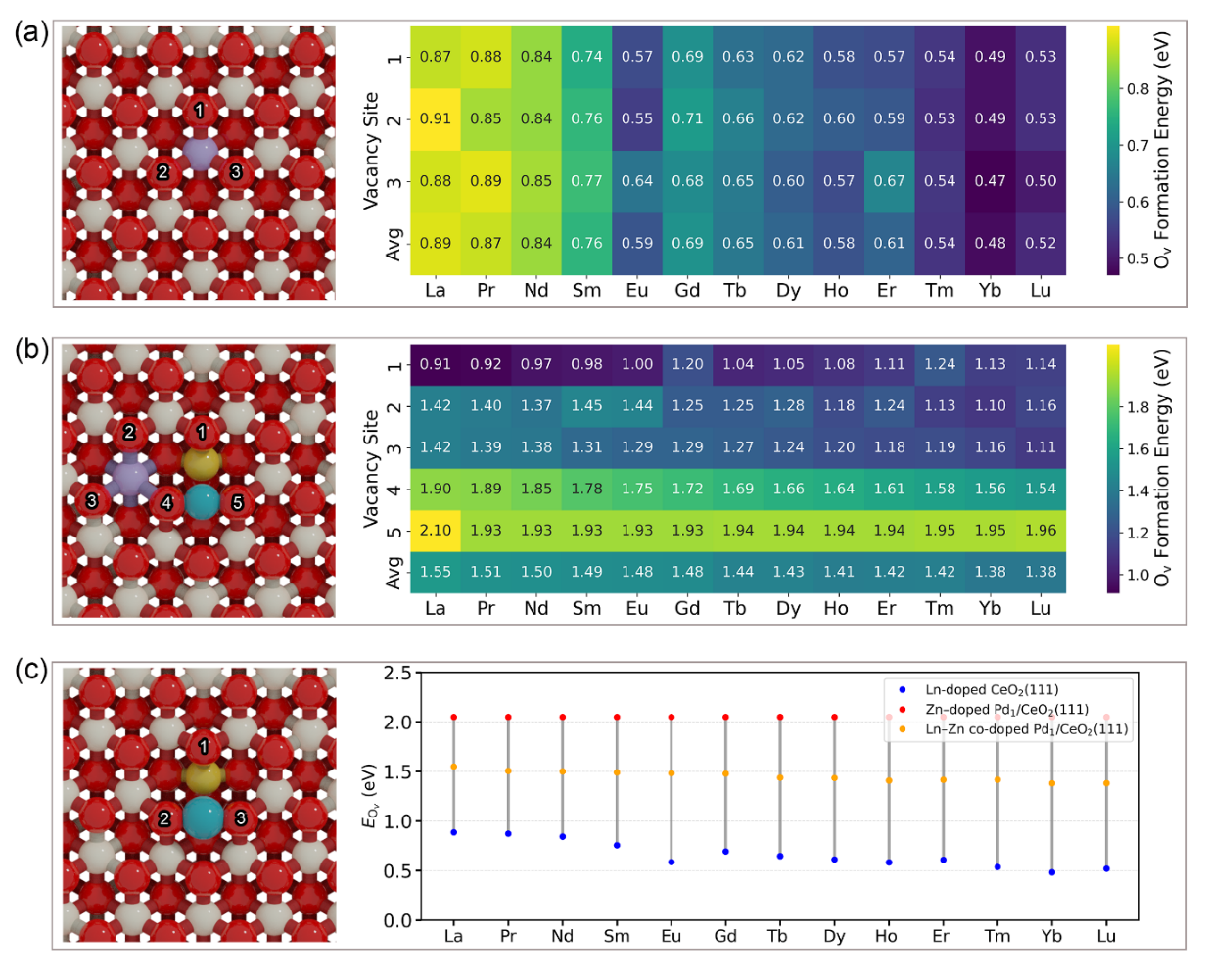
Fig. 1. Configurations (left) and corresponding Ov formation energy heatmaps (right) for Ln-doped CeO2(111) (a) and Ln-Zn co-doped Pd1/CeO2(111) (b) (Ln=purple; Zn=yellow; Pd=blue).
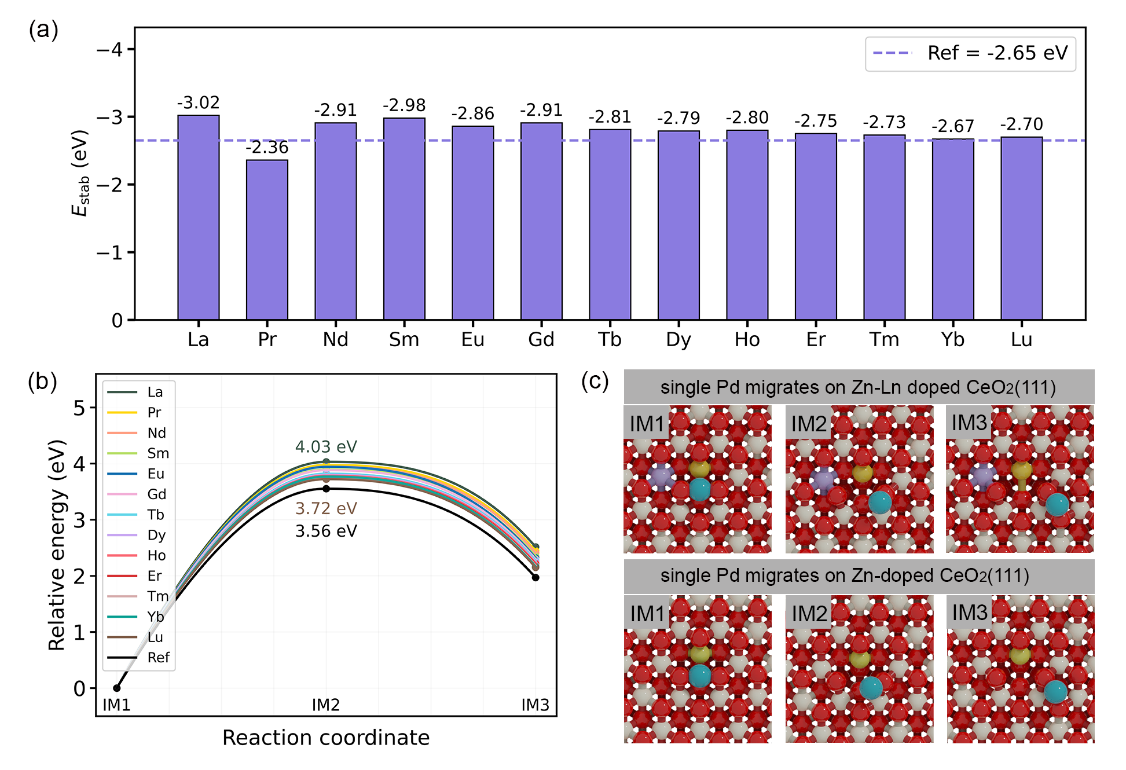
Fig. 2. (a) Stabilization energies of a Pd atom on Zn-Ln co-doped CeO2(111), with Zn-doped CeO2(111) taken as the reference (Ref). (b) Energy profiles for migration of a Pd atom on Zn-Ln co-doped CeO2(111) surfaces. IM1, IM2, and IM3 denote the initial, transition, and final states, respectively. The values reported along the migration pathway represent the energy difference between the transition state (IM2) and the initial state (IM1). (c) Corresponding structures along the migration pathway for IM1, IM2, and IM3 in both Zn-Ln co-doped and Zn-doped CeO2(111).
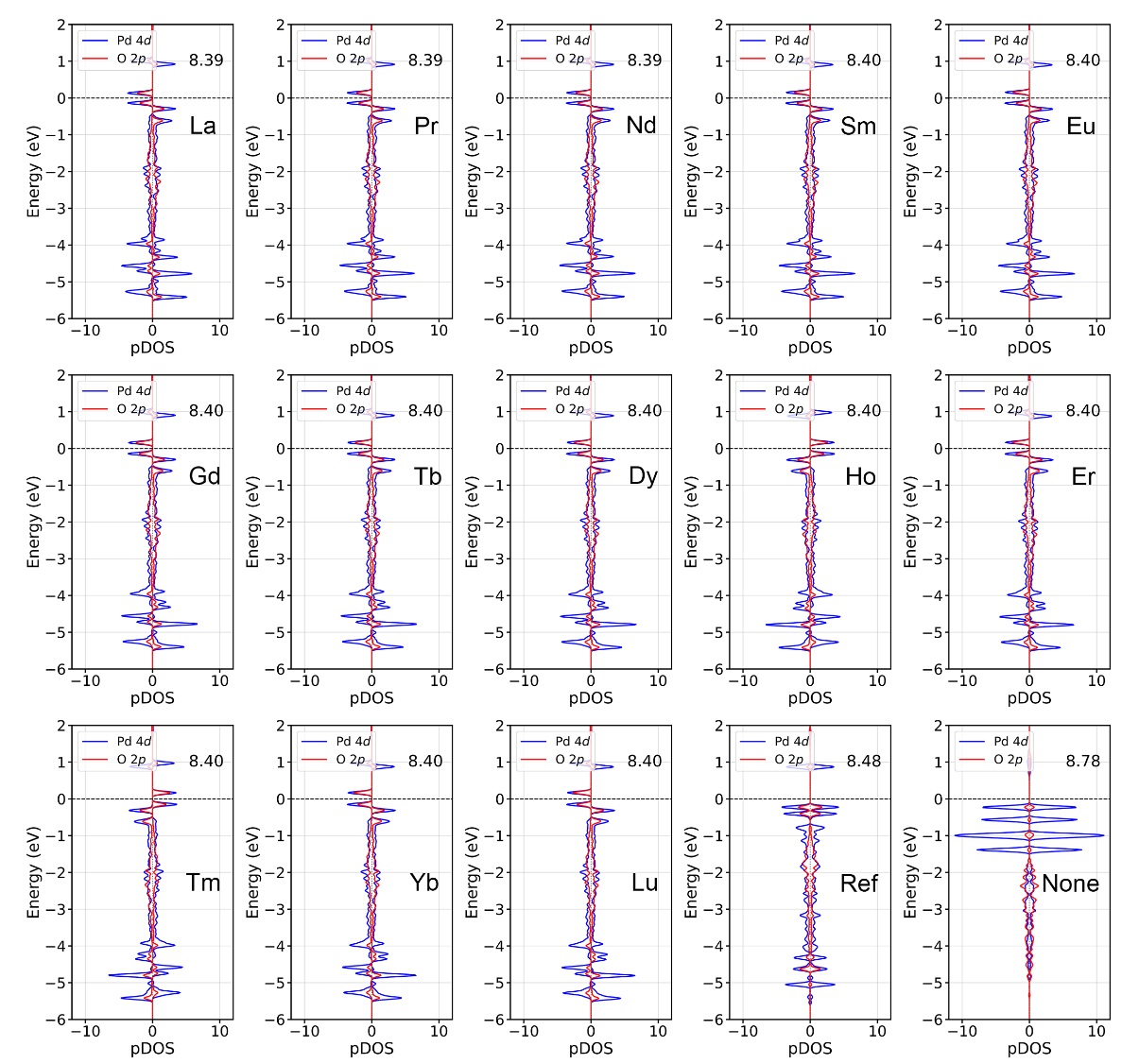
Fig. 3. The partial density of states of Pd-4d and O-2p orbitals (O adjacent to the Pd and Ln) in Ln-Zn co-doped Pd1/CeO2(111) (Ln=La, Pr, Nd, Sm, Eu, Gd, Tb, Dy, Ho, Er, Tm, Yb, and Lu). Energies are referenced to the Fermi level (EF=0). The value shown in each of the graphs corresponds to the integrated DOS (number of electrons) of the Pd-4d below the Fermi level. The corresponding pDOS of Zn-doped Pd1/CeO2(111) and pristine Pd1/CeO2(111), denoted as None, are included for comparison [65].
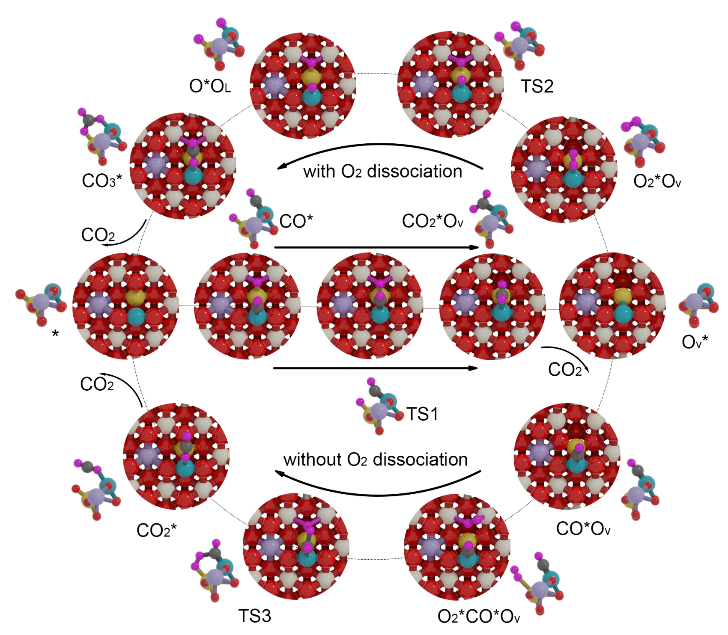
Fig. 4. The reaction pathways over Ln-Zn co-doped Pd1/CeO2(111) (Ln=La, Pr, Nd, Sm, Eu, Gd, Tb, Dy, Ho, Er, Tm, Yb, Lu) (colour code: white=Ce; red=lattice O; yellow=Zn; light purple=Ln; blue=Pd; grey=C; pink=O involved in reaction). Pathway 1=P1 + P2, Pathway 2=P1 + P3.
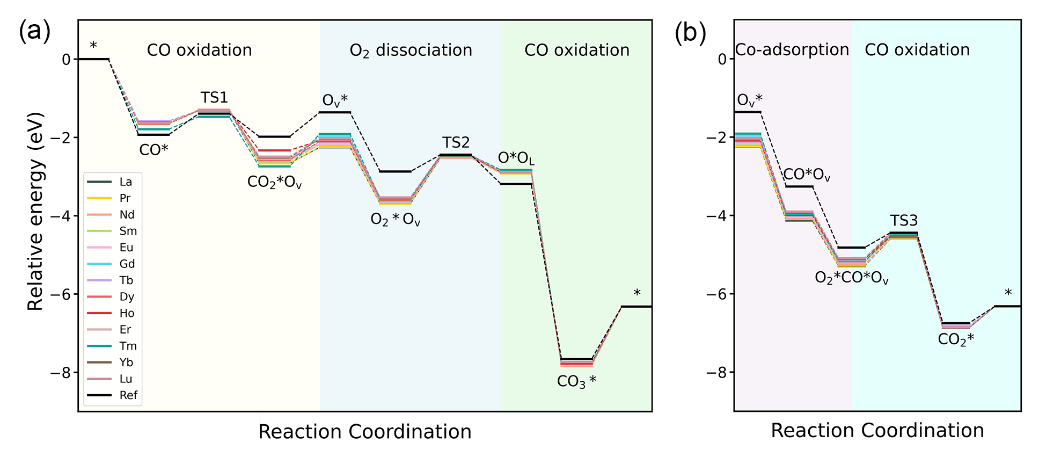
Fig. 5. Potential energy diagrams of CO oxidation on Ln-Zn co-doped Pd1/CeO2(111), with Zn-doped Pd1/CeO2(111) as reference (Ref). (a) The common initial pathway (P1), followed by O2 dissociative pathway (P2). (b) The possible O2 non-dissociative pathway (P3) following P1.
| CO oxidation with O2 direct dissociation (P1 + P2) | |||||||||
|---|---|---|---|---|---|---|---|---|---|
| Ln | COads | TS1 | CO2rea | CO2des | O2ads | TS2 | O2rea | COads | CO2des |
| La | ‒1.65 | 0.34 | ‒1.00 | 0.41 | ‒1.44 | 1.17 | 0.85 | ‒5.01 | 1.53 |
| Pr | ‒1.70 | 0.37 | ‒1.00 | 0.42 | ‒1.45 | 1.16 | 0.77 | ‒4.93 | 1.52 |
| Nd | ‒1.65 | 0.36 | ‒0.88 | 0.35 | ‒1.48 | 1.15 | 0.76 | ‒4.92 | 1.51 |
| Sm | ‒1.64 | 0.34 | ‒0.97 | 0.44 | ‒1.47 | 1.14 | 0.74 | ‒4.91 | 1.50 |
| Eu | ‒1.64 | 0.34 | ‒0.96 | 0.44 | ‒1.48 | 1.14 | 0.74 | ‒4.92 | 1.50 |
| Gd | ‒1.64 | 0.33 | ‒0.95 | 0.63 | ‒1.67 | 1.13 | 0.75 | ‒4.92 | 1.48 |
| Tb | ‒1.58 | 0.26 | ‒1.00 | 0.46 | ‒1.50 | 1.12 | 0.72 | ‒4.90 | 1.47 |
| Dy | ‒1.64 | 0.33 | ‒0.92 | 0.46 | ‒1.50 | 1.12 | 0.72 | ‒4.89 | 1.46 |
| Ho | ‒1.64 | 0.33 | ‒0.69 | 0.25 | ‒1.51 | 1.12 | 0.71 | ‒4.90 | 1.46 |
| Er | ‒1.63 | 0.32 | ‒0.91 | 0.49 | ‒1.53 | 1.11 | 0.73 | ‒4.90 | 1.44 |
| Tm | ‒1.80 | 0.33 | ‒0.94 | 0.82 | ‒1.65 | 1.11 | 0.73 | ‒4.92 | 1.43 |
| Yb | ‒1.62 | 0.32 | ‒0.89 | 0.49 | ‒1.53 | 1.10 | 0.68 | ‒4.88 | 1.44 |
| Lu | ‒1.63 | 0.33 | ‒0.86 | 0.48 | ‒1.51 | 1.09 | 0.65 | ‒4.86 | 1.42 |
| Ref | ‒1.93 | 0.53 | ‒0.06 | 0.63 | ‒1.51 | 0.43 | ‒0.33 | ‒4.46 | 1.34 |
| CO oxidation with O2 non-direct dissociation (P1 +P3) | |||||||||
| Ln | COads | TS1 | CO2rea | CO2des | COads | O2ads | TS3 | CO2rea | CO2des |
| La | — | — | — | — | ‒1.88 | ‒1.15 | 0.70 | ‒1.58 | 0.55 |
| Pr | — | — | — | — | ‒1.85 | ‒1.19 | 0.70 | ‒1.59 | 0.55 |
| Nd | — | — | — | — | ‒1.90 | ‒1.88 | 0.70 | ‒1.61 | 0.55 |
| Sm | — | — | — | — | ‒1.88 | ‒1.18 | 0.69 | ‒1.64 | 0.55 |
| Eu | — | — | — | — | ‒1.88 | ‒1.88 | 0.68 | ‒1.66 | 0.55 |
| Gd | — | — | — | — | ‒2.05 | ‒1.19 | 0.68 | ‒1.67 | 0.55 |
| Tb | — | — | — | — | ‒1.90 | ‒1.17 | 0.68 | ‒1.63 | 0.49 |
| Dy | — | — | — | — | ‒1.88 | ‒1.18 | 0.67 | ‒1.70 | 0.55 |
| Ho | — | — | — | — | ‒1.90 | ‒1.16 | 0.61 | ‒1.71 | 0.55 |
| Er | — | — | — | — | ‒1.90 | ‒1.19 | 0.66 | ‒1.73 | 0.55 |
| Tm | — | — | — | — | ‒2.05 | ‒1.16 | 0.66 | ‒1.74 | 0.55 |
| Yb | — | — | — | — | ‒1.91 | ‒1.18 | 0.60 | ‒1.75 | 0.55 |
| Lu | — | — | — | — | ‒1.88 | ‒1.19 | 0.65 | ‒1.77 | 0.55 |
| Ref | — | — | — | — | ‒1.90 | ‒1.57 | 0.39 | ‒0.05 | 0.43 |
Table 1 Calculated energies for the CO oxidation reaction of Ln-Zn co-doped and Zn-doped Pd1/CeO2(111), which also correspond to Figs. 4 and 5 (all energies in eV).
| CO oxidation with O2 direct dissociation (P1 + P2) | |||||||||
|---|---|---|---|---|---|---|---|---|---|
| Ln | COads | TS1 | CO2rea | CO2des | O2ads | TS2 | O2rea | COads | CO2des |
| La | ‒1.65 | 0.34 | ‒1.00 | 0.41 | ‒1.44 | 1.17 | 0.85 | ‒5.01 | 1.53 |
| Pr | ‒1.70 | 0.37 | ‒1.00 | 0.42 | ‒1.45 | 1.16 | 0.77 | ‒4.93 | 1.52 |
| Nd | ‒1.65 | 0.36 | ‒0.88 | 0.35 | ‒1.48 | 1.15 | 0.76 | ‒4.92 | 1.51 |
| Sm | ‒1.64 | 0.34 | ‒0.97 | 0.44 | ‒1.47 | 1.14 | 0.74 | ‒4.91 | 1.50 |
| Eu | ‒1.64 | 0.34 | ‒0.96 | 0.44 | ‒1.48 | 1.14 | 0.74 | ‒4.92 | 1.50 |
| Gd | ‒1.64 | 0.33 | ‒0.95 | 0.63 | ‒1.67 | 1.13 | 0.75 | ‒4.92 | 1.48 |
| Tb | ‒1.58 | 0.26 | ‒1.00 | 0.46 | ‒1.50 | 1.12 | 0.72 | ‒4.90 | 1.47 |
| Dy | ‒1.64 | 0.33 | ‒0.92 | 0.46 | ‒1.50 | 1.12 | 0.72 | ‒4.89 | 1.46 |
| Ho | ‒1.64 | 0.33 | ‒0.69 | 0.25 | ‒1.51 | 1.12 | 0.71 | ‒4.90 | 1.46 |
| Er | ‒1.63 | 0.32 | ‒0.91 | 0.49 | ‒1.53 | 1.11 | 0.73 | ‒4.90 | 1.44 |
| Tm | ‒1.80 | 0.33 | ‒0.94 | 0.82 | ‒1.65 | 1.11 | 0.73 | ‒4.92 | 1.43 |
| Yb | ‒1.62 | 0.32 | ‒0.89 | 0.49 | ‒1.53 | 1.10 | 0.68 | ‒4.88 | 1.44 |
| Lu | ‒1.63 | 0.33 | ‒0.86 | 0.48 | ‒1.51 | 1.09 | 0.65 | ‒4.86 | 1.42 |
| Ref | ‒1.93 | 0.53 | ‒0.06 | 0.63 | ‒1.51 | 0.43 | ‒0.33 | ‒4.46 | 1.34 |
| CO oxidation with O2 non-direct dissociation (P1 +P3) | |||||||||
| Ln | COads | TS1 | CO2rea | CO2des | COads | O2ads | TS3 | CO2rea | CO2des |
| La | — | — | — | — | ‒1.88 | ‒1.15 | 0.70 | ‒1.58 | 0.55 |
| Pr | — | — | — | — | ‒1.85 | ‒1.19 | 0.70 | ‒1.59 | 0.55 |
| Nd | — | — | — | — | ‒1.90 | ‒1.88 | 0.70 | ‒1.61 | 0.55 |
| Sm | — | — | — | — | ‒1.88 | ‒1.18 | 0.69 | ‒1.64 | 0.55 |
| Eu | — | — | — | — | ‒1.88 | ‒1.88 | 0.68 | ‒1.66 | 0.55 |
| Gd | — | — | — | — | ‒2.05 | ‒1.19 | 0.68 | ‒1.67 | 0.55 |
| Tb | — | — | — | — | ‒1.90 | ‒1.17 | 0.68 | ‒1.63 | 0.49 |
| Dy | — | — | — | — | ‒1.88 | ‒1.18 | 0.67 | ‒1.70 | 0.55 |
| Ho | — | — | — | — | ‒1.90 | ‒1.16 | 0.61 | ‒1.71 | 0.55 |
| Er | — | — | — | — | ‒1.90 | ‒1.19 | 0.66 | ‒1.73 | 0.55 |
| Tm | — | — | — | — | ‒2.05 | ‒1.16 | 0.66 | ‒1.74 | 0.55 |
| Yb | — | — | — | — | ‒1.91 | ‒1.18 | 0.60 | ‒1.75 | 0.55 |
| Lu | — | — | — | — | ‒1.88 | ‒1.19 | 0.65 | ‒1.77 | 0.55 |
| Ref | — | — | — | — | ‒1.90 | ‒1.57 | 0.39 | ‒0.05 | 0.43 |
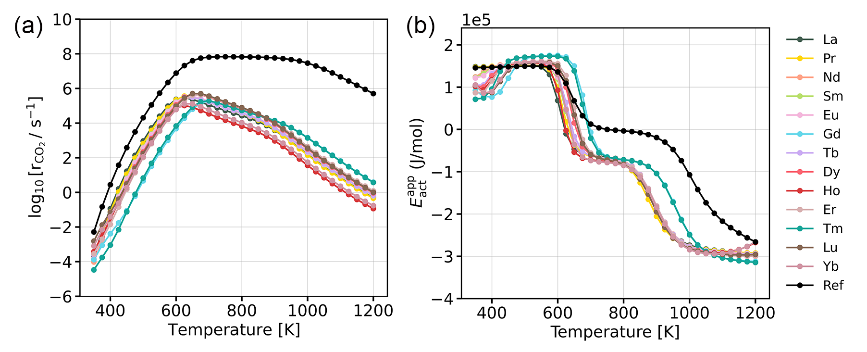
Fig. 6. (a) CO2 formation rate and (b) apparent activation energies ($E_{\text {act }}^{a p p}$) as a function of temperature for Zn-Ln co-doped Pd1/CeO2(111) systems, with Zn-doped Pd1/CeO2(111) system as reference (Ref).
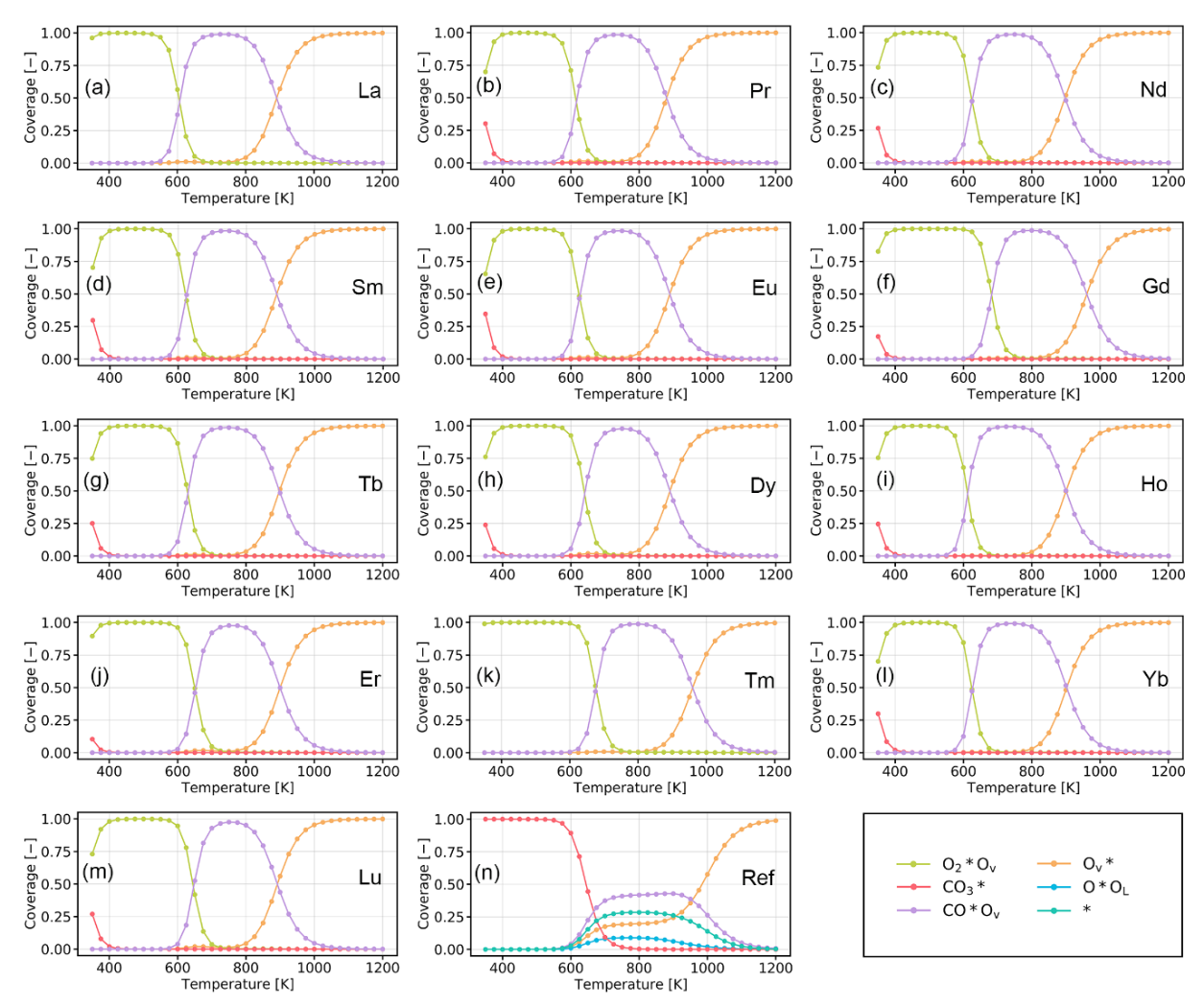
Fig. 7. (a)-(n) Surface coverages of key intermediates as a function of temperature during the CO oxidation reaction on co-doped Zn-Ln Pd1/CeO2(111) systems, where Ln=La (a), Pr (b), Nd (c), Sm (d), Eu (e), Gd (f), Tb (g), Dy (h), Ho (i), Er (j), Tm (k), Yb (l), and Lu (m). (n) The corresponding results for the Zn-doped are shown in panel (n) as the reference system (Ref).
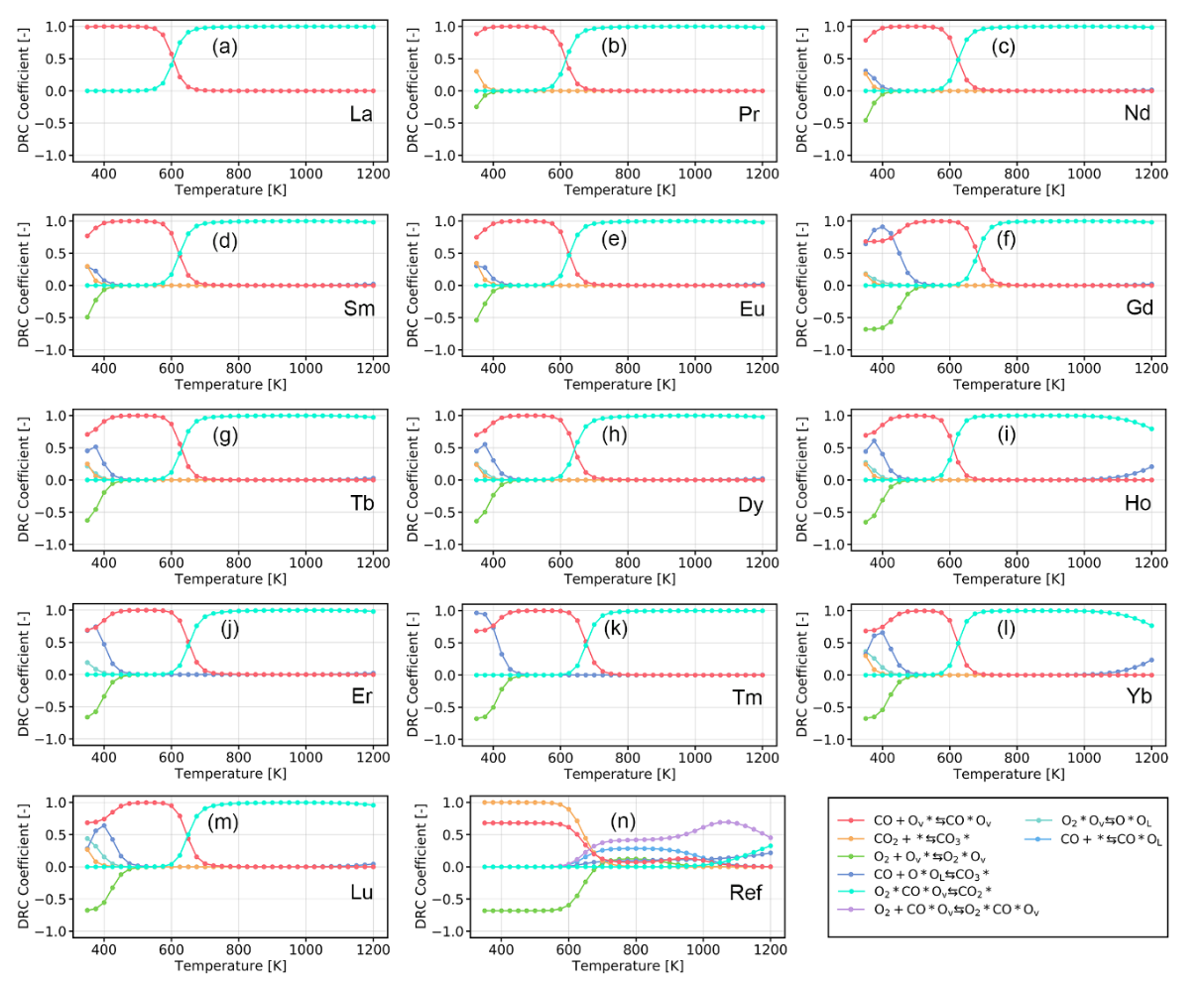
Fig. 8. Degree of rate-control coefficients for elementary steps in CO oxidation over Ln-Zn co-doped Pd1/CeO2(111) systems, where Ln=La (a), Pr (b), Nd (c), Sm (d), Eu (e), Gd (f), Tb (g), Dy (h), Ho (i), Er (j), Tm (k), Yb (l), and Lu (m), together with Zn-doped Pd1/CeO2(111) as the reference system (n).
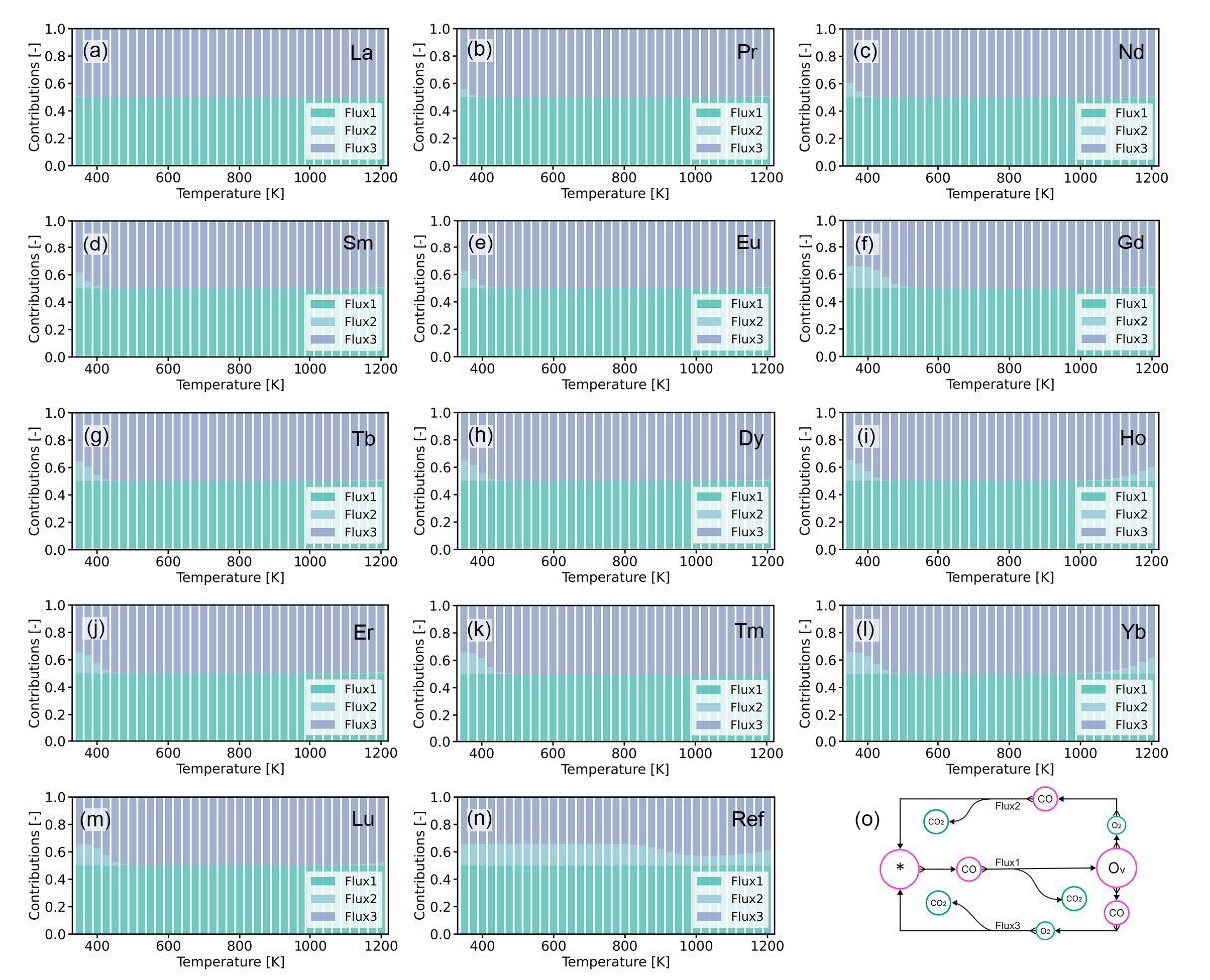
Fig. 9. (a)‒(n) Normalized contributions of each CO2-forming flux to the overall reaction of CO2 production as a function of temperature. (o) Schematic representation of the CO oxidation reaction network based on CO2 as a key intermediate.
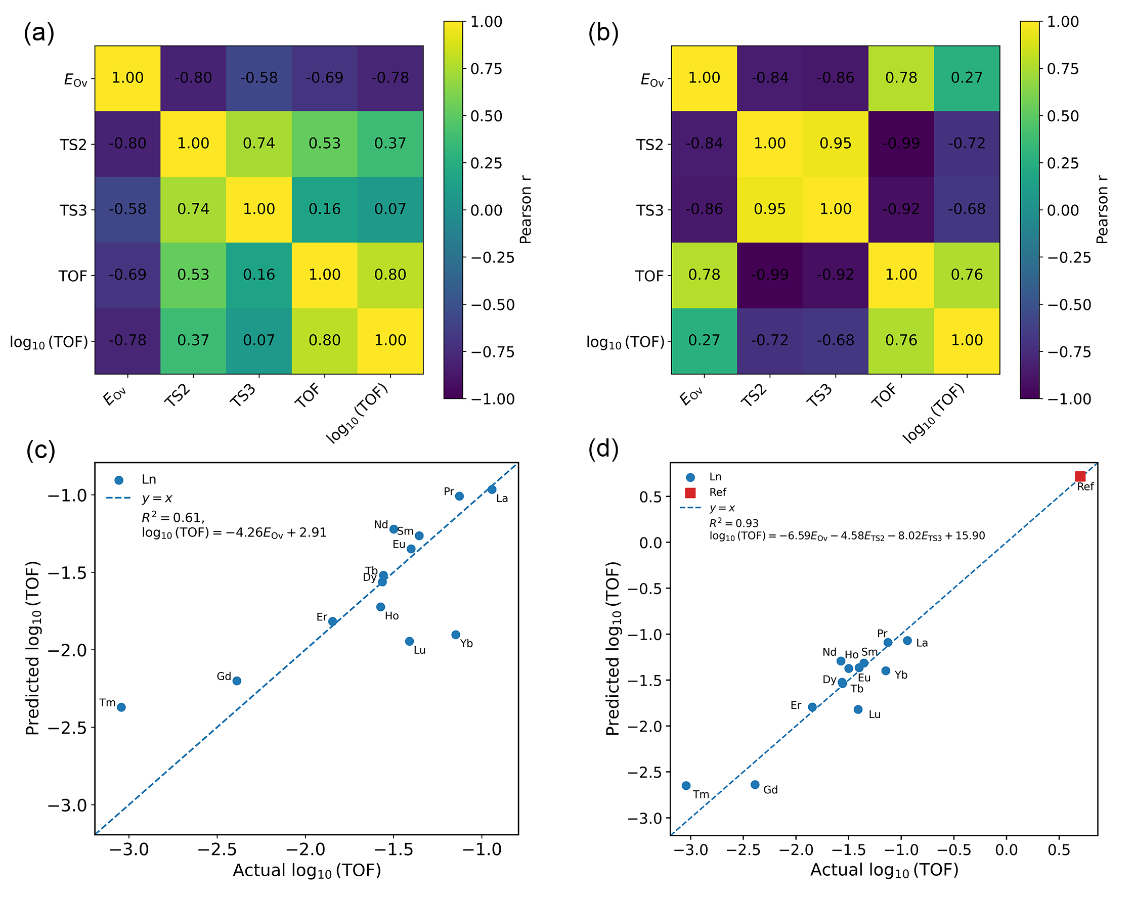
Fig. 10. Statistical assessment of the applicability and transferability of EOv as an activity descriptor. Pearson correlation matrices among EOv, TS2, TS3, TOF, and log10(TOF) for (a) Ln-Zn co-doped systems and (b) Ln-Zn co-doped systems together with Zn-doped reference. (c) Parity plot of the calculated and in-sample fitted log10(TOF) values for the Zn-Ln co-doped systems using a single-parameter linear regression based on EOv. (d) Parity plot of the calculated and in-sample fitted log10(TOF) values for the complete dataset using a multiple linear regression containing EOv, TS2, and TS3. The Zn-doped reference is highlighted by the red square, and the dashed lines in (c) and (d) represent perfect agreement between the calculated and fitted values (y=x). The detailed p-values, confidence intervals, adjusted R2, leave-one-out cross-validation metrics, variance inflation factors, and influence diagnostics have been added to Table S3 and Table S4, respectively.
|
| [1] | 雷文敏, 张艳, 孙大琳, 班林, 周恒, 杨松, 景立权, 胡劲光, 张衡. 过渡金属光催化剂用于木质素可持续转化生产生物燃料[J]. 催化学报, 2026, 88(9): 35-85. |
| [2] | 王洋, 范存冯, 刘洋, 郑晓芹, 刘譞懿, 张凯, 寇佳慧, 黄亨明, 孙林兵. 基于限域空间内原位形成的碳层构筑铁单原子催化剂用于高效芬顿反应[J]. 催化学报, 2026, 88(9): 432-441. |
| [3] | Sathi Chatterjee, 李红梅, 刘康, 林璋, 柴立元, 刘敏. 二维(2D)材料上的单原子催化剂用于光催化CO2还原: 基础、设计与新兴策略[J]. 催化学报, 2026, 88(9): 86-128. |
| [4] | 王淼, 沈天宇, 周恒, 杨帅康, 郝风坤, 王超辉, Mohan Kumar, 铁祚庥, 陈双明, 范战西, 金钟. 中性介质中利用原子级精准富羰基金属团簇直接电催化还原硝酸盐合成氨[J]. 催化学报, 2026, 88(9): 259-268. |
| [5] | 陈月铃, 林玉玲, 陈紫妍, 孔祥昱, 毕进红, 黄国城, 吴棱. 共价有机框架中不对称的N-Ru-S偶极子增强内建电场以实现高效的CO2光还原[J]. 催化学报, 2026, 87(8): 59-69. |
| [6] | 秦家祥, 张松培, 李星局, 陈鑫泰, 赵佳, 牟效玲, 宋宪根, 严丽, 林荣和, 丁云杰. 丁二烯半加氢反应中Pd-Ag纳米催化剂结构-选择性耦合关系解析[J]. 催化学报, 2026, 87(8): 342-352. |
| [7] | 何朝春, 刘纯莉, 柳雍华, 王涛. 均相催化合成氨中兼顾N≡N键活化与N-H键形成的理论构效关系[J]. 催化学报, 2026, 87(8): 316-326. |
| [8] | 段江林, 邓鹏程, 熊惠峰, 杨娜, 周雪灵, 王静雯, 张瑞, 冯丹, 杨级, 覃勇, 任煜京. 亚埃尺度空间调控Fe1-N4配位结构实现高效C-H键氧化过程[J]. 催化学报, 2026, 87(8): 305-315. |
| [9] | 张淑敏, 许第发, 朱文君. 设计具有选择性氧反应活性的光催化剂用于太阳能驱动的甲烷偶联[J]. 催化学报, 2026, 86(7): 5-8. |
| [10] | 周亚太, 袁成成, 夏伟, 王骏, 朱潇锋, 张勇, 朱必成, 余家国. 通过掺杂优化CdS/ZnO S型异质结界面电子转移和表面氢吸附的理论计算研究[J]. 催化学报, 2026, 86(7): 327-337. |
| [11] | 林哲冠, 何舒怡, 李铁森, 崔勍焱, 闫文付, 岳源源. CuO/Cu-SSZ-13界面结构的设计调控及其对NOx选择性催化还原与CO氧化的协同催化[J]. 催化学报, 2026, 85(6): 286-297. |
| [12] | Polina Lavrik, Jurjen Cazemier, Mohamed N. Hedhili, Sudheesh K. Veeranmaril, Abdallah Nassereddine, Antonio Aguilar-Tapia, Marina Chernova, Jean-Louis Hazemann, Alla Dikhtiarenko, Javier Ruiz-Martínez. 钯核数与乙炔半氢化催化活性及选择性之间的关系[J]. 催化学报, 2026, 85(6): 384-393. |
| [13] | 陈兰兰, 圣利, 周亚男, 罗其全, 李震宇, 张文华, 杨金龙. Ni1-MoS2单原子催化剂用于CO2加氢制甲醇的优越性: 密度泛函理论与微观动力学研究[J]. 催化学报, 2026, 85(6): 143-152. |
| [14] | 叶艺涵, 丁一伦, 彭涛, 刘成, 李昕哲, 赵勇智, 肖建平, 焦峰, 潘秀莲. 分子筛内累积碳物种的动态限域作用[J]. 催化学报, 2026, 84(5): 74-79. |
| [15] | 刘文宁, 安丽, 王金明, 李如玥, 牟洁, 龙永德, 曲丹, 刘弈畅, 胡宇翔, 汪夏燕, 蒋宁, 孙再成. 第三主族金属诱导的p-d轨道杂化提升Pd基金属烯在锌空气电池中的氧还原性能[J]. 催化学报, 2026, 84(5): 144-158. |
| 阅读次数 | ||||||
|
全文 |
|
|||||
|
摘要 |
|
|||||


