
Chinese Journal of Catalysis ›› 2026, Vol. 89: 444-452.DOI: 10.1016/S1872-2067(26)65158-3
• Article • Previous Articles Next Articles
Yang Yuana, Fangbei Gea, Xiao-Feng Wua,b,*( )
)
Received:2026-01-16
Accepted:2026-02-22
Online:2026-10-18
Published:2026-09-01
Contact:
*E-mail:xwu2020@dicp.ac.cn(X.-F. Wu).
Supported by:Yang Yuan, Fangbei Ge, Xiao-Feng Wu. Ligand-controlled divergent copper-catalyzed enantioselective dihydroallylation and ring-opening hydroallylation of methylenecyclopropanes[J]. Chinese Journal of Catalysis, 2026, 89: 444-452.
Add to citation manager EndNote|Ris|BibTeX
URL: https://www.cjcatal.com/EN/10.1016/S1872-2067(26)65158-3
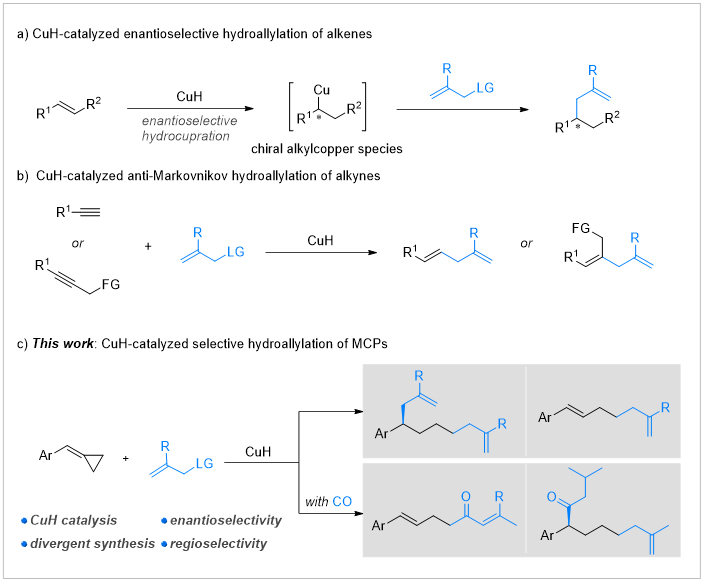
Scheme 1. Copper hydride catalyzed hydroallylation of unsaturated C-C bonds. (a) CuH-catalyzed enantioselective hydroallylation of alkenes. (b) CuH-catalyzed anti-Markovnikov hydroallylation of alkynes. (c) This work: CuH-catalyzed selective hydroallylation of MCPs.
| Entry | Variation from above conditions | Yield of 3a (%) | ee of 3a (%) | Yield of 4a (%) |
|---|---|---|---|---|
| 1 | None | 87 (73)b | 99 | trace |
| 2 | (MeO)2MeSiH instead of PMHS | 45 | 95 | 9 |
| 3 | (EtO)2MeSiH instead of PMHS | 51 | 99 | nd |
| 4 | THF instead of DME | 85 | 99 | 12 |
| 5 | 1,4-Dioxane instead of DME | 71 | 99 | 15 |
| 6 | 2a-1 instead of 2a | 37 | 98 | 6 |
| 7 | 2a-2 instead of 2a | 28 | 97 | 4 |
| 8 | Without LiOtBu | 0 | — | 0 |
| 9 | L2 instead of L1 | trace | — | 24 |
| 10 | L3 instead of L1 | trace | — | 43 |
| 11 | L4 instead of L1 | 5 | nd | 17 |
| 12 | L5 instead of L1 | 0 | — | 54 |
| 13c | L5 instead of L1 | 0 | — | 70 (61)b |
Table 1 Optimization of the reaction conditions a.
| Entry | Variation from above conditions | Yield of 3a (%) | ee of 3a (%) | Yield of 4a (%) |
|---|---|---|---|---|
| 1 | None | 87 (73)b | 99 | trace |
| 2 | (MeO)2MeSiH instead of PMHS | 45 | 95 | 9 |
| 3 | (EtO)2MeSiH instead of PMHS | 51 | 99 | nd |
| 4 | THF instead of DME | 85 | 99 | 12 |
| 5 | 1,4-Dioxane instead of DME | 71 | 99 | 15 |
| 6 | 2a-1 instead of 2a | 37 | 98 | 6 |
| 7 | 2a-2 instead of 2a | 28 | 97 | 4 |
| 8 | Without LiOtBu | 0 | — | 0 |
| 9 | L2 instead of L1 | trace | — | 24 |
| 10 | L3 instead of L1 | trace | — | 43 |
| 11 | L4 instead of L1 | 5 | nd | 17 |
| 12 | L5 instead of L1 | 0 | — | 54 |
| 13c | L5 instead of L1 | 0 | — | 70 (61)b |
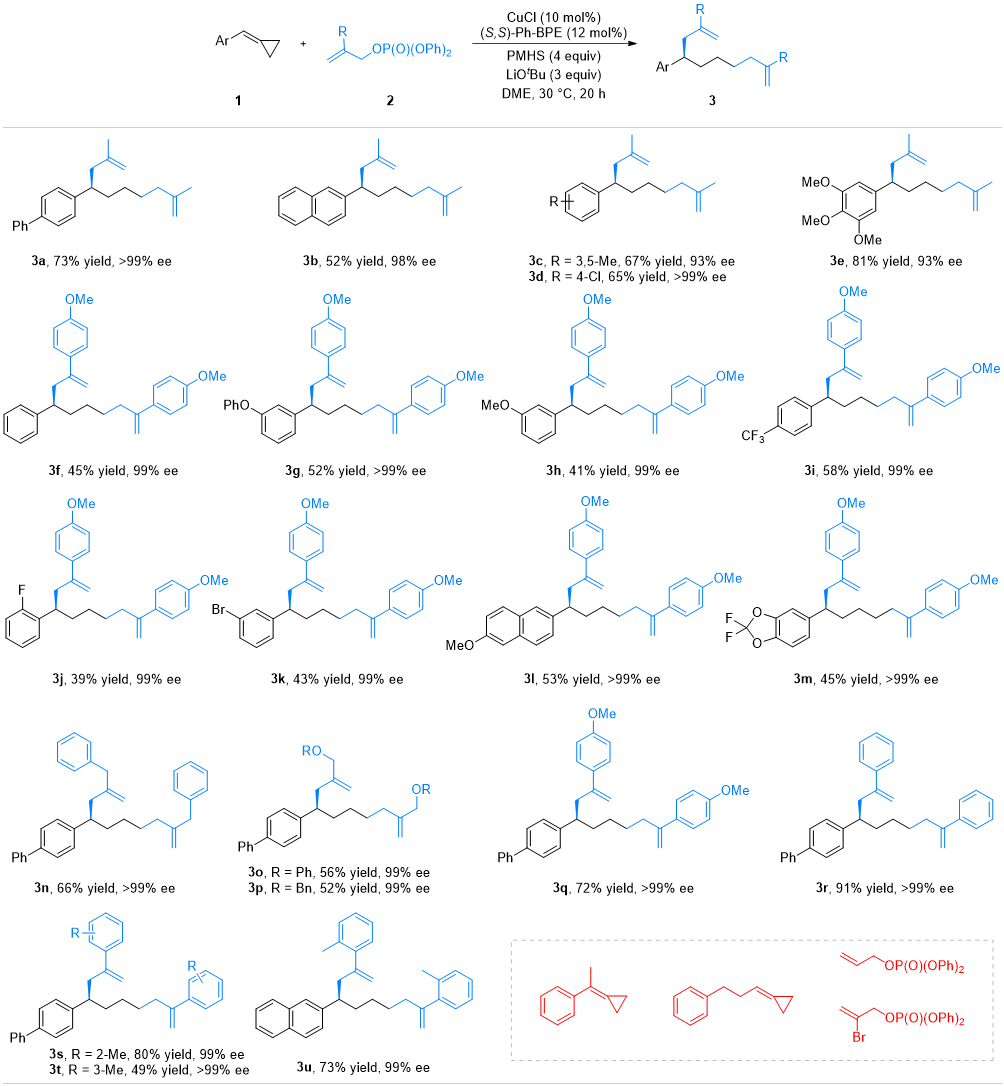
Scheme 2. Substrate scope for enantioselective dihydroallylation. Reaction conditions: 1 (0.1 mmol), 2 (0.3 mmol), CuCl (10 mol%), (S,S)-Ph-BPE (12 mol%), LiOtBu (3 equiv.), PMHS (4 equiv.), 30 °C and DME (0.5 mL). Isolated yields; ee’s were determined by chiral HPLC.
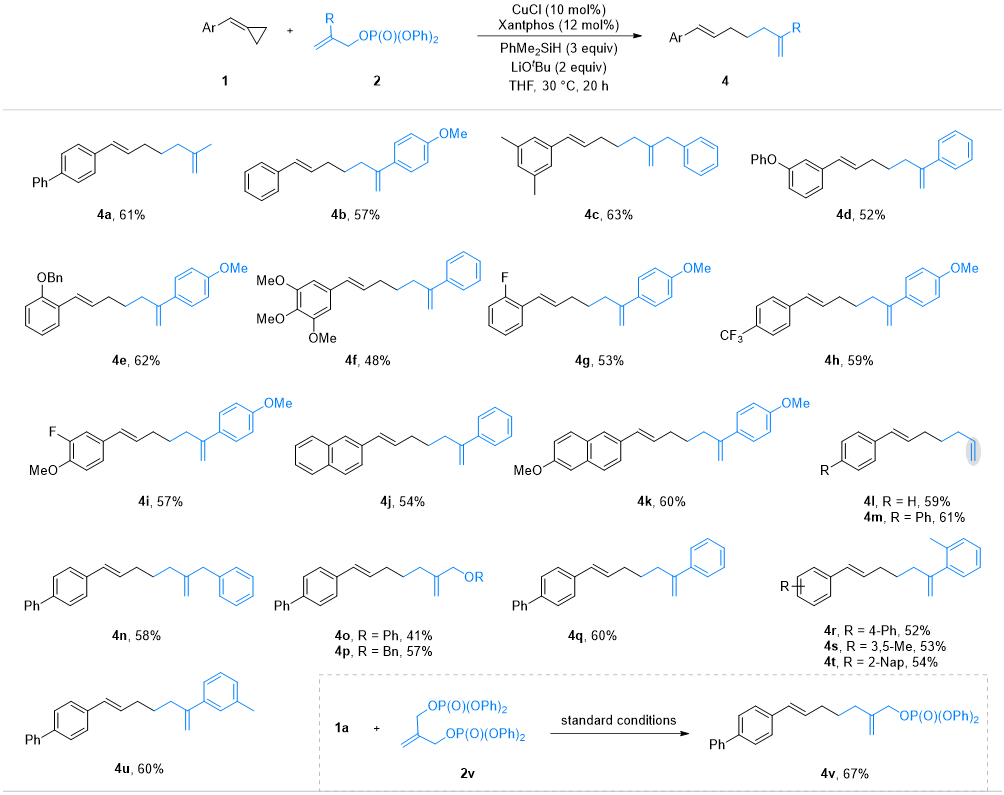
Scheme 3. Substrate scope for ring-open hydroallylation. Reaction conditions: 1 (0.1 mmol), 2 (0.15 mmol), CuCl (10 mol%), Xantphos (12 mol%), LiOtBu (2 equiv.), PhMe2SiH (3 equiv.), 30 °C and THF (0.5 mL). Isolated yields.
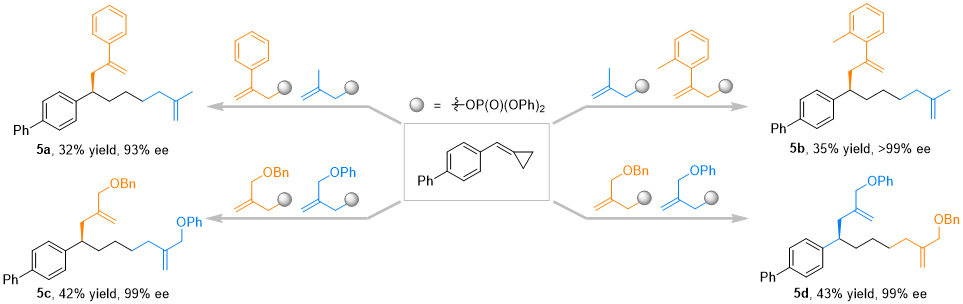
Scheme 4. One-pot cascade hydroallylation with two different allylic phosphates. Reaction conditions: 1a (0.1 mmol), allylic phosphate (0.15 mmol), CuCl (10 mol%), Xantphos (12 mol%), LiOtBu (2 equiv.), PhMe2SiH (3 equiv.), and THF (0.5 mL) were stirred at 30 °C for 20 h, then, the second allylic phosphate (0.15 mmol), CuCl (10 mol%), (S,S)-Ph-BPE (12 mol%), LiOtBu (0.2 mmol) and (MeO)2MeSiH (0.2 mmol) was added and the mixture was stirred for another 20 h. Isolated yields; ee’s were determined by chiral HPLC.
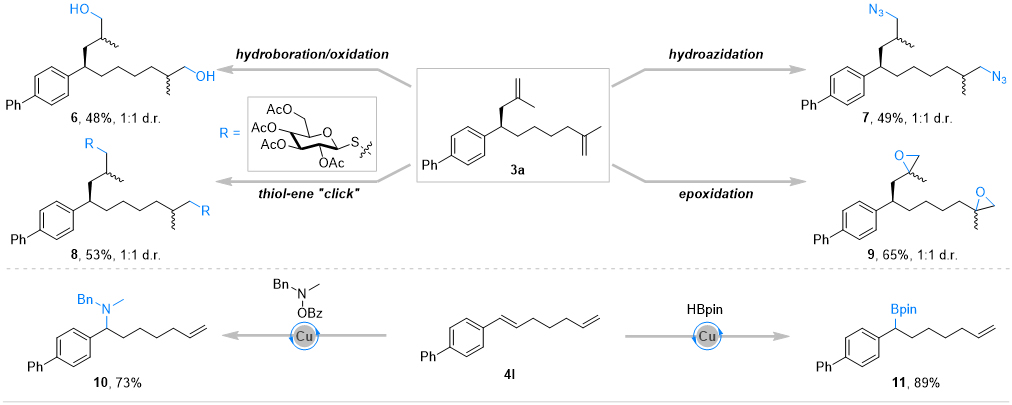
Scheme 5. Synthetic transformations.
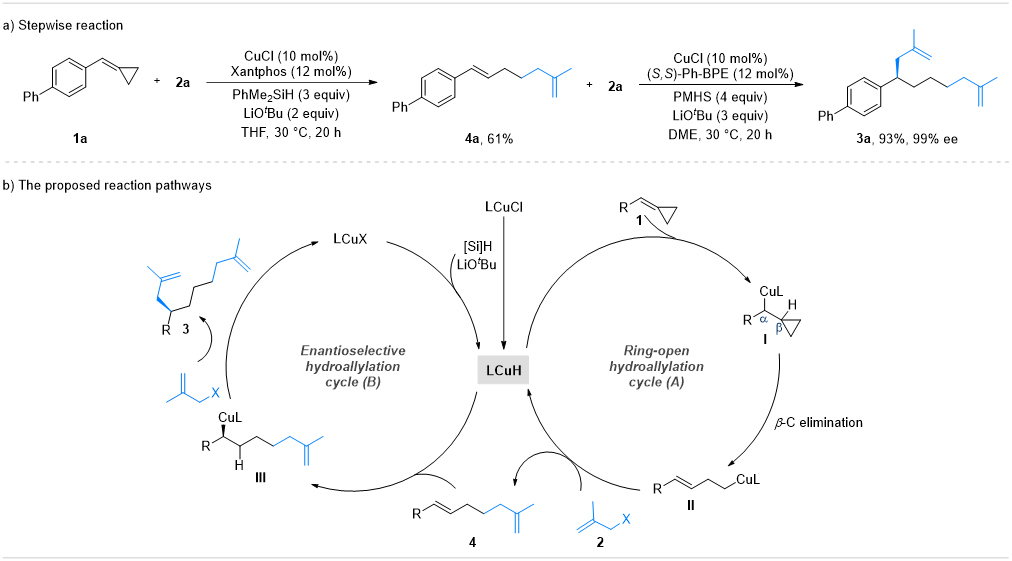
Fig. 1. Proposed reaction pathways.
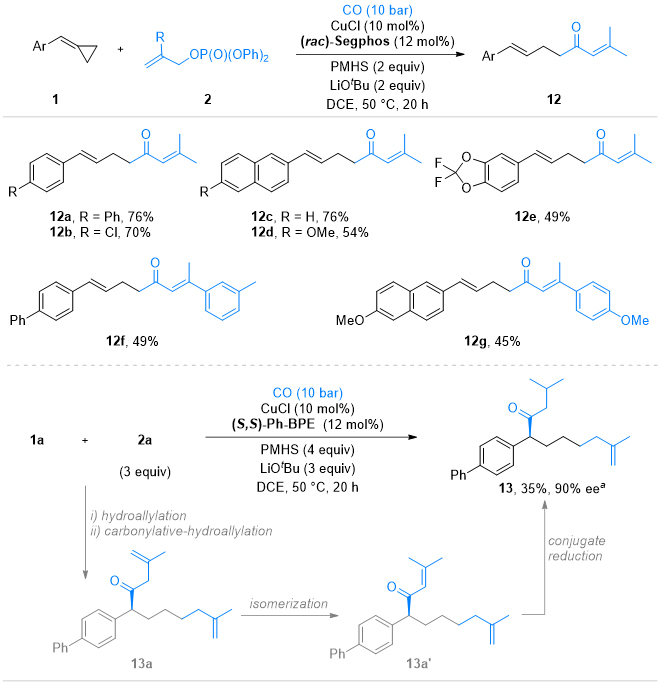
Scheme 6. Substrate scope for carbonylative hydroallylation. Reaction conditions: 1 (0.1 mmol), 2 (0.2 mmol), CuCl (10 mol%), (rac)-Segphos (12 mol%), LiOtBu (2 equiv.), PMHS (3 equiv.), 50 °C, DCE (0.5 mL) and CO (10 bar). a Reaction conditions: 1a (0.1 mmol), 2a (0.3 mmol), CuCl (10 mol%), (S,S)-Ph-BPE (12 mol%), LiOtBu (3 equiv.), PMHS (4 equiv.), 50 °C, DCE (0.5 mL) and CO (10 bar). Isolated yields, ee was determined by chiral HPLC.
|
| [1] | Jianwei Jiang, Minji Kang, Jeongcheol Shin, Kiyoung Park, Sungho Yoon. Cobalt nanoparticle catalyst with magnetic recoverability for high-performance epoxide carbonylation to β-lactones with high selectivity [J]. Chinese Journal of Catalysis, 2026, 86(7): 89-98. |
| [2] | Yanwei Cao, Yunhao Qu, Bin Su, Gongwei Wang, Yang Huang, Zhenmin Luo, Lin Zhuang, Lin He. CO2-H2O co-electrolysis to CO/O2 for safe oxidative double carbonylation of ethylene/acetylene [J]. Chinese Journal of Catalysis, 2025, 74(7): 202-210. |
| [3] | Jiajun Zhang, Xiao-Feng Wu. Copper-catalyzed carbonylative Suzuki-Miyaura coupling of un-activated alkyl bromides with aryl boronates [J]. Chinese Journal of Catalysis, 2025, 73(6): 146-152. |
| [4] | Jianwei Jiang, Vinothkumar Ganesan, Inrack Choi, Jeongcheol Shin, Sungho Yoon, Kiyoung Park. A stable acyl cobalt-based catalyst with exceptionally elevated activity for the carbonylation of epoxides into β-lactones [J]. Chinese Journal of Catalysis, 2025, 68(1): 336-344. |
| [5] | Shaolei Gao, Peng Lu, Liang Qi, Yingli Wang, Hua Li, Mao Ye, Valentin Valtchev, Alexis T. Bell, Zhongmin Liu. Dimethoxymethane carbonylation and disproportionation over extra-large pore zeolite ZEO-1: Reaction network and mechanism [J]. Chinese Journal of Catalysis, 2025, 68(1): 230-245. |
| [6] | Xiaomin Zhang, Kai Cai, Ying Li, Ji Qi, Yue Wang, Yunduo Liu, Mei-Yan Wang, Shouying Huang, Xinbin Ma. Mechanistic insights and the role of spatial confinement in catalytic dimethyl ether carbonylation over SSZ-13 zeolite [J]. Chinese Journal of Catalysis, 2024, 61(6): 301-311. |
| [7] | Zhi-Peng Bao, Nai-Xian Sun, Xiao-Feng Wu. A general palladium-catalyzed carbonylative synthesis of α-CF3-substituted ketones and carboxylic acid derivatives [J]. Chinese Journal of Catalysis, 2024, 60(5): 171-177. |
| [8] | Ke Huang, Shicheng Yuan, Rongyan Mei, Ge Yang, Peng Bai, Hailing Guo, Chunzheng Wang, Svetlana Mintova. Mo-promoted Pd/NaY catalyst for indirect oxidative carbonylation of methanol to dimethyl carbonate [J]. Chinese Journal of Catalysis, 2024, 60(5): 327-336. |
| [9] | Xingju Li, Zheng Li, Siquan Feng, Xiangen Song, Li Yan, Jiali Mu, Qiao Yuan, Lili Ning, Weimiao Chen, Zhongkang Han, Yunjie Ding. Promotional role of Ag1 on Pd1 in dual-site configurations from atomic dispersion of alloy nanoparticles for alkyne dialkoxycarbonylation [J]. Chinese Journal of Catalysis, 2024, 59(4): 282-292. |
| [10] | Yu-Shuai Xu, Hong-Hui Wang, Qi-Yuan Li, Shi-Nan Zhang, Si-Yuan Xia, Dong Xu, Wei-Wei Lei, Jie-Sheng Chen, Xin-Hao Li. Functional ladder-like heterojunctions of Mo2C layers inside carbon sheaths for efficient CO2 fixation [J]. Chinese Journal of Catalysis, 2024, 58(3): 138-145. |
| [11] | Jielin Huang, Jie Wang, Haonan Duan, Songsong Chen, Junping Zhang, Li Dong, Xiangping Zhang. Constructing mesoporous CeO2 single-crystal particles in ionic liquids for enhancing the conversion of CO2 and alcohols to carbonates [J]. Chinese Journal of Catalysis, 2024, 66(11): 152-167. |
| [12] | Junbao Peng, Jin Xie, Zelong Li, Can Li. Photon-induced regeneration of Pd catalyst for carbonylation of amines to ureas [J]. Chinese Journal of Catalysis, 2024, 66(11): 146-151. |
| [13] | Changpo Ma, Ying Lai, Tiange Zhao, Xiaoxuan Zhang, Haichao Liu, Weiran Yang. Direct synthesis of α,ω-dicarboxylic acids via dicarbonylation of cyclic ethers [J]. Chinese Journal of Catalysis, 2024, 56(1): 122-129. |
| [14] | Xing-Wei Gu, Youcan Zhang, Fengqian Zhao, Han-Jun Ai, Xiao-Feng Wu. Phosphine-catalyzed photo-induced alkoxycarbonylation of alkyl iodides with phenols and 1,4-dioxane through charge-transfer complex [J]. Chinese Journal of Catalysis, 2023, 48(5): 214-223. |
| [15] | Yaqi Tan, Yanli Yin, Shanshan Cao, Xiaowei Zhao, Guirong Qu, Zhiyong Jiang. Conjugate addition-enantioselective protonation to forge tertiary stereocentres α to azaarenes via cooperative hydrogen atom transfer and chiral hydrogen-bonding catalysis [J]. Chinese Journal of Catalysis, 2022, 43(3): 558-563. |
| Viewed | ||||||
|
Full text |
|
|||||
|
Abstract |
|
|||||


