
Chinese Journal of Catalysis ›› 2026, Vol. 89: 430-443.DOI: 10.1016/S1872-2067(26)65175-3
• Article • Previous Articles Next Articles
Lingji Liua,1, Xiaosheng Yua,1, Zhou Chena, Xueqing Haia, Yongzhao Wanga, Changzhen Wanga,b,*( ), Tiancun Xiaoc,*()
Received:2026-01-07
Accepted:2026-04-02
Online:2026-10-18
Published:2026-09-01
Contact:
*E-mail:czwang@sxu.edu.cn(C. Wang),xiao.tiancun@chem.ox.ac.uk(T. Xiao).
About author:1 Contributed equally to this work.
Supported by:Lingji Liu, Xiaosheng Yu, Zhou Chen, Xueqing Hai, Yongzhao Wang, Changzhen Wang, Tiancun Xiao. Assembly-line synergistic catalysis in isomorphic substituted Co3O4 nanocomposite for enhanced N2O decomposition[J]. Chinese Journal of Catalysis, 2026, 89: 430-443.
Add to citation manager EndNote|Ris|BibTeX
URL: https://www.cjcatal.com/EN/10.1016/S1872-2067(26)65175-3

Fig. 1. Schematic synthetic procedures and structural characterizations of the nanocomposites. (a) Schematic illustration for the preparation of the CoCaZr nanocomposites. HR-TEM (b), HAADF-STEM images and EDX element mappings (c), high-resolution atomic contrast imaging (d) of the CoCa6Zr9 from position I in (b). HR-TEM and corresponding GPA images of CoCa6Zr9 from position II (e) and reference Co3O4 with strain tensor maps (f) in xy direction (εxy). (e1) Schematic representation of the regional balance of tensile and compressive lattice strains. (g) XRD patterns in rietveld refinement of Co3O4 and CoCa6Zr9. The Fourier transform spectra of k2-Co K-edge EXAFS (h), Zr 3d XPS (i) and Ca 2p XPS (j) spectra for Co3O4, CoCa6Zr9 and Co/Ca6Zr9.
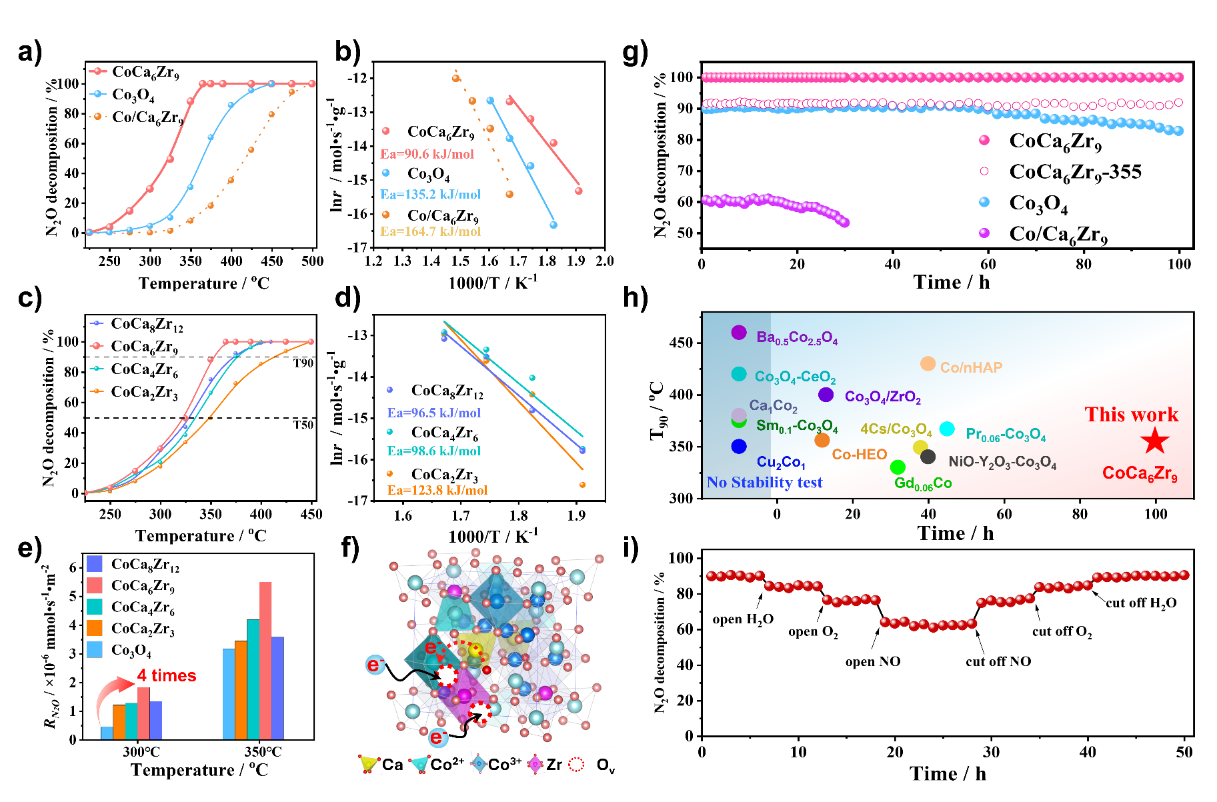
Fig. 2. Catalytic performance evaluation. N2O decomposition activity (a) and Arrhenius plots (b) for the decomposition of N2O over Co3O4, CoCa6Zr9 and Co/Ca6Zr9. N2O decomposition activity (c), Arrhenius plots (d) for the decomposition of N2O and reaction rates (e) at 300 and 350 °C over CoCaxZry nanocomposites. Reaction conditions: 1000 ppm N2O balanced with Ar, GHSV = 10000 h-1. (f) The schematic of structural properties of the Ca-O-Co-Ov-Zr substructure. (g) Stability test at 400 °C over CoCa6Zr9, Co3O4, Co/Ca6Zr9 catalysts and 355 °C over CoCa6Zr9 nanocomposite. (h) T90 and stability performance of CoCa6Zr9 and their comparison with the reported Co-based catalysts (refer to Table S4 for details), and (i) Test of impurities resistance over CoCa6Zr9 nanocomposite.
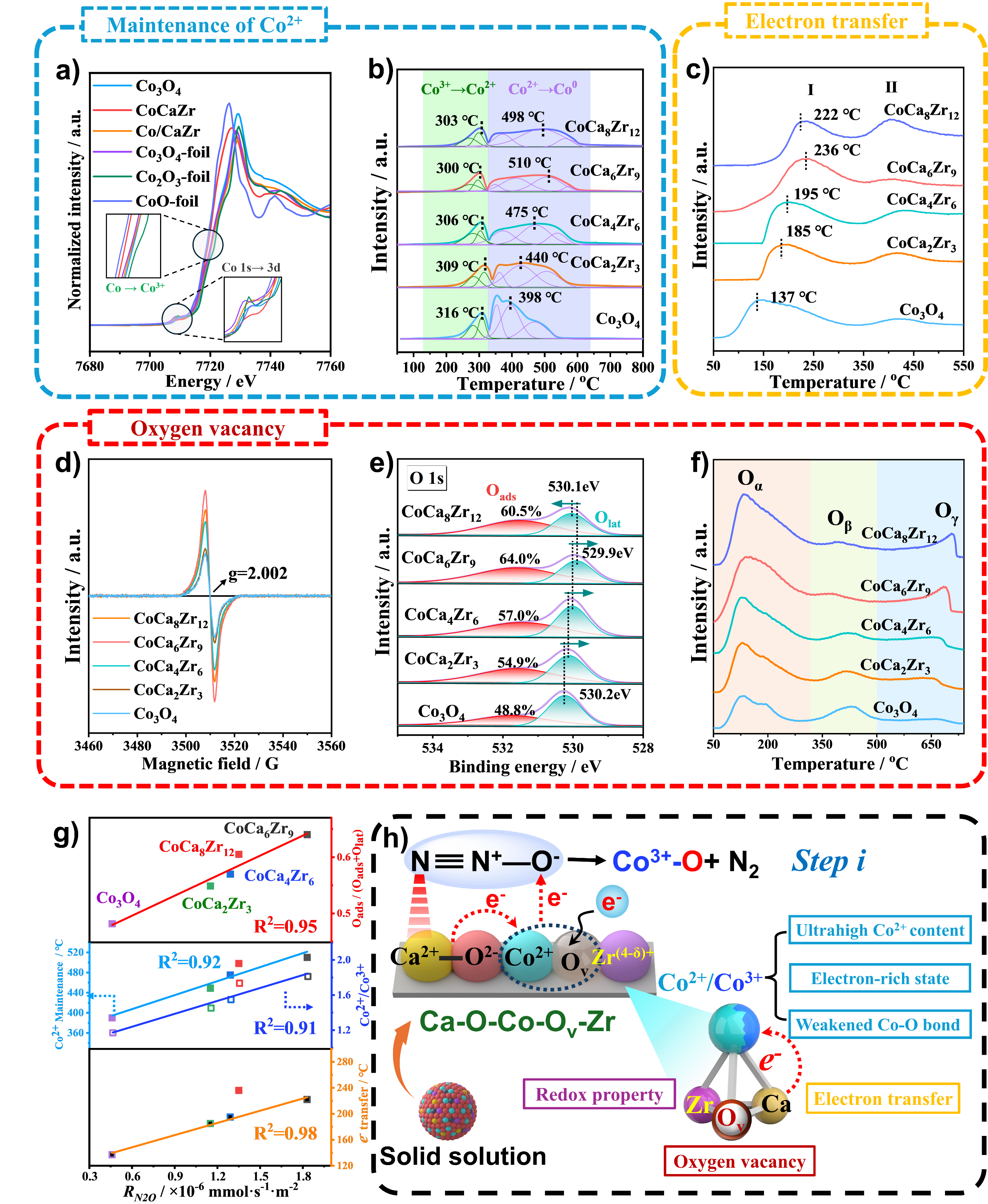
Fig. 3. Promotion factors analysis. The Co K-edge XANES spectra (a), H2-TPR profiles (b), CO2-TPD profiles (c), EPR spectra (d), O 1s XPS spectra (e), and O2-TPD profiles (f) of CoCaxZry nanocomposites. (g) The linear fitting relationship between the reaction rate at 300 °C and Co2+/Co3+ from Co XPS spectra, Oads/(Oads+Olat) from O XPS spectra, the Co2+ maintenance ability (reduction temperature of peak-2 in H2-TPR), the basic ability (desorption temperature of peak-I in CO2-TPD). (h) Possible bidirectional promotion mechanism on the surface of CoCaxZry nanocomposites.

Fig. 4. Theoretical calculation. N2O adsorption configurations of Co-O-Co (311) (a), Ca-O-Co-O-Zr (311) (b), and Ca-O-Co-Ov-Zr (311) (c). (d) The PDOS of the Co atoms on the Co-O-Co, Ca-O-Co-O-Zr, and Ca-O-Co-Ov-Zr; the black dashed line implies the Ef energy. The differential charge density diagram of Co-O-Co (e), Ca-O-Co-O-Zr (f), and Ca-O-Co-Ov-Zr (g), in which the cyan and yellow regions stand for the depletion and accumulation of charges, respectively. (h) Schematic illustration of electron transfer between Ca-O-Co-Ov-Zr and N2O. (i) The PDOS of the N2O molecule is adsorbed on the Co-O-Co, Ca-O-Co-O-Zr, and Ca-O-Co-Ov-Zr. (j) Schematic illustration of the orbital interactions between Co 3d and N2O 3π*. (k) Optimized structures and calculated transition state (TS) of N2O decomposition over the Co-O-Co (311) and Ca-O-Co-Ov-Zr (311) surface.

Fig. 5. N2O decomposition mechanism. O XPS spectra (a) and Co XPS (b) spectra of results of the fresh (dash line)/spent (solid line) CoCa6Zr9, Co3O4, and Co/Ca6Zr9 catalysts. (c) Concentration variation ratio of Oads/(Oads+Olat), and Co2+/(Co2+ + Co3+) before and after the reaction of the CoCa6Zr9, Co3O4, and Co/Ca6Zr9. (d) In situ FT-IR spectra of the CoCa6Zr9 catalyst recorded at 50 °C upon passing 1000 ppm of N2O. In-situ FT-IR spectra obtained during catalytic decomposition of N2O (1000 ppm) over CoCa6Zr9 (e) and Co3O4 (f) at varied temperatures. (g) Reaction stability mechanism in N2O decomposition over CoCa6Zr9 nanocomposite. (h) Schematic illustration of the assembly-line catalysis mechanism vs traditional catalysis.
|
| [1] | Chenggong Yang, Donge Wang, Rong Huang, Jianqiang Han, Na Ta, Huaijun Ma, Wei Qu, Zhendong Pan, Congxin Wang, Zhijian Tian. Highly active and stable MoS2-TiO2 nanocomposite catalyst for slurry-phase phenanthrene hydrogenation [J]. Chinese Journal of Catalysis, 2023, 46(3): 125-136. |
| [2] | Yuyan Qiao, Yanqiu Pan, Jiangwei Zhang, Bin Wang, Tingting Wu, Wenjun Fan, Yucheng Cao, Rashid Mehmood, Fei Zhang, Fuxiang Zhang. Multiple carbon interface engineering to boost oxygen evolution of NiFe nanocomposite electrocatalyst [J]. Chinese Journal of Catalysis, 2022, 43(9): 2354-2362. |
| [3] | Xiaohui Sun, Nuzahat Habibul, Hong Du. Co0.85Se magnetic nanoparticles supported on carbon nanotubes as catalyst for hydrogen evolution reaction [J]. Chinese Journal of Catalysis, 2021, 42(1): 235-243. |
| [4] | Shunji Xie, Haikun Zhang, Guodong Liu, Xuejiao Wu, Jinchi Lin, Qinghong Zhang, Ye Wang. Tunable localized surface plasmon resonances in MoO3-x-TiO2 nanocomposites with enhanced catalytic activity for CO2 photoreduction under visible light [J]. Chinese Journal of Catalysis, 2020, 41(7): 1125-1131. |
| [5] | Zeqing Long, Guang Xian, Guangming Zhang, Tao Zhang, Xuemei Li. BiOCl-Bi12O17Cl2 nanocomposite with high visible-light photocatalytic activity prepared by an ultrasonic hydrothermal method for removing dye and pharmaceutical [J]. Chinese Journal of Catalysis, 2020, 41(3): 464-473. |
| [6] | Guanghui Yue, Jiandi Liu, Jiangtao Han, Donghui Qin, Qiang Chen, Jianxiong Shao. Amorphous CoSnO3@rGO nanocomposite as an efficient cathode catalyst for long-life Li-O2 batteries [J]. Chinese Journal of Catalysis, 2018, 39(12): 1951-1959. |
| [7] | Mahmoud Nasrollahzadeh, Mohaddeseh Sajjadi, S. Mohammad Sajadi. Biosynthesis of copper nanoparticles supported on manganese dioxide nanoparticles using Centella asiatica L. leaf extract for the efficient catalytic reduction of organic dyes and nitroarenes [J]. Chinese Journal of Catalysis, 2018, 39(1): 109-117. |
| [8] | Chong Liu, Fazal Raziq, Zhijun Li, Yang Qu, Amir Zada, Liqiang Jing. Synthesis of TiO2/g-C3N4 nanocomposites with phosphate-oxygen functional bridges for improved photocatalytic activity [J]. Chinese Journal of Catalysis, 2017, 38(6): 1072-1078. |
| [9] | Ezzat Rafiee, Maryam Khodayari. Synthesis and characterization of PMoV/Fe3O4/g-C3N4 from melamine: An industrial green nanocatalyst for deep oxidative desulfurization [J]. Chinese Journal of Catalysis, 2017, 38(3): 458-468. |
| [10] | Xin Zhou, Jing Zou, Sheng Zhang, Ming Pan, Wanyun Gong. Preparation and application of g-C3N4-ZnS-DNA nanocomposite with enhanced electrocatalytic activity [J]. Chinese Journal of Catalysis, 2017, 38(2): 287-295. |
| [11] | Shafaq Sahar, Akif Zeb, Yanan Liu, Naseeb Ullah, Anwu Xu. Enhanced Fenton, photo‐Fenton and peroxidase-like activity and stability over Fe3O4/g-C3N4 nanocomposites [J]. Chinese Journal of Catalysis, 2017, 38(12): 2110-2119. |
| [12] | N. Thirugnanam, Huaibing Song, Yan Wu. Photocatalytic degradation of Brilliant Green dye using CdSe quantum dots hybridized with graphene oxide under sunlight irradiation [J]. Chinese Journal of Catalysis, 2017, 38(12): 2150-2159. |
| [13] | Hexin Zhang, Jae-Hyeong Park, Young-Kwon Moon, Eun-Bin Ko, Dong-ho Lee, Yanming Hu, Xuequan Zhang, Keun-Byoung Yoon. Preparation of graphene/MgCl2-supported Ti-based Ziegler-Natta catalysts by the coagglomeration method and their application in ethylene polymerization [J]. Chinese Journal of Catalysis, 2017, 38(1): 131-137. |
| [14] | Saeed Farhadi, Firouzeh Siadatnasab. CoFe2O4/CdS nanocomposite: Preparation, characterisation, and application in sonocatalytic degradation of organic dye pollutants [J]. Chinese Journal of Catalysis, 2016, 37(9): 1487-1495. |
| [15] | Weiyang Dong, Youwei Yao, Yaojun Sun, Weiming Hua, Guoshun Zhuang. Preparation of three-dimensional interconnected mesoporous anatase TiO2-SiO2 nanocomposites with high photocatalytic activities [J]. Chinese Journal of Catalysis, 2016, 37(6): 846-854. |
| Viewed | ||||||
|
Full text |
|
|||||
|
Abstract |
|
|||||


